Egberto Gismonti: Meeting Point (ECM 1586)

Egberto Gismonti
Meeting Point

Egberto Gismonti piano
Gintaras Rinkevicius conductor
Lithuanian State Symphony Orchestra
Recorded June 1995, Vilnius
Engineer: Markus Heiland
Produced by Manfred Eicher

If any title could sum up the ECM aesthetic in two words, it is Meeting Point. This disc features the Lithuanian State Symphony Orchestra, under the direction of Gintaras Rinkevicius, playing the music of Egberto Gismonti, who also acts as soloist. Having studied under Jean Barraqué and Nadia Boulanger in Paris, the multitalented Brazilian musician and composer puts his conservatory training into effect on this program of seven pieces. Of these, the diptych “Strawa no Sertão” is the shortest, making for a rollicking introduction that bustles like a market square, threading between fruit stands and children’s laughter. The nocturnal dances of “Música para Cordas” provide much-needed contrast to its surroundings, setting up a lively arrangement of “Frevo” (first heard on Sanfona). Gismonti now appears at the keyboard, adding urgency to this orchestral milieu. Interjections from horns burst onto the page like punctuation marks, while the flutes draw erasable underlines. The piano’s function as percussion instrument is further emphasized in the romping “A Pedrinha Cai.” It runs through that same market with stall prize clutched in hand, ending with that first sweet bite. Yet the most personal voice emerges in “Eterna,” for which a romantic solo violin blows like a summer breeze and breaks the orchestra down into the intimacy of a string quartet. Thus prepared for the roiling sea of a re-imagined “Música de Sobrevivencia,” we puzzle our way through brine and wisps of cloud, each blind to the other except through Gismonti’s overwhelming desire to communicate.

Though I wouldn’t recommend Meeting Point as your first Gismonti experience, one should never bypass the lungs on the way to the heart, for here is a breath of ineluctable brilliance, teaching, and careful thought.

<< Jan Garbarek: Visible World (ECM 1585)
>> Michelle Makarski: Caoine (ECM 1587 NS)

Terje Rypdal: Double Concerto / 5th Symphony (ECM 1567)

Terje Rypdal
Double Concerto / 5th Symphony

Terje Rypdal guitar
Ronni Le Tekro guitar
Riga Festival Orchestra
Normunds Šnē
 conductor
Recorded June 1998, Riga, and August 1998, Nyhagen
Engineers: Audun Strype and Dag Stokke
Produced by Manfred Eicher

Ever the slippery idiomatic eel, Terje Rypdal holds his own as composer in two massive works, the Double Concerto for two electric guitars and symphony orchestra and the 5th Symphony, totaling eight movements of classical brilliance. While the influences are as maverick as he, the overall consistency of texture is refreshing and clean. Rypdal and fellow guitarist Ronni Le Tekro build on a mutual appreciation as soloists for the opus 58 Concerto. Erkki-Sven Tüür fans will find much to admire here in the adroit incorporation of percussion and brass against a Baroque-flavored counterpoint in the leading motives of the first movement. After these pyrotechnic swoops, the meditations of the second movement are a welcome reprieve. Yet the torch still burns all the way to the fourth, braving a storm of Glenn Branca proportion toward cinematic resolution.

If the concerto is about closure, then Rypdal’s opus 50 is about openness. The 5th Symphony reveals a detailed aesthetic that builds with molecules of descriptive energy, as what at one moment may evoke the sway of windblown trees may trade places the next with a waterfall’s shimmering veil. From this cascade emerges a faunal English horn, poking its head through the foliage like a curious deer whose need for caution pales in the light of the comfort that surrounds it. From a dissonant rumbling from below, a wayfaring piano anoints us with slumber, pulling threads of pathos to harp-gilded crests and falls. A thorough and pervasive atmosphere wins out, hurling us into oblivion.

Rypdal swings from innocence to fortitude at the flick of a pick (or pen, as the case might be). Like the oceans of Solaris, his music is ethereal even as it feeds on our darkest fears.

<< Mozart: Piano Concertos, etc. (ECM 1565/66 NS)
>> Giya Kancheli: Caris Mere (ECM 1568 NS)

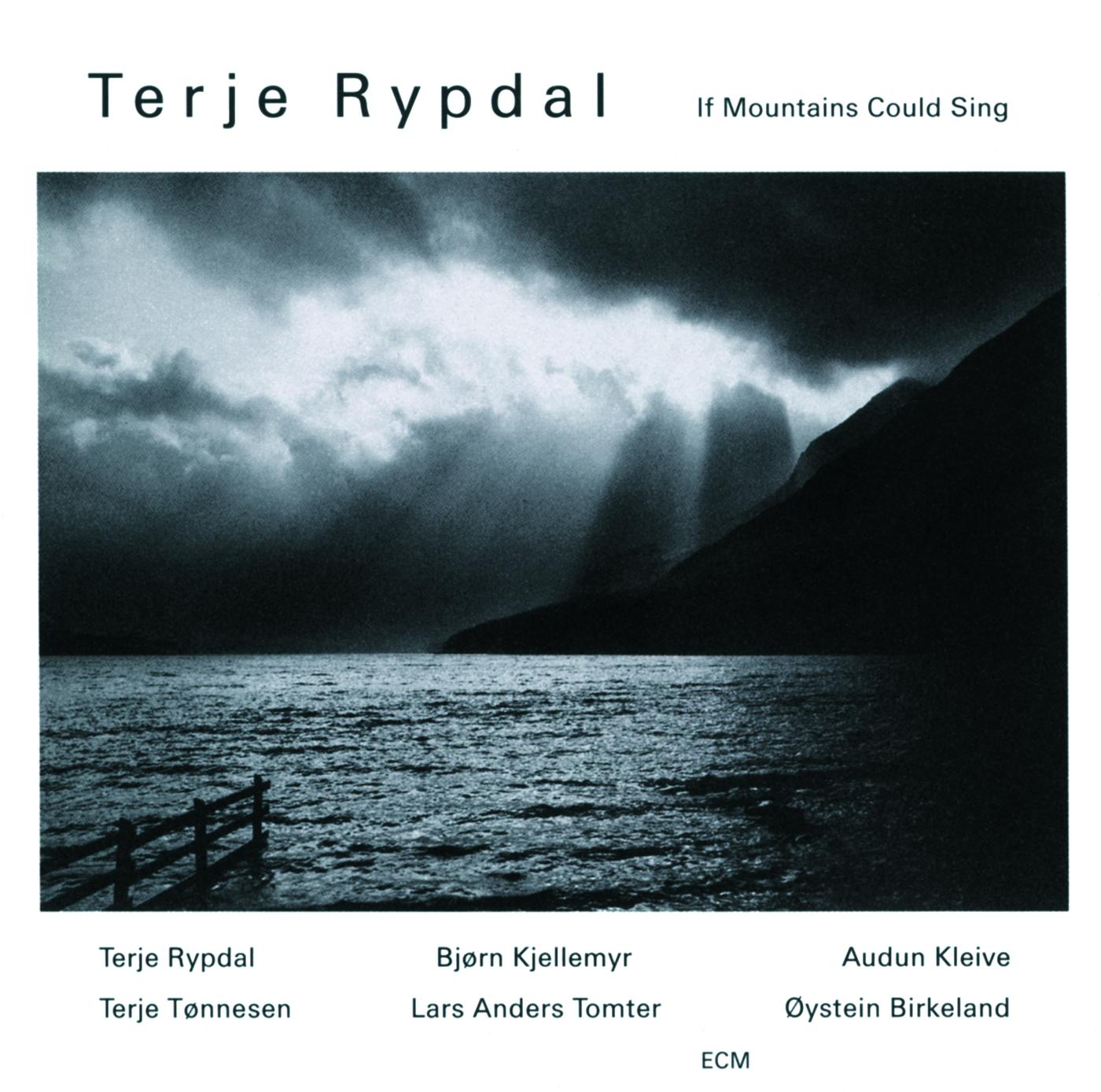
Terje Rypdal: If Mountains Could Sing (ECM 1554)

Terje Rypdal
If Mountains Could Sing

Terje Rypdal electric guitars
Bjørn Kjellemyr basses
Audun Kleive drums
Terje Tønnesen violin
Lars Anders Tomter viola
Øystein Birkeland cello
Christian Eggen conductor
Recorded January and June 1994 at Rainbow Studio, Oslo
Engineer: Jan Erik Kongshaug
Produced by Manfred Eicher

I start this review where I might end it, by marking If Mountains Could Sing as one of Terje Rypdal’s finest achievements. Marrying the Norwegian guitarist’s penchant for magnesium fire with his comparable passion for classical textures, this record gives us the clearest intersection of his split idiomatic personality since Descendre. “The Return Of Per Ulv” kicks off a journey that is modest in length—just shy of 48 minutes—yet anything but in scope and palette. Despite the odd title (“Per Ulv” being the Norwegian moniker for Wile E. Coyote), the smoothness of its melodic line, downright edible phrasing, and fluid bass playing (courtesy of Bjørn Kjellemyr) at once evoke snow and thaw, a landscape of discovery stretching beneath steel gray skies. If ECM were to make a single Best Of album for the label as a whole, omitting this one would be tantamount to crime. Running a close second is “Dancing Without Reindeers,” which after a pizzicato burst walks the violin off the plank into an ocean schooled by drummer Audun Kleive, who chronological ECM followers would have last heard with Jon Balke on Further. Kleive, in fact, shows incredible dynamic sensitivity throughout, supplying whispers of cymbal and snare in “It’s In The Air” and “Foran Peisen” as Rypdal awakens like some giant dragon from hibernation, splashing through the puddles of “But On The Other Hand” after a cosmic storm, and anchoring “Private Eye” with depth of experience. As for the composer behind all this, he breeds lifetimes of haze against tidal strings in the arresting title track and conjures up the object of Per Ulv’s ever-unrequited chase in “One For The Roadrunner” to gut-wrenching effect. The rhythm section gets its last gasp in “Genie” before he signs this love letter on a note of “Lonesome Guitar.”

Here we have a pinpoint of dawn stretched into a canvas large enough to fit any and all listeners. We can walk and admire, lounge or run as we please through its many moods, always knowing that the music is here for us and us alone. Open this door and don’t listen back.

<< Surman/Krog/Rypdal/Storaas: Nordic Quartet (ECM 1553)
>> Sándor Veress: Passacaglia Concertante, etc. (ECM 1555 NS)

Miklós Perényi: Britten/Bach/Ligeti (ECM New Series 2152)

Miklós Perényi
Britten/Bach/Ligeti

Miklós Perényi violoncello
Recorded November 2009, Auditorio Radiotelevisione svizzera, Lugano
Engineer: Stephan Schellmann
Executive producer: Manfred Eicher

I first encountered Benjamin Britten’s opus 87, the 1971 Third Suite for solo cello, as played by Steven Isserlis, and in the towering company, no less, of John Tavener’s The Protecting Veil. Whereas there it came across as an unexpected, if enchanting, epilogue to the Virgin Classics release in question, here it opens an unquestionably cohesive program at the horsehairs of Hungarian cellist Miklós Perényi. Heard previously on ECM for a survey with András Schiff of Beethoven’s music for cello and piano, here he offers a distillation, a community of symbols rich in affect and unity. As Paul Griffiths notes, Perényi “is playing the cello to present music by Britten, Bach and Ligeti, and at the same time playing music by Britten, Back and Ligeti to present the cello.” Such is the circle of life—a circle that smiles and winks as much as it keens and weeps—that guides his craft and abets full disclosure of Britten’s abounding curiosity in the first of many shorter movements, its pizzicato mantra whispering beneath gravid suspensions from the bow. But there the solemnity ends, as the cello leaps from its pitted stasis and drapes itself like a ribbon from a branch swaying in the wind of the third movement. The fourth gives the most obvious shades of Bach, dancing through a jagged fifth and eighth, and swirling into the distended groans of the ninth.

In light—or is it dark?—of this flowing palindrome, the D-major Sixth Suite of J. S. Bach unfolds in an architecture as naked as Perenyi’s instrument. If its Prélude were any more immaculate in its affirmations, then its balance would crumble. The final note, here drawn without vibrato in pure and throated song, leaves us poised heavenward for the Allemande’s seesawing descent. A will to live pervades, seeming to clutch at earthly things as might a pauper’s hands to trinkets and baubles. The Sarabande is a thing of beauty (one that puts me in mind of Ingmar Bergman’s film of the same name) and passes us through the mimetic Gavottes before double stops galore surround us in the final Gigue.

György Ligeti’s Sonata (1948/53) expresses, like much of his chamber music, a world of ideas in relatively microscopic terms. Although a touch of humor nuances the title (this “Sonata” only has two movements), the goings on feel like darkness upon darkness. Alternating between lute-like strums and mournful bowings, the first half lends brightness to the second, which at its fulcrum returns to the fingers, spinning lyric from prisms and breath.

Perényi is that rare cellist who plays Bach as if for the first time while approaching less performed works like Britten’s as if they’ve always been here. It is the solitary pursuit of melody and time through an instrument corporeal, of which the cello is infant, elder, and every age between.

David Darling: Dark Wood (ECM 1519)

David Darling
Dark Wood

David Darling cello
Recorded July 1993 at Rainbow Studio, Oslo
Engineer: Jan Erik Kongshaug
Produced by Manfred Eicher

In the middle of the journey of our life
I came to myself in a dark wood
For the straight way was lost.
–Dante Alighieri

Cellist David Darling continues where he left off on Cello, furthering the rings and grains of “Darkwood,” a multitracked suite drawn in otherwise acoustic measures, of which the latter four parts appear here. While such name might evoke visions of shadow and deepest night, each part starts its titled sections with anything but. Darkwood IV opens its eyes to the “Dawn” while V passes through “Light,” which marks the “Beginning” VI and illuminates downward to “The Picture” in Darkwood VII. The latter is one of the most heart-tugging pieces Darling has ever recorded, weaving tender threads of thought whose philosophies are drawn from the wayside where others have left their faith. Stained tones cradle us in cloud and wind, leveling stepwise motions into molasses tide, proceeding ever deeper into a monochromatic ceiling, at the center of which a light drives away the spirits of insects whose flights are captured “In Motion.” In the starlit expanse of these dreams, we step on floes of ice, each an eye closed by lids of water as it sinks.

Such are the stories, rising from within rather than falling from without. Plunged into the heavy pizzicato of “Earth,” Darling sparks kindling by torchlight, casting bones into a hearth of sky. In its smoke we find the fantasy of a folksong trembling in wake of sunset. Primal cry in slow motion, harmonic ostinato and trembling alto line—these connect one spirit to another and arch their heads, slingshots at the ready. Only instead of a sudden unleashing we get the meditative crawl of fadeout. “Searching” is the cello equivalent of Paul Giger’s “Birth Of The Bull,” which pries open its mortality to find that in death there is life, and in “Medieval Dance” we feel hands touching and releasing, bodies whirling in smoky midnight, following harvest and offering. This leaves only “Returning,” and the eclipse of “New Morning,” where hints of infinity plough and turn like the soil from which they were born, lustful for nothing but absence.

Ultimately, such (di)visions become as arbitrary as the names ascribed to them, etched as they are in perpetual cosmic change. They skip across the chasm of time, closing their parched lips around morsels of memory along the way. Darling bows his cello as if with a comet’s tail and leaves us similarly alone beneath a stretch of sky, harps at Poseidon’s call, hoping for that next chance encounter between perception and transience.

<< Eberhard Weber: Pendulum (ECM 1518)
>> Demenga/Demenga: 12 Hommages A Paul Sacher (ECM 1520/21 NS)

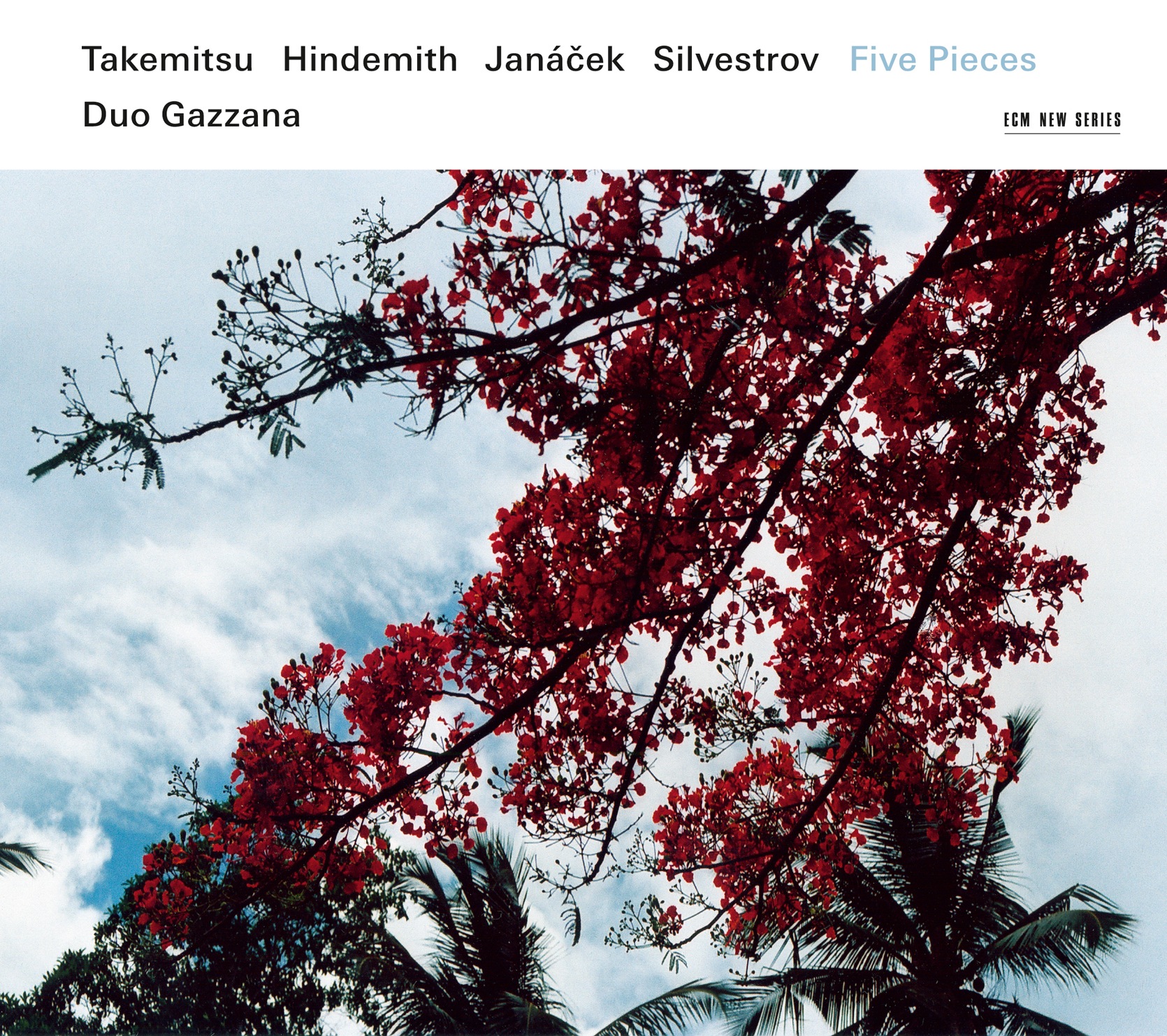
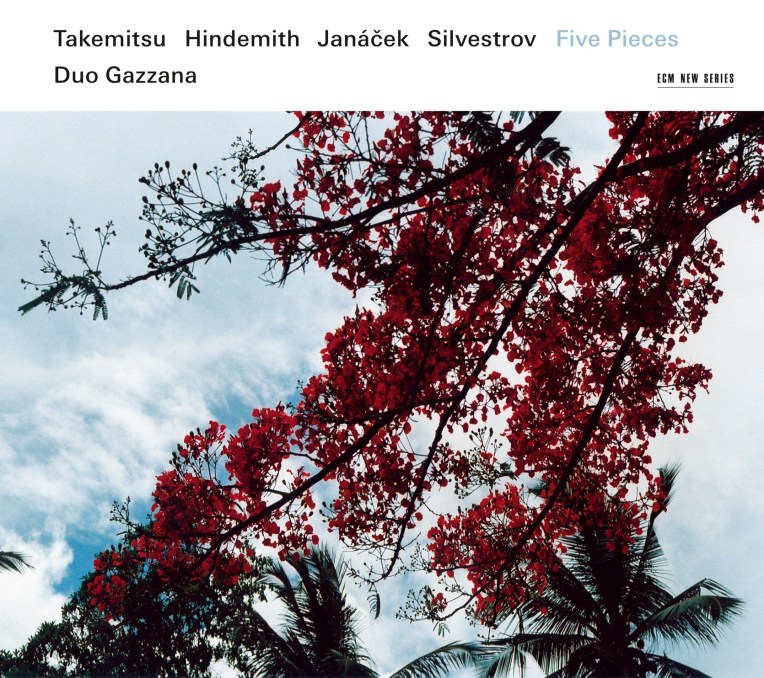
Duo Gazzana: Five Pieces (ECM New Series 2238)

Duo Gazzana
Five Pieces

Natascia Gazzana violin
Raffaella Gazzana piano
Recorded March 2011, Auditorio Radiotelevisione svizzera, Lugano
Engineer: Markus Heiland
Produced by Manfred Eicher

Beautiful teeth sung behind the trees
Finely shaped ears were between the clouds
Iridescent nails blended with water
Kicked off a pebble
All like footsteps
–Shuzo Takiguchi, trans. Noriko Ohtake

Natascia and Raffaella Gazzana are sisters in more ways than one. Having performed together since they began their classical educations, as Duo Gazzana they have been impressing audiences since the 1990s with the galactic swirl of their milk-and-coffee blend. It is perhaps no coincidence, then, that their sororal sound and abiding interest in modern music would lead them to ECM producer Manfred Eicher, who has seen fit to oversee their recording debut of a program that includes works by Tōru Takemitsu, Paul Hindemith, Leoš Janáček, and Valentin Silvestrov. I recently “sat down” (inasmuch as one can via e-mail) with the Gazzanas, who were gracious enough to expound at some length on the questions tickling this voracious listener’s brain.

The violin/piano repertoire is so vast. How did you begin to conceive of such a refreshing program? Were you looking at it in terms of obscurity versus knowability, or simply playing what you love?

Thanks for calling it “refreshing”! We liked the idea of proposing pieces not so often played, excluding perhaps the Janáček sonata. This became possible with the ECM label, which generally offers its listeners “unusual” music. We particularly enjoy playing all the pieces in this program, and each has its own reason for being on the CD. While Janáček and Hindemith were part of our usual repertoire, we encountered Takemitsu relatively late. We came to know Silvestrov’s music through the several ECM recordings that Manfred Eicher encouraged us to listen to. We were immediately captivated by his delicate and evocative writing.

Does the music in this program, as a whole, tell a story? If so, what you hear, see, or feel in it?

The four composers, so apparently far from one another in age and background, tell similar stories with different languages. We liked the idea of giving this program a direction by moving from central European expressionism (Hindemith), through Janáček’s tormented postwar sonata and the gentle approach of Silvestrov, and finally into the far eastern refinement of Takemitsu’s music, loaded with that French influence that takes us back to where we began. A travel through old and new stories, with plenty of different nuances!

Takemitsu’s Distance de fée (1951) is indeed all about nuance. Its Debussean magic lures us into twilight from Raffaella’s first chord. Natascia’s cotton-spun tone wafts across time and space like pollen in darkness—which is to say, unseen yet felt at the bridge of a nose, gracing the forehead with the promise of an unattainable daybreak. She waits, the wind seems to say, as if there were no alternative but to run with her into the future. Harmonics cry like birds in the boughs of our unrest and end where we began, a palindrome in the night.

With such evocative threads to unravel, I ask the Duo how they approach this young piece from a then relatively new composer, one navigating the moral topography of the postwar era with decidedly French tools. Are these geographical slights of hand, I wonder, important to keep in mind?

We have great affinity for Japanese literature and culture and were curious to learn as much as possible about their different aspects, in which ancient traditions are so well integrated with advanced technology. We approached Takemitsu just before a long tour we held in Japan a couple of years ago. It was the right occasion for us to play the new, refined music that we wanted to offer to such an audience. Distance de fée, inspired by a surrealistic poem of Shuzo Takiguchi, is an early piece in which, still searching for more personal and original writing, he was strongly influenced by French music, and Messiaen in particular. Takemitsu himself once described the process as “reciprocal action, musical art re-imported to Japan.” His fascination for impressionistic music came from the fact that harmonies of modal scales, so dear to French composers, had been at the base of traditional Japanese music for centuries. Both cultures were united by a keen sense of tone, for pictorial and naturalistic elements. Nevertheless, he only took inspiration from the great Frenchman’s modes to transpose and create a world properly Japanese. The philosophical concept of MA, so distant from our culture, in music can be translated as the “art of no sound” or “art of the vacuum,” by which is born an inseparable relation of continuity rather than opposition between music and silence. Silence surrounded by sound adds tension and gives unity. You can hear this right from the beginning of the composition: we are immediately transported into a suspended world rising from nowhere. There are no real melodic lines but fragmented motivic cells alternating with pauses on the violin. They are never truly developed but are reiterated literally or with little variations supported by the rich harmonies of the piano’s ever-changing chords. In a way they represent the world around us from which the composer extracts but a segment.

That one finds all of this and more in six-and-a-half minutes of music is a testament not only to the composer, but to the performers who sensitively tease out these subtleties in thought and gesture.

And while the shift to Hindemith’s Sonata in E may seem like a dramatic one, the expressivity of the writing and the playing bears itself out with likeminded attention to color. The first movement of this 1935 diptych is like lost children running off into the sunset, trailing shadows of superstition and leaving footprints like barely audible commas before the languid search of the second surges forth at an equine clip to find them.

If in Hindemith we find a quick and easy resolution, then in the Janáček Sonata of 1914 (rev. 1921) we find a composer who revels in the uncertainty and internal reflections leading up to it. The violin’s silvery threads foreshadow the quiet aftershocks in the final Adagio, along the way sharing a variety of interactions with piano. Sometimes they walk parallel paths while at others seem blissfully indifferent. The second movement takes us on a journey not unlike Takemitsu’s, the coil set to spring from Raffaella’s rainfall into the starkly contrasting Allegretto, for which Natascia shades those memorable punctuations with individuality and purpose.

It is tempting to quarantine Janáček from the surrounding company, but to my ears his sonata is a mixture, and then some, of everything else in the program. That you were able to draw out that kinship is wonderful. What is your take on Janáček?

We have always admired Janáček for his intensity in writing music rich with twists and turns. You could distinguish him from any other composer. Beside his moodiness he is always capable of drawing captivating melodic material, mostly marked by sadness and sorrow. That makes us think of him as a poet of his people, Czechoslovakia being so often bereft of freedom. We used to listen to his chamber music very often: his string quartets dense with impassioned lyricism and dynamics, his fairytale-like cello sonata, his deeply touching piano sonatas and miniatures. Before getting to know the sonata we play, we saw Kát’a Kabanová at the opera. It is the tragic story of a young woman and her attempts to escape from a stifling environment and marriage. Driven by remorse, she throws herself into a river. It was a nice discovery to recognize soon after many themes borrowed from that opera in the violin sonata. It became a source of liberation for our playing.

One of the most striking turns in the Janáček takes place in the concluding Adagio, during which the violin is asked to speak in echoes. Seeing as the sonata ends with this effect, what does it signify to you?

The final Adagio is perhaps the most tragic movement of the sonata. The piano plays a sad, gently nostalgic melody in octaves, rather resigned, in a kind of rough but quiet mood. The violin, with its nervous interventions, gives a restless strength to the music. We would rather speak of a real dialogue between the two instruments more than an echo effect. Indeed the violin points out the increasing anxiety that reaches its natural climax toward the end of the movement, where the piano plays tremolos con forza and the violin a very expressive ascending melody. A quieter atmosphere is finally restored with both instruments agonizing over the nervous violin fragments with which the sonata began.

Nervousness would seem farthest from the sound-world of Valentin Silvestrov, who in his Five Pieces (2004) builds a nest of long flexible motives. His music always seems to rise from nowhere, as if birthed from some infinite yearning, realized only through the fleshiness of instrument and human touch. And what demands, if any, might this quality place on the performers?

Silvestrov’s music is pervaded by a sense of nostalgia, pure tenderness, and touching simplicity. Almost paradoxically this simplicity is achieved by the interpreters with great efforts, because of the numerous and detailed indications in each bar of the score. Maintaining awareness of all these dynamics does nothing to stop the musical flow in its organic atmosphere. Everything has to sound like as if it were wrapped in distance, through the balance of the instruments; the shrewd use of long, half, and una corda pedaling throughout; continuous rubato, sudden accelerando and suspensions. Dynamics range from pianissimo to piano, with small peaks never going beyond mezzo-piano. The approach suggested by the composer is that of extreme delicacy toward the instruments. Indeed we tend to think of caressing our piano and violin. Maybe the best definition of this sublime Ukrainian composer is given by Wolfgang Sandner in the refined booklet of our CD, where you can read that Silvestrov was able to catch the flower at the edge of the path left by Schubert in his musical wanderings…

And in that opening Elegie we do, in fact, wander that same path. The flower is heartening, drawing us on a canvas without even seeming to touch it. Certain themes (e.g., the Serenade) seem to call not to us, but from us, and are all the more inescapable for it.

Natascia, I adore your pizzicato technique yet we hear so little of it. We get a taste in the Silvestrov Intermezzo, evocative and tiptoeing through shadow. What does it feel like to bring out this splash of color, so dramatic against the palette of which it is such a brief part?

I appreciate very much the possibility that Silvestrov allows interpreters of his music to develop many different techniques for both the right and the left hand. The Intermezzo pizzicato technique creates a completely new atmosphere. It gives the piece a separate and defined character in comparison with the previous Serenada and the following Barcarole. As we can see in the score, Silvestrov writes many musical indications and dynamic marks on each pizzicato to give a precise meaning to the piece. That’s a great opportunity for a musician to serve a musical idea with all the means at her disposal.

This sense of service, of offering something to the listener, flows through every movement, floating quietly through the Barcarole on bittersweet currents into the concluding Nocturne, a long and winding signature to this aural love letter.

There something arboreal and forested about all the sonic choices taken on this endearing record. We can hear it in Natascia ringed tone of her instrument and in the clarity of separation (especially in the lower register) that Raffaella elicits from hers. Each note rises like a silent trunk, even as it falls like the leaves from its boughs. There is also the sense of casting that Paul Griffiths so poetically articulates in his liner notes, of composers drawing lines between themselves and idealized, faraway places, and brought home again through individual expression.

To play this music with such color as you do, is it fair to say that you draw upon personal experiences and emotional understandings, as might stage actors, when performing?

Music is a means of communication. The life of a person is constantly changing. Every day we receive different stimuli according to what we see, what we listen to, who we meet…. Personal experiences and emotional understandings become meaningful through music. That is why it is so important for us to dedicate spare time to our interests that may not be so apparently related to music. We both hold university degrees: Raffaella in Italian Literature and Musicology, Natascia in Visual Arts. We study, respectively, Japanese and Russian language, because we are very fond of cultures so different from ours. We had the chance to grow up in a house full of Latin and Greek books because our parents taught both in high schools. We like reading, listening to music, and watching good cinema. Music gives us the great opportunity to travel, to see different countries and their ways of living, to learn and exchange opinions. Life and music are absolutely intertwined.

Can you tell us what it was like to record for ECM? How did Manfred Eicher approach you for this recording? What did he bring to the project? How did he encourage you? 

ECM is a legendary label, synonymous with high quality recording, attention to detail, elegance, refinement, and courage in programming. It was an honor and a privilege for us to make our recording debut for such a prestigious label. We had the chance to record in Lugano’s RSI Studio, one of the most reputed and acoustically perfect for classical music. Beside all these technical considerations, the most important thing was the professional relationship we established with producer Manfred Eicher. He told us from the beginning that the recording process starts long before the studio session. Indeed, we contemplated our CD program for almost a year before stepping into the studio. He encouraged our decision to play music from the twentieth and twenty-first centuries. Thanks to him, we discovered Silvestrov’s music, which has now become part of our concert repertoire. We felt very focused but completely at ease during the recording session. That is because Mr. Eicher, as a musician first and a producer second, understands the needs of artists and helps tremendously with his inspiration at just the right time, during such delicate moments.

Are you both ECM fans? If so, what artists, composers, or albums do you most admire and why?

Yes we are! We think ECM’s greatest merit is bringing the public “new” music of different geographical areas by contemporary composers that would probably never be heard so widely otherwise. There are many ECM New Series discs we listen to quite often, with great interpreters such as Gidon Kremer, András Schiff (whose account of Janáček,A Recollection,is one of our top favorites), and the Keller Quartett (Die Kunst der Fuge). We love Kim Kashkashian, whose playing is very near perfect in most of her recordings. We would single out, though, the double-CD set of Hindemith’s viola sonatas or the Brahms viola-and-piano masterpieces, to say nothing of her touching interpretations of the Shostakovich sonata, Schnittke’s concerto, and all of the Kancheli and Mansurian recordings. Silvestrov and Kancheli are the composers we appreciate most among many others for being so different and intimately touching. Jazz-wise we enjoy Keith Jarrett’s early solo records and Tord Gustavsen’s Nordic flavors.

To listen to samples, click here. To learn more about Duo Gazzana, click here.
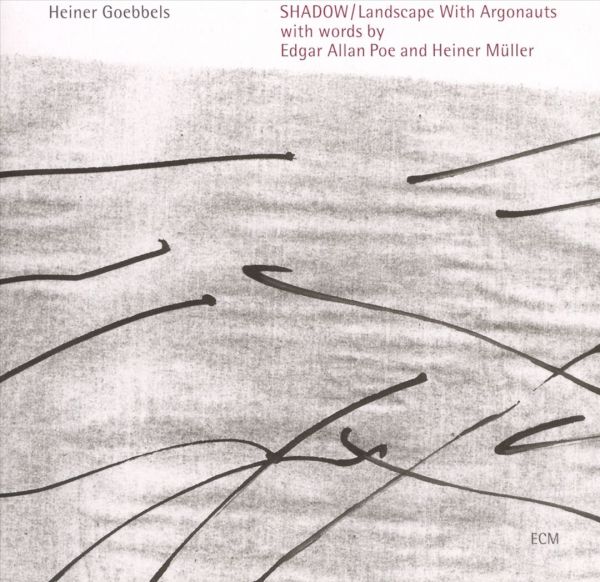
Heiner Goebbels: SHADOW/Landscape With Argonauts (ECM 1480)

Heiner Goebbels
SHADOW/Landscape With Argonauts
with words by Edgar Allan Poe and Heiner Müller

Sussan Deyhim vocals
René Lussier guitar
Charles Hayward drums, tipan, hand-percussion
Christos Govetas clarinet, chumbush, gardon
Heiner Goebbels keyboards, programming, accordion
Recorded September/October 1990 at Outpost Studio, Stoughton, Massachusetts
Engineer: G. B. Hicks
Produced by Heiner Goebbels

In the annals of the written word, there are chambers of suffering and chambers of joy, but in the mind of Edgar Allan Poe those chambers were one and the same. It is this twisted contradiction that Heiner Goebbels wrings out from the sodden towels of the human body’s myriad expectorations in SHADOW/Landscape With Argonauts. Following the same concept as its German radio play counterpart (only this time in English), for which random people on the street were asked to read a text aloud for later studio manipulation, this fully realized project draws even deeper connections between public and private spheres of communication. Because people’s hesitations and misunderstandings remain lucid in the final mix, we can relate immediately to the balance of confrontation and collaboration that ensues. From these initial unscripted stirrings arises the brilliance of Iranian singer and performance artist Sussan Deyhim, whose voice is a periodic touchstone in the work. “Ye who read” is the first of a handful of exquisite songs, glinting like a metal pushpin holding up the tapestry at large. A backgrounded organ trades plectrum musings with fluttering recitations of Poe, treading a Jon Hassell-like carpet of swampy electronics. Sirens of emergency echo in the distance, accompanied by laughter. Public transportation carries us away into the field of indecision that plagues these expressions and the honesty of their disavowal. As impossible as water that burns, it trickles along the throats of fever dreams into vessels shaped like literature. Firecrackers give up themselves in ecstatic pops, marking a year of terror against the celestial auguries of the urban sprawl, each a line on a star map drawn in subway routes. Machines disgorge loose change, grasped by sweaty fingers and thrown into the pockets of the itinerant. Deyhim, ever our internal guide, resolves from a klezmer shadow in “Over some flasks” into messages of many histories. In this environment, happiness is suffocation. And as the sky goes hunting in search of dawn, a distorted hotline breathes its empty promises into the wind. “A dead weight” stencils that rich contralto onto an ululating ocean of ill measure. Acrid squeals echo with the incisiveness of a razor. “No arrival no parking” levels a mocking energy, self-absorbed and self-reflected, spawning the delicate propulsions of “And lo” in a relay of echo and night. A radio dial arches its back toward a faraway jazz session, only to drown in the light of a caravan moon. Shrouded in the smoke of faraway dreams, a clarinet bubbles over into the as-yet-unwritten page.

Fascinating to contemplate are the ways in which Goebbels’s subjects read themselves into the text, as if the sounds of words dictated the constitutions of their bodies, the comportments of their quotidian selves blended into the wing-beats of farewell birds. I can no longer read myself, the music seems to say, so I will let others read in place of me. Anything spoken at the whim of the predetermined will always be at a distance removed.

The rest is poetry.

<< Jens-Peter Ostendorf: String Quartet (ECM 1479 NS)
>> Keith Jarrett: Vienna Concert (ECM 1481)

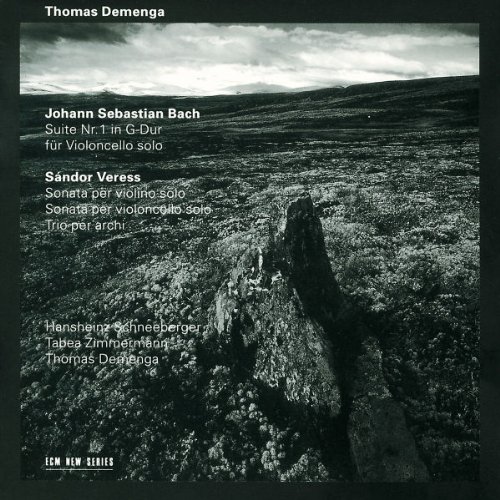
Thomas Demenga plays Bach/Veress (ECM New Series 1477)

Thomas Demenga
plays works of Johann Sebastian Bach and Sándor Veress

Hansheinz Schneeberger violin
Tabea Zimmermann viola
Thomas Demenga cello
Recorded December 1991 at Kirche Seon, Switzerland
Engineer: Teije van Geest
Produced by Manfred Eicher

Although this album is the second of five on which cellist Thomas Demenga boldly pairs the cello suites of J. S. Bach with chamber works from modern composers, it was the last to reach my ears. As a longtime admirer of Sándor Veress—whose music I discovered, no less, on Heinz Holliger’s champion recording for ECM—I was excited to sit down and mull over this disc at long last.

Under Demenga’s bow, Bach’s Suite No. 1 for Solo Cello in G Major flickers with candlelit intimacy, honed like the wood from the instrument through which it emotes in that distinct and mineral tone. One imagines the room where it was first practiced, walls dancing in a quiet play of light and shadow: the player’s arched head, swinging hands, lithe fingers curling about the neck of the one who sings. As to the later suites, Demenga brings a unique mix of fluidity and rusticity to his sound, but above all pays attention to negative spaces in a way that any accomplished Bach interpreter must. We hear this in the pauses of the Courante and in the substantial attentions of the Sarabande, which he suffuses with a downright soulful air. And through the subtle dramatic shape he imparts to the Menuets he dances his way to a reflective brilliance in the Gigue.

With this perfect tetrahedron so thoughtfully folded before us, Veress’s 1935 Sonata for Violin may seem to break the symmetry. Yet the sonata, among Veress’s first published works, more importantly reveals an economy of notecraft on par with the Baroque master. Its slow-fast-slow structure betrays a more complex and organic geometry that begins with a jig of Bartókian proportions and seeps through the Adagio’s quicksand, only to rise again, grabbing the tail of gorgeous gypsy air into the fresh air of the final leap. Violinist Hansheinz Schneeberger, who made his ECM debut with Demenga on the latter’s first Bach pairing, plays this jewel with an intensity and focus familiar to anyone who enjoys Kim Kashkashian’s take on solo Hindemith. Despite the meager comparisons I’ve attempted to draw to other such composers, this music thrives with a forward-looking robustness all its own.

The light at the end of this tunnel comes in the form of Veress’s Sonata for Cello. Composed in Baltimore, the 1967 piece also takes a three-movement structure, this time marked “Dialogue,” “Monologue,” and “Epilogue,” which, as Holliger notes in an accompanying essay, takes us through an inner turmoil on the path toward self-liberation. For me, the most solitary movement is the Dialogue. Its dirge-like density betrays an ecstatic turmoil while keeping a hand cupped to the ear of some cherished and unrecoverable stillness. By contrast, the Monologue seems almost resolute as it traces fingers blindly through the ashes, from which the final movement rises in its own agitated way with assertion on the tongue. As a student of Veress, Holliger no doubt took on some of his mentor’s quirks, and the influence of said Epilogue rings clearly in Trema.

Violist Tabea Zimmermann joins the roster for the Trio for Violin, Viola and Cello, backing us into 1954. The 20-minute piece takes two movements, the first of which moves like molasses into a dulcet and spectral territory ahead of its time, while the second brings the patter of urgency to a journey of immense detail and brilliance.

Of this journey the lowly reviewer can make no definitive claims. Naysayers of the modern may make a delightful discovery or two along the way, even as they cling to Bach, while defenders of the twentieth century will immediately recognize that its music would be nowhere without him. Either way, I can only commend Demenga and ECM for an ongoing commitment to bring their programming alive with the benefits of (im)possibility.

<< The Hilliard Ensemble: Walter Frye (ECM 1476 NS)
>> John Surman/John Warren: The Brass Project (ECM 1478)

Heiner Goebbels: Hörstücke (ECM 1452-54)

Heiner Goebbels
Hörstücke
based on texts by Heiner Müller and featuring the talents of:
David Bennent
Peter Brötzmann
Peter Hollinger
Kammerchor Horbach
Alexander Kluge
René Lussier
Megalomaniax
Heiner Müller
Walter Raffeiner
Otto Sander
Ernst Stötzner
We Wear The Crown
Die Befreiung des Prometheus recorded and edited by Walter Brüssow, Heiner Goebbels, Peter Jochum, Gisbert Lackner, Gerlind Raue, Rainer Schulz, and Martha Seeberger
Produced 1985 by Hessischer Rundfunk and Südwestfunk
Verkommenes Ufer edited by Peter Jochum, Martha Seeberger, and Heiner Goebbels
MAeLSTROMSÜDPOL recorded 1987/88 at F.T.F. and Unicorn Studios, Frankfurt/Main
Engineers: Peter Fey and Jürgen Hiller
Mixed at Rainbow Studio, Oslo
Engineer: Jan Erik Kongshaug
Produced 1984 by Hessischer Rundfunk
Wolokolamsker Chaussee recorded at Unicorn Studio, Frankfurt/Main and Südwestfunk Baden-Baden
Engineers: Thomas Krause and Alfred Habelitz
Mixing engineer: Alfred Habelitz
Produced 1989/90 by Südwestfunk, Hessischer Rundfunk and Bayerischer Rundfunk
Album produced by ECM

My respect for Heiner Goebbels only increases with each work I encounter. Yet while his art, not least through frequent collaborations with linguistic wizard Heiner Müller, has always had its heart in drama, from this collection of radio plays that drama emerges—in the wake of German reunification, no less—with a fresh, genuine voice.

The first of this massive collection’s four plays, Die Befreiung des Prometheus (The Liberation of Prometheus), will sound familiar to those who’ve followed Goebbels in chronological order, for its themes had already made an appearance on Herakles 2 two years before. Both are based on a chunk of text from Müller’s Cement, only here we actually come to know that text amid a filmic montage of others. This process of splicing places, spaces, and times for new mythology will be familiar to any Goebbels listener, but it rings more intensely than ever. From the opening nod to Laurie Andersen we feel right at home. Like her Superman, Müller’s Prometheus is deconstructed from the inside out. Rather than carrying the flame of knowledge, he roasts over that flame his own sustenance at the gods’ table, where he is doomed to eat himself in an eternal circle of hunger and release. Though freed by Heracles, he is plagued by a waning remembrance of godliness, chewed and spat by the rock of the earth. Where Goebbels excels is that, in setting all of this, he manages to evoke a wealth of environmental details that his mosaic of voices can only hint at. Through the bubbling crude of his electronic interventions, he unpacks intimations of the zeitgeist with enviable intelligibility. Incidental sounds turn and tumble, grasping at the enamel-hidden scraps of mastication in hopes of picking off a morsel, ending up instead with a fist full of weeds, and it is these we must weave into a basket if we are ever to catch a sense of things. Metallic edges, heavily serrated and rusted over with time, melt in our gaze. Goebbels marks these rhythms with clips and starts. Snatches of the everyday butt up against unpredictable and sometimes-confrontational turns, but always with a uniquely organic energy.

Verkommenes Ufer (Despoiled Shore) takes its seed from an early (1955) play by Müller. For this project, Thorsten Becker asked fifty strangers in Berlin to read the text in question, thus yielding the raw material for Goebbels’s subsequent mash-up. Because none of the readers were familiar with the text, their renderings bring out inner truths. What begins as a writhing and inarticulate being in the final product resolves itself into a landscape of hesitations, loops, and, above all, porous communication. The Argonaut’s promise kisses the face of chance too many times, leaving only the corpses of a onetime progeny swinging in the wind of manipulation. Poison seeps through the ground in reverse, seeking out those vials from which it was poured, but finding only the fullness of adolescent laughter wafting across the urban sprawl. A masterstroke in the Goebbels/Müller canon.

The album’s cover photo is taken from its third play, MAeLSTROMSÜDPOL (MAeLSTROMSOUTHPOLE). If its blood-red wash of solitude is any indication, we might easily know its fascination with reality and disconnect before a single word grabs us. The continuity of the text, inspired by Edgar Allan Poe’s The Narrative of A. Gordon Pym, is its own contradiction, carving out of those syllables a subterranean world. Speech stores hidden desires in its vowels, misted by white noise and the song of an open cataract: drones and queens, reeds and marshes, all blended into a smoothie only a ghost might drink. It is a photograph that grows blurrier the more it develops. The only way to discern it is to drink the vat of chemicals that brought it to visible life. Echoes turn into birds, the shimmering backdrop of an open mike emceed by the mistress of our deepest nightmares. “OH KEEP THE DOG,” she croons, as if to cut the running line that binds us to everything. She overwhelms us with the responsibilities of liberation.

Last is Wolokolamsker Chaussee (Volokolamsk Highway). Based largely on motives from writers Alexander Bek and Anna Seghers, this self-reflective look at social change in the DDR’s last gasps is vitriolic through and through. Part I, “Russian gambit,” introduces the voice of stage actor Ernst Stötzner and music by heavy metal band Megolomaniax. The combination is a fortuitous one, for the sheer theatricality of the language almost screams for these experienced thespians of two not-so-different stages (though, as Verkommenes shows, this needn’t be so across the board). Bloodshed and total recall dance with one another, spinning their way to “Forest near Moscow.” Stötzner continues his tirade, only now with gentler guitar accompaniment. Death still looms in every pregnant pause, given just enough room to spread a pair of wings which, though flightless, can at least move enough to remember flight. Some preparatory shuffling in Part III, “The Duel,” opens a 20-minute call and response between Stötzner and men’s choir, all of whom join lungs to blow the dust off the mood of German Arbeiterlieder. Behind the scenes, the musc underscores an important truth: namely, that no matter how robust we spin our sentiments regarding human existence on paper, they would all burst into ashen death at the touch of a match. Part IV, “Centaurs” (the title of which, a booklet note reminds us, comes from the Old Greek for “red tape”), recasts Kafka’s Gregor Samsa in a world ordered by totalitarianism, a theme finds blatant traction in a recycling of Shostakovich’s (in)famous Symphony No. 7. The narrative is even more localized in the mouth, which bites a desk in order to prevent its screams from tearing out the still-beating heart of resistance. The fifth and final part, “The Foundling” (after Kleist), is perhaps the most unusual, if only for being backed by hip-hop group We Wear The Crown. Stötzner’s “rapping” is a mélange of generic signatures that transcends its surroundings even as it relies wholly on them. In this prison of madmen speaking in “MARXANDENGELSTONGUES” there is only room for forgetting.

German speakers and/or those up on their German history (I can count myself among neither) will surely get the most out of this recording whose booklet forgoes translating every word (especially in Prometheus)—a real shame considering the parodic depths awaiting our swan dive of relish. The language is visceral in the deepest sense, at times vulgar but always self-aware. Completists wanting the most unfettered glimpse into the architecture of Goebbels’s craft would do well to track down this invaluable set. Though the sentiments throughout are as complex as their politics, certain common themes exploit the connections between songs and conflicts. Through songs we can hide in the foxholes of life and cover our heads against any aerial assault, but in the end all of their lyrics flow through us, be they of the enemy, of our mothers, or of ourselves.

<< Barre Phillips: Aquarian Rain (ECM 1451)
>> Eleni Karaindrou: The Suspended Step Of The Stork (ECM 1456)