Gidon Kremer/Kremerata Baltica: Schubert – String Quartet G major (ECM New Series 1883)


Gidon Kremer
Kremerata Baltica
Franz Schubert
String Quartet G major

Kremerata Baltica
Gidon Kremer violin and conductor
Victor Kissine orchestration
Recorded July 2003, Pfarrkirche St. Nikolaus, Lockenhaus
Engineer: Peter Laenger
Produced by Manfred Eicher

As a tireless champion of new interpretations of the old, the ever-adventurous Gidon Kremer has over the years forged a lasting relationship with, above most others, the music of Franz Schubert. One can only imagine, then, the excitement he must have felt when he learned of composer Victor Kissine’s having finished a string orchestral version of Schubert’s G-major String Quartet (op. posth. 161, D 887). The arrangement of this notorious masterpiece at first seems to embody a curious double bind, for while it certainly enhances the music’s dramaturgical spectrum, it simultaneously softens the edges thereof. The result is a rounded idol of the original. And yet, like a piece of glass that has been worn down by river’s flow or ocean’s tide, it takes on a new shape, becomes a jewel in the hands of a child, a glint of light noticeable even in an already vast and glowing population.

From the five seconds of silence that begin every ECM album made in the last 20 years, the orchestra emerges with a mounting proclamation that immediately justifies the means. Amid the dance of major and minor that ensues, the occasional soliloquy, like that of the pizzicato-ornamented cello in the opening movement, rings all the clearer. Here one must also note the Kremerata Baltica’s honed dynamic control, by which, despite the youthful magnitude of its combined forces, the music’s ruptures are allowed to sing with all the philosophy of their emptiness. Magisterial tempos give greater lift to the score and throw us into its spirals with swooning regard. The Andante enacts a veritable play of shadows, comporting its thematic actors with Beethovenian stagecraft. The cello reemerges as a voice with one foot behind closed eyes and one outside of them, and fades tear-like into the relatively brief Scherzo, where skittering motives place many a deft footstep through an agitated waltz before reworking the flames, only now more scintillating, in the final Allegro, which gallops its way through pages of light and shadow, leaving us to ride its ripple effect back into the open silence from which it awakened.

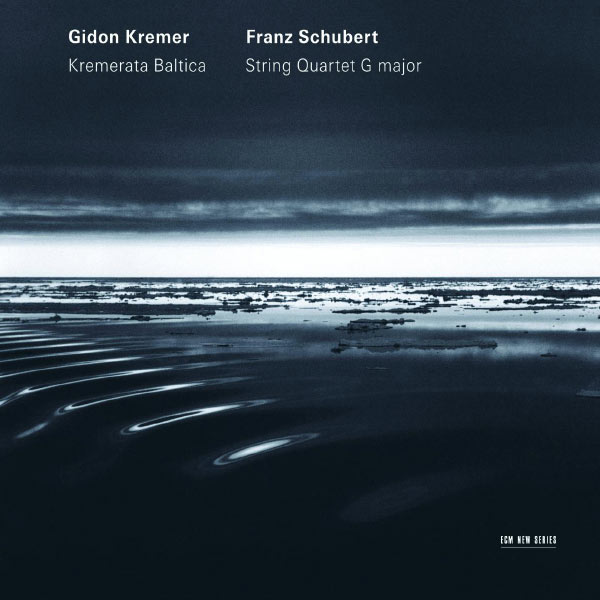
This project has Kremer written all over it. From his never-superfluous gildings to even the cover photograph (entitled “Heading for the North Pole” and taken by the man himself in 1990), Kremer has given his all to the finished product. This has nothing to do with ego, but with a reverence for Schubert, whose heart he and his entourage draw with the care of an anatomist. Kissine’s arrangement likewise allows us to hear the beating of this heart through a steady flow of melodic blood. And the sound? Wondrous. A sequins without the kitsch.

As I listen to this album it is snowing outside, yet the ground is warm enough to melt the snow on contact, giving the illusion that every flake continues to fall through the earth. I cannot help but map this sensation onto what I am hearing, for even as this music touches us it continues to fall through our skin and into a place in our minds where footsteps will never mar its confection.

Tigran Mansurian/Kim Kashkashian: Monodia (ECM New Series 1850/51)


Tigran Mansurian
Kim Kashkashian
Monodia

Kim Kashkashian viola
Leonidas Kavakos violin
Münchener Kammerorchester
Christoph Poppen conductor
Jan Garbarek soprano saxophone
The Hilliard Ensemble
David James counter-tenor
Rogers Covey-Crump tenor
Andreas Hirtreiter tenor
Gordon Jones baritone
Recorded November 2001, Himmelfahrtskirche Sendling, München and January 2002, Propstei St. Gerold
Engineers: Stephan Schellmann and Peter Laenger
Produced by Manfred Eicher

When the shadow of the sash appeared on the curtains it was between seven and eight oclock and then I was in time again, hearing the watch. It was Grandfather’s and when Father gave it to me he said I give you the mausoleum of all hope and desire…
–William Faulkner, The Sound and the Fury

Monodia represents the invaluable efforts of violist Kim Kashkashian to bring Armenian composer Tigran Mansurian onto the world stage. During this journey of discovery she was fortunate enough to have found in Manfred Eicher the ideal partner to ensure that this exposure be done properly and with the utmost respect. The composer’s homeland may not be visible in the flow of information that saturates mainstream media, but it is intensely audible in this landmark recording of a music and a culture that demands to be heard by virtue of the fact that it demands nothing at all.

Kashkashian brings her inimitable talents to bear upon “…and then I was in time again, a viola concerto written in 1995. The title comes from Faulkner, whose inky nooks harbor shades of meaning whereby the light of experience comes to be similarly refracted through the prism of the mind. Kashkashian’s harmonic whispers usher us into a world in which the viola not only sings, but also speaks. Through a sometimes-tortured narrative, Kashkashian externalizes the music’s inner life through her fearless translational abilities. The orchestra’s lower registers are favored here, so that the violas echo Kashkashian en masse, thereby drawing a genealogical thread from Allegro to Lento in a twin birth of lament and knowledge. As throughout, peace is hard to come by even in the absence of the occasional high-pitched interjections, each a sketch of histories long atrophied.

If we began rooted in time, in the Concerto for violin and orchestra (1981) we are left to fend far outside of it. After the earthy tones of the viola, the violin hangs from a much thinner thread, ever poised on the brink of a sudden fall. The soloist here is Leonidas Kavakos, who begins, as violin concertos are wont to do, somewhere above our heads. Kavakos underscores the solitude that permeates the score, emerging like an orphaned cub taking his first tentative steps across the forest floor. Sunlight works its way through the mists, spreading its fingers wide between the branches and coaxing the world back to life. The opening motive, while inaugural in its first appearance, is a powerfully disruptive force when it returns halfway through the piece. Its violence and fear spawn a thousand voices singing with agitated lyricism. Low strings sweep us under a watery carpet before spitting us out onto the shores of something oddly familial.

This sense of lineage continues in the 1999 Lachrymae for soprano saxophone (played here by Jan Garbarek) and viola. The patterns traced here are not unlike those on the CD’s cover, meeting as they do in a rosette of mystical curves through human rendering. Like an incantation, the music’s implications far exceed its means, for in the lingering echoes of this piece we can hear our own tears hoping for the curing touch of moonlight. A quintessential New Series piece from two of ECM’s finest musicians.

Lastly is Confessing with Faith (1998), for which Kashkashian is joined by the Hilliard Ensemble in evoking texts by St. Nerses the Graceful (1102-1173). The gut-wrenching depth of her playing here must be heard to be appreciated, and with the Hilliards its secrets become even more complex. One can’t help but feel that the voices are being spun from the same threads, as if to more fully flesh out that which already resides in the instrument. Once countertenor David James breaks from the gloomy waves, he dances with the viola in a lithe display of melodic inertia. Agitated tremolos enlarge the feeling of solitude, letting in a spirited round: one river overtaking another in a bed of tenors. James is resplendent in his delicate high lines from which hang the piece’s final mobiles. The viola is given the final word, which feels more like the first, drawing out a double stop as if it were a pair of lungs about to pray.

Sing a new song to Him who rose,
First fruits of life of them that sleep.


Alexander Lonquich: Plainte calme (ECM New Series 1821)


Plainte calme

Alexander Lonquich piano
Recorded January 2002, Radio Studio DRS, Zurich
Engineer: Peter Laenger
Produced by Manfred Eicher

A year and a half after debuting with the label on Odradek, German pianist Alexander Lonquich stepped into the studio to record Plainte Calme, his first solo recital for ECM. Lonquich is a player of dialogues: between himself and the music, between himself and himself, between the music and itself. Balancing a remarkably delicate touch with a strong attack when needed, his playing throughout this all-French program bodes well in the session’s rounded engineering.

The Impromptusof Gabriel Fauré (1845-1924) provide listeners with the most earthbound motifs on which to train their ears. Written between 1882 and 1909, these were never conceived of as a set, a fact underscored by their being scattered throughout the program. Although they incorporate influences from Chopin and from mentor Saint-Saëns, these pieces bear echoes in a chamber very much their own. Beyond the obligatory descriptor of “impressionistic” I am wont to attach to such music, there is an undeniably filmic energy therein. One can almost hear horse carriages and lovers’ talk, unaccompanied but for the whisper of their own song. Affection pours through every section with the temerity of a field mouse, while at the same time rolling itself down hills of youth into some of the composer’s most unadulterated expressions of joie de vivre on record—Lonquich’s performances thereof punctilious and perfect.

The 1929 Huit Préludes pour piano of Olivier Messiaen (1908-1992) was a discovery for me. This treasure was his first published work, written during his student days at the Paris Conservatoire. Already the synaesthetic composer was experimenting with color, which he splashes almost Pollock-like into a monochromatic world. One encounters a more weathered feel in comparison to the surrounding works, each a fresco in a monument which, though scarred by the passage of time, in its own way has become more beautiful, more like itself. Even at this early stage Messiaen folds every pleat with a reverence and sensitivity beyond his years. Yet there is far more than shadows and contemplation going on in this tapestry. There is also animation, the twisting and turning of life itself in all of its dramatic changes, though always ending as if to undermine that drama as but an illusory skin to stillness.

In light of these denouements, the formidable Gaspard de la Nuit of Maurice Ravel (1875-1937) feels like a bucket of dreams poured into the mind’s eye. This early work was written in 1908 after poems by Aloysius Bertrand and reflects the persistence of a composer who, as a student of Fauré at the Conservatoire in 1896, was famously expelled due to his inability to write an “adequate fugue.” Unfazed, he continued to sit in on Fauré’s class and honed what would become his hallmarks, which one notices to hardly greater effect than here. “Ondine” takes the most transcendent approach to the medium, seeming to stitch with an angel’s hair atmospheres of such rippling grace that one can only feel them below the skin, trembles of anticipation that are their own rewards. We find ourselves knee-deep in an inimitable sort of magic, growing into a quicksand of caresses in “Le Gibet,” while in “Scarbo” we are thrown into a new journey that leads us up the spiral staircase of the final Fauré Impromptu, at the top of which waits the destiny living inside all of this music: namely, the need to close eyes, spread wings, and jump.

Lonquich treats every note like its own voice in the grander unity of the choir, as it were, and brings an almost philosophical edge to his painterly renditions. He can sound like two musicians, one the light of the sun and the other its warmth. His sound bounces off the lockets of maidens in distant tower windows, their dreams of music suspended from the forests through which many a knight has traveled. Their voices come to us only now, at last requited in the body of an instrument that has never quite sung like this before.

One of the finest solo piano records on the New Series thus far.

Ingrid Karlen: Variations (ECM New Series 1606)

Ingrid Karlen
Variations

Ingrid Karlen piano
Recorded January 1996, Schloßbergsaal, Freiburg
Engineer: Peter Laenger
Produced by Manfred Eicher

Swiss pianist Ingrid Karlen makes her ECM debut with Variations, of which the program is as provocative as the title is vague. Beyond variations in the traditional sense, these are, rather, mise-en-abymes of abstractions. Or so they might at first aural glance seem, for within these sometimes troubling clusters of false starts breathes a unity at once organic and contrived. Anton Webern’s Variations for Piano, op. 27 (1935/36) is the primary example, for the only variations they seem to engender stem from that which cannot be notated. These pieces behave as might a solo violin sonata, jumping fluidly and bow-like through their ephemeral 12-tone links. They are the anti-motif, a stretch of childhood unable to be sifted.

If these constitute the program’s foundation, then Valentin Silvestrov’s Elegy (1967) is its hollow keystone. Dedicated to ECM regular Alexei Lubimov, this sonic egg is just that: indestructible when pushed from both ends, yet vulnerable to the slightest variation of pressure at its middle. Not unlike the program as a whole, its open spaces are there for us to project our desires and expectations in a space where they will not be judged.

Petrograd-born composer Galina Ustvolskaya is channeled to us via two pieces which, though they make up more than half of the album’s playing time, are selfless constructions. In both the Sonata No. 3 (1952) and the Sonata No. 5 (1986), the sheen of declaration quickly fades in interrupted washes of high/low contrasts hugging a forlorn middle register. Karlen stretches both like freshly dyed cloth in a stream, occasionally beating them against a rock for emphasis. Only at such moments do we realize the heights to which we have ascended. The gentility leading up to these thrashings is all the more swooning for its being whittled at by a blade of intense virtuosity. Ustvolskaya’s music inhabits a fascinating middle ground, neither melodic nor indecipherable, lying somewhere between the permanence of the scar and the ephemerality of the suture.

Where else to end but at the beginning? Pierre Boulez’s Douze notations pour piano (1945) is the composer’s Opus One and reason enough to experience this recital. The sheer depth of dramaturgical whimsy in these little sketches makes for a thoroughly engaging experience, which I can only imagine blossoms a hundredfold at the keyboard.

This daring recital is not the first I would recommend among the growing number available on ECM. This is not a critique, but simply a word of caution to the faint of heart. Still, no matter how convoluted the music becomes, it is never cloudy or obscure. The brilliance of Karlen’s program is to be found in her shaping of negative space, in precisely what is not being played. It is into this extra-musical aspect where I believe she wants to draw our ears. And if we are willing to join her, we might very well find sunlight where only shadows seem to roam.

<< Charles Ives: Sonatas for Violin and Piano (ECM 1605 NS)
>> Wheeler/Konitz/Holland/Frisell: Angel Song (ECM 1607
)

Thomas Demenga plays J. S. Bach/B. A. Zimmermann (ECM New Series 1571)

Thomas Demenga
J. S. Bach/B. A. Zimmerman

Thomas Demenga cello
Thomas Zehetmair violin
Christoph Schiller viola
Recorded February/July 1995
Engineer: Terje van Geest
Produced by Manfred Eicher

There is a time for everything,
and a season for every activity under heaven.

Cellist Thomas Demenga continues his Bach project by juxtaposing the Baroque master’s d-minor Suite No. 2 with the work of Bernd Alois Zimmermann (1918-1970), one of the most important non-Darmstadters after World War II. As ever, Demenga makes a convincing argument for the pairing (interestingly enough, most of the criticism of Demenga’s project sees the Bach as filler). In this case, Zimmermann is something of an effortless choice, for his fondness of quotation and respect for tradition were at the heart of his artistry. His approach to time in this regard was particularly significant, drawing on intersections of influence through a wide range of trends and idioms.

Thus do we find ourselves in the comforting waters of Bach’s generative whispers from the moment we dive in. For this performance Demenga adopts the approach of a viola da gamba player (to greatest effect in his raspily inflected Courante). This sound draws out the music’s inherent gaseousness, in which one feels something dark and cosmic taking shape. Demenga’s notecraft ensures that every molecule feels connected through a legato of silence. He digs as deep as he can for those distinct Bach lows, plows double stops as if they were fertile fields, and maintains subtle independence of line in the Sarabande. He bows the Menuets as if with shadows, then elicits one of the finer renderings of the Gigue I’ve yet heard, striking a fine balance between jubilation and regret.

The boldness of this architecture may seem an ill fit to Zimmermann’s sonatas, which despite their meticulous scoring also call for an improvisatory approach. This puts the musician in a potentially compromising space, though if anyone is up to the challenge, it’s Demenga. Many of Zimmermann’s works were considered unplayable when first written, the Cello Sonata of 1960 not least of all. Drawing from his usual pool of spatial and temporal concerns, the piece moves beyond the Romantic notion of cello as vox humana and into the realm of speech, action, and embodiment. In his liners, Demenga notes a particularly difficult passage in the first movement, which encompasses three distinct time-layers: “while the upper voice, played on the bridge, produces a continuous ritardando, the middle one is the most striking, because of its very large range and numbers of notes played pizzicato, and then the lowest, played on the nut of the bow, sounds like a scarcely perceptible accelerando.” Despite its brevity, unpacking the finer implications thereof took Demenga weeks to perfect.

That said, like all walls it can be, and is, overcome in such a way as to render those difficulties invisible and meaningless. It is a testament to his playing that the potentially distracting technicalities of this music become vital mechanisms to their own forgetting. In addition, the more the music progresses, the more one realizes that its virtuosity stems not only from the obvious difficulties, but more importantly from the way the performer must treat every cell as its own motivic entity while maintaining a sense of continuity (as in the “Fase” movement). Between the boldly intoned opening and the ethereal resolutions of “Versetto” we feel the cellist walking the edge of our Umwelt, stitching a morpheme for every step like a bead into patchwork.

Before this we are treated to two nearly intriguing sonatas. The Violin Sonata of 1951 was written after the composer’s concerto for the same. Demenga’s conceit is strengthened by a B-A-C-H cipher and likeminded spirit (notably in the Toccata). From the Paganini-esque heartbeat to the dramatic pizzicato slap that closes it, this is a tapestry of musical lines that is sure to delight. Christoph Schiller makes delicate work of the 1955 Viola Sonata thereafter and undoes a few of the frays left dangling. Subtitled “To the song of an angel,” the one-movement sonata was written in memory of the composer’s daughter Barbara, who died soon after her birth. This self-characterized “chorale prelude” is based on Gelobet seist Du Jesu Christ and tracks a pseudo-scientific journey of private inquiries. At times the instrument duets with its own implications, while at others it shatters itself into a hundred pieces.

This program is about nothing if not intimacy. Not only by virtue of the solo repertoire—Zimmermann himself believes the solo to be the only way by which one may access an instrument’s “almost inexhaustible power”—but also because of the way in which that repertoire speaks through the hands of such capable musicians. This is no-frills playing of music that, while at times distorted, rings forever crystalline in our memory of it.

<< Eleni Karaindrou: Ulysses’ Gaze (ECM 1570 NS)
>> Dave Holland Quartet: Dream Of The Elders (ECM 1572)

Trio Mediaeval: Soir, dit-elle (ECM New Series 1869)


Trio Mediaeval
Soir, dit-elle

Anna Maria Friman soprano
Linn Andrea Fuglseth soprano
Torunn Østrem Ossum soprano
Recorded April 2003, Propstei St. Gerold
Engineer: Peter Laenger
Produced by John Potter
Executive Producer: Manfred Eicher

The music on this, the second album from the Trio Mediaeval, represents 500 years of creation. And yet, as John Potter notes, “in a sense it is older than that, tapping into the continuing present—a timeless present, perhaps—that is what medieval music means to us.” These three Scandinavian singers have done so much for the music they touch, and in turn British composers Gavin Bryars, Ivan Moody, Andrew Smith, along with Ukrainian Oleh Harkavvy, have nourished that sound with newly fashioned music of their own. At the heart of these dedicatory contributions lies the Missa “Alma redemptoris mater” of Leonel Power (fl. 15th century). The mass is a fine example of early Renaissance polyphony and through the Gloria alone expresses a cathedral’s worth of light and shadow. The tonal qualities of the singers and the sung are luminescent, all coming to a flowering head in the visceral Agnus Dei. Power’s music comes to us in spite of Henry VIII’s Dissolution of the Monasteries, thereby speaking to us all the more lucidly through a history that might have silenced it. Its clarity is as pervasive as its texts and forms a warm framework through and around which the women of Trio Mediaeval weave their artfully conceived program.

Plainchant is the inhalation and exhalation of Harkavvy’s Kyrie (2002), as of the program as a whole, which unfurls bursts of polyphony in its pores. From ashes to flesh and back to ashes, it paints a tableau of life in barest terms, exceeded in simplicity only by the solo laude of Bryars, who also aligns all three voices in his stilling Ave regina gloriosa (2003). The Ave Maria (2000) and Regina caeli (2002) of Smith expand upon the gorgeousness of these horizons, again inscribing broad mosaics of faith with minimal vocal borders. Only when we get to Moody’s The Troparion of Kassiani (1999) do we find ourselves wrapped in a more detailed cartography. Its shifting microtonal harmonies, evocative textual phrasings, and resplendent highs cut to the core of the singers’ art. Moody also offers the pinnacle of this disc in his 2002 composition A Lion’s Sleep, if only because it seems to draw upon the Trio’s talents most intimately.

In light of the above impressions, however, I am wary of treating the album as anything but a unified whole. Like all Trio programs, it is structured like a stained glass window, each section having been soldered into place with great individual detail, but which comes to vibrant life when vocal light shines through it. Only then does the image tell its story, share its moral lesson, and open its wings to an understanding of vibration and sound that is as constant as the sun in its veins.

Charles Ives: Sonatas for Violin and Piano (ECM New Series 1605)


Charles Ives
Sonatas for Violin and Piano

Hansheinz Schneeberger violin
Daniel Cholette piano
Recorded December 1995 at Tonstudio van Geest, Sandhausen
Engineer: Teije van Geest
Produced by Manfred Eicher

The violin sonatas of Charles Ives were famously considered unplayable at the time of their composition (1903-1916). This is about as far my knowledge about their background reaches, for Ives represents a sore gap in my listening that was only recently salved by violinist Hansheinz Schneeberger and pianist Daniel Cholette, who bring 20 years of experience with the sonatas into the studio for what I imagine will be a reference recording for years to come. In this instance I feel fortunate in my ignorance, for it allows me to approach this music with fresh ears and an open mind. Having listened only a few times thus far, I clearly have much to learn and discover.

Perhaps akin to its French counterparts, the First Violin Sonata to my ears feels connected to the intersection of body and landscape, of song and action. It youthfully skirts the line between outright offense and justifiable play (and is that Bartók I hear creeping in through the exuberant double stops?). The second movement, an Allegro, is a pastiche of soaring melodies and grinding moments of impasse, while the final movement is like some anthemic dream turned in on itself. Such twisted charm seems part and parcel of the Ivesian experience, and backgrounds the “Autumn” movement of the Second Violin Sonata with tortured intimations in a magisterial wash of melody. These underlying struggles haunt with such regularity that whenever energies do pick up they seem like desperate attempts to break free from something dark and adhesive. In much the same way, “In The Barn” is at once exuberant and tempered by internal conflict, while “The Revival”—which opens with what I can only describe as a morose version of “Jingle Bells”—fascinatingly overlaps traditions and distortions with a jeweler’s eye. The Third Violin Sonata is the most consistent of the four. Its chain of verses moves through a mosaic of narratives, but always with a sense of forward motion and thematic drive. From the aggressive to the pastoral, it handles its moods with conviction. Subtitled “Children’s Day At The Camp Meeting,” the Fourth Violin Sonata opens with a terse Allegro and a cascading second movement, the latter being for me the masterpiece of the collection. Lullabies give way here to lilting rhythms and jolting cutoffs, inviting us to fill in the gaps with our own experiences and understandings.

Although these sonatas don’t make for the most “pleasant” listening, one can hardly fault them for their honesty. Ives’s was an uncompromising approach to style, which is to say he eschewed it. Instead, he seemed equally bound to a highly idiosyncratic aesthetic and to the whim of the moment. Schneeberger and Cholette bring out that very tension and walk the edge of predetermination and spontaneity with practiced intimacy. Not unlike the early compositions of John Cage, Ives’s music commits to its own unfolding even as it thrives on the mystery of impossible form(ation).

<< Bobo Stenson Trio: War Orphans (ECM 1604)
>> Ingrid Karlen: Variations (ECM 1606 NS
)

The Hilliard Ensemble: Guillaume de Machaut – Motets (ECM New Series 1823)

Guillaume de Machaut
Motets

The Hilliard Ensemble
David James counter-tenor
David Gould counter-ternor
Rogers Covey-Crump tenor
Steven Harrold tenor
Gordon Jones baritone
Recorded November 2001 at Propstei St. Gerold
Engineer: Peter Laenger
Produced by Manfred Eicher

As one who spent a good part of his formative Renaissance listening digesting the music of Guillaume de Machaut (c. 1300-1377) via non-Hilliard Ensemble recordings (most notably Ensemble P.A.N.’s exemplary Remède de fortune on New Albion), I have to admit to not taking much of a shine to these renditions at first. Yet after sitting with, and returning to, this recording a number of times over the years, I’ve been able to move beyond my preconceived notions and to appreciate the stunning light they shed. I venture to say that others may have the same reaction, but the rewards for immersing oneself in this ECM treatment are revelatory. The Hilliards have never been ones to take any project lightly, nor the choices within it, and the emotive care with which they sand and shape Machaut’s virtuosic settings is something to behold with wholehearted attention.

Like Gesualdo some two centuries later, Machaut was not without his preoccupations with mortality, love (both sacred and secular), and human beings’ penchant for suffering. It is perhaps for this reason that the Hilliards present their program in chronological order, as if to show us how Machaut grew behind and through its trajectory. And indeed we can almost hear that single comet’s tail drawn quietly from a tangle of cosmic lines. To be sure, these performances maintain the composer’s bold dissonances and challenging harmonies as they cascade over one another in waves of overwhelming polyphony (this, also, I think contributes to their hold on a listener), but in the Hilliards’ mouths their edges become rounded and fair, an effect only heightened by the resonance of Propstei St. Gerold, where the session was recorded.

The music is often anchored by dominant lines (e.g., Puis que la douce rousée) even as it spirals through a galaxy of atmospheres. Like a four-dimensional object it is impossible to fathom through the eyes, yet when we hear it through the shadows of the recorded medium it unscrambles our inner vocabulary like a Rubik’s cube until every side is uniform. Thus the movable nature of Machaut is so well suited to the Hilliards, for a likeminded meticulousness of vocal color and rhythmic staggering (O livoris feritas) truly distinguishes these singers from the rest. They also manage to enhance the sometimes-whimsical edge of the music’s piteous core, as in Helas! où sera pris confors. David James glows in the intimacies of Eins que ma dame d’onnour, Faus Samblant m’a deceü, as do the falsetto tenor lines in Fins cuers dous. Ultimately, however, one feels arbitrary in singling out certain moments over others, for Machaut’s knots are too well balanced to begin picking at individual threads.

I feel at pains to articulate what this music feels like, and equally so in trying extract some interpretive statement to which others, whether they’ve heard it or not, may relate. Like so much of what we encounter in our listening lives, these sounds come and go, lost even as they are experienced. That being said, I cannot help but believe that they leave discernible traces in the body, in the very synapses of the brain. If this recording has taught me anything about this art of reviewing in which I so humbly engage, it’s that immediate effect is not the criterion by which music should necessarily be judged. (In a world so bound by linear time, what currency does immediacy carry anymore?) Rather, I have increasingly tried to look at the specks of permanent change that Machaut, here and elsewhere, has lodged in me. Looking back on the experiences that led me to him in the first place, I know that fortune has indeed whispered into my ears with his texts and melodies from so many centuries ago.

If I may interrupt this stream of thought with a technical one, this was the first recording I ever heard with tenor Steven Harrold, who signed on with the Hilliard Ensemble in 1998. And while the colors of John Potter are certainly missed, Harrold delivers a fresh and slightly brighter tone (at the risk of undoing my earlier assertion, may I point your attention to his gorgeousness in the Veni creator spiritus). His presence is duly welcome in the context of Machaut’s motets, and along with countertenor David Gould enhances every motif he touches. If each motet is a series of numbers, then the Hilliards have provided us with legible solutions. Like a proof, each is filled with potential diversions and dead ends, but through this singular recording we are given a full map that we do well to follow with our eyes closed and our ears walking, open-armed.

The Dowland Project/John Potter: Care-charming sleep (ECM New Series 1803)


The Dowland Project
John Potter
Care-charming sleep

John Potter voice
Stephen Stubbs chitarrone, baroque guitar
Maya Homburger violin
John Surman soprano saxophone, bass clarinet
Barry Guy double-bass
Recorded 2001 at Propstei St. Gerold
Engineer: Markus Heiland
Produced by Manfred Eicher

With In Darkness Let Me Dwell, ex-Hilliard Ensemble tenor John Potter did something very special for the early Baroque, for what at first seemed a wild reconfiguration of songs and motives from John Dowland and his contemporaries was instead an act of deference to the improvisatory spirit that moved the music’s inception. The song- and partbooks of Dowland’s time were never meant to be prescriptive, but to function as stepping-stones for musicians’ creative interpretations. Here this concept is taken to task, and the result is music that carries itself across great divides with fluency and, dare I say, charming care. The inclusion of reedman John Surman and bassist Barry Guy is therefore an easy one to digest in what may look on paper to be a potentially disastrous experiment but which is, in fact, a program of awesome originality, which is saying something in a market flooded with early music interpretations of varying quality.

The project has also become an appropriate venue for the music of lutenist Stephen Stubbs, who contributes four plaintive Refrains to the proceedings. The first of these begins the program and weaves an elastic and chromatic net for all that follows. Its biggest catch is without a doubt the title song by Jacobean composer Robert Johnson (1583-1634). It is presented to us in two versions. The first of these takes advantage of the entire ensemble, spinning on the edge of Maya Homburger’s tremulous violin. Potter leaps into falsetto territory against a backdrop of harmonics, even as the entrance of Surman’s soprano adds further dimension and scope. Not unlike Jan Garbarek’s work with the Hilliards, Surman feeds off the infrastructure of the music at hand, spinning from it a weave at once respectful and innovative. An interlude provides Surman room for an enchanting rumination before Potter returns to the fold. In its reprisal, Johnson’s venerable number comes to us as we might expect it: through the familiar strains of lute and voice alone. Johnson’s aching moods wash over us again in two more songs, of which “As I walked forth” is wrought with due restraint and commentary from Homburger.

The often-played “Accenti queruli” of Giovanni Felice Sances (c. 1600-1679) provides some relief from the heavy pool of sentiments in which it finds itself. The tune plays like a jam session and best exemplifies the spontaneity behind the project’s concept. The regretful note on which it ends dovetails smoothly into “Weep, weep, mine eyes.” This mournful ballad by John Wilbye (1574-1638) draws out the program’s splintered relationship to love, and expresses through its saxophonic lines a suitable harmony of word and context. Surman likewise proves himself a defining presence in “Angela siete” by Cherubino Busatti (1600-1644), for here woodwind and throat swap roles like ribbons around a maypole.

Benedetto Ferrari (c. 1603-1681) was a new name to me, and his “Già più volte tremante” is a stunning piece of notecraft. Though brief, its unexpected minor shifts and Monteverdian phrasing make for a heart-stilling monologue.Yet while this album is rich with such luscious music, a single tune by Cipriano da Rore (c. 1515-1565) is for me its flashpoint. We encounter his “Ancor che col partire” also in two versions, once with lute and violin and again with vocals. The latter ends the program with a slow flourish that descends into the crypt from which it sprang in search of sunshine.

Nothing about the Dowland Project cries gimmick. This is not a mere ploy to capitalize on overdone material, but an offering of sounds already so rich with implication that the musicians cannot help but explore those sounds for all they’re worth. Anyone wary of approaching albums like Officium may want to ease into this rewarding ECM niche with Care-charming sleep.