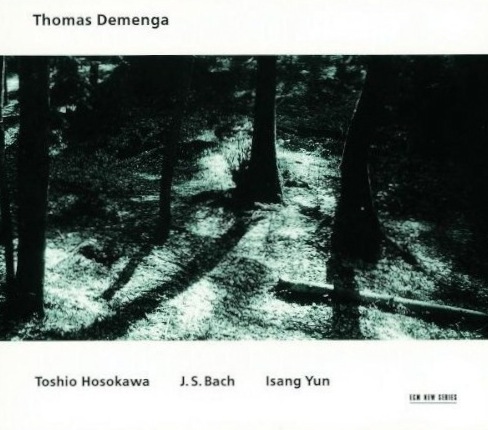
Thomas Demenga: Hosokawa/Bach/Yun (ECM New Series 1782/83)

Thomas Demenga
Hosokawa/Bach/Yun

Thomas Demenga cello
Teodoro Anzellotti accordion
Asako Urushihara violin
Aurèle Nicolet flute
Heinz Holliger oboe
Hansheinz Schneeberger violin
Thomas Larcher piano
Hosokawa/Bach: Suite No. 5 recorded November 2000, Kirche Blumenstein
Bach: Suite No. 6/Yun: Espace I, Gasa recorded December 1998
Engineer: Teije van Geest
Yun: Images (produced by Radio DRS) recorded July 1985, Radio DRS, Zürich
Engineer: Jörg Jecklin
Produced by Manfred Eicher

This album concludes Thomas Demenga’s Bach cycle which, begun in 1986, boldly sought out previously unimagined connections between the Baroque master’s solo cello suites (here, Nos. 5 and 6) and later visionaries. At every step along the way, Demenga has forced not a single hair of his bow in an arbitrary direction, instead finding in each pairing of works and composers a web of simpatico relationships.

Demenga plays the Bach suites a full whole tone down from modern pitch, a tuning contemporaneous with the time of their composition. He even uses unwound strings for a noticeably rawer sound. The Prélude of No. 5 is particularly visceral for it, those opening groans rising from the root of our expectations with withered leaves and rustling secrets. The Courante of the same no longer skips but struggles in an attempt to free itself from the swamps. The Sarabande, however, sings in a way I’ve never known it to before or since. The famous No. 6 Prélude also retains much of its inherent light and bridges over into one of the more heartfelt Allemandes on record. The penultimate Gavotte is also notable for its rustic edge. These are unlike most renditions out there, and for that reason may divide listeners. Either way, I feel as if I have spilled enough virtual ink in Bach’s name to leave my impressions at that and turn to what is most remarkable about this release: the works of Japanese composer Toshio Hosokawa and his mentor, the late Korean composer Isang Yun.

Of Hosokawa’s music, Oswald Beaujean has said, “These sounds, to be sure, never appear in the form of musical imitation. Instead, they are reduced to their essence and always retain something deeply artistic.” And indeed as we wrap ourselves in the silvery veils of In die Tiefe der Zeit (Into the depths of time) for cello and accordion (1994/96), we may not help but feel the ground falling away at our feet. The music pulses like a dying body, a light blinking through a gauze curtain. The overall sound is akin to a Japanese mouth organ with a harmonic outlier skirting the edges of its reedy sound. In it we hear a story of famine, of broken families, of burned villages, of people torn from their places of worship. The accordion (played to weeping perfection by Teodoro Anzellotti) shows us the way through this wreckage, so that we might sit before a cross, steeped in the lessons of trauma.

Similarly, the Duo for violin and cello (1998) shows a propensity for swelling, silences, and pauses, though it is far more agitated—a stage of denial that circles an indefinable center. At some moments the instruments seem intent on filling up as much space as they can while at others they beg for that space to fill them in return. This asymptotic push toward silence is a blessing of contemporary classical music, at once sharpening our ears to the world of the microscopic and abolishing the prescriptive master narratives of our histories in favor of fragments. The recording is accordingly porous, attuned to mid- and high-range sounds.

Winter Bird (1978) for violin solo is something of a reprieve from the weighty emotions of all that precedes it. With it Hosokawa manages to bring the subtlety of the shakuhachi to those four humble strings as snatches of melodic energy hop and warble in a cold gray sky brimming with the promise of snow.

Yun’s sound-world is one step removed from time. The works presented here come to us already affected by tortured political past from a man who struggled with his “Eastern” origins and the decidedly “Western” musical paradigms into which he was indoctrinated as a classical composer. Yet these paradigms crumbled as he began to redefine himself in the serial theory of the Darmstadt School, and it was in that aleatoric openness and dematerialization that he came into his own.

Gasa (1963) for violin and piano is a fine example of his holistic approach. Its balance of disparate languages is precisely what makes it grow. This small slice of intrigue trembles with delicate inversions and implosions, a tone-setting specimen under the microscope, dying for self-awareness.

Espace I (1992) for cello and piano, on the other hand, unravels itself in threads of equal thickness and, being the most recent of Yun’s works surveyed here, reveals a composer at the highest stage of personal development. This piece is more uniformly weighted, for where the counterbalances add up to a denser harmony in Gasa, here the dynamics are pockmarked, fading as the piano grumbles like a belly in want of sustenance.

Images (1968) for flute, oboe, violin, and cello brings the project to an enigmatic close. This music takes shape in block chords and releases embryonic tendrils of life into starry ether. Each tone is given life and therefore the potential to occupy space. The combination of instruments is quite effective, all the more so for the committed musicianship under its employ. Like the album as a whole, it shapes itself as if in dire need of contradiction, turning the mirror just so, thereby allowing us to see that the faces we thought we knew were really just reflections all along.

<< Gideon Lewensohn: Odradek (ECM 1781 NS)
>> Charles Lloyd: Hyperion with Higgins (
ECM 1784)

Alexander Knaifel: BLAZHENSTVA (ECM New Series 1957)


Alexander Knaifel
BLAZHENSTVA

Ivan Monighetti violoncello
Tatiana Melentieva soprano
Piotr Migunov bass
State Hermitage Orchestra
Saulius Sondeckis Principal conductor
Lege Artis Choir
Boris Abalian Artistic director
Recorded March 2006 at St. Catherine Lutheran Church and Capella Concert Hall, St. Petersburg
Engineer: Boris Isaev
Recording supervision: Alexander Knaifel
An ECM Production

Just when we ECM listeners had become lulled in the embraces of Arvo Pärt and Valentin Silvestrov, thinking no others might widen that door further, suddenly we encountered a new visionary: Alexander Knaifel. Although Knaifel shares the spotlight with other such stars of the Soviet avant-garde, his ability to paint with sound is arguably unrivaled among them. To experience his music is to experience the pathos of life itself: sometimes bumpy, even hurtful, but always rewarding with the tranquility of learning. In it one feels the weight of the world balanced like a feather on the breath.

Lamento (1967, rev. 1987) for cello solo is dedicated to the memory of choreographer Leonid Jakobson. And indeed, one can feel the shapely movements of the stage working their way into every facet of this sometimes-challenging work. From the opening series of attacks, chained by silence, to the heart-stopping double stop that carries us into prayer, we hear in it a promissory refrain. With youthful caution it spins from agitation a thread of such transcendent light that one feels blinded by its tonality. What follows skirts the line of harmony and dissonance, finding the divine without need of the Word. Knaifel’s attentive scoring allows us to hear the true interior of the cello. To accomplish this, he externalizes its full dynamic range. This is not a piece that answers its own question, but one that becomes the question itself.

Blazhenstva (1996) for soloists, orchestra, and choir also bears dedication, in this instance to mentor Mstislav Rostropovich in honor of his 70th birthday. It’s astonishing that such a meditative piece can harbor so much conflict, and yet here it is speaking to us in the sonic equivalent of Psalmnody. The voice of soprano Tatiana Melentieva proves to be one of the most heavenly on land, and one Knaifel does not exploit but rather bows to through his music, such that with the entrance of bass Piotr Migunov it reveals cardinal avenues of possibility. As a sustained piano intones, it flows like the text it engenders (Our Lord’s Sermon on the Mount, Mt 5:3-12). This overlaps in unexpected ways while maintaining an antiphonal feeling. Men’s voices make way for altos as a constant sheet of strings forms like ice beneath. Vocal lines stretch before fraying into a holy triad, unwound like Creation returning to its firmament. A cello solo lends finality and grace, as if passing along the wisdom of the Beatitudes through a more terrestrial channel before crossing their vertical transmission.

“Both compositions form a united way,” says Knaifel, and this we can hear without question. If one is death, the other is life, and together they complete a circle that touches us all. The sheer amount of space articulated therein (and on this note one must praise engineer Boris Isaev) envelops the darkness and the light, traveling a way of gray that walks as it breathes.

Igor Stravinsky: Orchestral Works (ECM New Series 1826)


Igor Stravinsky
Orchestral Works

Stuttgarter Kammerorchester
Dennis Russell Davies conductor
Recorded October 2002 at Liederhalle Stuttgart
Engineer: Peter Laenger
Produced by Manfred Eicher

This reference recording of conductor Dennis Russell Davies’s account of Igor Stravinsky is proof that a conductor can make all the difference. Davies sprinkles the Stuttgarter Kammerorchester with life at every turn and in the process reintroduces us to a composer whose music is all too often neglected in spite of his fame. He’s either the Russian provocateur whose ballet The Rite of Spring caused a riot during its 1913 premier or the poster child for a now passé neoclassicism. We can be thankful for having recordings such as this to educate.

In light of this, Davies has assembled a program that brings together the known and the not so known, opening in the latter persuasion with the 1960 Monumentum pro Gesualdo di Venosa ad CD annum. Stravinsky’s magisterial humility shines like light through the stained glass of his sources. As one might expect, brass figures heavily in these Baroque arrangements and recalls the matrix of Bach’s first Brandenberg Concerto. It is the thrill of the hunt and divine peace all rolled into one and paints Stravinsky as a skillful pastiche artist.

Davies and his musicians soften the neoclassical category by approaching the music as it presents itself to be. Consequently, a piece like the Danses Concertantes (1942) for chamber orchestra comes across as neither a reimagining nor a recycling of fashionable moods, but rather the exuberance of its own soundness. The halting rhythms and skillful wind writing—note, for instance, the bassoon in Variation IV—make for an enchanting experience all around.

Next is the Concerto in D (1946) for string orchestra, which here finds itself reborn in time. Its vivacious interior shows in the attention paid to dynamics and syncopation. The meat of its second movement sits comfortably between the two more strained slices above and below. The latter follows a line of agitation from which the rest is blended, leaving a cello to fade out of sight…

…only to resurface in the Apollon musagète of 1927/28. This ballet, written for Georges Ballanchine in two tableaux, finds the cello running through its half-waking dreams like remembrance. Its counterpart, the violin, makes similar orchestral encroachments, only to pull at the intertextual weave therein until a somber but spirited finish is all that remains.

Stravinsky’s is a macramé of inspiring proportions. Yet it is always surrounded by modesty, as if the very world might crumble were too many of its resources funneled into one place.

Anja Lechner and Vassilis Tsabropoulos: Chants, Hymns and Dances (ECM New Series 1888)


Chants, Hymns and Dances

Anja Lechner cello
Vassilis Tsabropoulos piano
Recorded December 2003, Festeburgkirche, Frankfurt am Main
Engineer: Markus Heiland
Produced by Manfred Eicher

The enigmatic sound-world of G. I. Gurdjieff (c.1877-1948) made its first appearance on ECM via the spirited renditions of pianist Keith Jarrett. Now another wizard at the keyboard, Vassilis Tsabropoulos, joins kindred spirit cellist Anja Lechner for a redrawing of old maps alongside the newly discovered continents of Tsabropoulos’s own stilling compositions around Byzantine hymns. The result is less a hybrid and more of a conversation across (and of) time. Harmonically a simple world, it elides the trappings of the social, forging its own divine concept in the grip of ideological binds. Some, like Chant from a Holy Book, build up in intensity as might a raga, spinning from humble beginnings a sustained lyricism that speaks with the language of afterlife. Others maintain that humility throughout, as in Prayer. Tsabrapolous’s approach to these free-floating motives is gently improvisational, and yet the star of every note seems to hold its place in the music’s nightfall. In Duduki, for one, we hear in the pianism a potency of such fragile proportions that Lechner’s cello seems to weep with the passion of a last dance.

The album’s heart also renders a portrait of Tsabrapolous’s, as he gives us his own bridging melodies in the wilting graces of Trois Morceaux après des hymnes byzantinshas. In these Lechner’s exquisite tone glows, threading an emotional line as one might find in an Eleni Karaindrou soundtrack. The playful undertones of Dance then give way to Chant, which is closest to its surroundings in mood. Although elegiac, it is bright with textless voices. More Gurdjieff rounds out program, of which the highlights are the evocative Assyrian Women Mourners and its sister piece, Woman’s Prayer.

Anyone who enjoyed Jarrett’s earlier take on the shape of things will find plenty to open the mind further on Chants. I can hardly imagine an album better suited for ECM’s pioneering programming. It is a quiet, unassuming space that takes nothing for granted, granting as it does all that it has ever received.

ECM New Series Anthology (ECM New Series 1405)

ECM New Series Anthology

Staatsorchester Stuttgart
Dennis Russell Davies
conductor
The Hilliard Ensemble
Gidon Kremer violin
Keith Jarrett piano
Meredith Monk voice, piano
Heinz Holliger oboe
Kim Kashkashian viola
Tamia voice
Pierre Favre percussion
Shankar double violin
Jan Garbarek soprano saxophone, flute
Paul Hillier voice
Stephen Stubbs lute
Erin Headley vielle
Thomas Demenga cello
Paul Giger violin

ECM made history in 1984 with the release of Tabula rasa, the first of the jazz label’s equally influential New Series. Not only did this beloved recording introduce many to the music of Arvo Pärt, but it also clarified producer Manfred Eicher’s classical roots and fed into the likeminded sensibilities Eicher was then bringing with increasing confidence to his groundbreaking approach to jazz. It is therefore appropriate that Pärt, the imprint’s shining star, should be represented here more than any other composer or performer. His Cantus In Memory Of Benjamin Britten, a haunting secular homage to a composer he would never meet, is the disc’s open door. Its quiet sweeps and intoning tubular bell resemble little in all recorded music. Pärt comes to us further through his spiraling Arbos for brass and percussion and through Fratres, a touchstone in his compositional career. Existing in many treatments, here it is given one of its most powerful through the greatness of violinist Gidon Kremer. Accompanied by Keith Jarrett at the piano, his simple yet burrowing progressions capture (and release) the essence of something so physiological that one cannot but help feel it in the veins.

If Pärt is the New Series’ mainstay composer, then the phenomenal singers of the Hilliard Ensemble are its star performers. Since making their label debut with a flavorful rendition of Thomas Tallis’s Lamentations Of Jeremiah, of which the Incipit is given here, they have redefined the art of the chamber vocal ensemble.

Meredith Monk shifts the light considerably in a selection from her Vessel: An Opera Epic. The New York-based composer and performer has established a loyal group of vocal artists, all of whom find in her voice a depth of inspiration all too rarely encountered. One would feel tempted to call her world mysterious, were it not for the fact that it sounds undeniably familiar. “Do You Be” is a representative work in this regard, an aria of sorts that blows her ululations through the branches of a faraway tree.

Swiss oboist Heinz Holliger is another major compositional force in the New Series catalogue, and his Studie Über Mehrklänge for solo oboe is as good a place as any to start for those adventurous enough to wander his musical paths. As the title (A Study in Multiphonics) already informs us, Holliger wrings a wealth of sounds and colors from the single woodwind. Whether unsettling or ethereal, they never fail to enchant and reinvent with every listen.

The peerless Kim Kashkashian gives us the final movement of Paul Hindemith’s fifth Viola Sonata. This 11-minute masterpiece is the first of a smattering of solo pieces on the album, the others being Thomas Demenga’s astonishing Sarabande from the fourth Cello Suite of J. S. Bach and an all-too-short excerpt (only three of its original twenty-two minutes) from “Crossing” by Swiss violinist Paul Giger. The album, Chartres, from which the latter was taken is one of the finest violin recordings ever released and is a must-have for those interested in exploring more of what the New Series has to offer.

Singer, scholar, and early music specialist Paul Hillier gives us “Can Vei La Lauzeta,” a haunting lilt of troubadour stylings by Bernart de Ventadorn (fl. 1145-1180). It is a fitting inclusion in a program that is but a thread in an ongoing tapestry—more than I can say about the album’s filler. Why, for example, do we find not one but two selections from saxophonist Jan Garbarek’s Legend Of The Seven Dreams? A fantastic album, to be sure, but not a New Series release. The same goes for “Ballade” by singer Tamia and percussionist Pierre Favre and “Adagio” by Carnatic violinist L. Shankar. Both are lovely sonic constructions yet neither appears under the New Series title. I realize that perhaps these were an attempt to show that the music of ECM proper can sometimes carry over into fuzzier areas of genre, but isn’t that what the far more numerous anthologies from the very same are for?

Another addition—that of actor Bruno Ganz’s recitation of “Vom Abgrund Nämlich” by Friedrich Hölderlein—may also seem curious, if only for its politics, but its opening lines at least ring to the tune of the ECM spirit, which has cast its sonic lessons into the widening sea of listening in which we are all embedded:

We began of course at the abyss
And have gone forth like lions

By and large, this is an adequate introduction to a side of ECM that some may feel hesitant to explore. Yet rather than pay for a well-chosen, if sometimes puzzling, collection, I would instead encourage the curious to get their hands on any one of the above recordings in full.

<< Aparis: s/t (ECM 1404)
>> Karlheinz Stockhausen: MICHAELs REISE (ECM 1406 NS)

John Holloway: Der Türken Anmarsch – Biber/Muffat (ECM New Series 1837)


Heinrich Ignaz Franz Biber
Georg Muffat
Der Türken Anmarsch

John Holloway violin
Aloysia Assenbaum organ
Lars Ulrik Mortensen harpsichord
Recorded July 2002 at Propstei St. Gerold, Austria
Engineer: Stephan Schellmann
Produced by Manfred Eicher

Many of the musicians we know and adore come to us only through recorded media. They step into a studio, bear their souls into a digital void, and send the results out into a world of ears. These blessed creators may seem immortal to us, for even when their bodies are gone they continue living through the art they have gifted to humanity. Such thoughts weighed on my mind when I first listened to Der Türken Anmarsch, for in addition to signing off a fourteen-year project by baroque violinist John Holloway to engage the fascinations of composer Heinrich Ignaz Franz von Biber (1644-1704), it was the last recording to feature Holloway’s wife, organist Aloysia Assenbaum, who along with harpsichordist Lars Ulrik Mortensen fashioned the most distinctive continuo in Baroque music.

My first Biber encounter came via Monica Hugget’s phenomenal Birds, Beasts and Battles recording on Channel Classics. I was immediately enlivened by its bold strokes and programmatic flair. Yet for this program, Holloway and company offer us five sonatas by the Bohemian-Austrian master in a more devotional vein, along with another by contemporary Georg Muffat (1653-1704). The former’s Sonata “Victori der Christen” in A minor sets the spiritual tone, through which shines the depth and complexity of his faith. Its ebb-and-flow energies enchant from the first. Here, as throughout, the rich continuo hovers like an energy waiting to be unleashed in the overflow of trills that spills from the violin’s gut strings. The remaining four Biber sonatas are culled from his 1681 Sonatae Violino solo. The opening birdcalls of the Sonata I in A major take full advantage of the scordatura so favored by the composer. Rocking a fulcrum of speed and lethargy, it explores modes at once Monteverdian and ahead of their time. The D-dorian Sonata II showcases Holloway’s dynamic range, as in an early passage for which his playing blends so well with the organ that a ghostly, clarinet-like overtone is created. The Sonata V in E minor has by far the most attention-grabbing introduction of the set. Like its cousins, it alternates between slow and fast, never staying in one mode for too long and thereby emphasizing merits of both. Biber’s melodic lines are always so flexible. They circle, splitting themselves into leaders and followers, ascending and descending as they do in the A-major Sonata VIII, which scales a hilly landscape into the roiling plains of Muffat’s Sonata Violino solo in D major. Its stunning melodies sound at first familiar, only to carry the secrets of places lost to us. It is both the end of its own cycle and of the album as a whole, a masterpiece truly on par with Biber’s unflagging virtuosity and inventive embodiments.

Holloway deftly mixes styles and tones, at times getting a rustic sound out of his D string while soaring effervescently on the E. Yet what ultimately makes him such a consummate performer is that, unlike some, who despite their great talents tend to embellish to the point of distraction, he brings something raw and unfettered to his studied approach, which is only intensified through the somehow gentle ferocity of his style. When we hear someone like Holloway we can truly appreciate the amount of embellishment already encoded into the music of this richly productive era. And when Assenbaum unfurls the final carpet as faders escort the music on its way from the chamber, we can take comfort in knowing that through such vital recordings as this the art of her and others like her will live in our hearts and minds so long as music is loved.

Valentin Silvestrov: Silent Songs (ECM New Series 1898/99)


Valentin Silvestrov
Silent Songs

Sergey Yakovenko baritone
Ilya Scheps piano
Valentin Silvestrov piano
Recorded 1986 in Moscow
Engineer: Piotr Kondrashin
Produced by Manfred Eicher

Down through shivering fog, the moon now
Makes its way across the night,
Soaking melancholy meadows
In a melancholy light.
–from “Winter Journey” by Alexander Pushkin (trans. A. Z. Foreman)

When producer Manfred Eicher decided to make the Stille Lieder of Valentin Silvestrov available on ECM, he accomplished one of the most unprecedented rescue efforts from Russian label Melodiya’s peerless archive. The title, I have it on good word, is more accurately rendered as “Quiet Songs,” and indeed they are startlingly present in their subtlety and depth of thematic power. Silvestrov’s score demands that the trained baritone sing at the threshold of his capacity, enabling a strained, vulnerable quality to what might normally be a commanding eloquence. Yet in that vulnerability the singer spreads wings that perhaps have remained folded since childhood, arresting the heart via a new level of narrative intimacy. The piano, played to gossamer effect by Ilya Scheps, floats Sergey Yakovenko’s emphatic wonders on a current of ink and time. These melodies look deep into the core of every poem (though the music is so evocative one needn’t even refer to the translations), and find in themselves the means to flourish in a space stilled by anticipation.

These are mournful songs of lost love, unstoppable nostalgia, and (sometimes satiric) exile, and from their nearly two-hour expanse one is hard-pressed to choose favorites. Yet in the interest of exposition I can hardly ignore the heartfelt intensities—in both composition and performance—of Silvestrov’s Pushkin settings, in particular “Winter Journey” and the elegiac “Verses Composed At Night At A Time Of Insomnia.” Like footprints in snow, they are deep and prone to disappearance. By contrast, two Lermentov settings—“When The Cornfield, Yellowing, Stirs” and “Mountain Summits”—stretch Yakovenko to the cycle’s highest registers, overflowing therefrom with honest innocence. In these one senses the same diffuse gaze as Yesenin’s “Autumn Song,” which aside from being one of the most heart-stopping of the set also lifts us above the landscapes through which we otherwise trudge in desperation.

The crowning highlight in this regard, however, is Keats’s “La Belle Dame Sans Merci,” which twists the mind into a simulacrum of its own cognition. Having sung this piece myself, my feelings toward it are admittedly skewed, though I will venture to say that if it doesn’t move you then nothing in these lieder will. “La Belle” is also representative of Scheps’s sensitivity, which renders the keys as might the wind rustle whispers from leaves. It is just present enough to carry along the voice without overpowering it, allowing its contours the grace of self-definition. Similarly, Shevchenko’s “Farewell, O World, O Earth” inspires some of Silvestrov’s most inspired songcraft, which he would revisit in his Requiem for Larissa.

The program ends with Four Songs after Osip Mandelstam (noteworthy is “Schubert On Water”), with the composer at piano. This quartet is significant not only for being a premier recording, but also for being a rare vocal postludium that, perhaps more succinctly than anything in the Silvestrov oeuvre, encapsulates Silvestrov’s post facto aesthetic with dignity and deference.

The writing throughout worms its way into the mind and nests itself where it cannot be reached by waking memory. Rather, it finds slumber in hopes of our own, seeking in the texts a source of fated sound. This is music that stops the heart and starts the mind. An incalculably important recording, at last given the permanence it deserves.

Without a doubt one of the top ten New Series albums of all time.

Eugène Ysaÿe: Sonates pour violon solo – Zehetmair (ECM New Series 1835)


Eugène Ysaÿe
Sonates pour violon solo

Thomas Zehetmair violin
Recorded September 2002 at Propstei St. Gerold, Austria
Engineer: Stephan Schellmann
Produced by Manfred Eicher

While I continue to wait—in vain, it seems—for a Thomas Zehetmair redux of Bach’s Sonatas and Partitas for solo violin on ECM, we do have, in this touchstone recording of EugèneYsaÿe’s comparable works for the same, easily one of the most enthralling albums to come from the repertoire in a long while. Composed between 1923 and 1924, Ysaÿe’s constructions emerged from a dearth of provocative solo violin literature to which his contributions were more than ornaments and seem as much predecessors as descendents of Bach (as if Bach had anticipatorily extracted from their less contestable passages a more concentrated form of solitude). If Bach’s is a perfect fruit, gilded by two centuries’ of difference, then Ysaÿe’s is both the soil that feeds it and nourishes its seeds, slumbering beneath a layer of frost in the morning sun.

The Grave of the Sonata No. 1 in G minor opens the set with a calligraphic flourish in reverse, funneling fanciful implications into an originary stroke. From these stirrings one already senses the many layers of historicity at work here. In the Fugato we encounter the sinewy balance of robustness and grace that infuses the performance as a whole, which glides off of Zehetmair’s bow like liquid mercury, those double stops seeming to come from a single string divided, opened rather than paralleled. His flexibility works wonders in the Allegretto, contrasting serrated runs with more amorphous shapes, before unwrapping its sweetest virtuosities in the Finale. This tour de force is on par with any of the Paganini caprices and again showcases the powerful subtleties of Zehetmair’s unparalleled (no pun intended) double stops.

The first movement of the Sonata No. 2 in A minor, appropriately titled “Obsession,” is many things to the Preludio of Bach’s Partita No. 3: fragmentation, recapitulation, homage, and parody, to name a few. Like two galaxies shuffled together, these monumental signatures share more than a few loops and hooks, exhaling nebulae on the muted strings of “Malinconia.” This call from distant shores is an afterlife brought into the continental drift of shadows. A lute-like interlude brings us to the ecstatic exposition that “Les furies,” from which Paul Giger draws (at 0:42) an intertextual marker in Chartres (listen for it in “Crossing”).

This distinct sense of exuberant introversion continues in the Sonata No. 3 in D minor (“Ballade”), the nuances of which we were given a taste alongside Heinz Holliger’s Violinkonzert. Thus do we bridge over into the Sonata No. 4 in E minor, which nods again in Paganini’s direction. Its tripartite structure cradles a languid Sarabande, after which the enthralling Finale—during which there hardly seems a moment when at least two strings are not being engaged—closes the most notoriously demanding piece of the set.

The movements pare down one by one, giving us the diptych of the Sonata No. 5 in G major. Equal parts Debussean ritual and imageless reflection, it concludes in a sensuous dance filled with avian throatedness. So, too, do the flying swoops of the single-movement Sonata No. 6 in E major regale us with songs of clouds and earth alike.

With a tone deferential yet trailblazing, Zehetmair captures and sets free the genetic codes enraptured by and through these sonatas. I cannot imagine a more ideal performer, or more ideal acoustics than the crisp reverberations of Austria’s Propstei St. Gerold. Every finger seems to rotate on its own axis in the grander solar system of Zehetmair’s playing, at the center of which shines the sun of Ysaÿe’s glorious music. Each planet is of such distinct character that as a family they seem to inhabit their own respective universes, meeting only in the aftermath of a binding cataclysm, which necessitates the retelling of their lost cultures. Picking through this referential hall of mirrors, we see exactly what we hear: a spontaneous recreation.

Valentin Silvestrov: Requiem for Larissa (ECM New Series 1778)

Valentin Silvestrov
Requiem for Larissa

Yevhen Savchuk
 choirmaster
The National Symphony Orchestra of Ukraine
Volodymyr Sirenko conductor
Valentin Silvestrov conductor
Recorded February 2001 in Kiev, Ukraine
Engineers: Arkady Vichorev and Valery Stupnitsky
Produced by Manfred Eicher

“I do not write new music.
My music is a response to and an echo of what already exists.”

The requiem is a curious object: on the one hand it memorializes someone important to the composer, while on the other most listeners will have never known the dedicatee. In that sense the requiem fulfills a transitory function, and a communicative one at that, bringing a sense of relational knowledge to the abyss. In the case of Valentin Silvestrov’s entry into the Requiem ledger, I feel only the mise-en-abyme of love, and the shape of its web after a cold wind has snapped half of its axial threads. Written between 1997 and 1999, it was intended to be the Ukrainian’s last composition—so affected was he by the death of his wife, musicologist Larissa Bondarenko. As with his above sentiments, the sound-world it introduces to us is a churning sea bordered in humility.

The more one listens to Silvestrov, the more one becomes accustomed to the piano’s (omni)presence in his orchestral imagination. It is both center and periphery of an ever-expanding field in which the wool of darkness is spun into light. And thus it is from the piano that the Requiem’s vocality proceeds, the choir sewn into the larger fabric with divided immediacy, such that emotions merely constitute an audible act shrouding an internal need for stillness. Tenor and alto solos shimmer against a reverberant mesh of harp and strings, each a clear path to struggle. In them Silvestrov admirers will recognize a redux of his Shevchenko setting in Silent Songs, and in the Agnus Dei a choral expansion of his Der Bote, the last piece of her husband’s Larissa ever heard. Though cut from a template, they whisper a self-taught language. Winds pressing in at all sides carry us back into the piano’s embrace, in which we realize that heaven is not a space above but one within. Retreating farther inward, morning glories all, we fold in moonlight with a simple bow, finding some respite in the laborious nature of our surroundings. Effervescence balances at the fulcrum of acceptance, only to be dispersed in the swirling pool of the final section, dissolving behind closed eyes.

I know I would not be alone in expressing thankfulness that Silvestrov has since continued to compose, but in doing so I would be missing the point. Aside from the long-distance comforts my meager consolations may or may not provide, such a gesture is as tear-distorted as the sounds that inspired it. I might also praise this recording for its engineering, performances, and packaging, but when reviewing a requiem these concerns are inconsequential. There is no way that such a project could defeat itself, for its heart has already been punctured by the loss from which it continues to grow. It is its own entity now, atrophied and crawling, searching for rest in a landscape without berth.

Larissa was unknown to me, but whenever I listen to this music in her honor, I feel as if that lack of knowledge becomes filled with something vaster, a nourishing remembrance that sustains everything we are once we have been thrown into the center of the universe to slumber whence we came.

<< Dave Holland Big Band: What Goes Around (ECM 1777)
>> Heiner Goebbels: Eislermaterial (
ECM 1779 NS)