Sofia Gubaidulina (ECM New Series 1775)

Sofia Gubaidulina

Elsbeth Moser bayan
Boris Pergamentschikow cello
Münchener Kammerorchester
Christoph Poppen conductor
Recorded January 2001, Himmelfahrtskirche Sendling, München
Engineer: Stephan Schellmann
Produced by Manfred Eicher

“There is no more important reason for composing music than spiritual renewal.”
–Sofia Gubaidulina

Shostakovich once famously said of his student, Sofia Gubaidulina, “I want you to continue along your mistaken path.” Mistaken, that was, in the former Soviet Union, where the deliverance preached through her devout composing sat uncomfortably with censors. So much so that when she composed her Seven Words in 1982, she was obliged to leave out “…of Our Savior on the Cross” from its title. Nevertheless, this riveting work is one of the twentieth century’s reigning masterpieces. One will want to compare Gubaidulina’s instinctive metaphorical approach to Haydn’s more direct setting of the same. The two could hardly be more different, either in sound or in circumstance, but they clearly embrace the same fragile heart. Providing the blood herein is the bayan, a button accordion typically heard in Russian folk contexts. Through Gubaidulina’s notecraft, and in the hands of longtime associate Elsbeth Moser, it becomes a speech act in its own right. In constant dialogue with a cello soloist and tentative orchestral commentary, the bayan comports itself not unlike the turbulent waves on the album’s sleeve. And while there are far too many moments to single out for praise, the epiphany of Part VI (“It is finished”) is a wondrous experience indeed, and leads us to an ending that is beyond earthly.

The following Ten Preludes (1974, rev. 1999) for cello were originally conceived as instructional etudes, with the final piece leaving room for improvisation, and therefore the creative edge of the performer. Inevitably, these have taken on lives of their own, and flow here in a line of fractured counterpoint that “resets” us for the heavenly strains of De profundis (1978) for bayan alone. The instrument’s multilayered sound lends itself beautifully to the Trinitarian gaze in which it finds itself illuminated, lapsing into trundled passages where lateral divisions turn our souls to the indecipherable limits of their own awareness.

There is no ground on which to stand in this music. One must remain elevated, if not airborne, in relation to one’s expectations, always approaching them from above. It is a revelation to finally have Gubaidulina’s music represented on ECM, where spacious production values give it all the berth it needs. Let us hope this is not a one-off affair.

<< Bach/Webern: Ricercar (ECM 1774 NS)
>> Valentin Silvestrov: leggiero, pesante (
ECM 1776 NS)

Kim Kashkashian: Bartók/Eötvös/Kurtág (ECM New Series 1711)

Kim Kashkashian
Bartók/Eötvös/Kurtág

Kim Kashkashian viola
Netherlands Radio Chamber Orchestra
Peter Eötvös conductor
Recorded January and July 1999, Musiekcentrum Vredenburg, Utrecht
Engineers: Stephan Schellmann and Markus Heiland
Produced by Manfred Eicher

The viola has long been one of my most beloved instruments. I see it less as a “neglected” presence in the string world and more as a quiet supporter whose ubiquitous presence has simply been taken for granted. In all this time, it has never been compromised, and for that I adore it. Nearly all of my adoration can be attributed to one musician: Kim Kashkashian. For this all-Hungarian program, the instrument’s most committed proponent raises the bar on a standard work in the literature and sets another for two others.

Of the first, Béla Bartók’s Concerto for Viola and Orchestra, I can say that in Kashkashian’s firm grasp it falls with the sweetness of rain onto drought-ridden land. The concerto was written between July and August of 1945 and never finished, due to the composer’s death just one month later. Here, the musicians use Tibor Serly’s standard completed score along with some adjustments of their own. After a robust introduction from the viola, the 14-minute Moderato comes to life like an afterthought that was always meant to be. The viola is such a profound presence in this piece that at points one almost forgets the orchestra is even there. Rather than see this dynamic as a distraction, I chalk it to the orchestra’s ability (both in the playing and the writing) to infuse the soloist’s every move. Pizzicati crumble off like debris as discernible themes come and go through a fractured lens that opens our eyes to the pastoral, openhearted exchange of the second movement. Though hardly a third in length of the first movement, it plies our scales of judgment with as much moral weight. The third movement, marked Allegro Vivace, bursts almost immediately into the final dance. Like the rest of the concerto, it is so melodically confident that it could easily hold its own as a solo piece. What the orchestra provides is a tonal palette upon which the viola’s many colors may rest.

Replica for Viola and Orchestra was written in 1998 for Kashkashian by this recording’s conductor, Peter Eötvös. Regardless of what its intended replication is, the viola and orchestra are always sketching one another: the former linearly like smudged charcoal and the latter in bold yet multifarious brushstrokes dripping with excess paint. The puddle that collects on the floor beneath the easel is its own replica, more than a mere remnant of the creative process. Throughout this single-movement piece, we are never sure of where we are, only that we are comfortable being there. It is music to which we may open our ears without fear of harm.

György Kurtág’s Movement for Viola and Orchestra (1953/54) is the lone survivor of an abandoned early concerto and a welcome change of pace from, if no less fragmentary than, the miniatures that dot much of his other label representations. Distant timpani and swells of brass throw wide the curtains of its keen melodic stage. Also in one movement, its terse balance is the result of astute composing adorned with virtuosic viola writing and not a few demanding moments. Through every spiral we hear the revelry of composer and performer alike, plucked like so much fruit in the orchestra’s final pizzicato.

While a handful of fine recordings of the Bartók certainly exist (of which Hong-Mei Xiao’s superb twofer on Naxos is a personal favorite for comparison), Kashkashian’s brings something untouchable to bear upon this masterwork. To the others she imparts a fresh and mounting vitality. She plays with fortitude yet also with such grace that we find ourselves stunned in the middle. The crisp recording and all-around pellucid musicianship only strengthen her case. Hers is neither the delicate chiseling of the fine woodworker nor the casual scraping of the whittler. Rather, it is the rough-hewn grace of the ice sculptor. And like our breaths that cloud in the air as we watch her at work, the music fades all too soon.

<< Jean-Luc Godard: Histoire(s) du cinéma (ECM 1706-10 NS)
>> Michelle Makarski: Elogio per un’ombra (
ECM 1712 NS)

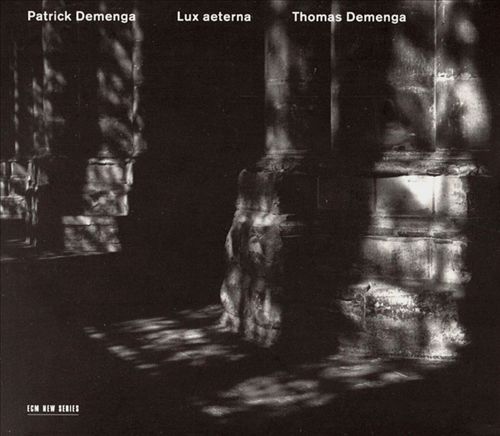
Patrick and Thomas Demenga: Lux Aeterna (ECM New Series 1695)

Patrick Demenga
Thomas Demenga
Lux Aeterna

Patrick Demenga cello
Thomas Demenga cello
Recorded November 1998, Propstei St. Gerold
Engineer: Teije van Geest
Produced by Manfred Eicher

This album is a special one for having introduced me to the awe-inspiring pathos of Alexander Knaifel. Here, the phenomenally talented Demenga brothers give their most heartfelt performance in the composer’s Lux Aeterna. It is, by no simple means, a glorious meditation on the notion of divine light. Its structure is simple: high harmonics on the cellos give way to words intoned by the musicians themselves (cast in the score as “psalm singers”) before combining with strings, so that song is produced from all aspects of the body, through gesture and through sacred vibrations. A profound and moving piece, played with utter sensitivity and a dedicated sense of direction, this title work is more than the album’s theme, but also its genesis. One cannot help but be comforted in its ethereal embrace.

We might hope this mood could be sustained throughout the entire program, but the remaining offerings are no less engaging in their own right, comprising an intriguing potpourri drawn from the duo’s longstanding repertoire. Thomas offers up his own piece, Duo? o, Du…, an insightful look into the mind of this singular (albeit twinned) musician that delights with its deep-throated croaks and delicate relay of harmonics.

French composer Jean Barrière (1707-1747) was the finest cellist of his day, but his music is hardly ever recorded. Despite its upbeat tempi and virtuosic scoring, there is solemnity to be found in his G-major Sonata No. 10. Its buoyancy presages the Mozartean paradigm by half a century and rests on laurels of comforting fluidity. At certain moments the cellos ring out in lush, sweeping harmonies, leaving the bass line to float like a ghostly implication in the corner of our mental eye. The raw Adagio plays like a viola da gamba divided into its complementary personalities and captivates with its Baroque sensibilities. The resonant space in which the album is recorded ensures the cellos are given the widest berth possible, stretching the sonata’s third movement into a majestic fabric. After this tour de force, the Demengas change gears with a piece from Swiss compatriot Roland Moser. A student of Sándor Veress and Wolfgang Fortner, Moser writes in feverish yet contained bursts, as evidenced in the dizzying pizzicati and sharp bowings of his Wendungen. A sprinkling of silence ensures that the immediacy of its drama stays true to its quieter affirmations. Barry Guy’s Redshift brings us full circle to Kniafel’s invocation of light. The title references a process by which, not unlike a Doppler effect in sound, changes the visible spectrum as distance increases. With bows a-bouncing the cellists reap a varied crop of meditations and improvisations through which a cunning rhythmic acuity is brought to fruition. We end on a lullaby, left to writhe like Odysseus strapped to the ship that threatens to sail him into a song that will mean his demise.

<< Peter Ruzicka: String Quartets (ECM 1694 NS)
>> John Cage: The Seasons (ECM 1696 NS
)

Frank Peter Zimmermann/Heinrich Schiff: Honegger, et al. (ECM New Series 1912)


Frank Peter Zimmermann and Heinrich Schiff
play the music of:
Arthur Honegger
Bohuslav Martinů
Johann Sebastian Bach
Matthias Pintscher
Maurice Ravel

Frank Peter Zimmermann violin
Heinrich Schiff violoncello
Recorded August 2004, Propstei St. Gerold, and January 2005, Festeburgkirche, Frankfurt am Main
Engineer: Stephan Schellmann
Produced by Manfred Eicher

Frank Peter Zimmermann and Heinrich Schiff make their ECM debuts with this scintillating program of music for violin and cello. Tapping into a surprisingly fecund repertoire for a too often neglected combination and dusting off a few under-recognized masterpieces of chamber literature along the way, the duo brings two decades of collaboration to the table for a rich banquet of sonic delights. The glue that holds the album together comes by way of Johann Sebastian Bach in two canons from his Kunst der Fuge. The seamless bifurcation between the musicians enhances their contrapuntal adhesion and recasts the surrounding works as ghostly echoes of untold virtue.

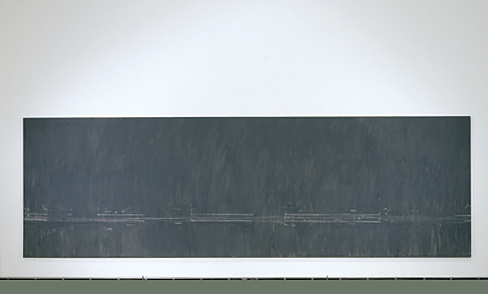
The rarely heard Sonatine VI for Violin and Violoncello in E minor (1932) of Arthur Honegger emits light with every stroke of the bow. With Ravel-like ebullience and a touch of Dvořák, its melodic trajectories converge at the listener’s heart. Skillful navigations between the energetic and the lyrical give the piece an organic undertone. Whereas a loving Andante tightens into a braid of introverted expression, the final Allegro breaks the violin into pieces against the punctuations of a Bartókian cello and ends with a flourish of exhilarating diffusion. Bohuslav Martinů’s Duo for Violin and Violoncello No. 1, H. 157 (1927) leads us next into a whimsical Preludium, balancing indifference and unity in two robust melodic lines. Here, the instrumentalists are less distinguishable in their new harmonically transcendent territory. With a flick of the proverbial wrists, a skillful Rondo unveils the composer’s ecstatic charm in greater clarity. A brilliant new discovery from the young Matthias Pintscher awaits in Study I (2004), an auditory exploration of “Treatise on the Veil” by artist Cy Twombly.

Cy Twombly: Treatise on the Veil (Second Version), 1970

As the newest statement on the album, it forms a tight circle with Bach, along which the other pieces may be comfortably plotted. As breathy sighs run their fingers along even vaguer harmonic edges, Pintscher’s deceptive minimalism reveals a wealth of vocal atmospheres.

Upon the death of Claude Debussy, Maurice Ravel composed this Sonata for Violin and Violoncello (1922) in memory of the composer to whom he was most often compared. As if to assert his own distinct voice, he tried a new approach by stripping the sonata to its barest elements. The result is a string quartet halved without any loss of density. The challenges therein seem only to have urged him on, producing one of his most vividly realized works. The sonata is ecstatic, beautifully played, and masterfully constructed, weaving its way through an Orphic center before breaching an exuberant outer shell.

Overall, this is a fascinating album filled to the brim with utterly gorgeous music. One might say the two instruments come together like the hands of a keyboard, only here they sing through more sustained interactions with strings. The piano is most certainly not missed, and indeed would find no room to stand.

John Cage: The Seasons (ECM New Series 1696)

John Cage
The Seasons

Margaret Leng Tan prepared piano, toy piano
American Composers Orchestra
Dennis Russell Davies conductor
Recorded January 1997, SUNY Purchase Performing Arts Center Theatre A, New York
Engineer: Gregory Squires
Produced by Manfred Eicher

“The responsibility of the artist consists in perfecting his work so that it may become attractively disinteresting.”
–John Cage

The Seasons brings together not a few major firsts. It is the first ECM appearance for John Cage (reason enough to own this disc) as well as for longtime friend and interpreter, pianist Margaret Leng Tan. It also contains the premier recording of Seventy-Four, Cage’s first orchestral score, played and conducted by the very musicians to whom it was dedicated. The other compositions featured here date from before the composer’s allegiance to “non-intention” and indicate a mind priming itself for enlightened calm.

Seventy-Four (1992) was named for the number of musicians set to perform it and, with the assistance of Lou Harrison and Virgil Thomson in the scoring, was to be one of the composer’s last pieces. The musicians at the orchestra’s outer rim determine time signatures at their own whim, thereby eliciting a markedly different performance every time around its composed center. Its first strains reach our ears almost unexpectedly in a rendering that combines total abreaction with superb “breath” control. Like a wheel that never stops turning, it renews itself with every revolution. In many ways, such a piece showcases what an orchestra is truly capable of, what distinguishes it from other instrumental groupings as the fragile collective that it is. Certain colors stand out, such as those painted by a silvery violin and the fluttering cello toward the piece’s conclusion, both drowned in the overwhelming totality of its sound.

Although the current orchestral version of The Seasons (1947) differs significantly from that for solo piano, we find the same red thread running through its core. This “considered improvisation” was a commission for New York City’s Ballet Society and prompted at least one critic to herald Cage as one of the twentieth century’s greatest orchestral colorists. Working in both painterly and programmatic modes, each of its gestures leaves a delible mark. Winter may fall like a snowflake, but it is also subject to unexpected gales and flash blizzards; Spring is an earthquake enhanced by the delicate trills of its aftershocks; Summer is a shimmering mass of good intentions gone rancid in a blinding glare; and Fall curls up like a cosmic roly-poly into a tight defensive sphere.

Although the prepared piano is one of Cage’s most immediately recognizable innovations, there remains an innocence about its construction, stemming as it does from that incomparable urge to leave one’s creative signature, however fleeting, on the immediate environment. The prepared pianist’s manipulations merely accentuate the indeterminacy of the musical act through an audible catalogue. As a centerpiece of the Concerto for Prepared Piano (1950/51), it is like a box that has been broken and rearranged. The music is a fractal, becoming ever more microscopic toward the edges. Very little marks one movement from another, for the pauses between them are shorter than those integrated into the movements proper, nothing more than inhalations to greater heavenly circulations.

Because Cage’s world is defined so much by chance (or is it the other way around?), the alternate version of Seventy-Four that follows becomes a wholly new utterance, suitably cleansing our palates for the whimsical Suite for Toy Piano (1948), which conjoins not a few contradictory creative processes. On the one hand, we have an instrument that is not normally defined as such, an object that has been subjectively removed from its intended context. The musician must, in a sense, retrain herself when learning its rules, for anyone who has experimented with a toy piano at the “appropriate” age must incorporate an entirely new layer of formal training into what was once an informal desire. It is a delightful inversion of the classical paradigm that manages to hold its own throughout, so that when we hear the same piece suddenly re-imagined for orchestra, it almost seems to lose something of its musicality as it slips into a new aural skin. The fourth movement is particularly beautiful in its transposed form.

There are some who believe that recording Cage is an antithetical project, that committing just one of infinite possibilities to record destroys the beauty of its indeterminacy. And yet, as one who enlarged and ruptured the musical landscape like no other, Cage has found a comfortable home on The Seasons, one that I am sure welcomes any incidental sonic guests that may happen to drop by during the listening.

<< Patrick and Thomas Demenga: Lux Aeterna (ECM 1695 NS)
>> John Dowland: In Darkness Let Me Dwell (ECM 1697 NS
)

Peter-Anthony Togni: Lamentatio Jeremiae Prophetae (ECM New Series 2129)


Peter-Anthony Togni
Lamentatio Jeremiae Prophetae

Jeff Reilly bass clarinet
Elmer Iseler Singers
Rebecca Whelan soprano
Lydia Adams conductor
Recorded October 2008 at All Saints Cathedral, Halifax, Nova Scotia
Produced by Manfred Eicher

I am become a derision to all my people, and their song all the day.
–Prophet Jeremiah

Nova Scotian composer Peter-Anthony Togni gets his long overdue inauguration into ECM’s hallowed halls with this gorgeously conceived “concerto” setting of Jeremiah’s Book of Lamentations. A bass clarinet dons improvisatory clothing as the Prophet in question, wandering the streets of a complacent populace, represented here by a modest vocal ensemble. Jeff Reilly is the virtuoso soloist and provides a nuanced performance against the choir’s own measured readings.

Lamentatio Jeremiae Prophetae (2007) is structured in five sections, each an ode to speech, time, and place. “Quomodo Sedet Sola Civitas” (How doth the city sit solitary) bemoans Jerusalem’s manifold miseries with a long oration from Reilly, whose technical prowess is shown to suitable effect as the voice that will not be heeded. The choir lifts eyes, only to blind itself in the glare of a reality it wishes not to accept. A dazzling soprano soloist draws her line of wisdom through this tangled argument, carrying us with grace into “Quomodo Dominus Filiam Sion Obtexit” (How hath the lord covered with obscurity the daughter of Zion). Jeremiah opens his arms again, only to be met with a mob of resistance. The choir raises its arms, but can only bring them down upon itself like a wrathful wound. As we open into “Silentio” (Silence), the Prophet pleads in frustration, where he is met with more urgency. These outbursts only serve to heighten the solace in whose name they are offered, each a stepping-stone to selfless understanding. This process offers our first intimation of hope, a touch of stasis before the gales of the next poem whip across our hearts. The case of “Quomodo Obscuratum Est Aurum” (How is the gold become dim) is quickly usurped by the soprano’s return, which again traces the people’s unwise actions to the very destruction their ways has wrought, before salvation returns with full force in “Recordare, Domine” (Remember, o Lord), bidding the Prophet to lift his voice in harmony as the light of Zion crashes on the shores of the suffering in which they all share.

While one may wish to draw an affinity to ECM’s popular Officium project, pairing as it does an aleatoric reed with relatively structured voices, the ascetic Lamentatio carves a distinct contemplative space in which the composer’s voice is duly heard. A harmonious marriage of form, production, and content, this is a welcome new addition to the label family that bears repeated aural and spiritual consideration.

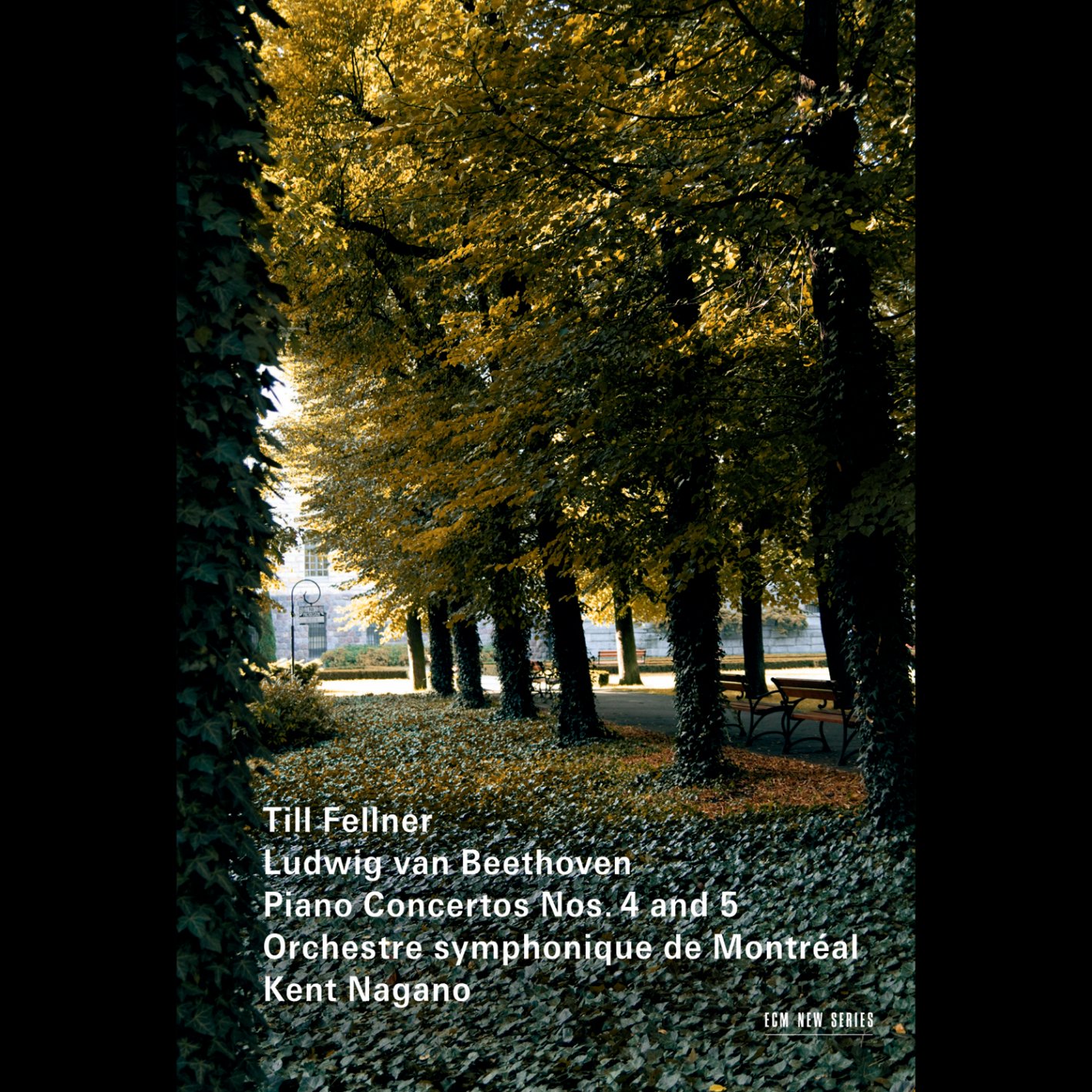
Beethoven: Piano Concertos Nos. 4 and 5 – Fellner/Nagano (ECM New Series 2114)


Ludwig van Beethoven
Piano Concertos Nos. 4 and 5

Till Fellner piano
Orchestre symphonique de Montréal
Kent Nagano conductor
Concert recordings, May and November 2008 at Salle Wilfrid-Pelletier, Montréal
Engineer: Markus Heiland
Produced by Manfred Eicher

In his liner essay, Paul Griffiths rightly credits Ludwig van Beethoven with having given the orchestra “a voice,” and in the composer’s final concertos offered here we have even greater reason to bask in his voluminous discourse, made all the more so for the temperamental piano at its center. These two musical forces, strings and keys, “speak to us by speaking to each other.” Such plurivocity, Griffiths further contends, is only heightened by the performances on this disc. Austrian pianist Till Fellner, who previously graced us with his Bach interpretations, now enacts an equally contested dramaturgy in these mighty, yet ever delicate masterworks. At the podium is Kent Nagano, a personal operatic favorite who treats the Orchestre symphonique de Montréal like a giant chorus far too expansive to be constricted by human throats.

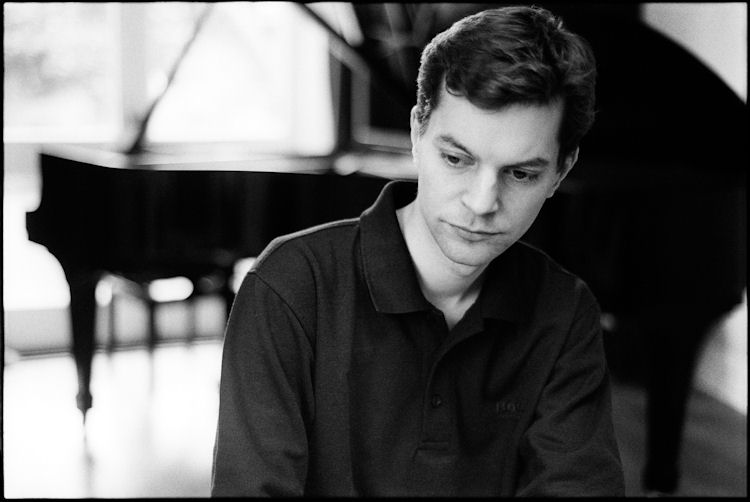
Fellner (photo by Ben Ealovega)

Piano Concerto No. 4 in G major op. 58 (1805/06)
While most concertos of this magnitude would begin with an orchestral prelude of sorts into which the soloist may be dropped like so much creative ink, here the latter opens the floor in the tonic before spreading its fingers into the dominant key. The composer holds our attention throughout its entire 19-minute expanse, a concerto in and of itself; no small feat considering that it twists the barest of thematic cores into a veritable unicorn’s horn of charging force, brought home in the glorious final chords. The second movement entrances us with its attendant imagery of Orpheus taming the Furies before Hades. Having only melody to hold on to in its shadows, we put our trust in this music completely. Our abstruse confusion is over before we know it, and as we are swept up in the ensuing Rondo we find that we’ve been dreaming all along.

Piano Concerto No. 5 in E-flat major op. 73 (1809/10)
Despite having earned the nickname of “Emperor,” this concerto is, Griffiths reminds us, nothing if monarchical. Opening in tutti and with a graceful cadenza, the Allegro charts a formidable exposition through landscapes unchanging and deciduous alike. Dancing configurations in the first half underscore not only a depth of virtuosity, but also of melodic effect, while denser punctuations in the second thread our minds with braids of protracted thematic closure. A pensive Adagio heralds ever so subtly the newly emerging Romanticism of the age. Fellner’s careful pedaling ensures that we get the most out of every phrase as the piano descends toward the lone bassoon that bleeds into the concluding Rondo. One can almost feel the hems of dresses and tailored lapels tracing their grand circles in the air as the instrumentalists engage in a lavish dance. Beethoven sweeps his brush through the piano’s densest colors and uses these to paint a rousing portrait of epic intimacies.

Both of these concertos are dedicated to Archduke Rudolph of Austria (1788-1831), a student of Beethoven’s who would also become a great patron. That such powerful creations might sometimes not exist without likeminded support is a sad yet potent reminder of the invisible tug-of-war between music and economics. Thankfully, ECM’s finely chosen interpretations and engineering betray none of these politics and present the music in all its richness without any strings attached. We see this in Nagano’s palpable free spirit, in the orchestra’s every nuance, and in Fellner’s attentiveness to each cumulative set of notes. He plays the middle movements faster than most, giving them new life for a new century, plowing ahead with the immensity of fortitude and passion that spawned them. Bravos all around.

Paul Giger: Vindonissa (ECM 1836)


Paul Giger
Vindonissa

Paul Giger violin, violino d’amore, viola d’amore, footbells
Robert Dick c-flute, glissando flute, bass flute in c, bass flute in f, contrabass flute
Satoshi Takeishi percussion
Recorded June 1998 and 2000

Modern-day gypsy, musical traveler, melodic nomad: call him what you will, but Paul Giger has created some of the most haunting music to ever grace your ears. Adding yet another branch to the bold tree that began with Chartres and which was expanded in three subsequent projects, the Swiss violinist/composer beguiles us yet again with this more whimsical, though no less trenchant, collaboration. On Vindonissa, he is joined by two outstanding musicians. Robert Dick is a truly revolutionary American flutist and composer who has taken his instrument to new heights. A pioneer in extended techniques, design, and improvisation, he is a welcome presence on ECM. Percussionist Satoshi Takeishi is a kindred itinerant spirit, and has worked with a wide range of musicians, including Anthony Braxton and Joe Zeytoonian. A skilled improviser in his own right, his openness to the musical moment is a no-brainer for inclusion here.

Giger bookends this yawning chasm of life with a meditation on solo violin from which the album gets its name, distilling from the chromatic banality of open strings a potent tincture of dissonance and transcendence. Such lone signposts dot the album with moments of pause, as in the lilting Introitus and Kyrie. The group tracks contrast with open spaces and colorful mysticism. Starting with the pointillism of Oogoogajoo and ending on the likeminded An Ear On Buddha’s Belly, these intersections of time and circumstance seem to grow organically, as if in waves. Dick and Takeishi walk comfortably alongside Giger, bringing vital human energy to the untouchable center of Lava Coils and even greater earthly care to Fractal Joy, the most profound triangle therein. Gloria et Tarantella, in which Giger rocks the viola d’amore to the beat of his own foot bells, is the album’s masterpiece and builds to a frenzy of Tartini-like exuberance. With every note, it burns a root and follows its smoke ever skyward.

Giger is easily one of the greatest violinists of our time, not only because of his technical prowess, but more importantly for his ability to grab hold of a melodic handle and never let go until it asks him too. Such talent can take some getting used to, especially in the presence of other musicians, but I think this is an album in which one can rest assured that a meeting of three bodies, minds, and worldviews can indeed find harmony through sound’s untold alchemies.

John Dowland: In Darkness Let Me Dwell (ECM New Series 1697)

John Dowland
In Darkness Let Me Dwell

John Potter tenor
Maya Homburger baroque violin
Stephen Stubbs lute
John Surman soprano saxophone and bass clarinet
Barry Guy double-bass
Recorded January 1999, Forde Abbey, Dorset
Engineer: Markus Heiland
Produced by Manfred Eicher

Weep you no more, sad fountains;
What need you flow so fast?

So begins ECM’s first foray into the sounds and songs of John Dowland (1563-1626), Renaissance lutenist and a songwriter for all ages. While many have captures the dance of voice and strings by which he set his chisel to the lathe of courtly melancholia, the group of musicians assembled on this disc manages to carve something refreshingly immediate. Explains tenor John Potter, creative director of what would come to be known as the Dowland Project, “This is the first time anyone’s approached Dowland not from an ‘early music’ angle, but simply as music. We’re working with Dowland as though he were still with us.” The present recording foregrounds early music’s malleability and upholds Dowland as a great improviser. It is precisely this spirit that coheres Potter and his rogues-in-arms. Stephen Stubbs provides the requisite lute, and with it a boundless cache of creative energy for all to share. It was at the suggestion of producer Manfred Eicher that double-bassist Barry Guy and Baroque violinist Maya Homburger were brought on board. Yet the most seemingly incongruous instrumental addition was that of jazz reedman John Surman, who actually ends up being the most conservative of the instrumentalists, providing a steady bass clarinet continuo and smooth saxophonic lines throughout.

For this collection of ayres and other curios, Potter and company have hand picked a fine array for our auditory pleasure. The disc’s crowning highlights come from the First Book of Songs. “Come Again” synthesizes the melodic relay between Potter and Surman with the utmost respect, as do the visceral “Now, O Now I Needs Must Part” and “Come, Heavy Sleep.” Guy delights us with his palpable lyricism in “Go Crystal Tears,” a song in which Surman also succeeds to astonishingly brilliant effect. From the Second Book of Songs, we get two polar opposites. The mournful “Flow My Tears” flows like honey from a wilting hive and makes two appearances on the album. Fine Knacks For Ladies is a more whimsical number. Potter’s quiet refrain of “the heart is true” resounds with genuine delight. The Third Book of Songs gives up two tearful ghosts of its own, of which The Lowest Trees Have Tops walks the most precarious line between laughter and lamentation. Surman’s bass clarinet infuses the title song, taken from A Pilgrimes Solace, and acts like a fulcrum of emotional balance. Potter is at his finest here, caressing every word with ceremonial urgency. Rounding out the program are three selections from Dowland’s Lachrimae, a book of pavanes based on Flow My Tears. Two of these are instrumentals that go straight for the heart, while the final track, “Lachrimae Amantis,” finds Potter slipping into countertenor on a pure and open Ah.

While perhaps not as cohesive as the project’s later albums (those with perfect pitch may stumble here and there in this darkness), In Darkness succeeds with no small humility in looking beyond Dowland’s enchanting, affected veneer and into the vivacious and melodious heart within. All in all, this is an emotionally satisfying start to an intriguing New Series project.

<< John Cage: The Seasons (ECM 1696 NS)
>> Dave Holland Quintet: Prime Directive (ECM 1698
)