Terje Rypdal: Undisonus (ECM 1389)

Terje Rypdal
Undisonus

Terje Tønnesen violin
Royal Philharmonic Orchestra, London
Christian Eggen conductor
Grex Vocalis
The Rainbow Orchestra

Carl Høgset
director

Recorded September 1986, St. Peter’s Church, Morden, London (Undisonus) and November 1987, Rainbow Studio, Oslo (Ineo)
Engineers: Arne Akselberg (Undisonus) and Jan Erik Konghaug (Ineo)
Produced by Arne-Peter Rognan

For as long as I’ve been listening to Terje Rypdal, I’ve known him to skirt idiomatic borders without presumption. I can only admire him for his dedication to jump headlong into such projects as this pairing of two classical pieces. As one who is so often present in the realization of his works, allowing the music to take on its own life isn’t always easy. Rypal, however, takes this step gracefully and with melodic integrity intact.

Undisonus, op. 23 is set for violin and orchestra, but it’s the brass section that first catches our attention with its subterranean rumblings. First seeded in 1979, the present version represents years of additions and fine-tuning, which one can hear throughout Terje Tønnesen’s fine playing. His tone is declamatory without being overbearing, lyrical yet more acrobatic than romantic, but always with the feel of a sketch running off the page. This puts the orchestra in a precarious position, taking on the role of caretaker at its haunts the aura of the soloist’s imagination. Silences are always heavy and felt like a remembered drone, ending on a shadowy slide in which double basses and violin circumscribe the entire musical space in a beautiful gesture of completion.

Where Undisonus skirts a dichotomy of call and response, Ineo, op. 29 (composed 1983) transcends that dichotomy into a more noticeably unified sound. Originally featuring Rypdal on guitar for its Danish Radio premier, here it has been reworked for choir and chamber orchestra. Lush writing for woodwinds and brass lends deeper poignancy to the choir’s memorial intonations. Constructed in gorgeous little cells drawn by near-silent threads, every utterance spreads into an overarching whole. A lyrical oboe solo recalls Rypdal’s formative meditations in his self-titled debut and in What Comes After, foreshadowing a glorious Alleluja that is as close to the spirit of Giya Kancheli’s Prayers cycle as I have ever experienced in another’s work.

Averaging 20 minutes each, these pieces make for a modest album in length that is anything but in scope. Rypdal clearly has nothing to prove, as the music drapes a blanket of sonic comfort over our prog rock expectations. It is best appreciated in half-slumber, where judgment is but a stepping-stone toward broader skies.

<< Ralph Towner: City Of Eyes (ECM 1388)
>> Abercrombie/Johnson/Erskine: s/t (ECM 1390)
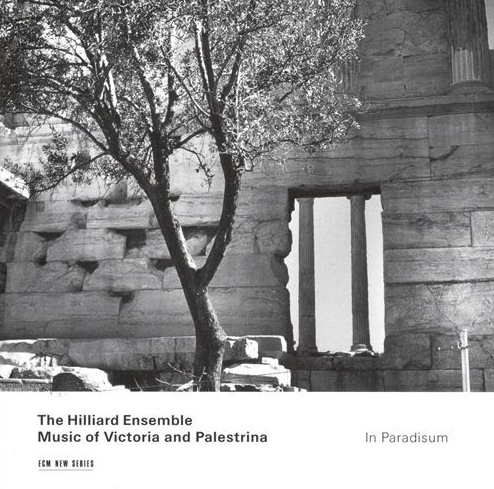
The Hilliard Ensemble: In Paradisum – Music of Victoria and Palestrina (ECM New Series 1653)

The Hilliard Ensemble
In Paradisum: Music of Victoria and Palestrina

The Hilliard Ensemble
David James counter-tenor
John Potter tenor
Rogers Covey-Crump tenor
Gordon Jones baritone
Recorded September 1997 at Propstei St. Gerold
Engineer: Peter Laenger
Produced by Manfred Eicher

In Paradisum is a trinity within a trinity. Shuffling the works of Tomás Luis de Victoria (1548-1611) and Giovanni Pierluigi da Palestrina(1525/26-1594) between plainsong selections from the Toule Graduale manuscript of 1610, the ever-attentive Hilliard Ensemble offer us one of their finest recordings yet. Ivan Moody duly reminds us in his accompanying essay that the prolific Palestrina and the younger, more reclusive Victoria lived primarily by and of the Spirit. As composers, they have grown into stars of a Renaissance music niche market, but in the Hilliards’ throats they are votive candles whose flames remain alive in our hearts as we listen, as evidenced by the liturgical surroundings in which we encounter their music here. Embracing every note with humility and grace, these performances chart a significant shift from monophony to polyphony.

Victoria’s Officium Defunctorum, his last published work, was written in memory of Dowager Empress Maria, for whom he served as personal chaplain until her death in 1603. Whatever thorns of sadness are to be found in this music are filed to rounded points by the fluid voices of this recording. The delicate changes of register in the opening “Taedet animam meam” set a plaintive model for all that follows. The effect of the “Libera me Domine” farther in, with its broad strokes and tender embraces, seems to percolate into the entire program. Those who appreciate the subtle complexities of both plainchant and polyphony will appreciate their being juxtaposed in the “Peccantem me quotidie,” which alternates between the two in a seamless responsory. We are humbled by another swath of responsorial humility in a second, 13-minute “Libera me Domine,” this time by Palestrina, who is further represented by a selection of motets, including the flowering Domine quando veneris (which almost comes as a soft shock to the senses in the company of Victoria’s denser invocations) and the resplendent Heu mihi Domine. Palestrina works with unsteady lines and favors weaving the lower voices into a deeper foundation, as in his Ad Dominum cum tribularer clamavi.

The chant that fleshes out the rest of the album is some of the most affecting one is likely to find on disc, and allows us an even more visceral understanding of our own mortality. And while all of this music deals with the darker sides of mortality (the Victoria and Palestrina being drawn from texts for the Office of the Dead, and the chants comprising an anonymous Requiem Mass), it steps outside of time, reminding us that death is something we all share, and that in being so it is holy.

<< Bach: Die Kunst der Fuge – Keller Quartett (ECM 1652 NS)
>> Arvo Pärt: Kanon pokajanen (ECM 1654/55 NS
)

Giya Kancheli: Trauerfarbenes Land (ECM New Series 1646)

Giya Kancheli
Trauerfarbenes Land

Vienna Radio Symphony Orchestra
Dennis Russell Davies conductor
Recorded March/August 1997, ORF Studio, Vienna
Engineer: Joseph Schütz
Produced by Manfred Eicher

As much as I adore the likes of Arvo Pärt and John Tavener, it mystifies me to see their names being repeatedly opened like comparative umbrellas under which other contemporary composers are ushered from the critical storm. Enter Giya Kancheli, who has carved such a lasting gouge in the recorded landscape that one could hardly mistake it for that of anyone else. Though he may share the same light as his contemporaries, the Soviet Georgia-born composer gives off an entirely unique reflection, and would seem to hold no illusions regarding the messages of his music. The massive orchestral works on this disc are like two mirrors held in front of one another, projecting endless sorrow into a trembling corridor.

From the opening measures of…à la Duduki (1995), we are graced by a sound that is at once anthemic and solemn. The intermittent brass proclamation invokes nothing more than itself. Although the music harbors a potential for regularity, it prefers to express its wordless sentiments with widely varying degrees of fluidity. Ultimately, gentle hearts still these moments of profound drama. The occasional piano introduces a human color to the palette, which otherwise seems to paint an atmospheric veneer far beyond our touch. The music falls as it rises: that is, in anticipatory silence.

1994’s Trauerfarbenes Land (“Land that Wears Mourning”) introduces another resounding breach of sound, only this time accentuated by a more pointed percussion section. For the next 37 minutes, we are subjected to a slow vacillation between agitation and peace, self-hatred and prayer. The power of this music is the power to unsettle, guiding us away from our comfort zones into a land that, like its title, is indeed cloaked in grief. Yet what appears on the surface a poignant meditation on the harms of the material and the abstract ends up the product of a beating heart and nothing more. Every moment of delicacy pulls those gravid statements closer and every bellowing cry brings that crawling darkness into blinding light. There is no tragedy to be found here, but only the nooks in which we hide our fears.

As with any Kancheli recording, one will find familiar footholds, and will thus feel supremely grounded in these musical surroundings. At the same time, there is an underlying (in)difference, an umbral presence creeping in from all sides. Kancheli shows a liking for more pronounced contrast in these larger settings, forging in that intersection a rather terse melodic territory that is constantly folding in upon itself like a cell dividing in reverse. It is also his unity. Like “left” and “right,” though divided into “evil” and “good,” respectively, we are reminded here that they both belong to the same body, and therefore can never be separated.

ECM set a new standard of classical recording with this album, capturing the music’s quietest whispers and resounding roars with equal presence and clarity.

<< Maya Homburger/Barry Guy: Ceremony (ECM 1643 NS)
>> Dominique Pifarély/François Couturier: Poros (ECM 1647
)

John Cage/Herbert Henck: Locations (ECM New Series 1842/43)

Herbert Henck
Locations

Herbert Henck piano, prepared piano
Recorded 1993 and 2000, Festeburgkirche, Frankfurt am Main

I remember seeing in my teens a documentary about John Cage (the title unfortunately escapes me), in which two seemingly bewildered elderly women are eying the auditory visionary in question as he darts around a concert hall with portable radio in hand. Rather than balk at him, as the viewer is led to expect, one of them simply smiles and says something to the effect of, “Oh look, there’s John, doing this thing.” This endearing moment stands out for me not only because of Cage’s ability to provoke childlike wonder in people of all ages and backgrounds, but also because “doing his thing,” as it was so aptly put, was for him a way of life. I like to think the same holds true for a pianist like Herbert Henck, whose fearless approach to making music is nowhere so explicit as on this timely double album.

The prepared piano is the quintessential Cagean innovation. It exemplifies not only his unwavering interest in play, but more importantly his infectious lucidity. I first heard the prepared piano on the essential Cage tribute album, A Chance Operation (1993, Koch International Classics). The pieces in question were the Three Dances, as played by Charles “Vision” Turner. That congregation of twangs, curtails, and jangles was a gamelan master’s most beautiful nightmare and unlike anything I had ever heard. Henck’s love for indeterminacy is as rejuvenating as his interpretations of the seminal Sonatas and Interludes found here. They are the most well known pieces for the “instrument” (though I am rather tempted to call it a “process”), which is saying much, considering that their fallibility is so markedly present in every utterance. Henck ensures that the pieces’ inner operations are never obscured. Some come across as intensely mystical (Sonata VII) through a depressed sustain. Others are more nervous (Second Interlude). Henck’s preparations encompass a thoughtful spread of percussiveness and vocality, and sometimes all of the above, as in the ritualistic Sonata IX. If favoritism has any validity here, then I humbly embrace the Fourth Interlude as my one and only. Sonatas XIV and XV are also particularly stunning in their crystalline fragility. This is the puppetry of music, the dead brought to fantastic life by a nimble touch.

Henck’s own improvisations, collected here as the Festeburger Fantasies and realized in the spirit of Cage, are like a torrent of pent-up energy suddenly released—a hodgepodge of extended techniques, augmentations, and preparations. Like a ballroom dance gone horribly, albeit enchantingly, awry, they are simultaneously coordinated and tangled amid limbs and unfinished steps. The solos come across as majestic elegies, while in the overdubbed duos Henck seems to wring out as much musical nectar as he can before those particular intersections of space, form, and time elude him. Here is a musician’s entire life compressed into an hour’s worth of unbounded expression.

I can only imagine the challenges such a recording presents to the engineer. Nevertheless, in the hands of ECM every conceivable nuance comes through, pitch perfect and severely organic.

Maya Homburger/Barry Guy: Ceremony (ECM New Series 1643)

Maya Homburger
Barry Guy
Ceremony

Maya Homburger baroque violin
Barry Guy double-bass
Recorded April and July 1997, Propstei St. Gerold and Rainbow Studio, Oslo
Engineer: Peter Laenger and Jan Erik Kongshaug
Produced by Manfred Eicher

By definition, the concept of “ceremony” is rooted in an abiding adherence to formality, regularity, and gesture. As the title of this equivocal recording, it bends to a different set of rules. The quill that writes them belongs in the alternating grips of Baroque violinist Maya Homburger, making her New Series debut, and bassist Barry Guy. Dipping into the ink well of Heinrich Franz Biber, the inestimable duo scratches its captivating deconstructions in a jagged improvisational script. Yet it is in between the lines where the real ceremony takes place.

Annunciation chalks the Praeludium of Biber’s Mystery Sonata No. 1 (“The Annunciation”) as the denominator by which Guy’s compositional numerators come to be defined. Its signals are grand and highly detailed, each evocative of an era relived through its instruments. Stepping out of this door, we walk into Celebration, a free-spirited violin solo distilled from a wealth of motivic information. Looking up into the Immeasurable Sky, we enter a gangly dream in which the progress of travel is meted out slowly at the hands of an unseen guide. Dancing turns into language, and language turns into art: the cartographer’s aspirations brought to light in sound. And when at last the Ceremony commences, it paints a lush fantasy that never quite sets its feet upon solid ground. Throughout its nearly 17-minute duration, the magic of multitracking allows Homburger to work her fractal spell. Perfect fifths are drawn out into a fine mesh to catch the dizzying agitations that follow. Forged by well-tempered strings, each intention is magnified by its situatedness in the dying echo of the last. We then find ourselves Still. Counterpart to the Celebration, this piece for bass alone circumscribes the ceremony with pensive cleansings before Breathing Earth takes the last movement of the Biber sonata and works it into a similar transfiguration of elements.

The Baroque passages glimmer like reflections of some hidden genius, exposing the dedication poured into a craft before it is opened to scrutiny. The sensitivity of their denouement is what really captivates throughout this fine disc, and in it we can always find a burnished string onto which we might place our own tattered bow of appreciation.

<< OM: A Retrospective (ECM 1642)
>> Giya Kancheli: Trauerfarbenes Land (ECM 1646 NS
)

Rosamunde Quartett: Webern/Shostakovich/Burian (ECM New Series 1629)

Rosamunde Quartett
Webern/Shostakovich/Burian

Rosamunde Quartett
Andreas Reiner violin
Simon Fordham violin
Helmut Nicolai viola
Anja Lechner cello
Recorded December 1996, Stadttheater Eichstätt
Engineer: Markus Heiland
Produced by Manfred Eicher

The Rosamunde Quartett began its increasingly fruitful ECM relationship with this lyrically conceived disc, which brings together one of the twentieth-century repertoire’s most widely played and recorded pieces (Shostakovich), one not so widely played (Webern), and one relatively unknown (Burian).

Although Anton Webern penned his Langsamer Satz in 1905, it would not be performed until nearly six decades later. One of many such single-movement string quartets produced at the behest of teacher Arnold Schönberg, it stands out for its balance of ergonomic contours and emotional fragility. In its attempts to gain purchase in the wake of a crumbling Romanticism in which the composer still found rooted value, the piece arches its back like a bridge across a gaping intellectual chasm. The result is an emotive stomach crawl that is quite visceral to hear and, I imagine, even more so to play. Through a series of languid turns, signposted by Ravel-like use of pizzicato, it carries the listener across a tundra of harmonies. It is its own inner fire, the instability of an art in and of being. The transitional agitations throughout are reactive rather than reactionary, and seem to gasp in slow motion toward an incomplete resolution.

Written in a three-day fervor following his diagnosis with polio, Dmitri Shostakovich’s String Quartet No. 8, op. 110 (1960) is a bidirectional memorial, pointing one finger to a world being crushed under the weight of totalitarianism and another to the self caught in the middle. Structured around the intimate pedal point of the composer’s initials—DSCH—and filled with allusions to many of his own works, its power is expressed through a protracted implosion in which not only our ears, but also our philosophical fantasies, come to be implicated. The opening Largo is one of modern music’s most honest statements. Characterized by a sinuous tenacity and burnished chording, its shifts in key and height are painfully organic. By the time of this release, the piece had already made an ECM appearance in orchestral costume on Dolorosa. As a quartet, however, it remains wiser to the score’s vast internal tensions. From the fibrous links and buzzing viola of the Allegro molto to the surprisingly ambulatory Largo reprise, the current version heaves with all the tears of its turbulent milieu. The call of the Allegretto is written off here not with the usual trill, but a restrained waver, and the pizzicati are so biting that one can almost feel them in the chest. The ever-mysterious viola solo is handled with the utmost delicacy as the violins recede farther than I have ever heard. The sustained violin note that follows echoes like tinnitus, a siren of historical malaise that slices through the mind. The staccato attack of the penultimate movement is not so much dramatic as it is traumatic, and in being so makes the resolved chords ring like a scar undercutting the healing process with the acrid fear of recurrence. My standard of reference for this seminal piece has always been the Lafayette String Quartet’s fantastic 1993 rendition on Dorian Recordings, and I must say that here we reach a new level of craftsmanship.

The Rosamundes finish with a name likely unknown to most. In addition to being a composer, Emil František Burian (1904-1959) was a singer, musician, poet, actor, journalist, and playwright. Described as a “one-man Czech avant-garde,” Burian was a strident communist whose primarily theatrical activities throughout the twenties and thirties served as mouthpiece for his leftist leanings. After surviving three German concentration camps, during which time he managed to put together a forbidden performance or two, he returned to his homeland, where he left a lasting mark in the comingling worlds of theatre and politics. His String Quartet No. 4, op. 95 was written just after the war. Though new to this listener, it reads like a synthesis of the Webern and Shostakovich: combining the former’s elegiac veneer with the latter’s tortured soliloquies. Its promises are fleeting, its dances icy and dense. Like a forgotten bottle of wine opened at long last, it contains a host of flavors locked at the peak of their historical creation.

This album is yet another example of how ECM New Series continues to revive the tried and true as no other imprint can. Of the many fine string quartet recordings offered, this is an ideal place to begin.

<< Christian Wallumrød Trio: No Birch (ECM 1628)
>> Brahms: Sonatas for Viola and Piano (ECM 1630 NS
)

Eduard Brunner: Dal niente (ECM New Series 1599)

Eduard Brunner
Dal niente

Eduard Brunner clarinet
Recorded October 1995, Propstei St. Gerold
Engineer: Peter Laenger
Produced by Manfred Eicher

Swiss clarinetist Eduard Brunner has appeared on such ECM albums as Kurtág’s Hommage à R.Sch. and Kancheli’s Caris Mere. With this fine disc, at last he gives his instrument its due glory in the spotlight, or should I say the shadows. Brunner’s extended technical precision and superb breath control amount to a humble program of contemporary selections that are all about the destination. Virtuosity is merely a means to getting there.

Isang Yun’s Piri is an extended saturnine call. It is as if the clarinet itself takes in and expels its own breath without human assistance. One could hardly ask for a more fitting introduction neither to the album’s sound-world nor to Brunner’s instrumental acuity. A longtime part of his performance repertoire, Piri instigated a friendship between performer and composer that lasted until Yun’s death in 1995. Dark sustained tones lead into flashes of light, which echo through the lofty ceiling of Propstei St. Gerold in nimble footsteps. The piercing quality of long-held notes gets behind the skull and awakens the brain. In those notes are cradled exquisite overtones for the careful ear. The piece’s many glissandi, mocking vocal qualities, and overblowing tell a potent dedicatory tale. As a “prayer” to incarceration (the travails of which Yun was no mere observer), its thread continues to hold strong.

Written for Brunner’s teacher Louis Cahuzac, Igor Stravinsky’s well-regarded Three Pieces for Clarinet Solo introduces some of the instrument’s lower timbers. With these, the music becomes more rhythmically discernible. We begin to feel agitation and weightiness, much in contrast to Yun’s relatively ethereal traumas. Brunner appends to this Stravinsky’s previously unpublished Piece for Clarinet Solo, jotted in the margin of a telegraph in April of 1917 and dedicated to Pablo Picasso.

The highly malleable Domaines pour clarinette seule of Pierre Boulez gives Brunner ample room in which to flex his melodic muscles. Equal parts rest and work, these twelve short pieces thrive in half-breathed reverie.

While Karlheinz Stockhausen’s In Freundschaft exists in versions for many solo instruments, in its present incarnation its birdsong-like qualities are enhanced. This potent dose of sunshine starts off delicately enough, played as if on separate instruments. Every note seems to peek around a corner and scamper before it is found out. A brilliant composition and evocation thereof.

Giacinto Scelsi’s Preghiera per un’ombra gives us another interior monologue. Veiled in its titular shadow and structured by the composer’s enchanting idiosyncrasies, it is suffused with marked changes in emotional climate.

The title of Helmut Lachenmann’s Dal niente (Intérieur III) means “Out of nothing.” And indeed, much of the music consists of forced air with mere hints of notes. Depressed keys plunk like marbles on a frozen lake, while the occasional note screeches above the solace. The sound is downright saxophonic, made all the more so for its metallic undertone. Each breath is different than the last, and shows Brunner’s command even further.

The album is meticulously conceived. The first half is structured around ambulatory bodies, minds, and personalities, while the latter half is more “spiritual” and descriptive. The music wiggles past our expectations, sharing with us its nightmares and fantasies alike. Brunner’s style reminds me very much of Heinz Holliger’s (as a point of reference, his oboe rendition of Piri can be heard on Lauds and Lamentations), for he brings a similar sense of depth and technical attention to his playing. Dal niente sets a challenging bar for contemporary clarinet recordings, one not to be surpassed in the foreseeable future.

<< György Kurtág: Musik für Streichinstrumente (ECM 1598 NS)
>> Jean-Luc Godard: Nouvelle Vague (ECM 1600/01 NS)

György Kurtág: Musik für Streichinstrumente (ECM New Series 1598)

MUSIK FÜR STREICHINSTRUMENTE

György Kurtág
Musik für Streichinstrumente

Keller Quartett
András Keller violin
János Pilz violin
Zoltán Gál viola
Ottó Kertész cello
György Kurtág celesta
Miklós Perényi cello
Recorded November 1995, Casino Zögetnitz, Vienna
Engineer: Peter Laenger
Produced by Manfred Eicher

“To work with him is, simultaneously, very beautiful and very hard. Because he is always moving, because there is no wrong and right. He demands that one lives in the music, from moment to moment. And that’s what we’ve learned from him: whatever we play, to live in that music.”
–András Keller on György Kurtág

With all the rhetoric these days about “macro” effects—be they economic, intellectual, or social—the music of György Kurtág remains a treasure trove of microcosmic delights. Packed with allusions and personal musings galore, Musik für Streichinstrumente gives us a stack of intimate letters through which to pore and discover new sentiments every time. From the whispered beginnings of Aus der Ferne III (1991) for string quartet, we find ourselves in the shadow of something even more ephemeral than the shadow. So, too, in the highly concentrated Officium breve in memoriam Andreae Szervánsky (1988/89). Kurtág’s block structure allows us to concentrate on each element on its own terms, as in Ligatura – Message to Frances-Marie (The Answered Unanswered Question). The Frances-Marie in question is Uitti, whose innovation and mastery of extended techniques allowed her, with the use of two bows, to enact what two cellists share here. It is a downright cosmic swelling, inhabited by the ghost of a distant star whose death reaches us light-years after the fact. It is not the prototype but the topotype, and cuts a fine cross-section of its own pathos. In its reprised form at the album’s conclusion, we get the mysterious appearance of a celesta (played here by Kurtág himself) in the final two measures.

Quartetto per archi (1959) is Kurtág’s Opus 1. It begins in fragments of awareness and structure, and bleeds through stages of insistence, call and response, and other delectable sporadica. As an organism, it is bound to the details of its own outcome as they are mapped out along the score and fleshed through practiced performance. Yet even in the latter, there is a sense of collapsed time in which the fleeting gesture becomes the primary mode of expression.

The twelve “microludes” for string quartet under the dedication Hommage à András Mihály (1977/78) attend to this process of collapse most attentively among the selections gathered for this program. Mihály was one of Kurtág’s earliest proponents, and Kurtág expands upon a motivic string from his cello concerto. These pseudo-variations span the gamut of the quotidian and the terse, the intertextual and the improvised, the urgent and the indifferent, so that by the end they cohere into a more lucid realization. The illusion of permanence is articulated through every bowing of a resonant string, which by nature must be finite in order for it to have begun.

The members of the Keller Quartett all studied with Kurtág at the Franz Liszt Academy of Music in Budapest, during which time they formed as a group and turned not a few heads with back-to-back wins at Europe’s most prestigious string quartet competitions. Their commitment to the moment results in a ponderous, nuanced performance.

Kurtág cannot be said to be accessing a continual ethereal voice from which he literally or figuratively plucks a few choice utterances. In describing the effect rather than creation of those utterances, he acknowledges both the light and that which is cast through its blockage. In every moment there is a galaxy, and in every galaxy a pocket of space in which this music continues to reverberate.

<< Maneri/Morris/Maneri: Three Men Walking (ECM 1597)
>> Eduard Brunner: Dal niente (ECM 1599 NS)

Arvo Pärt: Litany (ECM New Series 1592)

Litany

Arvo Pärt
Litany

The Hilliard Ensemble
David James countertenor
Rogers Covey-Crump tenor
John Potter tenor
Gordon Jones baritone
Tallinn Chamber Orchestra
Estonian Philharmonic Chamber Choir
Tõnu Kaljuste conductor
Lithuanian Chamber Orchestra
Saulius Sondeckis conductor
Recorded September 1995, Niguliste Church, Tallinn
Engineer: Teije van Geest

Drawing from the writings of St. John Chrysostum (c. 349-407), whose prayers for daily hours comprise the font from which Arvo Pärt anoints this musical setting, the Estonian composer spins a soft thread of light with limited information. Like the equally visceral settings of Tchaikovsky and Rachmaninoff before him, Pärt’s is utterly moving and uniquely colored by the sensitivity of his instrumental writing, such as listeners have encountered in his Miserere and Passio. The voices of Litany seem to arise out of their orchestral surroundings as if they have been hiding within it and are only now choosing to reveal themselves. Such is the effect of the Hilliard Ensemble’s unity throughout. Tubular bells and horns make their presence known. Subtle clues from orchestra and choir announce the hours as women’s voices pour their glorious shine like starlight from an alabaster jar. Philip Glassean punctuations of winds enhance the spell. The volume builds, only to subside, returning to the silence of a head bowed in contemplation. Under the guidance of Tõnu Kaljuste, the Tallinn Chamber Orchestra and Estonian Philharmonic Chamber Choir, along with the Hilliard Ensemble, have given us a most selfless reading of this masterful composition.

Following this are two pieces performed by the Lithuanian Chamber Orchestra at the baton of Saulius Sondeckis, under whose direction the world at large was first introduced to the music of Arvo Pärt through ECM’s Tabula Rasa. Originally conceived as a string quartet, Psalom emerges here as one of the composer’s most heartrending pieces for strings, second perhaps only to Silouans Song. Each phrase is lifted before it fades, blurring “vocal” lines like breath in winter air. Trisagion also takes its inspiration from St. John Chrysostum. Like a landmass over time, it falls into the inevitability of erosion, so that only the abstract remains untouched by the limits of tangibility. It ends on a repeated proclamation that would be overbearing in its insistence, if not for its decline in volume and number, mathematically reduced to zero.

Pacing is absolutely essential to the mood and architecture of the entire album, and this the musicians accomplish with uncanny immediacy. One of the more powerful post-Te Deum releases, Litany is sung and performed with unparalleled dedication. Countertenor David James is the perfect foil for Pärt’s anti-dualism, and emerges as the voice of reason in an unreasonable era.

<< Arvo Pärt: Alina (ECM 1591 NS)
>> Ketil Bjørnstad/David Darling: The River (ECM 1593)