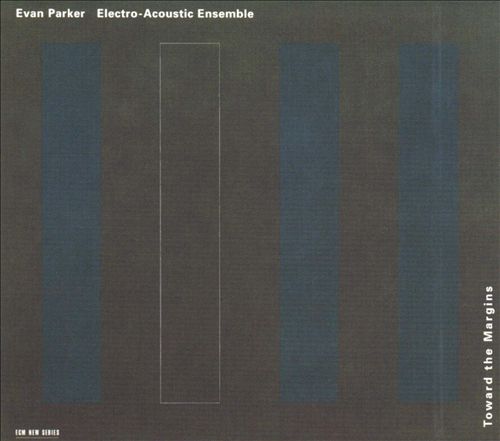
Evan Parker Electro-Acoustic Ensemble: Toward the Margins (ECM New Series 1612)

Evan Parker Electro-Acoustic Ensemble
Toward the Margins

Evan Parker soprano saxophone
Barry Guy double-bass
Paul Lytton percussion, live-electronics
Philipp Wachsmann violin, viola, live electronics, sound processing
Walter Prati live electronics, sound processing
Marco Vecchi live electronics, sound processing
Recorded May 1996, Gateway Studios, Surrey
Engineer: Steve Lowe
Produced by Steve Lake

What’s given:
If ECM had a musical attic, it would sound like Toward the Margins. Not to imply that the Evan Parker Electro-Acoustic Ensemble’s debut is filled with unwanted or forgotten things, but that it exists toward the margins of a human life, its shed skins stacked like boxes above our heads, waiting for a breath to blow the dust away. Parker has been with ECM almost since the beginning, having first appeared on The Music Improvisation Company and subsequently on Gavin Bryars’s After the Requiem, among others. An abiding interest in electronics as an improvisational medium led him to the present project, which draws from disparate disciplines bonded by an infatigable spirit of sound production.

What’s taken away:
Grating strings first clear out the rafters, shafting like light from behind a broken cloud. Parker’s soprano scratches gently at their back. Grumblings and sampled ether flutter and churn, tripping down sand-covered stairs like a creature covered with feet, so that it is always standing no matter how it lands. Compartmentalized echoes share their cubicles with shallow utterances of deeper assignments. Barry Guy’s double bass ties its strings into a tangle of self-awareness as Parker trembles within his own computer-augmented aftershocks. Like a flock of geese in overdrive, he burns in the upper atmosphere before he dares dream of land. Melody is but an afterthought to the sputtering multitudes, caught in the welcoming stare of an unwanted stranger. The overall sound is subdued yet robust. It inhabits the crawlspace of our dreams. The haunting final track lingers in our bones, long after the silence comes, animating a body whose only fear is cogency.

What’s left behind:
Parker is the rare musician who treats improvisation as composition—not so much an offering to the aleatoric gods as a vocabulary articulating its real-time derivations. His saxophonic work is high but far from mighty. He listens more than he plays, as the musicians faithfully tune themselves to a radio signal only they can hear. Washes of precipitation and other climatic changes stipple these aural landscapes, leaving Andy Goldsworthy-like rain shadows in their wake. Sometimes he rolls through rough detours, kicking up sparks and gravel; other times he hovers like an appraising insect, every note a kaleidoscopic cell unfolded into the whole of its vision. As the title makes unabashedly clear, this is an asymptotic experience with nowhere to hide but our ears, and there it burrows, hibernating until the next thaw.

<< Ralph Towner: ANA (ECM 1611)
>> The Hilliard Ensemble: A Hilliard Songbook (ECM 1614/15 NS
)

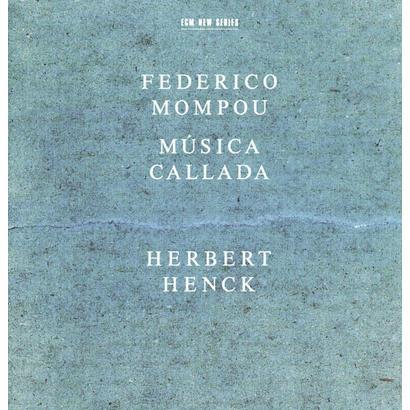
Federico Mompou: Música Callada (ECM New Series 1523)

Federico Mompou
Música Callada

Herbert Henck piano
Recorded August 1993, Festburgkirche Frankfurt am Main
Engineer: Andreas Neubronner
Produced by Manfred Eicher

The calm night
Announcing the advent of the dawn,
The silent music,
The sounding solitude,
The dinner that delights and enamors.
–Sister Juana Inés de la Cruz (1651-1695)

Federico Mompou (1893-1987) lived a long life filled with a quiet love for music. Although much has been said of his three decades spent in Paris, during which time he crossed paths with the likes of Debussy and Satie, it was in solitude that his crowning relic would be fashioned, already in a state of alluring dilapidation, and ultimately far from any of the geographic reference points that dotted his travels. Música Callada came into existence between 1959 and 1967, and represents one of the Catalan composer’s last major works. The untranslatability of its title (most renderings will have it as “Silent Music,” though certain nuances escape) is a key to its enigmatic construction, culled as it is from “Song between the Soul and the Beloved” of sixteenth-century Spanish Carmelite St. John of the Cross (1542-1591). This mystic poem was written as an imagined conversation between the Soul (Bride of Christ) and the Beloved (Christ the Spouse), describing in metaphor the human relationship with the transcendental word and its tangible effects. In the estimation of Nicky Losseff, “‘silent music’ can only be a conceptual audition, perceived not through the fleshy senses but directly through the soul’s inner ear, and as a concept it serves to demonstrate in a way that cannot be grasped at all—and yet cannot be grasped in any other way.” Yet we would be mistaken in thinking of this as a paradox, Losseff goes on to say, for what we hear in Mompou is anything but contradictory. Silent music exists all around us. Not only does it reside in images, dreams, and in our heads, but quite simply in the musical score itself, where notes await the touch of a bow, a fingertip, a human breath to animate them.

Of his Música Callada, Mompou wrote, “This music is silent because it is heard in one’s inner self. Restraint and discretion. The emotion remains hidden, and the sounds only take shape when they find echoes in the bareness of our solitude.” Over time, it has gelled into a slumbering touchstone of the pianistic landscape. The music bypasses all other organs and floods straight into the heart, its songs wavering like the surface of a large body of water describing its own unknowable depths. And while the effect is undeniably gorgeous, it is just as often ponderous, if not mournful. “Lento” is the operative time signature here, and threads the entire work with a tear-stained presence. That being said, no one mood dominates, for each is its own picture in a boundless physiological scrapbook. The crosshatched dissonances of No. 3 tickle the mind’s eye with a slow-motion frolic. The indeterminacy of everyday action animates No. 5, giving way to rustlings in moonlight. Such is the sadness also in No. 6, which drips like rain from the eaves of a house covered in hermetic vines. No. 9 is one of many inward glances, stunning in its honest impressionism. No. 13 haunts with its nervous expulsions of energy, while the final of the work’s four books closes its eyes in darkness.

Mompou’s atmospheres are honed to fine edges, made all the more so for their brevity and sense of direction. Brittle as they are, they manage to slice away our expectations layer by layer, until they rest on a bed of subcutaneous vulnerability. This is delicate music, to be sure, but it also thrives on sacrifice. Speaking practically, fans of his aforementioned French contemporaries will find much to love. Speaking spiritually, anyone might find something here to hold on to, tender and trembling in its infancy, but ever potent in melody and in stillness.

<< Charles Lloyd: The Call (ECM 1522)
>> Sidsel Endresen: Exile (ECM 1524)

Hommage à R.Sch. (ECM New Series 1508)

György Kurtág
Robert Schumann
Hommage à R.Sch.

Kim Kashkashian viola
Robert Levin piano
Eduard Brunner clarinet
Recorded August 1992, May and September 1994, Kammermusiksaal Beethovenhaus, Bonn
Engineer: Peter Laenger
Produced by Manfred Eicher

During his lifetime, the idiosyncrasies of Robert Schumann earned him little of the posthumous admiration that now abounds. A Romantic to the core, he found solace in the hollow spaces of his rich musical ideas, manifested to greatest effect in the potent miniatures he left behind. Perhaps no one has inherited this legacy in such a life-affirming way as György Kurtág. In this brilliantly realized album, which pairs both composers in a fortuitous program, we hear not only the bridge that arches between their worlds, but also the river that flows beneath it. Kurtág’s micro-compositional Neun Stücke für Viola solo are threaded by thinnest of intentions and a captivating dynamic contrast between nervousness and lyricism (though, to be sure, what qualifies as lyricism here exists always at the molecular level). The fragment takes on sensory completeness, compensated as it is by the symbiosis of performance and listening, so that even in absence of an audience, the performer remains the immediate receiver of the audible gesture. Jelek (Signs) op. 5 brims with the rich, heady double stops of Kim Kashkashian’s faultless phrasing, ensuring that hidden messages ring with all the robust fragility that surrounds them. Kurtág’s lines are by turns pliant and rigid, vaccinated with moribund attention. Distinctions between “interior” and “exterior” become irrelevant and fold into a shapeless entity with neither. The album is ordered in such a way as to centralize the viola, so that when the piano and clarinet emerge in Hommage à R.Sch. op. 15d, they seem to flank it from all sides. Through this transition, the music becomes more “visible.”

With the Märchenbilder (Fairy Tale Pictures) op. 113, we finally encounter Schumann in the flesh, though “stumble over” might be the more accurate term, as Kurtág’s ghostly echoes release us so effortlessly that we barely have time to breathe. These four vignettes for viola and piano melt into the ecstatic dramaturgy of the Fantasiestücke op. 73, in which the clarinet has its say before merging with the viola in the uniquely scored Märchenerzählungen (Fairy Tales) op. 132. These are profoundly embodied works that render any descriptive words mute to the touch, leaving me with little to offer for all their wonders.

Steady performances from all three musicians—but especially from Kashkashian, whose strings unravel like a mummy in the dusky light of an interstellar awakening—make for an engaging experience from front to back. Therein lies a pyramidal cycle, with the composers at its base, and a thread of life at its apex, pulled ever taut by an unseen alien hand.

<< Wadada Leo Smith: Kulture Jazz (ECM 1507)
>> Egberto Gismonti Group: Música de Sobrevivência (ECM 1509)

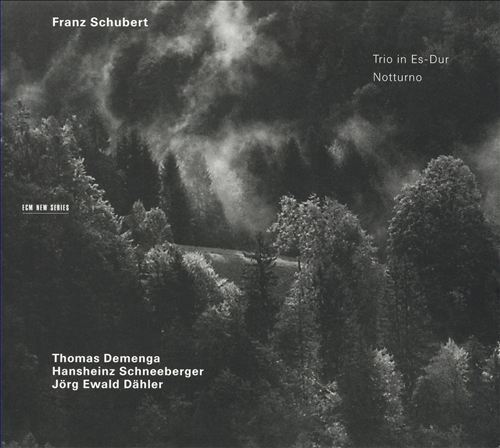
Schubert: Trio in Es-Dur/Notturno (ECM New Series 1595)

Franz Schubert
Trio in Es-Dur/Notturno

Jörg Ewald Dähler fortepiano
Hansheinz Schneeberger violin
Thomas Demenga cello
Recorded July 1995

ECM has nobly benefited the classical music industry by continuing to draw bold lines back to the works of Franz Schubert with consistently thoughtful performances and pairings. Although he never wrote for piano trio until his final year of life, Schubert seems to have put his all into the two masterworks that are the op. 99 and op. 100. For this major release, the latter has been paired with the often-neglected “Notturno,” published two decades after his death.

Harriett Smith calls the Trio in Es-Dur für Klavier, Violine und Violoncello op. 100, D 929 a “bridge between the trios of Beethoven and Brahms,” and was the longest ever composed (it equals, if not surpasses, the average symphony in scope) until Morton Feldman’s Trio of 1980. Penned in 1827, four years into the advancement of his syphilis, Schubert’s second piano trio came about when a close friend, Josef von Spaun, requested the piece for his wedding. Schubert would die in a matter of months after its premier, which reached his ears once before they heard no more.

The musicians superbly evoke the careful tension Schubert has worked into every phrase of the first movement. In its cosmos, one hears the voices of the stars, throttling the engine of space-time in dreamy suspension. A tinge of classicism adorns the Swedish folk song-enriched interior of the second movement, its delicate modality reflected in the pizzicato from both strings. An Austrian country-dance provides the basis for the Scherzo that follows, leading us into a massive Allegro moderato, which inventively brings back the theme of the second movement. Despite the daunting length of this and the first movement, our sense of progression never wavers. Schubert’s magical touches make exuberant experiences out of these longer narratives.

If, in the full trio, we get four worlds as one universe, in the Trio in Es-Dur für Klavier, Violine, Violoncello op. posth. 148, D 897 we get a glimpse into a newborn nebula. This single movement, dubbed “Notturno” (Nocturne) by publisher and composer Anton Diabelli, is believed to have been a rejected Adagio for the first piano trio in B flat major. As fragile as it is taut, it continues to thrive, a gorgeous offspring wrought in filigree and grace.

Jörg Ewald Dähler’s historically informed fortepiano, combined with the profoundly contemporary approaches of resident label cellist Thomas Demenga and the legendary Hansheinz Schneeberger on violin, infuses every moment of these performances with equal parts innovation and ritual. One need only listen behind closed eyes to see the images they recreate.

<< Peter Erskine Trio: As It Is (ECM 1594)
>> Misha Alperin: North Story (ECM 1596)

Helmut Lachenmann: Das Mädchen mit den Schwefelhölzern (ECM New Series 1858/59)

The Little Match Girl

Helmut Lachenmann
Das Mädchen mit den Schwefelhölzern

Eiko Morikawa Sopran
Nicole Tibbels Sopran
Helmut Lachenmann Sprecher (“Zwei Gefühle”)
Mayumi Miyata shō
Yukiko Sugawara Klavier
Tomoko Hemmi Klavier
Experimentalstudio der Heinrich-Strobel-Stiftung des SWR Elektronische Realisation
André Richard Klangregie
SWR Vokalensemble Stuttgart
SWR Sinfonieorchester Baden-Baden und Freiburg
Matthias Hermann Musikalische Einstudierung
Sylvain Cambreling Leitung
Recorded July 2003 in Freiburg, Germany

Angst is the necessary form of the curse laid in the universal coldness upon those who suffer of it.
–Theodor W. Adorno, Negative Dialectics

Helmut Lachenmann’s Das Mädchen mit den Schwefelhölzern (The Little Match Girl) is a beguiling, albeit loosely contextualized, redaction of Hans Christian Anderson’s fairytale of the same name. The girl in question pedals matches on New Year’s Eve before seeking shelter from the cold. She lights one match after another to keep from freezing, fearing her father’s wrath for not having sold any. With every conflagration, she is visited by visions of warmth, sustenance, and love—the last things she ever sees before the climate takes her life. Lachenmann augments this frigid morality tale with other textual sources: Leonardo da Vinci’s The Desire for Knowledge, in which the artist stands before a volcanic chasm, and the writings of Gudrun Ensslin, Red Army Faction reactionary, and acquaintance of Lachenmann’s, who marked her life with fiery eruptions of her own. Each of these figures, marginally marked by forces beyond their control, cowers in its respective hovel, succumbing to the darkest edges of already shadowed words.

What we have in the present recording is the opera’s “Tokyo version,” which, according to the composer, is definitive. Lachenmann’s self-styled “music with images” is beyond meticulous. Its first part is overwhelming and impenetrable, lost in gusts of scrapings, percussive half-statements, and voices doomed to inhabit the borders of incoherence. A dust storm of pops, whistles, skips, whispers, yawns, sighs, shouts, grunts, flutters, clucks and clicks, open-mouthed slaps, and general aphasia shares a lung with an extra-sensory instrumental constituent. Unrealized dreams are its blood, unformed words and broken promises its skin. Speech curls into itself, like a radio dial constantly tuned from one station to the next, an effect only heightened by the presence of electronics. Every sound disguises indecisiveness as ardent exploration, even while achieving that very thing, inhabiting the mouths and heads of its characters, such that human voices and instrumental utterances become so closely allied that often one is hard-pressed to distinguish between the two (and, in fact, feels no need to do so). The drama comes to a head in “Die Jagd” (The Hunt), leading at last to fully articulated speech in “Auf Allen Fenstern” (On Every Window), before a monumental closure. The second part wavers like a flame caressed by frosty winds, hiccups, and choked sentiments. “In Einem Winkel” (At An Angle) provides some startlingly beautiful moments, of a piece with the alchemical precision of Stockhausen and Ligeti at their most meditative. “Zwei Gefühle” (Two Sentiments) gives us the longest stretch of speech, culminating in a prickly crescendo. The opera finishes with a long drone laced with sine waves and counted in time by the rapping of death at our door. Its barely articulated fade is an epilogue to end all epilogues.

One might feel compelled to criticize Das Mädchen as a nervous wreck unsuitable for any self-respecting listener, but the consistency with which it cracks itself open, like a suicidal egg, is so visceral that any negative reactions fall with it to their doom. It transcends the utterance at every turn, dissecting “taboo” into its meaningless phonemes. Like a workout after years of inactivity, it exercises muscles we never even knew we had. Having never seen the opera live, and with only the booklet’s cryptic black-and-whites to go on, I cannot speak with any surety for its potential production value. Suffice it to say that I will be in the front row should the opportunity ever present itself.

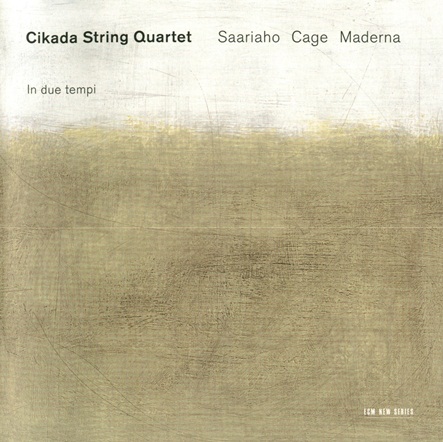
Cikada String Quartet: In due tempi (ECM New Series 1799)

Cikada String Quartet
In due tempi

The Cikada String Quartet
Henrik Hannisdal violin
Odd Hannisdal violin
Marek Konstantynowicz viola
Morten Hannisdal violoncello
Recorded August 2001 at Sofienberg Church, Oslo

“My music is as I am.”
–Kaija Saariaho

On April 10 of this year, I had the pleasure of meeting Kaija Saariaho after a lecture given at Mount Holyoke College. Her talk covered a range of topics, including her reclaiming of “compositrice” as a self-referential term; the conceptual tendrils that had coalesced into her third opera, Émilie; and the ever-present role of electronics in her music. She also waxed nostalgic about her many influences. Of these, her deep admiration for Witold Lutosławski stands paramount. The Polish composer once told her, “I am the first audience. I need to step back and see if I would accept the music as a listener.” These sentiments have since charged her music with a chameleonic energy, an energy that stems directly from Saariaho’s beloved dreams. Nymphéa (1987), for string quartet and live electronics, is like a breath of spectral wind in the trees. It is a fitting introduction of her work to the ECM catalogue, and one can only hope the conversation will continue. Where Saariaho stands out among contemporary composers is her ability to maintain a dense auditory palette without ever lapsing into distinctly melodic territory. The note becomes movement, a smile, an ankle in the shadows of the trees, a glimpse of a flowing dress upon the water. Together, they become a handful of medicinal tears, cast like seeds onto a lake’s fertile surface. Each gesture of the quartet is magnified in a fiery reverb, as the musicians are bid to whisper verses by Arseny Tarkovsky (father of director Andrei). Shades of Crumb’s Black Angels and André Boucourechliev’s Archipel II comingle in a magical incantation. And, like a whisper, the resulting sounds lay just beyond our reach. At points it flirts with cacophony, a composition in fast forward. A violin cracks its adolescent voice, cradled by echoes of former ghosts, and inaugurates a lilting series of responses, ending at the edge of our conscious field of vision.

After such a mind-altering experience, John Cage’s String Quartet in Four Parts (1949/50) wafts like a fragrance, familiar but forgotten. Its four seasonal movements consist of glassy block chords (what Cage called “gamuts”) in lateral formation, each casting a distinct shadow across the whole. Strings are played with minimal bow pressure, flowing with rapt neutrality until the last movement sheds its spring clothing. This makes for a fitting segue into Bruno Maderna’s more serial Quartetto per archi in due tempi (1955). Though one might not know it from this quartet (it is dedicated to Luciano Berio), Maderna much admired Cage and took it upon himself to pen one of the first analytical studies of his music. Here, slow and careful development leads to an increasingly fractured and nervous tale, rupturing into a more forcefully plucked affair before settling back into its quieter beginnings.

In due tempi is an album of transitory spaces, worth the price of admission for Nymphéa alone, after which the others seem to pale in comparison, yet which still provide more than enough intrigue for the open-eared listener. And while my bias obviously leans toward Saariaho, the album is, on the whole, a fascinating one. The Cikada Quartet, who made their label debut on Arild Andersen’s stellar Hyperborean, enact a clear, honed sound that works wonders with the chosen material. An overlooked New Series album, this deserves our full attention.

<< Morton Feldman: The Viola in My Life (ECM 1798 NS)
>> Keith Jarrett Trio: Always Let Me Go (
ECM 1800/01)

Barraqué: Sonate pour piano (ECM New Series 1621)

Jean Barraqué
Sonate pour piano

Herbert Henck piano
Recorded July 1996, Festburgkirsche, Frankfurt
Engineer: Andreas Neubronner
Produced by Manfred Eicher

The legacy of French composer Jean Barraqué (1928-1973) has at last been given its due berth. Pianist Herbert Henck, never one to bow out from a challenge, went through considerable efforts to annotate a viable score (a task that amounted to no less than 125 handwritten pages) from which he could extract this notoriously elusive piece. As this fine disc clearly attests, these efforts have paid off tremendously. The reputation of Barraqué’s Sonate pour Piano would seem to precede any listener’s (or performer’s) familiarity with its sounds. Composed between 1950 and 1952, it plots the multivalent trajectories of the composer’s foundational Serialism into deeper and more formidable territories. Despite the redactions to which it is often confined—namely, Pierre Boulez’s Second Piano Sonata and Beethoven’s “Hammerklavier”—any kinship therein is immediately overcast by the roiling clouds of the work’s uniquely idiosyncratic climate. Thus is his allegiance to twelve-tone rows selectively severed in favor of an approach that is at once enigmatically liminal and highly integrative, as much about erasure as it is about inscription.

The nearly 50-minute work, in two movements, finds its voice in a Pleiadean cluster, as if one were poking a pin into the balloon of the universe and notating everything that came spilling out. Through this porous barrage of galaxies, binary stars, and black holes, the music can only go where gravity bids it to go. Pianistic lows grumble with the weight of time’s inevitable progression, while highs sparkle like meteorites hitting an invisible atmosphere. What seems at first a perplexing experiment slowly fractures into its own auditory urtext. The sonata’s structure is ever unstable, discomforting, and discontented. In it, we see ourselves stripped of age and ideological concern, dropped headlong into a phantom of aberration. We encounter an increasing number of silences, which only coalesce with time into the piece’s final vacuity.

This is, presumably, not music that you will ever find humming to yourself. Rather, its melodies burrow deep into the subconscious, if not spring from it directly, lodging themselves where no other sound dares follow. Henck negotiates the technical minutiae of this piece with his usual erratic grace. He draws out individual notes with crisp punctuation, such that each emerges as a magnetic node to which the drive of surrounding tones becomes attracted. Every gesture seems to blow harder onto embers that would much rather fade, coaxing as much glow as can be had before ashes are all that is left.

<< Shostakovich/Vasks/Schnittke: Dolorosa (ECM 1620 NS)
>> Cain/Alessi/Epstein: Circa (ECM 1622
)

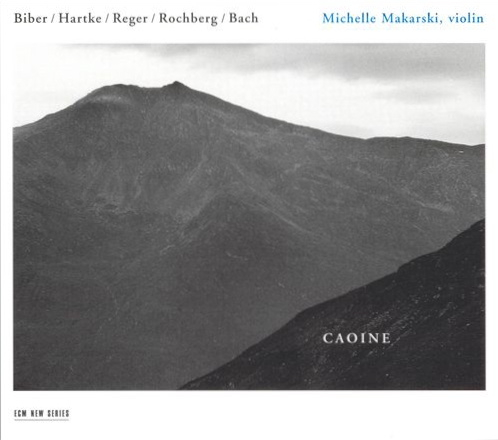
Michelle Makarski: Caoine (ECM New Series 1587)

Michelle Makarski
Caoine

Michelle Makarski violin
Recorded June 1995, Propstei St. Gerold
Engineer: Stephan Schellmann
Produced by Manfred Eicher

With such varied artists as Paul Giger, John Holloway, and Thomas Zehetmair vying for the violin enthusiast’s attention, ECM has revitalized the solo program perhaps more than any other label. Yet nowhere has it found such a colorful proponent of new and established repertoire alike as American musician Michelle Makarski. For Caoine, her first solitary ECM effort (she had previously appeared as soloist in Keith Jarrett’s Bridge of Light), Makarski has assembled a unique collection of music to be discovered. The program opens with the formidable “Passacaglia” of Heinrich Ignaz Franz Biber, a composition whose methods and melodies are one in the same. What seems on the surface purely etudinal breeds its own robust musicality without ever flaunting itself as such. Its ostinato of G, F, E-flat, D is repeated 65 times, each successive variation requiring deeper attention on the part of the performer. Being one of the earliest extant paragons of solo violin literature, it is perhaps the ideal meta-statement with which to begin such an album. Although the piece employs the full gamut of techniques available to the virtuoso at the time of its composition (ca. 1670), the result is solemn and rich in cosmological potency. The visceral title track is by Stephen Hartke, one of America’s most distinctive composers who has seen minimal but vital representation on ECM. The title itself (pronounced “keen,” from which the English word of the same spelling is derived) is a Celtic word referring to, in the composer’s words, the “wail or dirge sung by professional mourners in old Ireland.” Hartke’s almost folkloristic approach nestles comfortably in its surroundings. It seems to round itself into an emotive orifice, projecting its cries through funereal motions with all the tenacity of a genuine inner grief. After this catharsis, Max Reger’s “Chaconne” (1910) returns our attention to the Baroque. While blatantly indebted in Bach, Reger follows his own bold trajectory in this rather demanding piece. Makarski negotiates its many turns with just the right balance of force and finesse, not to mention an expert control of harmonics. Selections from George Rochberg’s 50 Caprice Variations (1970) pave the way to a tender performance of Bach’s first Partita (1720). The Variations speak in their own idiosyncratic vocabularies, never afraid to admonish and alleviate in the same breath. Nos. 41 and 42 stand out for me, the former for its Prokofiev-like syncopation and the latter for its high metallic sheen. These deconstructions of Paganini’s Caprice No. 24 speak directly to Rochberg’s essayistic fixations. As intertextual as they are self-negating, they comprise an homage individually wrapped in bite-sized morsels. As for the Bach, Makarski has felicitously chosen my favorite among the composer’s Sonatas and Partitas. Her performance of the captivating Allemande comes through with refined grace and rhythmic economy through to the sparingly realized finale.

What links these pieces is an appreciation of the originary motif as an aesthetic not necessarily of size, but more accurately of scale, mining the paradox of its highly expansive potential through the process of recapitulation. This is encapsulated most beautifully in the final track, in which Bach unpacks, not unlike Biber, a staggering amount of information from a mere handful of ordered gestures. Makarski’s profound recital is built as much around the variation of theme as around the theme of variation, pulling its red thread gracefully through four centuries of musical history in the span of a single CD.

Alternate cover

<< Egberto Gismonti: Meeting Point (ECM 1586)
>> Louis Sclavis Sextet: Les Violences de Rameau (ECM 1588)

Heiner Goebbels: Ou bien le débarquement désastreux (ECM 1552)

Heiner Goebbels
Ou bien le débarquement désastreux

André Wilms voice
Sira Djebate vocals
Boubakar Djebate kora, vocals
Yves Robert trombone
Alexandre Meyer electric guitar, table-guitar, daxophone
Xavier Garcia keyboards, sampling and programming
Heiner Goebbels sampling and programming
Moussa Sissoko djembe
Recorded June 1994 at Studios De La Grande Armee, Paris

If we have entered into familiarity with these particular offices of nature, if they have acquired the chance to be born in the world, it isn’t merely so that we may offer anthropomorphically an account of this sensual pleasure, it is so that there may result from it a more serious co-naissance (being born together/knowing). Let’s go deeper then.
–Francis Ponge, Le Carnet du Bois de Pins (The Notebook of the Pine Wood)

Ou bien le débarquement désastreux (Or the hapless landing) is another intriguing entry in ECM’s growing Heiner Goebbels lexicon. As a piece intended for the stage, one gets only half the experience, if even that, on disc, though minimal scoring ensures that the text (all of it in French) remains absolute. In this regard, Ou bien… requires only one actor (André Wilms) in the narrative role, and represents a direction that Goebbels has now taken further with his recent Stifters Dinge, which has need of neither actors nor musicians, per se, and relies instead on mechanically controlled “performers,” with Goebbels as their brain.

The present composition is based on texts by Joseph Conrad (from his Congo Diary), playwright and frequent Goebbels collaborator Heiner Müller, and essayist/poet Francis Ponge (from the work epigraphed above). All of these texts intersect at the site of the forest, which emerges as the primary visual field in this postcolonial space. Goebbels ruthlessly combines Senegalese and “Western” musical strands. The former emerges as refined and anything but primitive, while the latter by turns titillates and grates on the ears with its aggressive tendencies. The vivid kora of Griot Boubakar Djebate is the album’s alpha and omega and cuts out, in negative image, a porous backdrop for otherwise opaque texts. The ensemble is completed by instruments both familiar (trombone, electric guitar, djembe, keyboard, and sampler) and not (such as the daxophone, an amplified piece of wood brought to life when a bow is drawn across it). Instrumental interludes are rendered with the rougher textures of guitar and croaking brass. Conversely, the kora cuts through with the smoothness of a scalpel, even if closer inspection reveals a handle with decades of violence burnished into its grooves. Conrad’s diaristic structure contributes to the underlying unease, so that Djebate’s glorious rendition of “Il eut du mal” lifts us only partially from its surface like a scab. The range of emotional registers is pure Goebbels. From the drone of “Dangoma” to the upbeat pastiche of “Haches, Couteaux, Tentacules” and the banal charm of “Le Soir,” this album carries us through a journey as didactic as it is self-destructive, so that by its end we are in a grove of shattered intentions and piecemeal recollections.

In reference to this piece, Rodney Milnes observes: “As in all melodrama there is a conflict between word and note: it is more difficult for the human brain to absorb the two when the words are not simply set to music.” This is precisely what one finds enacted through the colonial process, the mindset behind which seems to bleed through Ou bien…, regardless of whether one understands its texts or not. Such is Goebbels’s gift for evocation. Still, a lack of French knowledge or translations at hand, not to mention of a stage upon which to view the comportment of the work as a whole, gives us an album that is but one reflective facet of a larger crystalline whole. Ultimately, I don’t believe Goebbels so reductive as to reenact oppression through the encroachment of his own musical ideas upon the lineages he exploits therein. Rather, he is interested in the ways in which lingering traces of such oppression may be refashioned into a new mode of speech, one both painfully aware of its roots while also hopeful for an amalgamated future.

<< Stephan Micus: Athos (ECM 1551)
>> Surman/Krog/Rypdal/Storaas: Nordic Quartet (ECM 1553)