Tigran Mansurian: Ars Poetica (ECM New Series 1895)


Tigran Mansurian
Ars Poetica

Armenian Chamber Choir
Robert Mlkeyan conductor
Recorded June 6, 2003, Saghmosavank monastery, Armenia
Engineer: Garen Proyan
Produced by ECM

Ars Poetica is a choral “concerto” based on the poetry of Armenian writer Yegishe Charents (1897-1937). The language is rustic, bumpy, and delectable. The works of Charents, who suffered at the hands of the Stalinist regime and would die in a Yerevan prison for his politically “subversive” writings, were liberated with Stalin’s death in 1953. Likewise, his words seem to wrestle out of their national confines and onto the world stage through Tigran Mansurian’s faithful settings.

“Night” begins with breath; words are only implied, shaped by lips and lungs like rustling leaves. As the choir swells, a deeply affecting baritone solo intones: “But all was pale and dull around me, / No words were there, and there was no sun…” In this first of the Three Night Songs, we are ushered into a place where stillness is aflame. The Three Portraits of Women that follow turn our attention from the ethereal to the corporeal. Mansurian dresses these poems with darkness left over from the waning night. Lines such as “What Spirit was it that brushed / Your countenance in radiant strokes?” feel torn with pain, as if accepting the beauty of one’s love might lead to self-destruction in surrender. Archetypes of angels and maidens wander labyrinthine depths of their own making, impervious to the talons of words seeking purchase on their shoulders. Three Autumn Songs give us our first taste of sunlight trickling through the breaking clouds. Even so, melancholy is never far away, holding us in a lukewarm embrace as voices kneel before the awesome power of all that withers. And Silence Descends brings indefinite closure with a long untitled verse. Intermittent climaxes fall like sudden showers as a single soprano voice cuts through the din with a painful resignation. Language takes on yet another guise in the form of death, creeping along the streets and through back alleys, threatening to erase the text that is one’s existence from its sallow pages.

Mansurian’s compositional style is linguistically informed; not only because he is working with poetry that is already so very musical, but also because the Armenian language is such a vital part of Mansurian’s worldview and expressive deployment. Ars Poetica is a naked and vital work. It screams as its cries, whispering secrets and intimate thoughts as it careens through the cosmos with the quiet restraint of a meteor. Ultimately, it transcends language, bringing with it the promise of internal meanings through which orthography is wrung of its juices and fed to us drop by drop.

The Hilliard Ensemble: Perotin (ECM New Series 1385)

Perotin

David James countertenor
John Potter tenor
Rogers Covey-Crump tenor
Mark Padmore tenor
Charles Daniels tenor
Gordon Jones baritone
Paul Hillier baritone, director
Recorded September 1988, Boxgrove Priory, Sussex, England
Engineer: Peter Laenger
Produced by Manfred Eicher

There is a moment in the opening Viderunt omnes when, to signal the final section, its voices modulate to a higher space. This shift from gravid baritone- to tenor-driven majesty is for me one of the most sublime moments in all of music. Such transformative moments are what make many of the Hilliard Ensemble’s endeavors so enduring. In medieval music in particular, the enigmatic Hilliards have found a groove of sorts from which they seem reluctant to part. As Paul Hillier notes, these sounds represent a major development in the polyphonous “organum” typical of the ars antiqua style, breaking from the staid (though certainly no less “organic”) Gregorian mode. This fine disc metes out a hefty dose of the works of Magister Perotinus (fl. c. 1200), along with some worthy anonymous pieces to thicken the brew. Listening to this music, I cannot help but try to imagine the time and place of its conception. I can almost taste the air, feel the cold stone of gothic architecture on my fingertips and the swept floor beneath my sandaled feet. The voices glitter like facets of the same dusty light that once pierced arched windows and landed softly on solid pews.

This is music we approach impressionistically, seeing it first as a worldly sound before distinguishing local colors. The interpretations are restrained yet full of overwhelming power. The Alleluia posui adiutorium is a stunning example of Perotin’s craft. On the surface transcendent, the piece is also laden with paratextual significance. The pedal tones here are airy yet substantial and the brief lapses into chant are like translucent beads on a deftly interwoven chain. Dum sigillum, sung here by tenors John Potter and Rogers Covey-Crump, sounds like four voices compressed into two. They flit and fall, taking one step back for every two taken forward. The Alleluia nativitas is, like its companion piece, a finely wrought macramé. David James’s glorious voice has its day in Beata viscera, a Communion prayer (and Perotin’s only extant monophonic work) rising like censer smoke in a solitary alcove. Sederunt principes closes the disc on a fittingly supplicatory note.

On April 23, 2004 I had the fortunate experience of seeing the Hilliard Ensemble live at Wesleyan University, where they opened with the Viderunt in an otherwise eclectic program. The experience was very much like putting on this disc: the audience had almost no time to prepare for the sudden immersion that ensued the moment they took the stage. This is precisely what the home listener can expect. As always the Hilliards offer an impeccable performance that speaks of a deep and heartfelt commitment to every project they undertake, and it is this same commitment that I feel obligated to bring to the table every time I sit down to partake of this finest of recordings.

<< Stephan Micus: The Music Of Stones (ECM 1384)
>> Paul Giger: Chartres (ECM 1386 NS)

Heinz Holliger: Schneewittchen (ECM New Series 1715/16)

Heinz Holliger
Schneewittchen

Juliane Banse soprano
Cornelia Kallisch contralto
Steve Davislim tenor
Oliver Widmer baritone
Werner Gröschel bass
Orchester der Oper Zürich
Heinz Holliger conductor
Recorded January 1999, Radio Studio DRS, Zürich
Engineer: Charles Suter
Produced by Manfred Eicher

As a self-proclaimed “musician whose medium begins where words end,” Heinz Holliger may seem an unlikely candidate to attempt a full-length opera. Yet looking at his source text, the idiosyncratic and delightfully schizoid Schneewittchen (Snow White) by Swiss writer Robert Walser (1878-1956), one senses a kindred spirit in the latter’s semantic approach. In light of this, Holliger’s adaptation is perhaps best described as a “subtextual” opera. As such, it begins in harmonic suspension before dropping into a confused milieu of verbal emotions. For Holliger, the job of the music here is to mask the characters on stage, thereby providing them with extension cords to fasten to their utterances.

The Prologue opens with an evocative and programmatic arrangement of wind gusts and tinkling icicles giving way to an eerie congregation of glassy voices and drones. Reminiscent of quieter moments in his equally ambitious Scardanelli-Zyklus, Holliger’s sound palette immediately draws us into an evocatively unstable environment. This plaintive mood is quickly undermined, however, by the appearance of words. “Child, are you ill?” the Queen asks, as if the tremulous unease of the preceding sounds were the inner turmoil in Snow White’s powdery gut. Thus begins a brief exchange between mother and daughter on the nature of disease and sin. A Huntsman, lackey to the Queen, appears. He is an easy target for Snow White’s pessimism: surely, the Queen has enchanted him, she wonders. Although the seduction is questionable, he admits to taking part in her assassination. In his compassion, however, he has killed a deer in lieu of her undamaged body, sucking its blood with reckless abandon. Fed up with this foolish talk, the Queen proclaims her maternal love, even as the Prince indulges Snow White’s fantasies of deception. He escorts Snow White to the castle that she might have the mental room to work through her grief.

The Prince’s proclamations to Show White in Scene II seem to echo the opera’s own methodology: “How merry is your word alone. Enraptured by its wealth, my ear hangs in a hammock, as it were, of hearkening, dreams of violins, of lispings, nightingales’ sweet sobs, love twitterings.” What follows is a profound, if tongue-in-cheek, parry-and-thrust discussion of sensuality and silence. The music ruptures as the Prince perversely describes the Queen’s sinful coupling with the Huntsman, made all the more ominous by keening voices in the background. Snow White proclaims, “Oh, I want nothing more, you see, than to be dead and smiling,” and sends the Prince on his way for lack of resolve.

Scene III finds Snow White and the Queen in a metatextual argument: the Queen touts her wicked past as laid out in fairy tales, while Snow White seeks to problematize her mother’s ill deeds for the sake of empowerment. In Scene IV the Prince returns, only to profess his love for the Queen over her daughter. The Huntsman joins in the fray, whereupon he is ordered by the Queen to reenact Snow White’s death. Before long the scene devolves into laughter, exposing the farce within. The opera’s resolution reflects the dangers of relying upon narrative to dictate the flow of one’s life. The ambiguity of Snow White’s past remains paramount, even if recast in the familiar mold of resolution, cracked as it is at the edges, like the metallic sheet of strings that brings the opera to a close.

Whereas Holliger is normally used to composing from the inside out, in writing this opera he felt required to do the opposite: that is, to open himself to spirited ideas flickering beyond the immediacy of his own embodied self. Schneewittchen represents a rare fusion of what Roman Brotbeck calls “mono-perspectival” and “poly-perspectival” opera. By this he means to say that both Holliger and Walser shine through the weave of the opera as a whole, while at the same time the authors’ voices and collective presence are destroyed, torn into self-sufficient shreds of identity untraceable to their hosts. Holliger’s aural façades serve to heighten this sense of disguise. The Walser text is mediated through, to borrow again from Brotbeck, “negative translations”: the opera is vocally driven while also dependent on the hints of implosion wrought into its language. The instrumentation reacts to these voices in kind. It bobs and sinks across a floe-laden ocean, multiplying like cell cultures in time-lapse film. Needless to say, the musicianship is as meticulous as the opera it brings to life and matched by weighty yet effervescent singing.

Unlike some operas, I find it difficult to listen to Schneewittchen without the libretto in front of me. It is so closely bound to its text that the two feel one and the same. Holliger has produced a rare achievement. Not unlike Walser in his postcriptorial treatment of a canonic tale, he has laid his source to rest in order to air it from the rafters of his own distinctive vocabulary.

<< Thomas Zehetmair/Camerata Bern: Verklärte Nacht (ECM 1714 NS)
>> Anour Brahem Trio: Astrakan Café (
ECM 1718)

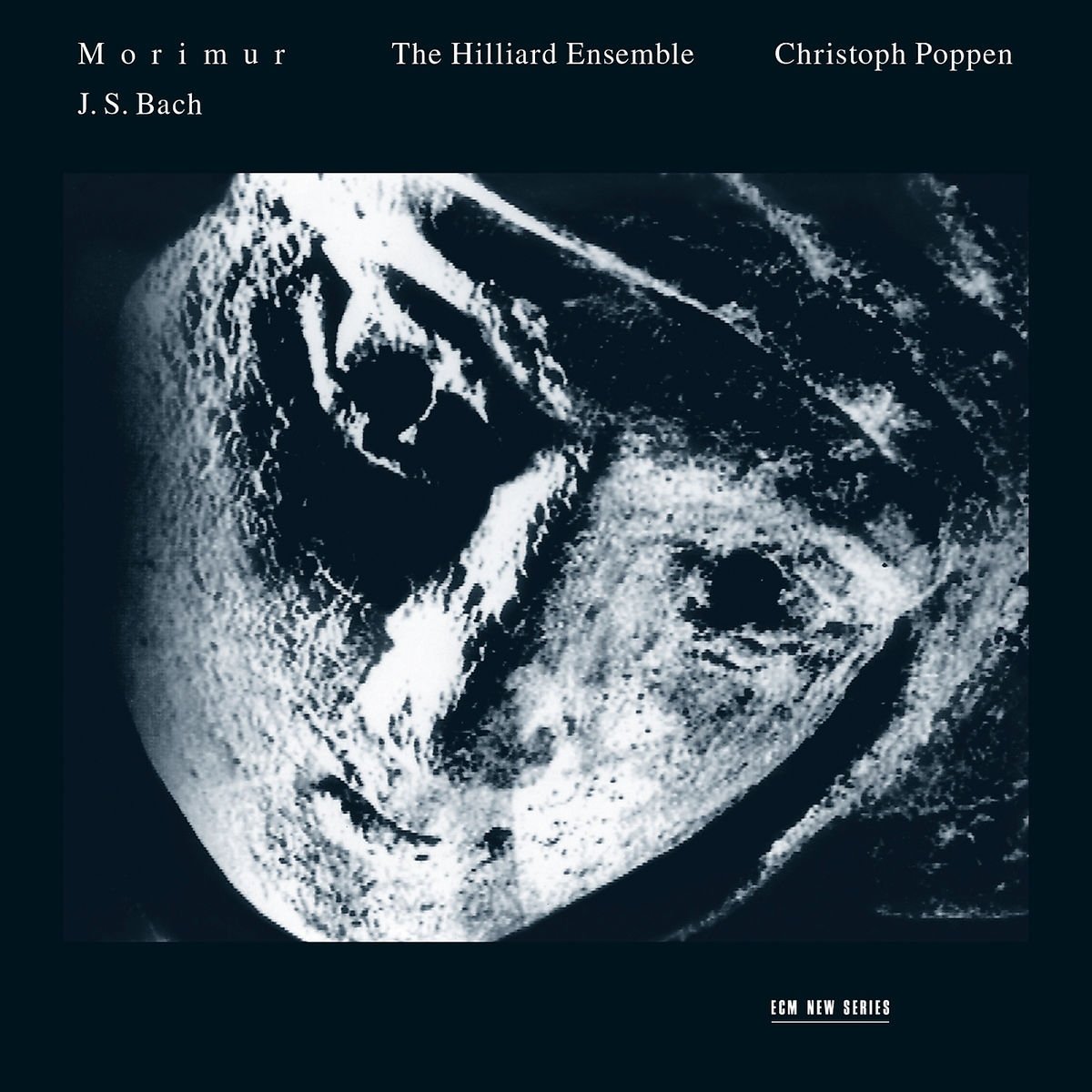
Christoph Poppen: Morimur (ECM New Series 1765)

Version 1.0.0

Morimur

Christoph Poppen baroque violin
The Hilliard Ensemble
Monika Mauch soprano
David James countertenor
John Potter tenor
Gordon Jones baritone
Recorded September 2000, Monastery of St. Gerold, Austria
Engineer: Peter Laenger
Produced by Manfred Eicher

Drawing on the research of musicologist Helga Thoene of the University of Düsseldorf, Christoph Poppen and the Hilliard Ensemble take great care in juxtaposing the monumental “Ciaccona” from J. S. Bach’s Partita in D Minor BMV 1004 alongside (and against) various Bach chorales, through which cryptic synchronicities are brought audibly to light. These “chorale quotations”—believed by Thoene to comprise a “tombeau” (i.e., epitaph) for Bach’s deceased wife Maria Barbara in the larger context of Christ’s death and resurrection—are transformed here into an entirely new experience that traces the intangible borders between life and death. And indeed, the title of the album, Morimur, connotes “death as a passage to life” and reflects the numerology therein as an equation for transubstantiation. Chorale passages are interspersed between movements of the refracted Partita, thus allowing us insight not only into the hidden connections of violin and voice (insofar as the Ciaccona is concerned), but also into the nearly tangible sinews that hold together the Partita as a whole. Poppen’s violining digs ever deeper into its source, as if overwriting the original manuscript with heavier ink.

This is a very challenging album to encapsulate in one review, for it is a listening experience like no other. With each new turn it offers hitherto unexplored avenues of creation. As a mere listener, it may be easy for me to dismiss the intense scholarship that has gone into this recording and simply enjoy it for the contemplative music it contains. After all, much of what lies hidden between the Ciaccona and its companion chorales is perhaps more obvious to the trained eye on paper than it is to the casual, if not enraptured, ear on disc. At the same time, I cannot help but think that the connections drawn out through its attendant scholarship are vastly important for the sole reason that this program would not exist in its present form without them. That being said, I feel that Bach’s ciphers stimulate the heart without the need for a direct correlation in numbers. In other words, we don’t necessarily require those connections to be spelled out for us as a guidebook to what remains fundamentally communicative.

Music never ceases to amaze and entice with its potential for infinite variation. The intersections drawn in Morimur are omnipresent and need not always be so contrived. Bach’s music, especially as it is rendered here, reminds us that sometimes those transparent bridges between our intellect and the environments around us are also the most fleeting and unexpected. Contrary to what we might expect from a project so described, this is not about solving some age-old code left for only the most astute of posterities. It is, rather, about uncovering those mysteries that never go away and make us who we are: mysteries of faith, of love and absolution, of desire, and of death. Therefore, I see this album not so much as a reflection of Bach’s often-touted genius, but of his humility.

<< Seim/Brække/Johansen: The Source and Different Cikadas (ECM 1764)
>> Susanne Abbuehl: April (
ECM 1766)

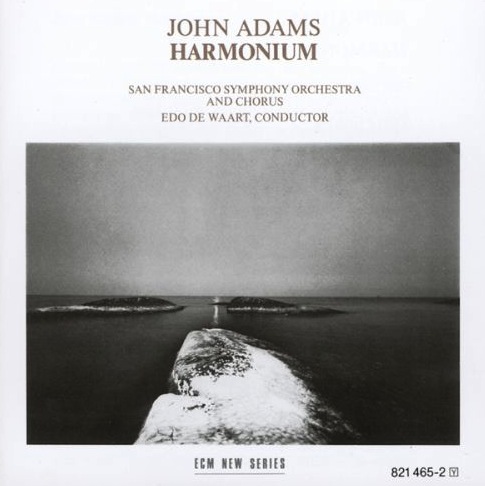
John Adams: Harmonium (ECM New Series 1277)

John Adams
Harmonium

San Francisco Symphony Orchestra and Chorus
Edo de Waart conductor
Vance George chorus director
Recorded January 1984, Davies Symphony Hall, San Francisco
Engineer: John Newton
An ECM Production

Music emerges from a dark tunnel, a smooth and liquid train with a large chorus as passengers. The accelerated evolution of Harmonium is brought forth in what Adams calls a “preverbal creation scene,” an inescapable feeling of solitary light tinted with the weight of retrospection as the voices intercede. Harmonium seems to revel in self-awareness, building as it does through a series of dynamic swings from the threshold of audibility to ringing pronouncements of verse. It is a convoluted world where density and transparency coexist in equal measure.

At times this piece sounds like Adams’s popular Shaker Loops with words, at others like a Philip Glass tribute with characteristic pulses of flute and strings, at still others like a ritual of its own kind. It is a pastiche of poetry (John Donne and Emily Dickinson provide the texts), a bridge of intentions, a house with only two windows.

The recording quality here may polarize listeners somewhat. While on the one hand it captures the overall mood of the piece in a rather heterogeneous mix, on the other it loses detail in the quieter moments. I would imagine, however, that engineering choices in this case were dictated by Adams’s vision for the piece as a whole. It is meant to be a single “fabric of sound,” thereby necessitating a more distanced recording. It is like a lake: deceptively uniform from a distance, but promising new life and environments if only we can plunge into its depths. Yet somehow we are unable to take that plunge. The recording engineer, like the listener, is an observer here rather than an intruder. We do not approach this music; it approaches us, and it can only come so far before receding into its womb.

<< Keith Jarrett: Trio Changes (ECM 1276)
>> Pat Metheny Group: First Circle (ECM 1278)

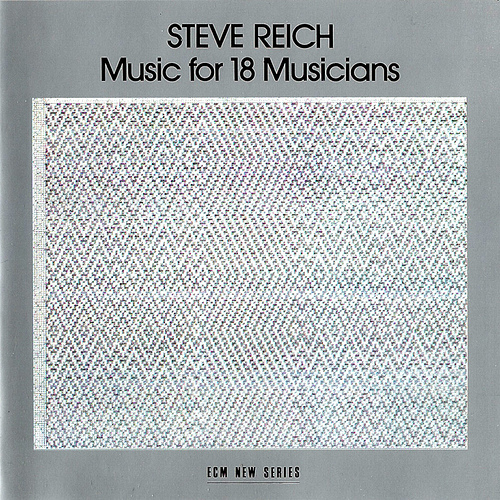
Steve Reich: Music for 18 Musicians (ECM New Series 1129)


Steve Reich
Music for 18 Musicians

Shem Guibbory violin
Ken Ishii cello
Elizabeth Arnold voice
Rebecca Armstrong voice
Pamela Fraley voice
Nurit Tilles piano
Steve Chambers piano
Larry Karush piano, maracas
Gary Schall marimba, maracas
Bob Becker marimba, xylophone
Russ Hartenberger marimba, xylophone
Glen Velez marimba, xylophone
James Preiss metallophone, piano
Steve Reich piano, marimba
David Van Tieghem marimba, xylophone, piano
Virgil Blackwell clarinet, bass clarinet
Richard Cohen clarinet, bass clarinet
Jay Clayton voice, piano
Recorded April 1976 at Town Hall, New York [?]
Engineer: Klaus Hiemann
Produced by Rudolph Werner

Music for 18 Musicians makes no efforts to obscure the methods behind its construction. As such, it reveals a wealth of mysteries never notated on the printed page. The piece is scored for violin, cello, 2 clarinets doubling bass clarinet, 4 women’s voices, 4 pianos, 3 marimbas, 2 xylophones and metallophone (vibraphone with no motor). With his characteristic attention to detail, Reich utilizes these instruments not necessarily for their evocativeness, but for the unique and varied ways in which their timbres can be blended in a nearly hour-long wash of sound. Calling this “minimalism” would be unfair both to Reich and to the musicians among whom he makes this demanding journey. There is a sense of movement here that is both linear and multidirectional. I say this not for the sake of verbosity, but because Reich’s notecraft commits to its own agenda while latching on to so many others along the way.

The piece begins with a seamless blend of piano and mallet instruments threading its full length like a living metronome. Joining this is a chorus of breaths from human voices and winds. The interweaving of these substantial strands reinforces the compositional density, like marrow and nerves cohering into a spinal c(h)ord of decidedly aural design. At the risk of belaboring this analogy, I venture to see this piece as one active body in which each instrument writes the genetic code of its musical biology. This dynamic is further heightened by the presence of vocal utterances. Although these function as egalitarian extensions of manufactured instruments, they lend fragility to the underlying spirit of the music at hand. These voices rise and fall, slowly replaced by clarinets as if one and the same.

Sudden changes in rhythm serve to reconfigure our attention to the intervention of the composer’s hand: just as we are being lulled into a sense of perpetuity, akin to a natural cycle studied from afar, we are reminded that what we are listening to has been contrived at the whim of a single human mind. Far from undermining the piece, this awareness invites us to share in its re-creation through the very act of listening. Like much of Reich’s music, Music for 18 Musicians is nothing if not accommodating. Rather than patronize or proselytize, it lays itself bare. This brackets Music for 18 Musicians off from much of the histrionic art music in vogue at the time of its creation (1974-76). One could argue that it is scientific in its approach to structure. I prefer to see it as simply honest.

The recording quality of this album is ideally suited to its subject matter. There is a sense of “clusteredness” throughout, so that the performers never stray too far from the nexus of their unity, while also providing just enough breathing room (the performers’ lung capacities determine the length of sonic pulses throughout) for individual elements to shine. Most of the mixing, as it were, is done live through the sheer skill of Reich’s assembly of dedicated musicians, and requires meticulous attentiveness on the part of the recording engineer to highlight that complex interplay without overpowering the core. A beautiful and compelling landmark achievement.

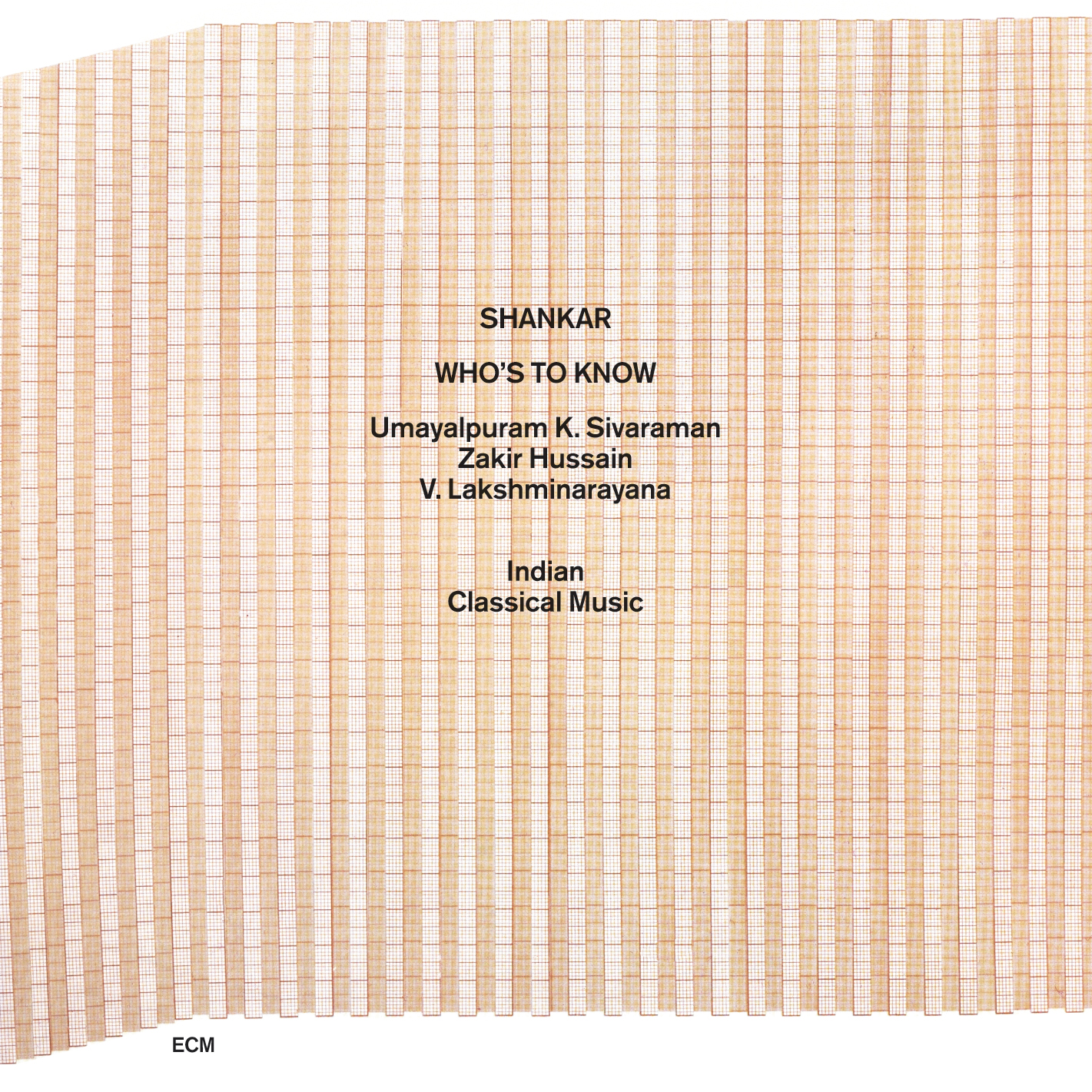
Shankar: Who’s To Know (ECM 1195)

ECM 1195

Shankar
Who’s To Know

Shankar 10-string double violin, tamboura
Umayalpuram K. Sivaraman mridangam
Zakir Hussain tabla
V. Lakshminarayana conductor (tala keeping)
Recorded November 1980 at Tonstudio Bauer, Ludwigsburg
Engineer: Martin Wieland
Produced by Shankar and Manfred Eicher

Tamilian violinist Lakshminarayana Shankar offers listeners a beautiful and powerful experience in this, his first outing for ECM. Shankar plays a 10-stringed instrument of his own design, and his personal hand in its construction is as deeply evident as his playing of it. Over a steady drone of tamboura and attuned rhythmic support from Zakir Hussain and Umayalpuram K. Sivaraman, Shankar’s flights of improvisation are free to soar. His melodies are driven by deep recognition of intent, visceral and immediate.

We are treated here to two long-form pieces, averaging 23 minutes each. Though distinct in form and mood, they are unified by an overarching sense of commitment and, I daresay, surrender. The first, Ragam-Tanam-Pallavi, introduces its theme with fluid precision. Shankar’s fingers seem never to rest on any single note for long, carried as they are by the as-yet-unspoken rhythms lurking just beyond the horizon. And so, when those rhythms do at last come to be articulated, the listener is salved by the comfort of a promise fulfilled. Ananda Nadamadum Tillai Sankara, on the other hand, carries itself forward with a touch of vulnerability, offering itself to the fate of its own musical environment. This is a more somber companion piece that slips into more adventurous registers and changes of key, and with a determination all its own. Eventually the violin turns in on itself, leaving our percussionists to play us out in an intimate call and response, culminating in the violin’s lilting swan song before the tamboura fades into silence.

Those familiar with Carnatic music will find much to admire in Shankar’s signature style and inexhaustible virtuosity. This is arguably his least “fusionesque” album to date, drawing its borders with reliable pigments that clearly serve its musicians well. Brimming with inspired playing, effortless execution, and a singular melodic sensibility, this is an impassioned and vivid record from start to finish and will ever remain an ECM jewel.

<< Goodhew/Jensen/Knapp: First Avenue (ECM 1194)
>> Thomas Demenga/Heinz Reber: Cellorganics (ECM 1196 NS)

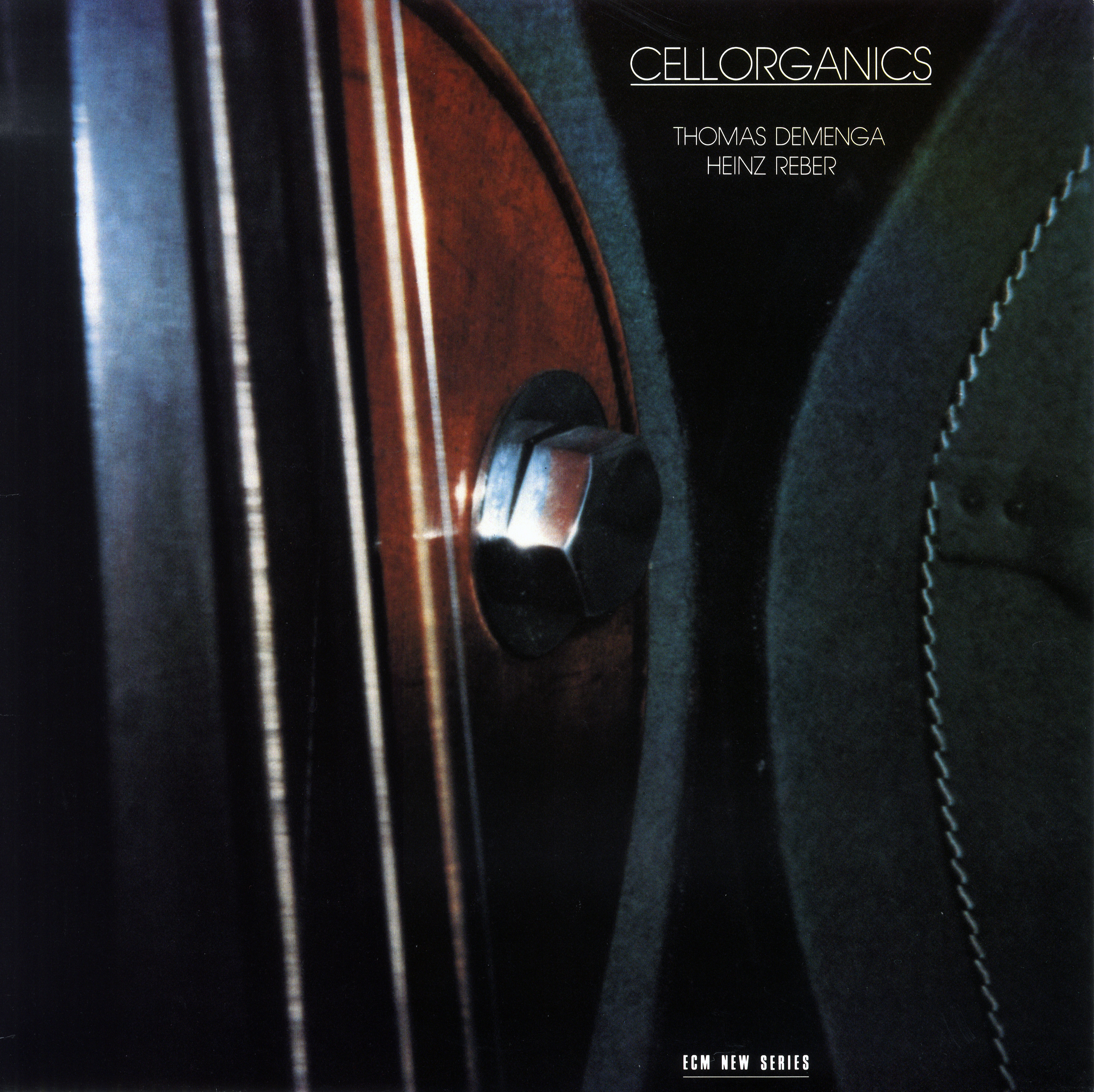
Thomas Demenga/Heinz Reber: Cellorganics (ECM New Series 1196)

ECM 1196 LP

Cellorganics

Thomas Demenga cello
Heinz Reber pipe organ
Recorded October 1980 at Pauluskirche Bern, Switzerland
Engineer: Martin Wieland
Produced by Manfred Eicher

Cellorganics is exemplary of what I see to be ECM’s primary aesthetic: the dialectic possibilities of seemingly disparate instrumental voices, cultures, and sociopolitical contexts. The pairing of cello with organ is but a step away from the former’s canonic place beside the piano. And yet this juxtaposition opens us to entirely new areas of sonic creation, dramatically enhanced by the lofty recording space.

The album arises as if from slumber with the lone cello, whereupon it is gently accosted by the organ. Thus begins a delicate conversation that before long erupts into a frenzied catharsis. At this point Reber repositions himself, providing a dense and layered backdrop for Demenga’s no less contemplative phrasing. This stichomythic structure continues, interspersed with stunning moments of confluence—occasionally dipping into reverberant depths of scraping and sustained chords—before the cello works through its own degradation into a sort of intertextual improvisation.

The album’s center finds the two musicians in an exuberant melancholy; one suffused with both rhythmic buoyancy and introspective caution. The organ’s pointillism becomes a comforting counterpoint to the cello’s harmonic glissandi, giving way to an expansive exposition and coda.

Ultimately, this album is about power relationships and their reconfigurations. The organ’s long-held position as a vessel for moral weight, as imposing as it is transcendent, is challenged here in its pairing with a “lowly” string. This is not a cello that yearns to be heard, but one that sings out of its own self-sufficiency. The pizzicato passages that open the final chapter in this narrative are like footsteps, neither approaching nor receding, dancing in place to the tune of their own inner voices. The organ, too, becomes a living organism, literally breathing life through a forest of esophagi.

This recording invites us not only to listen, but also to speak.

<< Shankar: Who’s To Know (ECM 1195)
>> Meredith Monk: Dolmen Music (ECM 1197 NS)