Jack DeJohnette: Works

DeJohnette

Jack DeJohnette
Works
Release date: April 1, 1985

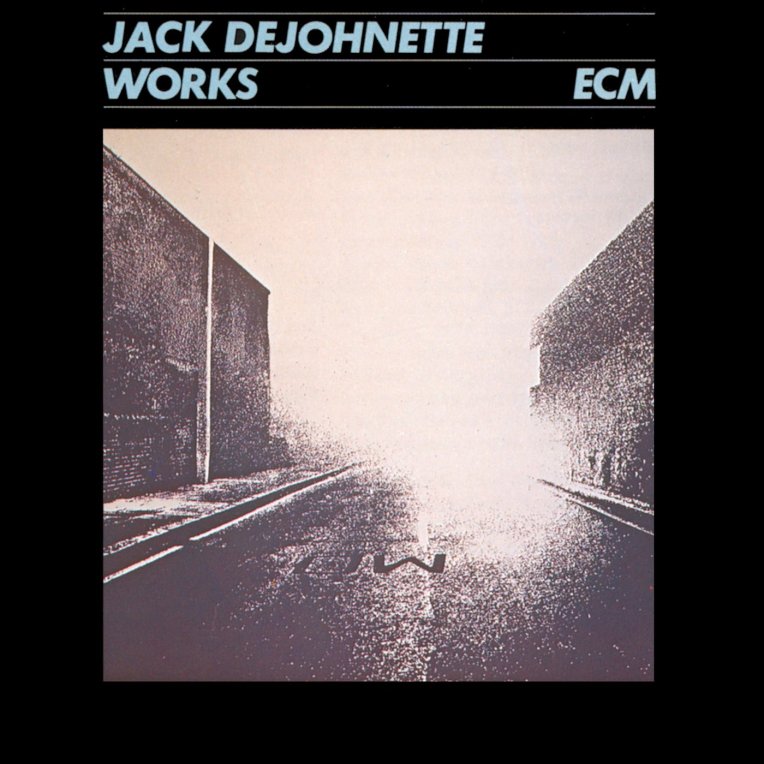
Jack DeJohnette has, of course, been long known as the go-to drummer on practically every Keith Jarrett trio album ever to be released on ECM. But he has also led a phenomenal double life as a composer and bandleader, and his strengths in those capacities—along with his mastery of the kit—are highlighted in this compilation. For intensity of atmosphere, you can’t go wrong with “Bayou Fever.” The opening tune off 1978’s New Directions places him in the esteemed company of trumpeter Lester Bowie, guitarist John Abercrombie, and bassist Eddie Gomez. Against Abercrombie’s surreal backdrop, Bowie’s trumpeting is delirious yet lucid while the band pulls its blues from another dimension. Building tension without release, they sustain their balance over an expanse of marshland, amphibious dreams, and childhood memories. Two cuts from the output of DeJohnette’s Special Edition outfit reveal deeper layers of his craftwork. “One For Eric,” from the band’s 1980 self-titled debut, situates Arthur Blythe (alto saxophone), David Murray (bass clarinet), and Peter Warren (bass) in a classic eruption of creative magma and shows DeJohnette at his most cathartic. As does “The Gri Gri Man” (Tin Can Alley, 1981) at his most atmospheric. Featuring the man of the hour on congas, drums, organ, and timpani, it illustrates distant and arid terrain even as it carries a storm’s worth of rain in the heart.

“To Be Continued,” from the 1981 album of the same name, reshuffles the deck and deals a new hand with guitarist Terje Rypdal and bassist Miroslav Vitous. As one of the most inspired combinations to spring from the mind of producer Manfred Eicher, it couldn’t not be represented here. Rypdal’s blue solar flares, in tandem with Vitous’s joyous extroversions, provide the very substance through which DeJohnette draws his continuous thread. A likeminded masterstroke is the Gateway trio with Abercrombie and bassist Dave Holland. Where the guitarist’s original “Unshielded Desire” (Gateway, 1975) is a duet with DeJohnette that finds the musicians speaking two dialects of the same fervent language, “Blue” (Gateway 2, 1978) swaps drums for piano in a lyrical love letter to time itself.

Taken together, these selections offer a glimpse into a career that continues to evolve yet compresses it into an idol worthy of self-regard. Candid, rooted, and authentic are the names of the game.
Chick Corea: Works

Corea

Chick Corea
Works
Release date: April 1, 1985

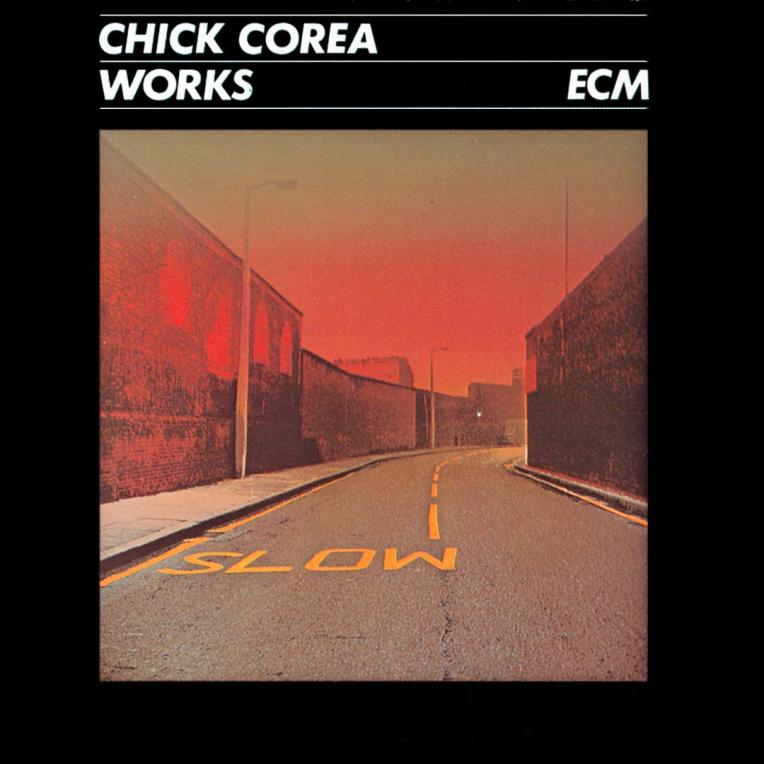
In contrast to the pianism of Keith Jarrett, which always seems to be moving, Chick Corea’s (at least during this particular period, on this particular label) is marked a sensation of profound stasis, especially in his solo work. In “Where Are You Now?” (Piano Improvisations, Vol. 1, 1971), from which we hear the first of eight “Pictures,” a slow-motion twirl ensues, while “Noon Song” from the same album undermines its own brightness with a forlorn heart, as if we were the only ones privileged to hear it, dissociated form the time and location in which it was recorded. “A New Place (Scenery)” (Piano Improvisations, Vol. 2, 1972) even more deeply highlights our own separation from the creative act, which we can only regard from afar. The otherwise solo program of 1984’s Children’s Songs yields the buoyant “Addendum” with cellist Fred Sherry and violinist Ida Kavafian, which epitomizes Corea’s penchant for sudden changes, dissonant surprises, and cuttings against the grain—all designed to hold us in place. The latter album is further referenced in the cyclical “Childrens Song” from 1973’s Crystal Silence with vibraphonist Gary Burton. The duo shares more spotlight with string quartet in the cinematically inflected “Brasilia” (Lyric Suite for Sextet, 1983).

For other ensemble configurations, we look first to “Slippery When Wet” (Trio Music, 1982). Alongside bassist Miroslav Vitous (with whom she shares a “Duet Improvisation” as well) and drummer Roy Haynes, Corea unleashes an aphoristic style of rhythming, treating bursts of energy as their own compositions in miniature over the fantastic interplay of his sidemen. From trio to quintet, Corea offers us the joys of “La Fiesta” (Return To Forever, 1972) with Joe Farrell (soprano saxophone), Stanley Clarke (bass), Airto Moreira (drums and percussion), and Flora Purim (percussion). This montuno jewel fronts Farrell’s lithe soprano and Corea’s electric piano, bubbling like hope to the surface of every life that crosses its path.

Keith Jarrett: Works

Jarrett

Keith Jarrett
Works
Release date: April 1, 1985

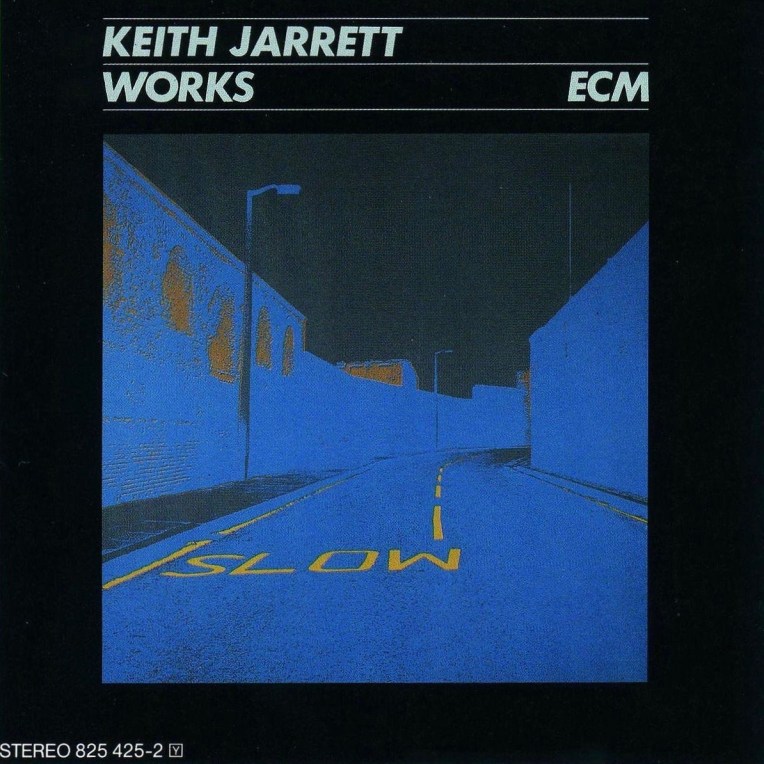
If the artists represented by ECM’s “Works” series so far have been princes, then Keith Jarrett would be candidate for their king. The pianist (and multi-instrumentalist besides), composer, and interpreter continues to chart the most prolific path through the label’s history in solo, trio, and quartet settings, as well as through the lenses of multiple genres. For this compilation, we encounter all of those strands, save for his trio outings, which would warrant a collection in and of itself.

Two tunes from his second European Quartet album, 1978’s My Song, touch our collective soul with a highly individualistic tone. “Country” reinscribes the unrepeatable nature of the band. From the ways in which piano and Jan Garbarek’s tenor saxophone lay down the theme while the rhythm section of bassist Palle Danielsson and drummer Jon Christensen emotes with equal assurance in horizontal (not vertical) relation to the exuberant restraint of Jarrett’s grounding throughout, it’s a tune that feels as much like a farewell as a hello. We then find ourselves walking “The Journey Home.” As Garbarek leads with melodic fortitude, he sets up a welcoming groove of light. Christensen is especially three-dimensional, while Jarrett defers to Garbarek’s charms and really only dominates in the final slowdown.

From that rich soundscape to the wonders of unaccompanied hideaways, we turn to “Ritooria,” from Jarrett’s 1972 ECM debut, Facing You. Like a candle burning in the dark for all who have ears to sense its dancing flame, it holds on to its wick in the left hand while the right flickers erratically yet connectedly. Another lone effort, Staircase, yields Part II of that 1977’s album’s title triptych. If you haven’t already revisited it, let this track remind you of it as one of Jarrett’s finest studio achievements alone at the piano. Like two transparencies of the same image overlapped yet slightly askew, it develops through not-quite-parallel voices, ending in almost ritualistic space. The only live solo selection is “Nagoya Part IIb (Encore)” from 1989’s Sun Bear Concerts. Treading the keyboard as if it were water, Jarrett holds every note in place before finding rest in gentle chords.

Between these relatively direct expressions of personal energy, Jarrett the composer is represented by the 2nd movement of his String Quartet, as performed by the Fritz Sonnleitner Quartet on 1974’s In The Light. Despite being a lovely work in its own right, it feels straightjacketed in its present company. (I might have chosen the beautiful Metamorphosis for flute and strings from that same program instead.) Somewhere in between those two poles of classicalist and improviser is Jarrett’s often-overlooked 1981 masterpiece Invocations/The Moth and the Flame, from which “Invocations (Recognition)” is excerpted. A semi-waltzing rhythm via pipe organ sets up an echoing soprano saxophone, warped and yet flowing in the right direction at any given moment. All of which serves to remind us that we are indeed nothing but moths in the presence of Jarrett’s alluring combustion, struggling to recreate our shape in the air long enough to be regarded as (to reference a much later title) a multitude of angels struggling to record what can never be notated, except on the ephemeral paper of the flesh.

Pat Metheny: Works

Metheny

Pat Metheny
Works
Release date: April 1, 1984

On the crowded cruise ship of unmatched talents that is ECM, Pat Metheny deserves a first-class suite. The prodigious guitarist cut teeth with Gary Burton, making his first label appearance on Dreams So Real, and recording that same month (December of 1975) what would become the splash heard around the musical world that was Bright Size Life. This compilation, however, jumps over that leader debut into his last two watershed moments of the 1970s. The first of these is “Sueño Con México” (New Chautauqua, 1979). Its combination of acoustic guitars and electric bass is about as close to the original cover photograph’s open road as one can imagine. Without a care (or a car) in sight, Metheny plays his way through patchwork fields, each with its own character and color, and which by their counterpoint suggest a collective song. The second, “(Cross The) Heartland,” represents the Pat Metheny Group’s sophomore album, 1979’s American Garage. This dream team of Lyle Mays (keyboards), Mark Egan (bass), and Dan Gottlieb (drums) renders every change of scenery with utmost clarity. Metheny plays with squint-eyed brilliance, riding an underlying current that never lets up until the end. Thus, the title feels less descriptive than prescriptive: a bidding to step outside everyday bounds and see some history for yourself.

Our ride takes us through later PMG intersections, including the title track of 1983’s Travels and “James” from 1982’s Offramp. Both find bassist Steve Rodby replacing Egan for an especially distant sound. From moonlight to sunlight, this overnight diptych spotlights Mays’s ability to spin progressive ropes from traditional filaments. On “It’s For You” (As Falls Wichita, So Falls Wichita Falls, 1981), he and Metheny join percussionist Nana Vasconcelos, who also lets his singing voice carry forth: a melodic backbone built to withstand any flexing of key change and forward motion. Rounding out this “Works” entry are two selections from 1980’s 80/81. Alongside Mike Brecker on tenor saxophone, Charlie Haden on bass, Jack DeJohnette on drums, the parenthetical wonder of “Every Day (I Thank You)” opens Metheny’s 12-string like a loom to narrative weaving. By contrast, “Goin’ Ahead” is a congregation of multitracked Methenys that distills the essence of his formative years. Brilliant, evocative, and timeless.

Metheny captures all of this and more as a camera takes in light, turning moments into lasting memories to be treasured time and time again.

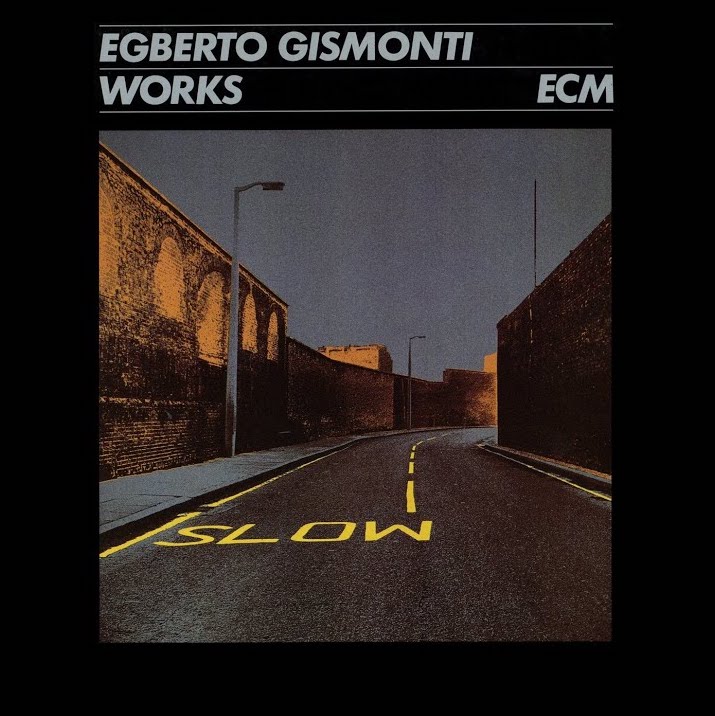
Egberto Gismonti: Works

Gismonti

Egberto Gismonti
Works
Release date: April 1, 1984

Egberto Gismonti is a force so enormous that ECM grandfathered his own label, CARMO, under its wing to archive much of his older material, as well as that of the younger musicians interpreting it still today. But to these ears his finest recordings have always intersected with ECM proper, and the late 1970s/early 1980s defined a golden age in this regard. Producer Manfred Eicher had a way of bringing out an inner peace in Gismonti’s frantic guitar playing and likewise enhancing something rough and ready in his sweeping pianism. It was therefore inevitable that such a sizable body of work would be faithfully abridged in his own “Works” compilation.

“Lôro” is one of two tunes from 1981’s Sanfona to find their worthy place in the mix. Impeccably recorded and performed, this jewel is one of Gismonti’s most precious on record and features the talents of his Academia De Danças band. Exemplifying the sound of both its era and its composer, its instrumentation, engineering, and execution glow in ECM’s resonant chamber aesthetic. “Maracatu” is another pianistic vehicle for Gismonti, whose rolling waves crash onto shore in the last rays of a setting sun. From here we jump back three years to Sol Do Meio Dia, a session shared with Nana Vasconcelos on percussion and Collin Walcott on tabla. Gismonti’s custom 8-string guitar is resolutely beat-driven throughout “Raga,” in which he experiments with harmonics and dissonances until only purest fusion remains.

“Magico” pays tribute to the 1980 album of the same name. This peerless trio with bassist Charlie Haden and saxophonist Jan Garbarek was the living definition of lockstep. As the latter two musicians embrace the space with hands of extremes, Gismonti solos over himself in a brilliant division into multiple voices. But nowhere does his ability clarify itself so resolutely than on his 1979 Solo, from which two tracks are excised. “Ciranda Nordestina” is a look inward through lenses of piano and bells, and is another stunning construction. “Salvador” returns to his 8-string guitar for a piece of remembrance. It is the musical realization that physical locations change just like those who inhabit them and can never go back to the way they used to be. We might flip (or click) through their histories, but the only way to know what things once were is to unbury them with things yet to be.

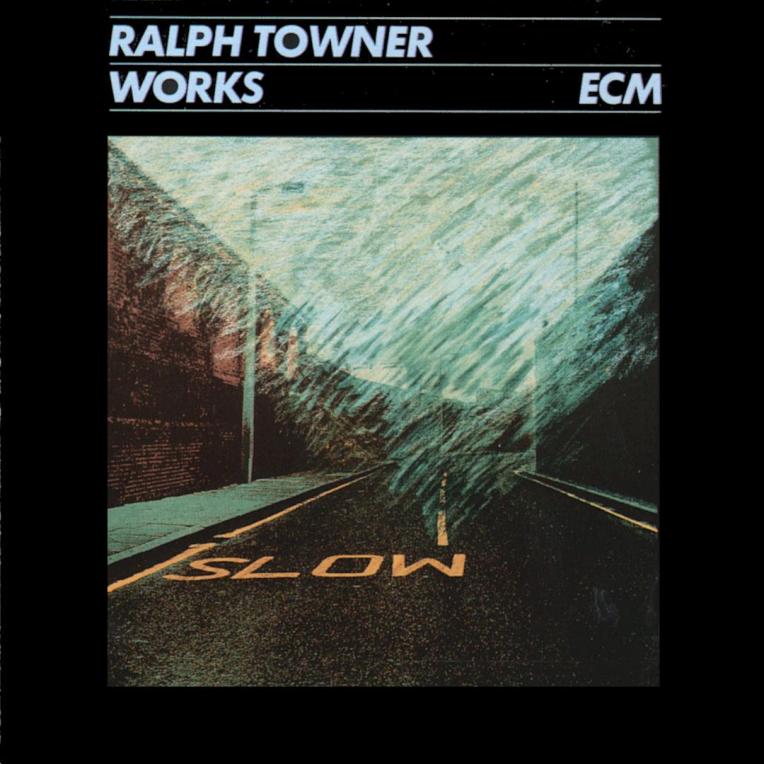
Ralph Towner: Works

Towner

Ralph Towner
Works
Release date: April 1, 1984

Guitarist Ralph Towner, like saxophonist Jan Garbarek (with whom he often collaborated during this formative phase), is one of ECM’s perennial talents and set a precedent for the label unlike any other on Solstice. Over the decades, the 1975 classic has acquired even more integrity than it exhibited when first released. “Oceanus” opens both it and this sensitively curated compilation, combining forces with Eberhard Weber, Jon Christensen, and Garbarek himself. It is perhaps the only logical first step with which to begin any foray into Towner’s universe. Weber’s cello, in combination with his plucked bass backbone, is an enchantment in and of itself, and elevates Towner’s resonating strings to nearly the same level as Garbarek’s tenor. Christensen’s sunlit cymbals complete the image. “Nimbus” finds Towner adding his piano to the mix. A patient intro unleashes the band’s total effect, Weber treading exuberantly across Christensen’s passionate soil.

The second album to be referenced is 1983’s Blue Sun, a solo effort from which two selections are presented. The title track features Towner on piano, Prophet 5 synthesizer, and percussion, alongside his trusted 12-string, for a nostalgic Polaroid that develops before our very ears. This is music that moves us, because it is movement in and of itself. “The Prince And The Sage” recalibrates the array to Prophet 5 and classical guitar only. Tracing a parabola over cities, villages, and waterways, it blends tastefully and in a way that would be unrepeatable with today’s ingredients.

Last we have two tracks from 1979’s Old Friends, New Friends. “New Moon” features Kenny Wheeler (trumpet and flugelhorn), David Darling (cello), Eddie Gomez (bass), and Michael DiPasqua (drums and percussion). If anything, it’s a memorable vehicle for Wheeler, who soars over landless expanse. “Beneath The Evening Sky” makes another reduction, this time to Towner’s 12-string and Darling’s cello. The latter unfolds a string quartet’s worth of backing in this deeply psychological character study.

And while there is some gold unmined in this collection, especially with regard to my all-time favorite Towner album, Solo Concert, there’s enough here to both satiate the hungry ear and inspire exploration for more.

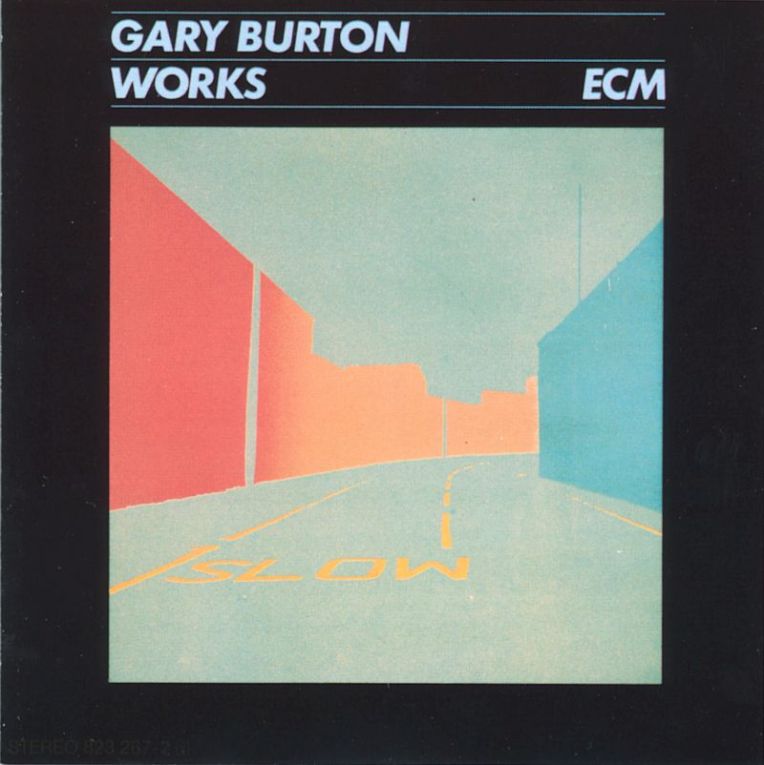
Gary Burton: Works

Burton

Gary Burton
Works
Release date: April 1, 1984

Vibraphonist Gary Burton, one of the defining voices of ECM’s formative years, is worthily honored in this second “Works” series installment. His contributions as virtuoso and interpreter of the instrument are unparalleled, and on ECM both aspects of his career found ample space in which to flourish. This particular era of the 1970s, which followed his RCA blitz, showed him also to be a musician of great patience, as on The New Quartet. The 1973 classic dropped him into a studio with guitarist Mick Goodrick, bassist Abraham Laboriel, and drummer Harry Blazer for a set as gorgeously played as it was conceived. From it we are treated to Keith Jarrett’s “Coral,” of which every spindly leaf is accounted for, and Carla Bley’s “Olhos De Gato,” which waters a groove that is laid back but never subdued. Those chamber sensibilities give way to more luscious details in “Vox Humana,” another Bley tune that references 1976’s quintet outing, Dreams So Real.

While Burton was quick to expound at length on any given theme, he also gave his bandmates room to breathe. This was especially true of 1974’s Ring, for which the quintet was augmented by bassist Eberhard Weber. From that album we are afforded “Tunnel Of Love.” Burton’s pitch-bending adds a degree of physicality to this nostalgic slice of life by Michael Gibbs. The third of 1974’s Seven Songs For Quartet And Chamber Orchestra is another master class in delayed gratification and defers to the bassing of Steve Swallow.

The remainder of this compilation features the deeper integrations of Burton’s duo projects. His highest achievement in this regard, 1973’s Crystal Silence, pairs him with pianist Chick Corea. The track chosen to represent it, “Desert Air,” is a springboard for some of the most virtuosic finishing of sentences one is likely to encounter in such a collaboration. Another duo project with Ralph Towner, 1975’s Matchbook, yields the title track, in which percussive impulses from the guitarist clear the road for an unimpeded ride over flatlands. And on “Chelsea Bells” and “Domino Biscuit” (Hotel Hello, 1975), both by Swallow, the composer joins Burton on piano with touches both anthemic and gospel-esque. All of which leaves us with an abridged version of an oeuvre steeped in timeless energy. A gift that keeps on giving, decades later.

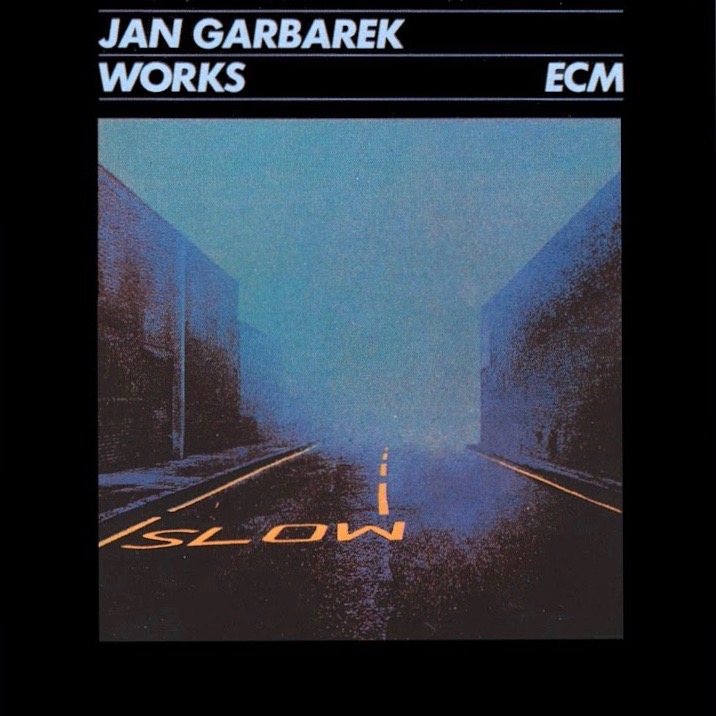
Jan Garbarek: Works

Garbarek

Jan Garbarek
Works
Release date: April 1, 1984

The “Works” series of ECM compilations began in 1984 to celebrate the label’s 15th anniversary, as it prepared to open a new chapter with its classically focused New Series imprint later that same year. It makes sense that Norwegian saxophonist and composer Jan Garbarek should be the subject of this first installment, as he defined not only the sound of ECM throughout the 1970s but also of a jazz scene that was relatively unknown outside its own borders until producer Manfred Eicher committed himself to the vision of broadening its wingspan.

Garbarek has taken on many roles throughout ECM’s now 50-year history, and even at this early stage had defined some key faces of his creative persona. In “Folk Song,” from 1981’s Folk Songs with guitarist Egberto Gismonti and bassist Charlie Haden, we find ourselves in the company of Garbarek the griot. With a telepathy as powerful as that of remembrance, the trio’s music transports us into ourselves. If Haden and Gismonti are shadow and light, respectively, then Garbarek is the one who wanders the valley between them, drawing a horizon wherever the sky will hold pigment. This is the spirit of Garbarek’s playing at all times: an itinerant yet grounded soul who understands the way of things to be carved in experience.

We also encounter Garbarek the sailor. In “Passing” (Places, 1978), he shares a vessel with John Taylor on organ, Bill Connors on guitar, and Jack DeJohnette on drums. With circadian rhythms and steady passage, marked like a fishing net by Connors’s acoustic wisdom, the quartet catches wind purposefully forward. And in “Svevende” (Dansere, 1976), inhaling brine and waves with Bobo Stenson on piano, Palle Danielsson on bass, and Jon Christensen on drums, Garbarek evokes sirens of both the mythical and preventative kind. Another track from Dansere, “Skrik & Hyl,” reveals a shepherd, now climbing a mountain with Danielsson alone. Sounding a call to the ether itself, Garbarek tends to his melodic flock without fear. Responding to said call are Terje Rypdal on guitar, Arild Andersen on bass, and Christensen again on drums in “Beast Of Kommodo” (Afric Pepperbird, 1970). This early build, from ECM’s seventh release, features guttural expression in a tactile setting. And in “Viddene” (Dis, 1977), his soprano meshing with the 12-string guitar of Ralph Towner over a windharp drone, he jumps from the cliff as one who looks down upon landscapes instead of up from them.

Finally, Garbarek the mystic welcomes us into internal spaces. In “Selje” (Triptykon, 1973), he turns to flute in the presence of Andersen, along with Edward Vesala on percussion, for an incantation of light. And in “Snipp, Snapp, Snute” (Eventyr, 1981), his flute is joined by Nana Vasconcelos on percussion, moving with the tide of biographical change.

Throughout these tunes, and regardless of focus, Garbarek activates thoughts of ancestors in the most undeniable terms: through sound. Vibrations thus activate us at the very core, stirring molecules of the heart with messages and songs. And while most compilers might use individual tracks to tell a larger story, Eicher has put together this sequence to show how that larger story feeds the individual.

Burkhard Reinartz: Eine Olive des Nichts (ECM New Series 2435)

Eine Olive des Nichts

Burkhard Reinartz
Eine Olive des Nichts

Burkhard Reinartz conception, reciter
Anja Lais reciter
Bruno Winzen reciter
Recorded August 2013, Rheinklang Tonstudio, Köln
Recording engineer/sound design: Alexander Hardt
Album produced by Burkhard Reinartz
Release date: September 19, 2015

For Eine Olive des Nichts (An Olive of Nothingness), Cologne-based radio director Burkhard Reinartz has curated a personal collage of poetry by Adam Zagajewski, Tomas Tranströmer, and Philippe Jaccottet, as read by Anja Lais, Bruno Winzen, and Reinartz himself. More than a spoken word project, however, it coheres by virtue of music drawn from ECM’s vast back catalog by Eivind Aarset, Susanne Abbuehl, Jon Balke, Nik Bärtsch’s Ronin, the Stefano Battaglia Trio, the Wolfert Brederode Quartet, Ketil Bjørnstad, David Darling, Andrey Dergatchev, Mathias Eick, Sidsel Endresen, Morton Feldman, Food, Michael Galasso, Paul Giger, Jon Hassell, Arve Henriksen, the Benedict Jahnel Trio, Meredith Monk, Arvo Pärt, Michele Rabbia, Trygve Seim, Steve Tibbetts, Tomasz Stanko, the Bobo Stenson Trio, the Tarkovsky Quartet, Steven Kovacs Tickmayer, and the Christian Wallumrød Ensemble, amounting to a play without a stage, if not a film without images.

Unlike Re: ECM by Ricardo Villalobos and Max Loderbauer, in which ECM snippets were stretched into barely recognizable washes of ambience, or, at the other end of the spectrum, Christian Reiner’s bare readings of Friedrich Hölderlin on Turmgedichte, here a haunting medium between the two is struck. Interwoven with the poets’ reflections on their art and pockmarked with plenty of nostalgic moments for label listeners, this montage of creations and creators speaks with a timeless quality, as if one could enter and exit it at any moment and it would continue flowing, with or without us.

Reinartz

Even without a shred of German recall, ECM completists and adventurous listeners alike will find purchase in this project’s deft blend of speech and sound. One can also appreciate the intimacy with which the poetry is read—so intimate, in fact, that one feels like they shouldn’t be there, as if the words were intensely private, fogging the mirrors between conscious and unconscious awareness.

The mixing of samples is seamless, passionate dip into the label’s oeuvre. Whether in the nocturnal tinges of Hassell’s “Blue Period” and Darling’s “Darkwood IV” or the sun-drenched excursions of Tibbetts’s 12-string, in the downward rhythmic spirals of “Modul 42” by Nik Bärtsch’s Ronin or the poignant elegy of Stanko’s “Dirge For Europe,” the inner lives of familiar tunes reveal fresh perspectives of association. Much like the poetry they surround, meanings in this music are suggested by their connection to lived experiences, and through those connections invite us to graft our own.