John Holloway: Der Türken Anmarsch – Biber/Muffat (ECM New Series 1837)


Heinrich Ignaz Franz Biber
Georg Muffat
Der Türken Anmarsch

John Holloway violin
Aloysia Assenbaum organ
Lars Ulrik Mortensen harpsichord
Recorded July 2002 at Propstei St. Gerold, Austria
Engineer: Stephan Schellmann
Produced by Manfred Eicher

Many of the musicians we know and adore come to us only through recorded media. They step into a studio, bear their souls into a digital void, and send the results out into a world of ears. These blessed creators may seem immortal to us, for even when their bodies are gone they continue living through the art they have gifted to humanity. Such thoughts weighed on my mind when I first listened to Der Türken Anmarsch, for in addition to signing off a fourteen-year project by baroque violinist John Holloway to engage the fascinations of composer Heinrich Ignaz Franz von Biber (1644-1704), it was the last recording to feature Holloway’s wife, organist Aloysia Assenbaum, who along with harpsichordist Lars Ulrik Mortensen fashioned the most distinctive continuo in Baroque music.

My first Biber encounter came via Monica Hugget’s phenomenal Birds, Beasts and Battles recording on Channel Classics. I was immediately enlivened by its bold strokes and programmatic flair. Yet for this program, Holloway and company offer us five sonatas by the Bohemian-Austrian master in a more devotional vein, along with another by contemporary Georg Muffat (1653-1704). The former’s Sonata “Victori der Christen” in A minor sets the spiritual tone, through which shines the depth and complexity of his faith. Its ebb-and-flow energies enchant from the first. Here, as throughout, the rich continuo hovers like an energy waiting to be unleashed in the overflow of trills that spills from the violin’s gut strings. The remaining four Biber sonatas are culled from his 1681 Sonatae Violino solo. The opening birdcalls of the Sonata I in A major take full advantage of the scordatura so favored by the composer. Rocking a fulcrum of speed and lethargy, it explores modes at once Monteverdian and ahead of their time. The D-dorian Sonata II showcases Holloway’s dynamic range, as in an early passage for which his playing blends so well with the organ that a ghostly, clarinet-like overtone is created. The Sonata V in E minor has by far the most attention-grabbing introduction of the set. Like its cousins, it alternates between slow and fast, never staying in one mode for too long and thereby emphasizing merits of both. Biber’s melodic lines are always so flexible. They circle, splitting themselves into leaders and followers, ascending and descending as they do in the A-major Sonata VIII, which scales a hilly landscape into the roiling plains of Muffat’s Sonata Violino solo in D major. Its stunning melodies sound at first familiar, only to carry the secrets of places lost to us. It is both the end of its own cycle and of the album as a whole, a masterpiece truly on par with Biber’s unflagging virtuosity and inventive embodiments.

Holloway deftly mixes styles and tones, at times getting a rustic sound out of his D string while soaring effervescently on the E. Yet what ultimately makes him such a consummate performer is that, unlike some, who despite their great talents tend to embellish to the point of distraction, he brings something raw and unfettered to his studied approach, which is only intensified through the somehow gentle ferocity of his style. When we hear someone like Holloway we can truly appreciate the amount of embellishment already encoded into the music of this richly productive era. And when Assenbaum unfurls the final carpet as faders escort the music on its way from the chamber, we can take comfort in knowing that through such vital recordings as this the art of her and others like her will live in our hearts and minds so long as music is loved.

Valentin Silvestrov: Silent Songs (ECM New Series 1898/99)


Valentin Silvestrov
Silent Songs

Sergey Yakovenko baritone
Ilya Scheps piano
Valentin Silvestrov piano
Recorded 1986 in Moscow
Engineer: Piotr Kondrashin
Produced by Manfred Eicher

Down through shivering fog, the moon now
Makes its way across the night,
Soaking melancholy meadows
In a melancholy light.
–from “Winter Journey” by Alexander Pushkin (trans. A. Z. Foreman)

When producer Manfred Eicher decided to make the Stille Lieder of Valentin Silvestrov available on ECM, he accomplished one of the most unprecedented rescue efforts from Russian label Melodiya’s peerless archive. The title, I have it on good word, is more accurately rendered as “Quiet Songs,” and indeed they are startlingly present in their subtlety and depth of thematic power. Silvestrov’s score demands that the trained baritone sing at the threshold of his capacity, enabling a strained, vulnerable quality to what might normally be a commanding eloquence. Yet in that vulnerability the singer spreads wings that perhaps have remained folded since childhood, arresting the heart via a new level of narrative intimacy. The piano, played to gossamer effect by Ilya Scheps, floats Sergey Yakovenko’s emphatic wonders on a current of ink and time. These melodies look deep into the core of every poem (though the music is so evocative one needn’t even refer to the translations), and find in themselves the means to flourish in a space stilled by anticipation.

These are mournful songs of lost love, unstoppable nostalgia, and (sometimes satiric) exile, and from their nearly two-hour expanse one is hard-pressed to choose favorites. Yet in the interest of exposition I can hardly ignore the heartfelt intensities—in both composition and performance—of Silvestrov’s Pushkin settings, in particular “Winter Journey” and the elegiac “Verses Composed At Night At A Time Of Insomnia.” Like footprints in snow, they are deep and prone to disappearance. By contrast, two Lermentov settings—“When The Cornfield, Yellowing, Stirs” and “Mountain Summits”—stretch Yakovenko to the cycle’s highest registers, overflowing therefrom with honest innocence. In these one senses the same diffuse gaze as Yesenin’s “Autumn Song,” which aside from being one of the most heart-stopping of the set also lifts us above the landscapes through which we otherwise trudge in desperation.

The crowning highlight in this regard, however, is Keats’s “La Belle Dame Sans Merci,” which twists the mind into a simulacrum of its own cognition. Having sung this piece myself, my feelings toward it are admittedly skewed, though I will venture to say that if it doesn’t move you then nothing in these lieder will. “La Belle” is also representative of Scheps’s sensitivity, which renders the keys as might the wind rustle whispers from leaves. It is just present enough to carry along the voice without overpowering it, allowing its contours the grace of self-definition. Similarly, Shevchenko’s “Farewell, O World, O Earth” inspires some of Silvestrov’s most inspired songcraft, which he would revisit in his Requiem for Larissa.

The program ends with Four Songs after Osip Mandelstam (noteworthy is “Schubert On Water”), with the composer at piano. This quartet is significant not only for being a premier recording, but also for being a rare vocal postludium that, perhaps more succinctly than anything in the Silvestrov oeuvre, encapsulates Silvestrov’s post facto aesthetic with dignity and deference.

The writing throughout worms its way into the mind and nests itself where it cannot be reached by waking memory. Rather, it finds slumber in hopes of our own, seeking in the texts a source of fated sound. This is music that stops the heart and starts the mind. An incalculably important recording, at last given the permanence it deserves.

Without a doubt one of the top ten New Series albums of all time.

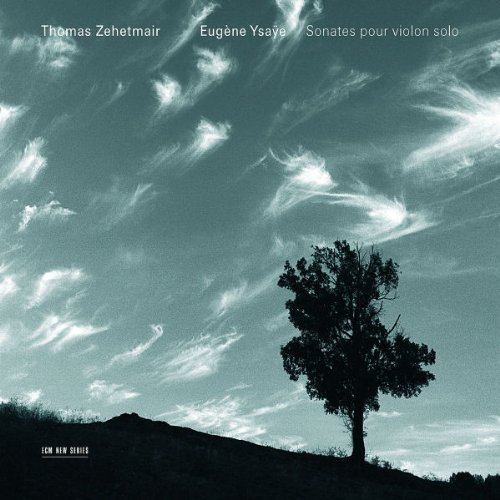
Eugène Ysaÿe: Sonates pour violon solo – Zehetmair (ECM New Series 1835)


Eugène Ysaÿe
Sonates pour violon solo

Thomas Zehetmair violin
Recorded September 2002 at Propstei St. Gerold, Austria
Engineer: Stephan Schellmann
Produced by Manfred Eicher

While I continue to wait—in vain, it seems—for a Thomas Zehetmair redux of Bach’s Sonatas and Partitas for solo violin on ECM, we do have, in this touchstone recording of EugèneYsaÿe’s comparable works for the same, easily one of the most enthralling albums to come from the repertoire in a long while. Composed between 1923 and 1924, Ysaÿe’s constructions emerged from a dearth of provocative solo violin literature to which his contributions were more than ornaments and seem as much predecessors as descendents of Bach (as if Bach had anticipatorily extracted from their less contestable passages a more concentrated form of solitude). If Bach’s is a perfect fruit, gilded by two centuries’ of difference, then Ysaÿe’s is both the soil that feeds it and nourishes its seeds, slumbering beneath a layer of frost in the morning sun.

The Grave of the Sonata No. 1 in G minor opens the set with a calligraphic flourish in reverse, funneling fanciful implications into an originary stroke. From these stirrings one already senses the many layers of historicity at work here. In the Fugato we encounter the sinewy balance of robustness and grace that infuses the performance as a whole, which glides off of Zehetmair’s bow like liquid mercury, those double stops seeming to come from a single string divided, opened rather than paralleled. His flexibility works wonders in the Allegretto, contrasting serrated runs with more amorphous shapes, before unwrapping its sweetest virtuosities in the Finale. This tour de force is on par with any of the Paganini caprices and again showcases the powerful subtleties of Zehetmair’s unparalleled (no pun intended) double stops.

The first movement of the Sonata No. 2 in A minor, appropriately titled “Obsession,” is many things to the Preludio of Bach’s Partita No. 3: fragmentation, recapitulation, homage, and parody, to name a few. Like two galaxies shuffled together, these monumental signatures share more than a few loops and hooks, exhaling nebulae on the muted strings of “Malinconia.” This call from distant shores is an afterlife brought into the continental drift of shadows. A lute-like interlude brings us to the ecstatic exposition that “Les furies,” from which Paul Giger draws (at 0:42) an intertextual marker in Chartres (listen for it in “Crossing”).

This distinct sense of exuberant introversion continues in the Sonata No. 3 in D minor (“Ballade”), the nuances of which we were given a taste alongside Heinz Holliger’s Violinkonzert. Thus do we bridge over into the Sonata No. 4 in E minor, which nods again in Paganini’s direction. Its tripartite structure cradles a languid Sarabande, after which the enthralling Finale—during which there hardly seems a moment when at least two strings are not being engaged—closes the most notoriously demanding piece of the set.

The movements pare down one by one, giving us the diptych of the Sonata No. 5 in G major. Equal parts Debussean ritual and imageless reflection, it concludes in a sensuous dance filled with avian throatedness. So, too, do the flying swoops of the single-movement Sonata No. 6 in E major regale us with songs of clouds and earth alike.

With a tone deferential yet trailblazing, Zehetmair captures and sets free the genetic codes enraptured by and through these sonatas. I cannot imagine a more ideal performer, or more ideal acoustics than the crisp reverberations of Austria’s Propstei St. Gerold. Every finger seems to rotate on its own axis in the grander solar system of Zehetmair’s playing, at the center of which shines the sun of Ysaÿe’s glorious music. Each planet is of such distinct character that as a family they seem to inhabit their own respective universes, meeting only in the aftermath of a binding cataclysm, which necessitates the retelling of their lost cultures. Picking through this referential hall of mirrors, we see exactly what we hear: a spontaneous recreation.

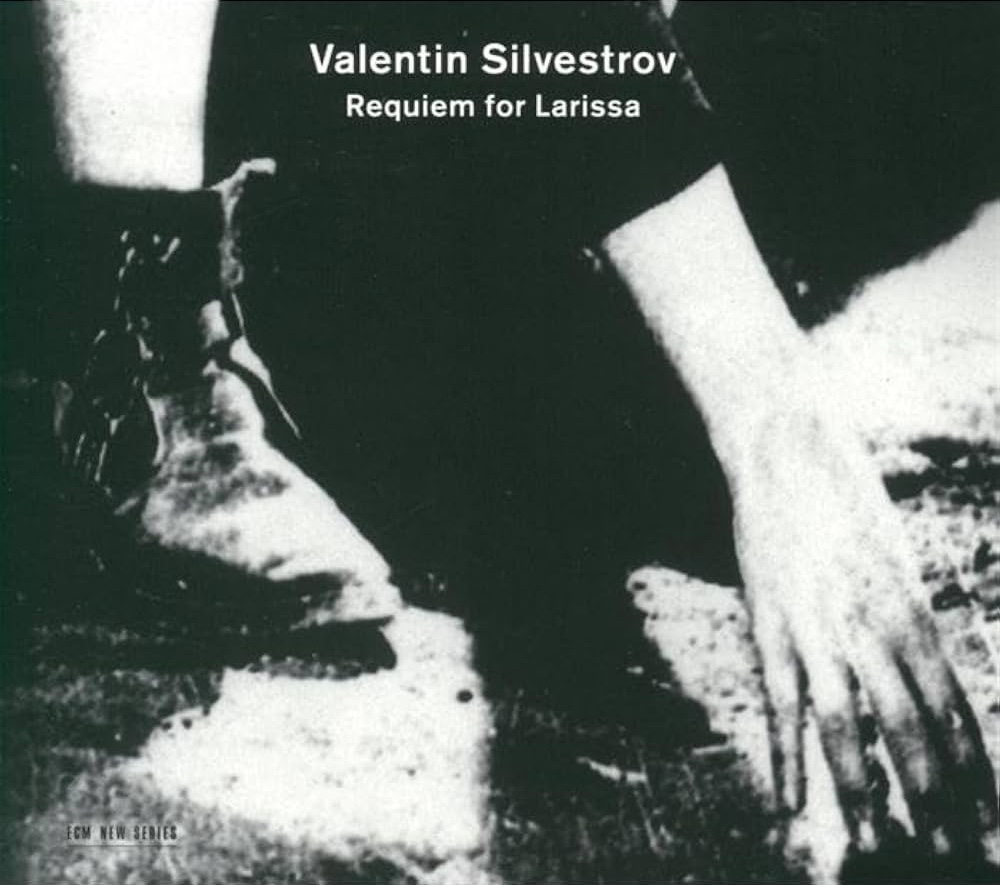
Valentin Silvestrov: Requiem for Larissa (ECM New Series 1778)

Valentin Silvestrov
Requiem for Larissa

Yevhen Savchuk
 choirmaster
The National Symphony Orchestra of Ukraine
Volodymyr Sirenko conductor
Valentin Silvestrov conductor
Recorded February 2001 in Kiev, Ukraine
Engineers: Arkady Vichorev and Valery Stupnitsky
Produced by Manfred Eicher

“I do not write new music.
My music is a response to and an echo of what already exists.”

The requiem is a curious object: on the one hand it memorializes someone important to the composer, while on the other most listeners will have never known the dedicatee. In that sense the requiem fulfills a transitory function, and a communicative one at that, bringing a sense of relational knowledge to the abyss. In the case of Valentin Silvestrov’s entry into the Requiem ledger, I feel only the mise-en-abyme of love, and the shape of its web after a cold wind has snapped half of its axial threads. Written between 1997 and 1999, it was intended to be the Ukrainian’s last composition—so affected was he by the death of his wife, musicologist Larissa Bondarenko. As with his above sentiments, the sound-world it introduces to us is a churning sea bordered in humility.

The more one listens to Silvestrov, the more one becomes accustomed to the piano’s (omni)presence in his orchestral imagination. It is both center and periphery of an ever-expanding field in which the wool of darkness is spun into light. And thus it is from the piano that the Requiem’s vocality proceeds, the choir sewn into the larger fabric with divided immediacy, such that emotions merely constitute an audible act shrouding an internal need for stillness. Tenor and alto solos shimmer against a reverberant mesh of harp and strings, each a clear path to struggle. In them Silvestrov admirers will recognize a redux of his Shevchenko setting in Silent Songs, and in the Agnus Dei a choral expansion of his Der Bote, the last piece of her husband’s Larissa ever heard. Though cut from a template, they whisper a self-taught language. Winds pressing in at all sides carry us back into the piano’s embrace, in which we realize that heaven is not a space above but one within. Retreating farther inward, morning glories all, we fold in moonlight with a simple bow, finding some respite in the laborious nature of our surroundings. Effervescence balances at the fulcrum of acceptance, only to be dispersed in the swirling pool of the final section, dissolving behind closed eyes.

I know I would not be alone in expressing thankfulness that Silvestrov has since continued to compose, but in doing so I would be missing the point. Aside from the long-distance comforts my meager consolations may or may not provide, such a gesture is as tear-distorted as the sounds that inspired it. I might also praise this recording for its engineering, performances, and packaging, but when reviewing a requiem these concerns are inconsequential. There is no way that such a project could defeat itself, for its heart has already been punctured by the loss from which it continues to grow. It is its own entity now, atrophied and crawling, searching for rest in a landscape without berth.

Larissa was unknown to me, but whenever I listen to this music in her honor, I feel as if that lack of knowledge becomes filled with something vaster, a nourishing remembrance that sustains everything we are once we have been thrown into the center of the universe to slumber whence we came.

<< Dave Holland Big Band: What Goes Around (ECM 1777)
>> Heiner Goebbels: Eislermaterial (
ECM 1779 NS)

Between One Embrace and the Next: Ulysses’ Gaze and the Pace of Discovery

And, if the soul is about to know itself, it must gaze into the soul.
–Plato, Alcibiades 133b

The film

In a quiet arthouse theater one night in May of 1997, a scene from Theo Angelopoulos’s 1995 masterwork Ulysses’ Gaze reached out and holds me still. In it the protagonist, A (Harvey Keitel), is relating a personal story to a curator from Skopje (Maia Morgenstern, who plays every woman Keitel encounters throughout the film’s nearly three-hour duration). As the latter runs alongside the train that threatens to vanquish their transient encounter, A’s story lures her into the clattering comforts of the car, and into the emptiness of his heart. He tells her of stumbling upon the birthplace of Apollo, of seeing there something so vivid that every Polaroid he attempted to take came out only blank, “as if my glance wasn’t working.” In those empty squares, those black holes made tangible, he sees both the past of which his body and mind were formed and the future into which he blindly walks.  Thus does Angelopoulos engage us, finding in this nameless figure an everyman whose quest for origins beyond his self leads only to a hollowing out of that self.
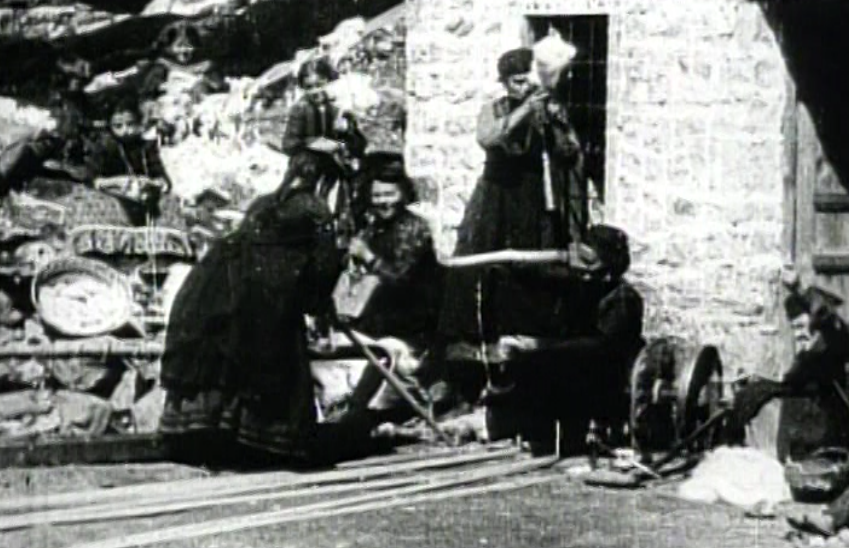
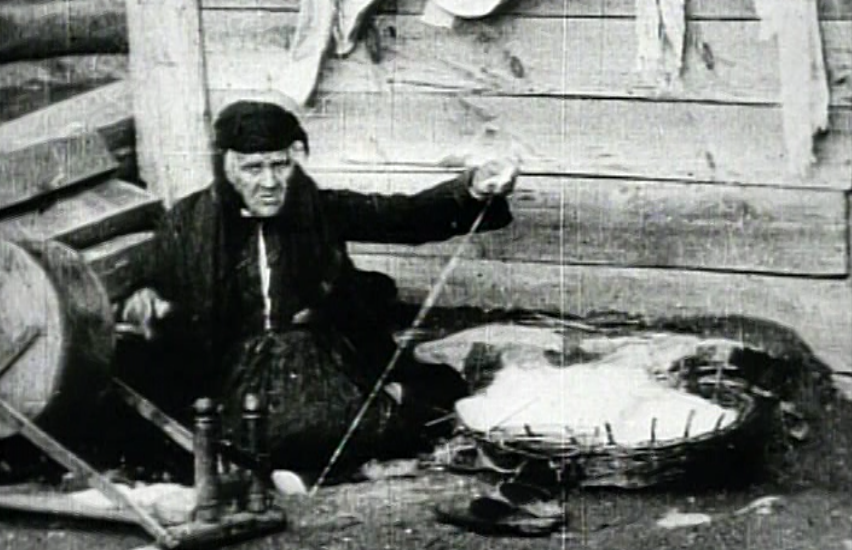
We see a film: Spinning Women by Yannakis and Miltos Manakias. It is perhaps the first film, speculates A’s voiceover. The first gaze. Yet once we are released from its black-and-white confines, the only gaze afforded us is of misty waters, indistinct and close to blanking out. Monochrome pales into color as we witness Yannakis’s last moments, and the single ship upon the sea that is his farewell.
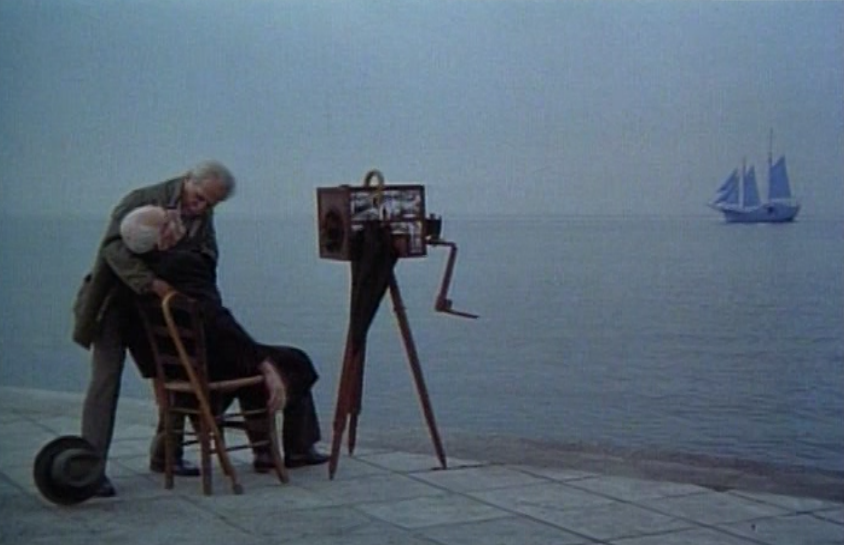
The vessel looms like a face, fills the screen with its expressive pace, and breaks the seal on a filmic letter like no other.
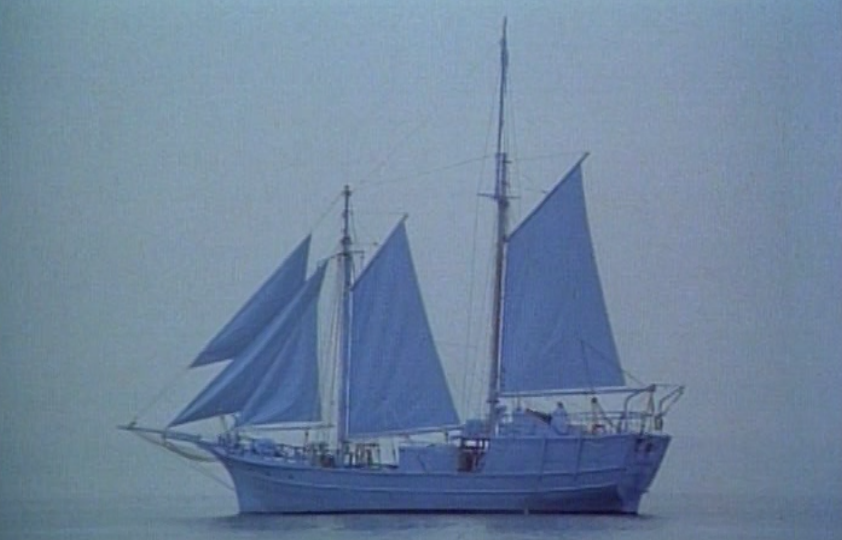

“How many borders must we cross to reach home?”

Yannakis, we learn, left behind three reels of undeveloped film, and it is these A wants like a light bulb hungers for electricity that will one day pop its filament. We contemplate the ship and the three missing reels as A sets out on his personal journey. He hopes a film archivist from Athens may be able to help him, but is instead escorted through crowded streets in which A has not set for 35 years, and which echo with the controversies of his latest film beyond the theater doors it has closed.
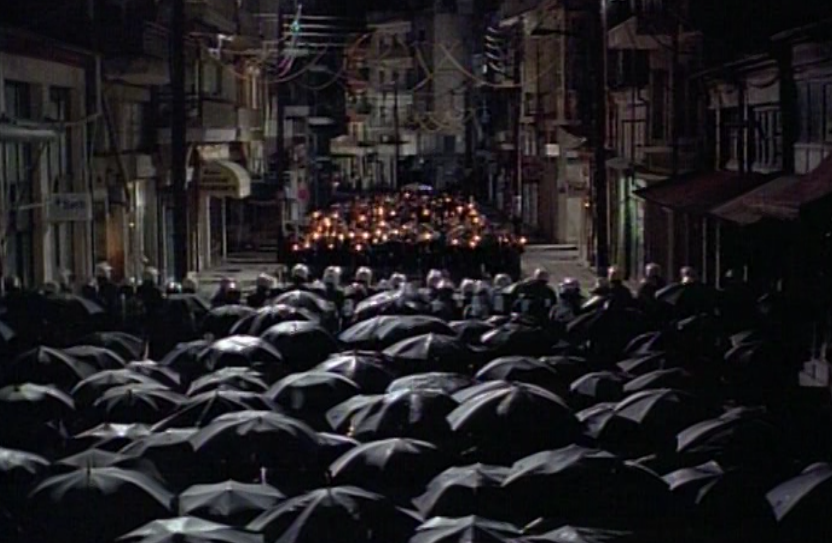
A follows the trail into Albania, a land of snow and silence where refugees stare at the mountainous border as if it might speak on their behalf.
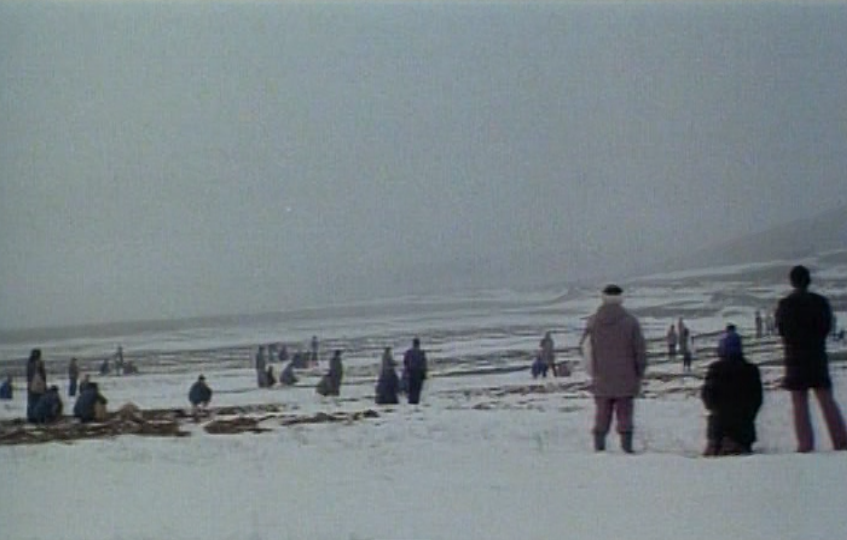
A woman who hasn’t seen her sister in 47 years since the civil war asks if A might take her along. His cab driver agrees and drops her off at Korytsa. Only she doesn’t recognize it as the place of her girlhood. She stands in the middle of the street, empty save for the agony of her shattered expectations. Part of us stays with her, knowing that all the comfort in the world will never alleviate the wounds she has endured to get here.
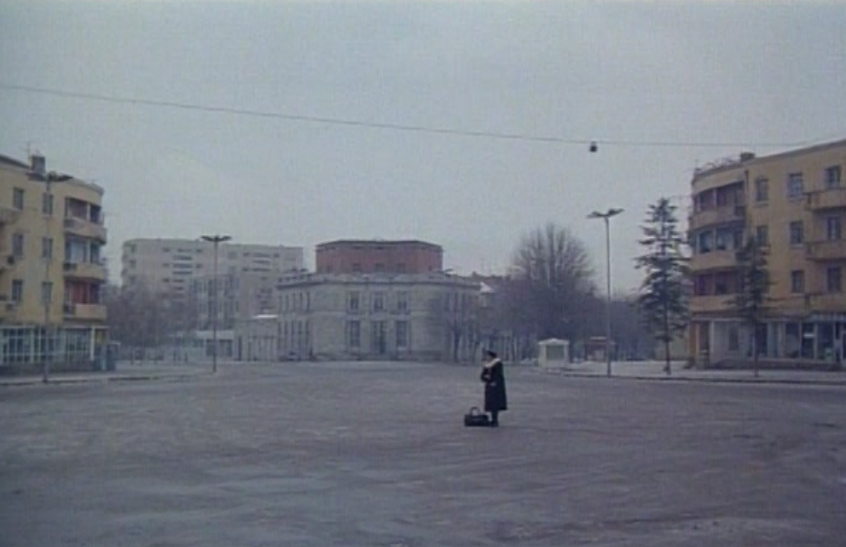
Haunted as much emotionally by the Manakias brothers’ film as we are visually by it, A maps a path of ruin through the Balkan Wars and the First Great War. The turmoil of the region is encoded in every frame of those missing reels. Yet the brothers were interested less in politics and more in people. They recorded “all the ambiguities,” A tells the woman from Skopje, who at first takes no interest in his obsession, which overtakes him to the point where he relives the brothers’ exile by the Bulgarian government as collaborators against the state, feels the confiscation of their archives like an artery ripped from his chest, smells the gunpowder of a mock execution. He wants to find his own first glance, long lost yet always tapping him on the shoulder, and his only way to know where it leads is to take on traumas of which he will never be a part.
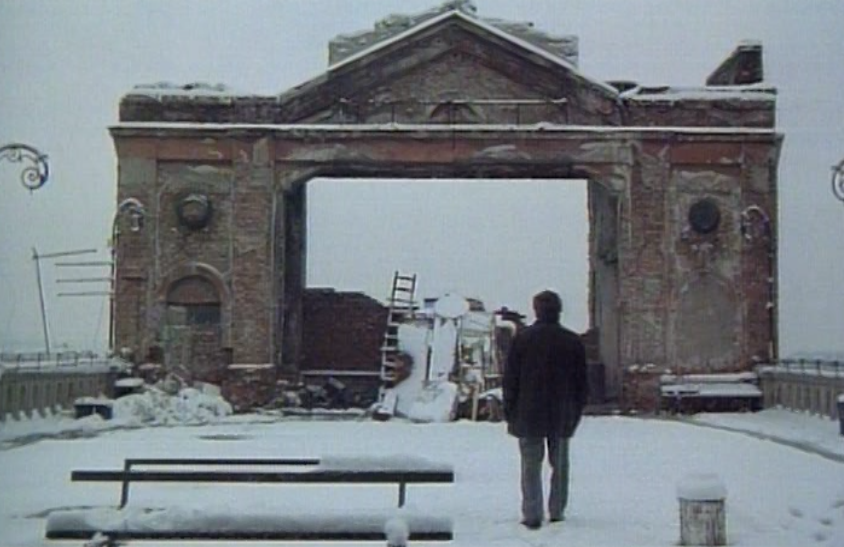
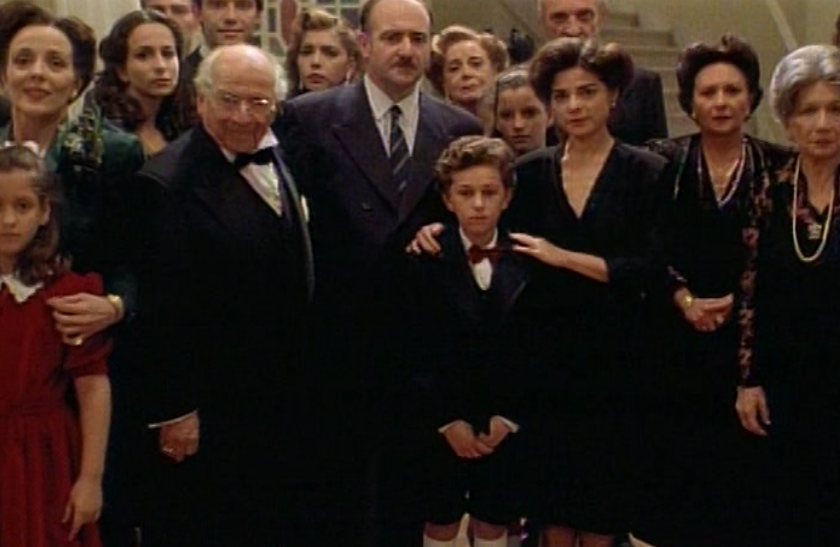
His itinerary reads like a litany of destruction. He follows footsteps into a time where his mother can care for him, a substitute in memory for what eludes him in the present. Then again, in this film there is no “present” as such, bearing as it does an eternal trace of that which bore it. A shares a dance with his mother, and in the space of that dance a family is destroyed, dispossessed, and broken before posing for its final group portrait by an illusory photographer who may be the director himself, if not us in his place.
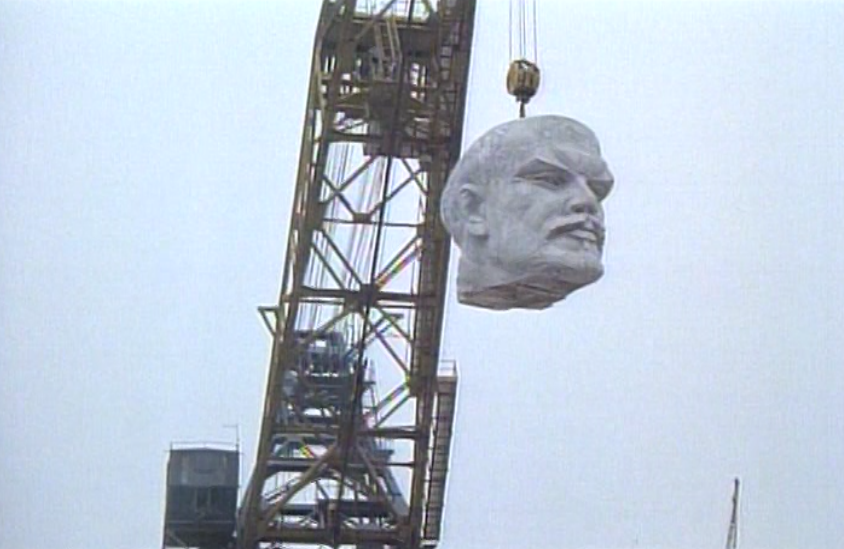
A awakens from that dream, shaken and silent. At the docks of an overcast morning, he bids farewell to Skopje, even as the head of an enormous statue of Lenin is craned onto a barge behind them.
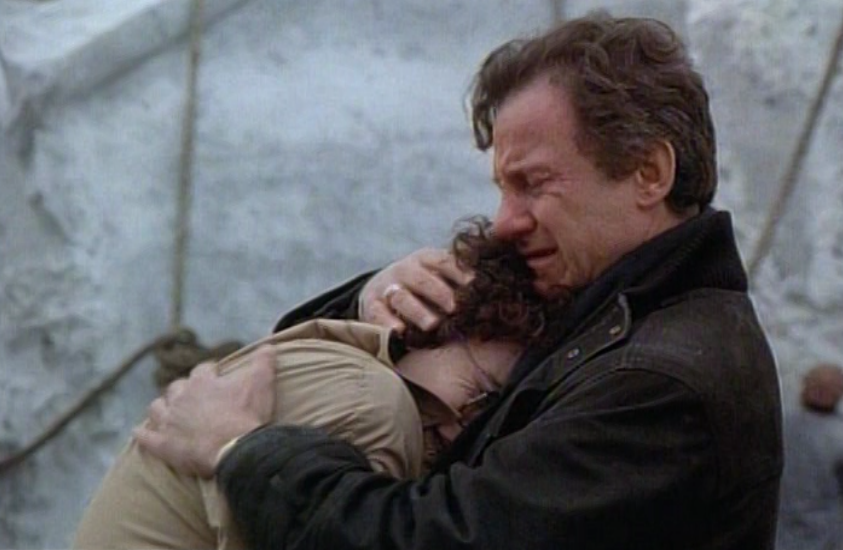
The nameless woman questions his tears. “I’m crying because I can’t love you,” he tells her between sobs, and tears himself away from the only security he may ever know.
“The war’s so close it might as well be far away,” observes an old journalist friend in Belgrade, where the head of its Film Archives has agreed to meet. The man tells A he once had the reels, but after failing to devise the proper chemical formula to develop them, gave them to a colleague in Sarajevo with whom he lost touch during the war. Of course, A insists on going to Sarajevo. He rows a boat into dark waters (an allegory, perhaps, for the toughness of Balkan reality itself) and nearly falls into a double life with a widow in mourning.
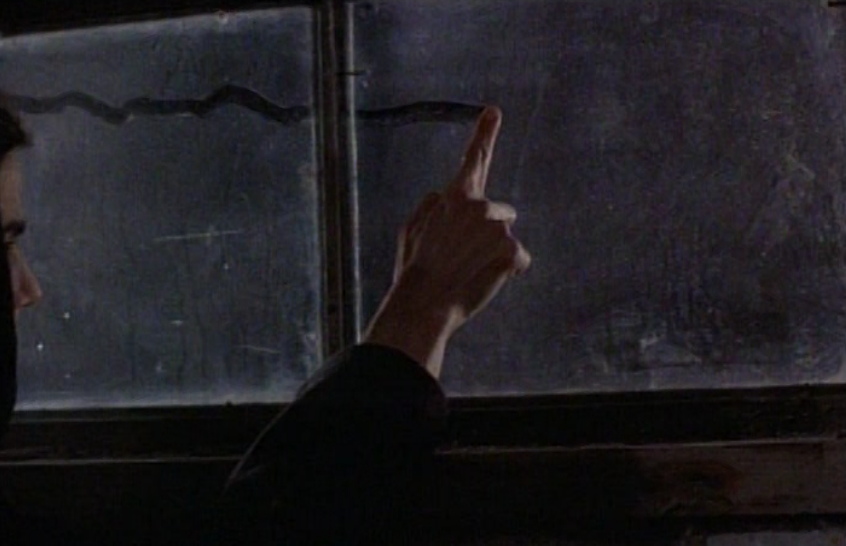

“The first thing God created was the journey, then came doubt…and nostalgia.”

Upon arriving in the city, surrounded by bombs and crumbling edifices, he foolishly asks of those fleeing around him, “Is this Sarajevo?” as if his purpose in being there were more important than their demise. It is the deepest moment of denial, and therefore of weakness, in the film, and throws us into the soul of a man whose love for history has blinded him to the visceral impact of its making.
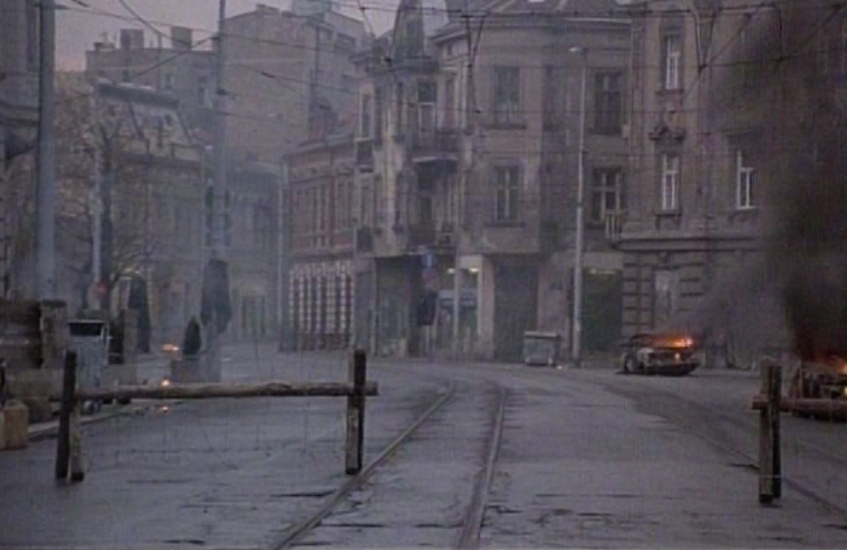
He finds who he is looking for: a film museum curator (the inimitable Erland Josephson) by the name of S. Even as the air explodes with dust and bloodshed, S commends A for his faith in having traveled this far for something believed to be lost.
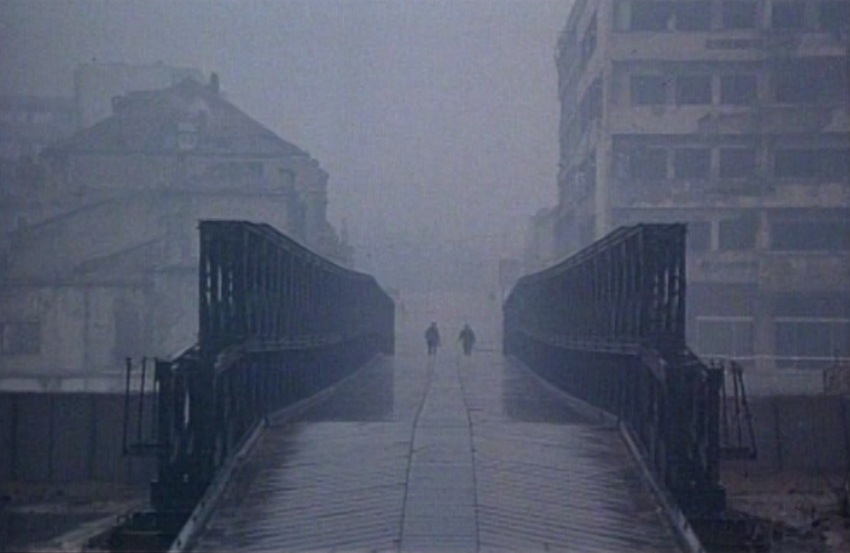
S, we learn, has been searching for that magic formula for years, and A’s persistence emboldens him to finish his task.
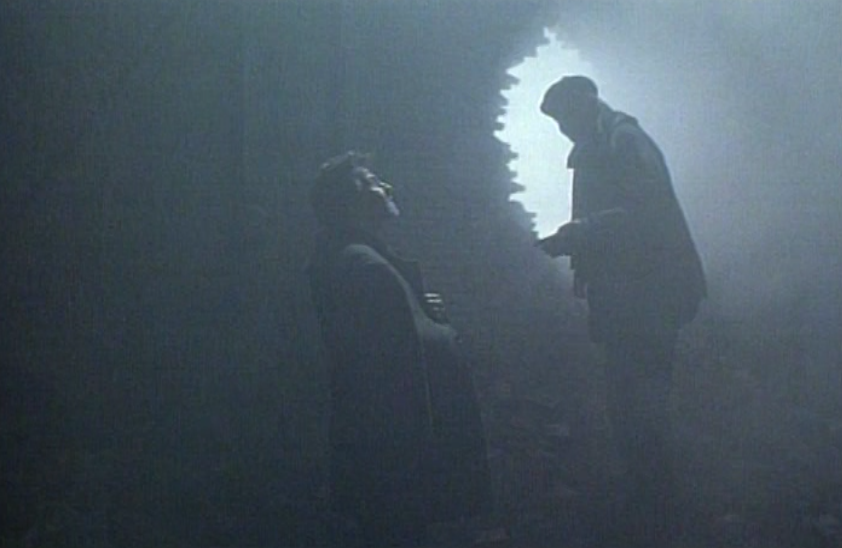

“You have no right to keep it locked away. The gaze…it’s the war, the insanity, the death…”

It is in Sarajevo that we learn the true meaning of the fog, which creeps in like a protective force, a shroud in which one can live without fear, if only for a brief time. In its embrace neighbors can speak without words. In its diffuse glow a youth orchestra made of Serbs, Croats, and Muslims, traveling from city to city during ceasefire, can play its song for all to hear.  But even this screen cannot keep them from harm, for behind its veil children are shot before their parents, thrown to the water from which they took shape. And so, the man who rescued a gaze from certain death now becomes a part of it, but not before leaving the successfully developed reels.
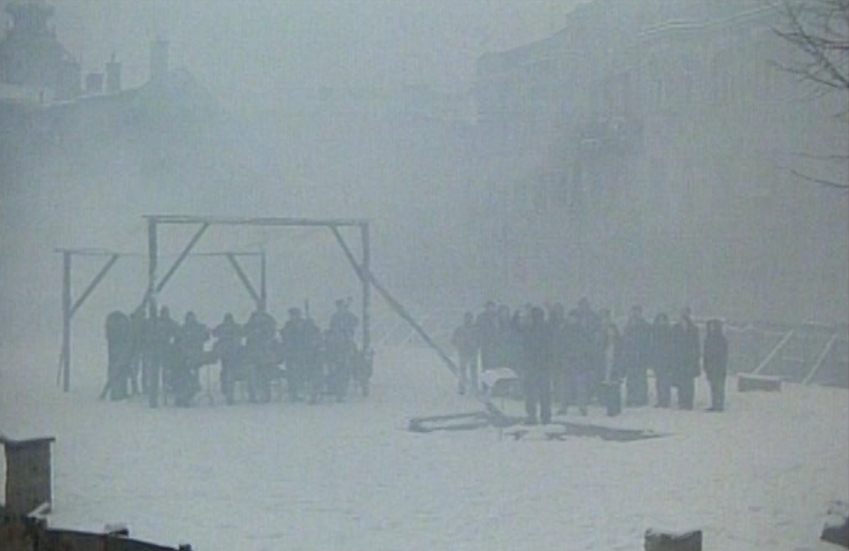
Yet we never see those reels, only their light flitting across A’s weary eyes. Whether or not he finds them is as immaterial as they legend they have grown to be. In those reels lies a dream, “a gaze struggling to emerge from the dark…a kind of birth.” And in birth there is no sight but the glare of strife, no sound but the wail of projection.
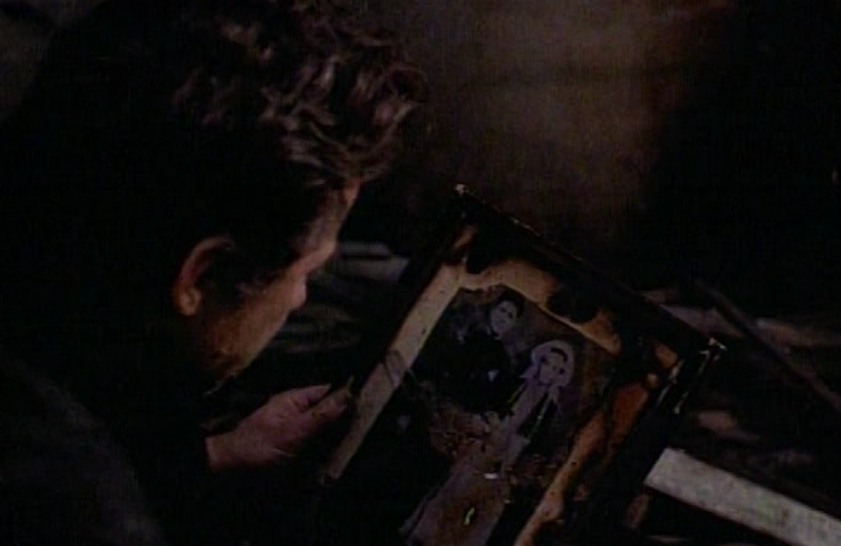

“What am I if not a collector of vanished gazes?”

And just what is all this gazing about? Beyond that of the camera, of the eye in reality (and of the soul in non), it is for me the slumber of the centuries, dismembered and left to drift like Lenin’s statue on river’s flow. It is the pathos of pathos, forever unrequited in the blink of a fettered eye.

As a teenager I used to have a recurring dream. In it I was younger still, perhaps 12, and clothed modestly in a tunic and brown leather sandals. I ran through a hilly landscape, dodging brush and fauna to the top of a rocky slope. And there I lay low beneath an olive tree, a quiver of arrows slung across my back, overlooking a landscape of ruins. I like to think that I was also gazing, like A, upon Apollo’s birthplace, of which I can remember nothing but the feeling: an unanswering abyss of rock and overgrowth into which I cast my questioning stones.

The more tangible it is, the more unrecoverable a past becomes, the more easily burned, the more easily dressed in the clothes of the dead.

The music

Among the many sonic cartographies it has innovated, ECM has redefined almost every genre it has touched. This includes the film soundtrack, which, through the work of Angelopoulos’s sonic partner, Eleni Karaindrou, has shown us music that stands alone before reaching toward the images it cradles.
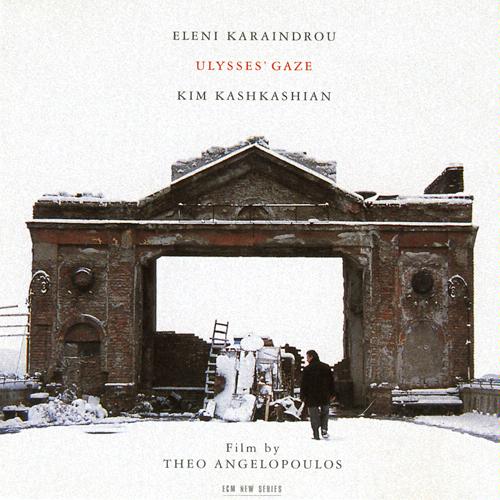
Eleni Karaindrou
Ulysses’ Gaze
(ECM New Series 1570)

Kim Kashkashian viola soloist
Vangelis Christopoulos oboe
Andreas Tsekouras accordion
Sopcratis Anthis trumpet
Vangelis Skouras french horn
Christos Sfetsas cello
Georgia Voulvi voice
Lefteris Chalkiadakis conductor
Recorded December 1994 at Sound Studio, Athens
Engineer: Yannis Smirneos
Produced by Manfred Eicher

This soundtrack introduced me to the Angelopoulos’s cinematic world long before I saw a single frame. It would be two years before I had a chance to see the selfsame film, by which time I had heard the soundtrack and stared at the booklet stills so many times that I felt like I knew every ventricle of Ulysses’ pensively beating heart. Though set against a backdrop of primal discovery, it ends up becoming its own discovery, linking the personal to the political to the universal in one red thread, represented to its fullest by Kashkashian’s gut-wrenching playing. Though mainly driven by the soloist, there are splendid moments of conversation with oboe, as in “Ulysses’ Theme Variation II.” Yet what comes across as an intensely mournful theme can, with just an intensification of speed, turn into an exuberant dance.

Among the more touching moments in both film and soundtrack is “The River.” With its elegiac horn wafting out over the misty waters like a requiem for a fallen past never to be recaptured in the crumbling ruins of an age blinded by innovation, it breathes through our rib cages with voices of passage. The 17-minute spread of “Ulysses’ Gaze – Woman’s Theme, Ulysses’” is the album’s most enchanting encapsulation, the entire narrative telescoped into a single epic mosaic, drawn from the same ink as the tears of its characters. A lilting accordion carries us like a feather on wind into the inner portal of a traditional Byzantine Psalm, from which we emerge with that same thread in our grasp, sinking deeper with every reiteration until the seedlings of our plight become the stuff of myth and melted celluloid.

Ulysses’ Gaze bears dedication to the memory of the great Italian actor Gian Maria Volonté, whose role in the film was cut short by a fatal heart attack and recast to Josephson. In kind, I can only dedicate this review to the memory of Angelopoulos (1935-2012), a director in whose oeuvre everyone seems to find a ghostly double self, whispering at the fringe of conscious imagination.

May his gaze live on.

“I live my life in ever widening circles that rise above things.
I probably won’t come last, but I’ll try. I circle around God.”
<< Alexandr Mosolov: Sonatas for piano Nos. 2 and 5, etc. (ECM 1569 NS)
>> Thomas Demenga: J. S. Bach/B. A. Zimmermann (ECM 1571 NS)

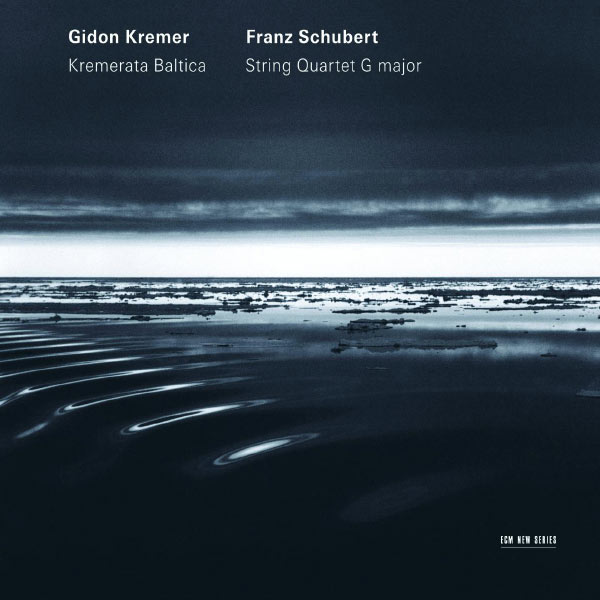
Gidon Kremer/Kremerata Baltica: Schubert – String Quartet G major (ECM New Series 1883)


Gidon Kremer
Kremerata Baltica
Franz Schubert
String Quartet G major

Kremerata Baltica
Gidon Kremer violin and conductor
Victor Kissine orchestration
Recorded July 2003, Pfarrkirche St. Nikolaus, Lockenhaus
Engineer: Peter Laenger
Produced by Manfred Eicher

As a tireless champion of new interpretations of the old, the ever-adventurous Gidon Kremer has over the years forged a lasting relationship with, above most others, the music of Franz Schubert. One can only imagine, then, the excitement he must have felt when he learned of composer Victor Kissine’s having finished a string orchestral version of Schubert’s G-major String Quartet (op. posth. 161, D 887). The arrangement of this notorious masterpiece at first seems to embody a curious double bind, for while it certainly enhances the music’s dramaturgical spectrum, it simultaneously softens the edges thereof. The result is a rounded idol of the original. And yet, like a piece of glass that has been worn down by river’s flow or ocean’s tide, it takes on a new shape, becomes a jewel in the hands of a child, a glint of light noticeable even in an already vast and glowing population.

From the five seconds of silence that begin every ECM album made in the last 20 years, the orchestra emerges with a mounting proclamation that immediately justifies the means. Amid the dance of major and minor that ensues, the occasional soliloquy, like that of the pizzicato-ornamented cello in the opening movement, rings all the clearer. Here one must also note the Kremerata Baltica’s honed dynamic control, by which, despite the youthful magnitude of its combined forces, the music’s ruptures are allowed to sing with all the philosophy of their emptiness. Magisterial tempos give greater lift to the score and throw us into its spirals with swooning regard. The Andante enacts a veritable play of shadows, comporting its thematic actors with Beethovenian stagecraft. The cello reemerges as a voice with one foot behind closed eyes and one outside of them, and fades tear-like into the relatively brief Scherzo, where skittering motives place many a deft footstep through an agitated waltz before reworking the flames, only now more scintillating, in the final Allegro, which gallops its way through pages of light and shadow, leaving us to ride its ripple effect back into the open silence from which it awakened.

This project has Kremer written all over it. From his never-superfluous gildings to even the cover photograph (entitled “Heading for the North Pole” and taken by the man himself in 1990), Kremer has given his all to the finished product. This has nothing to do with ego, but with a reverence for Schubert, whose heart he and his entourage draw with the care of an anatomist. Kissine’s arrangement likewise allows us to hear the beating of this heart through a steady flow of melodic blood. And the sound? Wondrous. A sequins without the kitsch.

As I listen to this album it is snowing outside, yet the ground is warm enough to melt the snow on contact, giving the illusion that every flake continues to fall through the earth. I cannot help but map this sensation onto what I am hearing, for even as this music touches us it continues to fall through our skin and into a place in our minds where footsteps will never mar its confection.

Tigran Mansurian/Kim Kashkashian: Monodia (ECM New Series 1850/51)


Tigran Mansurian
Kim Kashkashian
Monodia

Kim Kashkashian viola
Leonidas Kavakos violin
Münchener Kammerorchester
Christoph Poppen conductor
Jan Garbarek soprano saxophone
The Hilliard Ensemble
David James counter-tenor
Rogers Covey-Crump tenor
Andreas Hirtreiter tenor
Gordon Jones baritone
Recorded November 2001, Himmelfahrtskirche Sendling, München and January 2002, Propstei St. Gerold
Engineers: Stephan Schellmann and Peter Laenger
Produced by Manfred Eicher

When the shadow of the sash appeared on the curtains it was between seven and eight oclock and then I was in time again, hearing the watch. It was Grandfather’s and when Father gave it to me he said I give you the mausoleum of all hope and desire…
–William Faulkner, The Sound and the Fury

Monodia represents the invaluable efforts of violist Kim Kashkashian to bring Armenian composer Tigran Mansurian onto the world stage. During this journey of discovery she was fortunate enough to have found in Manfred Eicher the ideal partner to ensure that this exposure be done properly and with the utmost respect. The composer’s homeland may not be visible in the flow of information that saturates mainstream media, but it is intensely audible in this landmark recording of a music and a culture that demands to be heard by virtue of the fact that it demands nothing at all.

Kashkashian brings her inimitable talents to bear upon “…and then I was in time again, a viola concerto written in 1995. The title comes from Faulkner, whose inky nooks harbor shades of meaning whereby the light of experience comes to be similarly refracted through the prism of the mind. Kashkashian’s harmonic whispers usher us into a world in which the viola not only sings, but also speaks. Through a sometimes-tortured narrative, Kashkashian externalizes the music’s inner life through her fearless translational abilities. The orchestra’s lower registers are favored here, so that the violas echo Kashkashian en masse, thereby drawing a genealogical thread from Allegro to Lento in a twin birth of lament and knowledge. As throughout, peace is hard to come by even in the absence of the occasional high-pitched interjections, each a sketch of histories long atrophied.

If we began rooted in time, in the Concerto for violin and orchestra (1981) we are left to fend far outside of it. After the earthy tones of the viola, the violin hangs from a much thinner thread, ever poised on the brink of a sudden fall. The soloist here is Leonidas Kavakos, who begins, as violin concertos are wont to do, somewhere above our heads. Kavakos underscores the solitude that permeates the score, emerging like an orphaned cub taking his first tentative steps across the forest floor. Sunlight works its way through the mists, spreading its fingers wide between the branches and coaxing the world back to life. The opening motive, while inaugural in its first appearance, is a powerfully disruptive force when it returns halfway through the piece. Its violence and fear spawn a thousand voices singing with agitated lyricism. Low strings sweep us under a watery carpet before spitting us out onto the shores of something oddly familial.

This sense of lineage continues in the 1999 Lachrymae for soprano saxophone (played here by Jan Garbarek) and viola. The patterns traced here are not unlike those on the CD’s cover, meeting as they do in a rosette of mystical curves through human rendering. Like an incantation, the music’s implications far exceed its means, for in the lingering echoes of this piece we can hear our own tears hoping for the curing touch of moonlight. A quintessential New Series piece from two of ECM’s finest musicians.

Lastly is Confessing with Faith (1998), for which Kashkashian is joined by the Hilliard Ensemble in evoking texts by St. Nerses the Graceful (1102-1173). The gut-wrenching depth of her playing here must be heard to be appreciated, and with the Hilliards its secrets become even more complex. One can’t help but feel that the voices are being spun from the same threads, as if to more fully flesh out that which already resides in the instrument. Once countertenor David James breaks from the gloomy waves, he dances with the viola in a lithe display of melodic inertia. Agitated tremolos enlarge the feeling of solitude, letting in a spirited round: one river overtaking another in a bed of tenors. James is resplendent in his delicate high lines from which hang the piece’s final mobiles. The viola is given the final word, which feels more like the first, drawing out a double stop as if it were a pair of lungs about to pray.

Sing a new song to Him who rose,
First fruits of life of them that sleep.


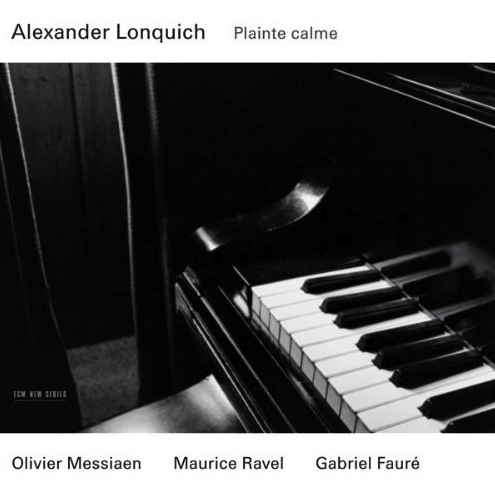
Alexander Lonquich: Plainte calme (ECM New Series 1821)


Plainte calme

Alexander Lonquich piano
Recorded January 2002, Radio Studio DRS, Zurich
Engineer: Peter Laenger
Produced by Manfred Eicher

A year and a half after debuting with the label on Odradek, German pianist Alexander Lonquich stepped into the studio to record Plainte Calme, his first solo recital for ECM. Lonquich is a player of dialogues: between himself and the music, between himself and himself, between the music and itself. Balancing a remarkably delicate touch with a strong attack when needed, his playing throughout this all-French program bodes well in the session’s rounded engineering.

The Impromptusof Gabriel Fauré (1845-1924) provide listeners with the most earthbound motifs on which to train their ears. Written between 1882 and 1909, these were never conceived of as a set, a fact underscored by their being scattered throughout the program. Although they incorporate influences from Chopin and from mentor Saint-Saëns, these pieces bear echoes in a chamber very much their own. Beyond the obligatory descriptor of “impressionistic” I am wont to attach to such music, there is an undeniably filmic energy therein. One can almost hear horse carriages and lovers’ talk, unaccompanied but for the whisper of their own song. Affection pours through every section with the temerity of a field mouse, while at the same time rolling itself down hills of youth into some of the composer’s most unadulterated expressions of joie de vivre on record—Lonquich’s performances thereof punctilious and perfect.

The 1929 Huit Préludes pour piano of Olivier Messiaen (1908-1992) was a discovery for me. This treasure was his first published work, written during his student days at the Paris Conservatoire. Already the synaesthetic composer was experimenting with color, which he splashes almost Pollock-like into a monochromatic world. One encounters a more weathered feel in comparison to the surrounding works, each a fresco in a monument which, though scarred by the passage of time, in its own way has become more beautiful, more like itself. Even at this early stage Messiaen folds every pleat with a reverence and sensitivity beyond his years. Yet there is far more than shadows and contemplation going on in this tapestry. There is also animation, the twisting and turning of life itself in all of its dramatic changes, though always ending as if to undermine that drama as but an illusory skin to stillness.

In light of these denouements, the formidable Gaspard de la Nuit of Maurice Ravel (1875-1937) feels like a bucket of dreams poured into the mind’s eye. This early work was written in 1908 after poems by Aloysius Bertrand and reflects the persistence of a composer who, as a student of Fauré at the Conservatoire in 1896, was famously expelled due to his inability to write an “adequate fugue.” Unfazed, he continued to sit in on Fauré’s class and honed what would become his hallmarks, which one notices to hardly greater effect than here. “Ondine” takes the most transcendent approach to the medium, seeming to stitch with an angel’s hair atmospheres of such rippling grace that one can only feel them below the skin, trembles of anticipation that are their own rewards. We find ourselves knee-deep in an inimitable sort of magic, growing into a quicksand of caresses in “Le Gibet,” while in “Scarbo” we are thrown into a new journey that leads us up the spiral staircase of the final Fauré Impromptu, at the top of which waits the destiny living inside all of this music: namely, the need to close eyes, spread wings, and jump.

Lonquich treats every note like its own voice in the grander unity of the choir, as it were, and brings an almost philosophical edge to his painterly renditions. He can sound like two musicians, one the light of the sun and the other its warmth. His sound bounces off the lockets of maidens in distant tower windows, their dreams of music suspended from the forests through which many a knight has traveled. Their voices come to us only now, at last requited in the body of an instrument that has never quite sung like this before.

One of the finest solo piano records on the New Series thus far.

Ingrid Karlen: Variations (ECM New Series 1606)

Ingrid Karlen
Variations

Ingrid Karlen piano
Recorded January 1996, Schloßbergsaal, Freiburg
Engineer: Peter Laenger
Produced by Manfred Eicher

Swiss pianist Ingrid Karlen makes her ECM debut with Variations, of which the program is as provocative as the title is vague. Beyond variations in the traditional sense, these are, rather, mise-en-abymes of abstractions. Or so they might at first aural glance seem, for within these sometimes troubling clusters of false starts breathes a unity at once organic and contrived. Anton Webern’s Variations for Piano, op. 27 (1935/36) is the primary example, for the only variations they seem to engender stem from that which cannot be notated. These pieces behave as might a solo violin sonata, jumping fluidly and bow-like through their ephemeral 12-tone links. They are the anti-motif, a stretch of childhood unable to be sifted.

If these constitute the program’s foundation, then Valentin Silvestrov’s Elegy (1967) is its hollow keystone. Dedicated to ECM regular Alexei Lubimov, this sonic egg is just that: indestructible when pushed from both ends, yet vulnerable to the slightest variation of pressure at its middle. Not unlike the program as a whole, its open spaces are there for us to project our desires and expectations in a space where they will not be judged.

Petrograd-born composer Galina Ustvolskaya is channeled to us via two pieces which, though they make up more than half of the album’s playing time, are selfless constructions. In both the Sonata No. 3 (1952) and the Sonata No. 5 (1986), the sheen of declaration quickly fades in interrupted washes of high/low contrasts hugging a forlorn middle register. Karlen stretches both like freshly dyed cloth in a stream, occasionally beating them against a rock for emphasis. Only at such moments do we realize the heights to which we have ascended. The gentility leading up to these thrashings is all the more swooning for its being whittled at by a blade of intense virtuosity. Ustvolskaya’s music inhabits a fascinating middle ground, neither melodic nor indecipherable, lying somewhere between the permanence of the scar and the ephemerality of the suture.

Where else to end but at the beginning? Pierre Boulez’s Douze notations pour piano (1945) is the composer’s Opus One and reason enough to experience this recital. The sheer depth of dramaturgical whimsy in these little sketches makes for a thoroughly engaging experience, which I can only imagine blossoms a hundredfold at the keyboard.

This daring recital is not the first I would recommend among the growing number available on ECM. This is not a critique, but simply a word of caution to the faint of heart. Still, no matter how convoluted the music becomes, it is never cloudy or obscure. The brilliance of Karlen’s program is to be found in her shaping of negative space, in precisely what is not being played. It is into this extra-musical aspect where I believe she wants to draw our ears. And if we are willing to join her, we might very well find sunlight where only shadows seem to roam.

<< Charles Ives: Sonatas for Violin and Piano (ECM 1605 NS)
>> Wheeler/Konitz/Holland/Frisell: Angel Song (ECM 1607
)