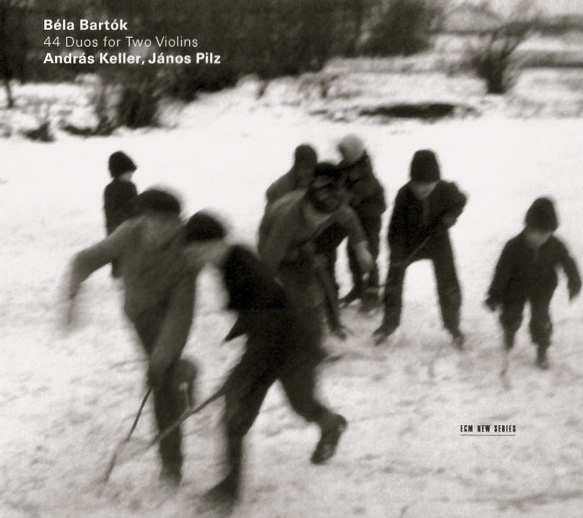
Bartók: 44 Duos for Two Violins (ECM New Series 1729)

Béla Bartók
44 Duos for Two Violins

András Keller violin
János Pilz violin
Recorded October 1999 at Propstei St. Gerold, Austria
Engineer: Peter Laenger
Produced by Manfred Eicher

Béla Bartók originally wrote his 44 Duos for Two Violins in the early 1930s at the behest of Erich Doflein, a Freiburg music instructor looking for a set of pieces both didactic and distinctly modern. Yet it is clear that the composer never intended at least some of these exercises to remain off the stage. András Keller and János Pilz of the widely celebrated Keller Quartett show us that neither were they meant to remain on the page, for in these benchmark performances they have enlivened the music with something it inherently possesses: a need to dance. That being said, and with the wealth of Eastern European sources bleeding through at nearly every stroke, folk music is not merely the means to Bartók’s message. A desire to look beyond this easy association is perhaps what lies behind the musicians’ decision to play the pieces out of sequence (Bartók had originally arranged them in order of increasing difficulty). In doing so, they focus our attention on the musicality of what is at hand.

From the verdant strains of “Erdély Tánc” (Transylvanian Song) one will hear how this music has influenced composers as diverse as Michael Galasso, Henryk Górecki, and Stephen Hartke, to name but a few. This song is like a tree of its own, every draw of the bow a newly articulated vein, and all that follows a book of its pressed leaves. Much of the work is pensive and exploratory, at once within and without. Some movements are all the more engaging for their brevity, like the uplifting and, dare I say, groovy “Párnás Tánc” (Cushion Dance), not to mention the trembling beauties of “Ujévköszöntö II” (New Year’s Greeting II), “Tót Nóta II” (Slovak Song II), and the “Menuetto.” The latter’s full double stops and swaying leads speak to the robustness of heart so characteristic of Bartók. From the sinewy leaps and bounds of “Szunyogtánc” (Mosquito Dance) to the meditations of “Mese” (Fairy Tale), he employs subtle dissonances that transmogrify seemingly straightforward gestures into more complex acts of implication. Others, like “Lakodalmas” (Wedding Song), cast simple shafts of light through a cracked attic wall, illuminating that same book of leaves into which every vignette is placed. “Szól A Duda” (Bagpipes) is one of the most stunning in the collection, its grammar so distinct that it is played twice in this recording. Keller and Pilz also underscore the percussive aspects of “Pizzicato” and “Arab Dal” (Arabian Song), the latter another standout performance in an already vivacious program. They add the most depth, however, to the more ponderous moments therein. Notable examples of this can be found in “Oláh Nóta” (Romanian Song) and “Bánkódás” (Sorrow).

While the liner notes give us no explanation regarding the program’s complementary encores, one can trace them back to the same cache of folk influences. One might also have added, if anything, the comparable duo sonatas of Prokofiev or, for that matter, Górecki, but instead we find two kindred spirits whose interest in deepening the essence of the form was as fleeting as the intensity with which they engaged it. György Ligeti’s Ballad and Dance after a Romanian folk song are two links in an otherwise obscured chain. The wavering cries of the first and the awakening of the second show us two sides of the same celestial body and wrap us in a cloak of night so intimate that the duo version of Ligatura – Message to Frances-Marie op. 31b by György Kurtág that closes reads like an orchestra whose voice strains to be heard over vast distances yet whose body has already rotted by the time that voice reaches us.

The rich sonority of these instruments and the music flowing through them moves like a blade across greased leather, and under the watchful ear of engineer Peter Laenger the recording inhabits a fine balance between capture and deference. The brilliance of this music is its ability to emote in lieu of euphemistic storytelling, getting to what Edward Gordon Craig would call “the spirit of the thing,” curling its fingers around something essential the more illusory those fingers become.

<< Tsabropoulos/Andersen/Marshall: Achirana (ECM 1728)
>> György Kurtág: Signs, Games and Messages (
ECM 1730 NS)

Gidon Kremer: Edition Lockenhaus (ECM New Series 2190-94)

Gidon Kremer
Edition Lockenhaus

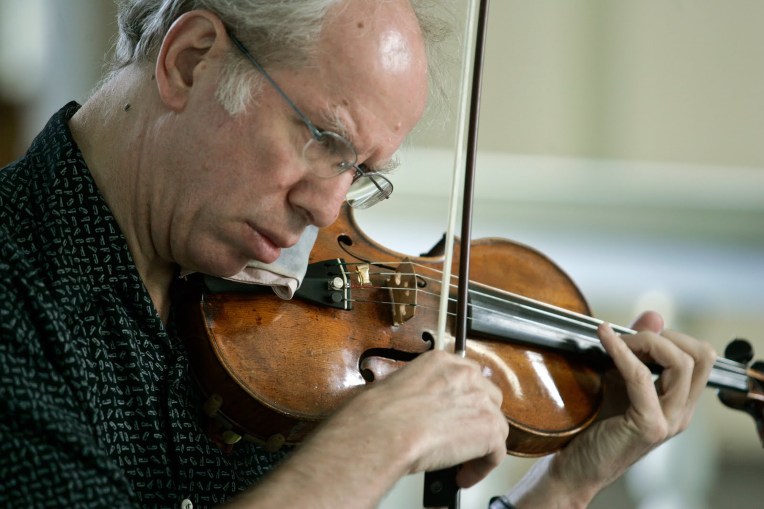
The Lockenhaus Chamber Music Festival is the brainchild of violinist Gidon Kremer. Once called an “anti-festival,” it is more a gathering of friends bound by a love of all things chamber and a certain haphazard brilliance: its constant cancellations, rescheduling, and daunting thematic choices somehow coalesce into a coherent yearly event. And an event, it most certainly is. As Peter Cossé writes in his liner notes: “In Lockenhaus, awareness, the casualness of a holiday atmosphere, a creative commitment bordering on musical revolution, and even instrumental mishaps that result from nightly round-the-clock socializing induce a shimmering acoustic ‘painting’ that the totally immersed chamber music fan views in alternating states of torpor and enlightenment.” This potent energy and the communal spirit that animates it abound in every note. For this five-disc Lockenhaus Edition, Kremer and coproducer Manfred Eicher have chosen from out of literally hundreds of recordings these highlights from the festival’s 30-year history.
Disc 1

Shedryk Children’s Choir, Kiev
Markus Bellheim 
piano
Christine Rohan 
ondes Martenot
Khatia Buniatishvili 
celesta
Andrei Pushkarev 
vibraphone
Dmytro Marchenko
Igor Krasovsky 
percussion
Kremerata Baltica
Simon Rattle 
conductor
Roman Kofman 
conductor
Recorded 2001 and 2008 at Lockenhaus Festival
Engineer: Peter Laenger

The Metamorphosen of Richard Strauss (1864-1949) makes for a formidable opener. This study in strings was dedicated to the great Paul Sacher and penned as the doors of the Second World War were closing. In light of its circumstances, one can hardly resist reading an almost Wagnerian shade of grey into its opening gestures, tinged as they are with a certain disillusionment with reality. The music is constantly finding itself through a blurring of conflict and resolution. It is a hall of mirrors where self-awareness is an understatement, in which every vague pizzicato turns the mirrors to new angles. The solo instruments don’t so much arise out of this swirling mass as glint off them. The double bass lines are especially overwhelming, while the violin becomes a looping sentiment curled ever so gently around the throat of trauma. It is as if a single molten thread were running through it, our vision of it but one of countless beads strung along its path. It finds its peace in little dissonances, casting a critical eye on platitudes, and in that way one finds perhaps only in Schubert recedes into the foreground. It is the flow not of water, but of the algae that visualizes the current’s direction. Lovingly played by the Kremerata Baltica and conducted by Simon Rattle, this performance shows Rattle’s eclectic talents in the raw, turning over as he does the sweltering underbelly of this piece. He is an ideal choice, for he knows how to make the lush feel like a drop in the bucket. He sees what the music nests itself in and works his baton around and through every twig. One of ECM’s finest live recordings.

Although Olivier Messiaen (1909-1992) composed his Trois petites Liturgies de la Présence Divine not long before Strauss’s Metamorphosen, its register could hardly be more different. Where the latter is a meditation on memorial, Messiaen’s aural triptych is an unfolding flower of light. The synaesthetic Frenchman has brought a profound imagination into palpable dimensions here. A wistful combination of piano, strings, and women’s voices opens the first liturgy, each the side to a nebulous triangle of forces. The agitations at the keyboard are like a broken crystal, drawing its light from vocal lamentations. The violin seems to rise with a spindly charm that is as alluring as it is self-destructive. We get the internal musings of an ondes Martenot, as well as various percussive accents falling like stardust in the religious imagination. In the second liturgy, jubilation quickly turns into a discomforting beauty, the piano jumping from a subterranean crawl to unmarked flight in but a fluttering of the keys. The third unravels a chant into its constituent lines, each an iridescent tether to sentiments performed rather than spoken. Passages of transcendence sit somehow comfortably alongside dips into magma, ending in a brushstroke of heavenly choirs.
ECM 1304_05

Discs 2/3 (originally Vols 1 & 2, ECM New Series 1304/05)

Gidon Kremer violin
Eduard Brunner clarinet
Oleg Maisenberg piano
Irena Grafenauer harp
Christine Whittlesey soprano
Ursula Holliger harp
Hagen Quartett
Kammerorchester der Jungen Deutschen Philharmonie
Heinz Holliger conductor
Recorded 1984, 1981, and 1982 by Austrian Broadcasting Corporation (ORF)
Engineers: Roland Pulzer and Martin Frobeen
Remix and editing: Martin Wieland

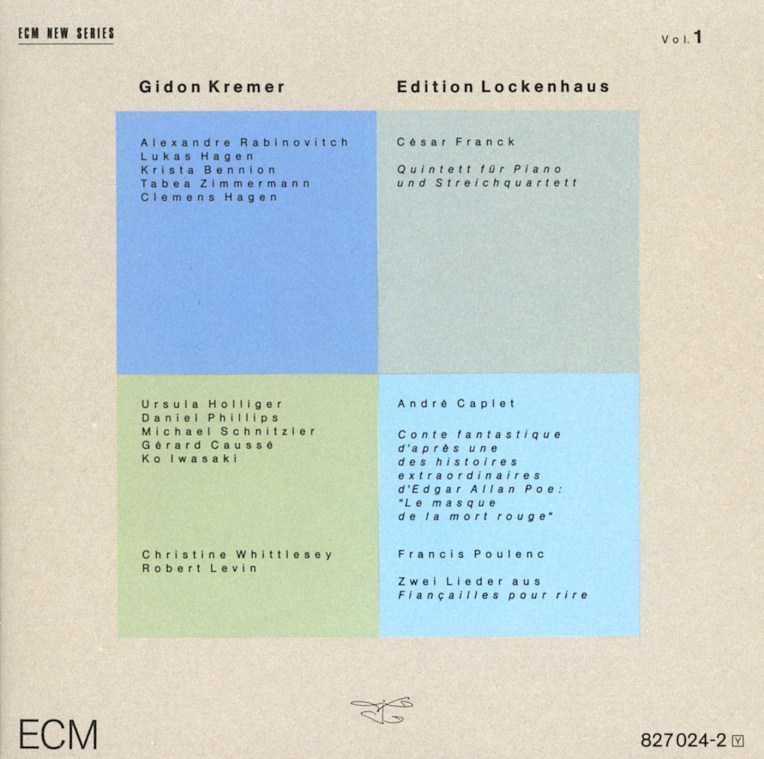
If the first disc was an introduction, then the Quintet in f minor for piano and strings by César Franck (1822-1890) is a rich first chapter. From the opening violin proclamation we are plunged headfirst into the depths of Romanticism proper: the piano as heartbeat, the strings as lifeblood. It is a plaintive world, at once cloudy and broken by light, unnamable except through sound. The piano vies for constant resolution, knowingly situated at the center of an unsolvable debate, sometimes leaping and sometimes falling back into the despair that first gave it meaning. As we tread softly into the distance of the second movement, the young Lukas Hagen displays profound versatility with his clarity of tone and burrowing vibrato. As the central melody emerges into arid light, our ears come into focus as might a pair of eyes. The piano’s high note phrases are like droplets laddering down leaves on a solitary tree. The third movement lays down an almost Philip Glassean ostinato in the strings develops with fractured intensity. The piano promises hope, but settles altruistically into shadow, where pizzicati lurk like a guitar in Death’s hands.

So begins a lush pairing of French and Slavonic works, which offers dramaturgical insight into the festival’s vibrant mentality. The former side of things continues with a curious piece by André Caplet (1878-1925), a composer whose orchestrations of the works of Claude Debussy outshone his own musical visibility. Based on Poe’s “The Masque of the Red Death,” Conte phantastique sounds like Maurice Ravel’s Trois poèmes de Stéphane Mallarmé turned into an opera, stripped of voices, and condensed into a string quartet. Add to this the aquatic brilliance of Ursula Holliger on harp, and you get a truly distinct experience. Holliger plays pianistically and extracts a profound power from her instrument. The music vacillates between the programmatic and the omniscient. Strings jumble together as the masquerade intensifies, the harp descending like Prospero in gracious intervention. A knock interrupts the action, prompting glassine whispers from the violins. Agitation mounts, only to flutter its eyelids for the last time.

Two songs from “Fiançailles pour rire” make for a fine entry from Francis Poulenc (1899-1963). These somber settings grab our attention with their potency. With empathetic effect, soprano Christine Whittlesey shapes every note with locative color. Her dynamics fall like ripe fruit from a tree of implication, caught in the capable hands of pianist Robert Levin. Every last shred of hope is laced with painterly melancholy, leaving only scars to show for its passing.

Leoš Janáček (1854-1928) was an intensely confessional composer, and nowhere more so than in his string quartets, of which we get his first. From the urgent suggestions and biting interjections of the opening movement to the enigmatic veil of the fourth, we are pulled through a diorama of illusory scenery. Clemens Hagen is especially brilliant here, his cello lighting the way through a fog of folk tales, while second violinist Annette Bik provides moments of rhythmic brilliance. The Quartet No. 1 is a blind spot in the Janáček oeuvre. We accept its disorienting illusions without fear of what lies behind them. We hear carriages drawn by spooked horses, the cries of a forlorn father, the hunting calls of an aristocracy in decline. Thus populated by our imaginations, the music brings us closer to our own internal dramas.

After such inescapable opacities, the neoclassical clarity of Igor Stravinsky (1882-1971) comes as a pleasant surprise. Scored for violin, clarinet and piano, these three dances from L’Histoire de Soldat show the composer at an evocative peak. Kremer brings characteristic fire to every nuance. His sonorous gypsy acrobatics are a joy to behold. Clarinetist Eduard Brunner peeks in for the opening Tango, offering constructive support. The beautifully syncopated Waltz holds to its core with enthusiasm, Aloys Kontarsky’s occasional high notes adding confectionary flavor. The final Ragtime brings a mounting complexity to these brief but vivacious utterances.

An enthralling performance of Stravinsky’s Concerto in D follows. Under the passionate direction of Heinz Holliger, the Kammerorchester der Jungen Deutschen Philharmonie springs to life with the opening pizzicato. Noticeable idiosyncrasies abound, such as a strikingly textured moment when the inside of piano is plucked for added effect during the Vivace. The flexibility of the second movement is intensified in hands of such bright young musicians, dancing lithely between pathos and fleeting awareness. Plunked double bass accents punctuate every moment of this graceful interlude. The final movement displays an astute sense of division, especially in the solo cello and its immediate refraction. These musicians bring an almost manic sense of multiplicity to music that is already beyond alive.

Who better to end this portion with than Dmitri Shostakovich (1906-1975)? A far cry from the monochromatic intensities of his quartets, the wonderfully Mozartean waltzes for flute, clarinet, and piano glisten with salon-like ebullience. The interplay between Brunner and flutist Irena Grafenauer makes for a clever listening experience. The second waltz is especially alluring in its ascending harmonies, its last flutters eliciting audible smiles from the audience.

The Two pieces for String Octet op. 11 comprise a more complicated diptych. After a dense opening statement in the Prelude, the lower strings spread out as violins dissolve like mist in the dawn. We get a hint of later Shostakovich in the Più mosso. Its mature balance of aggression and delicacy betrays a forward-looking mind. The final passages writhe in agitated beauty. A solo cello draws a long energetic line, accompanied by pizzicati and distant calls. More dissonant pairings and threats of a fall that never materializes draw us into a tensely mystical finish.

<< Terje Rypdal: Chaser (ECM 1303)
>> Ralph Towner/Gary Burton: Slide Show (ECM 1306)

… . …

Edition Lockenhaus Vol. 3 is excluded from this set (you can see my full review of it here).

… . …

ECM 1347_48

Discs 4/5 (originally Vols. 4 & 5, ECM New Series 1347/48)

Gidon Kremer violin
Thomas Zehetmair violin
Yuzuko Horigome violin
Philip Hirschhorn violin
Kim Kashkashian viola
Nobuko Imai viola
Veronika Hagen viola
Boris Pergamentschikow violoncello
David Geringas violoncello
Julius Berger violoncello
Thomas Demenga violoncello
James Tocco piano
Recorded Lockenhaus Festival 1985 and 1986
Engineers: Peter Laenger, Andreas Neubronner, and Stephan Schellmann

Although one is wont to paint a morose picture of Shostakovich, continues our melodic bridge into the final portion of the set, I think we can hear in these late string quartets especially that within him beat a vibrant heart of passion. Music cannot have been for him so much of an escape as it was simply a voice. We need only cast a careful ear toward the String Quartet No. 14 op. 142 to hear its vibrancy. The distorted jig that works out of the opening crawl is something of an achievement on paper and at the bow. David Geringas at the cello proves to be the ever-present anchor, guiding the quartet as a whole through a variety of registers—from gentle to ecstatic and back again. In the Adagio, his strings throb like ventricles. The more we listen to its words, the less we know of their origins. It is as if they have reached us only light years later, like a star long dead yet still visible. The cello cuts these shadows into a string of glassy shards in the final Allegretto, of which the violins are ecstatic reflections. This movement is more porous and waves its gossamer threads as might a plant to attract insects. Its intimate yet vast cross-pollination achieves something close to transcendence before taking its unnoticed leap into fantasies.

The String Quartet No. 13 op. 138, on the other hand, is a single-movement opus in twenty-two and a half minutes. Its gorgeous beginning unrolls a flat landscape along which a violin comes hopping, not unlike a creature from Vivaldi’s The Four Seasons. Others take up the call in a widening circle of light, launching into a spiral of percussive attacks (which in this performance never come across as declamatory but as clarity incarnate). The congregation disperses as quickly as it came together, leaving solitary voices, though distant, to unknowingly harmonize. And the landscape of mourning through which we have slogged opens itself to a beam of light in the violins,  reminding us that sometimes music matters only where it ends.

The Two Movements for String Quartet add yet another hue. These are more majestic and deftly spun through a slow-motion slalom course of light and dark. The higher and lower strings achieve delicate mutuality, seesawing on a fulcrum of potent stillness.

Czech composer Erwin Schulhoff (1894-1942), a forgotten ideologue-in-arms of Shostokovich, was an intensely dynamic composer. His music lies somewhere between the Russian and Górecki, and provides a fitting cap to an altogether fascinating Lockenhaus portrait. After an exultant introduction, his opus 45 Sextet wanders varicose paths with trembling caution. The violins shimmer like the surface of a moonlit pond in the second movement, under which glide the cello and viola, each an electric eel that lights up the night. In the chambers of this heart, the only blood is a silence that hangs from the trees, gripped like a branch beneath an owl’s talons. Some stellar pizzicato passages in the third movement add hope to our dreams, puncturing the backdrop until it resembles an artificial sky. The final movement is a fractured look back on the first three, a heavy and romantic flower whose weight barely bends the stem, its desires never spoken louder than a whisper.

A high energy and passionate execution make the Duo for Violin and Cello a true highlight of the entire set. Philip Hirschhorn, along with Geringas, navigates a landscape of varying tensions, moving from the snaking opening lines to crunchier motives for a broad, almost orchestral palette. The piece is always flowing in spite of its sometimes-abrupt movements, and is a testament to Schulhoff’s effervescent spirit. Yet it is in the slower passages where we most hear Shostakovich, lingering like a spirit overcoming limitations of time and space.

Pianist James Tocco turns out another star performance the Cinq Études de Jazz op. 58. These inventive pieces draw more upon the rhythmic than melodic colors of the genre. The result is an exposition that is not only delightful fun, but also one that provides foiled insight (especially in the second etude) into composers like Satie and Poulenc who were keyed into popular music idioms. The third etude has the majesty of a Gershwin yet the bleeding colors of the French impressionists, while the fourth is a romp and a cascade rolled into one, leaving the fifth to return full circle with the verve of the first, drawing a lively signature on which to end.

In an interview, Kremer remarks on the difficulties that inevitably arise in putting together such a festival. Quintessential are the tense circumstances surrounding the Franck Quintet, which apparently failed to come together to the musicians’ satisfaction during rehearsals. In spite of this, they managed to pull off one of the most lauded performances of that year (1984). Such is the spontaneity that Lockenhaus creates, encourages, and promotes. This is an exciting limited edition for reasons too numerous to list in full. Not least among them is the fact that the original recordings marked the debut of New Series stars Eduard Brunner, Thomas Zehetmair, Heinz Holliger, and Robert Levin. It is a stream-of-consciousness narrative linked in the fluidity of real-time recollection, the immediacy of which is only heightened by the superb musicianship and live recording. This treasure trove belongs on your shelf.

<< Terje Rypdal & The Chasers: Blue (ECM 1346)
>> Zakir Hussain: Making Music (ECM 1349)

György Kurtág: Signs, Games and Messages (ECM New Series 1730)

György Kurtág
Signs, Games and Messages

Kurt Widmer baritone
Orlando Trio
Hiromi Kikuchi violin
Ken Hakii viola
Stefan Metz cello
Mircea Ardeleanu percussion
Heinrich Huber trombone
David LeClair tuba
Recorded February/March 2002 at Radio DRS, Zurich
Engineer: Markus Heiland
Produced by Manfred Eicher

When the heavenly procession proceeds higher
Then the joyful Son of the Highest
Is called like the sun by the strong,

As a watchword, like a staff of song
That points downwards,
For nothing is ordinary.

–Friedrich Hölderlin, “Patmos” (trans. James Mitchell)

In literary criticism, we throw around our fair share of arbitrary terms. Yet one I stand by, and of which I am especially fond, is “intertextuality,” which refers to the borrowing, shaping, and influence of texts on other texts. Similarly, one can say many things about Hungarian composer György Kurtág. He is a “master of the miniature,” a microscopic craftsman. His language implodes with a hermetic (im)precision. His wit is boundless, unassuming, and unabashedly lyrical. And so forth. But in the end, his sound-world is nothing if not intertextual. For one, we might feel tempted to read the Hölderlin-Gesänge for baritone as an exercise in a less tenable buzzword: deconstruction. Kurt Widmer’s superbly controlled breath wanders from its cradle in search of feet on which to stand, but instead finds a carefully broken ground. Its wavering entrances drop from a cloudless sky. The unexpected appearance of trombone and tuba beget a coarser exposition, proving that Kurtág’s fractures are never twice the same (compare, for instance, to the Kafka-Fragmente). Where sometimes he externalizes the hidden, here he shows us just how fragile the hands of our psyches must be when holding language. These are pieces not with but about words. Therefore, I must respectfully disagree with Thomas Bosche, who in his liner notes says “there is a secret here that is difficult to decode.” Rather, everything about this music is naked.

If anything, it is the ever-evolving opus that is Signs, Games and Messages which presents us with a more enigmatic grammar to parse. These fleeting vignettes for string trio—no less descriptive than their vocal predecessors—shift from playful (“The Carenza Jig”) to plaintive (“Ligatura Y”) in the blink of a galactic eye. The title starts us on the path to understanding: signs are the essence of communication, games the fields in which signs are manipulated. Yet messages trapise somewhere in between. Signs work differently than games, creating a freer vocabulary which, though it may be bound by rules, is not necessarily restricted by them in outcome. One of the most masterful pieces in this respect is “Eine Blume für Dénes Zsigmondy,” which unfolds silently not unlike a flower (an image plain to hear even before one looks at the title—a testament to Kurtág’s flair for the descriptive) while also wilting. In this instance, however, secrets don’t extend beyond the personal, so that every idiosyncrasy of “Perpetuum Mobile” A and B becomes a diacritical mark, leaving only the orthography for us to deduce. Even pieces like the “Hommage à John Cage” crumble before the pantheon of inspiration, as if aware that the only way to bring about their finer implications is to grind them into dust. Yet perhaps all this secrecy simply boils down to subtlety, for even in the stealthy clicks of “Schatten” we may see ourselves reflected.

…pas à pas – nulle part… brings together these same instrumental forces (baritone and string trio) and adds percussion to settings of poems by Samuel Becket, with a sprinkling of aphorisms from the misanthropic French writer Nicolas Chamfort (1741-1794) for good measure. Over the course of—count them—34 parts, this collection draws strings between a fragile politic. From falsetto to whispers, the fantasy-like vocal aesthetic only seeks to enhance the “barely there” instrumentation. Against some intensely emphatic moments, the cello mocks with its self-harmonization, as if to simultaneously beautify and underscore an entire classical tradition. Lively stuff.

This is music that lingers, both within its own shadows and in the recesses of our memory. Unlike some contemporary music, it never feels like a challenge. It is, rather, a mellifluous gesture of hope born from fragments of hatred.

<< András Keller/János Pilz: Béla Bartók – 44 Duos for Two Violins (ECM 1729 NS)
>> Alexander Knaifel: Amicta Sole (
ECM 1731 NS)

Giya Kancheli: In l’istesso tempo (ECM New Series 1767)

Giya Kancheli
In l’istesso tempo

Gidon Kremer violin
Oleg Maisenberg piano
The Kremerata Baltica
The Bridge Ensemble
Recorded December 2000, Festeburgekirche, Frankfurt; July 2003, Pfarrkirche St. Nikolaus, Lockenhaus; June 1999, Festeburgkirche, Frankfurt
Engineers: Stephan Schellmann, Peter Laenger, Markus Heiland
Produced by Manfred Eicher

“I hope that listeners will be touched by my compositions and not confuse my deliberate simplicity with what I consider the most dangerous thing—the feeling of indifference.”

These words from Giya Kancheli—a composer-in-exile who is not “in between,” but rather who inhabits his “outsiderness”—speak for something beyond music, for it is the simplicity of life itself that glows at the heart of his works. Each inhabits the same vast country, as mythical as it is real. Together they are a landscape torn asunder and rebuilt through a passion that only strings, hammers, bows, and the occasional tongue can articulate. In such a country, Time…and again is not only a 1997 composition for violin and piano, but also the sign of a mind steeped in the tea of remembrance. It writes itself into existence with unified declarations, any given sentiment deeper than the last. Violinist Gidon Kremer draws breath from Oleg Maisenberg’s low rumbles at the keyboard, the latter of a storm on an uncertain path. Themes are incidental, their background as present as a thought. Shades of dislocation reveal themselves, sometimes secretly (the allusion to Arvo Pärt’s Spiegel im Spiegel at 4:41 provides a clue). Outbursts forgo catharsis in favor of renewed self-awareness. Flashes of dances and folk melodies paint familial pictures, if only to remind us that we have traveled far.

Yet the singing in V & V (1994) for violin, taped voice, and strings seems to bridge that distance, flowering directly from within us. As orchestra and soloist unravel the deeper implications of that voice, we are ever on the verge of fading with it into the surrounding dust. Persuasion is rare, dynamic contrasts wide, and callings deep. And it is in their vale that the title piece for piano quartet travels in caravan. Maisenberg traces a steadying presence, setting the tone from which the strings may work their way into soft glides and terse spirals. The strings, in fact, seem to inhabit a parallel dimension where the implications of an incomplete statement are the norm (Another allusion to Pärt at 21:57 pulls the threads lost therein through an enigmatic loophole, thereby binding us to a circular breath).

These are ponderous works, never concerned with virtuosity, shying away from injury, stretching out even the densest element into translucence. A challenging program for some, to be sure, but one that can never be faulted for following its own path with the gentle reassurance of a mortal gaze.

<< Susanne Abbuehl: April (ECM 1766)
>> Misha Alperin: At Home (
ECM 1768)

Valentin Silvestrov: Bagatellen und Serenaden (ECM New Series 1988)


Valentin Silvestrov
Bagatellen und Serenaden

Valentin Silvestrov piano
Alexei Lubimov piano
Münchener Kammerorchester
Christoph Poppen conductor
Recorded February 2006, Himmelfahrtskirche, München
Engineer: Stephan Schellmann
Produced by Manfred Eicher

All too often, contemporary classical music is framed as a forward-looking genre, falling under the rubric of “new music,” as if it somehow grew of its own accord in lieu of outdated motives. But then we encounter a figure like Valentin Silvestrov, whose music always seems to look into a watery mirror and tells us that the more this art form progresses, the more it mines the depths of that which has passed. Such is the realization that brings purity his Bagatellen (2005), a set of simple piano pieces that practically weep at the composer’s fingers. Airy at first glance yet overwhelming in their melodic weight, they record rather than create, though they more than diaristic. These are images in constant motion, a far cry from family photos with timeworn edges. Some speak with the clarity of a digital home video, while others drown in the timelessness of grief. Their cyclical structures lend a delicate urgency, one that speaks to the validation of reminiscence as a primary mode of expression. After such quiet, inexpressible splendor, to be confronted with the extroverted qualities of the Elegie for string orchestra (2002) is to experience the trembling heart of something ancient. And as the strings continue their serenade in Stille Musik (2002), we feel an acute suspension. Not of winged flight but of the marionetted body that knows its limits in the grand scheme of falling, never quite sustaining its foothold once found.

A stilling rendition of Der Bote for strings and piano (1996) is the album’s centerpiece, and one of Silvestrov’s most masterful forays into harmony. This distorted Mozartean wind tunnel of cloud and afterlife lies also at the heart of his Requiem for Larissa. And it is into afterlife that we continue with Zwei Dialog mit Nachwort for string orchestra and piano (2001/02). Dripping honey from a ruptured hive, this is music that luxuriates in the full spread of its pathos. As might a drop of ink into water, it opens its tendrils slowly, well aware that without the invisibility of its surroundings its mapping would mean nothing.

It bears noting that the Bagatellen were recorded by chance when, before and after this album’s orchestral sessions, Silvestrov played alone at the piano while the tape (such as it is in the digital age) was running. Although he never intended to contribute to this recording in such a physical way, we can only bow in gratitude that he did. One gets the sense that each fragment is a portrait of his life in miniature. In a world of tiresome postmodern gestures, sometimes we need to wrap ourselves in something so mysterious that it can be nothing but a comfort. Let this be your blanket.

Giacinto Scelsi: Natura Renovatur (ECM New Series 1963)


Giacinto Scelsi
Natura Renovatur

Frances-Marie Uitti cello
Münchener Kammerorchester
Christoph Poppen conductor
Recorded June 2005, Himmelfahrtskirche, München
Engineer: Stephan Schellmann
Produced by Manfred Eicher

Giacinto Scelsi (1905-1988) was among the handful of composers I came to admire early on in my contemporary foraging. His galaxies opened my ears as only Gubaidulina, Ligeti, Penderecki, and Górecki could. Here was another whose ability to translate the instrumental utterance into an experience of integrity and parthenogenetic ecstasy, whose sheer reach of vision and inspiring attention to detail, shaped my impressionable mind into an open vessel. And while Scelsi’s music has been profoundly represented elsewhere (most notably on the Mode label), it was something of a momentous occasion for me to see his name fronting an ECM New Series cover at last.


Scelsi

The present recording is the result of various dedications. There is the dedication of cellist Frances-Marie Uitti, to whom the composer imparted the task of archiving and transcribing his hundreds of hours of improvisations on the ondiola, a monophonic instrument that was his mouthpiece. There is also the dedication of Scelsi himself for making those recordings in the first place, and for letting his mind open beyond the body in some audible form. And then there is the dedication of Christoph Poppen, whose commitment to modern music is superseded only by his oneness with the material he conducts. It is as if he were playing it himself.


Scelsi’s ondiola

The program consists of pieces mainly from his fruitful Third Period (1960-69), of which Ohoi (1968) for 16 strings defines the pinnacle of the larger ensemble works. On the surface, it seems to start from somewhere far beyond the earth, working its way ever so slowly toward us. Yet it doesn’t take long for us to realize that in its microscopic clusters thrums something utterly earthly. Every molecule is a building block to discreet crystals of harmony, which en masse achieve an overwhelming beauty through their collective dissonance. Voices ascend into a realm where screams become language and words are the screams that cut language into pieces.

If Ohoi is a knot, then the lyrical Ave Maria (1966) is the blinding love that unties it. Along with the Alleluja (1970) that ends the program, it comes from the Three Latin Prayers for solo cello. Both are nestled in the fur of larger beasts, picking at lice and ticks unseen. With a finely honed solemnity, they breathe with expansive power, made all the more enthralling through Uitti’s afferent performances. Prayers is by far one of the most arresting pieces ever written for the instrument, and to have two of its three sides in glorious ECM sound is a treasure. Uitti continues that brilliance in Ygghur (1965). Another trilogy for solo cello, this self-professed “autobiography in sound” compresses an orchestra’s worth of statements into a microcosm of gut and wood. With two, sometimes three, voices enhancing one another at any given time, it develops humanly. Yet it is not a conversation with the self, but rather a conversation about the self. Not unlike the throat singers of the Tuvan steppes, Uitti treats the extended techniques therein with an organic rusticity. We can wax technical all we like about microtonal double stops, but in the end we are left with handfuls of nutrient-rich soil.


Uitti

The hapless reviewer is at pains to articulate the sound-world that awaits us in Anâgâmin (1965). Written for 11 strings, it defies categorizations like “modern” and “post-modern,” is neither an example of deconstruction nor of reconstruction. It crawls on its own gelatinous legs with a gait much akin to the album’s 1967 title composition, also for 11 strings, only in the latter the infusions of micro-clusters are even deeper. It is an unbroken string of tension. Bowings grow more agitated, textures denser, and the underline of the lower strings turns gravity inward.

To call this music mysterious would be to do it a great disservice, for it is so internal that we cannot separate it from who we are. Scelsi professes nothing. In being so selfless, his work casts its light on us and us alone. Is this nature renewed, or has the renewal simply been natured? Only we, the individual listeners, can make or break such an arbitrary question. Like the circle above the horizon of Scelsi’s signature we may never know whether it is rising or setting, but we can always be sure that it is singing.

Valentin Silvestrov: Metamusik / Postludium (ECM New Series 1790)

Valentin Silvestrov
Metamusik / Postludium

Alexei Lubimov piano
Vienna Radio Symphony Orchestra
Dennis Russell Davies conductor
Recorded April 2001 at ORF Studio, Vienna
Engineer: Anton Reininger
Produced by Manfred Eicher

“Meta” is a prefix often thrown around without much thought as to its origins. The academic world of which I am a part is especially fond of it. Yet the nuance of “meta” as “transcending” (as in “metaphysical”) is a mistake born of frequent misuse and reinforcement. Its origins lie in the Greek preposition, which means “in the midst of, in pursuit or quest of.” These get us closer to the heart of Metamusik, the title of a one-movement symphony for piano and orchestra from Ukrainian composer Valentin Silvestrov that forms the bulk of the third album dedicated to his music on the ECM New Series. And indeed, the opening proclamation of the selfsame composition already sounds as if it were in the midst of, if not in pursuit of, something. And while I normally find that Silvestrov’s motivic denouements emote more effectively in concentrated settings, in this case I find that the 48-minute running time allows both listeners and performers all the breathing room they need to delineate its finer anatomies. The soloist here is Alexei Lubimov, who first introduced us to Silvestrov in the ghostly recital, Der Bote. His role, however, is neither to lead nor respond, but to inhabit as many particles as he can of the piece’s opening Big Bang. These, he connects through a wavering orchestral environment with planetary care. He opens every note like an ocean in and of itself, ebbing and flowing simultaneously, redrawing the same lines along the shores of unpopulated worlds. It is that rare sound which mesmerizes by way of dark matter and black holes, falling without end into a void of shifting pathos. Whether our eyes are closed or open, we see nothing but the nebulae of our own consciousness, naked and diffuse.

If by now any of us expect to achieve familiarity in the accompanying Postludium, then we need only still ourselves before we are ready to see. The title here is another didactic one. It is Silvestrov’s default modality, the aural afterword to a non-existent referent. In short: an epilogue to silence. And though these same musicians may exert themselves and the composer may labor over the staves that engender the music’s emergence, our experience of it lacks the immediate visceral connection of having performed it. (It is just such a chain of meteoric intentions that binds us to the postlude as “genre.”) In acknowledging an emptiness from which forms all matter, we also know there is emptiness to be squeezed from the tangible, somehow beautiful in the embrace of our acoustic validations. We may float without direction, but Silvestrov seems to say that our voices, the very notecraft of our being, are the only compasses we need.

The power of this music speaks differently to all of us. It is a living force that mimics whatever vessel contains it. It is also a blank page: present yet weightless with meaning. Silvestrov’s is a sound-world of punctuation marks. It is up to us to fill in the words.

<< Helmut Lachenmann: Schwankungen am Rand (ECM 1789 NS)
>> Heinrich Ignaz Franz Biber: Unam Ceylum (
ECM 1791 NS)

Frode Haltli: Looking on Darkness (ECM New Series 1794)

Frode Haltli
Looking on Darkness

Frode Haltli accordion
Vertavo String Quartet
Øyvor Volle violin
Berit Cardas violin
Henninge Landaas viola
Bjøg Værnes cello
Recorded August 2001 at Sofienberg Kirke, Oslo
Engineer: Jan Erik Kongshaug
Produced by Manfred Eicher

Much like its bellowed cousins, the accordion’s mystique lies in its duality. With one hand the chords are laid, with the other a melody is wrought. Yet just as easily those roles may switch, intermingling in a constant process of renegotiation. Although they share the same breath, pushed and pulled through the same lungs, there is always a separation between the two, so that when they are brought together in a program like this, they seem to unfold, one division after another, into a greater unity. This refraction of audible intent renders any introspection attempted by the musician a moot endeavor, seeking instead a window of opportunity in which to curl one’s fingers about the contours of an unspoken promise. In this way the accordion becomes a psychological instrument, providing more insight into its handler than psychoanalysis ever could. Through this window we can see that Frode Haltli’s is a mind of depth, conviction, in service to the music he plays. For his first solo album, the young Norwegian puts his bellows to four solo compositions and one for chamber ensemble.

First, the solos.

Bent Sørensen’s title study in decay is the perfect place to open our ears. It eases us into an uneasy sound-world, where light is darkness and the vocal becomes instrumental. The result sits somewhere between a declamatory statement and an uncertain question. From this we are awakened to different shades of vulnerability. Haltli shows no fear in exposing these snatches of tenderness, proving just how delicate a line he walks.

PerMagnus Lindborg’s abiding interest in all things electronic shines through in his Bombastic Sonosofisms. The sound is more pointillist here, and seems to peer into even darker recesses of the psyche. While it does require some astounding virtuosity, a shimmering, cosmic veneer obscures any possible wow factor that might get in the way of the listening. Where Sørensen drew in arcs, Lindborg favors the erratic, nesting us in a field of right angles.

Take away the “Per” and you are left with Finnish composer Magnus Lindberg and his Jeux d’anches. This piece thrives on identity crises and rhythmic leaps, gathering into its purview a life unfulfilled yet resigned. It is a puzzle unfolding piece by piece, only each is of uniform shape and size. In such great numbers, however, one is baffled to put them together. Haltli accomplishes the daunting task of forming a cogent picture out of them all.

Asbjørn Schaathun’s Lament explores the accordion more than any of its companions. From growling low notes to piercing highs, it surrounds a turgid middle ground. It is a church organ being born, coming into self-awareness as the music marks its slow passage through muddy terrain. Notes coincide, double, and fragment, seemingly unable to strike out on their own and achieve true independence. In the end, they are bound by air.

Then there is the program’s centerpiece, the gagaku variations of Maja Solveig Kjelstrup Ratkje, which pairs the accordion’s fullness with another: the string quartet. In this configuration, violins melt into Haltli’s richer sound like ghosts hidden in between its folds. The contrast between brief pizzicato passages and the more sinuous notes of the accordion cut through the very tensions they define. Some probing questions from the high strings bring our focus away from the sky and back to the soil, and in the end paint us with their own language. If this were a play, we would be the ones on stage, and the performers would be watching, waiting for us to speak.

The accordion is not an instrument one is used to hearing in a classical setting, and yet here it blossoms without generic borders. In Haltli’s hands, it attains a level of depth rarely heard. His performances are bold and detailed, as if he were holding a magnifying glass to a newspaper photograph in an attempt to show us the dots and blank spaces it is made of. The album’s title tells us all: rather than looking into darkness, we are looking on it, for the naked eye will never uncover the core of that which is infinite.

<< Zehetmair Quartett: Robert Schumann (ECM 1793 NS)
>> Arvo Pärt: Orient & Occident (
ECM 1795 NS)

Bach: Die Kunst der Fuge – Keller Quartett (ECM New Series 1652)

Johann Sebastian Bach
Die Kunst der Fuge

Keller Quartett
András Keller violin
János Pilz violin
Zoltán Gál viola
Ottó Kertész cello
Recorded May 1997, Altes Stadttheater Eichstätt
Engineer: Peter Laenger
Produced by Manfred Eicher

In the end, we self-perceiving, self-inventing, locked-in mirages are little miracles of self-reference.
–Douglas R. Hofstadter, I Am a Strange Loop

One is tempted, perhaps, to experience the fugue as a puzzle. In that puzzle are strings of numbers unraveling from a central rope, even as they spin into one. Yet when listening to Bach’s Art thereof, and especially in the Keller Quartett’s sensitive hands, we find that even our best similes are weak and arbitrary, for this music, this expression of internal power, is alive. By no means universal, it takes a different form every time to every listener. We in turn can take comfort in knowing that the final triple fugue was never finished, for into it the composer wove his signature B-A-C-H (B-flat-A-C-B) theme, as if signing off on a lifelong document. Thus is The Art of Fugue an “emancipatory work” in the estimation of Hans-Klaus Jungheinrich, who in his accompanying essay goes to great lengths to demythologize the unrealistic pedestals upon which the work has been placed. The instrumentation was never resolutely determined, though it was likely intended for the nascent pianoforte. The string quartet presents a compelling solution. In this respect the Kellers push the envelope, varying tempi considerably and in doing so point us to a humbling truth: namely, that if this was to be Bach’s most lasting statement, it had to be invisible.

One with a deeper background may train a musicological magnifying glass to every weaving line, but these ears are more interested in the effect than the cause. And of that effect, I am at pains to say anything worthwhile. Although its movements comprise a moving target of speeds and densities, a constant hum runs through them. It is something we feel rather than hear. Cellist Ottó Kertész is particularly well suited, evoking the slightly metallic continuo of yore with a tinge of intangibility. (This, I think, explains the curious production, which favors distance and cavernousness—it is not historically informed, but seeks to inform history.) That being said, the music is nothing if not expressible. It might very well be Bach’s swan song, and therefore the culmination of his craft, but I prefer to hear it as a homecoming, a clearing of clouds to let fall the darkness that nourishes all artists, paling into the light that embraces them once they’re gone.

One day, we encounter this music and it sings to us. But then the voices stop mid-phrase, as the Kellers have preserved them, and suddenly the galaxy unravels, leaving us floating in the stagnant pool of all silence. Listen, and you know there is truth in the number:

One.

<< Roscoe Mitchell: Nine To Get Ready (ECM 1651)
>> The Hilliard Ensemble: In Paradisum (ECM 1653 NS
)