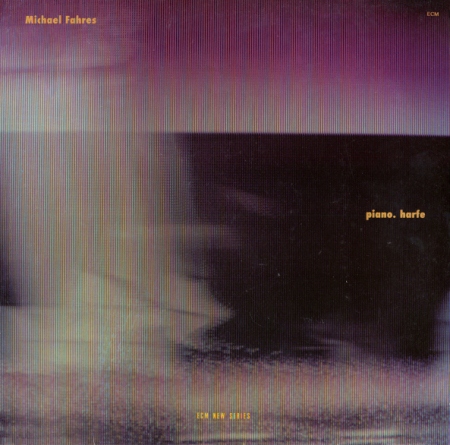
Michael Fahres: piano. harfe (ECM New Series 1281)

Michael Fahres
piano. harfe

Polo de Haas piano
Gyde Knebusch harp
Paul Godschalk live electronics
Hans Stibbe live electronics
Digital Recording, August 1982, Tonstudio Bauer, Ludwigsburg
Engineer: Martin Wieland
Produced by Manfred Eicher

German-born, Netherlands-based composer and sound installation artist Michael Fahres flirted with ECM for the duration of this single album only. Simply titled after its two central instruments, this vinyl-only rarity gives healthy intimations of the electro-acoustic depth for which he is now so highly regarded.

We find in both of these early pieces a sense of self-directed wonder, as if one’s reflection has come to life and danced a version of the future. The low note that spawns a taped echo in piano sets just such a tone. A crack in the window of our desires spiders its way to the edges, falling into the garden when it has nowhere else to go. Every shard sprouts legs and trips through the underbrush. Foxes and moles—each a clouded memory returning with soft vengeance—nip at their ankles like herding dogs. The live piano stares into a digital mirror. Thus confronted with its mortality, it grows still, like a foot poised above a landscape of eggshells. Behind closed eyes, it falls into looped miracles. The jangle at the periphery, never clear before, is now crystalline. Voices tremble, a flock of rubber bands falling one at a time into a synthetic gallop. Veins resonate, each the tube of a televised existence. Your hand passes through childhood like the illusion it is, a canopy of little legs kicking above its Alvin Lucier-like current. They crawl over one another as high as they can, growing more distorted with every promise, until there is only shadow to hold you.

But then, in harfe, strings are touched by flesh, each unfolding a city map. Streets hum like birth. (The atmosphere reminds me of a Zeena Parkins performance I once attended as a teenager: an undercurrent of restless comfort bedding naked scrawls.) Between watery ascents and muddy stumbles, someone speaks: “The voice of reason is the one that achieves distance.” There is a beating of the string, subtle and barely noticeable. A knock at the door of a museum where only the debris of earthquakes is shown. A meditation without eyes, a prickling of hairs, an imploding temple. There is something sacred implied here. Its transcendence melts into a single piece of candy, placed on a serpent’s tongue. The trees buckle their knees in guttural pathos, every torn root a string plucked by green hands. The sky awakens, pouring its flood into a restorative nightmare. Finis.

In spite of my unsettling impressions, I would never characterize this album as such. There is something hopeful about its inventiveness. In exploring the contours of ruin, it holds itself aloft, away from those whose only desire is to crush music into a dark key. The lock to that key is nowhere but here, floundering like a fish cradled back into a sea of twilight.

<< Jack DeJohnette’s Special Edition: Album Album (ECM 1280)
>> Chick Corea: Voyage (ECM 1282)

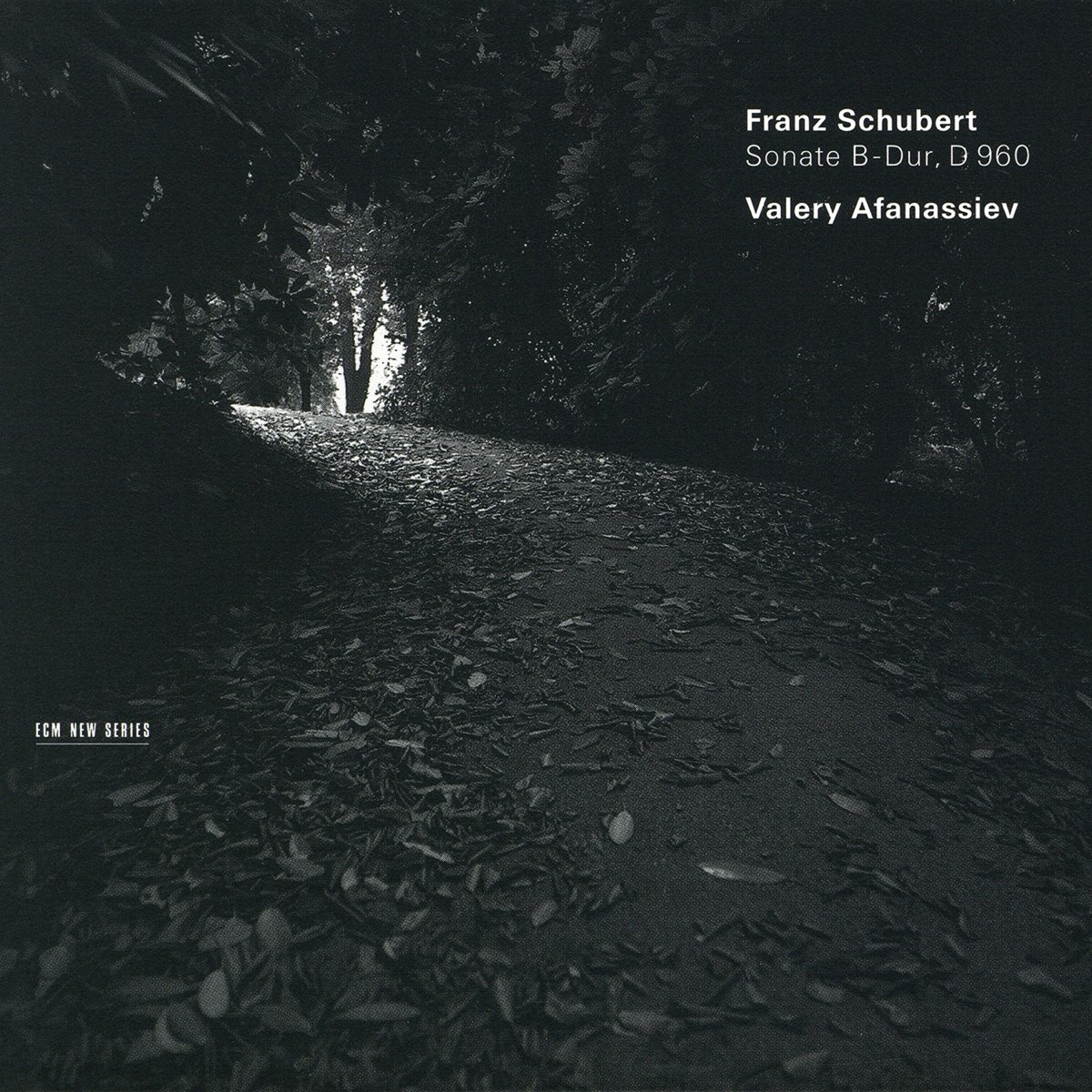
Schubert: Sonate B-Dur op. posth. D 960 – Edition Lockenhaus, Vol. 3 (ECM New Series 1682)

ECM 1682

Edition Lockenhaus, Vol. 3:
Franz Schubert: Sonate B-Dur op. posth. D 960

Valery Afanassiev piano
Recorded July 1985 at the Lockenhaus Festival
Engineers: Peter Laenger and Stephan Schellmann
Produced by Manfred Eicher and Gidon Kremer

With over 100 recordings of Franz Schubert’s last sonata, one might ask: Why another? Valery Afanassiev gives us a resounding answer with this performance from the 1985 Lockenhaus Festival (a last-minute substitution for a canceled trio), bringing to glorious life what Bryce Morrison has called “the pianist’s Hamlet.” As a swan song, the B-flat Sonata may easily be read as a tarnished mirror where our mortality balks at its own reflection. Yet in the listening, I am wont to hear not the looming specter of death, but rather the fluttering of a curtain letting in the light. Like a piece of fruit rotting in reverse, the B-flat Sonata awakens to find that its decay was but a dream, that it is as crisp and as ripe as the day it was born.

As it stands, Afanassiev’s interpretation is broader than most and respires through a powerful dynamic range. In his liner notes the Moscow-born pianist speaks of absolute truth, and of how the low flutter of the opening movement—what he calls “the most uncanny trill in the history of music”—grounds us from our high horses. For him, this sonata is a monstrous thing, the shock of horror behind a veil of art. He also critiques himself for leaning on sentimentality, though I think we can forgive his brazenness, for it is of the gentlest kind.

The first movement begins where many would end: in utter suspension. Every rustling is a bird falling into an abyss of yearning, where memories collide with the yet to be. Voices bubble up from that seismic trill, shielding us from our own expectations. Afanassiev’s punctuations are expectorate and his ascending lines as lilting as they are forlorn. Implications of perpetual motion interlock their fingers with weighty pauses and distant considerations, resolving into stained-glass intimations of “Adeste Fideles.”

The formidable Andante—a Largo in Afanassiev’s hands—whispers in half-light. He builds this slow prance brick by ephemeral brick, as if through a haze of recollection. At eleven and a half minutes, it is among the longest versions on record, and clothes a heart that one finds beating even more nakedly in the piano works of Valentin Silvestrov. Reason enough to own this disc.

After the stark wash of this silent film, we are thrown into the sparkle of a Technicolor spectacle in the Scherzo before sliding down its rainbow into the final Allegro. Here Afanassiev’s deep breath acts as emotive bellow, seeming to blow dust at the feet of the finale, which remains frozen in mid air—racing but never quite touching ground, flapping but never quite lifting off.

Despite the breadth of his tonal spectrum, Schubert is not a composer who works in gradations, but in densities. The light is always there. We simply see or less of it depending on how porous the scrim of the music becomes. Some sections, like the opening leitmotif, are latticed; others are tightly woven baskets; still others, nets through which any hope may pass unfiltered. It is music that works in ages, by turns dancing and hunched on the gnarled cane of infirmity.

If Schubert speaks in tenses, then Afanassiev is a master conjugator. This is a rendering at once flagrant and conservative. A valuable performance to have on record.

<< Paul Giger: Ignis (ECM 1681 NS)
>> John Abercrombie: Open Land (ECM 1683
)

Harald Weiss: Trommelgeflüster (ECM New Series 1249)

1249

Harald Weiss
Trommelgeflüster

Harald Weiss percussion, voice
Recorded September 1982 at Tonstudio Bauer, Ludwigsburg
Engineer: Martin Wieland
Produced by Manfred Eicher

Looking at the title of Harald Weiss’s only album for ECM, which means “Drum Whisper,” leaves us with no mysteries regarding what we are about to hear. This simplicity of purpose is characteristic of a composer whose modest discography has sadly left him little represented outside of his native Germany. As percussionist, vocalist, writer, and actor, Weiss brings a love of the theater to his performance style and world, which here is overrun with a thousand bare feet along the dusty earth. Weiss is also well traveled, and from his widely cast net hauls a wealth of local influences onto the vessel of his craft. And so, while flashes of Ramayana re-creation and Peking opera paint Trommelgeflüster as a disjointed pastiche, in the context of this recording these references take on a life of their own. Each percussive cell circles itself into an Ouroboros of change in a larger chain of being. Between the steel drummed steps and melismatic chants of Part I and the darker territories of Part II, which begin as if an offshoot of “Lucifer’s Farewell” from Karlheinz Stockhausen’s Samstag aus Licht before spreading into a diffuse palette of outbursts and whistling dreams, Weiss renders something intensely organic toward the concluding twang, steady and distant like a jaw harp in the mouth of providence.

A wonder of an album that defies categorization in the most pleasant way, Trommelgeflüster has the makings of a ritual, even as it uses itself as a stepping-stone into non-ritual realities, where regularity is but the dream of a nomadic soothsayer. The music skirts the edges of consciousness, even as it plumbs the depths of wakefulness.

Weiss is the recipient of numerous awards, and was just coming into prominence when Manfred Eicher decided to put him into the studio. The result is an intriguing session, and an artist, not be overlooked.

<< Charlie Haden: The Ballad Of The Fallen (ECM 1248)
>> Ralph Towner: Blue Sun (ECM 1250)

Frances-Marie Uitti / Paul Griffiths: there is still time (ECM New Series 1882)

there is still time

there is still time

Paul Griffiths speaking voice
Frances-Marie Uitti violoncello
Recorded August 2003 at Rainbow Studio, Oslo
Engineer: Jan Erik Kongshaug
Produced by Manfred Eicher

“I shall th’ effect of this good lesson keep
As watchman to my heart.”
–Ophelia

Subtitled “scenes for speaking voice and cello,” the fortuitous meeting of music writer, novelist, and librettist Paul Griffiths and cellist Frances-Marie Uitti that resulted in there is still time wears no masks. Using only the 482 words available to Ophelia in Shakespeare’s Hamlet, Griffiths works with a vast magnetic poetry set on a refrigerator that runs on Uitti’s often-haunting improvisations. It is neither Ophelia nor Griffiths who speaks, but someone in between, a voice not so much twice removed as one once excavated and once buried. And while the backstory to this recording is fascinating in and of itself, its aural language is such that one may enter it blind and emerge from it fully sighted, if not the other way around. Griffiths treats language as a precipice from which to hang rather than as a spine from which to sprout nerves and muscle. Thus does the music’s grip deepen our mood with each weakening finger.

“I cannot remember” are the first words to awaken our senses, “when this is all over” the last before silence engulfs us: a brief life forgotten, regained at death’s door. Only the future can be held close, swaddled in opaque linens as it slips slowly from our hands into Uitti’s mournful fundaments and harmonic firmaments alike. Her reverberation becomes a stencil, and breath the paint sprayed through its glyphic wounds, where plasma congeals at the hinges of revelation. Griffiths’s intonations are fatigued, as if from the effort of articulation alone. In “think of that day,” he asks, “what should I fear?” A question that slithers thence, only here we get one of its clearest answers: what the voice fears is that “you,” the other to whom is being spoken, will say nothing. Such trepidations are thematic, hidden like Hamlet behind the curtain, stabbing at the wrong enemy. This troubled air returns for “how I wish,” over which the cello looms, a commentary on a commentary. Again, Griffiths speaks as if the very effort were much to bear, as if utterances of desire were the sole means of undoing it. The “you” remains silent, stagnant like a pool in some deserted landscape where the wind is never missed beyond perpetual cloud cover.

Griffiths doesn’t merely read his words, but comports them. If there is such a thing as method reading, then via his delivery we find an especially potent example in “call from the cold.” Its poetry draws a series of contact points between the body and the intangible, between expectation and inception, between the cello’s snowy scrapings and the listener’s suspension of disbelief. The narrative then sprouts bittersweet fruits from the buds of “touching,” skins of hope peeling away from flesh of horror. The melodious “there it was” measures the past like some vast diurnal clock compressed into the mouth before being expectorated in but a fleeting conjuration of lips, teeth, and tongue as Uitti draws whisper-screams in the air with her sobbing. Where the sunrays once frolicked at dawn, we find traces of “the bells,” no longer immortal yet still haloed by a lost cause, fading beyond every closing ear-lid. We are alone with their voices “some where,” bound by a capsule of parallel selves and places split by the prism of a single morpheme. The internality of it all is lifted once “for you” flies off the tongue with urgency. As much a question as it is a challenge, it emotes like an animal peering through the foliage at its own reflection, cello rasping, a gravelly Echo. “I did look” further slices open memory—an impossible dissection, it seems, for only more memory lies within, beating to the rhythm of an extended arco meditation, drawing out this operation to its most healing conclusion yet.

These points of contact are at once a source of expression and a denial of the self-generation implied by spoken words, such as in “my one fear.” The verb “touching” rings truest here and surfaces vividly as a means of grappling with the unknown. The nameless other is drawn in whispers and time, through which all is revealed, vulnerable and contrived. At this point, I cannot help but extend a line to King Lear, for it is speech over which the maddening patriarch harbors the deepest anxiety. Without Cordelia’s obligatory words of praise, for instance, he is but a blank page before her. (We hear this again in Lear’s deprecation: “She hath…struck me with her tongue.”) Similarly, in “the door,” the voice fears finding what it searches for: the mouth shut like a gate to possibility. In light of this, Griffiths’s final words (every detail captured by the superb engineering) are perhaps the most Ophelian. They lie in wait beneath the surface of the lake, grabbing hold of refractions baited on the cello’s fish hooks, pulled like a sheet from a sleepless bed.

Uitti’s ability to sound as if she were at once reacting to the words and birthing them is captivating, as are her wordless interludes, four of which trail-mark the program. The recitations strung between them make statements by enhancing the fallibility of statements, each utterance a fantastic implosion. Griffiths’s circadian rhythms are sometimes off center, sometimes regular to the point of apathy, and in being so speak with immediate effect. This is, perhaps, why Uitti’s art meshes so organically, for it pulls at the same frayed edges in hopes of unraveling a color, a texture, and a pattern unfamiliar to them both. Whether or not that unfamiliarity extends to us depends on our willingness to touch the text as a living sound, so that by the end we are renewed through impermanence, redrawn in monochrome by a parallel self in the here and now. What we fear is not to receive but to give and be received.

My own humble gift, then, is an offering cast from those same 482 runes:

his breath does honour to the words
his countenance more patient than a soldier’s
cold letters compos’d in noble fashion
in them I know doubt

it is not for naught
that the lady is here
the daughter of a lord
nay, of an owl

there’s a saint
larded with false affection
please, fear him not
for he hath bore it all for you

what is a courtier’s mind but a steward
held on the tongue of a king
a watchman in the closet
touching his eye with tragedy

belike the lady rises on this day
and becomes snow
on a mountain of dead flowers
as grace is deceived by remembrance

quoth she,
“steep is the way to dalliance”

a scholar’s tongue is his sword
it becomes a play
a chorus of tragedy
a shroud of charity

lock’d by his command of speech
the key to which is
something of a piteous fear
in our rich perusal

I know not where
I twice observ’d
the maid unkind and shaking
like a glass mould blasted by the night

I was lost
promis’d to another
when these eyes
wither’d in fennel perfume

down a thorny path
the music treads
long o’erthrown by horrors
young and beauteous

quoth she, “take them again
these flaxen columbines
and cast them by your deathbed
for they will keep you heavenly”

some may call it sweet
I call it an oath to memory

Heinz Holliger: Induuchlen (ECM New Series 2201)


Heinz Holliger
Induuchlen

Anna Maria Bacher recitation
Albert Streich recitation
Sylvia Nopper soprano
Kai Wessel countertenor
Olivier Darbellay horn
Matthias Würsch percussion
Swiss Chamber Soloists
Heinz Holliger conductor
Recorded 2007-2010
Engineer: Andreas Werner
Produced by Manfred Eicher

Ever since the star-covered Scardanelli-Zyklus found its way into my life, Heinz Holliger’s increasingly fractal compositions have been a vital part of my personal development. As a teenager, I felt such an intense connection to the early ECM Holliger releases that I used an online message board (back when such things were novel) as a venue to proclaim Holliger as one of the most important composers of the century. I was immediately met with a smattering of criticism, of which one comment remains lodged in my mind: “Though Holliger is a talented musician and, I admit, an interesting composer, I don’t think his colleagues or family members would ever consider him ‘important.’” In my youthful naïveté, I accepted this contention and shied away from mine. And yet now, some fifteen years later, I find my initial reactions being confirmed by critics and friends, all of whom have long recognized the significance of his multifarious deeds. I relate this anecdote not to underscore my prophetic abilities, nonexistent as they are, but only to direct the listener’s attention to the depth of Holliger’s output and the uncanny ways it has of getting under our skin over time.

This is an album of many things: silence and half-language, shadow and movement, liminality and articulation. Through a technique that Holliger calls “vocal masking,” potentially straightforward motives are turned in on themselves, such that by the end our memories speak not in solos but in delicate aftershocks. Continuing the composer’s interest in marginal voices begun in such works as Beiseit is Puneigä. Reading like a well-compressed Scardanelli dissected under a microscope, it begins with the Walser-German poetry of Anna Maria Bacher (recited by Bacher herself) followed by Holliger’s spidery and biologically attuned settings thereof. In the absence of English translations, these pieces are left for the rest of us to emote on their own terms. And perhaps this is for the best, as Holliger has always seemed to approach a given text from the inside looking out, such that we need never concern ourselves with the arbitrary contours of its many surfaces. Either way, in them one can hear the cellular approach of his craft, an approach that seems as interested in unpacking language as it is in dismantling it. One hears this especially in the rattles and hums of the Zwischenspielen, each a wondrous division of spatial relationships that is incidental only to itself. Rotating through a series of watery reflections (“Wen mu plangät), earthly contacts (“Hêif!”), and reverberations (“Der Toot”), images stick out with the quiet interruption of a rock protruding from the glassy sheet of a waterfall. Within each rests the lock to a key.

Albert Streich’s poem “Induuchlen,” also prefaced from the author’s lips, provides a verbal runway into the soaring title piece for countertenor and natural horn. Holliger’s work gains facets the more its performers are reduced in number, and here one finds a wealth of such demands. Yet these are handled with such grace that one might think the results were entirely improvised. The countertenor is asked not only to plumb the depths of his baritone register, but even to step beyond them into some uncanny quotidian realm of, I daresay, Wagnerian anxiety, for indeed the music’s deepest secrets are, not unlike the sword in Die Walküre, fully visible yet can only be dislodged with the attendant promise of self-destruction. Here is a matrix of auditory gravel in which tremolos gasp, where overlays misalign, and from which arises a golem who seeks clouds more than land.

Embracing these throated reliefs is a frame of chamber works. Toronto-Exercises speaks in aphasic mumblings, which is to say in a vocabulary at once molecular, somnambulate, and exquisite. Scrapings, flaps, shivers, and overtones carve a broken chain of stone through this gorgeous little quatrain of forested sounds, while the fractured virtuosity of the percussive Ma’mounia deciphers its own fingerprints one vein at a time, releasing the screams and helical motives squirming therein.

Holliger’s is the music of a soul in search of those intricate gifts that enliven our bodies and minds. It is highly idiosyncratic and yet speaks of a wide-reaching science. For the sake of analogy, one might say he sits comfortably between Lachenmann and Kurtág, singing through the sometimes haunting immediacy of the former while holding close the latter’s appreciation for the miniature. In doing so, he gives us a medium of the anti-essence, wherein breathes only the potential for quiet rupture. He speaks more than any other composer I know, and yet never proselytizes.

Like an Italo Calvino novel, this music ladles over us a pathos we have long forgotten and through which we only now find a chance to embrace anew.

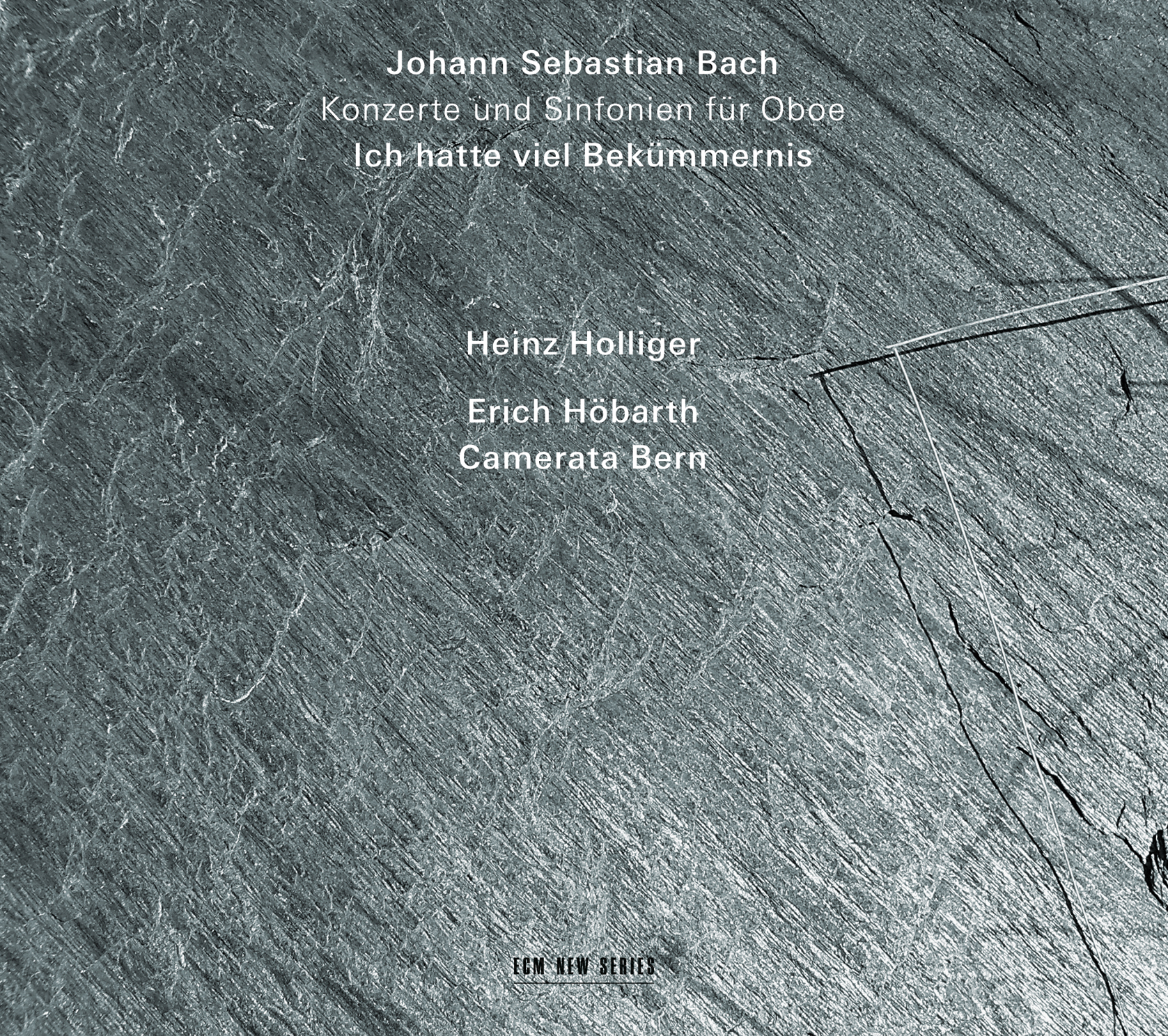
Johann Sebastian Bach: Ich hatte viel Bekümmernis (ECM New Series 2229)

Johann Sebastian Bach
Ich hatte viel Bekümmernis

Heinz Holliger oboe
Erich Höbarth violin, direction
Camerata Bern
Recorded December 20-22, 2010
Radiostudio Zürich
Engineer: Andreas Werner
Produced by Manfred Eicher

Of
a tree, of one.
Yes, of it too. And of the woods around it. Of the woods
Untrodden, of the
thought they grew from, as sound
and half-sound and changed sound and terminal sound…
–Paul Celan, “And with the Book from Tarussa” (trans. Pierre Joris)

On October 4th, within an hour of having listened to this album for the first time, I went out for lunch, when I noticed a peculiar sight. There, sitting at an outdoor table, was a hermetic figure with a Monarch butterfly resting on his outstretched hand. How could I not engage him in a conversation? The man, I soon found out, was Rolfe Sokol, a local fixture in Ithaca, New York for over a decade and one of the most sought-after violin teachers in the area. Rolfe had saved the injured butterfly after spotting her on the side of the road. During her recovery from two crimped legs and a damaged wing, she hardly left him. As Rolfe animatedly informed me, drawing his story as he might a bow, the butterfly spent most of her time on his shoulder or perched on a finger, living off the sugar water he provided. When she had recovered enough to make short flights, he took her to the park, where she greeted strangers but always returned.

Rolfe and I inevitably turned to topics musical. After being regaled with stories of some of my favorite violinists and composers, I asked if he was familiar with ECM Records and with Heinz Holliger’s latest Bach recording. Though the answer was no on both counts, he did tell me how the butterfly reacted most positively, fluttering her wings and “stamping” her forelegs, whenever he or his students played Bach. Upon hearing this, I immediately asked for Rolfe’s address and later sent him a copy of Ich hatte viel Bekümmernis to aid in the butterfly’s recovery, for the title—which translates to “I had much affliction”—seemed appropriate for one in a stage of healing. It is in that spirit of rejuvenation that I discuss the music at hand.

Rolfe’s butterfly

With his usual blend of humility and cogency, Holliger gives us in his liner notes an informed account of these recordings, which together represent a pastiche of reconstructions, arrangements, and restorations from, to recapitulate his quoting of Hegel, the “fury of disappearance” that so befell much of Bach’s oboe literature. Such unrecoverable shadows will have cast themselves over many a Baroque enthusiast and so bear no redrawing here. In any case, after listening to this recording almost once per day since receiving it so kindly from a faraway friend, I have become as intrigued by where its beauties are going as by where they came from.

Holliger’s latest for ECM is so rich it’s almost unhealthy. Three sinfonia introductions, two from among Bach’s cantatas and one from an Easter Oratorio, form its crux. Some music simply stills us, and the darkening swells of “Ich hatte viel Bekümmernis” (BWV 21) constitute such music. Holliger and violinist Erich Höbarth intertwine like birds in slow motion, each leaving a trail of something forgotten, blazing across the sky in a slow-moving fire, by which only one’s fate can be written, ever out of reach but always readable in the light of divine countenance. But where my description may be overblown, Holliger’s technique never is, always held in check by a profound reserve that allows the music to flourish on its own terms. Bach’s mournful reflection sings with a palpable retrograde, and from its first draw pulls the center of our being toward that of some unnamable other.

Of the four concertos offered here, the c-minor for oboe, violin, strings and basso continuo (BWV 1060) is the most humbling. Joined front-stage by the nimble fingerwork of Höbarth, Holliger details a multivalent sound palette. And in the d-minor (BMV 1059) his legato phrasings explore parts of the surrounding orchestral architecture that most oboists would neglect to see, let alone articulate. The slow, waltz-like quality of the Adagio is an especially profound wind-up for the heavenward lob of the Presto that concludes. Holliger looks even more inwardly in the A-major concerto (BWV 1055). Here, he luxuriates in the subtle turns of phrase and moments of tension that seem to stretch between orchestra and soloist and dance across water with every trill. And then there is Bach’s reworking of an Alessandro Marcello concerto, which glistens with poised ornamentations. A lively dance in the Presto percolates with bewitching charm as Holliger populates every interstice with his inextinguishable passion.

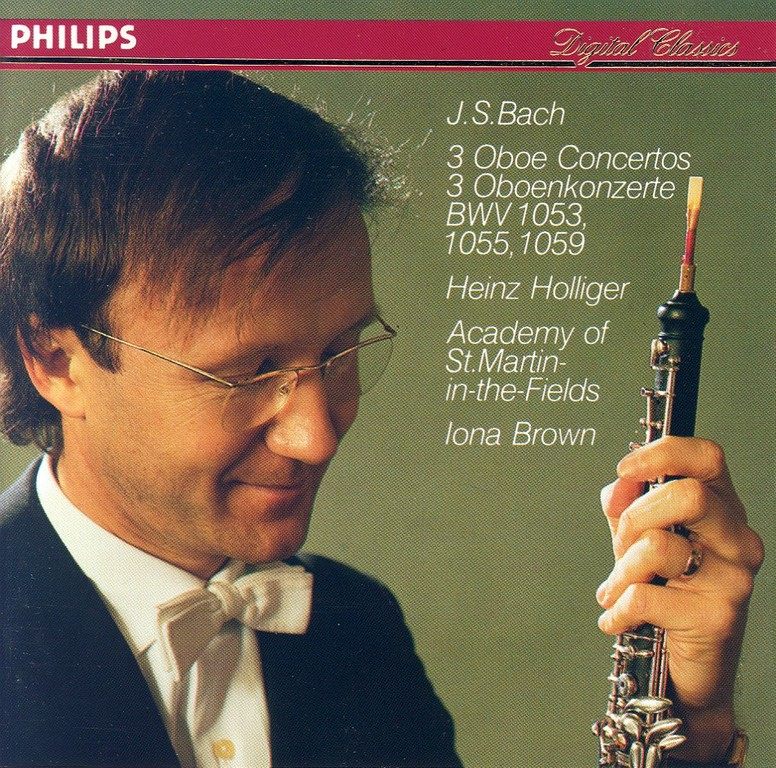
As one who believes the assembled performers to be a virtually uncriticizable combination, I risk redundancy in praising their results as a scintillating tour de force of tempo, timbre, and above all vocality. In light of the already wondrous 1982 recordings of BMV 1055 and 1059 on Philips with the Academy of St. Martin-in-the-Fields (back during the latter’s hyphenated golden age), this could never be anything less than superlative in its complementary light.

Yet one notices also the striking differences between the two. ECM’s recording, while bright, explores this music’s deeper colors, balancing the swirls of refinished wood with an expertly miked continuo. Holliger’s playing has rarely sounded so earthy, so focused on its ephemeral task. These are not reimaginings but reawakenings. And while tempted, I hesitate to use the term “benchmark recording,” as it would speak of its interpretive possibilities as having been branded in time, checked off on the never-ending tick sheet of Bach recordings.

It is also tempting, following Hans-Klaus Jungheinrich, to think that “all roads lead back to Bach.” Yet rather than see Bach as the endpoint to a musical funnel that cuts across histories and geographies, we might better witness the avatar of a composer whose gestures of humility brought to fruition a sense of openness. We do well to resist painting Bach as a Universalist. In search of a alternate analogy, I return to the butterfly. Monarchs are known for their annual 2500-mile migration. Contrary to popular belief, no single pair of wings survives the entire journey. In essence, the group is a kaleidoscope of constant regeneration that returns a different entity from when it left. Like those roving splashes of black and burnt orange, Bach’s music itself travels in a constant state of regeneration, such that every fresh performance, every pair of ears newly enchanted, spreads its own venation of appreciation.

Two weeks ago I ran into Rolfe for the first time since our initial meeting, only to discover that his lepidopteran companion had not survived the cooling Ithaca climate in time to hear this album, but that when he received it he did play it for her. And so, in the interest of continuing this chain of memorial, which began with the death of Bach’s favored pupil (fresh in the composer’s mind when penning the titular sinfonia) and which is linked by Holliger’s loving dedications to the memories of his brother, Eric, and friend Gabriel Bürgin, if you ever find yourself in possession of this jewel of an album I hope you might also take a moment to remember Rolfe’s butterfly, who I like to imagine now rests contentedly on Bach’s shoulder, her proboscis no longer necessary for the music of the spheres that will forever sustain her.

Heiner Goebbels: Eislermaterial (ECM New Series 1779)

Heiner Goebbels
Eislermaterial

Ensemble Modern
Joseph Bierbichler voice
Recorded live October 1998 at Hebbel-Theater, Berlin
Engineer: Max Federhofer, SWR
ECM Records co-production with Ensemble Modern, Südwestrundfunk, Deutschlandfunk

“Fear is a false expression.”
–Hanns Eisler

Hanns Eisler (1898-1962) is the subject of Heiner Goebbels’s fascinating homage, which has become as beloved as the music that inspired it. Eisler was the third protégé, after Berg and Webern, of the Schönberg dodecaphonic school, and a German expatriate who fled with close friend/collaborator Bertold Brecht in the 1930s to the United States, where he would go on to compose two Oscar-nominated film scores (1943’s Hangmen Also Die!, for which Brecht also wrote the script, and None but The Lonely Heart one year later). Just as he was settling into his exile, however, Eisler was deported (he was among the first to find his name on the Hollywood blacklist), but not before a series of benefit concerts—sponsored by Aaron Copland, Roger Sessions, Charlie Chaplin, Igor Stravinsky, and Leonard Bernstein, to name an illustrious few—were given to raise funds for his defense. Virgil Thomson, writing for the New York Herald Tribune, said of the final program on 11 March 1948:

The impressiveness is due less to any profound originality, as in the case of his master, Arnold Schönberg, or in that of his sometime model, the German-language works of Kurt Weill, than to his graceful and to his delicate taste. Eisler’s music, whether the style of it is chromatic and emotional, diatonic and formalist, or strictly atonal in the dodecaphonic manner, always has charm. It has charm because the tunes are pretty, the textures bright and light, the expressive intentions thoroughly straightforward and clear. Eisler is that rare specimen, a German composer without weight. He uses no heaviness, makes no insistence.

When Eisler returned to East Berlin he penned the GDR’s national anthem amid a spate of intense musical activity, culminating in a Faustian opera that was characterized by Neues Deutschland as “a slap in the face of German national feeling” and therefore never completed. After the death of Brecht, Eisler’s disillusionment intensified and plunged him into depression, during which time he breathed his last.

Eisler and Brecht, 21 March 1950 (Bundesarchiv)

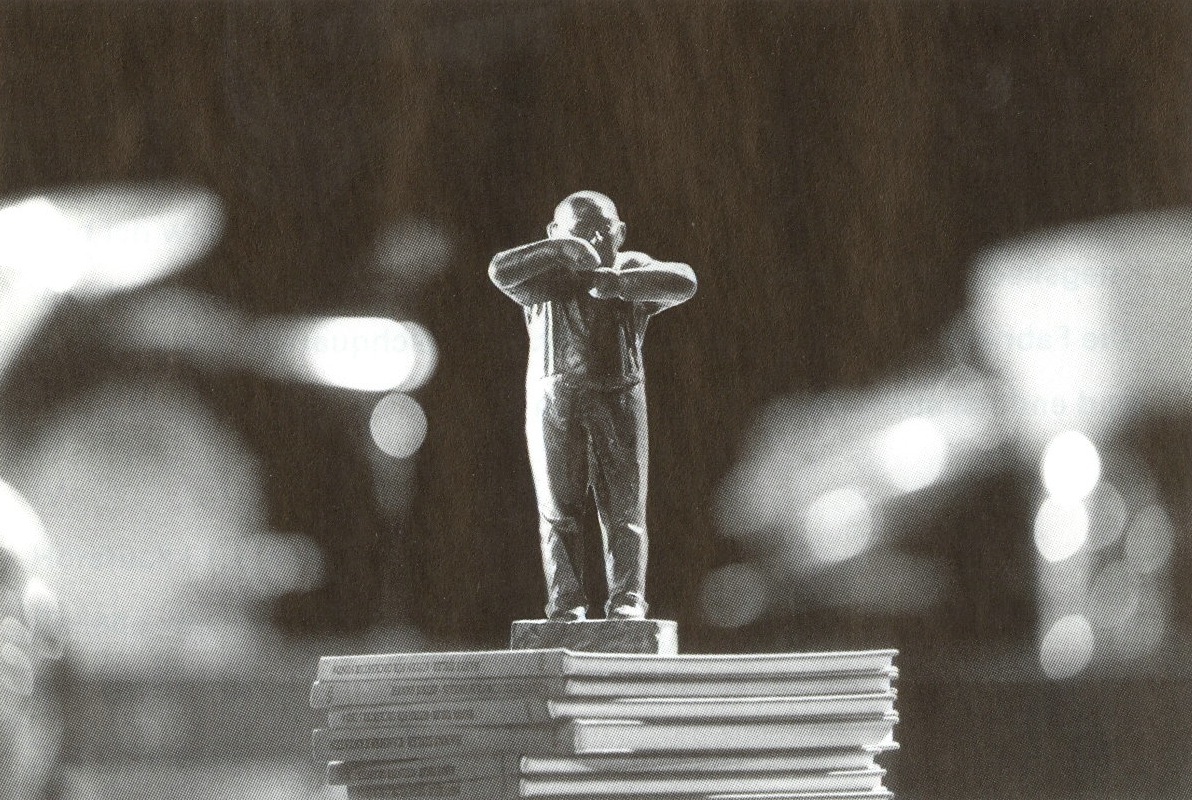
The dramaturgy of Eislermaterial calls for a small statue of its namesake to be placed at the center of the performance space: the surrogate conductor, standing in a field plotted like some gridless Go board. Befittingly, Eisler’s compositions make up the piece’s entirety. The resulting “assemblage” uses his many voices as raw materials for a tribute that shuns ideological heavy-handedness in favor of a bittersweet portrait comprised of lieder and relatively unknown instrumental pieces. The latter are artfully arranged and performed here by the discerning musicians of Ensemble Modern, who crack open the kinetic energy residing within. Of these, Suite for Septet No. 1 provides particularly delightful insight into this eclectic mind, while a fragment for string quartet is rendered all the more moving for being juxtaposed with a turn from his Orchestral Suite No. 3, which sounds like a big band falling down a flight of stairs. Wonderful.

Eisler statue, up close and in situ (photos by Matthias Cruetziger)

Surrounded as these are by nine of Eisler’s songs, they take on more than mere interludinal quality, rather embedding themselves like nodules of concentration. Eight of these are settings of poems by Brecht. Tones range from patriotic (Children’s Anthem) and nostalgic (And I shall never again see) to proletarian (Four Lullabies for Working Mothers), and cover such themes as adaptability (The Grey Goose), the visibility of privacy (Mother Beimlein), renewal (Of Sprinkling the Garden), and fatalism (War Song). On Suicide unfurls the set’s most pensive backdrop, both lyrically and musically:

In such a country and at such a time
There should be fewer melancholy evenings
And lofty bridges over the rivers
While the hours that link the night to morning
And the winter season too each year, are full of danger.
For having seen all this misery
People won’t linger
But will decide at once
To fling their too heavy life away.

A verse by Peter Altenberg closes the set with a melancholic picture of resignation: “Eventually, longing dies, too, / as blossoms languish in a cellar / waiting daily for a little sun.” The interpretations are sometimes augmented by stark contrasts, such as the scratchy free jazz solo of The Grey Goose and the morose rubato of Mother Beimlein. Singer Joseph Bierbichler makes no attempt to sing like Eisler and instead brings out subjective and endearing performances that are as genuine as they are vulnerable. Goebbels also includes two “Audio dramas,” making use of clips from the Eisler archive in true Glenn Gould fashion. In these we are treated to his thoughts on sound, culture, science, and contemplation, evoking an age of black and white imposed upon a world of horrid color.

The comprehensive booklet for Eislermaterial includes an interview with Goebbels, who credits Eisler with having jumpstarted his life in sound. Certainly, one need hardly look deeply to see the affinity. Not only did Goebbels find his own Brecht in Heiner Müller, but both he and Eisler have successfully united politics and music in such a way that one finds them impossible to separate in the listening and likewise to dilute in the thinking. Eisler was more than a Marxist cog with a creative streak, and no one is better suited than Goebbels to tell that story to its fullest. This is the most “filmic” of Goebbels projects and lends itself wisely to an aural and textual world bound by an undying love for theatre. A masterpiece on all counts and a crowd favorite among fans and newcomers alike.

<< Valentin Silvestrov: Requiem for Larissa (ECM 1778 NS)
>> Keith Jarrett Trio: Inside Out (
ECM 1780)

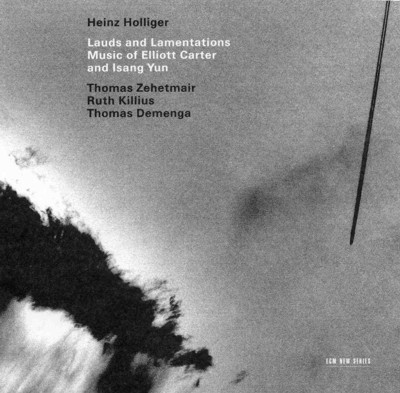
Lauds and Lamentations – Music of Elliott Carter and Isang Yun (ECM New Series 1848/49)

Lauds and Lamentations
Music of Elliott Carter and Isang Yun

Heinz Holliger oboe, English horn
Thomas Zehetmair violin
Ruth Killius viola
Thomas Demenga cello
Recorded September 2001 and February 2002 at Radio Studio DRS, Zürich
Engineer: Stephan Schellmann
Produced by Manfred Eicher

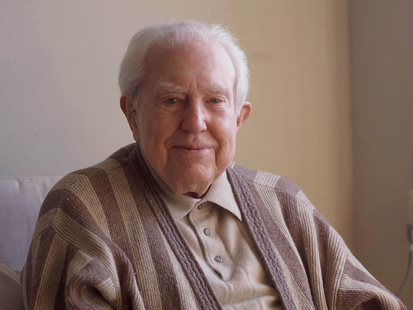
Elliott Carter is the Benjamin Button of contemporary music: the more he ages, the more youthful he seems to become. At the time of this writing, he’s still going strong at 102. That being said, his is not an endeavor to overcompensate for a fading mortality, but rather a deeper exploration into a key aesthetic of his entire output: possibility. What that possibility looks like depends entirely on the whim of the moment, the colors of scoring and performance that mark his oeuvre at all stages.

Elliott Carter (photo courtesy of The Arts Fuse)

The Oboe Quartet of 2001 is a quintessential example of Carter’s tightly wound exuberance. While distinctly “modern,” there is something downright fun about the piece. It is playful, inventive, and positively bursting with life. And who better than Heinz Holliger to act as its heliocenter? Here is a musician who not only plays the oboe as if it were a part of him, but who also brings a singular admiration for Carter to light in every measure. The quartet is a peanut gallery of moods, some meditative and others jarring, each more fascinating than the last. The final passages show especial and intensive concentration. After this 17-minute chunk of gravid whimsy, the 4 Lauds (1999/1984/2000/1999) for solo violin pat the cheeks of our comatose inner children into wakefulness. Each has its center—be it a note, an atmosphere, a statement, or a phrase—from which emanates a fresh start. A 6 Letter Letter (1996) for English horn in F scales a modest cliff, reaching at last with its final hand-crawl the horizontal plane it seeks. The tongue-in-cheek Figment (1994) for cello alone unfolds like a beautiful lie, for which its companion, Figment II: Remembering Mr. Ives (2001), provides gorgeous contrast with its lower microtonal vowels and high-pitched consonants.

Isang Yun (photo courtesy of Boosey & Hawkes)

The pairing of Carter with Korean dissident Isang Yun (1917-1995) is more than circumstantial. Theirs is an inexplicable sort of affinity. Where the former elicits winsome optimism, the latter drowns us in ceremony. Piri (1971) for solo oboe solo is a discipline in and of itself. Spurred by Holliger’s focused tone, it spins themes from the thinnest of fibers. This deeply internal sense of space and accumulation is expanded in Yun’s own Oboe Quartet of 1994, which skitters sideways like a crab on sand. Over three densely packed movements it starts in collective naivety before falling to its knees amid the slowed air raid sirens at its center. A potentially lucid finale is hinted at through a memorable trill shared between oboe and violin, only to crack under the pressure of earthbound agitations.

For the two oboe quartets featured on Lauds, we must thank Heinz Holliger, who asked both composers to write pieces for this neglected configuration, as yet “unchallenged” since Mozart. Both receive their world premiere recordings here and glisten with the golden seal of any benchmark achievement. The musicians on Lauds are all ideally suited to the material and its “linguistic” stumbling blocks. Thomases Zehetmair and Demenga (both ECM mainstays) and Ruth Killius (violist of the Zehetmair Quartett) round out the limitless talents of Holliger in a program that is sure to yield many new discoveries for years to come.

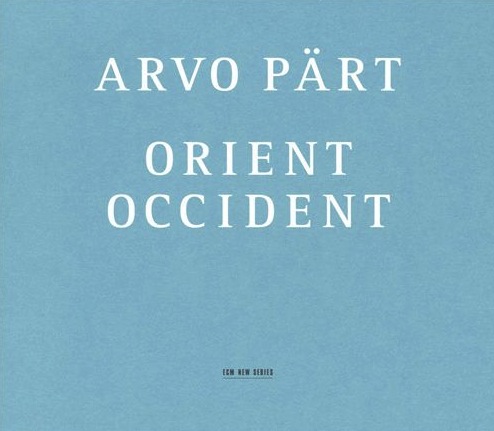
Arvo Pärt: Orient & Occident (ECM New Series 1795)

Arvo Pärt
Orient & Occident

Swedish Radio Symphony Orchestra
Swedish Radio Choir
Helena Olsson soprano
Tõnu Kaljuste conductor
Recorded May 28 – June 1 2001, Berwaldhallen, Swedish Radio, Stockholm
Engineers: Jan B. Larsson, Anders Hägglöf, and Rune Sundvall
Produced by Manfred Eicher

The name of Arvo Pärt has become something of an institution in the consumer culture of classical music. The “New Spiritualism” heralded by such seminal recordings as his Tabula rasa and Te Deum crystallized a sentiment that listeners were craving in the ruins of a postmodern malaise. Yet with this music came a host of expectations: it was supposed to heal us, guide us to an inner light, and provide an inexpensive and convenient means of achieving (temporary) peace. It was something to rely upon, a sonic friend that would never leave us. In believing this, however, we began to lose sight of our own powers and the tremendous dependence we were placing upon recorded media to wrestle with moral dilemmas in our stead. Beautiful and, yes, spiritual though these media are, they can never be a substitute for the enlightenment we read into them.

The frame of Orient & Occident captures the dark side of Pärt’s compositional moon. Stand too close to it, and its darkness overwhelms; too far and it becomes a mere block of shadow. Wallfahrtslied (Pilgrim’s Song), a German setting of Psalm 121, positions us at a median distance and allows us to appreciate the best of both worlds. Composed in 1984 in memory of the composer’s close friend, Estonian director Grigori Kromanov, and since revised for men’s choir and strings, it is a harrowing slice of emotion. The music seems to grit its teeth in a slow, seething discontinuation as voices lay themselves at the orchestral altar. Strings try to remain passive, yet cannot help but break free from their subordinate position with cries of supplication. Before long, they stretch themselves into the thinnest of layers, through which one may see the translucence of the “self” and the “other” and acknowledge that the same light passes through and gives both substance.

The seven-minute title composition, penned in 2000, is for strings only and continues the path that Pärt first began laying with Psalom and Trisagion. It is a grand statement, to be sure, but works its effect through tiny sonic miracles and primes us for the sojourn that awaits us in Como cierva sedienta (1998), a Spanish setting of Psalms 42-43 for women’s choir and orchestra. Exquisite winds recall 1989’s Miserere and rock like a cradle for soprano soloist Helena Olsson’s spiraling invocations. This is music firmly entrenched in its surroundings, while also content to break free from its compulsory resolutions. Strictly choral passages add pastoral unrest. Words tumble out of their own volition, filled with outbursts and infectious proclamations. Like the soul in this final Psalm, downcast even in the light of salvation, I realize that I fall into traps only of my own making. Every time I pull myself out of one, I am reminded that sounds like these are more than incidental to that struggle. Rather, they embody it to the fullest, a collective reminder of the physicality of living experience and the lessons it provides.

The title of Pärt’s eighth ECM album makes me think of colonialism and its feeble justifications for subversion. That being said, I don’t think this is what the music is about. It deals instead with the gap that links these two words and the sacrifices that fill it with song. It is the blood flowing through that emptiness, and we the plunger pulling back to suction out the contagion of enslavement that prevents us all from staring into the face of love.

<< Frode Haltli: Looking on Darkness (ECM 1794 NS)
>> John Surman/Jack DeJohnette: Invisible Nature (
ECM 1796)