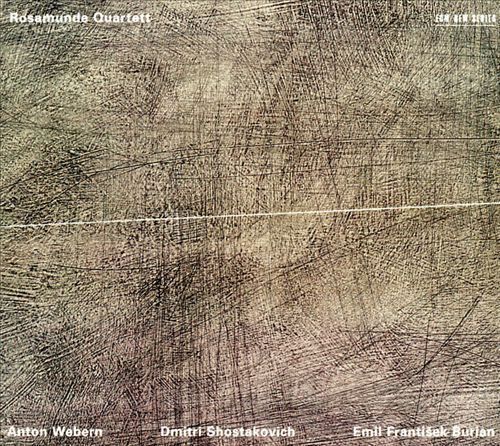
Rosamunde Quartett: Webern/Shostakovich/Burian (ECM New Series 1629)

Rosamunde Quartett
Webern/Shostakovich/Burian

Rosamunde Quartett
Andreas Reiner violin
Simon Fordham violin
Helmut Nicolai viola
Anja Lechner cello
Recorded December 1996, Stadttheater Eichstätt
Engineer: Markus Heiland
Produced by Manfred Eicher

The Rosamunde Quartett began its increasingly fruitful ECM relationship with this lyrically conceived disc, which brings together one of the twentieth-century repertoire’s most widely played and recorded pieces (Shostakovich), one not so widely played (Webern), and one relatively unknown (Burian).

Although Anton Webern penned his Langsamer Satz in 1905, it would not be performed until nearly six decades later. One of many such single-movement string quartets produced at the behest of teacher Arnold Schönberg, it stands out for its balance of ergonomic contours and emotional fragility. In its attempts to gain purchase in the wake of a crumbling Romanticism in which the composer still found rooted value, the piece arches its back like a bridge across a gaping intellectual chasm. The result is an emotive stomach crawl that is quite visceral to hear and, I imagine, even more so to play. Through a series of languid turns, signposted by Ravel-like use of pizzicato, it carries the listener across a tundra of harmonies. It is its own inner fire, the instability of an art in and of being. The transitional agitations throughout are reactive rather than reactionary, and seem to gasp in slow motion toward an incomplete resolution.

Written in a three-day fervor following his diagnosis with polio, Dmitri Shostakovich’s String Quartet No. 8, op. 110 (1960) is a bidirectional memorial, pointing one finger to a world being crushed under the weight of totalitarianism and another to the self caught in the middle. Structured around the intimate pedal point of the composer’s initials—DSCH—and filled with allusions to many of his own works, its power is expressed through a protracted implosion in which not only our ears, but also our philosophical fantasies, come to be implicated. The opening Largo is one of modern music’s most honest statements. Characterized by a sinuous tenacity and burnished chording, its shifts in key and height are painfully organic. By the time of this release, the piece had already made an ECM appearance in orchestral costume on Dolorosa. As a quartet, however, it remains wiser to the score’s vast internal tensions. From the fibrous links and buzzing viola of the Allegro molto to the surprisingly ambulatory Largo reprise, the current version heaves with all the tears of its turbulent milieu. The call of the Allegretto is written off here not with the usual trill, but a restrained waver, and the pizzicati are so biting that one can almost feel them in the chest. The ever-mysterious viola solo is handled with the utmost delicacy as the violins recede farther than I have ever heard. The sustained violin note that follows echoes like tinnitus, a siren of historical malaise that slices through the mind. The staccato attack of the penultimate movement is not so much dramatic as it is traumatic, and in being so makes the resolved chords ring like a scar undercutting the healing process with the acrid fear of recurrence. My standard of reference for this seminal piece has always been the Lafayette String Quartet’s fantastic 1993 rendition on Dorian Recordings, and I must say that here we reach a new level of craftsmanship.

The Rosamundes finish with a name likely unknown to most. In addition to being a composer, Emil František Burian (1904-1959) was a singer, musician, poet, actor, journalist, and playwright. Described as a “one-man Czech avant-garde,” Burian was a strident communist whose primarily theatrical activities throughout the twenties and thirties served as mouthpiece for his leftist leanings. After surviving three German concentration camps, during which time he managed to put together a forbidden performance or two, he returned to his homeland, where he left a lasting mark in the comingling worlds of theatre and politics. His String Quartet No. 4, op. 95 was written just after the war. Though new to this listener, it reads like a synthesis of the Webern and Shostakovich: combining the former’s elegiac veneer with the latter’s tortured soliloquies. Its promises are fleeting, its dances icy and dense. Like a forgotten bottle of wine opened at long last, it contains a host of flavors locked at the peak of their historical creation.

This album is yet another example of how ECM New Series continues to revive the tried and true as no other imprint can. Of the many fine string quartet recordings offered, this is an ideal place to begin.

<< Christian Wallumrød Trio: No Birch (ECM 1628)
>> Brahms: Sonatas for Viola and Piano (ECM 1630 NS
)

Eduard Brunner: Dal niente (ECM New Series 1599)

Eduard Brunner
Dal niente

Eduard Brunner clarinet
Recorded October 1995, Propstei St. Gerold
Engineer: Peter Laenger
Produced by Manfred Eicher

Swiss clarinetist Eduard Brunner has appeared on such ECM albums as Kurtág’s Hommage à R.Sch. and Kancheli’s Caris Mere. With this fine disc, at last he gives his instrument its due glory in the spotlight, or should I say the shadows. Brunner’s extended technical precision and superb breath control amount to a humble program of contemporary selections that are all about the destination. Virtuosity is merely a means to getting there.

Isang Yun’s Piri is an extended saturnine call. It is as if the clarinet itself takes in and expels its own breath without human assistance. One could hardly ask for a more fitting introduction neither to the album’s sound-world nor to Brunner’s instrumental acuity. A longtime part of his performance repertoire, Piri instigated a friendship between performer and composer that lasted until Yun’s death in 1995. Dark sustained tones lead into flashes of light, which echo through the lofty ceiling of Propstei St. Gerold in nimble footsteps. The piercing quality of long-held notes gets behind the skull and awakens the brain. In those notes are cradled exquisite overtones for the careful ear. The piece’s many glissandi, mocking vocal qualities, and overblowing tell a potent dedicatory tale. As a “prayer” to incarceration (the travails of which Yun was no mere observer), its thread continues to hold strong.

Written for Brunner’s teacher Louis Cahuzac, Igor Stravinsky’s well-regarded Three Pieces for Clarinet Solo introduces some of the instrument’s lower timbers. With these, the music becomes more rhythmically discernible. We begin to feel agitation and weightiness, much in contrast to Yun’s relatively ethereal traumas. Brunner appends to this Stravinsky’s previously unpublished Piece for Clarinet Solo, jotted in the margin of a telegraph in April of 1917 and dedicated to Pablo Picasso.

The highly malleable Domaines pour clarinette seule of Pierre Boulez gives Brunner ample room in which to flex his melodic muscles. Equal parts rest and work, these twelve short pieces thrive in half-breathed reverie.

While Karlheinz Stockhausen’s In Freundschaft exists in versions for many solo instruments, in its present incarnation its birdsong-like qualities are enhanced. This potent dose of sunshine starts off delicately enough, played as if on separate instruments. Every note seems to peek around a corner and scamper before it is found out. A brilliant composition and evocation thereof.

Giacinto Scelsi’s Preghiera per un’ombra gives us another interior monologue. Veiled in its titular shadow and structured by the composer’s enchanting idiosyncrasies, it is suffused with marked changes in emotional climate.

The title of Helmut Lachenmann’s Dal niente (Intérieur III) means “Out of nothing.” And indeed, much of the music consists of forced air with mere hints of notes. Depressed keys plunk like marbles on a frozen lake, while the occasional note screeches above the solace. The sound is downright saxophonic, made all the more so for its metallic undertone. Each breath is different than the last, and shows Brunner’s command even further.

The album is meticulously conceived. The first half is structured around ambulatory bodies, minds, and personalities, while the latter half is more “spiritual” and descriptive. The music wiggles past our expectations, sharing with us its nightmares and fantasies alike. Brunner’s style reminds me very much of Heinz Holliger’s (as a point of reference, his oboe rendition of Piri can be heard on Lauds and Lamentations), for he brings a similar sense of depth and technical attention to his playing. Dal niente sets a challenging bar for contemporary clarinet recordings, one not to be surpassed in the foreseeable future.

<< György Kurtág: Musik für Streichinstrumente (ECM 1598 NS)
>> Jean-Luc Godard: Nouvelle Vague (ECM 1600/01 NS)

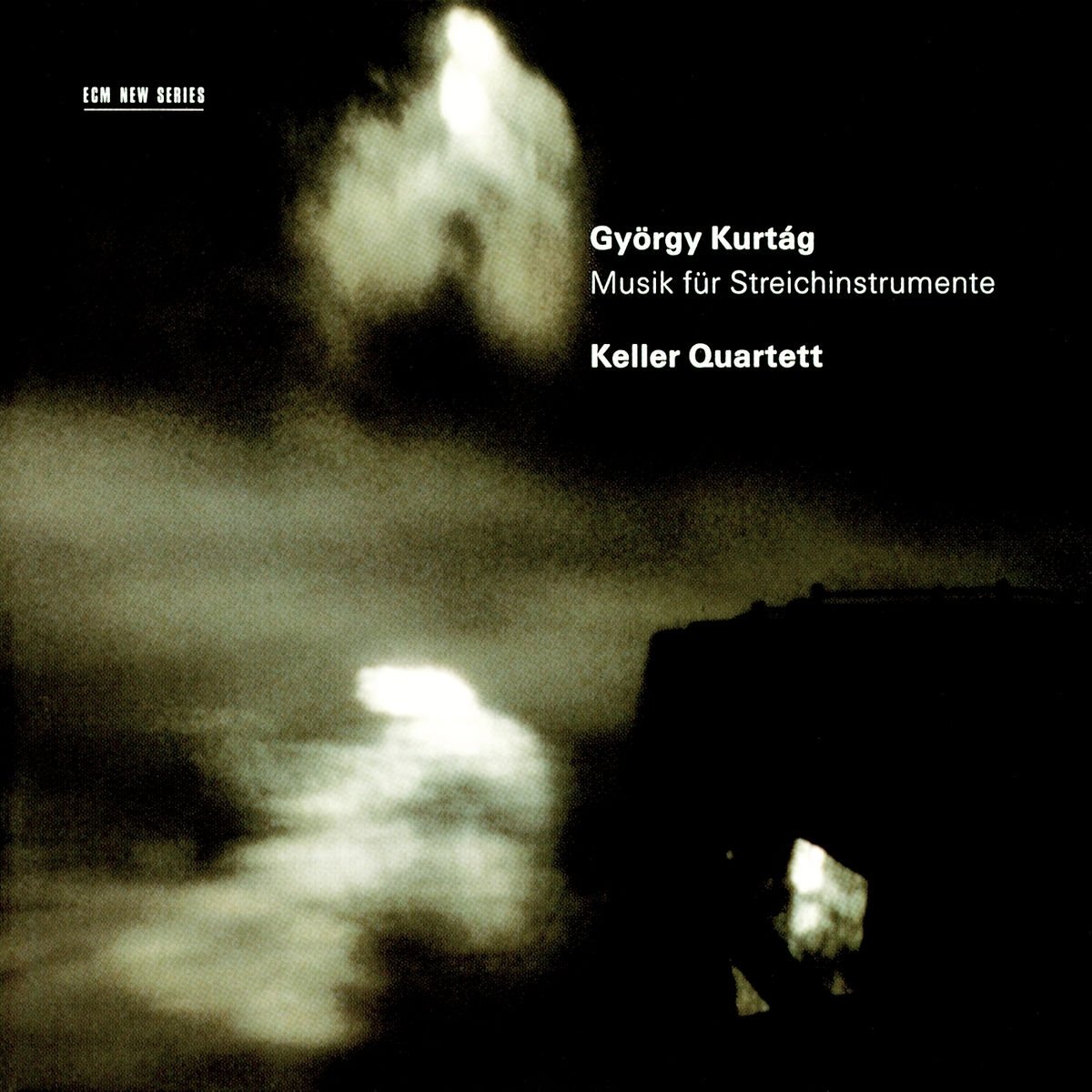
György Kurtág: Musik für Streichinstrumente (ECM New Series 1598)

MUSIK FÜR STREICHINSTRUMENTE

György Kurtág
Musik für Streichinstrumente

Keller Quartett
András Keller violin
János Pilz violin
Zoltán Gál viola
Ottó Kertész cello
György Kurtág celesta
Miklós Perényi cello
Recorded November 1995, Casino Zögetnitz, Vienna
Engineer: Peter Laenger
Produced by Manfred Eicher

“To work with him is, simultaneously, very beautiful and very hard. Because he is always moving, because there is no wrong and right. He demands that one lives in the music, from moment to moment. And that’s what we’ve learned from him: whatever we play, to live in that music.”
–András Keller on György Kurtág

With all the rhetoric these days about “macro” effects—be they economic, intellectual, or social—the music of György Kurtág remains a treasure trove of microcosmic delights. Packed with allusions and personal musings galore, Musik für Streichinstrumente gives us a stack of intimate letters through which to pore and discover new sentiments every time. From the whispered beginnings of Aus der Ferne III (1991) for string quartet, we find ourselves in the shadow of something even more ephemeral than the shadow. So, too, in the highly concentrated Officium breve in memoriam Andreae Szervánsky (1988/89). Kurtág’s block structure allows us to concentrate on each element on its own terms, as in Ligatura – Message to Frances-Marie (The Answered Unanswered Question). The Frances-Marie in question is Uitti, whose innovation and mastery of extended techniques allowed her, with the use of two bows, to enact what two cellists share here. It is a downright cosmic swelling, inhabited by the ghost of a distant star whose death reaches us light-years after the fact. It is not the prototype but the topotype, and cuts a fine cross-section of its own pathos. In its reprised form at the album’s conclusion, we get the mysterious appearance of a celesta (played here by Kurtág himself) in the final two measures.

Quartetto per archi (1959) is Kurtág’s Opus 1. It begins in fragments of awareness and structure, and bleeds through stages of insistence, call and response, and other delectable sporadica. As an organism, it is bound to the details of its own outcome as they are mapped out along the score and fleshed through practiced performance. Yet even in the latter, there is a sense of collapsed time in which the fleeting gesture becomes the primary mode of expression.

The twelve “microludes” for string quartet under the dedication Hommage à András Mihály (1977/78) attend to this process of collapse most attentively among the selections gathered for this program. Mihály was one of Kurtág’s earliest proponents, and Kurtág expands upon a motivic string from his cello concerto. These pseudo-variations span the gamut of the quotidian and the terse, the intertextual and the improvised, the urgent and the indifferent, so that by the end they cohere into a more lucid realization. The illusion of permanence is articulated through every bowing of a resonant string, which by nature must be finite in order for it to have begun.

The members of the Keller Quartett all studied with Kurtág at the Franz Liszt Academy of Music in Budapest, during which time they formed as a group and turned not a few heads with back-to-back wins at Europe’s most prestigious string quartet competitions. Their commitment to the moment results in a ponderous, nuanced performance.

Kurtág cannot be said to be accessing a continual ethereal voice from which he literally or figuratively plucks a few choice utterances. In describing the effect rather than creation of those utterances, he acknowledges both the light and that which is cast through its blockage. In every moment there is a galaxy, and in every galaxy a pocket of space in which this music continues to reverberate.

<< Maneri/Morris/Maneri: Three Men Walking (ECM 1597)
>> Eduard Brunner: Dal niente (ECM 1599 NS)

Arvo Pärt: Litany (ECM New Series 1592)

Litany

Arvo Pärt
Litany

The Hilliard Ensemble
David James countertenor
Rogers Covey-Crump tenor
John Potter tenor
Gordon Jones baritone
Tallinn Chamber Orchestra
Estonian Philharmonic Chamber Choir
Tõnu Kaljuste conductor
Lithuanian Chamber Orchestra
Saulius Sondeckis conductor
Recorded September 1995, Niguliste Church, Tallinn
Engineer: Teije van Geest

Drawing from the writings of St. John Chrysostum (c. 349-407), whose prayers for daily hours comprise the font from which Arvo Pärt anoints this musical setting, the Estonian composer spins a soft thread of light with limited information. Like the equally visceral settings of Tchaikovsky and Rachmaninoff before him, Pärt’s is utterly moving and uniquely colored by the sensitivity of his instrumental writing, such as listeners have encountered in his Miserere and Passio. The voices of Litany seem to arise out of their orchestral surroundings as if they have been hiding within it and are only now choosing to reveal themselves. Such is the effect of the Hilliard Ensemble’s unity throughout. Tubular bells and horns make their presence known. Subtle clues from orchestra and choir announce the hours as women’s voices pour their glorious shine like starlight from an alabaster jar. Philip Glassean punctuations of winds enhance the spell. The volume builds, only to subside, returning to the silence of a head bowed in contemplation. Under the guidance of Tõnu Kaljuste, the Tallinn Chamber Orchestra and Estonian Philharmonic Chamber Choir, along with the Hilliard Ensemble, have given us a most selfless reading of this masterful composition.

Following this are two pieces performed by the Lithuanian Chamber Orchestra at the baton of Saulius Sondeckis, under whose direction the world at large was first introduced to the music of Arvo Pärt through ECM’s Tabula Rasa. Originally conceived as a string quartet, Psalom emerges here as one of the composer’s most heartrending pieces for strings, second perhaps only to Silouans Song. Each phrase is lifted before it fades, blurring “vocal” lines like breath in winter air. Trisagion also takes its inspiration from St. John Chrysostum. Like a landmass over time, it falls into the inevitability of erosion, so that only the abstract remains untouched by the limits of tangibility. It ends on a repeated proclamation that would be overbearing in its insistence, if not for its decline in volume and number, mathematically reduced to zero.

Pacing is absolutely essential to the mood and architecture of the entire album, and this the musicians accomplish with uncanny immediacy. One of the more powerful post-Te Deum releases, Litany is sung and performed with unparalleled dedication. Countertenor David James is the perfect foil for Pärt’s anti-dualism, and emerges as the voice of reason in an unreasonable era.

<< Arvo Pärt: Alina (ECM 1591 NS)
>> Ketil Bjørnstad/David Darling: The River (ECM 1593)

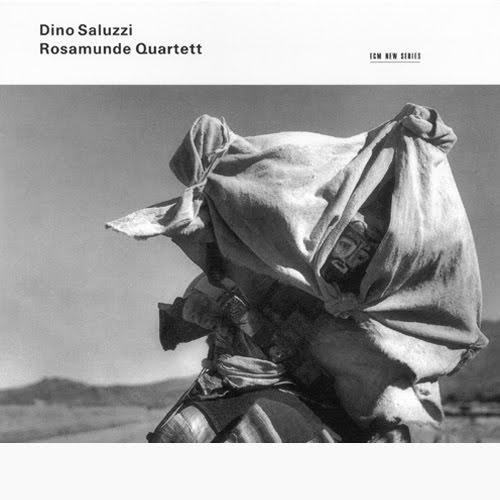
Dino Saluzzi/Rosamunde Quartett: Kultrum – Music for bandoneón and string quartet (ECM New Series 1638)

Dino Saluzzi
Rosamunde Quartett
Kultrum: Music for bandoneón and string quartet

Dino Saluzzi bandoneón
Andreas Reiner violin
Simon Fordham violin
Helmut Nicolai viola
Anja Lechner cello
Recorded March 1998, Propstei St. Gerold
Engineer: Markus Heiland
Produced by Manfred Eicher

The relationship between Argentinian bandoneónista Dino Saluzzi and ECM’s mainstay Rosamunde Quartett has produced some of the most intriguing cross-culturalisms the label has yet to offer. Not so much a coming together of genres as it is an unraveling of possibilities within them, Kultrum manifests much of the latent orchestrations lurking within Saluzzi’s compelling solo outings of years past. The inaugural “Cruz del Sur” is utterly emblematic of the project’s fecundity, cutting strings from the cloth of Saluzzi’s distinctive sound and winding them into a singular amalgamation of rustling and stillness. At once dolorous and laudatory, the sound strays ever so gently into the ecstatic harmonies of “Salón de tango,” in which sparks of confluence abound at every turn. Here, as in much of the album’s hour-long recollection, Saluzzi asserts his rhythmic and melodic authority with a humble joie de vivre. Generally, the music dons solemn clothing, as in its most potent moments between Saluzzi and Rosamunde cellist Anja Lechner, giving us a foretaste of their untouchable Ojos Negros session some eight years later. Every color they mix is rendered lighter by the surrounding musicians. Brief dissonances either slide with ease or are slowed to the point of non-existence. “Miserere” provides brittle catharsis in a brewing fugal storm. Pizzicato statements flash like lightning without thunder. “El apriete” wrings the heart of its sympathy and rehydrates it with renewed life, as if to shield us from the mournful edge of the album’s remainder, which erases thin lines from a darkening periphery before folding in on itself to end.

Much like Ástor Piazzolla, of whom he is heralded as the only legitimate successor, Saluzzi cuts an unmistakable form in any auditory context. His reach is already so orchestral that the present expansion seems only nature. And while the musical talents thereof are as high as one would expect in an ECM recording of this caliber, the compositions themselves are the real stars here, leading said talents into new directions. This is an album that inhales in black and white, but exhales only color. Assuming we are able to approach it with a blank canvas in mind, who knows what images might come of it?

<< Jack DeJohnette: Oneness (ECM 1637)
>> John Surman: Proverbs and Songs (ECM 1639
)

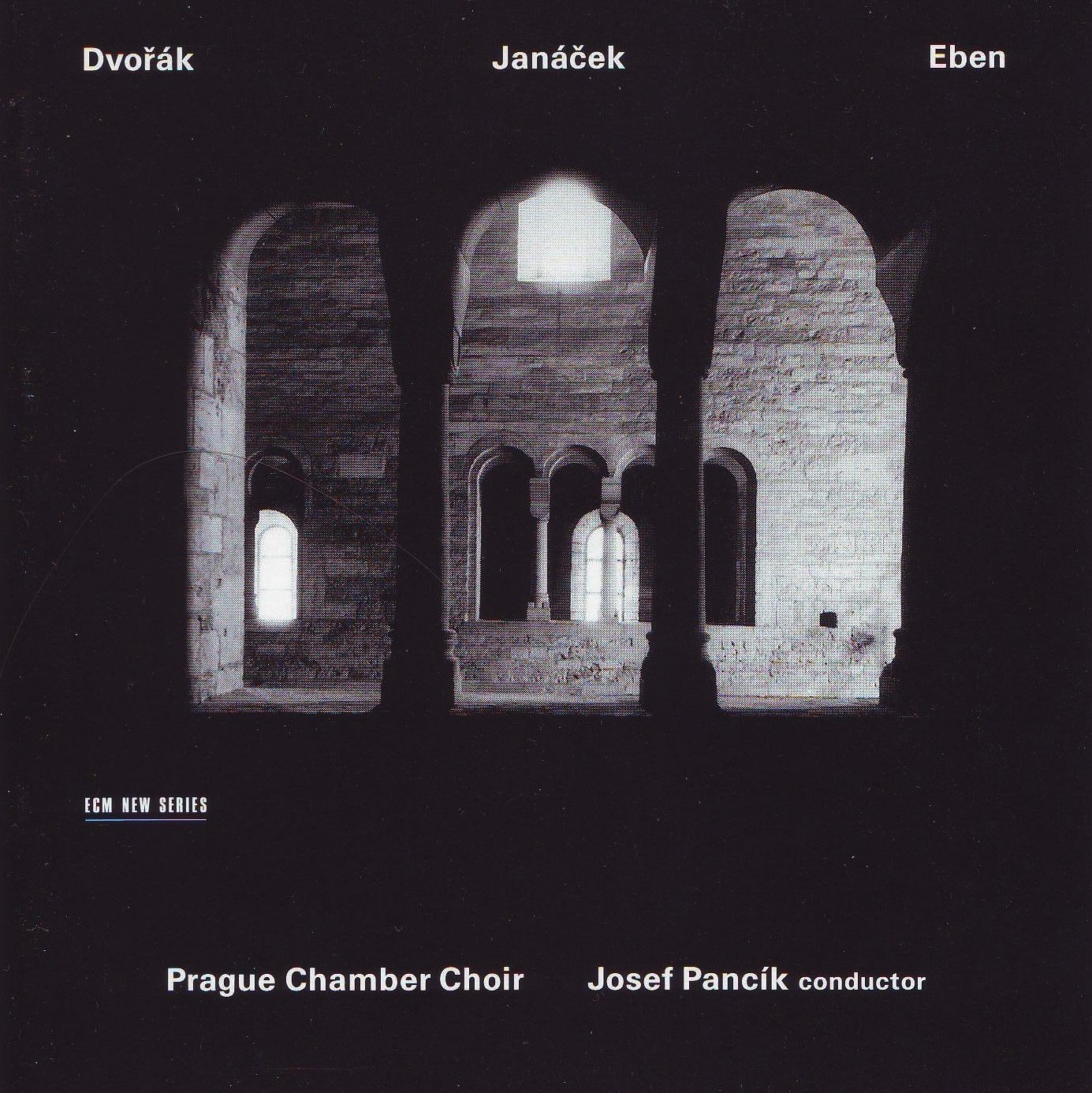
Prague Chamber Choir: Dvořák/Janáček/Eben (ECM New Series 1539)

Prague Chamber Choir
Dvořák/Janáček/Eben

Prague Chamber Choir
Dagmar Masková soprano
Marta Benacková alto
Walter Coppola tenor
Peter Mikulás bass
Lydie Härtlová harp
Josef Ksica organ
Josef Pancík conductor
Recorded November 1993 at Rudofinum/Dvořák Hall, Prague
Engineer: Markus Heiland
Produced by Manfred Eicher

Formed in 1990, and emergent in the newly independent Czech Republic, the Prague Chamber Choir offers in its only ECM appearance this harmonious program of Bohemian church music. In the accompanying liner notes, Antonín Pešek draws our attention to the thriving Catholic pulse beneath what was then a topical spread of patriotic provincialism, and in so doing allows us to contextualize the music as part of an auditory archive. The three works on this program are like a spectrum of light, gradating from ultraviolet to infrared in the space of an hour.

Antonín Dvořák may not have been primarily known as a choral crafter, but his “honorary” Mass in D major, op. 86 (1887), through which the composer pays homage to the ruins of the past without succumbing to the “progressive” tendencies of their rebuilding, has an allure all its own. The Kyrie is a lovely opening, each vocal line clearly articulated in a loose macramé of faith. Glittering moments from the tenors crash like the crest of a wave over a sandy organ. Four soloists arise from this dense tide, of which the soprano is arrestingly emotive. The Gloria provides an exuberant change of pace, again set aloft by a gorgeous tenor section. The 10-minute Credo, on its own a masterful composition, is perhaps a touch saccharine and longwinded, even if it makes the Sanctus all the more jewel-like for its brevity. The latter’s exuberant opening, transcendent organ solo, and mounting volume coalesce like an unforgettable memory. The famous, often singled-out Agnus Dei remains the high point of the piece, a lullaby in spiritual clothing.

Leoš Janáček’s humble offering is Our Father (1901), a sensitively set Creed with an unmistakable harp ostinato and lush organ writing. The insightful tenor solos stick to the mind like glue, bonding love and awe through a single human voice. Says Pešek of this piece: “The calls for bread reflect the feelings of the defiant plebian, who does not demand the ‘consecrated bread of tradition,’ but the daily bread of true humanity.” And indeed, we find in it as much secular as spiritual solidarity. Janáček’s protean understanding of the human voice was entirely his own, and comes through in the physical shape in which every note seems to be described. Arousing in its flavors and unique in its textures, the shattering Amen at the end rings in the head and in the heart long after its resonance fades.

The Prague Te Deum (1989) of Petr Eben is a fitting cap to this fountain of vocal wisdom. Eben’s ode to renewal after oppression has a somewhat antiphonal structure and pays strict attention to the rhythms of its text. Like the sociopolitical about-face that undergirds its creation, the music vacillates between dissonance and harmony, if not embodies both simultaneously, as it basks in the glow of an uncertain future. The upward-looking ending revels in its own sound in the face of a God whose silence is music.

This is a proclamatory album representative of a significant trajectory in European history, but one often obscured by ECM New Series heavyweights. The music is cumulative, the performances committed, and the sound crystalline. A worthy addition to any choral enthusiast’s collection.

<< Azimuth: “How it was then…never again” (ECM 1538)
>> Heinz Holliger: Beiseit/Alb-Chehr (ECM 1540 NS)

Bach: Six Partitas – Schiff (ECM New Series 2001/02)


Johann Sebastian Bach
Six Partitas

András Schiff piano
Concert recording, September 21, 2007, Historischer Reitstadel, Neumarkt
Engineer: Stephan Schellmann
Produced by Manfred Eicher

After completing his highly praised Beethoven cycle, pianist András Schiff returns to Bach in this spot-on live recording of the Six Partitas. Though published as his Opus 1, the Partitas were Bach’s last compositions for keyboard. Both reasons make it a keystone in the mythical Bach pantheon. Although “partita” is essentially a euphemism for “suite,” in Bach’s hands the form was opened to a freer and more complex sense of infrastructure and performative demands.

The introductions show both composer and performer at their best. The Praeambulum of Partita V is a tour de force of rhythmic urgency and dynamic control. The Fantasia of Partita III is another astounding inauguration, its resplendence cluing us into the genesis of the music to follow. The meditative Praeludium of Partita I contrasts sublimely with the Sinfonia of Partita II, the latter a stately lead-in to the courtliest of the Partitas. The accompanying Allemandes overwhelm with their sparks, conflagrating our souls into rapt attention. The pacing throughout is nothing short of extraordinary. Schiff’s sprightly Correntes glisten like rain-drenched leaves, tempering their surrounding flames with a quiet power.

Schiff truly excels in his ornaments. Take, for example, the heart-stopping trills of the Partita III Tempo di Minuetta, his detailed graces in the Passepied of the same, and the half-step motions of his Partita I Gigue. The Partita II Gigue provides some especially enlivening moments in which the right hand goes high and left hand carries the rhythm downward. Such motions broaden the expanse of the music into epic territories, which is all the more amazing for music that is so closely confined to the arm span of a single performer. Not to be outdone by his own passionate spirit, Schiff finesses his way through the Sarabandes of Partitas I and IV with the gentle persuasion of an aristocrat stripped to the naked heart. Also of note are the flowing syncopations of the Partita II Rondeau, played here to perfection in one of the performance’s most glorious turns. The following Capriccio pirouettes its way through a deft and vivacious choreography.

Schiff’s ordering—V, III, I, II, IV, VI—is conscious, moving in ascending keys from G major to E minor. It also carries us into the most heartfelt pieces therein. Partita VI is the castle of these sprawling grounds. Its lofty spaces give ample breathing room for the loveliest Sarabande of the collection, not to mention a strikingly forward-looking melody. Moving with a delicate ease and supreme comfort, it primes us for the epic Fugue through which all comes to a rousing close.

I have no interest in staking a claim in the already bristling ground of musical criticism as to whether Schiff is the better interpreter. All this humble admirer knows is that, like the other superstars to which one might compare him, he is unafraid to show us how he “feels” Bach. It’s not as if he accesses some pure core of the music that others do not, for he plays it as if it were his own. Whether or not one agrees with his stylistic choices, his commitment to them is undeniable. And perhaps said commitment is a more profound measure of the performer. If we consider some of the greats in this regard—Glenn Gould, Rosalyn Tureck, Sviatoslav Richter, and Tatiana Nikolayeva—we find in each a style without regret, an allegiance to a particular historical moment (or possible transcendence thereof, in the case of Gould), and a total lack of interest in relativity. Each performance is not an ingot to be judged against the quality and density of others, but is a reflection of the musician’s own creative makeup that is beyond petty comparison. Rather than look at how and why interpretations differ, as listeners we can only find the differences they bring out in ourselves. And are we not also contributing to the uniqueness of the performance? For the same music can change with our moods and circumstances. And so, when we approach the Partitas, perhaps it benefits the music more to consider what we have to bring to the experience that no other listeners can bring, just as we might expect the same for the musician performing it. For me, the strength of Schiff’s playing is that it duly reminds us of our role on the other side of the piano, foregrounding our engagement, which is the music’s lifeblood. We see this in Schiff’s Beethoven cycle, his Schumann, and his Goldberg Variations. And now, with the Partitas we are given a greater responsibility to provide that “live” feeling ourselves in whatever private chambers we inhabit, or with whomever we might share it. This music is always there for us.

Like Bach’s other masterworks for solo instruments, the Partitas have a distinctive aura of completeness about them, which is to say they feel entirely self-satisfied. And it is this satisfaction Schiff brings to his playing: not a sign of arrogance, of professed authority, nor even of excellent musicianship, but rather the consummation that the music invites in the performing and in the listening. This is the genius of Bach: not the music itself, but in knowing our ability to hear in it forgotten pieces of ourselves. It may not be universal music, but so help me if it isn’t universally musical.

Bach: Inventionen und Sinfonien/Französische Suite V – Fellner (ECM New Series 2043)


Johann Sebastian Bach
Inventionen und Sinfonien/Französische Suite V

Till Fellner piano
Recorded July 2007, Mozartsaal, Wiener Konzerthaus
Engineer: Markus Heiland
Produced by Manfred Eicher

What is a “Bach interpreter”? Is it someone who draws from creative reserves to put as unique a spin as possible on much-performed repertoire? Must s/he be selfless and allow the music to “speak for itself”? After a four-year wait, Austrian pianist Till Fellner follows up his humble ECM debut recording of Bach’s Well-Tempered Clavier with the often overshadowed Two and Three Part Inventions, through which he answers these questions with one of his own: However Bach is painted, what is the image being maintained?

From note one, this is a clearer, more present album than Fellner’s somewhat murkier (and no less affecting) WTC. He holds up every piece to his jeweler’s eye, that we might better see its overall prismatic nature. His rhythms are protean and proper, giving the faster movements just enough pep to gain savory traction while lacing the slower ones with a luxuriant sweetness. As with his last studio effort, Fellner shows a profound ability to draw out the denser implications of the latter (particularly Inventions No. 6 and No. 7; Sinfonias No. 2, No. 6, and No. 7). The more rapid flights are so clearly separated in his fingers that one never gets lost in their overload of grace. From the gravid yet fluid treads of Inventions No. 4 and No. 8 to the trill-infused menagerie of No. 10 and the invigorating No. 13, each instructive development unfolds a new page in this evolving book. Two Sinfonias—No. 11 and No. 15—grow especially more complex with each new listen. Their aquatic transparency and sweeping runs bow like a servant at court to a faceless monarch of sound. Fellner caps the program with a spacious rendition of Bach’s French Suite No. 5. Showing again his supreme pacing in the opening Allemande, he continues through a must-stop-whatever-you’re-doingly gorgeous Sarabande on his way to a winged Gigue.

Intended as the Inventions were as mere didactic exercises, their lines are unmitigated and succinct. Yet for all their brevity, a macrocosm of chords swings between its molecular monkey bars. Fellner plays utterly pianistically, and in doing so makes no qualms about the newness his style can bring. The variable volume of the instrument is taken full advantage of by Fellner, who allows choice notes to ring out and descend. In doing so, he manages to pull off an astounding feat: reinvigorating Bach with utter complacency. Says Fellner of these pieces: “Literally every note counts.” But when he plays, it all comes down to one.

Erkki-Sven Tüür: Crystallisatio (ECM New Series 1590)

Erkki-Sven Tüür
Crystallisatio

Tallinn Chamber Orchestra
Estonian Philharmonic Chamber Choir
Tõnu Kaljuste Conductor
Recorded 1994-1995 at Estonia Concert Hall, Tallinn
Engineer: Maido Maadik, Estonian Radio
Produced by Manfred Eicher

Estonian composer Erkki-Sven Tüür (b. 1959) admits that we are products of our environment. To be sure, he and his compatriots would seem to have carved out a distinctive niche in the terrain of classical music, chipped from the ice that locked their creative heritage under Soviet rule. In the same breath, however, he cautions us about adhering our identities to any particular place over another, lest we shun the illustrative details of our indeterminable experiences. In that sense, there is something to be said for music, which in Tüür’s case is as close to audio refraction as one can get: there is no distinguishing its inner and outer upheavals. Enter architectonics, an abiding process through which Tüür discloses the chemical compositions of his singular auditory experiences. As a onetime prog rock musician, he brings a “band” sensibility to his sound, in which one hears an undeniable cohesion.

Architectonics VI (1992) for flute, vibraphone, and strings descends from violins into a series of complex resolutions. It is mathematical in the truest sense, making a case for chaos as its primary expression. Convoluted outbursts from winds, neither spastic nor deliberate, are punctuated by strings, shining a light into this lively debate of inter-instrumental politics.

Passion (1993) for string orchestra is a rare achievement. Its development recalls Henryk Górecki’s Third Symphony, working its way from ground level into the stratosphere of our emotional purview. Its shifts from minor to major keys glisten in a dew-drenched field, accepting the sun’s slow rise. There is, in this piece, as much lateral movement as vertical. Each stage is both a revival of the past and a rehearsal of the future. As the upper strings tighten their grip on reality, the cellos resound with a note for the ages, not unlike a certain tenor’s proclamatory crest in Arvo Pärt’s Magnificat, if relatively foreshortened.

Illusion (1993) for string orchestra dances with every sinew of its bowed body. Though brimming with dynamic suppleness, it turns every statement into a new paragraph. As double basses mark staccato points of articulation, violins reassert their seemingly innate desire to lead. Tõnu Kaljuste’s immaculate direction brings phenomenal dynamic control to bear as the piece builds into an ecstatic reinstatement, an aesthetic lock that grows progressively quieter until the final exultation.

Crystallisatio (1995) for 3 flutes, glockenspiel, strings, and live electronics ushers us into a congregation of drowsy banshees, draping themselves in the canopy of a darkened forest. Electronically processed flutes echo like spirits recast in the image of their own reflection. The cellos are given a mournful urgency, through which they enact a promise of daylight. The glockenspiel’s doublings tickle our very spirits with their arousing pinpoints. The frenzy mounts as the processing reveals its illusions more explicitly. We end on an overblown flute and a single glockenspiel note—a drop in the cosmic pond.

Requiem (1994) for soprano, tenor, chorus, triangle, piano, and strings is the masterpiece of this program, and beyond reason enough to buy this album. Written for friend and conductor Peeter Lillje, it gives us the clearest portrait of an artist working in real time. A struck triangle opens the proceedings, from which baritones spin the Introit. Strings operate sympathetically as the cellos double the tenor line, and the violins skip along their own skyward paths. A tenor introduces the Kyrie eleison as the violins continue their improvisatory pirouettes. Vocal constituents volley back and forth, while at their center a piano comes crashing down in a rupture of spiritual information. Altos and sopranos emerge from the rubble as wavering sirens. They keen and shout in Orff-like exuberance before cracking open a breathtaking Rex tremendae in tutti. A lithe soprano provides reflection in the Recordare. A violin wanders abstractly in timid, almost insectile, commentary. All the while, choral forces are gathering themselves toward a somber end that reenacts the cycle’s beginnings.

Violins play a key role throughout, scratching like an animal searching for something buried but long decayed, a kernel of faith long sprouted into the tree under which it claws in vain. The triangle that opens and closes the Requiem is proof positive that the most direct access to enlightenment isn’t always the grandest, but that sometimes the keyhole rupture of the blinking eye, and the single glint of light upon the tear that falls from it, are sufficient to show the way. The piano, too, plays a commensurate role, a voice of reason at center stage.

This is a transportive album—absolutely so—and one that I will always champion. Like the frozen surface of the jacket photo, it seems at first glance a field of stars, forever locked at the height of brightness. Although I do not feel that ECM’s subsequent Tüür releases have quite attained the magical realism of this one, anyone who shares an enthusiasm for Crystallisatio would do well to place the others alongside it. Tüür’s resolutions are always revolutions in that they, through the promise of completion, only bring forth further fragments for consideration. Rather than trying to achieve balance through this process, Tüür seems to want to make a meta-statement regarding the nature of his compositional process, which is constituted by a need for discourse and reevaluation. Like the tintinnabulations of Arvo Pärt, his atmospheres lay out for us the very topography of a nameless musical environment. Every turn brings about a new needle of contention by which to sew our physiological threads. This is music that makes no promises, yet in doing so fulfills countless numbers of them. As one of ECM’s most groundbreaking releases, second perhaps only to Giya Kancheli’s Exil, this is a must-have for the New Series enthusiast.

<< Meredith Monk: Volcano Songs (ECM 1589 NS)
>> Arvo Pärt: Alina (ECM 1591 NS)