Morton Feldman: The Viola in My Life (ECM New Series 1798)

Morton Feldman
The Viola in My Life

Marek Konstantynowicz viola
Cikada Ensemble
Norwegian Radio Orchestra
Christian Eggen conductor
Recorded August 2001 at NRK Studios, Oslo

Morton Feldman’s The Viola in My Life (1970/71) is a work of great scope and detail. Each of its first three parts is scored for viola and a variety of chamber ensembles, while the last pairs viola with orchestra in what Feldman calls a “translation” of the first three. Unlike his earlier forays into indeterminacy, Viola is thoroughly composed. Its genius lies in Feldman’s ability to forge massive amounts of empty space into a layered resonance that is anything but “minimal.” The music slowly undulates in tune with the viola’s crests and fades, touched by patches of darkness like a figure slowly walking through lattice-obstructed sunlight. The viola is the center around which the other instruments revolve. This revolution brings the listener full circle with each new phrase, for despite the seeming regularity, each marks an uncertain orbit. The piano in parts I and III grazes the edges of silence, in pursuit of nothing but its own pursuit; the celesta in part II dots our minds with stars; and the orchestral backdrop of part IV carries the viola like a feather riding an upward breath. Such ethereality harbors no romantic promise of freedom. As Feldman himself admits, “The viola’s crescendos are a return to a preoccupation with a musical perspective which is not determined by an interaction of corresponding musical ideas—but rather like a bird trying to soar in a confined landscape.” Eventually we must reperch, and Viola is constantly skirting the boundaries of our cage like a silent but ever-watchful eye. And as I drift off to sleep during the final movement, I feel the eye closing around me, like a lost child embracing himself in lieu of human contact.

This album could easily be titled “The Life in My Viola,” for it is so rich with intimations of a generative spirit. The recording and performances are finely attuned to the music’s inner core, the Cikada Ensemble creating a fine setting for Marek Konstantynowicz’s restrained soloing throughout. Morton Feldman can be a challenge, but his rewards can be even more internal than his music.

<< Trygve Seim: Sangam (ECM 1797)
>> Cikada String Quartet: In due tempi (
ECM 1799 NS)

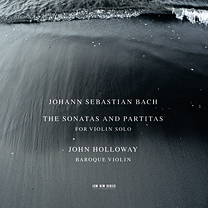
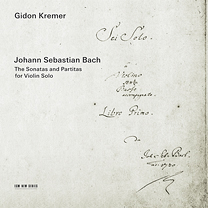
Bach: Sonatas and Partitas (ECM New Series 1909/10 & 1926/27)

Johann Sebastian Bach
The Sonatas and Partitas for Violin Solo
as played by John Holloway and Gidon Kremer

Recorded July and September 2004, Propstei St. Gerold (Holloway)
25-29 September 2001, Lockenhaus, Pfarrkirche St. Nikolaus, and 10-15 March 2002, Riga (Kremer)
Engineers: Stephan Schellmann (Holloway) and Niels Foelster (Kremer)
Produced by Manfred Eicher (Holloway) and Helmut Mühle (Kremer)

I first heard Bach’s Sonatas and Partitas for solo violin on vinyl under the bow of Thomas Zehetmair in his awe-inspiring Teldec recording, which remains my interpretation (and format) of choice. Ever since Zehetmair signed with ECM, I have constantly wondered what untold pleasures a repeat performance for the label might bring. Sadly, this has yet to be realized. Thankfully, however, ECM listeners have two complementary representations to choose from, and for this reason I review them side by side.

Looking Back
As one of the world’s foremost Baroque violinists, John Holloway brings four decades of intimate engagement with these masterworks to the proverbial table. Working from the original autograph score, Holloway takes meticulous care in observing every detail of articulation as a means of arguing for the composer’s own deeply informed knowledge of the instrument. His supple playing and humble approach make for one of those rare “historically informed” performances that actually dusts off the ravages of time and breathes cleanly rather than calling attention to its antiquity. Not only does he bring a visceral robustness to the Adagios and a refreshing regularity to the Prestos, but he also makes sure that every tempo in between is given its own dynamic quality.

I have always cherished the Allemanda of the B minor Partita over all, as it is the last piece I learned to play on the violin before I abandoned the instrument to focus on training my voice. It is typically the standard I go by when encountering a new version for the first time and I am proud to report that Holloway draws from it a wealth of seductive material for our auditory perusal. He adopts a similar posture in the Fuga of the A minor Sonata and in the Siciliana of the G minor sonata, both of which scintillate like dark pools in moonlight. But the true gem of this collection is the D minor Partita, where we encounter one of the most heartrending Sarabandes imaginable, an absolutely resplendent Giga, and as finely executed a Ciaccona as one could hope for. The C major Sonata brings out another exemplary performance, especially in the haunting vulnerability injected into the Allegro assai. The E major Partita is pitch-perfect. Its immediately recognizable Preludio shines with renewed verve in Holloway’s hands.

Looking Ahead
What can one say about Gidon Kremer? He is one of the leading innovators among contemporary classical performers, having inspired a wealth of commissioned music and a somewhat controversial discography of variable projects. Kremer first recorded these pieces for Philips in 1980 and returns to them here in a self-professed “final statement” on Bach. As any avid Kremer listener can expect, this interpretation is at once fiercely idiosyncratic and deeply aware of its roots. His G minor Sonata is appropriately subdued and sets an introspective tone for the entire performance. Kremer truly stands out in the fast movements, such as in the Double Presto of the B minor Partita and the delicately executed Allegro assai of C major Sonata, where he is able to put his dynamic energy on full display. He also puts his “GK” stamp on the more dance-like movements, such as his ravishing Tempo di Borea from the B minor Partita and the Gavotte en Rondeau of the E major Partita. This is not meant to imply, of course, that he is without sensitivity. Under Kremer’s agile fingers the Andante of the A minor Sonata weeps with unrivaled ardor, the Sarabanda of the D minor Partita stumbles with an unusually supplicatory air, and his C major Sonata Adagio brings a whole new sense of tortured emotion to a movement so often played with reserve. Kremer revels in the rhythmic possibilities afforded to him by the score, stretching out as many moth-eaten holes in its musical fabric as he can, so as to emphasize its polyphonic structure and harmonic integrity. He also shows a predilection for sharp attacks. Witness, for example, his crisp Ciaccona, which punctures the ether with the power of a thunderclap. And what of my beloved B minor Allemanda? It has taken some getting used to, but I can now appreciate Kremer’s halted style and flawless tuning, and the liveliness he brings to this somber dance is uniquely his own.

I would never venture to say which of these performances is “better” than the other. Holloway plays at period pitch, while Kremer opts for a modern tuning, resulting in two entirely different experiences. Holloway’s opaque sonorities become Kremer’s airy glitter. These are both recordings to be savored and revisited. The reverberant acoustics and attentive microphone placement put Holloway’s a head above the rest in sound quality, while its somber undertones speak to the violinist’s humility in the face of Bach’s complex symmetries. Then again, Kremer’s staggering attention to detail and variation prove once again why he is one of the instrument’s sharpest proponents. I can only recommend both for their technical spread and complementary attitudes. Not to mention that the pieces themselves belong on any music lover’s shelf.

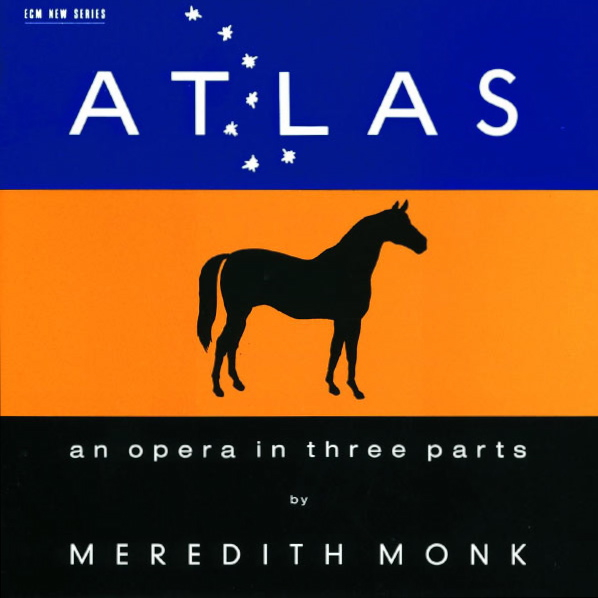
Meredith Monk: Atlas (ECM New Series 1491/92)

Meredith Monk
Atlas

Carlos Arévalo voice
Thomas Bogdan voice
Victoria Boomsma voice
Janis Brenner voice
Allison Easter voice
Robert Een voice
Emily Eyre voice
Katie Geissinger voice
Dana Hanchard voice
Wendy Hill voice
Meredith Monk voice
Ching Gonzalez voice
Dina Emerson voice
Robert Osborne voice
Wilbur Pauley voice
Radall Wong voice
Shi-Zheng Chen voice
Stephen Kalm voice
Susan Iadone violin
Darryl Kubian violin
Kathleen Carroll viola
Anthony Pirollo cello
Meredith Monk cello
John Cipolla clarinets
Wayne Hankin shawm, sheng, recorder
Wayne Hankin conductor
Steve Lockwood keyboards
Cynthia Powell keyboards
Thad Wheeler percussion
James F. Wilson french horn
Recorded June 1992 at Power Station, New York
Engineer: James A. Farber
Produced by Manfred Eicher

Meredith Monk’s first opera Atlas received its premier at the Houston Grand Opera in February of 1991 and is by far one of her most beautifully realized works. Much of the opera came to the studio in sketches, only to be solidified through improvisation and the synergy of performing with a handpicked group of singers. Inspired by Alexandra David-Néel’s classic book Magic and Mystery in Tibet, the opera’s three acts trace the personal quest of its heroine, also Alexandra, through a life rich in material and spiritual experience. The libretto is so scant that it fits snuggly into this review in its entirety. And while the lack of words certainly challenges operatic norms, it is to no ill effect. If anything, it heightens the work’s profundity.

I. Personal Climate
A young Alexandra takes solace in the domestic comforts of her girlhood, all the while dreaming of what awaits her once she goes out in the world. A minimal overture opens into the comely “Travel Dream Song.” Keyboard arpeggios and a small instrumental ensemble cradle Alexandra’s yearning in a tender embrace. She looks skyward on her swing, running through the majestic details of a life lived in transit:

Mountains…cities…steamships…grass skirts…canyons…cinnabar.

After the haunting overtone singing of “Rite of Passage A,” we come to a crucial intersection in the opera’s crossroads. “Choosing Companions” presents Alexandra’s recruitment of the travelers who will help make her dream a reality. A knock at the door introduces each potential companion, who arrives with a résumé of attributes. The first knock reveals a man who speaks in Mandarin before continuing in English:

Wǒ hěn jiānqiáng.
I am strong.
My heart is broken.
I am a good cook.

The Chinese translates to “I am strong,” and the repetition in English opens a linguistic crack in the opera’s already fragile edifice. Another knock, and in walks a boastful, well-seasoned adventurer:

I own my own equipment.
I’ve got a strong stomach.
I’m good looking.

The last knock introduces the practical explorer:

I have desire.
I have a dry sense of humor, good hiking boots.

Each of these spoken lists is followed by a bit of singing meant to convey the constitution of each character, and takes a rather humorous turn when the egotist sings terribly off key despite his most valiant efforts. “Airport” is the most complex section of the opera, and builds to a fiery climax as a man intones, “Three, Four, One,” until silence overtakes him.

II. Night Travel
This central section features some of the most eclectic sounds in the opera. From the exquisite introductory melody to the apocalyptic “Possibility of Destruction,” we are treated to a sort of aural travel by which the listener is transported along with its subjects. Of note here are the working songs of “Agricultural Community,” and of course Janis Brenner’s brilliant banshee-like vocals and Shi-Zheng Chen’s fearful tremors in “Hungry Ghost.” A glass harmonica introduces a major climate shift in “Ice Demons,” carrying on with laughter and thematic resolution. “Explorer #5” brings more spoken text into the fray:

She can hear for miles.
She is very patient.
She has royal blood.
She drives both shift and automatic.
She has a green thumb.
She can read Sanskrit.

Soon after, the supremely evocative “Forest Questions” bubbles with turgid vocabularies, wailing sirens, and lupine howls. Here, the travelers happen upon the world’s oldest man, of whom they ask:

Has anything changed?
Can I find love?
But I still hear noise.
What is pain?
Will all this last?

If any answers are given here, they are lost in the music, for in being asked they are already gone. “Desert Tango” and “Treachery (Temptation)” provide the opera’s most frivolous moments. The latter in particular is an amusing, almost Heiner Goebbels-like gallery of fools that takes pleasure in drowning in its own vanity:

Finish by five, by five.
Finish by five.
By five, finish by five.
You know you have to, you know you have to do it.
If you put the first one here, and the second there, well then the third…

III. Invisible Light.
The final act is all about reflection, as Alexandra looks back on her life and recounts the ups and downs of her journey. This act works more as a cohesive whole, and in “Explorers’ Junctures” provides a detailed aural map of its entire musical landscape. “Earth Seen From Above” is the most divine portion of the opera, melting into “Rite of Passage B,” which leaves us floating in the upper atmosphere.

Although the staging of Atlas adds a vital component of movement, the “incidental” soundtrack is no less powerful here for its absence. This is motion personified in sound, the poetry of life’s easily forgettable details wrapped in a cloud of human contact. Behind closed eyes we can feel the primordial depth of these performances and of the final destination they seek to illuminate, so that by the time we open them we are already there.

<< Gary Peacock/Ralph Towner: Oracle (ECM 1490)
>> Andersen, et al.: If You Look Far Enough (ECM 1493)

Jan Garbarek/The Hilliard Ensemble: Officium (ECM New Series 1525)

Officium

Jan Garbarek soprano, tenor saxophones
The Hilliard Ensemble
David James countertenor
Rogers Covey-Crump tenor
John Potter tenor
Gordon Jones baritone
Recorded September 1993, Propstei St. Gerold
Engineer: Peter Laenger
Produced by Manfred Eicher

Behold now, I shall sleep in the dust:
and if thou seek me in the morning, I shall not be.

1994 was an intriguing year in music. Jeff Buckley had begun his tragically halted rise to fame with the debut studio album Grace; Portishead brought trip-hop to the mainstream with Dummy; Kurt Cobain shocked many of my generation with his suicide; Pierre Boulez won the Grammy for Best Classical Album with his Deutsche Grammophon recording of Bartók’s The Wooden Prince; and the wildly popular Chant by the Benedictine monks of Silos had taken the North American market by storm. And then there was Officium, a humble recording with the distinction of being the only ECM album I have ever seen advertised on television. I don’t think anyone knew what to expect of its unique combination of soprano and tenor saxophones and choral skimmings from the 12th, 15th, and 16th centuries, but I can still remember the splash it created, selling the better part of a million copies. I made sure to buy mine on the day of its release, simply because of its label and its musicians, and continue to be mesmerized by its sounds to this day. With so many ECM recordings floating through my CD player, it had actually been years since I’d heard this album before revisiting it for this review. I’m pleased to say that, despite the unwarranted flak it has drawn (which, as much as I can tell, is far less than the praise), Officium has aged beautifully and remains a pinnacle of nostalgia in my life as a listener, for it provided some of the most delectable nourishment imaginable at a time when my budding mind was ravenously hungry for new sounds.

At its core is the Hilliard Ensemble’s choice of music, much of it open to interpretation even in its day, by composers such as Pérotin, Pierre de la Rue, and Guillaume Dufay, in addition to a range of earlier anonymous (much of it Czech) material. The opening track, combining Garbarek’s liquid improvisations with the Parce Mihi Domine of Cristóbal de Morales, will always be the one that speaks to me most clearly, if only because it was first to lure my heart into the album’s many inner sanctums. I would say that any claims of disjointedness are quickly dispelled by the anonymous Primo tempore that follows, in which Garbarek’s tenor swells with the mournful quality of an additional human voice. Some tracks are more seamless than others, which is to be expected in the first release of this innovative and ongoing project. Regnantem sempiterna, for example, gives Garbarek less room to work with, forcing him to wriggle his way through a narrower set of possibilities. But then there is the Pulcherrima rosa, during which I sometimes need to remind myself he is even there. There are also those fascinating moments, especially in the Sanctus, when Garbarek descends into unexpected territories, as well as his seductive solo turn in Virgo flagellatur. Either way, Garbarek has an acute ear for vocal contours and matches his playing accordingly. The Hilliards are in typically fine form. Procedentem sponsum and Beata viscera both feature sublime solos from David James, who navigates the droning landscape with utter faith, and Gordon Jones’s* lone rendition of the Gregorian chant Oratio Ieremiae provides some of the loveliest moments on the entire album. Parce mihi domine is reprised at the program’s center (without saxophone) and again at the end (this time, with), thus enacting a tripartite ritual throughout its overall cohesion.

I like to think that Officium led listeners to look at some of ECM’s other fine recordings, if not at other choral albums in general, both new and old. Regardless of any dismissals of this album as a failed New-Age experiment, I like to think of it as a glorious window into a timely solace that enriched the lives of many. Like any album, it may not be for everyone, but one need only take a peek to see what effect(s) it might have.

*Many thanks to Joanna Z. for this correction.

<< Sidsel Endresen: Exile (ECM 1524)
>> Louis Sclavis/Dominique Pifarély: Acoustic Quartet (ECM 1526)

Gesualdo: Tenebrae (ECM New Series 1422/23)

Carlo Gesualdo
Tenebrae

The Hilliard Ensemble
David James countertenor
Ashley Stafford countertenor
John Potter tenor
Rogers Covey-Crump tenor
Mark Padmore tenor
Paul Hillier baritone
David Beavan bass
Recorded March 1990, Douai Abbey, England
Engineer: Peter Laenger
Produced by Manfred Eicher

Those who have read my first post on this site will know that my teens marked an important transition in my listening life through the discovery of classical music, in particular by way of ECM’s New Series. At the same time, I found my mind and ears opening to more esoteric forms of musical expression. This, coupled with my growing interest in Japan, led me to discover Haino Keiji, who after decades is still the reigning troubadour of the Japanese underground and whose discography numbers well over 100 albums. During my first trip to Japan in the summer of 1998, I had the honor of attending two of his performances in Tokyo. Haino often likes to spin a CD before he takes the stage, coaxing his audience into a certain mood that prepares them for what they are about to experience. And sure enough, before one of these shows, he was playing a recording of choral music by Carlo Gesualdo (ca. 1561-1613). I had one of the greatest meetings of my life when a contact arranged an informal interview with Haino after the second show. During that conversation, Haino professed his adoration for Gesualdo, which, if you’ve ever heard Haino’s music, may come as something of a surprise. He went on to tell me that, in his estimation, Gesualdo had explored almost every harmonic possibility available to him, and that in so doing had left behind a musical corpus that was in its own way “complete.” I was already quite familiar with the Hilliard Ensemble’s standard-setting ECM recording of the Tenebrae Responsoria and, upon my return from Japan, I went back to this recording with renewed interest, and discovered in it far more than I had ever dreamed. Years later, I find that its mysteries still evade me. By “mysteries” I do not mean to mythologize an already indisputably gorgeous exposition of polyphony, but to uphold it as a singular testament of a troubled soul.

The details of Gesualdo’s life are likely familiar to anyone who has delved even briefly into the biographies of the Renaissance’s most revered composers, for in 1590, the Neapolitan-born nobleman would stain his reputation with the blood of his first wife, who he had murdered along with her not-so-secret lover in the throes of what they believed to be a clandestine passion. According to some researchers, his second infant son—whose paternity Gesualdo may have doubted—also fell victim to his indignation. In spite of his heinous crime(s), Don Carlo’s noble rank as Prince of Venosa absolved him of any and all legal repercussions, though as a precaution he relocated from Naples to a private residence in Fererra, where he would meet and marry his second wife before returning to his castle. Their marriage was not a happy one, and Gesualdo was plagued by depression after the death of their son in 1600. Speculations abound as to the nature of this depression, though the evidence suggests he’d been confronting the specter of his past deeds. These responsories for Holy Week were to be his final compositions, and their Passion texts deal appropriately with crucifixion and betrayal, reflecting the inner turmoil of a mind in decline.

I somehow feel it would be a disservice to Gesualdo to single out any particular responsory over the rest, just as it would be impossible to single out any of the tears I imagine were shed in his lifetime. Every piece blossoms with the unstoppable force of nature, even as it questions that very nature for having driven a man to such extremes. The music is knotted with gut-wrenching and unbridled honesty. It is a wellspring of supplication into which one never dives and from which one never emerges, filling one nostril with the stench of death and the other with the perfume of remorse. It seems to puncture holes in the sky and thread through them a most painful confession that supersedes our peripheral constellations. The music also has a peculiar quality that I can only describe as an “ascendant descension,” as it always seems to reaching toward some semblance of God, even as it feels itself being pulled underground, so that by the end its identity has been torn and exists in neither place. This would seem to be the nature of Gesualdo’s repentance: one that dissolves rather than resolves. The tectonic plates of his chosen texts shift beneath their execution. Even in the greatest moments of upheaval they retain earthly shape. The final Miserere alternates between recitative polyphony and monophonic chant, animating the formless into the material. This pattern continues until the final chant disappears into the darkness: a star that burned out millennia ago, but which only now blinks from the sky unnoticed.

It’s difficult to imagine the Hilliard Ensemble sounding better than they do here in their duly magnified incarnation. The addition of Ashley Stafford broadens the already heavenly palette of David James, and both of them form the shining sun in the center of this choral zodiac. The performances are replete with unpredictable key changes, rhythmic anomalies, and luscious morphological details, so that every word seems its own composition, bound to its neighbors by a narrative that may only be divinely understood.

Just last night I was present at a live performance by Pomerium in the beautiful acoustics of St. Patrick – St. Anthony Church in Hartford, Connecticut, where they sang two of the Gesualdo responsories in a program of carefully chosen mannerist music. Finally hearing Gesualdo live brought a whole new understanding of the tortured drama that binds them. Like the Hilliards, Pomerium’s conductor Alexander Blachly has been a tireless champion of music that is both well established in the repertoire and that which begs exposure. If anything, his fantastic ensemble taught me one thing: music from even the most despicable circumstances can indeed transcend those circumstances through each new listener. The power of collective musical ablution may have no equivalent, but in this recording we get to experience just that in solitude.

<< Keith Jarrett Trio: Tribute (ECM 1420/21)
>> Gavin Bryars: After the Requiem (ECM 1424 NS)

Veljo Tormis: Forgotten Peoples (ECM New Series 1459/60)

Veljo Tormis
Forgotten Peoples

Estonian Philharmonic Chamber Choir
Tõnu Kaljuste conductor
Recorded February 1990, Tapiola Church, Finland
Engineer: Peter Laenger
Produced by Paul Hillier

“I do not use folk song, it is folk song that uses me.”
–Veljo Tormis

During the final years of the Soviet occupation in the Baltic states, Estonia took charge in a characteristic way by staging a series of peaceful demonstrations in demand of sovereignty. These came to be known as the Singing Revolution. Two high points of this resistance revolved around the annual Song of Estonia festival, held in the capital city of Tallinn. On 11 September 1988, 300,000 citizens gathered in solidarity and sang old songs until sunrise, uncaring of the reproach such a blazon act might incur. During the same festival the following year, and with a similarly sized crowd surrounded by armed Soviet troops, voices broke out into the Estonian national anthem, still forbidden under the current communist regime. Throughout this censorious period, composer Veljo Tormis found his politics nourished by song, as evidenced in the ban of his more passivist compositions. Yet despite this censure, if not because of it, Tormis’s music only gained popularity. At the heart of his compositional output, containing some 500 choral works, is the regilaul, a song form stemming from the oral traditions of the Balto-Finnic peoples. Regilaulud are distinguished by their call-and-response structure, but add a unique twist: a soloist’s line is taken up at the last word by the chorus, while the chorus’ last line is subsequently taken up by the soloist, thus creating a musical “chain” to which any number of dynamic elements may be linked.

The music of Tormis, who retired from composing in 2000, nevertheless continues to thrive in worldwide performances and recordings such as the one under review here. One unfortunate side effect of this increasing popularity is the way in which the Estonian composer has become romanticized. Many reviewers—which, to be fair, often have only scant liner notes to work from—paint a rather Bartókian image of Tormis: the heroic anthropologist trekking through outlying villages in order to rescue the final vestiges of their oral culture by preserving them in a more widely accessible form. Although Tormis did some minimal fieldwork, and even then only as compiler, he relied heavily on the extensive and no less significant collections of Finnish and Estonian language institutes and university archives. Nevertheless, Tormis holds to his source material as something to be nurtured. As the famous quote above implies, he sees himself as a mediator and advocates a syncretic approach, which takes into account not only the song’s “original” function, but also its new setting and (re)presentation.

Unustatud rahvad (Forgotten Peoples), written between 1970-89, is Tormis’s magnum opus: a collection of 51 songs, each one more immersive than the last, divided into six cycles representing the Livonians, Votians, Izhorians, Ingrian Finns, Vepsians, and Karelians. The first of these, Liivlaste pärandus (Livonian Heritage) is also the earliest, and shows a composer searching for his own voice in the voices of others. Its melodic structures comprise a deft blend of chromatism, orthodox chant, and sustained drones, across which monophonic lines are drawn with careful textual attention. Herding calls, an amusing satire of patrilineal inheritence, and one content little mouse all play equal roles in this colorful set. The seven pieces that make up the Vadja pulmalaulud (Votic Wedding Songs) bristle with more overt regilaul qualities. Their cyclical structure seems to underscore the matrimony at their center. Every aspect of the celebration falls under the music’s watchful eye: from the “Arrival of the Wedding Guests,” through the obligatory “Mockery Singing” and dowry distribution, to the charming “Praising the Cook,” which reminds us even in the most heightened moments of frivolity to acknowledge those whose hard work have made that frivolity possible. In these songs, one can almost smell the provisions, feel the textures of the fibers being worn, feast upon the gentle lay of the landscape and the solid colors of the architecture, which linger in the senses long after the final decrescendo. What follows is the longest and most dramatic cycle. Isuri eepos (Izhorian Epic) begins with a creation myth and launches into a retrospective of Izhorian principles, divine musings, and customs. Women’s voices dominate here, both in the singing and in the narration, adding an emphatic power matched nowhere else in the entire collection. Ingerimaa õhtud (Ingrian Evenings) is more domestic in both feeling and content, focusing as it does on the mundane pleasures of village life. A bare sense of rhythm and unwavering inner energy lend these songs a rustic flavor that speaks directly to the heart. Vepsa rajad (Vepsian Paths) consists of fifteen children’s miniatures. The songs exist only in fragments, but their brevity only underscores their joyful evocativeness. Highlights include the delightful “Pussy-cat,” which purrs and meows just as one might hope, and the melodic but bittersweet “Forced to Get Married,” with its gorgeous glissandi from the sopranos and motherly alto responses. Finally, Karjala saatus (Karelian Destiny) presents us with five examples of Tormis’s most profoundly developed choral sensibilities, culminating in the masterful “Lullaby,” with its promises of comfort and salvation.

This is a culturally and musically important collection sung by one of the world’s finest vocal collectives. The Estonian Philharmonic Chamber Choir seems to have a limitless supply of breath. Yet while this music certainly does draw in faraway listeners, it also casts a powerful cultural message into a world that had shunned it for so long. This is part of what makes Forgotten Peoples so potent. By the same token, Tormis himself has said that his “promotional” approach to folksong is just as instructive to his own people as it is to the global market, which may or may not see his music as little more than a niche to be filled. He is not advocating a revival, nor is he looking to return to way of life forever lost. Rather, he is using his music as a way of claiming these songs for his own, in the hopes that others will feel them as theirs. Either way, the astoundingly committed performances and ECM’s well-balanced recording—itself significant for having been produced before Estonia regained its independence—ensure these peoples will be anything but forgotten.

For the most balanced perspective on Tormis available in English, I cannot recommend highly enough Mimi S. Daitz’s insightful book Ancient Song Recovered: The Life and Music of Veljo Tormis, from which some of the information for this review was gathered.

<< Louis Sclavis Quintet: Rouge (ECM 1458)
>> Edward Vesala/Sound & Fury: Invisible Storm (ECM 1461)

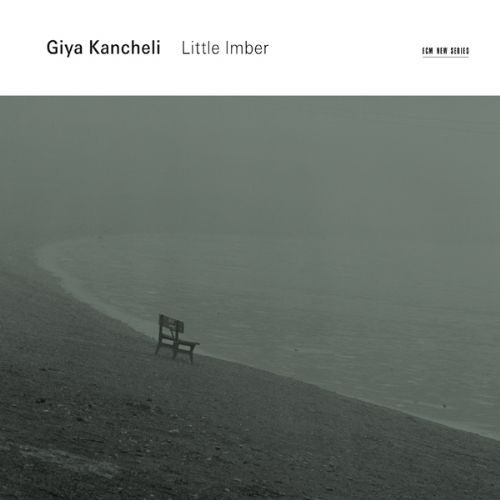
Giya Kancheli: Little Imber (ECM New Series 1812)


Giya Kancheli
Little Imber

Nederlands Kamerkoor
Raschèr Saxophone Quartet
Klaas Stok conductor
Mamuka Gaganidze voice
Zaza Miminoshvili guitar
Matrix Ensemble
Rustavi Choir
Children`s Choir
Recorded May 2006 at Waalse Kerk, Amsterdam (Amao Omi)
Recorded August 2003 at Imber Village, Salisbury Plain, Wiltshire (Little Imber)
Children’s Choir recorded October 2003 at Georgian Records, Tbilisi
Recording supervisor: Giya Kancheli
Produced by Manfred Eicher

“There is this saying that beauty will save the world. But who will save beauty? I think when you sit down at the piano and write music you are trying to do just that.”
–Giya Kancheli

During a total eclipse, there is only a small window of opportunity to watch the event with the naked eye when the moon has completely covered the sun, leaving a corona visible in near darkness. After totality is achieved, the first bead of sunlight peaks beyond the shaded moon in a phenomenon known as the Diamond Ring. This is the moment when viewers must either look away or otherwise protect their eyes. The two pieces on this album are very much like an eclipse, except that they are filled with Diamond Rings, moments of sheer musical intensity that blind the mind’s eye with their urgent desire to be heard.

Amao Omi (2005), the title of which translates to “Senseless War,” is uniquely scored for mixed choir and saxophone quartet. Through an exceptionally unified palette, quartet and choir echo one another in a microtonal journey of ascents and descents. The reeds are played by the phenomenal Raschèr Saxophone Quartet and recorded so as to become an extension of the voices, and vice versa. Like much of Kancheli’s music, Amao Omi swells to moments of dynamic rapture before quickly retreating into quiet solace. Often the choir and the quartet exchange roles: one passage finds the choir bolstering a series of saxophonic solos, while the next finds the latter in a more supportive role as the choir hangs its linear melodies in the airspace above. In those brief moments when the voices do shine their light, the effervescent nebula of the piece bursts into solar flares. Yet rather that shield ourselves from the glare, we willingly open ourselves to it.

Once in a great while, there is an inexplicably effective merging of sound, place, and intent that turns one’s heartstrings into music. Little Imber (2003) is one such composition. In June of 1944, the village of Imber, in Wiltshire’s Salisbury Plain, was evacuated as a strategic training ground for German-bound US troops. Its residents were never able to return, despite repeated protests before and after the war. To this day the village remains in the hands of the Ministry of Defence, which opens Imber’s St. Giles church once a year on the Saturday closest to the feast day (September 1) of its patron saint. Because the performance here was captured in that very church, this isn’t simply a landmark recording, but more importantly the recording of a landmark. The piece is scored more expansively than Amao Omi, though by no loss of intimacy, for small ensemble, voice, children’s and men’s choirs, and uses as its core text an anonymous poem about Imber:

Little Imber on the Downe,
Seven miles from any Towne,
Sheep bleats the unly sound,
Life twer sweet with ne’er a vrown,
Oh let us bide on Imber Downe.

The verse ends the piece on a bittersweet note, resounding with playful verve in the children’s voices before being taken up more somberly by the adults. Captivating solos from Georgian singer Mamuka Gaganidze take Little Imber to even greater heights and clearly manifest the music’s global reach.

When traversing the Kancheli landscape, one can always expect to come across something familiar. He makes use of weighty pauses to ensure that moments of resplendence never develop too far, lest we lose sight of the central path from which they deviate. Staying to true to that path is a spiritual task, and it is only to our benefit to keep our feet moving forward.

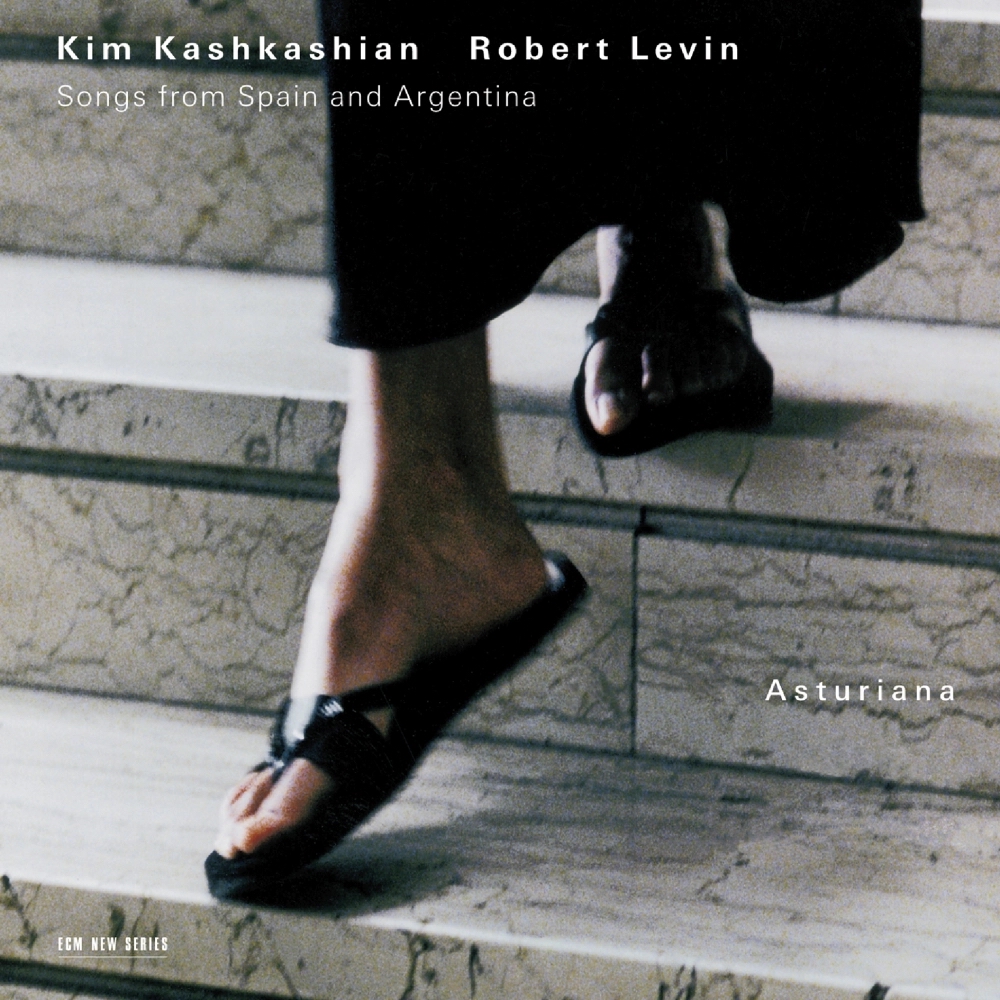
Kim Kashkashian/Robert Levin: Asturiana (ECM New Series 1975)

Asturiana: Songs from Spain and Argentina

Kim Kashkashian viola
Robert Levin piano
Recorded August 2006, Radio Studio DRS, Zürich
Engineer: Stephan Schellmann
Produced by Manfred Eicher

As it opened, the rose embraced the willow.
The tree loved the rose so passionately!
But a coquettish youth has stolen the rose.
And the disconsolate willow weeps for it. Ah!

What can we know of a text when its words are taken away from us? Is it forever lost, or does its ghost still linger? Do we simply replace it with another, or do we revive it in another form? In an expansive and carefully thought out program of Spanish and Argentinean folk songs adapted by a handful of famous and not-so-famous composers and arranged here for viola and piano, the subject of this review provides a simple answer to these questions: all of the above and more. The songs on Asturiana may be without words, but they want for nothing in communicative power. The booklet contains English translations of every song being rendered, if not sung, through Kim Kashkashian’s flawless touch and Robert Levin’s colorful accompaniment, thereby allowing us direct access to each melody’s interior life.

The title of Asturiana comes from its opening song, set by Manuel de Falla (1876-1946) as part of his Siete canciones populares españolas, and is probably the most well-known melody among the album’s twenty-three. This is also the first of three songs that appear twice, each time in a differently nuanced performance—the others being the whimsical “La rosa y el sauce” by Carlos Guastavino (1912-2000) epigraphed above, and heartbreaking “Triste” by Alberto Ginastera (1916-1983) from the fellow Argentinean composer’s Cinco canciones populares argentinas. The latter tells of a shunted lover who has only the shaded pool where he once gave his heart, and which now only reflects the face of a dejected man. Four songs by Enrique Granados (1867-1916) dramatize the loves of majos and majas, denizens of Spain’s lower class. From Xavier Montsalvatge (1912-2002) we get four of the Cinco canciones negras, which look beyond the composer’s Catalonian roots to the West Indies for their inspiration. Avid Mompou listeners will find much to admire in Montsalvatge’s melodic density and personal flair. Then comes the full cycle of de Falla’s Siete canciones, where the title track makes its cameo. Of these, “Jota” is the most exuberant and brims with the blissful naivety of young love, while Kashkashian’s rendition of “Nana” touches the heart as tenderly as any singer ever could (having sung some of these pieces in concert with classical guitarist Joseph Ricker, I can personally attest to this statement). After de Falla’s masterful arrangements, Ginastera’s “Triste” is reprised, followed by a selection of songs by Guastavino. These are the most poetic of the verses represented here, carried along by an almost mystical interest in naturalism and magic. The two final songs by Carlos López Buchardo (1981-1948) speak of deep communication and love’s self-destruction in the same breath.

These timeless, and timely, melodies come to life in Kashkashian’s utterly capable hands. As such, they become more than adaptations, but journeys into the heart of song. Kashkashian’s viola resonates like a deeply exhaling lung, and leaves us just as breathless. If the shortest distance between two points is a straight line, then her musicianship is the straightest line one could possibly drawn between the listener and the music contained on this superlative CD. May she never stop singing.

Heinz Holliger/Clara Schumann: Romancendres (ECM New Series 2055)


Heinz Holliger
Clara Schumann
Romancendres

Christoph Richter violoncello
Dénes Várjon piano
SWR Vokalensemble Stuttgart
SWR Stuttgart Radio Symphony Orchestra
Heinz Holliger conductor
Recorded February 2008, Auditorio Radio Svizzera, Lugano (Romanzen, Romancendres), and July 2007, Stadhalle Sindelfingen (Gesänge der Frühe)

Romance and ashes: not only do these two words comprise the portmanteau that is this album’s title, but they also describe the makeup of the music therein. We may easily praise Romancendres for the ingenious and fascinating concept that lies behind it, and would certainly be far from wrong in doing so. Yet we do well to recognize the passivity of its subjects who, having themselves returned to ashes, continue to inspire “romance” in countless listeners as the unwitting inspiration for new explorations in sound. Much of the album’s genesis stems from a fortuitous confluence of personages and events surrounding the year 1853, when a young Johannes Brahms first visited the Schumanns in Düsseldorf and the symptoms of Robert’s mental breakdown would soon become too obvious to ignore. The latter was, of course, the source of much dismay for his wife Clara, who even took to burning some of his final compositions for fear of tainting his legacy. From these biographical anecdotes Heinz Holliger has pieced together an audio scrapbook of cold facts and suppositions, culminating in a sort of verbal and instrumental detection that defies category.

Clara Schumann was perhaps the most underrated composer of the nineteenth century, albeit one of its most hailed performers. Her 1853 Drei Romanzen—originally for violin (swapped here for cello) and piano—are as enchanting as can be. Richter and Varjón achieve a remarkable separation between their instruments, coming together and separating with the practiced skill of longtime dance partners. The music flows in turns like a bubbling stream or a strong river current, never losing its pastoral edge in the face of more urbane resolutions.

Heinz Holliger’s identically scored Romancendres (2003) gives us a more cryptic, though no less emotive, look back in time. This work seeks to do more than recreate Robert Schumann’s Five Romances, among the handful of pieces silenced by his wife’s hands, and which exist only as they are described in a letter from violinist Joseph Joachim. Rather, they become a meticulous and bipartisan slog through the pathologies of both spouses. As if to make this duality clearer, the piano is played as much on its inner strings as it is topically, making for a subtle effect that is soon vanquished when the music snaps and looses its hidden energies. The playing, like the music, harbors a finely nuanced amalgam of sanity and infirmity. Having listened to this album numerous times, I’ve come to notice that the transition from Schumann and Holliger is hardly apparent anymore. In spite of the surface-level differences between the two, a like-minded connectivity remains evident throughout, at some moments interlocking while at others hanging only by a tendon.

In 1853, Robert Schumann composed five piano miniatures under the title Gesänge der Frühe (Songs of Dawn). Though written just weeks before the Romances, thankfully they survived. The original title for Schumann’s pieces was Diotima, the name given to Susette Gontard, with whom the poet Friedrich Hölderlin was in love and who inspired his magnum opus Hyperion. Incidentally, Schumann would write just one more work for piano: the Theme with Variations in E-flat, the central motif of which Schumann believed to have been dictated to him by a ghost, but which was actually one of his own, having made its most recent appearance in the slow movement of his Violin Concerto not one year earlier. A specter would also seem to haunt Holliger’s monumental piece for choir, orchestra, and tape, which takes more than its title from Schumann’s penultimate pieces. A consonant, almost parochial choral riff sits uneasily on a tenebrous drone before bleeding into a veritable gallery of echoes, voluminous peaks, whispered asides, distorted instruments, and percussive threads, making for a Scardanelli-Zyklus in miniature (in fact, this piece dates from 1987, placing it in the latter half of the cycle’s fruition). The orchestra functions as a repository of emotion, releasing its torrential conclusions in the final two movements.

The lack of English translations in the liner notes is somewhat frustrating—as when, for example, voices read off autopsy reports of Schumann and Hölderlin—even if the intent comes through all the same. Either way, this is no mere concept album but an album about concept, one concerned with the vestiges of insanity, destruction, and of the boundless creativity to be found in both.