Kim Kashkashian/Robert Levin: Elegies (ECM New Series 1316)

Elegies

Kim Kashkashian viola
Robert Levin piano
Recorded 1984 in New York
Engineers: Marc Aubort and Joanna Nickrenz
Produced by Manfred Eicher

Kim Kashkashian is easily one of the finest violists to ever place her bow on the instrument. She shines just as effervescently in the company of an orchestra as she does solo or here alongside Robert Levin, a trusty accompanist with whom she shares a palpable musical bond, and puts the range of her talents on full display in this fine chamber program of mostly rarities.

Benjamin Britten: Lachrymae: reflections on a song of Dowland (1950)
As the title suggests, Lachrymae is built around the merest skeleton of quotations. One doesn’t go into this piece expecting a recognizable motif. Rather, one wanders a dense exegesis of thematic material that splits the narrative into unspoken “reflections.” The only way in which these voices are renderable is through a music born in obscurity, like a film transitioning from blur to discernible image. This emergence from a darker history does little to foreshadow the drama that follows. An early pizzicato passage glitters with poignant resonance and the occasional touch of vibrato. At moments, Kashkashian and Levin fall into unison, only to scamper off again into the shadows. Kashkashian draws out a mosaic of double stops as Levin sprinkles her playing with suitable adornments. This leads to an eruption of emotion that seeks resolution through the sharpening of its own agitation. In its quieter passages, the music evokes a mouse running skittishly through hollow walls. At 14 minutes, Lachrymae is much to absorb in a single movement. Still, the fervor of the performance of this finely nuanced masterpiece is a revelation. In the hands of these competent musicians it is given its fullest possible breadth, so that the end leaves us wanting more.

Ralph Vaughan Williams: Romance
A rarely heard work that blossoms in a gorgeous, almost cathartic outpouring of emotion, Romance is neo-romanticism at its finest. One thinks perhaps of summer, of those youthful infatuations that seemed so utterly consuming, only to be replaced by those even stronger and unimaginably overpowering. Whereas Vaughan Williams’s orchestral arrangements often evoke the pastoral landscape in all its vastness, Romance skirts the edges like a wayfarer who, during an unseasonable cold snap, stumbles upon a half-buried skull: remnants of a forgotten hunt. As the sun rises, the animal’s spirit animates the dawn with promise and leaves us feeling light as air.

Carter: Elegy (1943)
If the Vaughan Williams is inhalation, then Carter’s attractive miniature is exhalation, a windy sigh across nostalgic waters. Each note lilts with careful equality. Even as the energy increases, the music remains constant in its message. This is a solitary world where only composers can open their eyes, and only listeners can close them.

Glazunov: Elegie (1892)
This is perhaps the most evenly structured statement on the program, a crystalline rivulet that knows exactly where it is headed. Kashkashian’s vibrato is particularly resplendent here and one can almost imagine the comportment of her playing, the arches of fingers and tilts of body that produce such sounds from this neglected instrument. Her tone is rich and inviting, if a touch regretful. Elegie is melodically succinct, rhythmically consistent, and symmetrical in approach, closing with a lovely phrase amid an ivory cluster.

Liszt: Romance Oubliée (1881)
Liszt’s dedication on the original manuscript reads: “To Herr Professor Herman Ritter, the inventor of the viola alta.” Ritter (1849-1926) was responsible for designing the instrument in question, a 5-string affair with a larger body for a higher range combined with deeper tone. And certainly, one can hear the expansive reach Liszt has wrought into this piece, weaving as it does like a needle and thread. Our musicians here work in studied synergy, building to a carillon-like crescendo. Listening to this piece is like body surfing: you just have to let its undulations take you where they will. The viola goes down to its lowest note, never venturing much higher as it washes ashore in a mournful end.

Kodály: Adagio (1905)
Composed just before Kodály would launch his monumental gathering of Hungarian folksongs, this quaint Adagio shines with a Brahmsian lacquer. The music is plaintive, even timid. It gives the piano a few asides in which to speak with minimal interjection. These segue into a gorgeous series of fast arpeggios over which the viola glides with an ice skater’s ease. This breaks down into a dirge that turns slowly toward a more uplifting song. The viola seems almost to weep; whether with joy or sadness is never clear.

Vieuxtemps: Elegie (1854)
This closing piece feels choral and almost militaristic, as if it were an anthem or war song meant to inspire troops down on hard times. The nostalgia with which it is painted attests to its arousing qualities as it marches through silent trenches in a flurry of confusion. This dark mood leaves the listener with much to ponder after the CD ends.

On the whole, this album is very warmly recorded. Levin pulls from the piano an almost gamelan-like quality, while Kashkashian luxuriates in the plurivocity afforded to her. She interacts with her instrument as would fingers upon a spine and her tonal depth often breaches cello territory. For anyone who is curious to discover what her playing is all about but who is wary of her penchant for the contemporary, this is an ideal place to start.

<< Werner Pirchner: EU (ECM 1314/15 NS)
>> Keith Jarrett Trio: Standards Live (ECM 1317)

Meredith Monk: Do You Be (ECM New Series 1336)

Meredith Monk
Do You Be

Meredith Monk voice, piano, synthesizer
Robert Een voice
Ching Gonzalez voice
Andrea Goodman voice
Wayne Hankin voice, keyboards, bagpipes
Naaz Hosseini voice, violin
Nicky Paraiso voice
Nurit Tilles piano, voice, keyboards
Johanna Arnold voice
John Eppler voice
Edmund Niemann piano
Recorded June 1986 and January 1987, Tonstudio Bauer, Ludwigsburg and Clinton Sounds, New York
Engineers: Martin Wieland and James Farber
Produced by Manfred Eicher

The appearance of words in Meredith Monk’s work can be rather jolting, as it is so easy for one to get used to the lack of semantic footholds. Like few other vocalists (Elizabeth Fraser comes to mind), Monk grinds the surface of what is being conveyed to such a fine patina that quantifiable meaning is often no longer necessary. Her vocal ramblings are mimetic, purposeful. Monk ably switches between registers and modes with lightning precision, creating a veritable conversation in and through a single body, gazing in multiple directions in the same breath.

Do You Be is a Meredith Monk hodgepodge culled from an assortment of operas and theater pieces. As such, it contains more in the way of quantifiable semantics.

We open with four selections from Acts From Under And Above. A synth ruptures the silence that precedes “Scared Song,” in which Monk’s immediately recognizable voice furls and unfurls itself across a text that blurs the line between confession and innocent recollection. And just when we have been primed to embark on yet another wordless journey, we recognize the emergence of narrative from its constituent parts as she sings:

And a runnin’ and a skatin’
and a runnin’ and a skatin’
A runnin’ and a skatin’    A runnin’ and a skatin’
A runnin’ and a skatin’    A runnin’ and a skatin’    A run, oh I’m scared
Oh I’m scared, oh she’s scared, oh she’s scared
Scared, oh he’s scared, scared    Oh, oh, oh, oh

This rondele of sorts is self-contained, and as such bars its own interpretive cycle from completion. Enter piano, coloring the sound with a somewhat harsh and underlying urgency, and a series of fragmentary commentaries. “I Don’t Know” continues pianistically, now in quieter accompaniment. Against this faded backdrop, Monk squeals and dips, sounding veritably bird-like as she hops among the branches of her scant libretto:

So what, what do you know?
What, what do you know?
I don’t know, I don’t know

and variations thereof. She seems to inhabit the edges of these words, picking at their scabbed edges until those membranes join the dust of countless expelled breaths. “Window In 7’s” comprises a brief interlude, a linear narrative upon a road that is freshly paved, yet which also retains all the old potholes and cracks that its travelers remember so well, and along which we proceed with the regularity of a printing press. “Double Fiesta” abounds with sublime vocal reflections. A second piano joins the first, playing a staccato note that becomes almost indistinguishable from Monk’s voice as it punctuates the audio landscape like a Morse code signal. Monk laughs, but musically—that is, in accordance with a predetermined time signature. She lowers herself, only to rise higher with each recapitulation. Amid a series of motives, she leans back and laughs. And with this the pianos build to a crescendo and release.

The next piece is our title track and is excerpted from Vessel: An Opera Epic. “Do You Be” ululates and runs around in frantic circles. As with much of her earlier work, Monk plumbs the depths of communication.

This is followed by a representative selection from The Games. “Panda Chant I” works in a round, tracing its center with the throat and coloring it in with air. Unpretentiously built around the syllables “PAN-DA,” an a cappella ensemble provides its own rhythm and direction. “Memory Song” lays down a delicate Casio ostinato, over which women’s voices skip like stones across water, jumping octaves with beautiful ease. They narrate from a space in between German and English:

Ich vergesse, Ich vergesse, vergesse, vergesse
Ich vergesse, vergesse, vergesse
(I forget)
Ich vergesse, vergesse, vergesse
Ich vergesse

Trees, trees
Oh trees, birds
Oh trees, birds, coffee, coffee, coffee
Do you remember, do you remember, do you remember…

as a violin comes and goes, arising in solo at last as if to mourn while also paving the way to resurrection. The voices speak through their song:

Trees, birds
Champagne, champagne, champagne
Football, football, football
Cherries, cherries, cherries

After a sylvan cacophony, there is a litany of memories:

I remember mushrooms
I remember candlelight
I remember early morning coffee
I remember fish
I remember newspapers
(Ich erinnere mich an altes Großsteinpflaster)
I remember a black Suzuki
(Ich erinnere das Tischgebet)
I remember aspirin
I’m thinking about Shakespeare’s garden

As Monk so brilliantly demonstrates time and time again, after the rather startling aphasia that lulls us into this unusual sense of communion, when hearing language in its more standard form, even the most innocuous asides take on fresh meaning. “Panda Chant II” is another a cappella round. Perhaps a distant cousin of the Ramayana Monkey Chant, it similarly recreates the chattering of lush forestland.

“Quarry Lullaby” is our only selection from Quarry, and opens with a plaintive male voice, joined in unison by a female one, and still by others in counterpoint. The piece builds to a fine display of extended vocal techniques. As the dirge ends, it lays itself bare to a strange animal rhythm, the complexity of which lies in the open spaces that it leaves unbreathed upon.

We close with two more selections from The Games. “Astronaut Anthem” inhabits, as its title would imply, the depths of outer space, reaching us only through a sort of dynamic motionlessness, like that of a comet in the sky. It unfolds with the resonance of medieval polyphony and is certainly the most “atmospheric” piece on the album. Its resplendent harmonic twists and soaring sensibility; its confluence of title and musical expression; its closing sirens that hurtle themselves into the ether with the force of rocket propulsion—all of these elements make for a mystical experience. For the final “Wheel,” the listener is fed on bagpipes and a linear vocal line. It is a fitting closing that proceeds like end credits rolling over characters’ faces in freeze-frame. Memories still move among us, but we know the story must end. Accepting this end, we find great beauty in the solace it promises. The bagpipes summon shrill breath, even as the vocal after-effects linger with the assurance of something that will outlive us all.

Listening to this music we might swear we’ve heard it before, for it may very well tap into something familiar but hidden, something intimately touched by the promise of singing and sealed by the taste of mortality.

<< Steve Tibbetts: Exploded View (ECM 1335)
>> Norma Winstone: Somewhere Called Home (ECM 1337)

Gavin Bryars: Three Viennese Dancers (ECM New Series 1323)

Gavin Bryars
Three Viennese Dancers

Pascal Pongy French horn
Charles Fullbrook percussion
Gavin Bryars percussion
Arditti String Quartet
Recorded February 1986, Tonstudio Bauer, Ludwigsburg
Engineer: Martin Wieland
Produced by Manfred Eicher

The opening moments of this seminal disc encapsulate Bryars in a nutshell: restrained yet so full of life. A murky prologue drags us through reverberant waters, never quite breaking the waves of percussion above. Like the tides, sustained tones caress the coasts of our attention with invisible rhythm. If one were to record a wind chime, slow it down to a languid crawl, and submerge it in a tank, and if we were outside that tank with our ears pressed against the glass, straining to feel the vibrations with every inch our bodies, we might approach an analogous sound. Despite the lack of discernable melody, the mood is thick, fading into the silence whence it came.

String Quartet No. 1 (“Between the National and the Bristol”)
The result of a 1985 Vienna Festival commission, this quartet allowed Bryars to look beyond the insular world of his main instrument (the double bass) and into new territory. Having never written for string quartet, Bryars was faced with the task of both expanding upon the intricacies of his instrument while being faithful to the dynamics of this new medium. On the title, Bryars says:

During the time that I was working with Robert Wilson on The CIVIL WarS I undertook research into the life of Mata Hari in order to find text for an aria. One night in 1906, unknown to each of them, the three most famous dancers of the period were staying in Vienna. Maud Allan was at the National, Mata Hari was at the Hotel Bristol, and Isadora Duncan, another reference within the quartet, was staying in a hotel “somewhere between the National and the Bristol”.

While one might easily dismiss the anecdotal underpinnings of the quartet, they do add a splash of color to its monochromatic canvas. The instruments seem to enter in procession, with the violins in the lead. Each layer of the quartet is clearly introduced, as if each were its own string in a larger instrument, speaking as one story between worlds. The music here is fairly minimal and at moments puts me in mind of Michael Galasso’s wonderful album Scenes, also available on ECM. With the same grace that embodies so much of his work, Bryars traces his path in arcs. The quartet evokes a European city in pastiche. Violins raise a call to arms and, with one foot firmly planted in the arid terrain of imperialism, sound an alarm of imminent histories. We become privy to the sentiments of a young girl who has grown up in an oppressive regime and who must now choose between life and death, between family and freedom. She wanders the lamp-lit streets, glistening with a fresh spate of rain, and she despairs because she has lost something more than her grounding: her identity. The state does not beat her with its fists, but oppresses her with its presence of mind, even as her not-so-distant memories haunt her with promises of a better life. But then, we are suddenly lifted away from this scene in a swish from cello to violins, whereupon the narrative slips into a bizarre sort of dance—one that sways and tilts in conversation with gravity. It is the twirl of slippered feet dotting the landscape with steps as yet undiagrammed. The passage of time becomes contested as strings ascend once more into new harmonic possibilities.

First Viennese Dance
This third piece nears the 20-minute length of its predecessor and is scored for French horn and percussion. Again, we get a broad swell of gongs and liquid tones. Tubular bells resound in our ears as metallic clusters glitter like handfuls of coins dropped into a fountain. Like the prologue, this music is murky—so much so that even the trebly glockenspiel is diffused in a haze of post-production. Unlike the first string quartet, the structure of this first dance is so amorphous that all potential themes are stretched to the point of misrecognition. By the time we get to the end of any melodic line, we are so far from the beginning that we forget it. This music is more atmosphere than motive, flickering somewhere between an unknown future and nostalgia. Bryars is able to elicit from these acoustic ingredients a sound that is almost electronic in taste. In contrast to Bryars’s earlier The Sinking of the Titanic, however, the music represented on this album seems to have no specific vessel. It is, rather, the aura of a war-ravaged city yet to be built, much less destroyed.

The album ends where it began, plumbing the depths of clouded waters, leaving us to recede ever downward into a heavy darkness. This is an album to be experienced with closed eyes.

<< David Torn: cloud about mercury (ECM 1322)
>> Jan Garbarek: All Those Born With Wings (ECM 1324)

Meredith Monk: Turtle Dreams (ECM New Series 1240)

ECM 1240

Meredith Monk
Turtle Dreams

Meredith Monk voice, piano, organ, mini-moog, casio
Andrea Goodman voice
Paul Langland voice
Robert Een voice
Julius Eastman organ
Steve Lockwood organ
Collin Walcott organ, didjeridoo
Recorded June/July 1982 and January 1983 in New York and Ludwigsburg
Engineers: John Kilgore, Thomas Lazarus / Howard Kaufman, Phil Lee, M. Monk, M. Wieland
Produced by Manfred Eicher and Collin Walcott

The shell of Meredith Monk’s Turtle Dreams is, like that of its eponymous animal, of cellular design and impenetrable strength while also housing a fragile heart within. This turtle’s heart is the album’s rhythmic center, represented through the regularity of the organ that opens the title track. The instrument is stripped of effects, direct and without pretension. We meet a voice that might be described as eerie, yet which with a few deep listens reveals its sobering honesty. A second vocalist mimics these incantations. Their combined syllables feel precisely notated and yet free, as if passed down orally rather than through the written page. Eventually the voices rise into mechanical sirens, becoming protracted and devoid of the regularity that has spawned them, until they bubble and froth. The organ stops suddenly, leaving vocal trails to flash and fade like shooting stars. Notes ululate and dance, congregating like insects—dispersed with the wave of a hand, only to return in greater chorus. The first movement ends with return of the two voices, only now slightly askew and in freefall, as other voices rise in countermeasure before fading against the organ, which continues its commentary before deciding on a contentious chord.

The second movement, “View 1,” introduces a sharper pianistic sound. The music is so precise and so cyclical that it almost resembles that of video games, which must also be open-ended so that it can be looped seamlessly (and potentially endlessly) to match the imagery for which it was composed. A single voice comes in, post-processed with a shallow echo, presaging a similarly processed keyboard that slathers the music with nostalgia. Against Monk’s private songs, two voices interject like teasing children. The electric piano then signals a shift in narrative. No longer is the human voice responsible for telling us the tale, but is instead co-opted by silence, reminding us that the same realm which guards our cherished past is the same realm from which arises the most hurtful things. A modulated synthesizer shows its face before bringing the movement to a close.

Next is “Engine Steps,” in which timed silence breeds an unusual industrial rhythm, like a conveyor belt carrying things to be stamped and shipped out into the universe.

A diminutive voice laces the following “Ester’s Song,” a brief peek into the mind of a child at play.

“View 2” signals the organ’s final return, carrying upon its back the same choral cargo. The single voice, the narrative voice, becomes divided, speaking of ancestors, each of whom casts a single lure into Ester’s mind. Her hair grows, but her face stays the same.

The title of the album as a whole, aside from being rather evocative, also might just be the most accurate description of the mood contained therein. For what is a turtle, if not a living being whose body is its home, whose life is lived in and near water, and whose dreams must also be liquid, submerged, and full of the sounds of the marsh. As with much of Monk’s compositional work, what we get on this CD is only half the journey, complimented as it is by dance and imagery. The brief clips available online don’t seem to do justice to the overall shape and feel of what I am sure is a far more inclusive live experience. Nevertheless, the descriptive power of Monk’s wordlessness is staggering, and albums like this one continue to enlarge the scope of linguistic possibility. I can only hope it might do the same for all who listen.

<< Denny Zeitlin/Charlie Haden: Time Remembers One Time Once (ECM 1239)
>> Bill Frisell: In Line (ECM 1241)

Meredith Monk: Dolmen Music (ECM New Series 1197)

ECM 1197

Meredith Monk
Dolmen Music

Meredith Monk voice, piano
Collin Walcott percussion, violin
Steve Lockwood piano
Andrea Goodman voice
Monika Solem voice
Paul Langland voice
Robert Een voice, cello
Julius Eastman percussion, voice
Recorded March 1980 and January 1981 at Tonstudio Bauer, Ludwigsburg
Engineer: Martin Wieland
Produced by Manfred Eicher and Collin Walcott

Like much of Meredith Monk’s work, the atmospheres on this album are as foreign as they are familiar and comprise a vivid testament to the staying power of her compositional talents. When I first heard Dolmen Music as a teenager, I thought of it as folk music from lands that had yet to be discovered (admittedly, this interpretation was shaped by an oft-cited description to the same effect). Listening to it anew, I prefer to think of it as music that comes from a place so deep within, so familiar, that we tremble to hear it blatantly exposed. Monk’s music is all about the voice: it extends from the voice, begins and ends in the throat, reveling in its elasticity, its pliancy, its fragility.

Gotham Lullaby
Over a sparse layer of four-note arpeggios, Monk sings and squeals, tracing her swan song in the dust. Sustained tones hover in the background just out of reach as her voice ebbs and flows along a wordless coast. This is a lullaby of trees, if not for trees; a dream of darkness between branches and the decay of leaves falling past the city’s edge; a place where the wind can still be felt…

Travelling
This little journey springs to life with a rollicking piano laced with ritualistic drumbeats. Monk carries full weight in her confident ululations. The emergence of a rain stick adds an air of ceremony, where the piano becomes our circle and Monk the medium who channels voices of the dead in a semblance of life. Words dissolve, wetted by the trickling of monosyllables, grunts, and cries. Monk converses with her self, as if the piano were not another voice but a landscape in which the voice has found purchase. She casts her lot into the chasm at her feet as one other voice takes up the call, floating like a severed head in the ether, its mouth agape to expel the song of its birth and its death.

The Tale
A thread of piano and mouth organ supports a series of vocal beads in which we get our first and only discernible words. Over this conformist backdrop, she proclaims:

I still have my hands.
I still have my mind.
I still have my money.
I still have my telephone…hello, hellooo, hellooooo?

And between these seemingly innocuous interjections, she riddles our attention with rhythmic laughter against the sound of breaking glass, the detritus of the living.

I still have my memory.
I still have my gold ring…beautiful, I love it, I love it!
I still have my allergies.
I still have my philosophy.

This is not the voice of the insane, despite what its many disjunctions might have us believe. It is the voice of a larger social body gone awry rather than that of a single individual corrupted by its oppressive infrastructure.

Biography
This is the most emotional composition on the album and makes me stop what I’m doing every time it comes on. It is a keen in reverse that scrapes the interiors of our lungs. Peeking out from the deepest recesses of articulation, Monk sings as if in mourning. Her utter abandon allows her access to divine control through the very lack of her desire to control. In doing so, she looses the strictures of emotional conduct, shedding the outer walls of her physical makeup. She cries as she sings, intoning and droning. Her register strays into animal territory, as if intent on communicating to any and all creatures that might be listening. She runs through this vocal catalog, as it were, as a way of rearticulating the nature of her supposed loss and the comportment of its breathing remnants. This piece in particular rests on a razor’s edge, seemingly content on lying back and letting the world press down until it is cleaved in two. She wakes and walks, a divided self, into the night.

Dolmen Music
The last 24 minutes of the album are dedicated to its title piece, and what an epic journey it is. Dolmen Music unfolds liturgically, as delicate as it is persistent. A cello breathes into our ears with soft harmonics: introit. Women’s voices evoke the fundamental phonemic underpinnings of language. This language is not primitive so much as formative, spreading its vocabulary across space and time. Male voices process, lilting with “Ahs” that degenerate into a sort of ritualistic aphasia constrained only by time signatures. The cello returns: communion. The congregation partakes of a musical host and drinks vocal wine. And in the ecstatic peace that follows, Monk’s voices gather energy and speed with evangelical fervor. The voices work in canon, floating even as they crash into the limits of meaning.

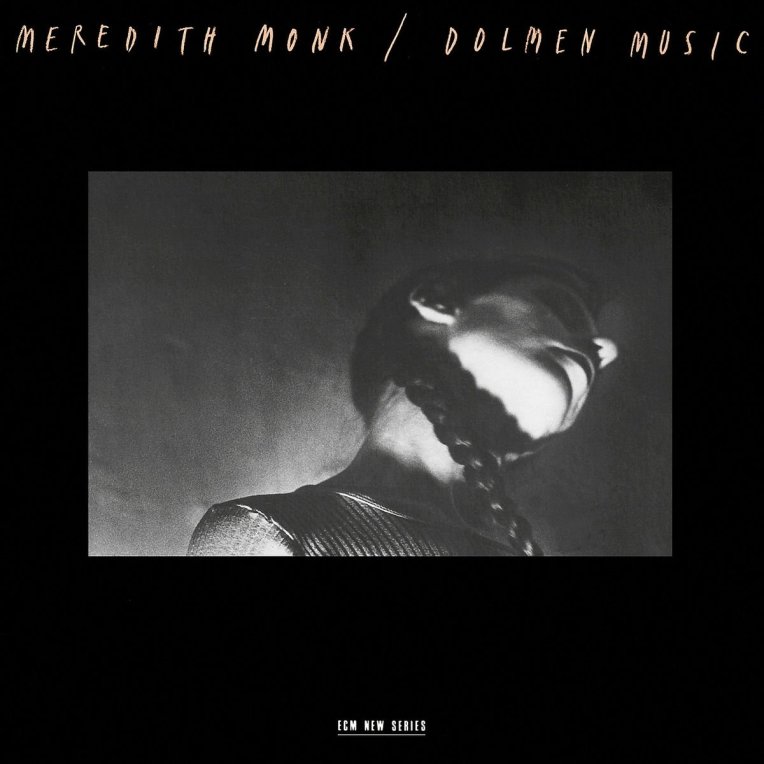
With this album Monk reinvigorated the linear song, the sole/soul singer, the monophonic performer. With the barest resources, she and her highly trained ensemble gave us an eternity of sounds. Dolmen Music makes a stunning addition to any music collection not only for its audible dimensions, but also as an art object, for it boasts one of the most perfectly suited covers in the entire ECM catalog.

<< Thomas Demenga/Heinz Reber: Cellorganics (ECM 1196 NS)
>> Steve Eliovson: Dawn Dance (ECM 1198)

Steve Reich: Tehillim (ECM New Series 1215)

Steve Reich
Tehillim

Pamela Wood voice
Cheryl Bensman voice
Rebecca Armstrong voice
Jay Clayton voice
Bob Becker percussion
Russ Hartenberger percussion
Garry Kvistad percussion
Steve Reich percussion
Gary Schall percussion
Glen Velez percussion
Virgil Blackwell clarinet, flute
Mort Silver clarinet, piccolo
Vivian Burdick oboe
Ellen Bardekoff English horn
Edmund Niemann electric organ
Nurit Tilles electric organ
Shem Guibbory violin
Robert Chausow violin
Ruth Siegler viola
Chris Finckel cello
Lewis Paer bass
George Manahan conductor
Recorded October 1981 at Tonstudio Bauer, Ludwigsburg
Engineer: Martin Wieland
Produced by Manfred Eicher

Human languages are contrived, insofar as they have undergone extensive sociopolitical reshaping. In Steve Reich’s Tehillim, however, words take on a self-sustaining feel, deeply rooted as they are in the nutrient-rich soil of the composer’s instrumental configuration, and serve to dictate the rhythmic and dynamic flow of a seminal shift in American “minimalism.” Being the first document of this new path in Reich’s personal and professional development, this recording matches an endearing trepidation to every practiced gesture. The music therein, says Reich, may be “heard as traditional and new at the same time,” as it was both a way for him to explore his Jewish roots while weaving a fresh brand of secularism into the many liturgical threads at his feet. At just under 30 minutes, Tehillim is but a fleeting unraveling of that very fabric.

Tehillim, meaning “praises” and referring to the Hebrew Book of Psalms from which it borrows its texts, is more than a remarkable work. It is also a work of remarks. The scoring is deceptively simple, built around a core of drum and clapping before introducing a female voice doubled by clarinet. This opens into a series of four-part canons against a backdrop of electric organs and maraca. Each melodic line—human and instrumental alike—moves distinctly, unaffected by the trappings of vibrato or other flourishes, as an imitative counterpoint works its way into the smoke of this short-burning votive candle. Part II carries the women’s voices into higher elevations in which the passage of time is marked by a light interplay of drums. Part III is the slowest of the four, ebbing and flowing with a breath’s involuntary precision. Like the most engaging of Gavin Bryars’s ensemble pieces, this section pulses with the quiet splendor of a deep-sea organism. The final part opens our eyes again to sunlight. With the barest assortment of auditory keys, it unlocks just enough doors to usher us into a more personal understanding of exultation. It can be no coincidence, then, that the derivation of the title—Hey, Lamed, Lamed (HLL)—also forms the root for “hallelujah.” And so, when the hallelujahs that close the piece spring up like so much plant life, they seem to forage even deeper into their origins. Tehillim is the Tree of Life feeding off itself, bathing in the spores of the Word made flesh.

Jean-Luc Godard: Histoire(s) du cinéma (ECM New Series 1706-10)

Jean-Luc Godard
Histoire(s) du cinéma

As one of the world’s most distinctive and important filmmakers, Jean-Luc Godard has not only an amazing eye for images, but also an astute ear for sounds. I first encountered the work of Godard in the singular experience that is Je vous salue, Marie (1985). Having now seen the film dozens of times (it remains one of my most cherished), aside from its unflinching tongue-in-cheek narrative, intimate atmospheres, and visual parallels I am always struck by the film’s innovative deployment of sound. Godard’s splicing of the Dvořák Cello Concerto simply makes sense. Like a rapid-fire commentator, he throws in descriptive snippets wherever and whenever appropriate, never afraid to cut them off at their most soaring moments. This technique has continued to dominate his subsequent work, and nowhere is it more fully realized than in his Histoire(s) du cinéma. What separates Histoire(s) from its predecessors and followers alike is an unequivocal sense of time and image. It is far more than a developmental exposé of the art form, twisting itself as it does into an utterly personal Möbius strip. With his characteristic rough-hewn grace Godard skirts the line between the sacred and the profane, holding a floodlight behind every palimpsestial theme to reveal the ravages of sight and the idolatry of retrospection.

After seeing Godard’s Histoire(s) I felt my view of the imagistic world forever changed; not because what he was doing was particularly revolutionary, but because it was so honest. Whatever one may think of Godard, one can hardly fault him for laying himself bare in every project he takes on. Histoire(s) is so unabashedly mitigated that it becomes translucent.

The ECM enthusiast will already know Godard, whether having seen his films or not, through the occasional visual borrowings manifest in a representative spread of album covers (Voci, Trivium, and Asturiana, to name a few). Regardless, the stereophonic intertextuality of Histoire(s) is obvious. More than just a thoughtfully arranged ECM greatest hits album, this complete soundtrack slithers through a provocative obstacle course sculpted and collaged from a vast archive.

Godard hammers his thoughts into the ether with his automatic typewriter, and its steady rhythm provides a pedal point to Chapter One as he calmly sketches the divisive nature of cinema, upholding its founders while reviling its abusers. Cinema was forged in black and white, he asserts: that is, in the colors of mourning. This is not to say that film was already dead the moment it was born (even if it was never alive to begin with), but that it has always been interested in that which is lifeless. Indeed, Godard believes the only two viable stories of the cinema since its inception have been sex and death.

“that which has passed through cinema
and been marked by it
can no longer get in anywhere else”

The sounds represented on this collection, slip-cased in minimal beauty, are as much something to behold as they are to be held. We may read the words, flipping through their corresponding pages with the careful patience of a novice, and yet we can never disassociate their orality from the visual cultures they describe. The cinema has already taken shelter in our heads by the time its music finds us. Godard is more literary than literal, undermining our wonder for celluloid in favor of the patchwork that is its constructedness.

“if George Stevens hadn’t been first to use
the first sixteen millimetre colour film
at Auschwitz and Ravensbrück
there’s no doubt that
Elizabeth Taylor’s air of wellbeing
would never have found a place in the sun”

By no means is Godard drawing a direct correlation here, luring the nascent viewer with the smoldering promise of self-destruction. Elizabeth Taylor flickers with all the iconicity of a votive candle, unspooling from her reel with a single expulsion of breath. She cannot last like death, and yet that is precisely the dichotomy we fervently hold dear. The march of cinema is a march of faces, each one more clearly disassociated from its body than the last, and serves to ritualize the art of viewing to the point of absurdity.

“technicians will tell you
it’s not true
but it’s worth remembering
that the nineteenth century
which invented all the technologies
also invented stupidity”

Such pronouncements remind us of our own complicity in the ethical vacuum of the cinematic enterprise. In the same way that every film is edited, so too do we clip our lives and adhere them back together in a series of lies and convenient elisions. That being said, I see no reason to believe that Godard is trying to be antagonistic. He is certainly not on a mission to open our eyes, for clearly they are already observing his work in tandem with its message. Rather, he seems to desire nothing but the recording of his desire. He doesn’t make films to be seen, but makes films to be read. With his hands hidden, revealed only by their periodic contact with an ever-present cigar, Godard is able to reform himself with the deceptive real time of his narration.

Chapter Two draws an implicit parallel between the development of recorded sound and recorded imagery. While the former preceded the latter, the two would require decades to synchronize. Godard is perhaps addressing the cinematic turn to melodrama, all the while lamenting over his slumber within, and painful awakening into, the whirlwind of moving-picture production. In human grasp, such a marriage is unavoidable and inviolably tethered to defaulted outlets of mass entertainment.

“to me, big history
is the history of cinema
it’s bigger than the others
because it’s projected”

In this sense, history is not the token of its own achievement, but the extant scar welted from centuries of picking and contortion. The master narrative in which we are schooled turns out to be nothing more than a flat image—there is none of the dimensionality we so readily accepted in our youth.

Time cannot be the sustenance of reason.

Chapter Three is a measured attack on the atrocities of European conflict. It is a scathing about-face related in a half-whisper, caressing the facts with self-reflexive pauses and audible punctuation. Politics ooze into a diatribe on the nature of their unraveling. The traversed border becomes the broken sentence, spilling its meaning like an inkblot across the map. Godard’s musical selections here are especially attuned to his subject matter, mimicking the mass media effect upon history: the dramatization of tragedy via the juxtaposition of graphics and sound bytes. It is the mise-en-scène of everyday life splashed against a backdrop formatted to fit our television screens. Our feelings are led down the aisle, wedded as we are to the didactic interpretations spun for our supposed protection, only to realize too late that the moving image is, at heart, motionless. If we accept Godard’s famous idiom that film is “truth 24 times a second” and that “every cut is a lie,” then the only way we can accept the truth of film is to package it in a lie. The editing room becomes the kill floor.

Chapter Four presents us with a critique of individualism through a visually marked conception of time. The filmic medium is no longer just a tool, but a way of life, a means of extending the reach of oneself beyond the world as one knows it.

“Alfred Hitchcock succeeded
where Alexander, Julius Caesar, Hitler, and Napoleon
had all failed
by taking control of the universe”

Cinema is not the key to conquest, but is one way in which we can visualize conquest and thus ensure its permanence. It allows us the luxury of repetition, the illusory mastery of time. And if the only mediation between an audience and the event depicted is the film itself, then the director has essentially offered him- or herself as a living replacement of the cause, in effect of the forces of nature.

“perhaps there are ten thousand people
who haven’t forgotten Cézanne’s apple
but there must be a billion spectators
who will remember the lighter
of the stranger on the train”

Although film, in Godard’s estimation, evolved out of painting, it has also destroyed the highly wrought image with the illusion of movement. Suddenly we can relate, seeing connective tissue where it had atrophied before. Like the film noir detective, we flit in and out of shadow—in and out of existence—as much in life as on screen. And so, whereas the museum piece reminds us of our transience by visually foregrounding an object that will outlive us, at least in cinema we find a kindred spirit willing to share in our self-deception to the point of death. Yet its indifference keeps us coming back for more:

“the cinema doesn’t cry
it doesn’t comfort us
since it is with us
since it is us”

Godard’s video essay is polyglottal and non-linear, a watershed composition for and of the twentieth century. Listening to the film on CD, however, I find that it speaks more directly. While the accompanying stills allow me to reenact the full experience as I see fit, I almost find them distracting when approaching Histoire(s) as a purely audio experience (assuming this is even possible). Godard’s voice becomes one of many, stripped of its paternalism through the concrete approach of his pastiche. We are implicated, imbricated, and insulated at every moment. Histoire(s) is inescapable. And yet, we can never be its prisoners, for the cage is honed in our very flesh.

<< Louis Sclavis Quintet: L’affrontement des prétendants (ECM 1705)
>> Kim Kashkashian: Bartók/Eötvös/Kurtág (
ECM 1711 NS)

Heinz Holliger: Beiseit/Alb-Chehr (ECM New Series 1540)

Heinz Holliger
Beiseit/Alb-Chehr

David James countertenor
Elmar Schmid clarinet
Teodoro Anzellotti accordion
Johannes Nied double bass
Klaus Schmid clarinet
Paul Locher violin
Marcel Volken Schwyzerörgeli
Markus Tenisch Schwyzerörgeli
Oswald Bumann bass
Recorded 1992/1993, Schweizer Radio DRS, Studio Zürich (Alb-Chehr)
March 1994, Psychiatrische Klinik, Münsterlingen (Beiseit)
Engineer: Peter Laenger
Produced by Manfred Eicher

This earthly offering from Heinz Holliger finds the inimitable composer comfortably at home. As with in the more recent Schneewittchen, Holliger has chosen to set the words of Robert Walser in the whimsical collection of vignettes that is Beiseit (Apart), scored for countertenor, clarinet, accordion, and double bass. Focused, fecund, and delightful, these are highly perceptive pieces delineated in small brushstrokes that are few and far between. While certain sections—most notably “Und ging” (“And Went”)—are gorgeously lyrical, for the most part these pieces allow the texts at hand to dictate their own arrhythmias, thereby allowing an open intimacy to shine through. The performances are uniquely suited to the work (David James’s recitation is wonderful to hear for its stark contrast) and are impeccably recorded—in a psychiatric institute, no less. The epilogue “Im Mondschein” (“In Moonlight”) is particularly evocative, both in word and in feeling:

I thought when the night was deep
that the stars must be singing,
for, roused from my sleep,
I heard a gentle ringing.

But it was a little harp
that pierced the walls of my room,
and through the cold, the sharp
night it rang out like doom.

I thought of vain struggles, vain clinging,
the prayer, the curse breathed away,
and long I still heard the singing,
long awake I lay.

It is an introspective and unabashedly nocturnal coda, leading us out with a wolf’s distant cry.

Alb-Chehr recounts the Valaisan tale of a cowherd’s ghostly encounter and the boorish village cheese-maker whose jealousy and prying ways lead him to a tragic end. The title means “return of the ghosts but also music of the Alps and music of ghosts,” and clearly outlines the divergent personalities of the music to follow. This piece plays like a Holligerian Peter and the Wolf and must have been a joy to compose. I say this not because Holliger is such a modernist that this was just a pleasurable one-off for him, but precisely because such music lies at the core of his process in its directness and unmitigated commitment to feeling.

Holliger is not one to impose his compositional will upon a text, but to become its willing ally. He composes from the heart and it is into the heart that his music directly falls.

<< Prague Chamber Choir: Dvořák/Janáček/Eben (ECM 1539 NS)
>> Edward Vesala/Sound & Fury: Nordic Gallery (ECM 1541)

Heinz Holliger: Scardanelli-Zyklus (ECM New Series 1472/73)

Heinz Holliger
Scardanelli-Zyklus

Aurèle Nicolet flute
London Voices
Ensemble Modern
Terry Edwards
Heinz Holliger
Recorded September 1991, Inselhalle Lindau, Germany
Engineers: Andreas Neubronner, Markus Heiland
Produced by Manfred Eicher

The rivers are, like plains, the shapes of wildness
Are scattered also, more revealed the mildness
Of life continues, and our cities’ traces
Appear most clearly in unmeasured spaces.
–F. Hölderlin

Scardanelli-Zyklus (Scardanelli Cycle) is Heinz Holliger’s crowning compositional achievement. It is so lovingly crafted that I cannot help but bask in its atmospheres anew with each listen. This was my inaugural Holliger encounter—as either musician or composer—and will always hold a special place in my life for that among other reasons. I first heard Scardanelli-Zyklus when I was sixteen (as many years as it took to compose), and the experience was nothing short of a revelation. To compare it to anything else would be an injustice.

The cycle is a composite work and is comprised of:

The Seasons, three sets of four songs for a cappella choir
Exercises for Scardanelli for small orchestra
comments, mirrors, responses, marginalia to The Seasons
(t)air(e) for solo flute
Excerpts from:
Tower Music for solo flute, small orchestra and tape
Ostinato Funebre for small orchestra

These are squared and shuffled like a deck of cards. Holliger sets vocal passages to the words of famed German poet Friedrich Hölderlin (1770-1843), and for this has selected poetry from the latter years of Hölderlin’s life, a period of mental instability and obsessive writing and revision. Much in contrast to the free verse at his peak, Hölderlin eventually took to penning rhymed quatrains on rather innocuous subjects, many of which he signed with the nom de plume “Scardanelli” and which he dated with absurd imprecision, sometimes years into the future. In many ways, this is exactly what the music feels like: caught in time against the blatancy of its own transcription.

The Seasons are the glue that holds Scardanelli-Zyklus together. Each is divided into three sections and sprinkled liberally throughout. While Hölderlin tends to opt for traditional seasonal imagery, he occasionally surfaces with rather insightful readings of nature. In Scardanelli’s world, Spring is less about new life than the reinvention of its vocabulary. Peaks graze the sky in order to emphasize the darkness between them, looming over the explicit deference to perfection and valorization of the lowly-wise agrarian. Summer is fittingly presaged by Holliger’s Summer Canon IV, in which precision is no longer mathematical, but emotive. Here, the season is about life, the body in all its fragile stages. It is a landscape of rippling water rife with intimations of unity. Holliger makes sure to leave its surface tension unbroken. Sunlight is reduced to a whisper, no longer a blinding presence. We see the wonders of production and learn to appreciate the harvest all over again. These are hymns of heat waves, hair-thin rays of light woven into audible dimensions. Summer is uneasy, unpredictable, more causal than caustic. Glittering streams feed the valley, made known more by light than sound. Autumn is the brittle leaf transformed into a promissory spirit underfoot. We are treated to a stunning confluence of voices and instruments in Holliger’s arrangements thereof. Each word is given equal weight, gilded by an underlying drone. It is supremely unsettling and undeniably gorgeous. A glass harmonica ushers in Winter, lending an icy repose to deadening voices. Some tremolo is introduced, as if of a thrashing possibility yearning for the distant thaw. It is one incarnation of Winter that ends the cycle, growling and scraping the bottom of each singer’s vocal range.

The more instrumentally focused works are cue cards signaling new turns in the cycle’s narrative flow: Fragments is a flute-driven explication of the incomplete; Bell-Alphabet features Japanese bells cradling flute and orchestra on a tonal journey through speech unspoken; Paddlewheel revolves until it is the rasping of strings and air; Ice Flowers burgeons slowly into a frosty cornucopia of sound; Ostinato Funebre is a sketched crease in time overlaid with a warped deconstruction of a Mozart motif; The Distant Sound is a stunning instrumental reworking of an earlier Winter section; (t)air(e) is to the solo flute what Holliger’s Studie über Mehrklänge is to the oboe, and then some (taire = keep secret, not to talk; air = air, song, aria, breath; te = you)…a masterful exposition piece for the non-exhibitionist; Ad Marginem, based on a Paul Klee painting of the same name, utilizes taped frequencies thinner than a molecule’s breath to elicit an inescapable effect.

For all of its complexity and ambition, Scardanelli-Zyklus is a refreshingly straightforward work. Voices sing with little trickery (the most adventurous of which merely requires singers to follow the beat of their own pulses) and instruments faithfully follow the mechanics of their titular signposts. This music carries itself neither programmatically nor incidentally. Scardanelli-Zyklus is not only Holliger’s magnum opus, but is also undoubtedly one of the most compelling masterpieces of twentieth-century music. What a joy to have this recording to preserve its existence.

<< Kancheli/Schnittke: Vom Winde beweint (ECM 1471 NS)
>> Terje Rypdal: Q.E.D. (ECM 1474)