Christoph Poppen: Morimur (ECM New Series 1765)

Version 1.0.0

Morimur

Christoph Poppen baroque violin
The Hilliard Ensemble
Monika Mauch soprano
David James countertenor
John Potter tenor
Gordon Jones baritone
Recorded September 2000, Monastery of St. Gerold, Austria
Engineer: Peter Laenger
Produced by Manfred Eicher

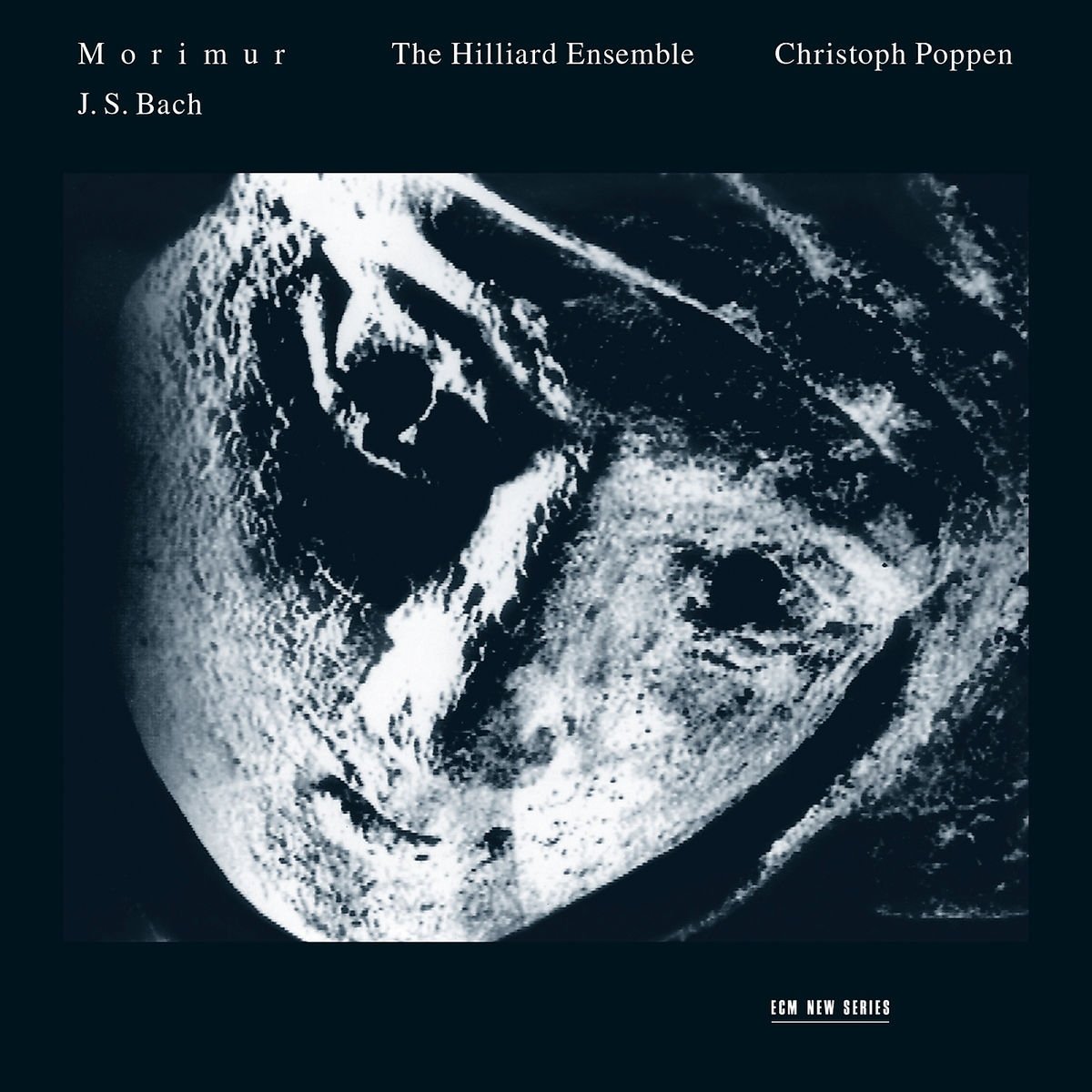
Drawing on the research of musicologist Helga Thoene of the University of Düsseldorf, Christoph Poppen and the Hilliard Ensemble take great care in juxtaposing the monumental “Ciaccona” from J. S. Bach’s Partita in D Minor BMV 1004 alongside (and against) various Bach chorales, through which cryptic synchronicities are brought audibly to light. These “chorale quotations”—believed by Thoene to comprise a “tombeau” (i.e., epitaph) for Bach’s deceased wife Maria Barbara in the larger context of Christ’s death and resurrection—are transformed here into an entirely new experience that traces the intangible borders between life and death. And indeed, the title of the album, Morimur, connotes “death as a passage to life” and reflects the numerology therein as an equation for transubstantiation. Chorale passages are interspersed between movements of the refracted Partita, thus allowing us insight not only into the hidden connections of violin and voice (insofar as the Ciaccona is concerned), but also into the nearly tangible sinews that hold together the Partita as a whole. Poppen’s violining digs ever deeper into its source, as if overwriting the original manuscript with heavier ink.

This is a very challenging album to encapsulate in one review, for it is a listening experience like no other. With each new turn it offers hitherto unexplored avenues of creation. As a mere listener, it may be easy for me to dismiss the intense scholarship that has gone into this recording and simply enjoy it for the contemplative music it contains. After all, much of what lies hidden between the Ciaccona and its companion chorales is perhaps more obvious to the trained eye on paper than it is to the casual, if not enraptured, ear on disc. At the same time, I cannot help but think that the connections drawn out through its attendant scholarship are vastly important for the sole reason that this program would not exist in its present form without them. That being said, I feel that Bach’s ciphers stimulate the heart without the need for a direct correlation in numbers. In other words, we don’t necessarily require those connections to be spelled out for us as a guidebook to what remains fundamentally communicative.

Music never ceases to amaze and entice with its potential for infinite variation. The intersections drawn in Morimur are omnipresent and need not always be so contrived. Bach’s music, especially as it is rendered here, reminds us that sometimes those transparent bridges between our intellect and the environments around us are also the most fleeting and unexpected. Contrary to what we might expect from a project so described, this is not about solving some age-old code left for only the most astute of posterities. It is, rather, about uncovering those mysteries that never go away and make us who we are: mysteries of faith, of love and absolution, of desire, and of death. Therefore, I see this album not so much as a reflection of Bach’s often-touted genius, but of his humility.

<< Seim/Brække/Johansen: The Source and Different Cikadas (ECM 1764)
>> Susanne Abbuehl: April (
ECM 1766)

John Adams: Harmonium (ECM New Series 1277)

John Adams
Harmonium

San Francisco Symphony Orchestra and Chorus
Edo de Waart conductor
Vance George chorus director
Recorded January 1984, Davies Symphony Hall, San Francisco
Engineer: John Newton
An ECM Production

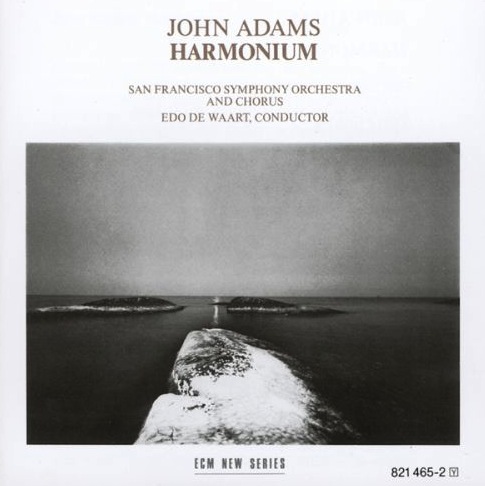
Music emerges from a dark tunnel, a smooth and liquid train with a large chorus as passengers. The accelerated evolution of Harmonium is brought forth in what Adams calls a “preverbal creation scene,” an inescapable feeling of solitary light tinted with the weight of retrospection as the voices intercede. Harmonium seems to revel in self-awareness, building as it does through a series of dynamic swings from the threshold of audibility to ringing pronouncements of verse. It is a convoluted world where density and transparency coexist in equal measure.

At times this piece sounds like Adams’s popular Shaker Loops with words, at others like a Philip Glass tribute with characteristic pulses of flute and strings, at still others like a ritual of its own kind. It is a pastiche of poetry (John Donne and Emily Dickinson provide the texts), a bridge of intentions, a house with only two windows.

The recording quality here may polarize listeners somewhat. While on the one hand it captures the overall mood of the piece in a rather heterogeneous mix, on the other it loses detail in the quieter moments. I would imagine, however, that engineering choices in this case were dictated by Adams’s vision for the piece as a whole. It is meant to be a single “fabric of sound,” thereby necessitating a more distanced recording. It is like a lake: deceptively uniform from a distance, but promising new life and environments if only we can plunge into its depths. Yet somehow we are unable to take that plunge. The recording engineer, like the listener, is an observer here rather than an intruder. We do not approach this music; it approaches us, and it can only come so far before receding into its womb.

<< Keith Jarrett: Trio Changes (ECM 1276)
>> Pat Metheny Group: First Circle (ECM 1278)

Steve Reich: Music for 18 Musicians (ECM New Series 1129)


Steve Reich
Music for 18 Musicians

Shem Guibbory violin
Ken Ishii cello
Elizabeth Arnold voice
Rebecca Armstrong voice
Pamela Fraley voice
Nurit Tilles piano
Steve Chambers piano
Larry Karush piano, maracas
Gary Schall marimba, maracas
Bob Becker marimba, xylophone
Russ Hartenberger marimba, xylophone
Glen Velez marimba, xylophone
James Preiss metallophone, piano
Steve Reich piano, marimba
David Van Tieghem marimba, xylophone, piano
Virgil Blackwell clarinet, bass clarinet
Richard Cohen clarinet, bass clarinet
Jay Clayton voice, piano
Recorded April 1976 at Town Hall, New York [?]
Engineer: Klaus Hiemann
Produced by Rudolph Werner

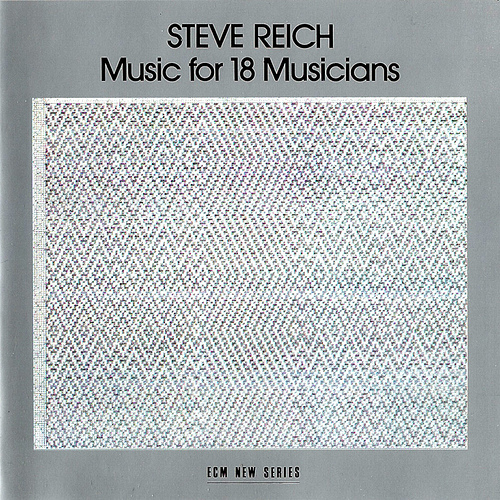
Music for 18 Musicians makes no efforts to obscure the methods behind its construction. As such, it reveals a wealth of mysteries never notated on the printed page. The piece is scored for violin, cello, 2 clarinets doubling bass clarinet, 4 women’s voices, 4 pianos, 3 marimbas, 2 xylophones and metallophone (vibraphone with no motor). With his characteristic attention to detail, Reich utilizes these instruments not necessarily for their evocativeness, but for the unique and varied ways in which their timbres can be blended in a nearly hour-long wash of sound. Calling this “minimalism” would be unfair both to Reich and to the musicians among whom he makes this demanding journey. There is a sense of movement here that is both linear and multidirectional. I say this not for the sake of verbosity, but because Reich’s notecraft commits to its own agenda while latching on to so many others along the way.

The piece begins with a seamless blend of piano and mallet instruments threading its full length like a living metronome. Joining this is a chorus of breaths from human voices and winds. The interweaving of these substantial strands reinforces the compositional density, like marrow and nerves cohering into a spinal c(h)ord of decidedly aural design. At the risk of belaboring this analogy, I venture to see this piece as one active body in which each instrument writes the genetic code of its musical biology. This dynamic is further heightened by the presence of vocal utterances. Although these function as egalitarian extensions of manufactured instruments, they lend fragility to the underlying spirit of the music at hand. These voices rise and fall, slowly replaced by clarinets as if one and the same.

Sudden changes in rhythm serve to reconfigure our attention to the intervention of the composer’s hand: just as we are being lulled into a sense of perpetuity, akin to a natural cycle studied from afar, we are reminded that what we are listening to has been contrived at the whim of a single human mind. Far from undermining the piece, this awareness invites us to share in its re-creation through the very act of listening. Like much of Reich’s music, Music for 18 Musicians is nothing if not accommodating. Rather than patronize or proselytize, it lays itself bare. This brackets Music for 18 Musicians off from much of the histrionic art music in vogue at the time of its creation (1974-76). One could argue that it is scientific in its approach to structure. I prefer to see it as simply honest.

The recording quality of this album is ideally suited to its subject matter. There is a sense of “clusteredness” throughout, so that the performers never stray too far from the nexus of their unity, while also providing just enough breathing room (the performers’ lung capacities determine the length of sonic pulses throughout) for individual elements to shine. Most of the mixing, as it were, is done live through the sheer skill of Reich’s assembly of dedicated musicians, and requires meticulous attentiveness on the part of the recording engineer to highlight that complex interplay without overpowering the core. A beautiful and compelling landmark achievement.

Thomas Demenga/Heinz Reber: Cellorganics (ECM New Series 1196)

ECM 1196 LP

Cellorganics

Thomas Demenga cello
Heinz Reber pipe organ
Recorded October 1980 at Pauluskirche Bern, Switzerland
Engineer: Martin Wieland
Produced by Manfred Eicher

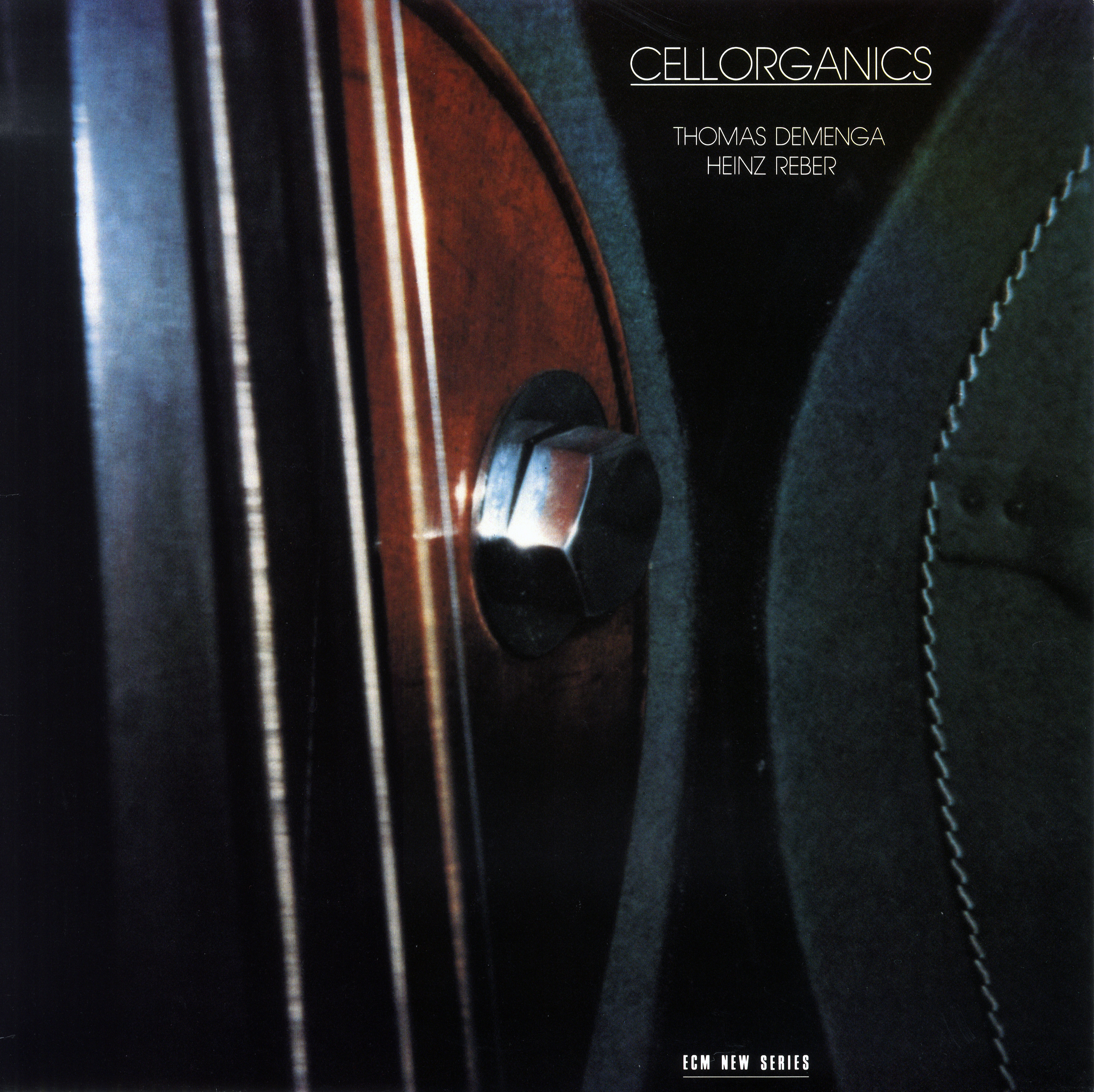
Cellorganics is exemplary of what I see to be ECM’s primary aesthetic: the dialectic possibilities of seemingly disparate instrumental voices, cultures, and sociopolitical contexts. The pairing of cello with organ is but a step away from the former’s canonic place beside the piano. And yet this juxtaposition opens us to entirely new areas of sonic creation, dramatically enhanced by the lofty recording space.

The album arises as if from slumber with the lone cello, whereupon it is gently accosted by the organ. Thus begins a delicate conversation that before long erupts into a frenzied catharsis. At this point Reber repositions himself, providing a dense and layered backdrop for Demenga’s no less contemplative phrasing. This stichomythic structure continues, interspersed with stunning moments of confluence—occasionally dipping into reverberant depths of scraping and sustained chords—before the cello works through its own degradation into a sort of intertextual improvisation.

The album’s center finds the two musicians in an exuberant melancholy; one suffused with both rhythmic buoyancy and introspective caution. The organ’s pointillism becomes a comforting counterpoint to the cello’s harmonic glissandi, giving way to an expansive exposition and coda.

Ultimately, this album is about power relationships and their reconfigurations. The organ’s long-held position as a vessel for moral weight, as imposing as it is transcendent, is challenged here in its pairing with a “lowly” string. This is not a cello that yearns to be heard, but one that sings out of its own self-sufficiency. The pizzicato passages that open the final chapter in this narrative are like footsteps, neither approaching nor receding, dancing in place to the tune of their own inner voices. The organ, too, becomes a living organism, literally breathing life through a forest of esophagi.

This recording invites us not only to listen, but also to speak.

<< Shankar: Who’s To Know (ECM 1195)
>> Meredith Monk: Dolmen Music (ECM 1197 NS)