Pepl/Joos/Christensen: Cracked Mirrors (ECM 1356)


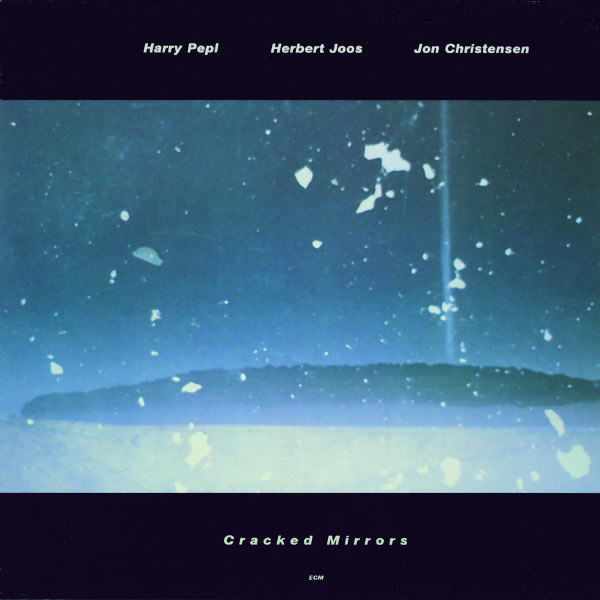
Harry Pepl
Herbert Joos
Jon Christensen
Cracked Mirrors

Harry Pepl guitar, roland midi guitar system, piano
Herbert Joos fluegelhorn
Jon Christensen drums
Recorded February 1987
Engineer: Gerhard Tauber
Mixed at Rainbow Studio, Oslo
Engineer: Jan Erik Kongshaug

After my faulty impressions of guitarist Harry Pepl’s effort with Werner Pirchner and Jack DeJohnette, I was gratified to stop on my listening journey at an unassuming little way station called Cracked Mirrors, which proves a far better showcase for Pepl’s innovative talents. For this collaboration, he welcomes Herbert Joos on fluegelhorn and drummer Jon Christensen. Joos lays down a breathy gorgeousness in his two-part “Wolkenbilder” (Cloud Picture). The first of these sets Pepl’s acoustic sequences into the recesses of an ambient storm, while the second makes beautiful use of midi and underscores Pepl’s off-kilter regularity. Joos shines like a snake of light into “Reflections In A Cracked Mirror.” In a rare death by drum machine, Christensen hauls us through a thicket of unsettling midi guitar, which is only strengthened by the punctiliousness of Pepl’s execution. “Schikaneder Delight” pays homage to, I can only surmise, Emanuel Schikaneder, Mozart’s famous librettist, with a showy ball dance that plods like something from a calliope before morphing into a Bill Frisell-esque fantasy. “Die alte Mär und das Mann” (The Ancient Tale And The Man) is straightforward trio work that features more greatness from Joos, who also excels throughout “More Far Out Than East,” in which Pepl is clearly having fun skittering through the rafters. “Purple Light” brings back the shaking and trembling, leaving us drained of our “Tintenfisch Inki” (Squid Ink). This final track features lovely piano from Pepl, who sends this eclectic marble skee-balling into orbit at last.

Pepl’s playing, as restless as it is welcoming, is difficult to pin down. This makes it all the more fascinating. He is the bloodstream of a vast organic landscape, where feelings of fracture share the roads with heavy travelers. One to explore.

<< Steve Tibbetts: Yr (ECM 1355)
>> Koch/Schütz/Käppeli: Accélération (ECM 1357)
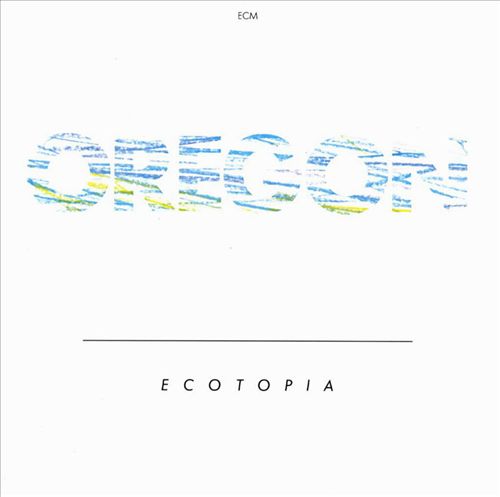
Oregon: Ecotopia (ECM 1354)

Oregon
Ecotopia

Trilok Gurtu tabla, percussion
Paul McCandless oboe, English horn, soprano saxophone, wind-driven synthesizers
Glen Moore bass
Ralph Towner classical and 12- string guitars, piano, synthesizers, drum machine
Recorded March 1987 at Tonstudio Bauer, Ludwigsburg
Engineer: Carlos Albrecht, Martin Wieland
Produced by Manfred Eicher

The stars of Ecotopia, Oregon’s third and final album for ECM and one wounded by the absence of Colin Walcott, are undoubtedly Ralph Towner and Paul McCandless. One could easily be content in listening to just the two of them for the album’s 50-minute duration, pairing so gorgeously as they do on tracks like “Zephyr.” As it is, we get a rich sound palette that, while a definite shift from what came before, speaks to a mode of experimentation that is therapeutic and adventurous. McCandless’s lines in “Twice Around The Sun” are somewhat lost in the cheapening synthesizer, but make for a light-footed introduction all the same. Thankfully, Glen Moore’s bass and Trilok Gurtu’s percussion steer this vessel into more organic waters. As the group swings in retrograde, Moore works his corona through a shower of bells and stardust. Piano and reeds fall behind silhouetted mountains, leaving Gurtu to ponder the landscape with nimble footsteps, writing the history of a savannah without wind. “Innocente” is the album’s zenith, a wondrous journey in which Towner rides a wave of table beneath McCandless’s lone seagull, who touches wing to water with every chromatic dip. His reeds sound absolutely resplendent, every note a thin ray of sunlight gathered in able grasp. After a brief throwaway improvisation (“WBAI”), the title track vindicates the use of electronics, while the swanky late-night stroll of “Leather Cats” does not. Thankfully, McCandless’s soprano wins out in this conversation. Towner lays down the groovy backbone of “ReDial,” which Gurtu and McCandless are more than willing to flesh out with all manner of delicate venation. Towner outdoes himself and brings his gentle cascade to bear on a smooth finish. “Song Of The Morrow” also makes beautiful use of synthesizers and ends this colorful and classic album which, despite its unnecessary forays into technology, is now assured of its status as one of ECM’s Touchstones.

<< Dave Holland Quintet: The Razor’s Edge (ECM 1353)
>> Steve Tibbetts: Yr (ECM 1355)

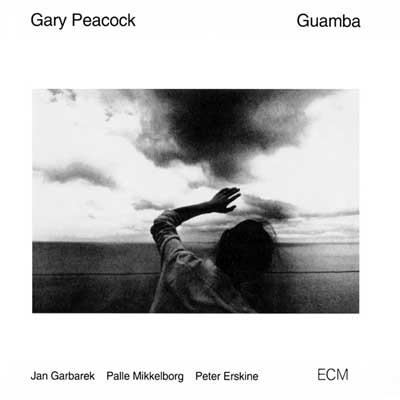
Gary Peacock: Guamba (1352)

Gary Peacock
Guamba

Gary Peacock bass
Jan Garbarek tenor and soprano saxophones
Palle Mikkelborg trumpet, fluegelhorn
Peter Erskine drums, drum computer
Recorded March 1987 at Rainbow Studio, Oslo
Engineer: Jan Erik Kongshaug
Produced by Manfred Eicher

Despite the fact that bassist Gary Peacock has emoted some of the liveliest passages in his long stint with the Keith Jarrett trio, as frontman he has always shown us the merciful heart that moves him. Listen to the eponymous opener of Guamba, and you hear not the rhythmist but a parent tendering a lullaby for his sleeping child. Only after this Escherian staircase in sound is Peacock joined by his session mates—Jan Garbarek on tenor and soprano saxophone, Palle Mikkelborg on trumpet and fluegelhorn, and Peter Erskine on drums—for “Requiem,” which lulls us into a low-slung saddle of bass and drums before Garbarek’s razor-sharp agitations sober us. Yet Garbarek also shows great sensitivity on this date, bowing out for the beguiling trio of “Celina” and crackling with Mikkelborg over a smooth grounding in “Thyme Time.” In this upbeat number, Erskine takes the lead amid a brocade of drum computer accents. Peacock takes us aside again at the start of “Lila.” His steps are watered by droplets of cymbal, every strum a burgeoning shoot spreading Garbarekian flowers, and nourished by Mikkelborg’s sunshine. Erskine delights yet again with his delicate precision, and with the variegated rhythms that lure us into “Introending.” Peacock dances here amid a string of horns, making for a fantastic ride on par with the subtle grooves of Manu Katché. We end in a bed of “Gardenia,” another solo around which our leader’s band mates slide with utmost care. Garbarek has hardly been gentler, giving Mikkelborg more than enough canvas across which to bleed watercolor into the final exhalation.

<< Marc Johnson’s Bass Desires: Second Sight (ECM 1351)
>> Dave Holland Quintet: The Razor’s Edge (ECM 1353)

The Bill Frisell Band: Lookout For Hope (ECM 1350)

The Bill Frisell Band
Lookout For Hope

Bill Frisell electric and acoustic guitars, banjo
Hank Roberts cello, voice
Kermit Driscoll bass
Joey Baron drums
Recorded March 1987 at Power Station, New York City
Engineer: James Farber
Produced by Lee Townsend

Listening to Lookout For Hope is like wandering into a windblown cowboy town. The dirt is bare, save for the errant tumbleweed that dares set twig in this dustbowl. You wander past the Sheriff’s office. A poster hangs outside the door:

WANTED
FOR ARMED ROBBERY OF GENRE

BILL FRISELL
REWARD: MUSICAL LUXURY

And indeed, Frisell has run off with many a stagecoach prize, fashioning each into a personal politic of twisted charm.

On this, another seminal effort on ECM’s Touchstones, Frisell continued to chart his inimitable sound. The wordless vocals of Hank Roberts in the album’s title opener waver like something from the dream diary of Pat Metheny, with whom Frisell shares much insofar as it is almost impossible to listen to either guitarist without seeing epic films of vivid imagery. But make no mistake about feeble comparisons: Frisell is the only dude on this ranch. From his gentle entrance, we know that his is an axe that melts, revealing thematic contours in negative space. He frees melodies from the chopping block and lets them bump into one another as they will. Roberts’s sinewy cello is a no-brainer. As it extends its forked tongue from this sonic bayou, defenestrating itself in a blissful unraveling, it lands smack in the molasses of “Little Brother Bobby,” where with easygoing persuasion it rocks like a back porch chair before stumbling on through the banjo-infested prophecy of “Hangdog” and into the crystalline vision of the album’s capstone, “Remedios The Beauty.” And where “Lonesome” is a raw slab of Podunk beauty that glistens with Frisell’s acoustic, “Melody For Jack” is a dream tunnel into a trio of miniatures before the warm fuzziness of “Alien Prints” plays us out with understated panache.

Lookout For Hope is a walleyed world replete with hokey profundity and slack jaws. Like a good Stephen King novel, it gets under our skin even as it nourishes it. The titular lookout seems but a toothpick of a shadow on the horizon. But no matter, for by the time the final note has run away we’ve already found our hope.

<< Zakir Hussain: Making Music (ECM 1349)
>> arc Johnson’s Bass Desires: Second Sight (ECM 1351)

Zakir Hussain: Making Music (ECM 1349)

Zakir Hussain
Making Music

Zakir Hussain tabla, percussion, voice
Hariprasad Chaurasia flutes
John McLaughlin acoustic guitar
Jan Garbarek tenor and soprano saxophones
Recorded December 1986 at Rainbow Studio, Oslo
Engineer: Jan Erik Kongshaug
Produced by Manfred Eicher

In March of 2010, I had the great honor of seeing Zakir Hussain and the Masters of Percussion give an unforgettable performance. I had always been a great admirer of him, but to experience that blissful power firsthand was beyond special. This liveness can hardly be replicated on disc, though we can still feel the passion that imbues his every action in the studio and beyond.

The key to Making Music lies in its title. This is not about a fusion of East and West. This is about creation for its own sake. The selfsame track opens our ears to the flute of Hariprasad Chaurasia, who turns breath into gold. Guitarist and Mahavishnu Orchestra guru John McLaughlin is another welcome addition to a quartet rounded out by saxophonist Jan Garbarek. As lines curve their way through subtle changes in temperature, we can feel the rhythm being formed, piece by ephemeral piece, even before Hussain lays hands to drum. Garbarek works some of that same magic that enlivened his earlier recordings with Shankar, while McLaughlin showcases his mastery of classical forms (the duet with Hussain on “You And Me” is one of many highlights), matching the tabla master’s deftness with ease.

Yet Chaurasia is the jewel of this session. His dialogues with McLaughlin (“Zakir” and “Sabah”) in particular reveal a purity of tone all his own. Sometimes, he lowers the threads from which the music hangs, pulling us along with them into a verdant sky. Others, he bends like an outstretched leaf hit by the first raindrop of spring (“Toni”). The album’s remainder is filled with rainbows. The most verdant of these is “Water Girl,” a mosaic spread with saffron and rosewater, willed into life by that generative flute. Garbarek makes his voice clearest in “Anisa,” which first pairs him with McLaughlin in an exchange at once forlorn and sweet before Hussain regales with such grace that one has to wonder if his fingers aren’t pure energy. After this saga of tribulation and triumph, Garbarek’s skyward incantation in “Sunjog”—incidentally, another standout for McLaughlin, who shares a winged exchange with everyone in turn—proves well suited to this musical nexus, for he, like the others, plays not in unison but in tandem, and in so doing binds the overall unity toward which they strive together. And so, when they do join in the occasional doubling, the sound becomes gentler, each voice restraining itself so as not to overpower.

Hussain is a carpenter who delicately hammers the edges of every project he touches into perfect alignment. Yet after listening to Making Music, one has the feeling this project had only just begun.

<< Gidon Kremer: Edition Lockenhaus Vols. 4 & 5 (ECM 1347/48 NS)
>> The Bill Frisell Band: Lookout For Hope (ECM 1350)

Keith Jarrett: Book Of Ways (ECM 1344/45)

Keith Jarrett
Book Of Ways

Keith Jarrett clavichord
Recorded July 1986 at Tonstudio Bauer, Ludwigsburg
Engineer: Martin Wieland
Produced by Manfred Eicher

Trying to describe Keith Jarrett’s alchemical explorations of the clavichord is like trying to describe love: if you’ve never fallen into it, the words of others mean little. All I can do is share and hope my impressions might speak, for the album promises something so ineffable that it can only be expressed in music.

Over the course of nineteen improvisations, Jarrett transcends both the medium and the message in search of something untouched for centuries. He burrows into the heart of this nearly forgotten instrument, seeming to make music as if only after centuries of slumber. By the time he awakes, his body has fused with every molecule of metal and wood, so that he needs only step into a latter-day age, where the magic of technology allows us a glimpse of that anatomy, wavering and fair.

1
Like some vast lute, curled into a withering plant of dedicatory power, it wishes itself clean of all earthly things, finding balance in song where there can be no troubadours to sing.

2
It is a self-sustaining lantern, whose oil is memory and whose flame is the flick of a maiden’s tongue along the edges of speech.

3
It is a scribe in a dimly lit cave, where every note is the scrawl of a quill on cracked parchment, sipping nourishment from an inkwell.

4
It is a taste of birth on the mind’s palette. A tearful wish discarded like so many handkerchiefs along garden paths. A joyful reunion reflected in her broach. A portrait in miniature, forgotten in a decaying drawer next to her brittle volume of poetry. She hums, her throat wound like a string.

5
It is a dream, wistful yet morose, putting a stopper into the night’s hidden vial. There it holds us, ever thoughtful, winded like an errant pageboy cursed with an undeliverable charge.

6
It is a child of time who speaks through dance, our feet its only partners. It looks to itself for guidance, only to touch an anxious moth who hopes the window will melt away, as if its millennia of grime will somehow afford a view of the impossible horizon.

7
It tickles the feet of our childhood, making us laugh in ways we have since denied.

8
It trembles like a plucked string that, once slowed to show every nuance of its warbling activation, finds much to fear in its own echo.

9
It turns to every Baroque master who sat alone at a keyboard and painted the room with novel sounds.

10
It is a percussive message that knocks on every castle door and rattles the bones in its crypt.

11
It is a love letter, a heart unfolded into the map of another heart. A dewy pasture that remembers lovelier days when the torturous end of an age was not upon us.

12
It strums an unmade bed in the hopes of recreating the music that once rustled there, but alas, there is only the lingering scent of a love that can never be washed away.

13
It is a necklace of memories, each bead more translucent than the last.

14
It opens our eyes to the clouds and to the trembling Tree of Life that hangs the wash of history from its boughs.

15
It carries us down an eroded stairway, even as it lifts us to the top of the tower.

16
It is a forlorn carnation, every petal the leaf of a story whose only tether is its maternal stem.

17
It upholds a chivalrous decorum, tilting its hat to the unbroken gait of a faithful horse. Through thick and thin, it has batted neither tail nor eye at knighthood’s unstoppable demise.

18
It is a funereal ode, a pyre burning to its glowing orange roots.

19
It brings us full circle to the avenues from which that first shadow extended before a dying sun.

Not only does this recording show us a book of ways, but it also shows us the way of books, for it teaches us that the written word, like music, is but a stepping-stone to silent understanding.

<< Enrico Rava/Dino Saluzzi Quintet: Volver (ECM 1343)
>> Terje Rypdal & The Chasers: Blue (ECM 1346)

Edward Vesala: Lumi (ECM 1339)

Edward Vesala
Lumi

Esko Heikkinen trumpet, piccolo trumpet
Pentti Lahti alto and baritone saxophones, flutes
Jorma Tapio alto saxophone, clarinet, bass clarinet, flute
Tapani Rinne tenor, soprano saxophones, clarinets
Kari Heinilä tenor, soprano saxophone, flute
Tom Bildo trombone, tuba
Iro Haarla piano, harp
Raoul Björkenheim guitar
Taito Vainio accordion
Häkä bass
Edward Vesala drums, percussion
Recorded June 1986 at Finnvox Studios, Helsinki
Engineer: Risto Hemmi
Produced by Manfred Eicher and Edward Vesala

Take a moment to wander the art of Morten Haug, whose cover photograph (one of ECM’s best) is a gateway into what’s to come. Like Edvard Munch’s The Scream mummified, it silences that which is already silent, and in so doing unleashes a slow torrent of organic music. As the rain of Iro Haarla’s harp trickles through the branches of “The Wind,” picking away the last crumbs of our disbelief, we are able to ease into the careful telepathy this ensemble braids together. Thus blown of our dust, we meditate in “Frozen Melody,” which, though it may begin in stillness, melts with every rendered note. “Calypso Bulbosa” is a rougher diamond, freshly unearthed, the grunge of an electric guitar still clinging to every clouded knurl. Birdcalls and flightless reeds share the same forest, twisting into all manner of distorted reflections. After sailing through the elliptical orbits of the “Third Moon,” we reach the title track, which indeed brings light to bear, cloud-shafted and wavering. The saxophone work here, and in the “Camel Walk” (Vesala’s own “Donkey Jamboree”) that follows, is gorgeous, watery, silted. “Fingo,” no dissimilarly, sounds like a Bill Frisell tune blended in a sonic food processor with Dino Saluzzi spice and a dash of late-night cabaret. A brilliant inclusion. The album’s briefest spit comes in “Early Messenger,” and brings us “Together” in the full-circle closer, interlacing creative fingers in the full dark of finality.

Another puzzling masterpiece from Vesala. Savor it as you will.

<< Mark Isham/Art Lande: We Begin (ECM 1338)
>> Thomas Demenga: Bach/Holliger (ECM 1340 NS)

Doran/Studer/Wittwer: Red Twist & Tuned Arrow (ECM 1342)

Red Twist & Tuned Arrow

Christy Doran electric and acoustic guitars
Fredy Studer drums, percussion
Stephan Wittwer electric guitar, synthesizer, sequencer programming
Recorded November 1986 at Soundville Recording Studios, Luzern
Engineer: Rene J. Zingg
Produced by RT&TA and Manfred Eicher

Guitarist Christy Doran, who nowadays divides his time between teaching in Switzerland and recording, is another in a line of unique guitarists on the ECM roster. For those new to this intriguing musician as I am, this seems as good a place as any to start, though one may also encounter swatches of his art flapping in the wind of the OM collective. For the Red Twist & Tuned Arrow project, he joins improviser extraordinaire Stephan Wittwer and OM founder Fredy Studer on drums and percussion. The product of this chemical reaction is a record of great ingenuity that has worn well. What first impresses about Doran and Wittwer is their delicacy. We find out right away in the Derek Bailey-esque vibes of “Canon Cannon” that both musicians are far less interested in powering their way through material than they are in uncorking a fine vintage of fermented logic. Moving from the synth ground lines here to the perpetuity of “1374,” again we are awash in the microscopy, which is only enhanced by Studer’s evocative colors. Like something out of a sci-fi film, it pulses with alien energy. On that note, “Quasar” might as well be called “Quaver,” for that it does in abundance, moving through a gallery of playing that is nocturnal yet blinding. Doran does much to admire here in the date’s crowning achievement, which is not without its more forthright moments in the oh-so-satisfying grunge of “Belluard.” Along with “D.T.E.T.,” “Backtalk” casts a jazzier, if more abstract, reflection onto the mix. The trio ends smashingly with “Messing,” a quintessential track for Doran, who takes his signature seizures to their greatest height yet. An acoustic breaks from its cage and runs rampant with its freedom cries, leaving the piece’s latter half to fend for itself electronically. Awesome.

Doran grists a pliable sound that never stays in one place or genre for very long. His quick costume changes ensure that we remain on our toes. Perhaps an acquired taste for some, but satisfying and ultimately joyful, with nary a pessimistic puddle to step in.

<< Thomas Tallis: The Lamentations Of Jeremiah (ECM 1341 NS)
>> Enrico Rava/Dino Saluzzi Quintet: Volver (ECM 1343)

Terje Rypdal & The Chasers: Blue (ECM 1346)

Terje Rypdal & The Chasers
Blue

Terje Rypdal electric guitar, keyboards
Bjørn Kjellemyr electric and acoustic bass
Audun Kleive drums, percussion
Recorded November 1986 at Rainbow Studio, Oslo
Engineer: Jan Erik Kongshaug
Produced by Manfred Eicher

Terje Rypdal, Bjørn Kjellemyr, and Audun Kleive continue where they left off on Chaser with this equally memorable set. Blue is not a companion album, however. It is the yin to the other’s yang: on the surface they are solid teardrops of color, but closer listening reveals an eye of one in the other. Swiveling in at a mere 90 seconds, “The Curse” provides an alluring introduction that fades all too quickly into the bass-driven groove of “Kompet Går.” Rypdal may run like a melodic rat with his tail on fire at first, but soon paints the sky with cool winds in a free anthem of strings and rhythms. These last are ever an audible undercurrent to what’s going on above the surface. Their analog warmth lends particular comfort to “I Disremember Quite Well,” where it is enhanced by a hum of bass. Rypdal’s inescapable lyricism is the calm before a quiet storm that rains liquid flame into the cauldron of “Og Hva Synes Vi Om Det.” Every utterance of the bass is like a bubble of lava popping, every echo a dying bird going down in smoke. Even the drum machine in “Last Nite” somehow enchants us, holding on to Rypdal’s feathered back as he peaks above the clouds in denial of the deserts below. The title track lowers us slowly on the bass’s thickly wound strings, Rypdal the melodic bait on this hook, twirled like a ribbon around the finger of a forgetful deity. “Tanga” gets us back into the swing of things with a catchy vamp, even as Rypdal works a magical mood far away. This excursion grinds to a halt in a crunchy solo before “Om Bare,” a solo punctuated by outbursts from synth, casts us into the sea.

Essential for the Rypdal fan.

<< Keith Jarrett: Book Of Ways (ECM 1344/45)
>> Gidon Kremer: Edition Lockenhaus Vols. 4 & 5 (ECM 1347/48 NS)