Ralph Towner with Glen Moore: Trios/Solos (ECM 1025)

ECM 1025

Ralph Towner with Glen Moore
Trios/Solos

Ralph Towner guitar, piano
Glen Moore bass
Paul McCandless oboe
Collin Walcott tabla
Recorded November 27/28, 1972 at Sound Ideas Studio, New York City
Engineer: George Klabin
Produced by Manfred Eicher

Essentially an Oregon album under a different name, Trios/Solos consists mainly of Ralph Towner originals culled from the group’s Vanguard sessions. The opening “Brujo” is anchored by Towner’s twelve mighty strings and the late Collin Walcott’s tabla stylings, leaving a winding crevice through which Glen Moore works his whimsical bass. “Noctuary” features Paul McCandless on oboe, soaring loosely through the Towner/Moore fulcrum before the trio ties itself into a tightly improvised not. The Bill Evans tune “Re: Person I Knew” stands out in a gorgeous rendition. Towner doubles on piano and 12-string—laying down a sound that would soon crystallize into his classic ECM album Solstice—as Moore lurks in the background. “Raven’s Wood” continues the same configuration, only this time with nylon, darkening its pastoral modality with nocturnal visions.

Despite the intimate wonders of these trios, the album’s titular solos abound with some of its most focused and furthest-reaching moments. Moore’s “A Belt Of Asteroids” is a curious one at that. Seeming at first out of place in its present company, it carefully peels open the album’s outer layers with every twang. The remainders feature Towner doing what he does best. Take the compact “Suite: 3×12,” a carefully thought out composition in which his palpable picking and love for harmonics shines through at every turn, not to mention his consistently progressive energy. The last of the three movements is more aggressive in its attack and wound around a precise rhythmic core. “Winter Light” is heavily steeped in 6-string nostalgia, lonely but content in its solitude. “1×12” is, by contrast, a run along a blazing trail. Lastly, we have “Reach Me, Friend,” a snapshot of expectation that breathes with audible resolve.

As the driving force behind the album, Towner’s technique is mellifluous as usual, forging an aerial sound that constantly surveys the untouched lakes shimmering below like mirrors in the brilliance of his execution. Despite the lush performances throughout, the imagery is all so viscerally sere. And while there is no danger in what we see, there remains a threat unseen, lingering just beyond the horizon, quelled only by the arrival of the morning sun.

<< Gary Burton/Chick Corea: Crystal Silence (ECM 1024)
>> Stanley Cowell Trio: Illusion Suite (ECM 1026)

Keith Jarrett/Jack DeJohnette: Ruta and Daitya (ECM 1021)

ECM 1021

Keith Jarrett and Jack DeJohnette
Ruta and Daitya

Keith Jarrett piano, electric piano, organ, flute
Jack DeJohnette drums, percussion
Recorded May 1971 at Sunset Studios, Los Angeles
Engineers: Rapp/Wieland
Produced by Manfred Eicher

Keith Jarrett and Jack DeJohnette, who continue their formidable partnership to this day, join forces for an early and unique collaboration. This being the tail end of Jarrett’s electric period with Miles Davis, Ruta and Daitya marks an archivally important transition into his imminent acoustic pilgrimages. “Overture Communion” captures our attention from the start with a funky, wah-wahed electric piano, warmly guiding us into the album’s exciting, yet somehow always plaintive world. The title track shakes things up with a spate of hand percussion as Jarrett flutes a more abstract improvisation than the one that began the album, though to no less captivating effect. When Jarrett abandons flute for piano, a markedly different shape brands itself into the foreground. In doing so, something gets obscured. It’s not that instruments from such seemingly disparate geographies cannot tread the same path, but simply that they don’t speak to each other as complementarily. Thankfully, Jarrett’s return to flute, this time of bamboo variety, puts us right back into the conversation. DeJohnette takes up a standard drum kit for “All We Got,” a cut that runs around in circles, even as it rouses us with its gospel-infused aesthetic. Jarrett finds himself acoustically redrawn in “Sounds of Peru.” Piano and hand drums work magically this time around as the duo hones further the groove it has been searching for. Jarrett opens up his playing, giving DeJohnette a wider berth in which to lose himself. No longer do the drums skirt the periphery, but frolic in the territory proper. There is even what amounts to a percussion solo as Jarrett coos in the background with delight, thus preparing him for an inspired passage that grinds bass notes in counterpoint to his running right hand. In “Algeria,” Jarrett sings into the flute again, leaving me to wonder why we don’t hear him on the instrument more often, though perhaps its linearity is somewhat limiting to a musician with such expansive hands (hence, his propensity for polyphonic playing). “You Know, You Know” brings us full circle to the electric piano for a more laid-back coolness before we end with “Pastel Morning,” a beautiful meditation on the electric piano. In the absence of punchy distortion, it sounds almost like a vibraphone, its gentler capacities allowed to float of their own accord.

The album’s title is a curious one, and offers at best a rather opaque X-ray of the conceptual skeleton it sheathes. Ruta and Daitya refer to two island-continents, remnants of the second cataclysm to befall the great island of Atlantis. Both were populated by races of titans, known as “Lords of the Dark Face” as a means of indicating their ties to black magic. If we are to believe Madame Blavatsky, who in her second volume of The Secret Doctrine outlines their genealogical significance in her mystical, albeit highly racialized, account of creation, the Egyptians inherited the cosmological legacy of the Ruta Atlanteans, as supposedly evidenced in the similarities of their Zodiacal beliefs. Whatever the origins, there is much to ponder in Ruta and Daitya. The sensitive pianism for which Jarrett is so renowned is in full evidence throughout, though for me his flute playing really sells the album. Jarrett proves himself more than adept and plays with an addictive sense of abandon. DeJohnette, meanwhile, enchants with a melodic approach to his kit, especially in his use of cymbals.

ECM 1021 LP
Original cover

This isn’t an album I would necessarily recommend to those just starting their Jarrett or ECM explorations. For what it is—a meeting of two consummate musical minds—its importance is a given. While perhaps not as consistently inventive as other likeminded projects (see, for example, the phenomenal Charles Lloyd/Billy Higgins effort Which Way Is East), it is certainly more hit than miss, and strikes this listener with the ambitions of its musicians’ reach every time.

<< Chick Corea: Piano Improvisations Vol. 2 (ECM 1020)
>> Chick Corea: Return To Forever (ECM 1022)

Circle: Paris Concert (ECM 1018/19)

ECM 1018_19

Circle
Paris Concert

Anthony Braxton reeds, percussion
Chick Corea piano
Dave Holland bass, cello
Barry Altschul percussion
Recorded February 21, 1971 at the Maison de l’O.R.T.F, Paris
Engineer: Jean Delron
Produced by Manfred Eicher

The short-lived Chick Corea outfit outdoes itself in this 1971 live recording. A delicate piano intro primes us for an extended rendition of Wayne Shorter’s “Nefertiti” to start. Once Braxton throws himself on top of incoming bass and drums, however, what began as contemplative awakening quickly turns into a spastic jaunt into more upbeat territory. The gnarled unity of the quartet paints in bold strokes, all the while flirting with total breakdown. Braxton’s perpetual motion and uncompromising tone make a superb tune out of a great one. “Song For The Newborn” gives Holland a moment in the spotlight. Swaddled in all the innocence of its title and bound by a mature sense of structure, this is an engaging interlude to the Braxton/Corea duet that follows. Corea’s frenetic style in the latter works its way through a host of rhythmic options before settling into a row of block chords. Braxton’s heady phrasing tears a page from the book of Coltrane, while his solitary diversions crackle with the urgency of a broken mirror, as yet unframed by the bastion of mundanity. Altschul delights in “Lookout Farm,” in which he dives headfirst into his percussive arsenal. The tinkling of icicles and cowbells in an open field give way to an extended solo, thus providing ample segue into “73 506 Kelvin 8,” a beautifully convoluted organism that could only come from the mind of Braxton. Below its cacophonous surface pulsates a vast network of instrumental veins, through which flows the passionate immediacy that is Circle’s lifeblood, and from which Holland’s rapture sings with detail and imagination. “Toy Room ­- Q&A” (Holland) boasts Corea in notably fine form, leaving plenty of elbowroom for Braxton to flex his reeds. The freer aesthetic crashes in on itself by the end, leaving us craving a familiar foothold. This, we get in the standard “No Greater Love,” capping things off with notable turns from all.

Corea busts out with some of his most captivating fingerwork, proving himself finely attuned to the mechanisms of his caravan at every rest stop along the way; Braxton’s “Pharaonic” sound titillates the ear; and one could hardly ask for a tighter rhythm section at one’s side. As a collective unit, Circle doesn’t so much make music out of as inhabit its raw melodic materials. This recording is a lasting testament to a vibrant formative period for ECM. The audience’s enthusiastic reactions give the listener the feeling of being present in the making of history.

<< Keith Jarrett: Facing You (ECM 1017)
>> Chick Corea: Piano Improvisations Vol. 2 (ECM 1020)

Heiner Goebbels: Ou bien le débarquement désastreux (ECM 1552)

Heiner Goebbels
Ou bien le débarquement désastreux

André Wilms voice
Sira Djebate vocals
Boubakar Djebate kora, vocals
Yves Robert trombone
Alexandre Meyer electric guitar, table-guitar, daxophone
Xavier Garcia keyboards, sampling and programming
Heiner Goebbels sampling and programming
Moussa Sissoko djembe
Recorded June 1994 at Studios De La Grande Armee, Paris

If we have entered into familiarity with these particular offices of nature, if they have acquired the chance to be born in the world, it isn’t merely so that we may offer anthropomorphically an account of this sensual pleasure, it is so that there may result from it a more serious co-naissance (being born together/knowing). Let’s go deeper then.
–Francis Ponge, Le Carnet du Bois de Pins (The Notebook of the Pine Wood)

Ou bien le débarquement désastreux (Or the hapless landing) is another intriguing entry in ECM’s growing Heiner Goebbels lexicon. As a piece intended for the stage, one gets only half the experience, if even that, on disc, though minimal scoring ensures that the text (all of it in French) remains absolute. In this regard, Ou bien… requires only one actor (André Wilms) in the narrative role, and represents a direction that Goebbels has now taken further with his recent Stifters Dinge, which has need of neither actors nor musicians, per se, and relies instead on mechanically controlled “performers,” with Goebbels as their brain.

The present composition is based on texts by Joseph Conrad (from his Congo Diary), playwright and frequent Goebbels collaborator Heiner Müller, and essayist/poet Francis Ponge (from the work epigraphed above). All of these texts intersect at the site of the forest, which emerges as the primary visual field in this postcolonial space. Goebbels ruthlessly combines Senegalese and “Western” musical strands. The former emerges as refined and anything but primitive, while the latter by turns titillates and grates on the ears with its aggressive tendencies. The vivid kora of Griot Boubakar Djebate is the album’s alpha and omega and cuts out, in negative image, a porous backdrop for otherwise opaque texts. The ensemble is completed by instruments both familiar (trombone, electric guitar, djembe, keyboard, and sampler) and not (such as the daxophone, an amplified piece of wood brought to life when a bow is drawn across it). Instrumental interludes are rendered with the rougher textures of guitar and croaking brass. Conversely, the kora cuts through with the smoothness of a scalpel, even if closer inspection reveals a handle with decades of violence burnished into its grooves. Conrad’s diaristic structure contributes to the underlying unease, so that Djebate’s glorious rendition of “Il eut du mal” lifts us only partially from its surface like a scab. The range of emotional registers is pure Goebbels. From the drone of “Dangoma” to the upbeat pastiche of “Haches, Couteaux, Tentacules” and the banal charm of “Le Soir,” this album carries us through a journey as didactic as it is self-destructive, so that by its end we are in a grove of shattered intentions and piecemeal recollections.

In reference to this piece, Rodney Milnes observes: “As in all melodrama there is a conflict between word and note: it is more difficult for the human brain to absorb the two when the words are not simply set to music.” This is precisely what one finds enacted through the colonial process, the mindset behind which seems to bleed through Ou bien…, regardless of whether one understands its texts or not. Such is Goebbels’s gift for evocation. Still, a lack of French knowledge or translations at hand, not to mention of a stage upon which to view the comportment of the work as a whole, gives us an album that is but one reflective facet of a larger crystalline whole. Ultimately, I don’t believe Goebbels so reductive as to reenact oppression through the encroachment of his own musical ideas upon the lineages he exploits therein. Rather, he is interested in the ways in which lingering traces of such oppression may be refashioned into a new mode of speech, one both painfully aware of its roots while also hopeful for an amalgamated future.

<< Stephan Micus: Athos (ECM 1551)
>> Surman/Krog/Rypdal/Storaas: Nordic Quartet (ECM 1553)

Keith Jarrett: In The Light (ECM 1033/34)

ECM 1033_34

Keith Jarrett
In The Light

Keith Jarrett piano, gong, percussion, conductor
String Section of the Südfunk Symphony Orchestra Stuttgart
Mladen Gutesha conductor
The American Brass Quintet
The Fritz Sonnleitner Quartet
Ralph Towner guitar
Willi Freivogel flute
Recorded 1973
Engineers: K. Rapp, M. Wieland, M. Scheuermann
Produced by Manfred Eicher and Keith Jarrett

One look at my other Keith Jarrett reviews is enough to confirm that I have been guilty of separating his skills as performer and improviser from those of his role as composer. After listening to an album such as In The Light, however, I begin to suspect that for him they are one and the same.

The lush flavors of Metamorphosis for flute and strings are a most substantial appetizer to the many courses that follow in this early foray into larger territories. Soloist Willi Freivogel soars through the orchestra’s empty skies with a free and easy charm, bringing a pastoral sound in which memory is more than recreated; it is relived. Jarrett’s balance of density and linearity speaks with the same sense of total concentration and calculated surrender to the melodic moment as his most admirable improvisations. Moods and techniques take sudden turns, as in a particularly inventive passage during which the members of the orchestra tap their instruments for a pointillist interlude. The album has its fair share of similarly expansive works, including the enchanting Short Piece For Guitar And Strings (with Ralph Towner on nylon), and the anthemic In The Cave, In The Light (pairing Jarrett on piano, gong, and percussion with orchestra). While the latter two never quite scale the heights of Metamorphosis, they are so distinctly realized that one is hard-pressed to make a case for such comparisons. A smattering of chamber works rounds out this ambitious double effort, of which the String Quartet is the most appealing. Its pseudo-neoclassical style is sharp, taut, and uplifting. Unfortunately, Crystal Moment for four celli and two trombones doesn’t work so much for me, and seems to meander from the album’s otherwise steady path. The Brass Quintet, on the other hand, is a wonderful hybrid of timbres and chameleonic styles. Two solo pieces, Fughata for Harpsichord and A Pagan Hymn (both played by Jarrett on piano), provide the sharpest angles in a gospel-Baroque pastiche.

Overall, the idiomatic slipperiness of In The Light keeps us on our toes and ensures that we never outstay our welcome in any given label. Though perhaps a daunting journey to take in one sitting, it is nevertheless a deep insight into one of contemporary music’s most fascinating figures. These orchestral projects are in some ways Jarrett’s most “experimental.” Then again, isn’t experimentation what music is all about?

<< Ralph Towner: Diary (ECM 1032)
>> Keith Jarrett: Solo Concerts Bremen/Lausanne (ECM 1035-37)

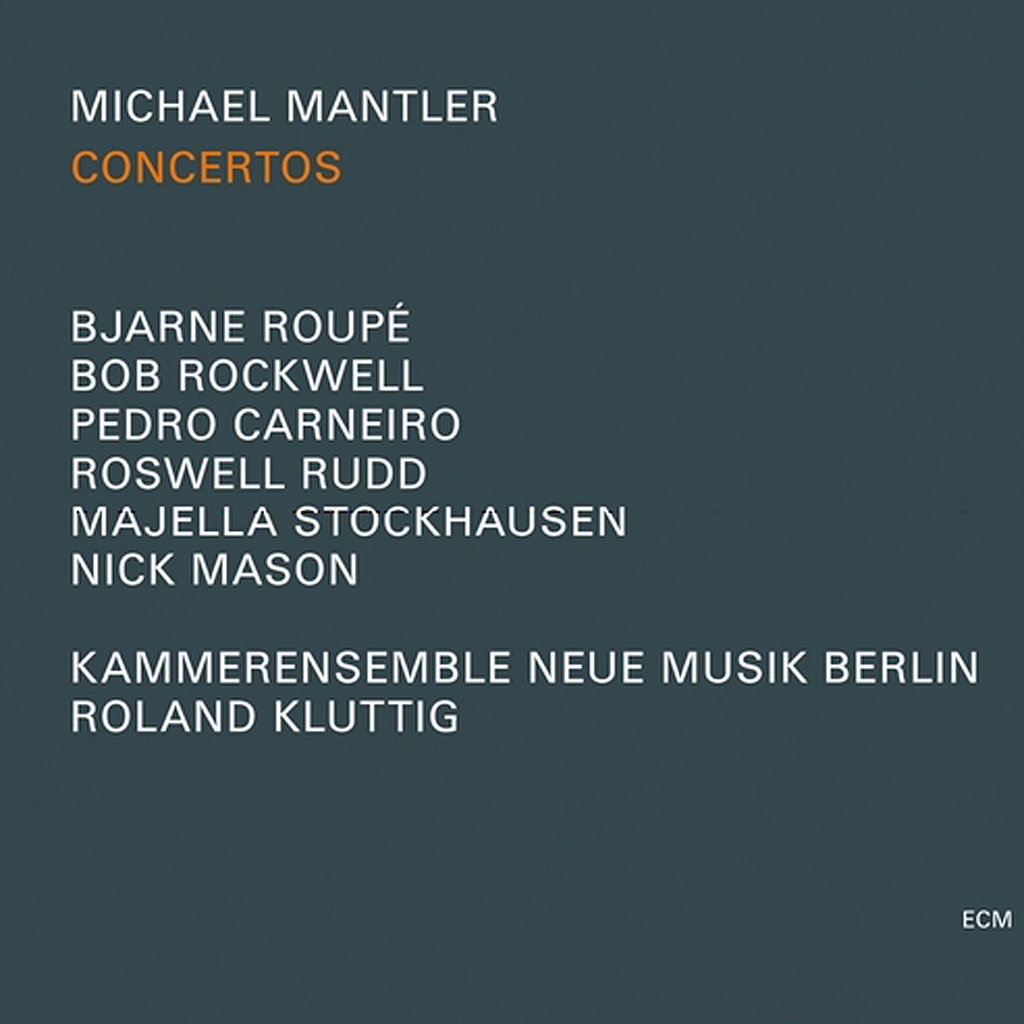
Michael Mantler: CONCERTOS (ECM 2054)


Michael Mantler
CONCERTOS

Michael Mantler trumpet
Bjarne Roupé guitar
Bob Rockwell saxophone
Pedro Carneiro marimba, vibraphone
Roswell Rudd trombone
Majella Stockhausen piano
Nick Mason percussion
Kammermusikensemble Neue Musik Berlin
Roland Kluttig conductor
Recorded November 2007
Kaleidoscope Sound, Union City, NJ
RBB Radio Studio 2, Berlin
Studios La Buissonne, Pernes-Les-Fontaines

As one who grew up in the polarized Vienna music scene, journeyed at 19 to New York (where he founded the Jazz Composers’ Orchestra and the WATT music label), and returned to Europe in 1991, Michael Mantler is, writes Bert Noglik in his liner notes, “truly nowhere at home, a drifter seasoned in the role of creative outsider, uniting the perspective of two continents and two cultures. He views music from the twin vantage points of the elaborated European tradition and the American rebellion in jazz—a rebellion that sought to topple every convention applicable to date.” This is Mantler’s first album of new material since 2000’s Hide and Seek and a lively testament to an ever-productive musical mind. Like the far-reaching constructions of Heiner Goebbels, Mantler never fails to work his indiscriminate way into our attention, even if his expressive quirks thrive on a rather different brand of theatricality.

The present album is a series of seven self-styled “concertos,” each scored for a different soloist along with a chamber ensemble under the direction of Roland Kluttig, whom Eberhard Weber listeners may remember from his Stages Of A Long Journey. All of the solo instruments are included (with the possible exception of the saxophone) in the ensemble at large at some point throughout the album, each surfacing like a jazz soloist in a protracted suite.

The first concerto, Trumpet, features Mantler himself as soloist. His improvisations are clear, acute, and vocal in character, acting with the confidence of a seasoned performer (somewhat ironic, given that Mantler is known for his reticence in this regard). Any agitation to be found in this piece is undercut by whimsy. Compelling Rypdal-like strains from Bjarne Roupé temper Mantler’s jagged lines while also providing a lovely segue into the guitar concerto that follows. The latter is a far more delicate piece relative to its surroundings. Brass and winds clamber for a view on the sidelines as piano and guitar frolic in the center toward a transcendent finish. Saxophone feels confined at first, but opens up as the violins gather clout. A marimba warms the air before taking center stage. MarimbaVibe is the most disturbed turn of phrase, caroming uncontrollably between disparate spheres of influence. It ends on another enigmatic note, made all the more ethereal for its indifference. Jazz Composers’ Orchestra veteran Roswell Budd is phenomenal in Trombone. His soulful sound cries with an almost street-savvy flair in the narrative of a life lived on the margins, yet which is anything but marginal in the centrality it occupies here. Its bursts of energy, always co-opted by a certain dismal zeitgeist, make for an honest though hard-to-swallow tale. Piano brings our attention to a voice that has been an integral presence for most of the album thus far. It is the instrument from which all of this music has sprung, yet which now desires its own liberation from acoustical symbiosis. It’s a rather “messy” piece, like a sharp image evenly smeared with finger-paints that attains its own abstract cohesion: an impossible kaleidoscope, devoid of symmetry. The dynamic performance here comes from Majella Stockhausen, daughter of the late Karlheinz. The final concerto, Percussion, is no less musical than its predecessors. Pink Floyd’s Nick Mason provides the beat, ringing out his snare with the conviction of a melodic battalion and bringing the album to a fine close with his delicate cymbal work.

Listening to Mantler is an experience that only grows with time. His music is fully invested in its own knowledge production and is never afraid to flaunt it in a world in which resonance has become a long-lost dream. It speaks in poetry, but moves in prose. Or is it the other way around?

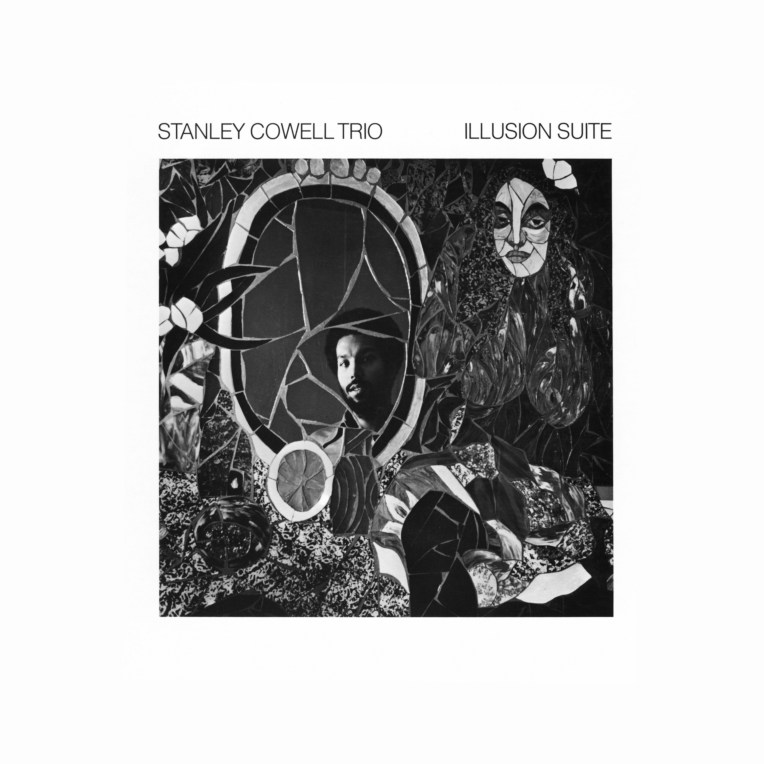
Stanley Cowell Trio: Illusion Suite (ECM 1026)

ECM 1026

Stanley Cowell
Illusion Suite

Stanley Cowell piano
Stanley Clarke bass
Jimmy Hopps drums
Recorded November 29, 1972, Sound Ideas Studio, New York
Engineer: George Klabin
Produced by Manfred Eicher

Human beings are adventurous eaters. We are constantly trying new things, loving some and hating others. We change our diets drastically, watching our calories and tallying every morsel we ingest. But sometimes, in the throes and woes of a food culture gone horribly awry, we just want to sit down to a good plate of comfort food, for nothing seems able to replicate the psychological benefits it provides. Stanley Cowell’s Illusion Suite is like that: a heaping portion of comfort food.

Backed by steady support from Stanley Clarke on bass and Jimmy Hopps on drums, Cowell delivers the goods and then some. The timid opening strains of “Maimoun” betray none of the album’s subsequent drive. A confident beat and bowed bass ease us into Cowell’s denser style, made all the more elegiac for its frequent use of octaval doublings in the right hand. (Incidentally, an alternate version of this track worth checking out can be found on Marion Brown’s 1975 Vista.) Cowell kicks off “Ibn Mukhtarr Mustapha” with a sporadic run across the piano before making a deft switch to his electric. Before long, this arid groove quiets into a percussion-heavy outro, bristling with African thumb piano. “Cal Massey” brings us into bop territory, with a great drum kick and deliciously twangy bass line to boot. Smooth is the name of the game is “Miss Viki.” Its fluid bass and wah-pedaled electric piano show off a cool sense of style and finesse. “Emil Danenberg,” named for a former director of the Music Conservatory at Oberlin College in Cowell’s home state of Ohio, is the album’s only ballad to speak of. Its raw, complex chords run straight into the darkest alleys of our internal cities. “Astral Spiritual” is a bit more straightforward, and features some quick turns and fancy musicianship all around. Spectacular drumming and astute pianism abound, ending unexpectedly on a downtempo turn, like an abandoned swing coming to rest. Nostalgic, thought-provoking, and tender, this is fantastic music from a gifted composer and performer that is now easily available thanks to an ECM digital reissue.

<< Ralph Towner with Glen Moore: Trios/Solos (ECM 1025)
>> Dave Holland Quartet: Conference Of The Birds (ECM 1027)

Terje Rypdal: s/t (ECM 1016)

ECM 1016

Terje Rypdal

Terje Rypdal guitar, flute
Inger Lise Rypdal voice
Ekkehard Fintl oboe, English horn
Jan Garbarek tenor saxophone, flute, clarinet
Bobo Stenson electric piano
Tom Halversen electric piano
Arild Andersen electric bass, double-bass
Bjørnar Andresen electric bass
Jon Christensen percussion
Recorded August 12 & 13, 1971, Bendiksen Studio, Oslo
Engineer: Jan Erik Kongshaug
Produced by Manfred Eicher

Terje Rypdal’s first ECM effort as frontman is a bewitching look into the Norwegian guitarist’s formative years. With a bevy of talented musicians in tow, he forges a mercurial portrait of late-night melodies and hidden desires. “Keep It Like That – Tight” is stifling and seedy, buffeted by cooling fans and laced with the fumes of an alcoholic haze. It’s a desolate hotel room where more than evening falls, a cigarette put out on the skin, incoherent words spilling from warm lips. The atmosphere is acutely palpable, oozing with film noir charisma and slurred speech. Garbarek spins a notable solo here, only to be overtaken all too soon by Rypdal’s drunken swagger. One might think this would be a taste of things to come, but Rypdal surprises with “Rainbow,” a most ethereal track laden with reverb and stratospheric beauty, dominated by oboe for a more classical sound. The background clinks and hums with a variety of percussion, bowed electric bass, and flute. The third track, “Electric Fantasy,” lies somewhere between the first two, a jazz suite with symphonic flavor. Rypdal’s former wife Inger Lise adds some moody vocals as an English horn expands the sound even further. Illusive drumming from Christensen and the occasional wah-wah guitar add dynamic touches of their own. The ambient crawl of “Lontano II” reverses the opening effect by leading into the more blues-oriented “Tough Enough,” leaving a grittier aftertaste.

The striking differences in instrumentation between tracks may be off-putting to some, while others may see it as part of a larger concept. Either way, this self-titled album is thematically rich and more than worth the listen.

<< Jan Garbarek Quintet: Sart (ECM 1015)
>> Keith Jarrett: Facing You (ECM 1017)

Food: Quiet Inlet (ECM 2163)

Food
Quiet Inlet

Thomas Strønen drums, live-electronics
Iain Ballamy tenor and soprano saxophones
Nils Petter Molvær trumpet, electronics
Christian Fennesz guitar, electronics
Recorded live in Norway, 2007/08
Produced by Food and Manfred Eicher

The earth is very still, like an infant asleep. Into a quiet inlet, a streamlet is falling. It is singing to the sleeping earth, telling it of the days to come when the great silence shall be broken by the voice of man, and life shall fill alike the darkling wave and the sunlit field.
–T. A. Rickard, “A Story in Stone”

Considering the distinct lyrical path Food has been forging since 1998, it was perhaps only a matter of time before the group would migrate into ECM territory. The guest appearance of Nils Petter Molvær is therefore a no-brainer. Fans of Molvær’s work will feel like they are slowly falling into the Norwegian trumpeter’s waking dreams. The results are an undeniably unique blend of nu jazz sensibilities and ritual melodic power.

“Tobiko” opens with metallic percussion against a cascade of synths and muted beats. A radio dial is tuned, reaching through the airwaves as if for a familiar voice to latch onto. Only then does Ballamy’s sax rise to the surface of this oceanic passage: if our ears are vessels, then here is the dolphin swimming silently alongside them. Before long, live drums make their presence known and lead us out of the fog. Having shown us the way, our guides then recede into the darkness, where light and sonar dare not venture. “Chimaera” is a gentler number. Sax lines continue their passage as percussion and electronics cocoon them with deep thematic threads, free-flowing and heavenly. “Mictyris” is distinguished by Strønen’s intense rhythmic drive, over which we encounter some fantastic electronics that sound as if a sax were being torn apart and rebuilt as a train whistle. Tight drumming, combined with the protracted ambient wash in the background, meshes wonderfully with Ballamy’s constellate reed work. “Becalmed” builds itself around a repetitive leads motif, its aftereffects ever ghostly and omnipresent. Whether intentional or not, this track also contains oblique references to Eleni Karaindrou’s “Parade” from the film Happy Homecoming, Comrade. “Cirrina” and “Dweller” both flow with Molvaer’s distinct sound, seeming to revel in their grace and liberation from formulaic constraints, while “Fathom” ends the album bittersweetly, as if the music were looking into a mirror, unsure of what it sees.

The electro-acoustic sound honed on Quiet Inlet works wonders at every turn. And on that note, it’s inspiring to see a wonderful artist like Fennesz crossing over into the ECM circuit. Let’s hope this is a sign of things to come.

(To hear samples of Quiet Inlet, click here.)