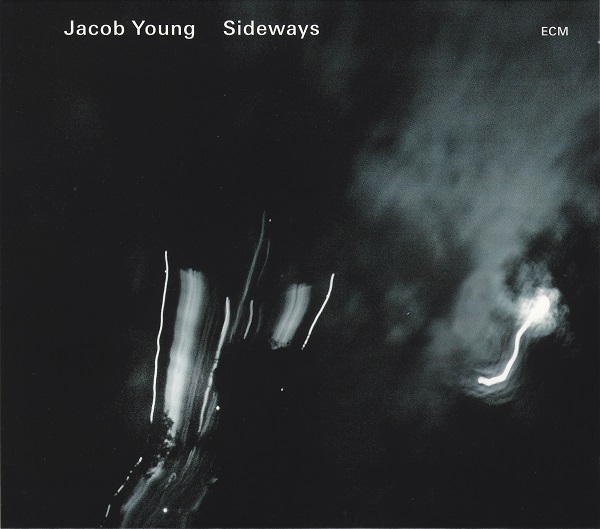
Jacob Young: Sideways (ECM 1997)

Sideways

Jacob Young
Sideways

Jacob Young guitars
Mathias Eick trumpet
Vidar Johansen bass clarinet, tenor saxophone
Mats Eilertsen double-bass
Jon Christensen drums
Recorded May 2006 at Rainbow Studio, Oslo
Engineer: Jan Erik Kongshaug
Produced by Manfred Eicher

Norwegian guitarist Jacob Young’s sophomore effort follows coolly on the heels of his debut, Evening Falls. The wealth of Scandinavian talent at his side is enviable, to say the least. Trumpeter Mathias Eick, reedman Vidar Johansen, bassist Mats Eilertsen, and drummer Jon Christensen bring their uniquely tessellated feel for rhythm and hues to ten of Young’s originals, of which the title track sets the stage with the bandleader’s unmistakable acoustic. Mallet-caressed cymbals, trumpet, bass clarinet, and upright bass comingle in simpatico resonance, riding a slow and steady frequency from start to finish.

On that note, it’s difficult to say whether or not this music ever finds closure. Rather, each tune suspends itself high above the clouds, catching breath before measuring another dive into the next. In this regard, fans of Manu Katché’s ECM outings—into which the personnel here dovetails slightly—will surely rejoice in Young’s architecturally sound themes, ringing out clearly and distinctly before being recast in light harmonies and natural improvisational turns. Case in point: “Hanna’s Lament,” of which the two horns hover over Eilertsen’s landing pad before Young’s solo on classical guitar threads them all with the skill of a tailor’s needle. The evocative “Near South End” is another representative example, and traces its head through a unifying of bass and guitar. Christensen is the real key to unlocking the inventive nostalgia at play, as also in “St. Ella,” a volcano at the ready.

Eick is the most chameleonic of the bunch, as comfortable highlighting the canvas as he is slashing it with Tomasz Stanko-like leaps of intuition in “Maybe We Can.” Johansen, for his part, treads the line between dream and reality in “Out Of Night,” which at over 10 minutes could be an overbearing tune were it not for the naked clarity of his tenoring. With so much to admire and interpret in its unfolding, it best showcases the album’s finessed engineering.

That Young was fortunate enough to study with Jim Hall and John Abercrombie will be obvious on three tracks for which he goes electric: “Time Rebel,” “Slow Bo-Bo,” and “Wide Asleep.” Each is the side of hidden triangle, rendered to the tune of a watercolor enchantment. At some moments a balladic brew while at others a cosmic layering, the overall shape emerges only with thoughtful listening. Like the multi-tracked guitar-only epilogue, “Gazing At Stars,” it follows the gaze into sunset and to the twilight beyond.

Even with its air of mystery, Sideways comes to us as a completed puzzle, glued and framed so that we might admire its scenery without the task of putting it together. This leaves us free to bask in its light, turning its shadows like the pages of a book personally inscribed.

Terje Rypdal: Vossabrygg (ECM 1984)

Vossabrygg

Terje Rypdal
Vossabrygg

Terje Rypdal guitar
Palle Mikkelborg trumpet, synthesizer
Bugge Wesseltoft electric piano, synthesizer
Ståle Storløkken Hammond organ, electric piano, synthesizer
Marius Rypdal electronics, samples, turntables
Bjørn Kjellemyr electric and acoustic bass
Jon Christensen drums
Paolo Vinaccia percussion
Recorded live April 12, 2003 at Vossa Jazz Festival, Norway
Engineer: Per Ravnaas, NRK
Executive producer: Manfred Eicher

Terje Rypdal’s Opus 84 is an interdisciplinary suite of epic proportions. The fruit of a 2003 commission by Norway’s Vossa Jazz Festival, this live recording finds the Norwegian guitarist-composer fronting an all-star cast that brings trumpeter Palle Mikkelborg, bassist Bjørn Kjellemyr, drummers Jon Christensen and Paolo Vinaccia, and keyboardists Bugge Wesseltoft and Ståle Storløkken to the fold. Truly special, though, is the ECM debut of Marius Rypdal, who provides digital connective tissue at key points along the way and mines his father’s own discography—particularly Ineo, op. 29 and the 5th Symphony, op. 50—to nu-jazz levels. His veritable hand basket of samples, breakbeats, and atmospheres spreads a picnic that tastes much like Khmer (and, for the obscurists out there, also like Japanese guitarist Sugizo’s 1997 drum ‘n’ bass solo effort, Truth?). His computational acumen is clearest on the three movements he co-writes with Terje: “Hidden Chapter,” “Incognito Traveller,” and “Jungeltelegrafen.” Of these, the first two wield classically cinematic brushes, moving waves of ambience and computerized utterances across swaths of bedrock. Samples range from violin and chorus to a warped phone call pulsing through city streets under cover of night. Gesture for gesture, Mikkelborg matches Rypdal’s every cry, breaking out in the final piece toward full-on escape.

The “brygg” of the album’s title means “Brew,” a forthright reference to Miles Davis’s seminal electric-era Bitches Brew. The introductory, 18-and-a-half-minute “Ghostdancing” mixes a likeminded concoction of heat-distorted drums and organ over a rocking bass line. The thinking is bold, dynamic, and recalls “Rolling Stone,” the once-lost track off Rypdal’s own Odyssey. In this sea of reverberation, Mikkelborg’s vessel stretches the broadest sail.

If Rypdal and friends seem to be digging into the past, it’s only because they are messengers from the future. Be it encoded in the double-headed “Waltz For Broken Hearts / Makes You Wonder” or the halting “That’s More Like It,” his resonant stream is palpable whether his plectrum touches string or not. In this context, Mikkelborg, ever the empathic performer, plays the melodic prince to Rypdal’s atmospheric king. The guitarist holds his authority by no small feat of restraint, as he does further in the post-meridiem groove of “You’re Making It Personal.” Bass and drums haul a heavy cart of night while trumpet cuts shooting star scars over the cityscape. This leaves only “A Quiet Word,” actually a rather dense wave of dreams, to build the afterglow, particle by particle.

This is how it’s done.

Gianluigi Trovesi: Vaghissimo Ritratto (ECM 1983)

Vaghissimo Ritratto

Gianluigi Trovesi
Vaghissimo Ritratto

Gianluigi Trovesi alto clarinet
Umberto Petrin piano
Fulvio Maras percussion, electronics
Recorded December 2005, Artesuono Recording Studio, Udine
Engineer: Stefano Amerio
Produced by Manfred Eicher

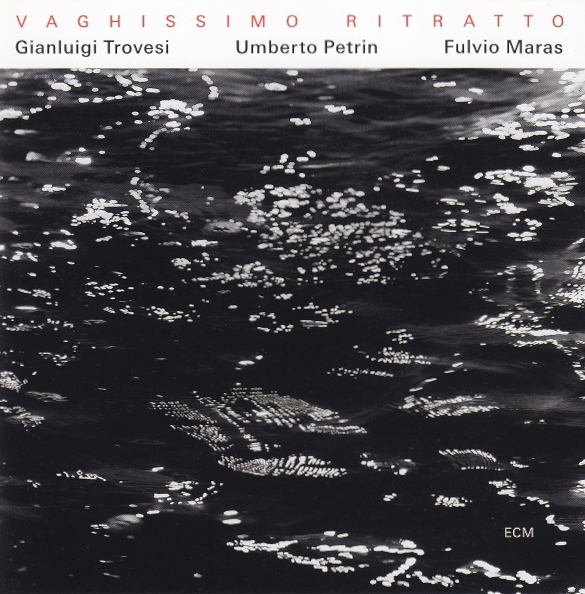
This album’s title, informs Steve Lake in his fascinating liner notes, comes from a madrigal by Giovanni Pierluigi da Palestrina, and connotes a beautiful, if hazy, portrait. From that concept, the trio of clarinetist Gianluigi Trovesi, pianist Umberto Petrin, and percussionist Fulvio Maras (who also provides subconscious electronics) unreels a bolt spanning premodern to modern textures, each deconstructed and rewoven along the way to the tune of each musician’s improvisational acumen. Vaghissimo Ritratto is thus a picture gallery that is as much spatial as temporal, painting with good-humored pigments over ECM’s vast canvas.

Trovesi has, of course, already left indelible marks on that same canvas, but perhaps none so distinctive as this. With Maras (heard also on the Trovesi Octet’s Fugace) and Petrin (of Trovesi’s Italian Instabile Orchestra) to assist him, the overall effect is a revelation. A good measure of the album’s “portraits” references Italian cellist and composer Alfredo Piatti. His themes resonate at regular intervals, each a cleansing exhalation before the next intake. In them, not only does Maras hint at a boundless inner world with his light applications, which haunt the edge of perception like dreams jumping off the cliff of waking; he also foils the record’s otherwise acoustic nature. Whether by means of an artful synthesizer or by the touch of hand on drum, he cuts a flash of poetry across every prosodic eye. Through it all, Trovesi stands like a prophet of the here and now. With a lyricism that is an intense as it is entirely his own, Trovesi hones a vibe as only he can elicit from even the simplest melodies.

As a unit, the trio sips from various glasses, moving photographically through stages of development. A taste of cabaret comingles with an operatic piquancy, while nostalgia binds the two in harmony. What might feel like the inside of a café at one moment could very well turn into a death scene the next. Such is the album’s theatrical edge, by which the trio adlibs its way through such tracks as “Serenata” with all the comfort of one reading from a score. And in “Mirage,” notable for the arresting, shawm-like quality that issues from Trovesi’s alto clarinet, we feel cargo moving across the sands while tintinnabulations, soft and hymnal, echo from the piano.

Two twentieth-century singer-songwriters, Luigi Tenco and Jacques Brel, are referenced in “Angela” and “Amsterdam,” respectively. In the hands of Trovesi and company, both of which move through changes with the greatest of ease, and with such grandeur as to make one yearn to have been there when first written. Maras and Petrin each contribute a tune in kind, delving through their rapport into jazzier turns.

If these are the vanity muscles, then the album’s blood supply comes from its host of Renaissance composers, including Claudio Monteverdi, Orlando di Lasso, Luca Marenzio, and Josquin Desprez. In the subsection, for instance, marked “Ricercar vaghezza,” the ritornello from Monteverdi’s opera “L’Orfeo” sounds downright futuristic, so pure is its antiquity, and receives the proper Trovesi treatment in the reedman’s “Grappoli orfici” (Orphic clusters), from which he unravels that Monteverdean thread and with it re-stitches the night sky to a toothsome smile of mountains along the horizon. Further delights await in Desprez’s classic “El grillo,” a song all the closer to my heart not only because it shares my last name, but because the spirited rendering it receives here removes that tongue-in-cheek wrapper and cracks open a little transcendence from within it.

By the time we reach our title destination, a vague and freely improvised foray that sparkles as it slumbers, we splinter along with the trio into a motif from Palestrina. Its message, though whispered, is clear enough: The circle is not a cycle, but the ripple of the first stone.

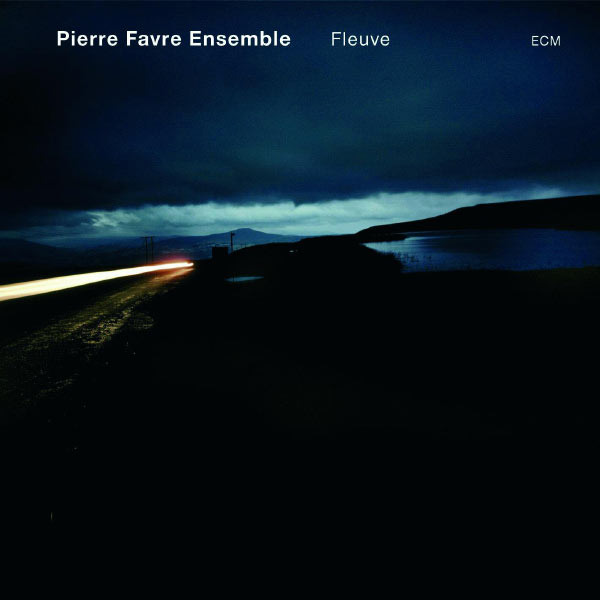
Pierre Favre Ensemble: Fleuve (ECM 1977)

Fleuve

Pierre Favre Ensemble
Fleuve

Philipp Schaufelberger guitar
Frank Kroll soprano saxophone, bass clarinet
Hélène Breschand harp
Michel Godard tuba, serpent
Wolfgang Zwiauer bass guitar
Bänz Oester double-bass
Pierre Favre percussion, drums
Recorded October 2005, Volkshaus Basel
Engineer: Daniel Dettwiler
Produced by Manfred Eicher

A vital current in the European jazz circuit for decades, Pierre Favre gets full spotlight as composer on Fleuve, which finds the Swiss percussionist in the company of a most unusual ensemble that includes two bassists, tuba, harp, reeds, and guitar. The album certainly lives up to its name, which means “river” in French, and accordingly funnels springs and streams into a larger, contrapuntal current.

Although every musician contributes viable color to the Fleuve palette, the alizarin crimson of harpist Hélène Breschand, forest green of bassist Bänz Oester, sky blue of guitarist Philipp Schaufelberger, and the sunlit soprano saxophone of Frank Kroll (also on bass clarinet) add especially noteworthy streaks to the emerging image. Of that image, track titles such as “Mort d’Eurydice” and “Reflet Sud” give us tantalizing hints, reflecting a mythology as personal as it is timeless.

The music is delicately paced, and spins from that core group (with Favre’s adaptive rhythms completing the pentagon) a narrative of elemental conversion. Whether through the spiraling hide and seek of “Panama” or the angled wingspan of “Albatros,” Favre and his bandmates change up combinations, switching above and below, with seamless intuition. One moment might find a theme pouring from the group in tutti, while the next shifts into a duet of guitar and brushed drums, or harp and bass, that strings every melody with care.

Hints of enchantment abound, as in the bass clarinet ambling along the banks of the “Nile” or the medieval song that ghosts the inner sanctum of “Decors.” As throughout the album, gestures abound with glorious promise and find realization through Favre’s orchestral sensitivity.

An album of sense and originality, this is the pinnacle of Favre’s ECM output.

Trio Beyond: Saudades (ECM 1972/73)

Saudades

Trio Beyond
Saudades

John Scofield guitars
Larry Goldings Hammond organ, electric piano, sampler
Jack DeJohnette drums
Recorded live November 21, 2004 at Queen Elizabeth Hall, London
Engineer: Patrick Murray
Edited and mastered at Rainbow Studio by Jan Erik Kongshaug and Manfred Eicher

If you can’t stand the heat, then run—don’t walk—into the kitchen. That seems to be the message of Saudades, the unrelenting album by Trio Beyond. The title connotes a longing or melancholy in Portuguese. Yet the music bursts with conviction left and right, so the only thing one might long for is another two discs’ worth. At the heart of Beyond is Jack DeJohnette. His talents have orbited the sun more times than anyone can count, and here he initiates a project in honor of the great Tony Williams, who stepped off the Miles Davis platform in the late sixties to focus on his Lifetime trio, the guitar/organ/drums format of which is preserved here. Even in the absence of this information, the music clearly serves a time when fusion was not yet a sullied word, when its crosspollinations bore fragrances as fresh as spring. In the album’s official press release, DeJohnette humbly notes Williams’s “visionary concept of time and space,” but we can, of course, give similar credit to DeJohnette, a drummer without whom the landscape of modern American music would be much flatter. Fleshing out this homage are two phenomenal musicians in their own right, each with one eye trained to and the other fro. Keyboardist Larry Goldings is magic at the Hammond organ, often playing the parts of bassist and lead with two remarkably independent hands, while guitarist John Scofield fights fire with fire in his blistering yet welcoming style.

Indeed, once Joe Henderson’s “If” lights the match, there’s no turning away from the ensuing glow. Like this set (recorded live at London’s Queen Elizabeth Hall in late 2004) as a whole, it engages at both the level of performance and through its call to the fortunate listener by way of carefully chosen tunes. Inspiring and inspired, Goldings parallels Scofield’s flame trail like the DeLorean’s tire tracks in Back to the Future. The organist further offers up his original “As One,” which paves a spacy runway into the full (if brief) melodic shout of Larry Young’s “Allah Be Praised.” The title track, first of two cuts by the trio as a unit, proves a fast-moving vehicle for Scofield, who leads the way with staggering variety of tone and control, all the while getting jiggy with increasingly wild electronic enhancements. “Love In Blues,” also by the trio, is no less lovingly crafted, and finds Scofield holding his intense own over a mosaic of rhythms and voices, and finding intensity on his journey toward calm.

Williams’s spirit is apparent throughout, but gets his most overt props as composer of “Pee Wee” and “Emergency.” The first is a relatively tender chunk of goodness in which Scofield plays downright saxophonically, sustaining and clipping notes in kind. The boisterous second is rich as cream sauce—Scofield bringing the rise and Goldings the fall—and scales the cliffs of a spellbinding improvisational mountain. John McLaughlin’s “Spectrum,” given here a 16-minute treatment, is another thoroughly awesome adventure. The nature of DeJohnette and Scofield’s crosstalk, virtuosic yet free to bask in the groove, is a veritable master class of how musicians should listen to each other.

Our requisite ballad comes in the form of “I Fall In Love Too Easily,” by Broadway legend Jule Styne, in which Goldings treads a smooth and sultry line. It’s a soft reprieve after the sharp focus of Miles Davis’s “Seven Steps To Heaven.” DeJohnette steps up his game in a tune filled with propulsive depth and turn-on-a-dime changes, Scofield and Goldings trading expert handoffs all the while. Of course, Miles goes down all the better with a Coltrane chaser. The latter’s “Big Nick” gives more prime time for Goldings, who slingshots past the moon and back. Yet it’s DeJohnette’s perfect timekeeping that lingers longest on the palette, tasting of vibrant life and love for the moment.

Trio Beyond

Dans les arbres: s/t (ECM 2058)

Dans les arbres

Dans les arbres

Xavier Charles clarinet, harmonica
Ivar Grydeland acoustic guitar, banjo, sruti box
Christian Wallumrød piano
Ingar Zach percussion, bass drum
Recorded July 2006 at Festiviteten, Eidsvoll, Norway
Engineer: Thomas Hukkelberg, Desibel
Produced by Dans les arbres

Dans les arbres (“In the trees”) is named for the collaboration of clarinetist Xavier Charles, guitarist Ivar Grydeland (who also plays prepared banjo and sruti box), pianist Christian Wallumrød, and percussionist Ingar Zach. Together they illuminate a microscopic diorama of improvisation, letting their inhibitions go in service of the moment. What comes of this is as unknowable as it is unscripted, a mystery that is yet naked before us, hiding nothing—only, we have forgotten its way of speaking.

Immediately striking about this all-acoustic quartet is its seemingly electronic blood flow, nonetheless letted by means unplugged. The feeling comes out in feather-light high tones, which caress the air like a hearing test administered by some distant deity. For much of the album’s duration, listeners are thus suspended at an intersection of thresholds: between motion and stillness, utterance and silence, melody and noise. Each of these is, of course, illusory at best, and this is the album’s greatest lesson.

With one exception—“Le Flegme” (Phlegm)—each movement of Dans les arbres describes a state of mind or being. Titles such as “La Somnolence” (Drowsiness) and “L’Engourdissement” (Numbness) are purely descriptive. They are not pretentious hints toward deeper intrigues, although one can hardly deny the music’s mysterious side effects. If anything, the sounds seem cryptic because of their warping of time. Hence, their pervading suspension. What we hear is what we hear.

The album’s initial stirrings paint a forest fire in its infancy, which sparks unnoticed and by the end reaches such force that it’s too far gone to quell. Nor would we ever think to, for by then the flames have already consumed us. Such dynamics come about through the expertise of the musicians, whose ability to listen to one another is mesmerizing, if only because often the instruments are unrecognizable in their extended play. An obvious piano motif might be overtaken by percussion or overblowing from the clarinet, and those in turn by less discernible soundings. In them is the whispering of the veins. Intimations of rhythm are occasional at best, giving way more often to stretches of aphasia and fitful dreams. As if to put a finer point on it, the self-obliterating prophecy that is “L’Assoupissement” (Slumber) echoes like a mournful gamelan for the inner sanctum.

What holds Dans les arbres together is the fact that every element remains crisply defined, each a key that doesn’t so much unlock as interlock. Whether by way of Wallumrød’s hymnody, Charles’s guttural language, Grydeland’s clicking gears, or Zach’s genetic incantations, the overall transmission comes through with messages intact. Throughout the album’s slow crawl toward the resonating chamber of the sun, where histories of inertia dwell in fantasies of their own design, the insistence of a struck gong or a splitting reed comes like a knock on the door, flowing from itself into itself in a cycle of renewal, residue, and retention.

The only comparison I can offer for reference is Nijiumu’s Era of Sad Wings, which may just be the most enchanting things ever committed to record. Whatever the analogue, this is an unusually beautiful creation from ECM, one well worth the risk of expanding your listening for its benefits.

Tord Gustavsen Trio: Being There (ECM 2017)

Being There

Tord Gustavsen Trio
Being There

Tord Gustavsen piano
Harald Johnsen double-bass
Jarle Vespestad drums
Recorded December 2006 at Rainbow Studio, Oslo
Engineer: Jan Erik Kongshaug
Produced by Manfred Eicher

There’s no mistaking a Tord Gustavsen Trio record. Intimate in measure yet profound in scope, each builds on the last like another level of a pyramid built from the capstone down. In this manner Being There follows Changing Places and The Ground as the last of a trilogy, though it is by no means the be all and end all of the trio’s capabilities. There’s so much to admire on Being There that one could see its vessel off contentedly were it never to return to shore. If the album’s title sounds familiar, that’s because it comes by way of a tune off The Ground. But this baker’s dozen casts two forward glances for every backward, always moving toward the goal of utter respect: for the notecraft, for the sound, for the moment.

Those who subscribe to the stereotype of contemplative Nordic jazz will be both rewarded and pleasantly surprised. On the one hand, there is “At Home,” which begins the album, as it has often done for the trio’s stage sets, with honed lyric intensity and lullaby charm. The brushed ruminations of Gustavsen’s bandmates—bassist Harald Johnsen and drummer Jarle Vespestad—buoy the pianist on inky currents. The downtempo mood holds true for much of the album’s hymnody, taking fullest (which is to say, spacious) form in the anthemic “Still There” and the veiled “Vesper.” With barest touch but also viable emotional weight, the trio moves further through the balladic changes of “Around You” and “Draw Near” with an embrace so warm that three become one. Each is a profession of faith in love through love of faith, drifting a hair’s breadth from the divine in “Sani.” This duet for piano and drums describes a blown feather. Free of wing in its own dream of flight, it wanders along a quiet storm’s path. These slower songs take full advantage of the acoustics, both live and post-processed, and build to a density of expression that nevertheless allows room to breathe. It’s as if the trio explores knots in wood, each a galaxy waiting to be sung. In them Gustavsen paints flowering worlds with every keystroke, as he does especially in the melodic orbit of “Karmosin” (penned by Johnsen and the only track not by the pianist) and the solo improvised “Interlude.” The latter is the modal hip at which the album flexes. Poetry flows from its deference, clear as sunlight on a river, across a brittle page, which is then folded, sealed, and held above a burning candle.

While much of the album is suited to closed-eye listening, there are a few breaks in the waves. Between the swooping wingspan of “Vicar Street” and the uplifting “Where We Went,” there is “Blessed Feet,” a masterful and obvious nod to Keith Jarrett. This swinging number proves Gustavsen a magician at the keyboard, by which he, ever the melodic herdsman, corrals every note in formation. Even the lethargic clouds of “Cocoon” abide by structural principles, at once conscious and free.

Yet it is on the waters of “Wide Open” that the trio finds what it’s been looking for: a step into the future, as yet unknown, with eyes fixed on the horizon. Where the album opened at home, here it ends with a homecoming. And it is in your home that this music belongs, right there on the shelf next to your most prized discs.

Steve Tibbetts: Natural Causes (ECM 1951)

Natural Causes

Steve Tibbetts
Natural Causes

Steve Tibbetts guitars, piano, kalimba, bouzouki
Marc Anderson percussion, steel drum, gongs
Recorded 2008 in St. Paul
Engineer: Steve Tibbetts
An ECM Production

If ever there was a case for quality over quantity, Steve Tibbetts is it. A full eight years after A Man About A Horse, the Minnesotan guitarist returns with his most intimate statement yet. Alongside percussionist Marc Anderson, collaborator of over three decades, Tibbetts crafts a geography so inward-looking that it becomes a parallel world. Tibbetts originally flirted with the idea of releasing Natural Causes as one single track. Were such the case, listeners would feel no less aware of its science. Either way, its 13 tracks are not variations on a theme, even if they do play with the theme of variation. He calls them, rather, “complex little cathedrals,” building them as he does stone by stone, if not string by string. Indeed, his trusted 12-string guitar is possessed of something divine, its frets pared down to almost nothing over years of playing, so that fingers glide freely.

In a rare turn, Natural Causes is nearly all acoustic and accordingly finds Tibbetts playing piano, kalimba, and bouzouki to flesh out the palette. In addition to these, he employs a midi interface, by which he triggers samples of gongs and metal-key instruments collected during his travels. Of these, “Lakshmivana” is the fullest integration of plugged and unplugged. Told in the language of prayer—i.e., of human artifice embracing sacrality—it is an astonishing meditation that is only deepened by the story told in “Chandogra.” Here the periphery is barely noticeable. Instruments peek from the shadows, seemingly incidental, and fade at the instant of regard.

From the back-porch motif that introduces “Sitavana,” the album’s gateway, and through the burgeoning field that follows toward the solo “Threnody,” it’s obvious that Tibbetts’s attention to detail has grown like the preceding metaphor. His playing, mellifluous as ever, establishes global reach with tracks like “Padre-Yaga,” in which Anderson’s hand drumming leaves trails on the beaten plains. It develops, as does the album as a whole, in distinct cells, every pause linking the body to the less tangible impulses that make fingers ache for the fretboard.

There is an almost keening quality to Tibbetts’s portamento. “Attahasa,” for one, is a tree shedding spores. For another, “Sangchen Rolpa” wavers on the precipice of some great abyss. Across that expanse Tibbetts extends brief, tender bridges, paved with inner fire. Between them, the album’s groundswells reveal texture and breadth.

Although this is Tibbetts’s most inward-looking record, it is also his farthest reaching. His art is as honest as the landscapes that inform it, changing form and color as he moves from one riverbank to the next. Whether you choose to walk with him or listen upon him from above, just know there is a home for you here to which you may always return.

Stefano Battaglia: Raccolto (ECM 1933/34)

Raccolto

Stefano Battaglia
Raccolto

Stefano Battaglia piano
Giovanni Maier double bass
Michele Rabbia percussion
Dominique Pifarély violin
Recorded September/December 2003, Artesuono Recording Studio, Udine
Engineer: Stefano Amerio
Album produced by ECM

Raccolto is one of ECM’s most fascinating productions, though for some listeners surely also one of its most challenging. Significant enough for welcoming Italian pianist Stefano Battaglia to the label, it may be equally so for introducing percussionist Michele Rabbia, whose contributions are nothing short of revelatory throughout this double-disc effort. Battaglia and Rabbia are the common links to the album’s back-to-back trios, the first with bassist Giovanni Maier (better known as Triosonic) and the second with violinist Dominique Pifarély (a.k.a. Atem).

The standard jazz trio here is anything but in execution, as evidenced by the title track (meaning “harvest”), which opens the first session with Battaglia’s careful footsteps, joined by others in a dimly lit hall of mirrors. Striking here, aside from the rhythm section’s awakenings, are the Bach-like changes at play. It is as if the ensuing theatre of abstractions issues from the heart of history. With names like “All is language” and “In front of the fourth door,” it’s easy to get lost in each track’s spell, under which certainties become uncertainties and uncertainties become mantras. Motives seek rupture but find only a scrim of caution between them and full-on embodiment. And so, they dream of that embodiment instead, and this is the sound to which we are made privy, especially in the brief, and sometimes astonishing, culminations scattered throughout. Rhythms are thus implied more than they are directed, caught in virtuosic blips from the man at the keys or from Rabbia’s dustings of shrapnel and time. In these examples, as in “Our circular song,” the percussionist reveals worlds unto himself.

Not to be left behind, Maier grabs a lion’s share of spotlight in “L’osservanza,” which concludes the set in a vehicle of tender, lyric flashes. It’s a billowing weave that cups wind as a flower would sunlight. The bassist’s soloing in “Triangolazioni” adds depth to whispers and occupies a poetic center. He further inspires Battaglia to crystalline segues of call and response. “Coro,” then, can be nothing but a maze. Rabbia adds to it insect wings, hushes of children and slumber, of hiding and protection, so that Battaglia’s chording can find consummation only within. Hence, too, the two tracks marked “Triosonic,” in which the piano gives up its ghosts so that others might live.

Disc 2 swaps Maier for Pifarély for a dozen classically inflected improvisations built around abstract themes. As the go-to violinist of Louis Sclavis, Pifarély should surprise no one familiar with the violinist’s selective chamber appearances, each a window into another. His slippery playing recalls Luciano Berio’s Voci, especially in the folkish lilt of “Lys” and in the two “Cantos.” The latter feature prepared piano for a glassine effect, while Rabbia dips into more metallic streams of consciousness. And then, there is the obvious homage, “Recitativo in memoria di Luciano Berio,” which finds the trio mining the Italian landscape for ideas.

Surrounding moods range from frenetic to elegiac, achieving soul-digging brilliance in “Riconoscenza,” “Velario de marzo,” and “Pourquoi?” The last is tempered by Pifarély’s gravelly soothsaying in a showing of perfect restraint. Through various geometric configurations, the three musicians follow string paths as blood navigates veins until they reach the resonant frequency of “…Dulci declinant lumina somno…” It is the unforeseen view underlying everything, a vista within a vista, fragile as a moth’s wing.

It’s only appropriate that Battaglia should have found a home at ECM. The pianist cites Paul Bley’s Open, To Love and Keith Jarrett’s Facing You as defining encounters that pushed his classical rigor into dovetailed paths of improvisatory possibility. His Raccolto is one stubborn staircase, indeed, but well worth the climb. A debut to remember.