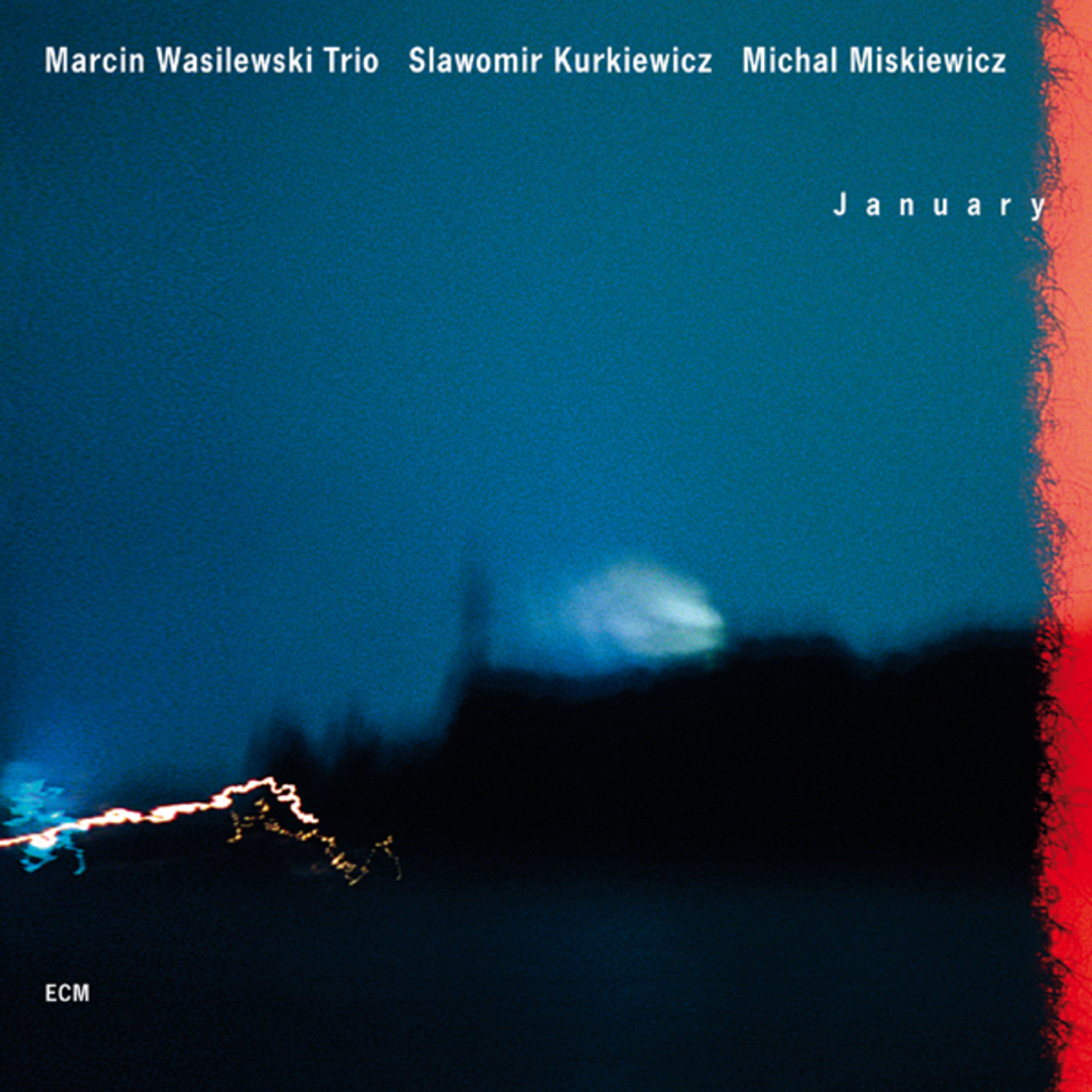
Marcin Wasilewski piano Slawomir Kurkiewicz double-bass Michal Miskiewicz drums Recorded February 2007, Avatar Studios, New York Engineer: James A. Farber Produced by Manfred Eicher
Pianist Marcin Wasilewski is a seeker of themes. As nominal leader of one of the most assured trios in recent jazz history, he throws together a variety of sources, moods, and songs into one pot, stirring until every ingredient takes on something of the rest. Bassist Slawomir Kurkiewicz and drummer Michal Miskiewicz are therefore no mere sidemen. Their flavors permeate every morsel of this sonic stew, the group’s sophomore disc for ECM. With well over a decade of steady experience going into this record, it would be harder not to enjoy the synergy at play.
As per usual, the set list is grab bag of delights. Wasilewski leads off “The First Touch,” one of four original tunes, on a tender foot. The rhythm section here marks time by beats irregular and less discernible: kisses of raindrops before the album’s quiet storm. The title track, another penned by the pianist, is as somber as its season and finds Miskiewicz in a decorative mode. Balancing these are “The Cat” and “The Young and Cinema,” both decidedly hipper affairs replete with flourish and sparkle. Drums and bass crosstalk beautifully in both, the latter miked in such a way as to capture every inflection with immediate clarity.
Brightening the music’s silver screen pulse is Ennio Morricone’s “Cinema Paradiso,” of which the pianism is so delicate that it nearly floats away of its own volition. Gentle, yes, but patterned by the razor edge of nostalgia. Such blurring between image and sound is paramount at ECM, and fans of the label will encounter much to admire between two cuts suggested by producer Manfred Eicher. The trio’s loving attention to detail is especially poignant in “Vignette,” which casts a backward glance to Gary Peacock’s seminal yet often-neglected Tales Of Another. The bassing here is magnetic, independent yet resolving by a gradual return to fold. By contrast, jocularity abounds in Carla Bley’s “King Korn,” which gets a treatment to be reckoned with. There is, further, a poignant nod to Tomasz Stanko—with whom the trio first gained international notoriety—by way of “Balladyna,” an enduring swirl of leaves fallen from the tree of Stanko’s label debut.
The group’s tradition of pop do-overs continues with Prince’s “Diamonds and Pearls,” bringing to light the album’s most soaring passage and providing an aerial view of the trio’s melodic landscape. All of this ties together in “New York 2007.” This improvised blip completes the radar sweep by which this album navigates. January belongs on any jazz lover’s shelf right next to Changing Places as yet another groundbreaking statement of trio-ism from ECM. Its sounds are hollow-boned and ready to fly.
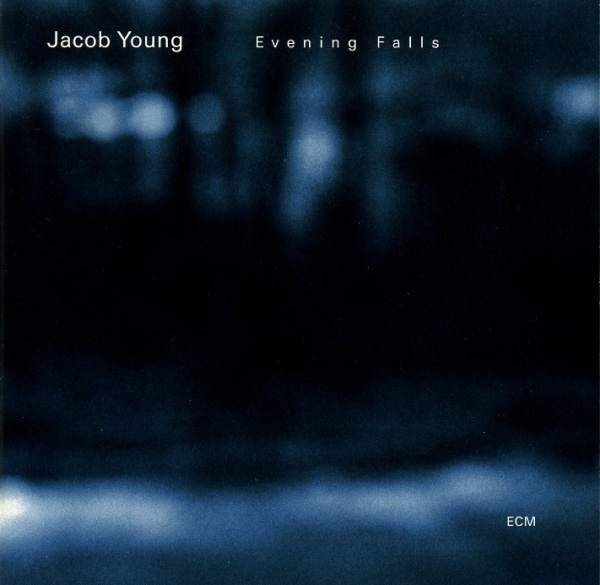
Jacob Young guitar Mathias Eick trumpet Vidar Johansen bass clarinet, tenor saxophone (track 6) Mats Eilertsen double-bass Jon Christensen drums Recorded December 2002 at Rainbow Studio, Oslo
Engineer: Jan Erik Kongshaug
Produced by Manfred Eicher
Considering the legion of Norwegian talents with whom Jacob Young has played, and of which he is one star in a constellation of them, it was perhaps inevitable that his sound should migrate over to ECM. Enter Evening Falls, the guitarist’s sensuous international debut for the German powerhouse following four albums on local labels. The Jacob Young Group, as it has come to be styled, finds him in the enviable company of trumpeter Mathias Eick, reedman Vidar Johansen (primarily on bass clarinet), bassist Mats Eilertsen, and drummer Jon Christensen. This who’s who of northern talent brings a wealth of history to the table, so that the lyrical results are not merely intuitive, but comfortable like worn-in denim.
That Young studied under Jim Hall and John Abercrombie is apparent in “Blue,” although one may also hear a bit of Bill Connors glinting off his rural edge. Young’s composing also spans territories, sounding one moment like a Tomasz Stanko ballad (check the brilliant, trumpet-driven “Minor Peace”) and for all at others like a dulcet etude (cf. “Falling”). The fluidity of his teachers shines through music that, although weighing little, is emotionally robust. There is warmth here, a love for life in all its colors seeping like rain through soil into all that follows. Eick connects the dots to another satellite reference—Kenny Wheeler, whose insightful laddering can be heard in the trumpeter’s nonetheless distinct soloing.
No one on this record, however, is as distinct as Young, who navigates ever-changing currents with the skill of an ancient mariner. Despite his acoustic penchant, he does plug in for a few tunes, notably “Looking for Jon” and “Sky.” The former skips by virtue of Christensen’s brilliant drumming and Eick’s clarion fluency, while the latter tune flies not like a bird but lilts as would a paper airplane thrown from a tall building. The effect is nothing short of profound. Even in the acoustic tracks, such as “Formerly,” Young’s playing shines with its own electricity. Either way, the dynamic checks and balances continue in “Evening Air,” in which Young draws bass clarinet and trumpet from hiding in a beauteous thematic braid. Guitar and bass play especially well off one another. Eick’s trumpet likewise flowers, while Christensen’s cymbals trickle in with the last rays of sunset.
In trio with Eilertsen and Christensen, Young carries the full weight of his compositions with the effortlessness of respiration. This nexus works in elastic, tactile fashion throughout, seesawing between Mediterranean reveries (“The Promise”) and slick turns of phrase. So synergistic is this core unit that it bears an album’s worth of weight in the web of its interplay. In light of this, Johansen’s contributions are more enigmatic but no less integral, although with one exception. His bass clarinet does wonders whenever it appears, charting the tailwinds of that which has preceded it, but on tenor saxophone he proves superfluous on “Presence of Descant,” of which Eick’s trumpeting leaves little room for embellishment. What this track lacks in a melodic frontline Christensen makes up for with masterful color, laying down a mood as few drummers can.
In the end, we are gifted a superbly listenable album with all the qualities of an old friend.
Jan Garbarek soprano and tenor saxophones Chick Corea piano John McLaughlin guitar Miroslav Vitous double-bass Jack DeJohnette drums Isaac Smith trombone (tracks 2 to 4) Wayne Bergeron trumpet (tracks 2 to 4) Valery Ponomarev trumpet, flugelhorn (tracks 2 to 4)
Recorded at Universal Syncopation and Rainbow Studios, Oslo
Edited and mixed March 2003 by Miroslav Vitous, Manfred Eicher, and Jan Erik Kongshaug
Produced by Manfred Eicher and Miroslav Vitous
Miroslav Vitous’s Universal Syncopations is an ode to many things. To the late 60s, when he laid down the seminal album Infinite Search with guitarist John McLaughlin and drummer Jack DeJohnette, both featured on the present disc. To the purity of improvisation as a game of thrones over which melodic integrity forever reigns. To the joys of making music in fine company. Indeed, the Czech bassist could hardly ask for better session mates with whom to share the infinite search that is jazz. To that end, he is further joined by pianist Chick Corea and saxophonist Jan Garbarek, the latter of whom produces some of his liveliest playing yet. For ECM fans, it should be especially poignant to hear Garbarek and DeJohnette reunited in the studio, a planetary alignment not heard on the label since 1982’s Voice from the Past – PARADIGM.
Although Vitous has never been one for predictability, he is a poster child for reliability. One catch of “Bamboo Forest,” and it’s obvious: he is a musician’s musician, whose muscling ranges from powerful to miniscule (note, for example, his acrobatics in the penultimate track, “Medium”). Spurred along by a Brazilian vibe, the joyous sweep of this album opener finds Garbarek ticking off a smooth list of errands, adding depth to the gloss with every lick of his reed. And really, it’s the Vitous-Garbarek-DeJohnette nexus that holds the molecule together throughout, flexing with especial limberness in “Univoyage.” Here DeJohnette holds down the fort while the rest flit about with all the freedom of the world at their wingtips. McLaughlin and Corea provide spectral flashes in the brightness of their playing, painting the stardust to Garbarek’s eagle-eyed navigation. The swanky “Tramp Blues” finds the same trio walking a tightrope of expression toward more playful destinations.
Other configurations, however, do arise organically from the mix. There is the bass-drums-guitar grouping of “Faith Run,” which deposits DeJohnette’s propulsion at the center of it all, now gilded by McLaughlin’s sparkling ringlets (it’s also the last of three tracks featuring light brass accompaniment). Yet another coloration introduces itself in “Sun Flower,” which brings Corea back into the mix alongside the dynamic rhythm section. Pianist, drummer, and bassist dance and divine by turns, Garbarek hanging low to bring earthier hues to canvas. Corea hangs around for “Miro Bop.” This swinging piece of prosody lights its fair share of fireworks from DeJohnette, while Garbarek again proves his chops and strategic deployment as a jazzman. The saxophonist joins Vitous in “Beethoven,” a slick lesson in translation with DeJohnette acting as interpreter. What goes around comes around as “Brazil Waves” ends the album in the same vein with which it began: an atmospheric ride through surging beats and melodic treats.
Universal Syncopations is a tapestry of sound woven by steady, practiced hands. Each musician knows when to make way for another’s pass of thread and to contribute his own color when appropriate. The overall effect is unanimous and gifts us with a chunk of unforgettable, life-affirming jazz, its heart in all the right places.
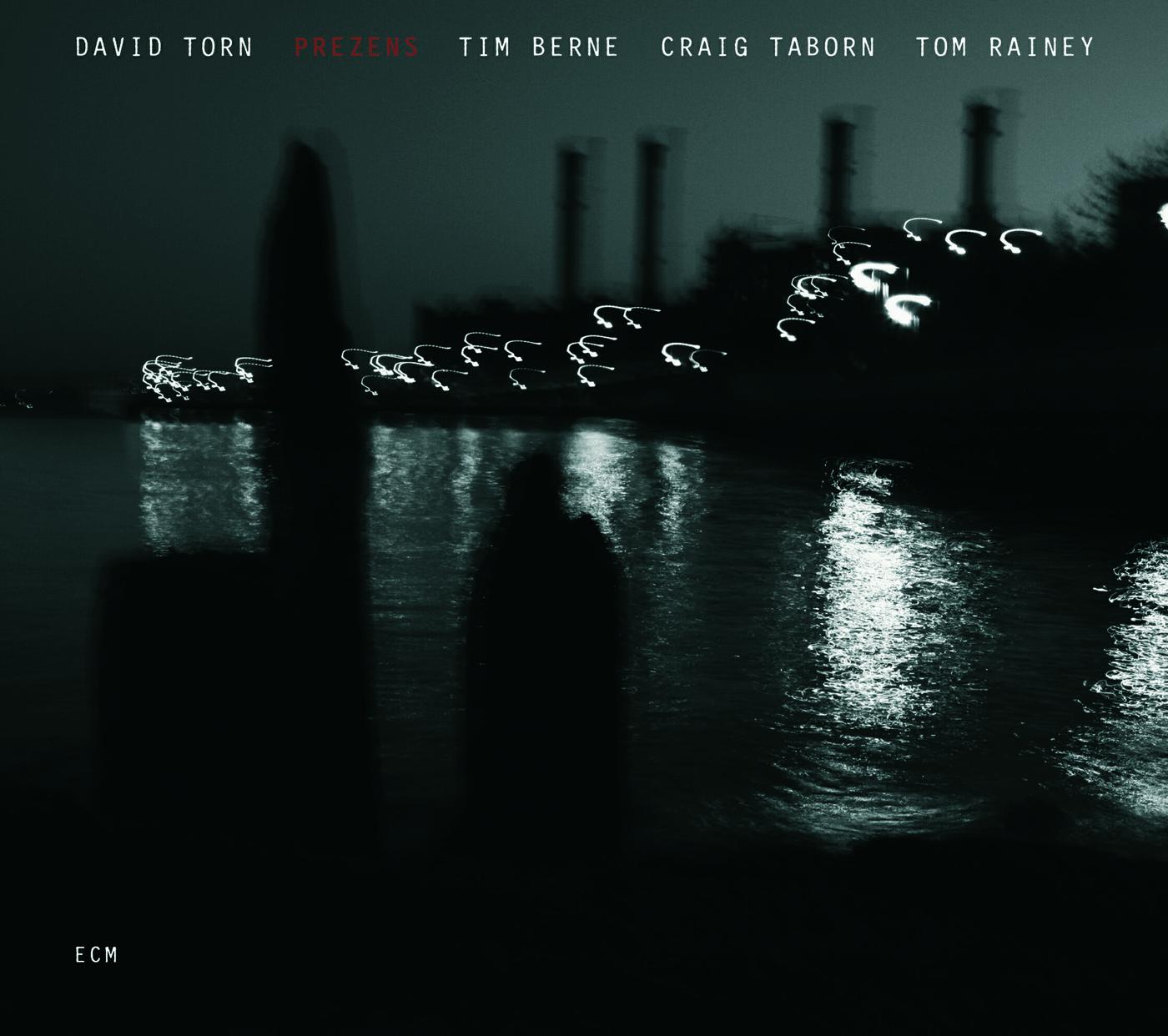
David Torn guitars, live-sampling and manipulation Tim Berne alto saxophone Craig Taborn Fender Rhodes, Hammond B3, mellotron, bent circuits Tom Rainey drums Matt Chamberlain drums
Recorded March 2005 at Clubhouse Studios, Rhinebeck, New York
Engineer: Hector Castillo
Produced by David Torn
Prezens marks David Torn’s return to ECM after a long hiatus since cloud about mercury. Here the guitarist joins altoist Tim Berne, keyboardist Craig Taborn, and drummer Tom Rainey for a combustible tangle of music making. The band, goes the backstory, recorded a dozen hours of free improvisation, from which were culled and refashioned an album’s worth of material, surgeried by Torn post factum. Finding one’s way through the end product may be no small task, but reaps its rewards in proportion to the openness of the ears receiving them.
At sound center is Torn himself, who, if not picking his glyphs across six amplified strings, is deepening them at the mixing board. Indeed, his presence (the album’s title under another name?) echoes far beyond the chord that stretches its yawn across “ak” in a swirling electronic haze. If the appearance of drums, organ, and saxophone seems out of place in this opening track, it is because they belong there so needfully. Ambient constructions flit in and out of aural purview, foiling the physicality of the acoustic here and now. Trailing the footfalls of Berne’s ghostly doppelganger, they trip over grungy riffs from Torn, who invites satirically blissful finish. Ganglion to ganglion, each instrumental element touches the third eye of something cerebral yet instantly accessible. Accessible, yes, because of the music’s inability to clothe itself. This isn’t meant to make your head nod, but to implode.
Spoken words hide like poison in “rest & unrest,” an exploration of the illusory nature of reality, a musical testimony led astray by its own shadow. It reveals the album’s variety of diction and leads into the evolved patterning of “structural functions of prezens.” As Torn’s electric keens distantly yet with the bleed-through of a Venn diagram, cells of machine-gun drumming turn this forlorn jam session into an exercise in self-destruction. Berne’s alto weaves its legato path across a landscape that is equal parts Jon Hassell and Steve Tibbetts, as if smuggling genomes across the border between consciousness and unconsciousness. So begins a chain of possible references one might connect. The electrical charge of Elliott Sharp activates the filaments of “bulbs,” while Bill Frisell’s weeds tumble through the ghost town of “them buried standing,” the latter further notable for its angelic resolution.
The album’s latter half mines decidedly urban sites of sonic production. The mélange of beat and grunge that is “sink” pulses with the muffled wisdom of an underworld nightclub. Berne’s hard-hitting altoism here gives the sheen of dislocation that comes with dreams. Yet grooves are rare on Prezens, because this project is less about the hook than about the catch dangling and writhing on its barb. Despite the metallurgy of “ever more other” and “ring for endless travel,” two further rhythmic outliers, warped atmospheres prevail. By those atmospheres the music is always connected, whether in the jangly slide acoustic of “miss place, the mist…” or in the mock shredding of “transmit regardless,” so that by album’s end we find ourselves wrapped in a swan song to impetuous youth by way of looking into the maturity of an artist who with his cohorts has unearthed a timeworn stone to contemplate for decades more.
Prezens is an album of inbound escapism—that is, one which enjoys getting lost in itself. Its codes come to us broken, for they speak only of that which was never whole.
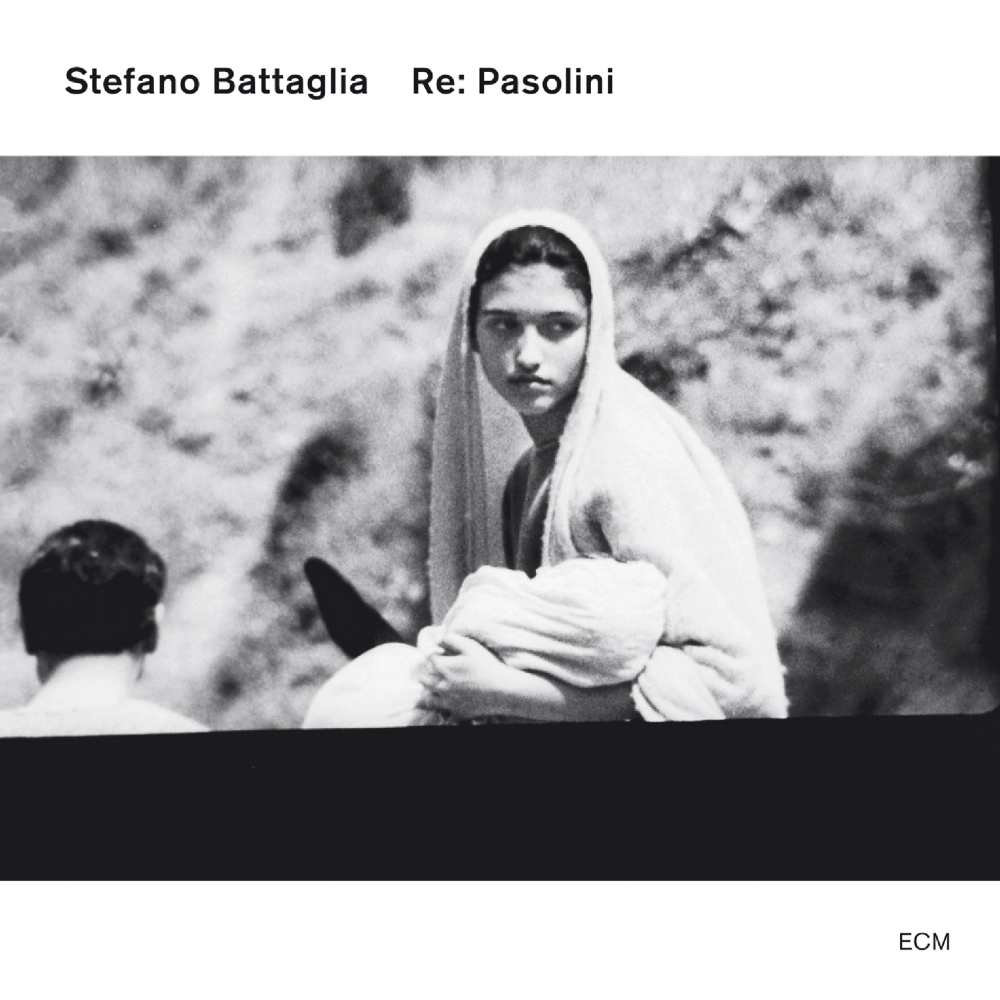
Stefano Battaglia piano, prepared piano Michael Gassmann trumpet Mirco Mariottini clarinets Dominique Pifarély violin Vincent Courtois cello Aya Shimura cello Salvatore Maiore double-bass Bruno Chevillon double-bass Roberto Dani drums Michele Rabbia percussion Recorded April and July 2005, Artesuono Studio, Udine Engineer: Stefano Amerio Produced by Manfred Eicher and Stefano Battaglia
Pier Paolo Pasolini (1922-1975) was one of the twentieth century’s great auteurs. A true interdisciplinarian, he activated discourses of post-colonialism (The Savage Father), politics (Salò, or the 120 Days of Sodom), and literature with comparable fervor. These honeycombs and more shaped the hive of his restless craft through an imagination of superimposition and mélange. In his book The Passion of Pier Paolo Pasolini, scholar Sam Rohdie likens prototypical works such 1967’s Oedipus Rex (incidentally, my first experience of Pasolini as director) to archaeological sites. We do well to analyze them as such, brushing away the dirt of history ever so carefully so as not to damage a single bone. For pianist-composer Stefano Battaglia, the challenge of fleshing out this double album was therefore not to make him musical (Pasolini was notoriously meticulous about every aspect of his mise-en-scène, including sound) but to make him walk again. And surely, within the wide angle that is Re: Pasolini, we can sense his footsteps.
For the first half of the program, Battaglia is joined by Michael Gassmann (trumpet), Mirco Mariottini (clarinets), Aya Shimura (cello), Salvatore Maiore (double-bass), and Roberto Dani (drums), with whom he spins a veritably orchestral web in “Canzone di Laura Betti.” Like the album as a whole, it is a love song (in this case, to the eponymous actress and filmmaker) that unfolds compact wisdom. At its heart is a jazz trio, around which trumpet and cello spin their filaments—interpreters between worlds. As the first of many nods to the silver screen, it sets in motion Battaglia’s greatest strength: namely, his instinct for development. Like a film itself, the program has a beginning, middle, and end, and opens on this facial close-up with all the possibility in the world at its feet.
One face becomes two in “Totò e Ninetto,” a sonic fable in which clarinet carries with it the fragrance of a cutting room. The intonation and togetherness of the musicians here are such that one feels them to have arisen from the ground fully ripe. Two faces become many in “Canto popolare,” a nod to the Italian folk traditions that Pasolini so adored and the recession of which he lamented. For these few minutes, at least, their spirit flourishes anew. All the more appropriate that this should be the trio, unmasked. Maiore’s bassing is particularly gorgeous, at once anchoring and decorating the pianism with undulating care.
Gassmann’s trumpet, sounding like Enrico Rava’s, piles on the nostalgia in “Cosa sono le nuvole,” a song co-written by Pasolini and Domenico Modugno (of “Volare” fame) that sets up the poetics of “Fevrar.” Maiore again astonishes, content as he is to blend into the background, building off Battaglia’s lines in shadowy emphasis, sometimes surfacing as he does here with quivering little cries that seem to say, “I am here and my melody is now.” Chromatic shifts in the surrounding terrain catch us just before we fall off the edge. Literary impulses continue with “Il sogno di una cosa” (named for Pasolini’s sub-proletarian novel) and flit once again in “Teorema,” a plodding and morose twist of emotional lemon.
Act I ends with “Callas” and “Pietra lata,” the former of which brings heartfelt undercurrents to glowing fruition. A tribute in both feeling and practicality, it comes to us revised from an earlier, 1984 piece (in Battaglia’s words: “a simple music box melody inspired by the ascending vocal exercises used daily by singers”). The final tune is a chorale for Rome, a cave where shadows do not move, frozen in time like the stalactites of Battaglia’s slow-forming crystal.
The second disc shuffles personnel, Battaglia now flanked by Dominique Pifarély (violin), Vincent Courtois (cello), Bruno Chevillon (double-bass), and Michele Rabbia (percussion). The bulk of this parallel chamber setting consists of eight “Lyra” pieces, all of which deepen Battaglia’s engagement with Pasolini the poet. In various combinations of violin, cello, and piano (plus the occasional percussive spotlight), they build a storehouse of freely improvised mementos. Like an attic, they grow darker as more memories are poured into it. The string players tend toward the outer edges of their instruments, while Battaglia treads the middle path, forging music that sees itself reflected but does not recognize its own face.
These pieces, scattered throughout, give context to the weighty impressionism of “Meditazione orale” and “Scritti corsari,” both attuned to an adamant politic. Another diptych of sorts (if not for “Lyra VI” between them), in the form of Battaglia’s solo pieces “Epigrammi” and “Setaccio,” tells the story of Pasolini’s formative years. The dialogic elements implied therein flourish tenfold in “Mimesis, divina mimesis,” melting down Apollo and Dionysus in a crucible of prepared piano and percussion. Yet another pairing rolls the end credits. “Ostia” names the town where Pasolini was murdered in 1975 and evokes his last moments before slippage. It expands the molecules of the “Lyra” pieces to planetary scale, drawing wobbling arcs in a surreal yet naked comprehensibility. All of which brings us to the beginning, as it were, with “Pasolini.” As the first piece Battaglia ever composed in this vein, it is the seed of all that precedes it. On its tomb: a bouquet of black roses, each petal forged of gut and flesh and fronded with lens flares of the soul.
It would be easy to say that Re: Pasolini defies description, when in fact it yearns for it, if only because its honoree built a life around speech, character, and action—vital aspects each to our shaping of words. Despite, if not because of, its elegiac finish, the album confirms of all that is good and beautiful in life. It is the comfort of humanity, of communication, of sounds and the inclinations behind them, an all-encompassing embrace of something invisible yet common to it all. No small feat, to be sure, in light of Pasolini’s psychological knots. Battaglia and his allies have crafted a genre unto itself, a paragon of audio cinema that was a classic before it was even recorded. It is a pair of lips that passes us in the night like a kiss that might have been, but which instead hobbles on crutches of wordless keep.
Tord Gustavsen piano Harald Johnsen double-bass Jarle Vespestad drums
Recorded December 2001 and June 2002 at Rainbow Studio, Oslo
Engineer: Jan Erik Kongshaug
Produced by Manfred Eicher
The debut of pianist Tord Gustavsen’s all-Norwegian trio was a much-lauded event. Famously trending on the Scandinavian pop charts, this album more importantly trended in many listeners’ hearts, building its tunes—each a monument to subtlety—entirely out of infrastructure. Speaking as they do on the inside, said tunes come to us fully realized. The gossamer curtains on the sleeve give us only half the story. As towers of gaseous flame, their folds belie the chemical properties therein. Yet there is also the scene beyond, waiting for those who dare to brush the curtains aside. Here is where the music’s ambient nature thrives, unlimited and thrumming with purpose.
“Deep as Love” is as defining an introductory statement as one could imagine. Everything about it describes the trio to a T: the smoothness of execution, a yielding strength of theme, and the breadth of the band’s collective signature. Bassist Harald Johnsen elicits the album’s first revelation as he connects the DNA ladder between Gustavsen’s bluesy accents and drummer Jarle Vespestad’s hourglass timekeeping. This track speaks most clearly to Gustavsen’s sensitivities as player and composer, as does the subsequent “Graceful Touch.” The latter’s chromatic twists linger long after their execution, each a comforting tickle at the back of the temporal lobe. Based on these alone, one could be forgiven in thinking that the band is nothing but shadow and flutter, but the swing implied by Gustavsen’s solo intro to “IGN” is picked up beautifully by the cymbalism of Vespestad, who navigates by sense of touch rather than by hearing. The end effect brims with hip, urban energy that by the sparkling finish leaves us suspended between realms. So, too, does “Turning Point,” which marks a shift in the album’s planetary alignment, and the smoother “Going Places.”
Still, with so much pathos to be savored, it’s no wonder that the band’s strongest tunes should also be its gentlest. From the expansive (“Melted Matter”) to the intimate (Gustavsen’s solo “Interlude”), melodies impose themselves with the force of windblown grass. Solos likewise emerge with such ease that one almost doesn’t notice their crocodilian eyes peeking above the surface. The democratic integrity of “Where Breathing Starts,” for instance, is such that no single instrument can be separated from the others. Johnsen’s depth-soundings proceed robustly here against Gustavsen’s splashes of anthemic color, Vespestad keeping the frame intact all the while.
The magic of Gustavsen’s trio thrives not only in its forward thinking, but also in its nods to bygone days. Hence, the classic sheen of “Your Eyes.” Also resonant in this regard is “Song of Yearning,” which expresses its titular emotion by way of Johnsen’s curlicues. Noteworthy is the simple yet profound drift into the major that sets up Gustavsen’s commentary, recapitulated in this tune’s solo version that steeps the album’s final minutes in the color of prayer.
In the case of Changing Places, one can just as easily hear how much ECM has informed its landscape as how it has informed ECM’s in return. Every motif finds a place to call home and, like the title of “At a Glance,” turns the fleeting into the robustly proportioned.
I hesitate to call an album perfect, but no other adjective will do.
John Surman soprano and baritone saxophones, bass clarinet Chris Laurence double-bass Rita Manning violin Patrick Kiernan violin Bill Hawkes viola Nick Cooper cello
Recorded February 2006, Propstei St. Gerold
Engineer: Markus Heiland
Produced by Manfred Eicher
When reedman John Surman first collaborated with bassist Chris Laurence and an ad hoc string quartet on 2000’s Coruscating, the end result was a cause for beginnings. Unlikely surprising to the veteran Surman listener yet fresh as sun-dried sheets, the music of that debut opened a chapter in his compositional thinking now fleshed out to the depth of a novel on The Spaces In Between. Indeed, despite the wealth of fine performances all around, it’s the writing that makes this album such a notable entry in Surman’s expansive discography. The folk-infused melodies, and the means by which they are elucidated, shine through translucent curtains of improvisation, at which the bow-wielders now more forthrightly try their hands.
Balances abound. At the larger level, the album works in two halves, spit at the fulcrum of the title track. This playful sojourn for solo violin, brought to evocative fruition by quartet leader Rita Manning, upgrades the album’s wingspan from butterfly to bird, flitting from limb to limb in search of emerging buds. Before this, the set list steeps itself in winter, interlacing embraces and lettings go. Surman etch-a-sketches his own branches in “Moonlighter,” his methodical figurations seeming to describe a return from hard labor. In them is a sense of tragedy, with bass acting as narrator and strings as chorus. More nuanced balances follow. There is the diurnal contrast of bass clarinet (which under his fingers sings incarnate) and soprano saxophone. The latter doesn’t so much add to as emerge from the strings, drawing out warmth of heart from “Wayfarers All” and the crisper “Winter Wish.” As for those strings, they speak in pastoral dialects, their home a hearth among the ice.
Spring abounds on the other side of the album’s titular spaces, with “Now See!” setting tone in bucolic tracings. Only this and “Where Fortune Smiles” rely on the soprano’s inherent buoyancy to speak its own accord, favoring instead the baritone’s relatively challenging bounce. “Mimosa” (originally written for, but never included on, Thimar) elicits the jazziest inflections in this regard, that low reed moving jaggedly yet surely across the plains. This leaves only “Leaving The Harrow,” a song of drifting, of chemical reactions, of moving on.
Although its mise-en-scène is minimal, the emotional complexities of The Spaces In Between reach far and wide. Like the skies above, they welcome every change in weather, rain or shine, as if it were the first.
Joe Lovano tenor saxophone Bill Frisell guitar Paul Motian drums
Recorded May 2006 at Avatar Studios, New York
Engineer: James A. Farber
Produced by Manfred Eicher
Paul Motian: a drummer of such intuition that his kit might as well have been a part of his body. Joe Lovano: a saxophonist who lights the way with darkness. Bill Frisell: a guitarist who turns six strings into a symphony. A trio to die for. Then again, why deprive yourself of the luxury? A trio, then, to live for.
Since first meeting in the context of Motian’s Psalm quintet, this nimble nexus worked its tunes for decades from the inside out with freshness intact. As per usual, most of this session’s thematic material comes to us by way of Motian, whose “Cambodia” joins guitar and drums in methodological harmony. Frisell plays around the melody in much the same way that Motian plays around the beat, each descriptive in his approach (check, for example, the crystalline “Whirlpool”), so that when Lovano’s cautious lyricism slinks into the picture, we welcome him as an alley might welcome a stray cat with a song that defines the night. Such feline moods flow through a good portion of the set list, curling their tails around highlights “In Remembrance Of Things Past” and “K.T.” In the latter tune, Motian makes yin and yang of snare and cymbal.
Yet where he truly shines (if not also shades) is in those tracks penned by others, each a space in which he feels content to lurk in admiration of his bandmates’ sensitivities. From the Rodgers and Hammerstein show tune “This Nearly Was Mine” and the luminous spirals of Monk’s “Light Blue” to Lovano’s “Party Line,” the drummer’s capacities for melody, swing, and subtlety are on full display. He walks on beds of flowers, leaving pollen for many beds more.
For all the album’s listlessness, an undeniable clarity of expression abounds. We hear this especially in “Onetwo,” both for its thematic fortitude and presence of mind, and in the concluding title ballad. From strings of ordinary things, it weaves extraordinary pictures. The free spirit that moves this trio surfaces nakedly in these swan minutes, turning postcard into movie and recollection into reality.
Christian Wallumrød piano, harmonium, toy piano Nils Økland violin, Hardanger fiddle, viola d’amore Arve Henriksen trumpet Per Oddvar Johansen drums
Recorded September 2004 at Rainbow Studio, Oslo
Engineer: Jan Erik Kongshaug
Produced by Manfred Eicher
A Year From Easter is the third ECM leader date for pianist Christian Wallumrød. Nourished on the same label’s diet, his skills as an improviser (and as a composer) have sprouted fields of their own making and artfully striate the colors of fiddler extraordinaire Nils Økland, trumpeter Arve Henriksen, and drummer Per Oddvar Johansen into the present spectrum. Wallumrød has always folded his aesthetic along tactile creases, but the chambering of Easter finds him unusually palpable.
The triangular melody of “Arch Song” sets the stage accordingly, scanning its laser of pathos across the barcode of “Eliasong” (and its deeper sequel) with equal precision. From gray to shining gold, Henriksen’s elliptical reasoning morphs over harmonium, an instrument Wallumrød plays to further, glassy effect on “Lichtblick.” With the gentility of breeze through poplars, his keyboarding—regardless of instrument—puts lips to candle and blows just enough to make things flicker. Such is the bearing of “Stompin’ At Gagarin,” a delightfully programmatic piece that emits Wallumrød’s east-leaning aura. His understated feel for arrangement and storytelling is clearest in such tunes, as also in “Japanese Choral.” Here, over an icy surface, keys and horn unfold with chromatic purpose, misted like a Kenji Mizoguchi still.
Indeed, cinematic feelings abound. Like a crafted visual story, the slow figurations of “Wedding Postponed” build into dynamically richer constructions as more characters are introduced. Similar impulses mark “Horseshoe Waltz,” of which the pianism beams an attic of clattering relics. Pizzicato strings scuttle along the hard wood, carving rays of light into the air by freshly liberated dust plumes.
Yet the album’s focus remains out of doors, the title track being a representative example. With its warming skies and leaf-lined pathways, it leads us to the sacred spaces of tunes like “Psalm” and “Neunacht,” both like hymns reverse engineered to their stained-glass origins. Such is Wallumrød’s approach: conjoining cells of color by the solder of his crafting. In the latter solo piano piece, block chords process like candle-bearers from rear to fore, making way for linear melodies and violin sketches. Rasping across the night, his motifs swing ably from tree to barren tree, leaving ashen poetry in their wake.