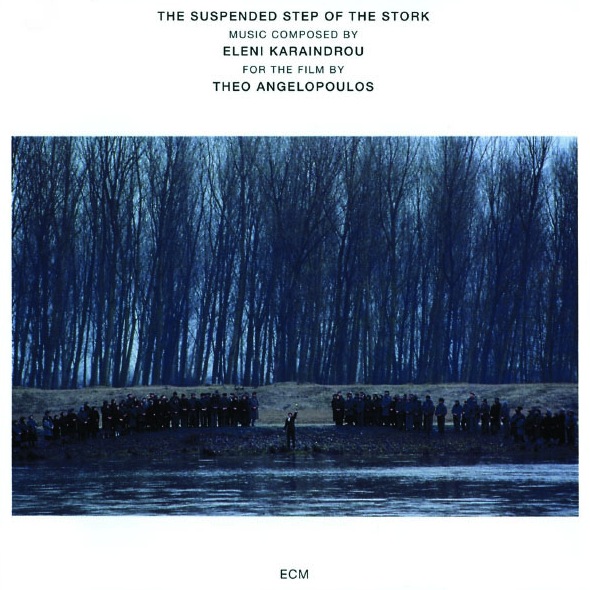
Eleni Karaindrou: The Suspended Step Of The Stork (ECM 1456)

Eleni Karaindrou
The Suspended Step Of The Stork

Vangelis Christopoulos oboe
Nikos Spinoulas French horn
Andreas Tsekouras accordion
Dimitris Vraskos violin
Christos Sfetsas cello
Ada Rouva harp
Lefteris Chalkiadakis director String orchestra
Recorded April and August 1991, Polysound and Sound, Athens
Engineer: Yannis Smyrneos
Produced by Manfred Eicher
“How does one leave?”

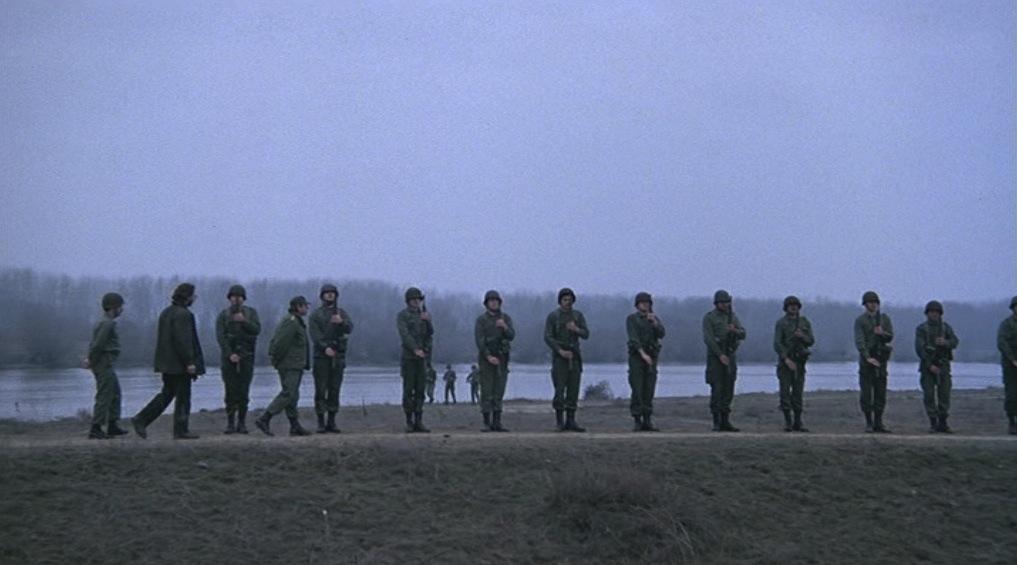
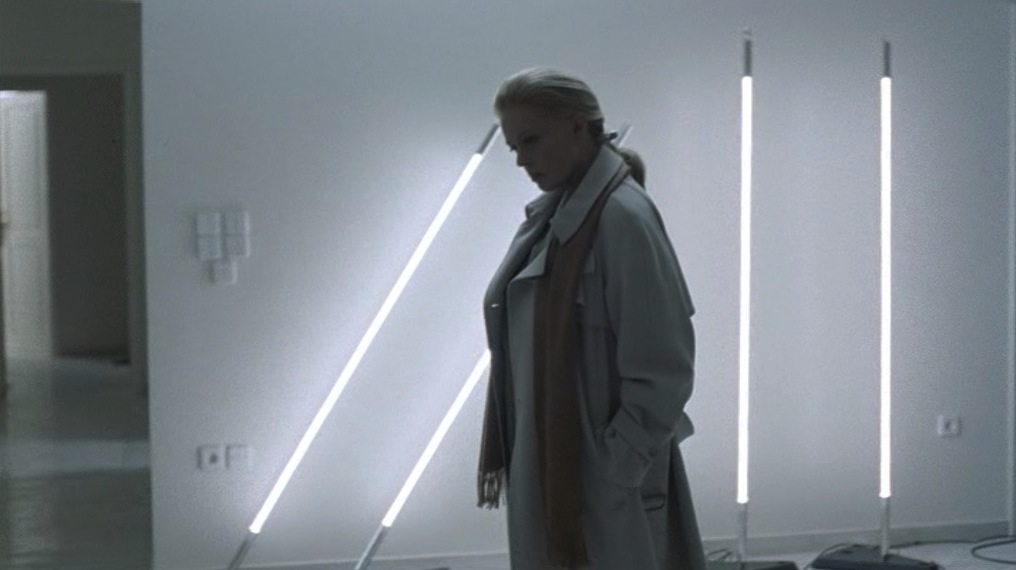
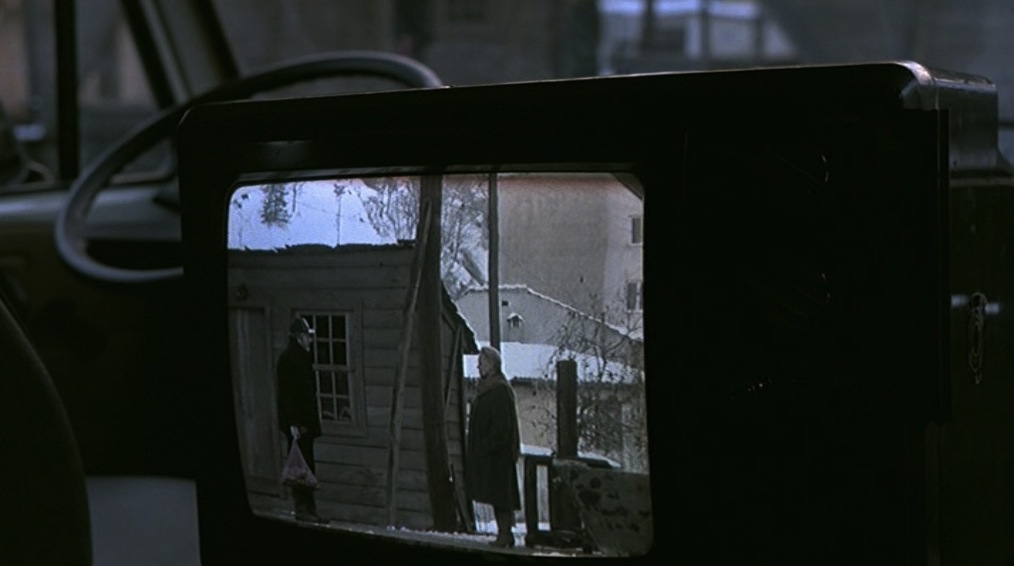
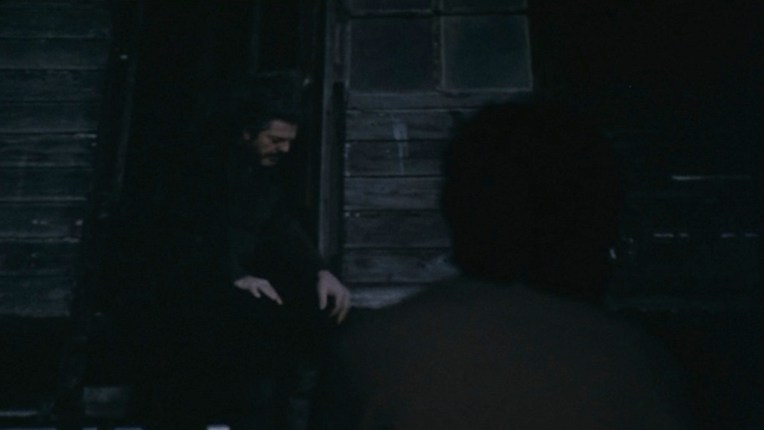
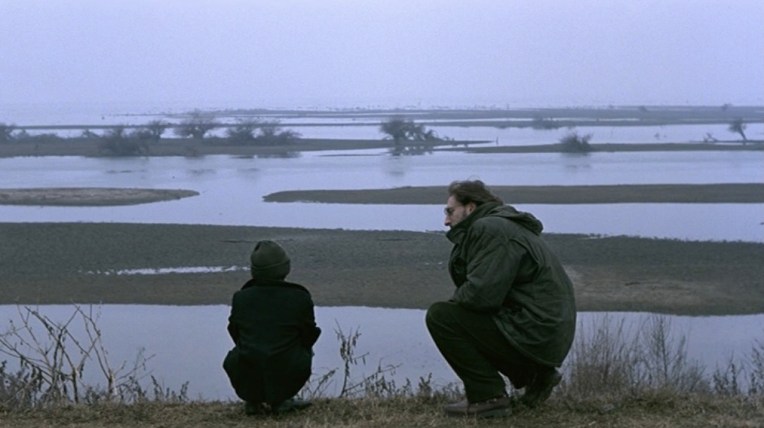
This question haunts The Suspended Step Of The Stork, Part I of Theo Angelopoulos’s “Borders” trilogy. A film of subcutaneous power, it finds beauty where there is suffering, stark yet foggy, as if through tearful recollection. Peeling layers to the emotional center of Stork is composer Eleni Karaindrou, whose soundtracks were never so much inserted into as bled from the late Greek director’s canvases. Hers is the audio equivalent of a tracking shot, scrolling through face, space, and race with barest touch. “Refugee’s Theme” shrouds the credits like an overture to lives whose variations are leaves on a tree of displacement.

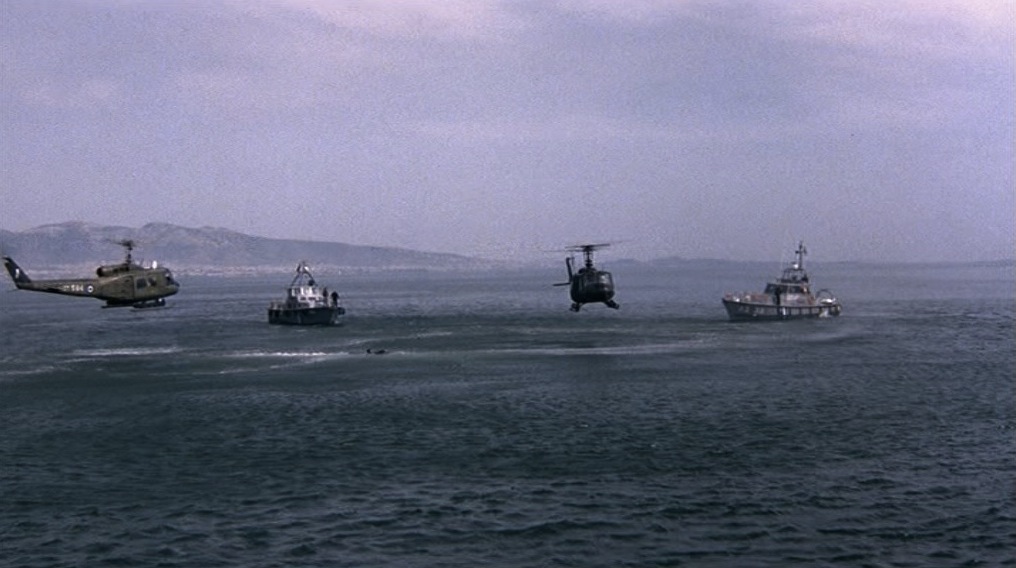
Of those lives we get only leitmotifs, each seeming far too short in the grander symphony of human suffering. Like the bodies floating in the opening shot, they bob at the whim of two rhythms: one natural, the other mechanical.

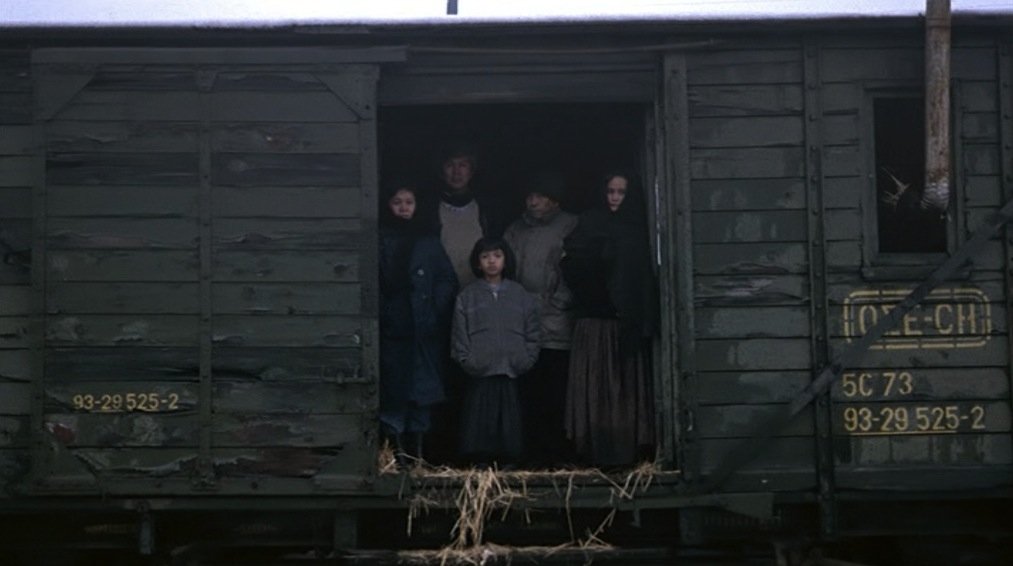
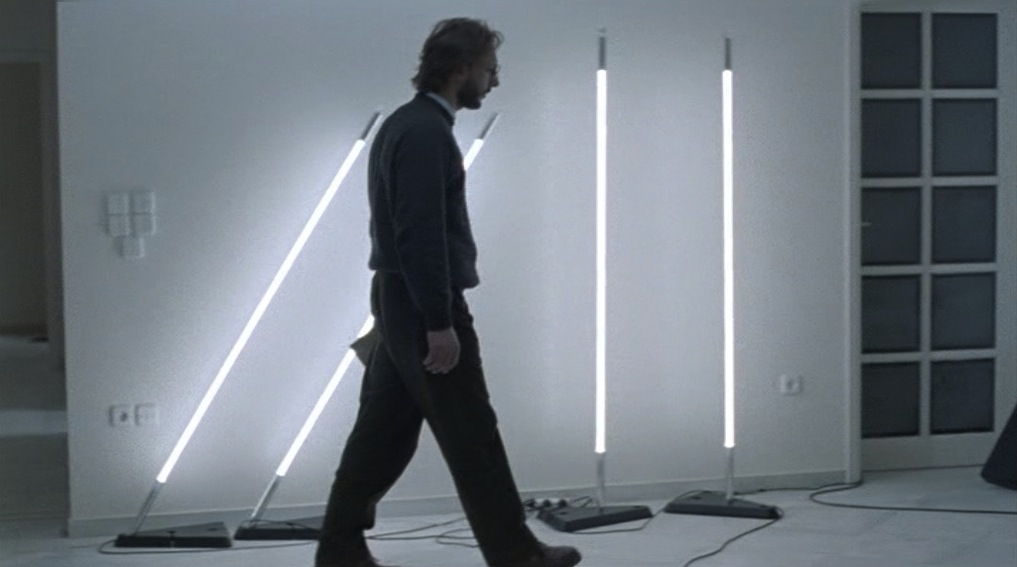
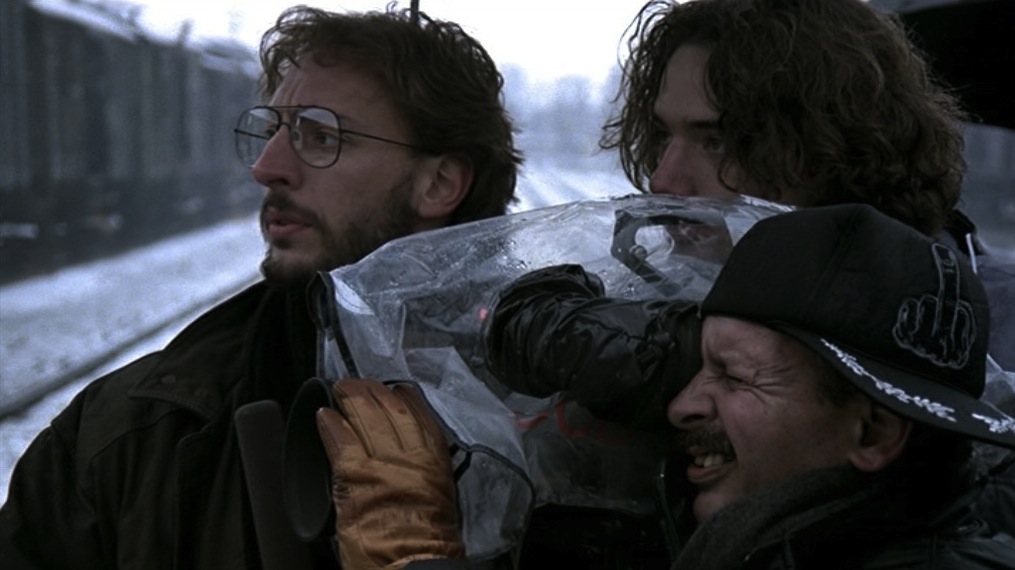
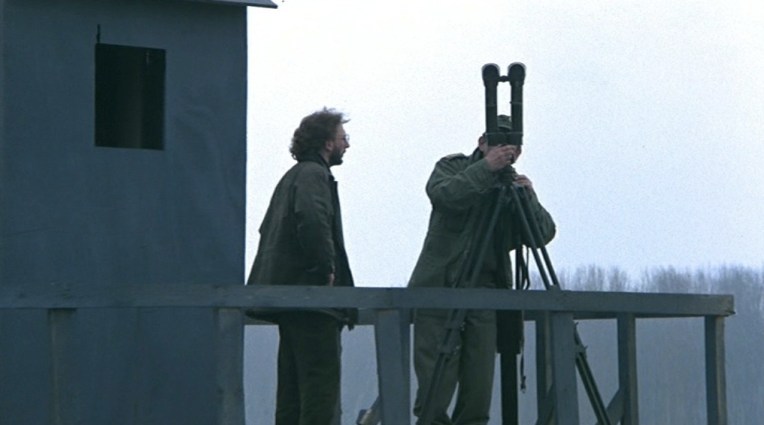
Helicopters and boats circle these transient martyrs, whose bodies huddle together still as they might have when still alive. Our protagonist, Alexandre (Gregory Patrikareas), a television reporter on his way from Athens to the Greek-Albanian border to do story, watches those same corpses—Asian stowaways refused political asylum by Greek authorities—and muses on the silence they represent amid all the commotion. The name of the ship from which those unfortunate souls would rather have leapt to certain death rings true: Oceanic Bird. Each has become exactly that, soaring far from the public eye on wings of salt spray and denial.

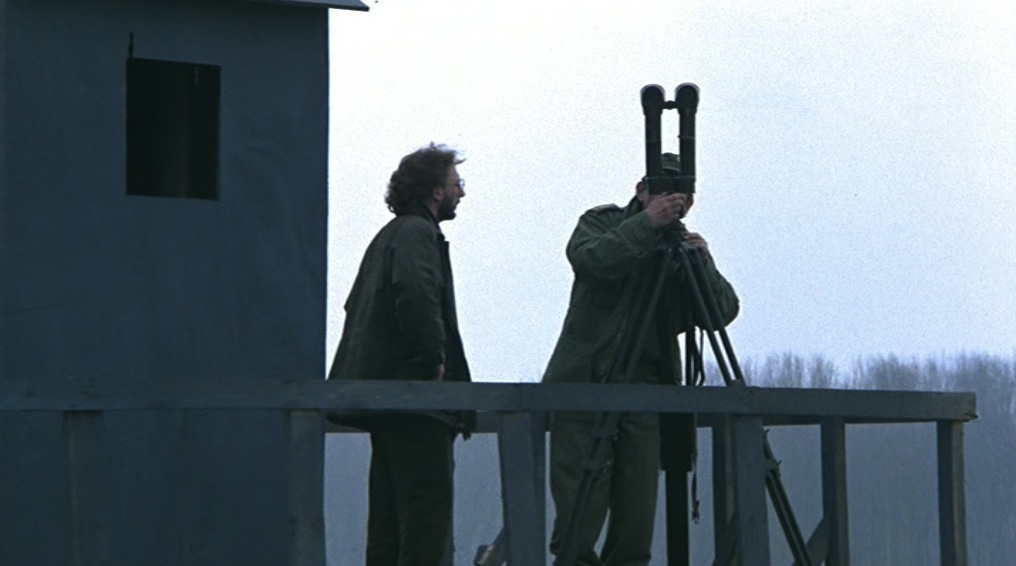
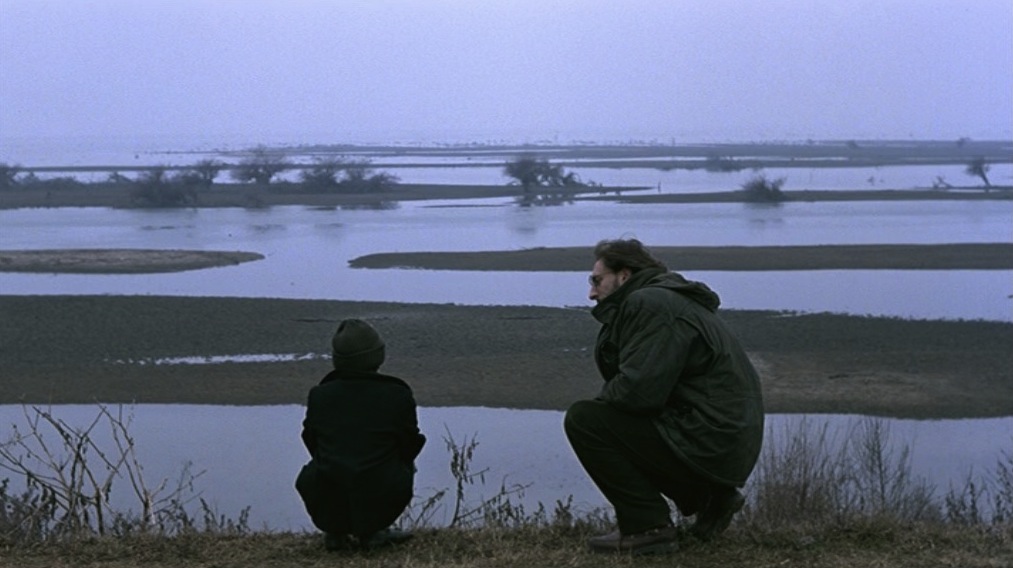
In a border town far from those waters, yet never from their ripples, a patrol Colonel (Ilias Logothetis) aids Alexandre in his search for information. Known by locals as the Waiting Room, said town plays host to refugees from Albania, Turkey, Kurdistan, among others. It is place with its own dimension, or so the Colonel asserts, a place where people lose themselves in the tide, forgetting that any such dimension is not inherent to the place, but forced upon it by politics and circumstance. It is, more to the point, a place of fear, where even the roar of the nearby river turns dreams into nightly prisons.
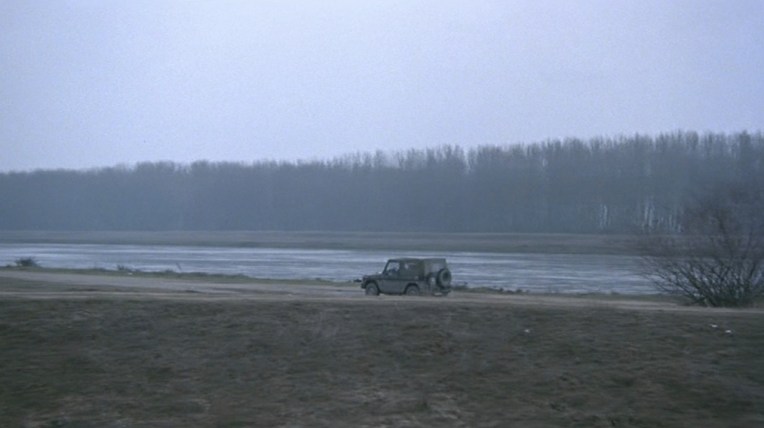
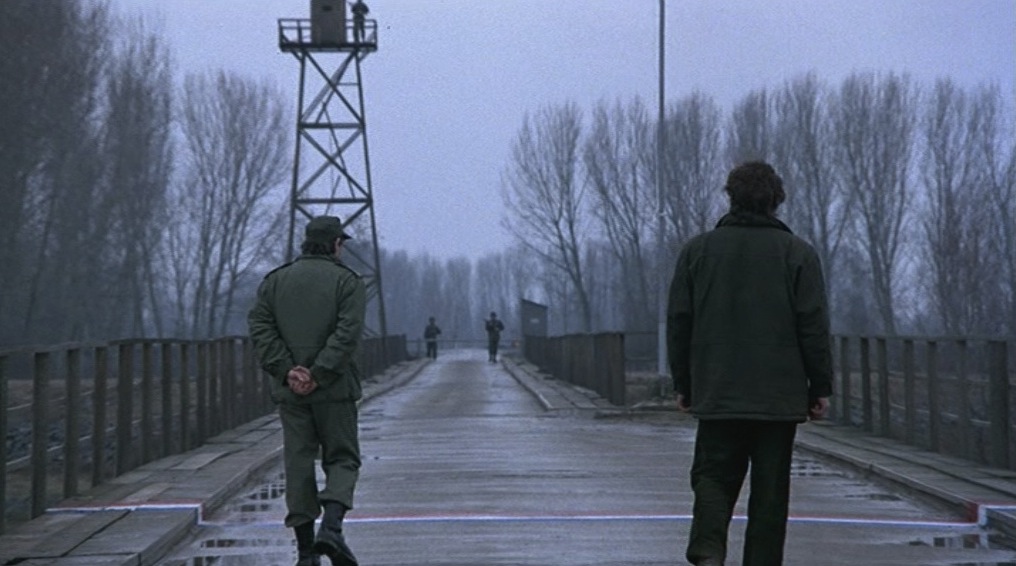
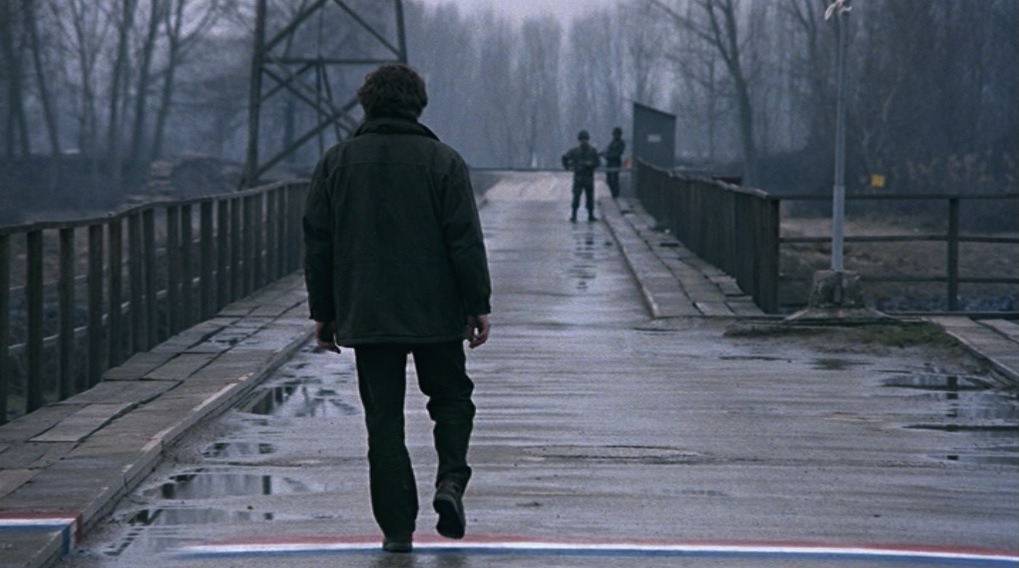
“Do you know what borders are?” the Colonel asks Alexandre in a key scene, as if the concept were in need of philosophical elaboration. This is the set piece he lives behind, the stage Alexandre so desperately, in his quiet way, hopes to transcend.
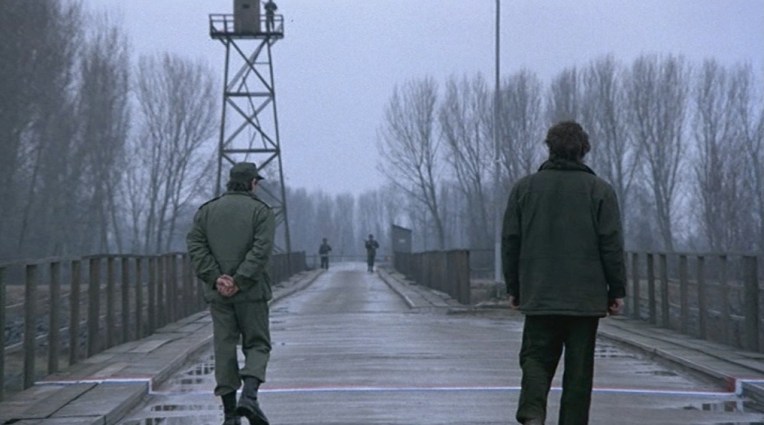
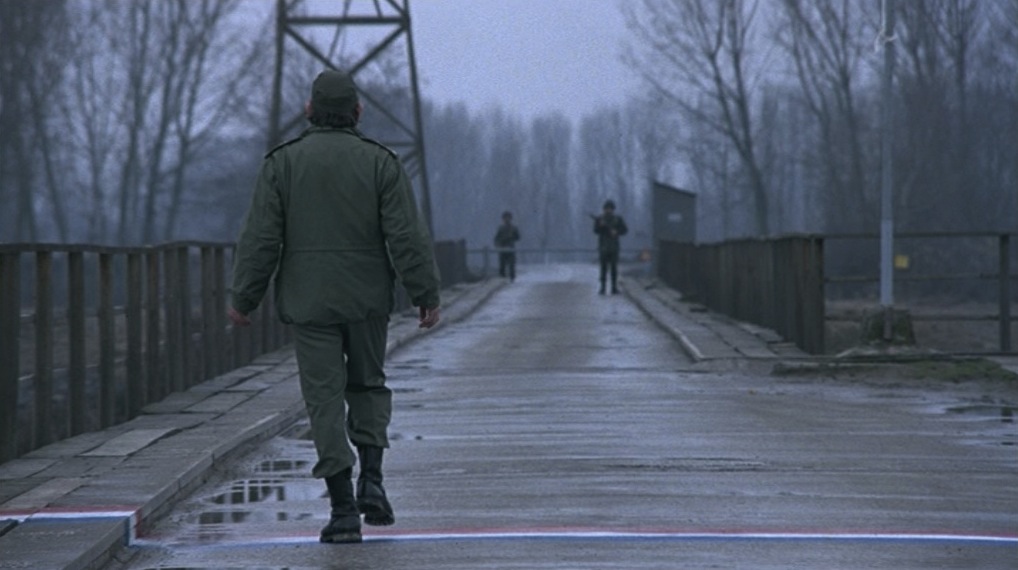
The Colonel lures the hapless reporter to that very line, threatening to cross it.
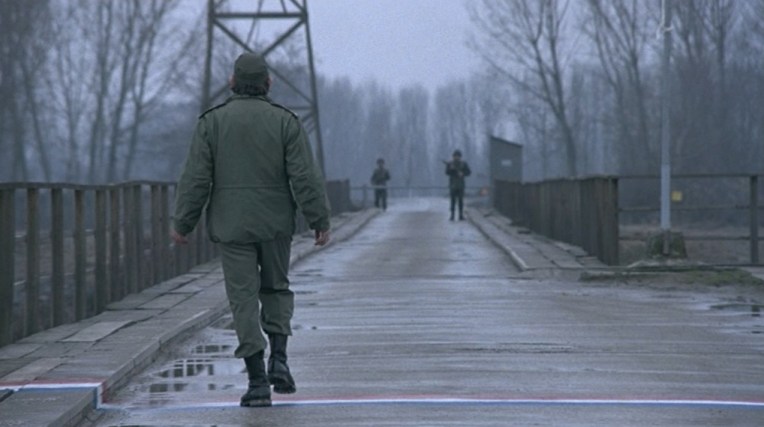

“If I take one more step, I’m ‘elsewhere’…or I die.”

What seems on the surface a fruitful bonding moment, a shedding of rank that leaves two men at the brink of something profound and indelible, proves just as arbitrary as the border of their shared interest. Ever ahead of his audience, Angelopoulos offsets this shadow play with an audio montage of firsthand refugee accounts. Says one, recounting the fear of being seen during his night passage, “I could never imagine that I’d ever want the moon to die.” These words cut the Colonel’s sentiments like Brie, revealing the vulnerable innards of his arrogance. We are duly reminded that the “elsewhere” of which he feigns knowledge has, for them, taken on mythical meaning. It is the asymptote to their path of travel, seen in every expression as the camera pans along a train filled with survivors. Here, Karaindrou’s “Train-Car Neighbourhood” draws a thread through each life like a bead on a necklace of hardship.
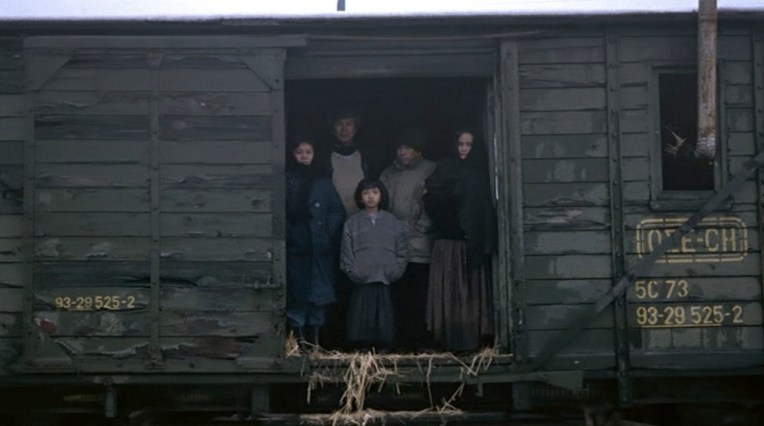
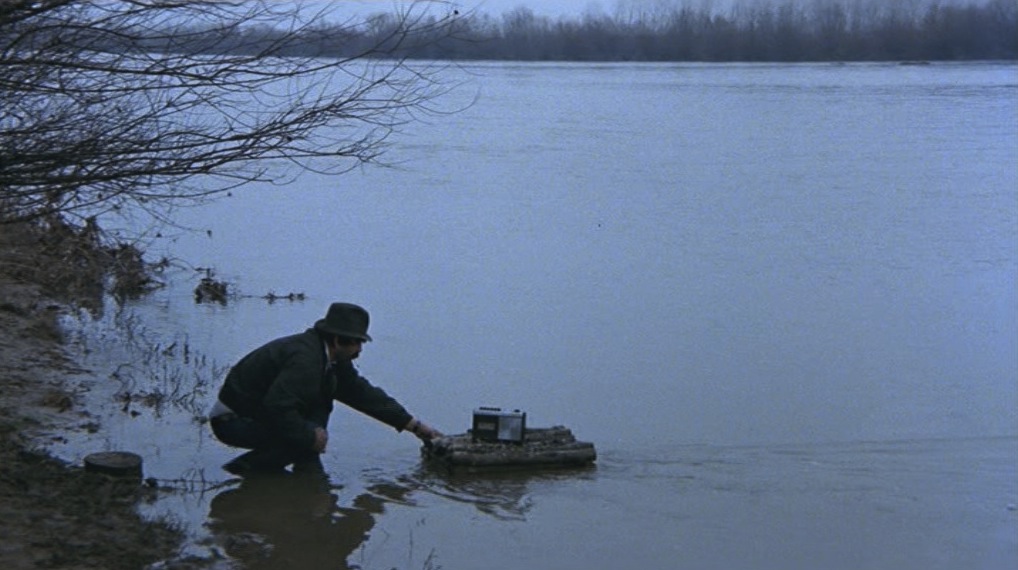
Yet perhaps no moment captures this separation of nomad and state power so heart-wrenchingly as when the Colonel berates a man for trading music across the river.
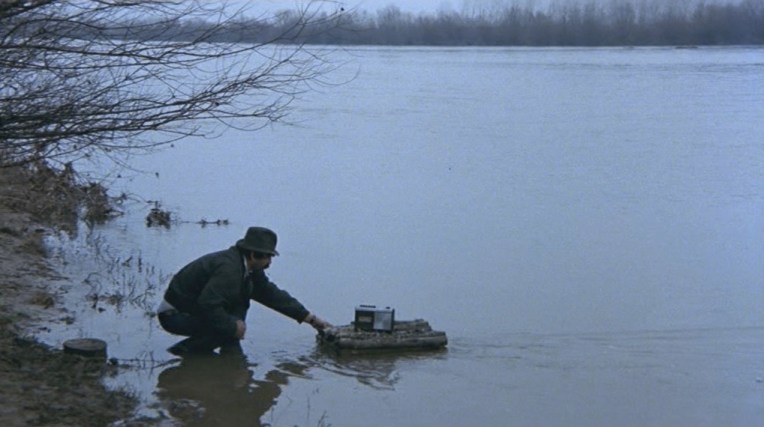
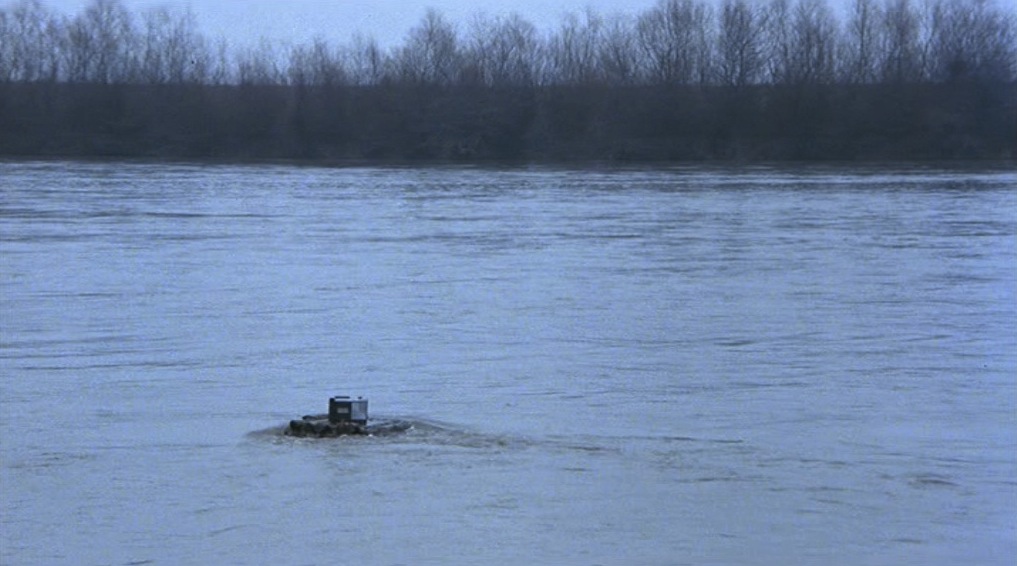
A cassette player spews popular lyrics of a better time on a small makeshift raft, which the man changes out before the player is pulled off screen.
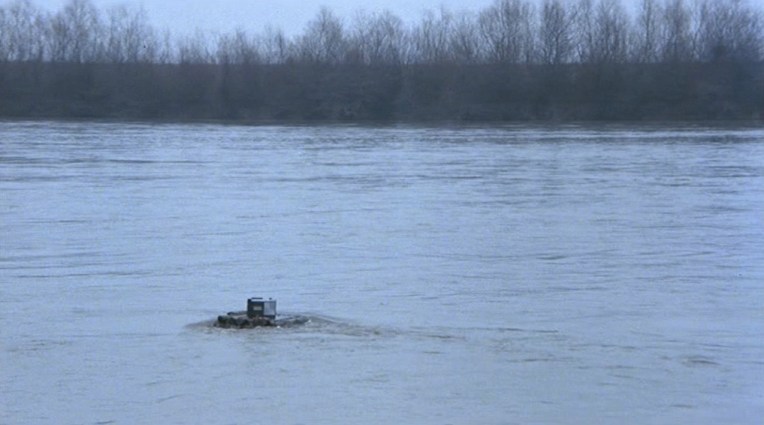
Love is a full moon, croons Haris Alexiou from its weary speakers. It drives my body mad.
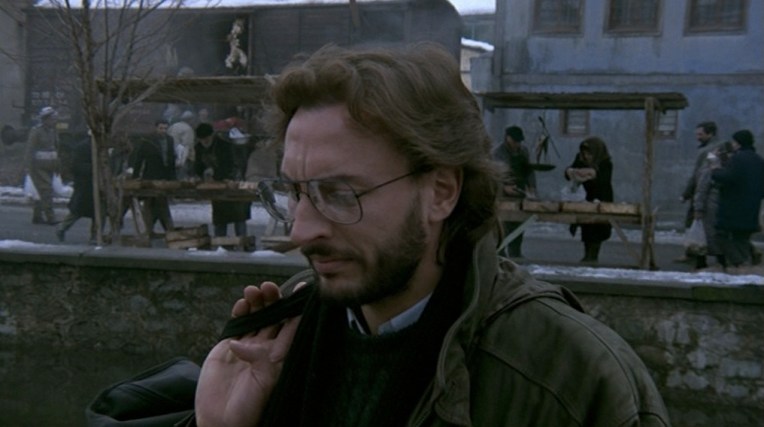
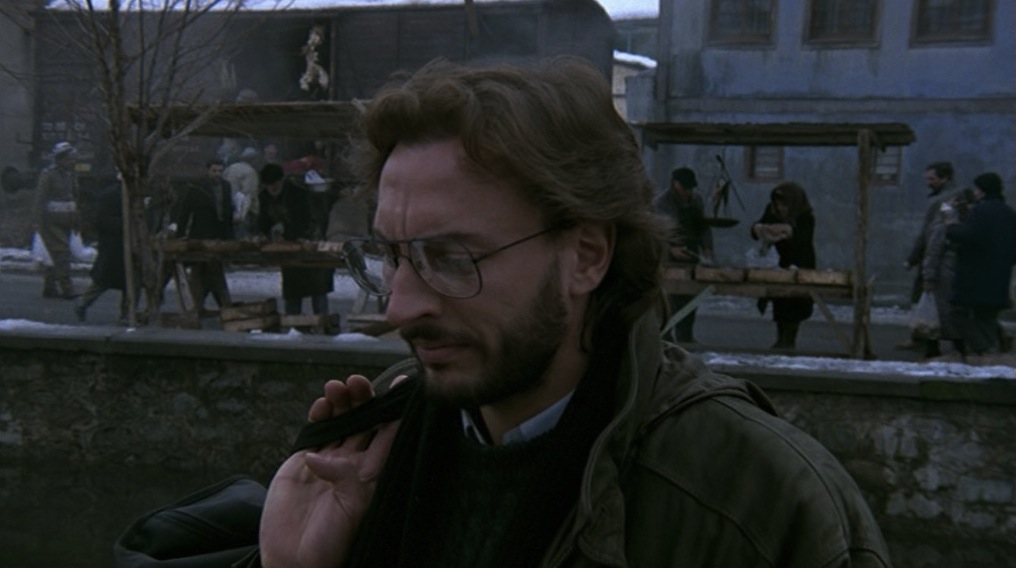
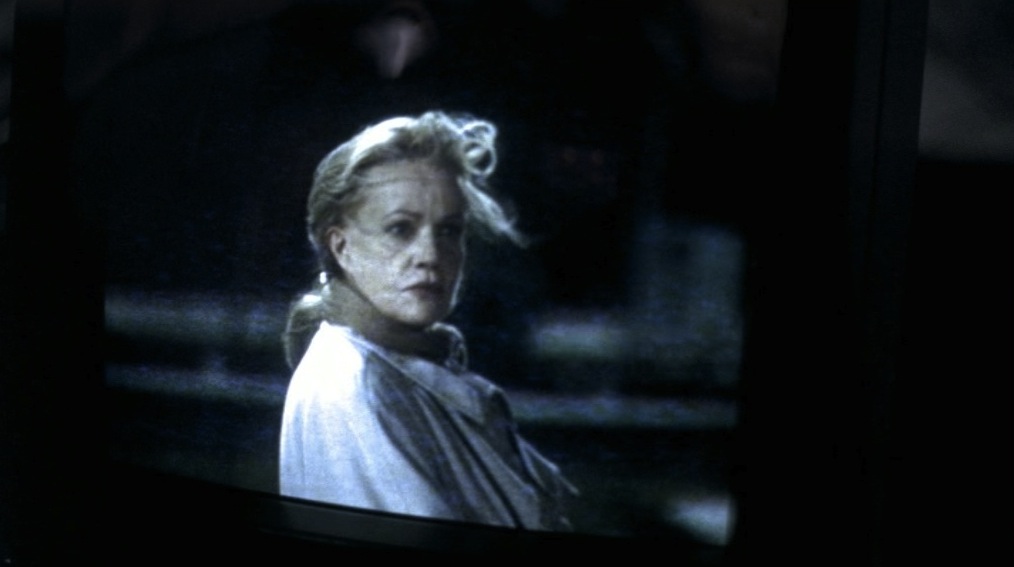
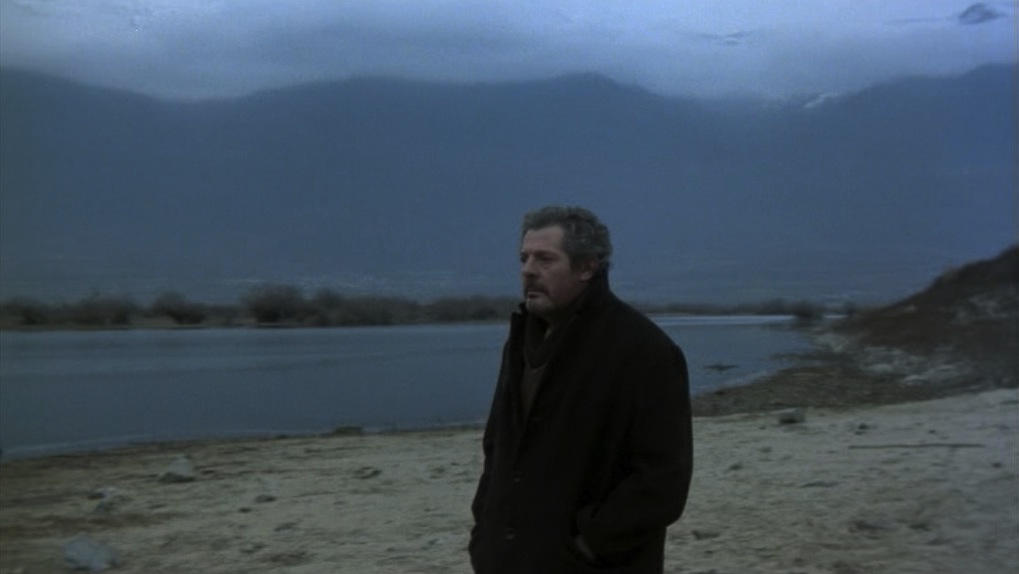
A rare close-up from Angelopoulos allies us with Alexandre, who believes he has spotted among the Waiting Room’s destitute a once-famous politician (Marcello Mastroianni). In Athens, he confronts the man’s ex-wife (Jeanne Moreau), who relates an abbreviated story of his mysterious 40-day disappearance—which indeed left him transformed upon his return—and subsequent vanishing act. She amends her brusqueness by coming to Alexandre’s home with a tape containing the last answering machine message her husband ever left, in which he admits, “I’m only a visitor.”
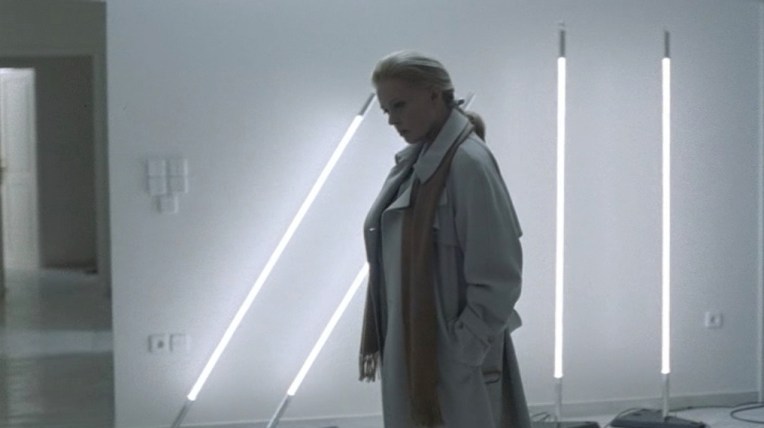
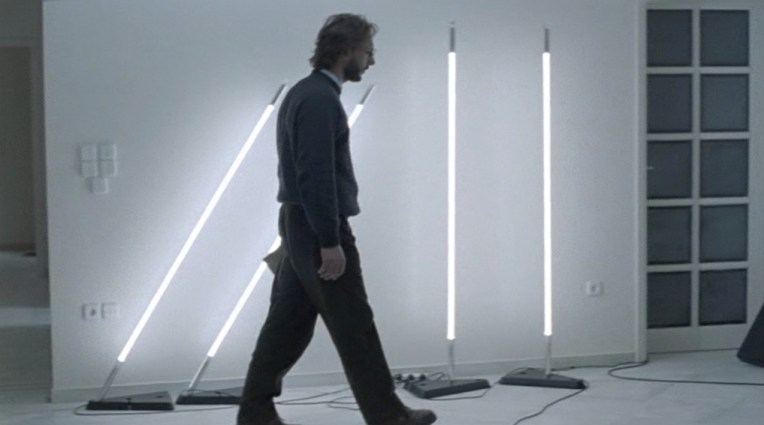
The woman tells Alexandre of a secret wound: “The thought that he wouldn’t share it with me was unbearable.” As the two move into the night, we realize that the cameras of reportage are now rolling, rendering her private confession into open testimony.
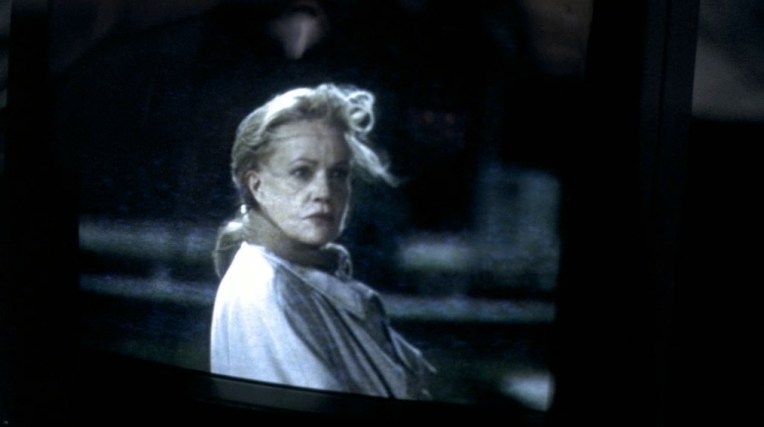
Alexandre searches the archives in the hopes of finding, somewhere in those tomb-like files of society’s forgotten, proof of the politician’s whereabouts. This chase leads him back to the border, and into the town’s only dance hall.
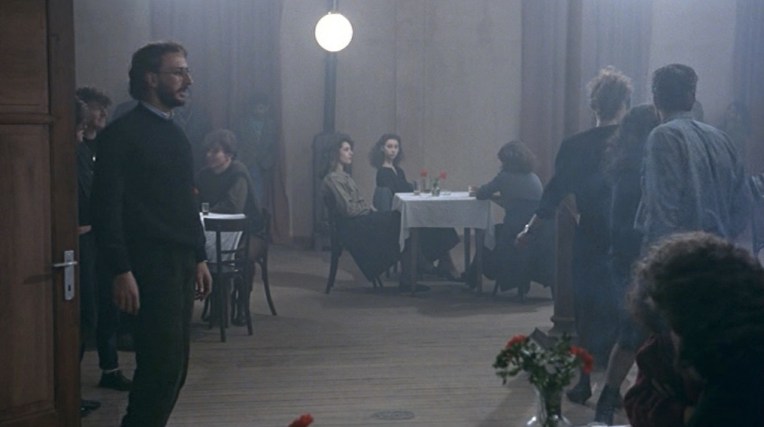
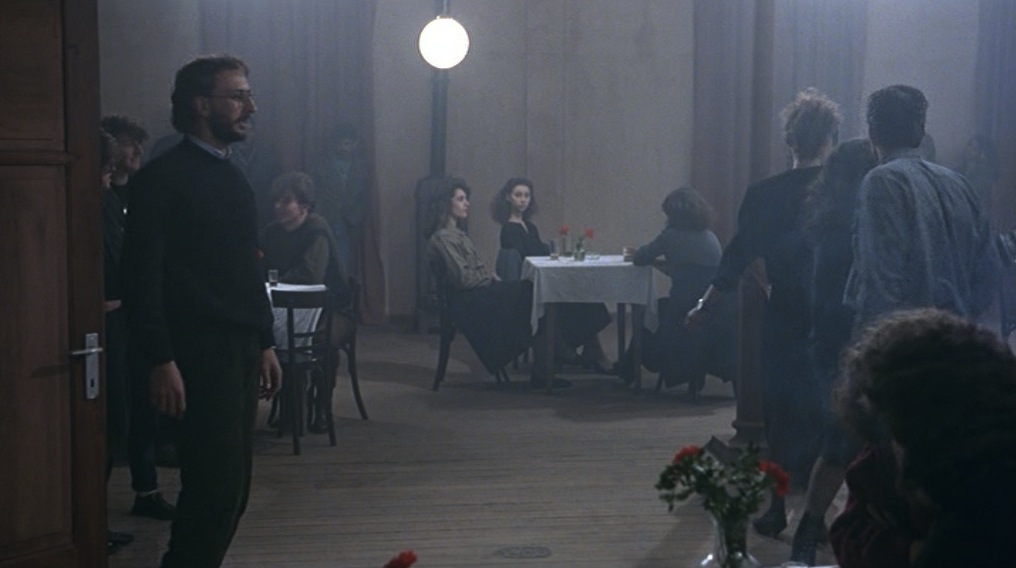
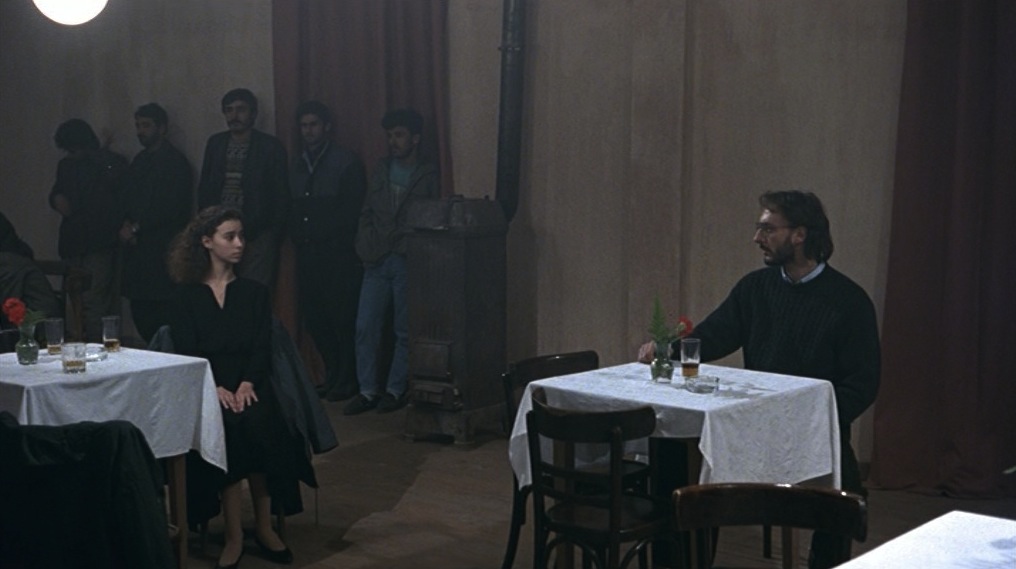
What begins as a chance to steep his thoughts in drink, however, soon funnels into a turned head, a stare from an enchanting girl (Dora Chrysikou), whose eyes now reverse the intense regard with which he has made his career back onto him.
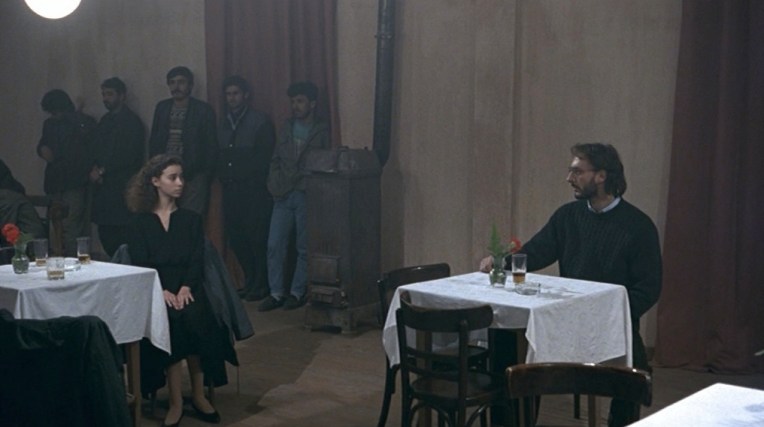
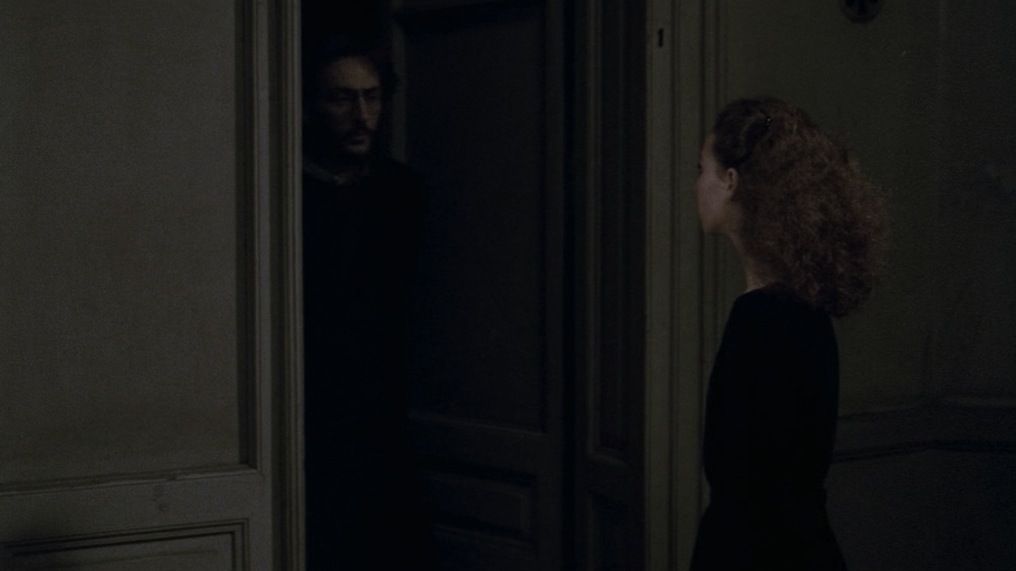
Although he makes to leave, the girl approaches and follows him, silently, to his hotel room.
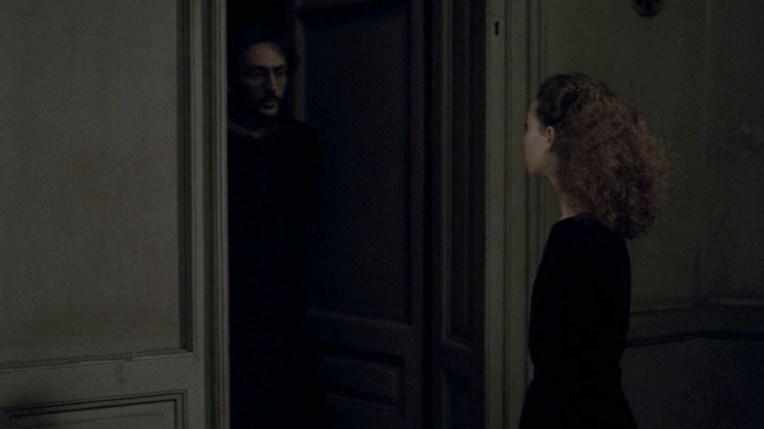
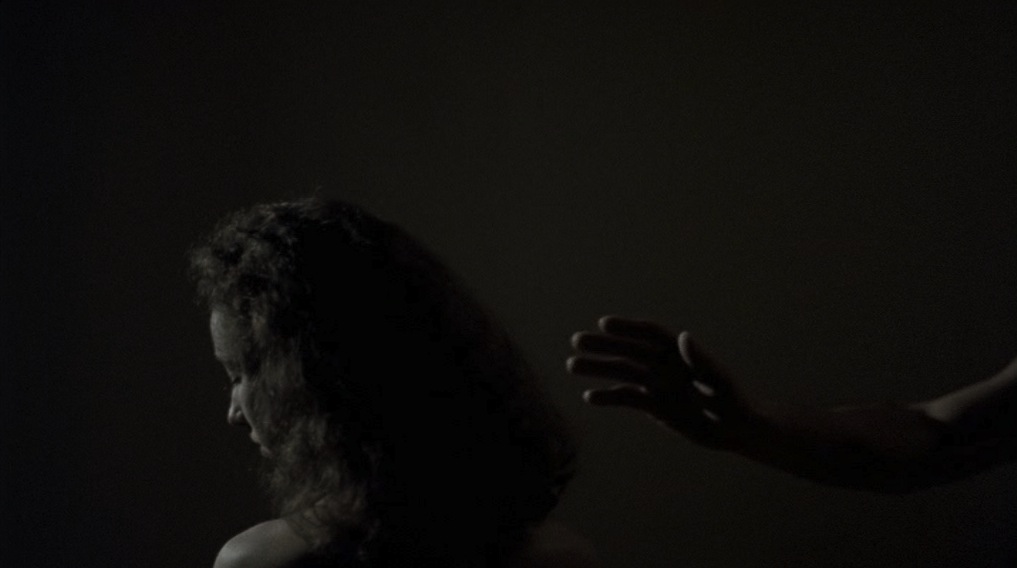
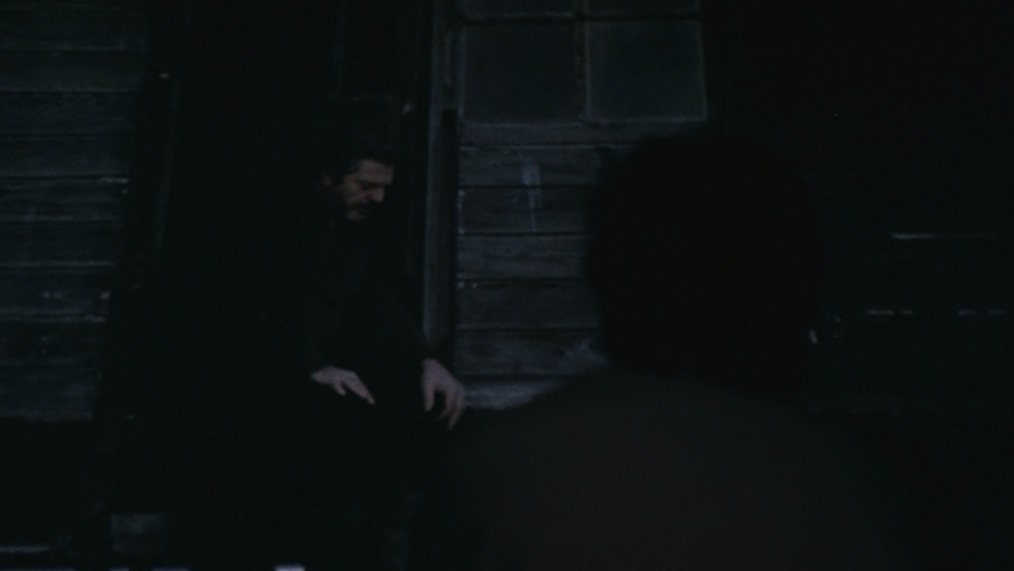
He recedes into shadow, able to touch her only as one might a rainbow.
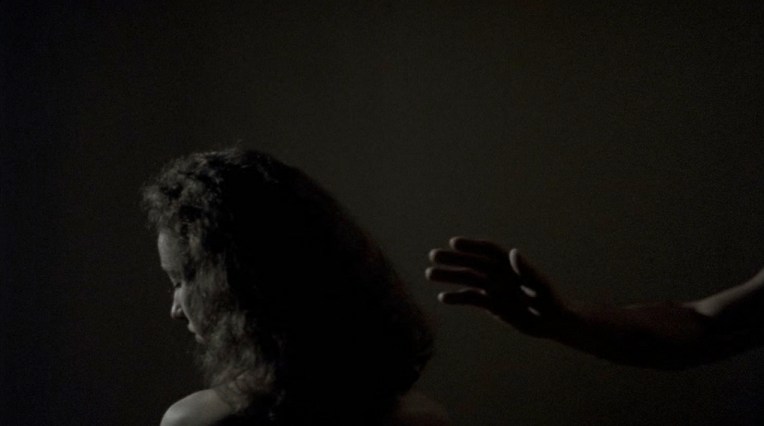
This moment locks his resolve to get to the heart of this place, even as he (and the viewer) knows that such thinking is wishful at best. For although he does track down the politician (who we learn is the girl’s father), what he finds is the shell of a man who no longer is. Gone is the savvy figure of the spotlight. In its place is a storyteller who regales children with end time speculations.
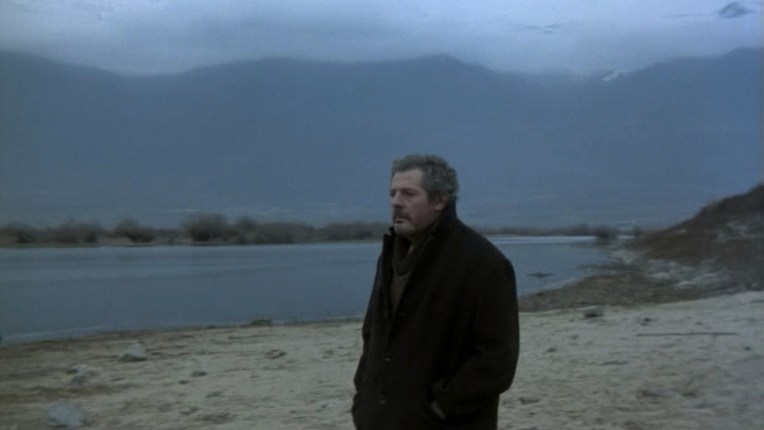

“Forget me in the sea…”

Rather than leave this man to his own devices, Alexandre further reveals his own selfish interests when he arranges, and films, a reunion. The woman claims it is not him, retreating into the fantasy that her husband is long dead. The power of her statement resides in its duality: she is lying, but also not.
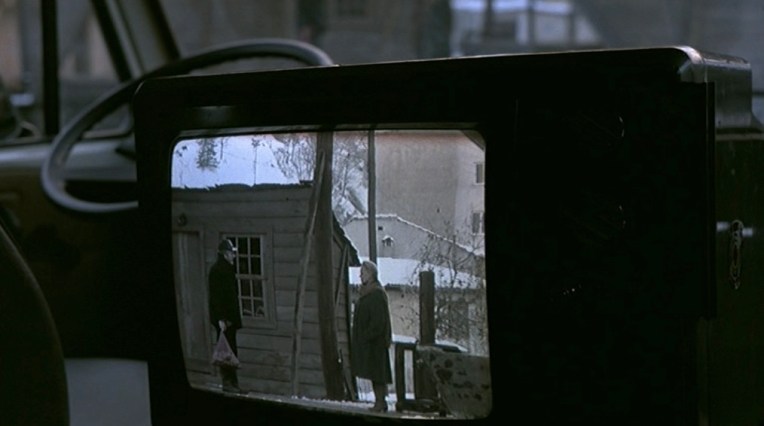
In the wake of this defeat, Alexandre suffers another when he discovers the girl of his refuge is to be married to a boy across the border. Only then does he admit to the Colonel, “The only thing I knew was to film other people without caring about their feelings.”
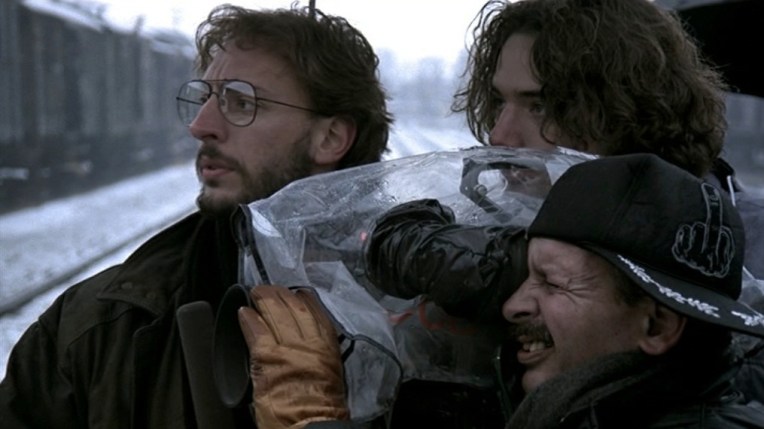
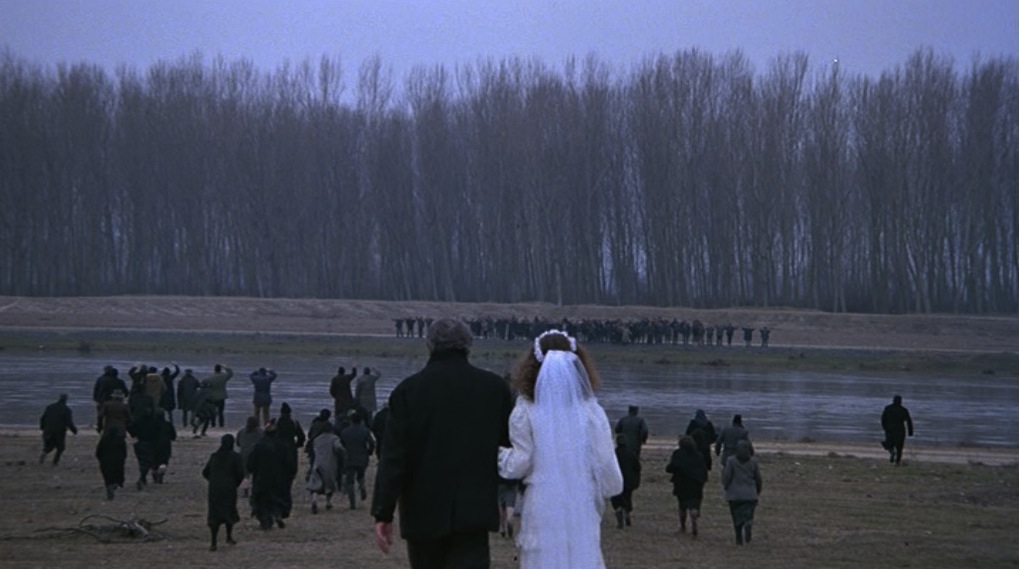
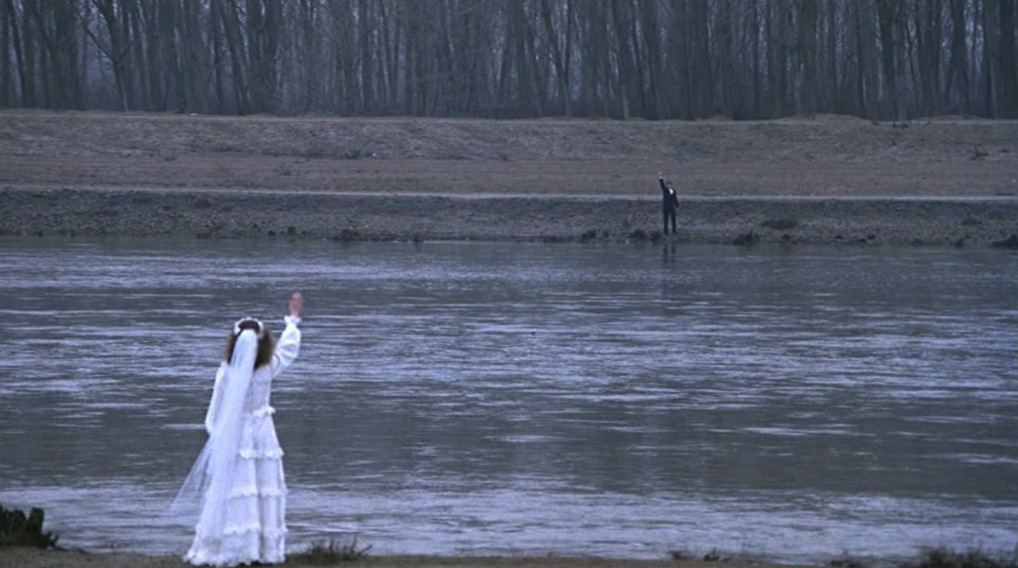
The ceremony must be conducted between patrols, even as that immutable river continues to roar and beckon between them.
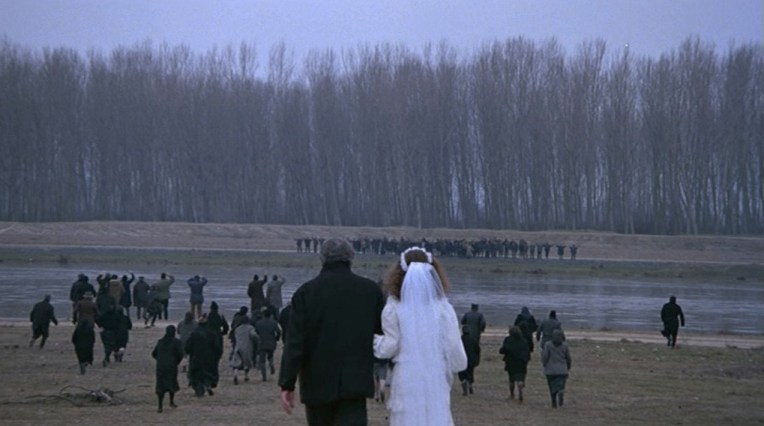
Still, even after Alexandre’s epiphany, it falls under the watchful eye of his camera.
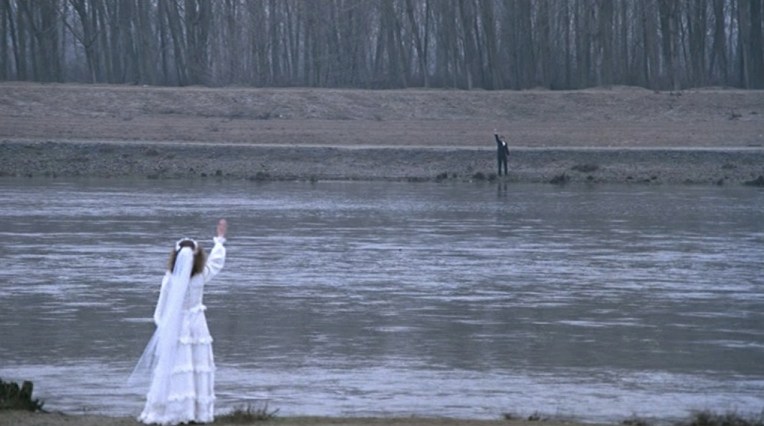

“We’re of the same race. I feel his hands holding me.”

It is obvious to us now, if not before, that he can never be anything more than a tourist, a refugee who can never step out of his skin. Before leaving, he pauses at the border, holding up his foot like the Colonel, a crane in contemplation.
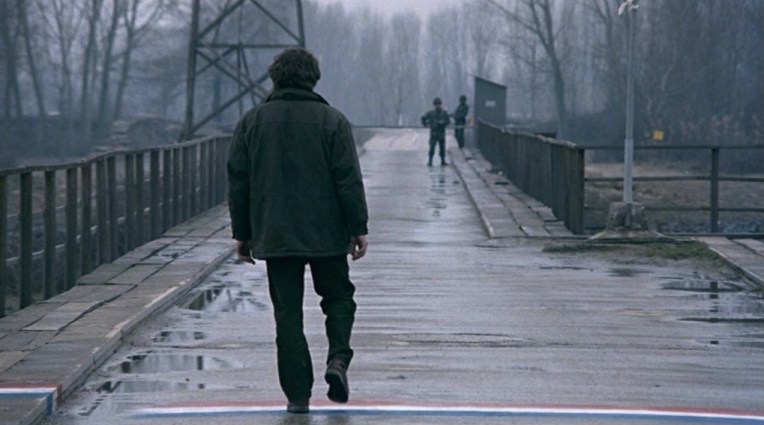
If the ceremony is the peak of the film’s narrative mountain, then these steps at the border are its sloping sides.
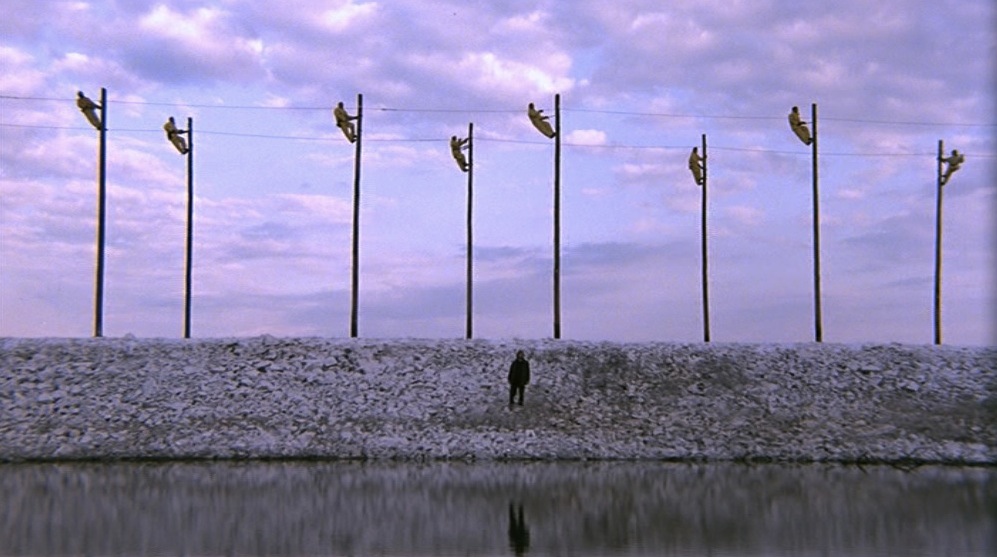
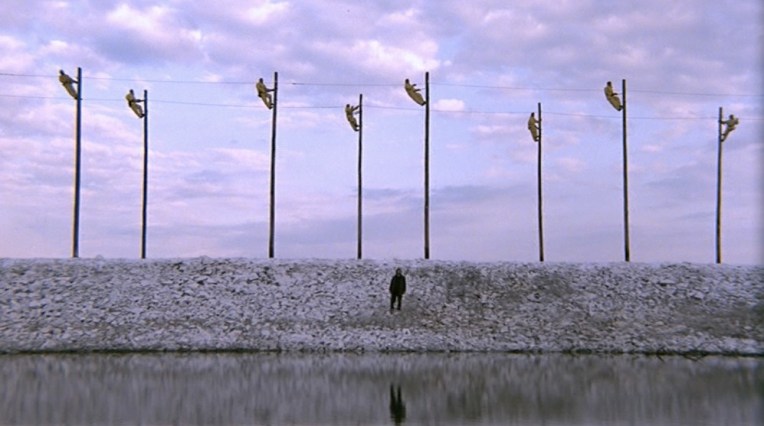
Heavy on Alexandre’s mind, we can be sure, is the news that the politician has again fled across the border, blending into the trees Angelopoulos paints so artfully in our vision throughout. And it is from those trees that the telephone poles that end the film are born, rising into the heavens, their wires able to connect nations in ways that no flesh, or even love, is capable.
Even with these powerful scenes pulsing through us, the sweeping carriage of Karaindrou’s soundtrack (the 36-minute running time of which betrays a ghostly presence) digs even deeper. An affect-rich creation, it solders the stained glass window that filters the film’s fettered light. From its heaving strings to forlorn winds, the music recedes into, as quickly as it awakens from, a wavering memory. One can almost feel in slow motion the searing cords of strife robbing necks of their breath, and minds of their faith, to the pathos of governmental indifference. And while moments of hope, such as the endearing accordion of “Waltz Of The Bride,” do appear, it is the slow pall of mist and water that Angelopoulos so favors that leave the boldest impressions in our ears.
The words the politician once spoke at a parliamentary session haunt us still: “There are times when one has to be silent in order to be able to hear the music behind the sound of the rain.”

How one leaves, then, has become an empty question. In the end, all that matters is how one sounds.

<< Hal Russell/NRG Ensemble: The Finnish/Swiss Tour (ECM 1455)
>> Anouar Brahem: Conte de L’incroyable Amour (ECM 1457)

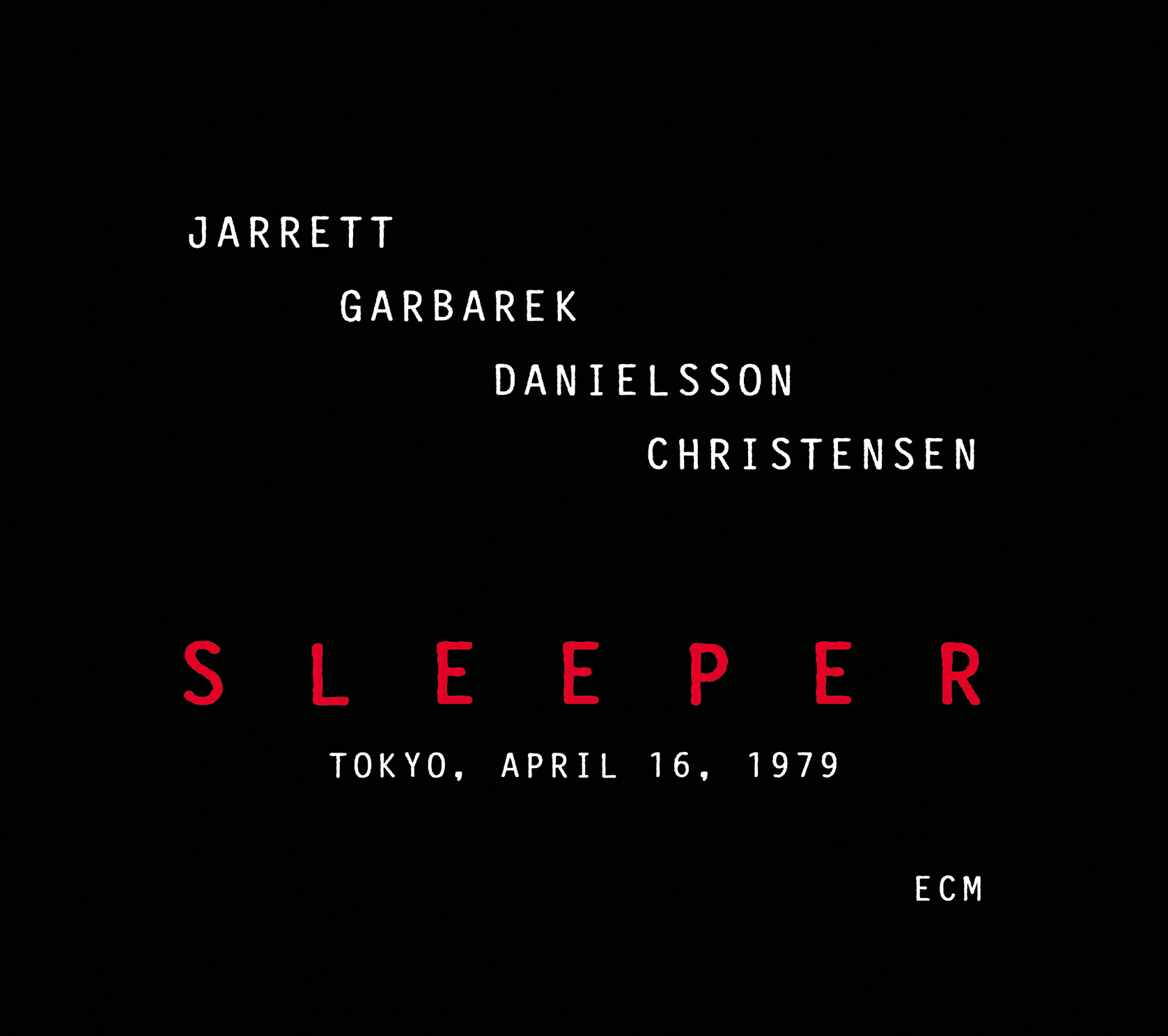
Keith Jarrett: Sleeper (ECM 2290/91)

Keith Jarrett
Sleeper

Keith Jarrett piano
Jan Garbarek tenor and soprano saxophones, flute, percussion
Palle Danielsson double-bass
Jon Christensen drums, percussion
Concert produced by AI Music (Toshinari Koinuma) in collaboration with Trio Records/ECM/Bose
Recorded live April 16, 1979 at Nakano Sun Plaza, Tokyo
Engineer: Jan Erik Kongshaug
Mixed 2012 at Rainbow Studio, Oslo by Jan Erik Kongshaug and Manfred Eicher
Produced by Manfred Eicher

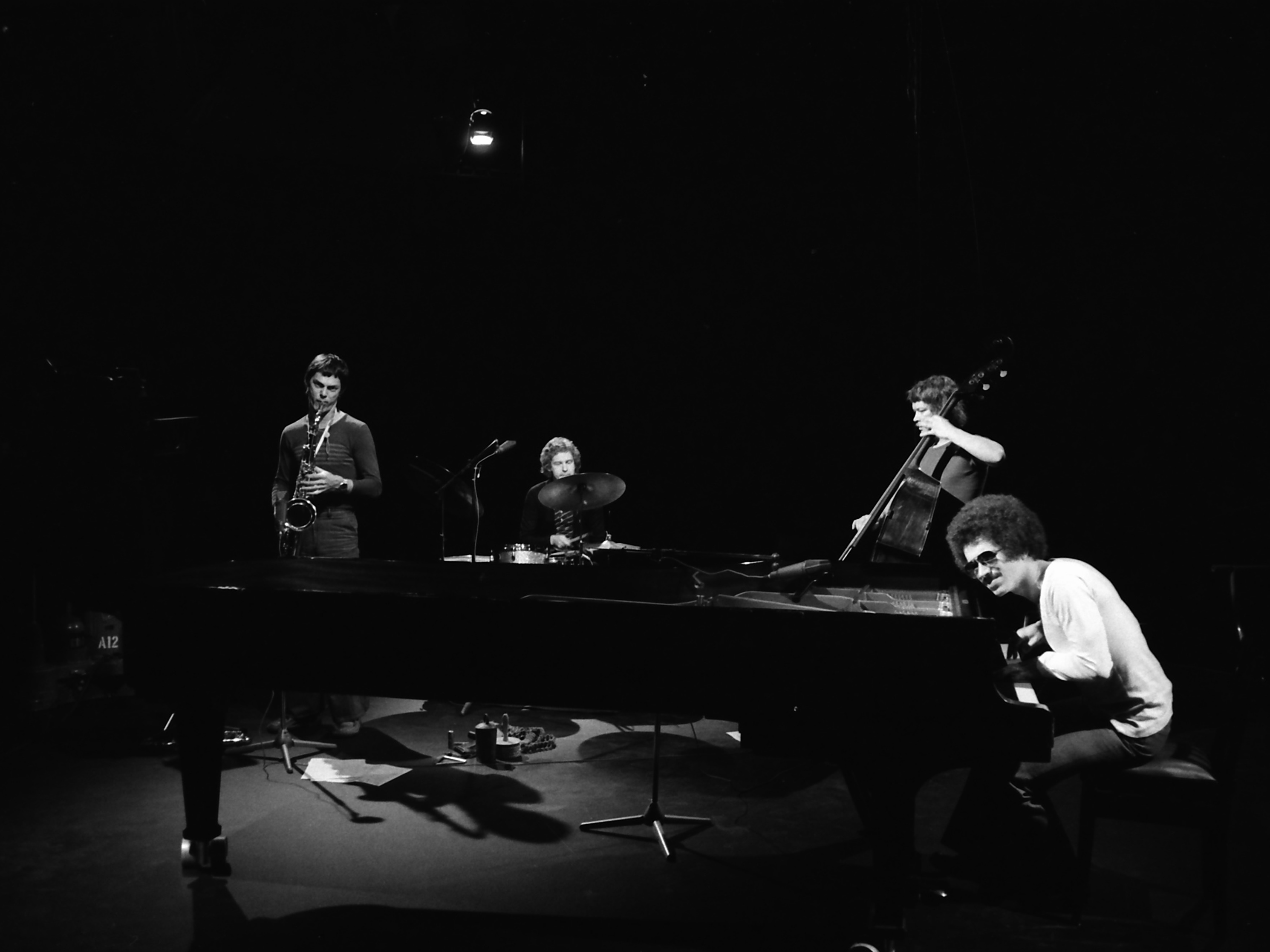
Keith Jarrett’s European quartet—with Scandinavian cohorts Jan Garbarek of the reeds, Palle Danielsson of the strings, and Jon Christensen of the sticks—was the missing link to his trio endeavors with Gary Peacock and Jack DeJohnette, finding a happy medium between the latter’s standards-based approach and his marathon improvised performances alone at the keyboard. The quartet boasted not only fine technique and dovetailed sense of timing, but also the fruit of its leader’s compositional labors during a period of career-defining development. Representing the pinnacle of five sporadic years, Sleeper documents a 1979 Tokyo show from the same tour that brought us Personal Mountains. That very tune kicks off this set of amethyst originals, Jarrett and Garbarek comprising the perfect hand-tooled leather for D&C’s riffling pages. Their Niagara pulse splashes this April canvas with blistering watercolor, Garbarek close behind as he leads us by the ear into “Innocence.” For this he adopts a folkish quality against support so synchronous, it’s as if it were responding to something as elemental as wind. And Jarrett likewise, as he pours on the syrup of “So Tender.” This unexpected travelogue proceeds at an inviting clip and features resplendent emoting from Jarrett, who manages to brighten even Christensen’s characteristic glitter. Garbarek both shouts and whispers, riding a wave so robust that every lick feels thematic while also trembling at the threshold of Jarrett’s spontaneous pulchritude. So do we proceed, funneling romance into an “Oasis” that can only be filled by a lifetime of love for music. The nearly half-hour take given here is reason enough to celebrate this record. From the opening Spirits-like incantations, infused with wooden flute and gamelan-like percussion, to the uplifting procession with which they end, Garbarek and Jarrett draw shades of gut-wrenching intensity. Despite its length, this track walks an intimate, ritualistic space. Majestic without being magisterial, it touches us like the energy that sustains it and flavors the waters of its namesake with the promise of restoration. “Chant Of The Soil” locks early and doesn’t let go. Bass and drums work like dolphins to keep us from drowning, enlivening Garbarek’s soulful phrasing with conviction, while “Prism” (another highlight from Personal Mountains) finds itself resurrected here in flowing dialogue before the invigorating circle of “New Dance” gives fresh meaning to the encore.

If ever it were possible for a recording to be even more alive than the day it was laid down, this is it—such is the value of its release. In addition to the symbiotic rhythm section, Garbarek naysayers may find themselves knocked on their rears by the exuberant, life-affirming themes issuing from his bell, each fitting snugly in Jarrett’s pianistic relief. A classic before it ever hit the shelves, Sleeper may just be the ECM event of the year and is, as its title implies, a dream to hear at long last.

Listen to samples here.


(Photo by Terje Mosnes)

Heiner Goebbels: SHADOW/Landscape With Argonauts (ECM 1480)

Heiner Goebbels
SHADOW/Landscape With Argonauts
with words by Edgar Allan Poe and Heiner Müller

Sussan Deyhim vocals
René Lussier guitar
Charles Hayward drums, tipan, hand-percussion
Christos Govetas clarinet, chumbush, gardon
Heiner Goebbels keyboards, programming, accordion
Recorded September/October 1990 at Outpost Studio, Stoughton, Massachusetts
Engineer: G. B. Hicks
Produced by Heiner Goebbels

In the annals of the written word, there are chambers of suffering and chambers of joy, but in the mind of Edgar Allan Poe those chambers were one and the same. It is this twisted contradiction that Heiner Goebbels wrings out from the sodden towels of the human body’s myriad expectorations in SHADOW/Landscape With Argonauts. Following the same concept as its German radio play counterpart (only this time in English), for which random people on the street were asked to read a text aloud for later studio manipulation, this fully realized project draws even deeper connections between public and private spheres of communication. Because people’s hesitations and misunderstandings remain lucid in the final mix, we can relate immediately to the balance of confrontation and collaboration that ensues. From these initial unscripted stirrings arises the brilliance of Iranian singer and performance artist Sussan Deyhim, whose voice is a periodic touchstone in the work. “Ye who read” is the first of a handful of exquisite songs, glinting like a metal pushpin holding up the tapestry at large. A backgrounded organ trades plectrum musings with fluttering recitations of Poe, treading a Jon Hassell-like carpet of swampy electronics. Sirens of emergency echo in the distance, accompanied by laughter. Public transportation carries us away into the field of indecision that plagues these expressions and the honesty of their disavowal. As impossible as water that burns, it trickles along the throats of fever dreams into vessels shaped like literature. Firecrackers give up themselves in ecstatic pops, marking a year of terror against the celestial auguries of the urban sprawl, each a line on a star map drawn in subway routes. Machines disgorge loose change, grasped by sweaty fingers and thrown into the pockets of the itinerant. Deyhim, ever our internal guide, resolves from a klezmer shadow in “Over some flasks” into messages of many histories. In this environment, happiness is suffocation. And as the sky goes hunting in search of dawn, a distorted hotline breathes its empty promises into the wind. “A dead weight” stencils that rich contralto onto an ululating ocean of ill measure. Acrid squeals echo with the incisiveness of a razor. “No arrival no parking” levels a mocking energy, self-absorbed and self-reflected, spawning the delicate propulsions of “And lo” in a relay of echo and night. A radio dial arches its back toward a faraway jazz session, only to drown in the light of a caravan moon. Shrouded in the smoke of faraway dreams, a clarinet bubbles over into the as-yet-unwritten page.

Fascinating to contemplate are the ways in which Goebbels’s subjects read themselves into the text, as if the sounds of words dictated the constitutions of their bodies, the comportments of their quotidian selves blended into the wing-beats of farewell birds. I can no longer read myself, the music seems to say, so I will let others read in place of me. Anything spoken at the whim of the predetermined will always be at a distance removed.

The rest is poetry.

<< Jens-Peter Ostendorf: String Quartet (ECM 1479 NS)
>> Keith Jarrett: Vienna Concert (ECM 1481)

Wadada Leo Smith: Kulture Jazz (ECM 1507)
Wadada Leo Smith
Kulture Jazz

Wadada Leo Smith trumpet, fluegelhorn, koto, mbira, harmonica, bamboo notch flute, percussion, vocal
Recorded October 1992, Hardstudios, Winterthur
Engineer: Martin Wieland
Produced by Steve Lake

To characterize Wadada Leo Smith as a genuinely musical soul would be a gross understatement. Having shunned the spotlight that might so easily have blinded him, he continues to draw thread after thread between the world’s many shadows and the sustaining fire within (if you haven’t heard his 4-hour magnum opus, Ten Freedom Summers, you don’t know what you’re missing). We have Manfred Eicher to thank for first bringing Smith to ECM among the company of Dwight Andrews, Bobby Naughton, Charlie Haden, Lester Bowie, and Kenny Wheeler on 1979’s Divine Love, and further Steve Lake for bringing the label’s touch a second time to this subtly profound solo meditation on the energies that make the world turn. Wrapped in the strains of “Don’t You Remember,” which depicts with mbira and voice a traveler’s view of atrocity and victory, we find ourselves swept in less than four minutes through a tide of earthen histories and cotton-scented tribulations. To express such depth with such minimal means speaks not only to the talents of Smith as a musician, but also to the inherent power of the individual to affect change at the galactic level. We feel this power in the visceral bite of his trumpet solos. The muted “Song Of Humanity (Kanto Pri Homaro),” to choose but one, speaks the language of those same celestial energies, climbing down ladders of starlight into the pitted chambers of our hearts, where the strains of a koto in “Mississippi Delta Sunrise (for Bobbie)” and “Seven Rings Of Light In The Hola Trinity” intimately skirt the edge of a bandwagon’s trail, popping heritage like candy. “Fire-Sticks, Chrysanthemums And Moonlight (for Harumi)” is the album’s central ceremony (one, if the reader will allow a comparison, in the vein of Keith Jarrett’s Spirits). It haunts coves turned red by ancestral blood, into which Smith dips a fluted brush. He spreads his aural calligraphy in the fire of dawn and begins to fashion from it a love letter to those who have given him courage and life: through the celebratory braid of trumpeted strands in “Louis Armstrong Counter-Pointing,” the forested song of “The Healer’s Voyage On The Sacred River (for Ayl Kwel Armah),” and the porous dronescape that is “The Kemet Omega Reigns (for Billie Holiday),” we come to know the spirit of a friend, lover, and acolyte. And in the unitary transmissions of “Love Supreme (for John Coltrane)” and “Uprising (for Jessie and Yvonne)” Smith shields an essential and unwavering flame.

Kulture Jazz is a body of dedication with two extroversions for every intro. Unafraid to marvel at the rawness of creation, Smith plays as one might write in a diary or sketch on newsprint, sanding the figurines of his past into a rounded family of novel ideas. An album of such sparseness may not appeal to everyone, but with such indelible spiritual truth suffused into every moment, how can we keep ourselves from adding our adoration to its melodious font?

Truth, crushed to the earth, shall rise again.

<< Kim Kashkashian: Lachrymae (ECM 1506 NS)
>> György Kurtág: Hommage à R.Sch. (ECM 1508 NS)

Garbarek/Brahem/Hussain: Madar (ECM 1515)

Madar

Jan Garbarek tenor and soprano saxophones
Anouar Brahem oud
Ustad Shaukat Hussain tabla
Recorded August 1992 at Rainbow Studio, Oslo
Engineer: Jan Erik Kongshaug
Produced by Manfred Eicher

Following in the footsteps of Ragas and Sagas, which found Jan Garbarek in the seemingly unlikely company of Ustad Fateh Ali Khan to uplifting effect, the Norwegian saxophonist continued to expand his horizons with Tunisian oud virtuoso Anouar Brahem and tablaist Ustad Shaukat Hussain on Madar. The three bond naturally in the lengthy “Sull lull,” a nearly 17-minute prayer of keen and sensible interaction for which Hussain brings constant airflow and foils Garbarek’s chameleonic talents superbly. It is one of two tracks based on folk melodies of Garbarek’s native land. The other is the saxophone/oud duet “Joron.” Madar serves in this vein as an internal conversation between the two instruments, their sounds speaking to one another like rocks from a river’s touch. Together they become a pair of hands etching stories into a stretch of hide, twisting incantations until they bleed light (“Sebika”) and dark (“Ramy”). As they continue to circle overhead, surveying a landscape of withering sin, they bring out something unknown in one another.

Despite the loveliness of these interactions, the album works best in solitary. Brahem’s contemplative solo, “Bahia,” treks over twilit mountains with aching footsteps, carrying us as if by palanquin into a vale of lost intentions. The wind of his percussiveness shakes the boughs of leafless trees and sends their dead seeds clicking to the ground like sand against a window. And in the rhythmic cast of “Jaw,” Hussain emotes lifetimes in a single beat of his tabla, thus offering some intensely lucid moments. He returns to the fold in “Qaws,” giving voice to those waiting eyes at last with solid excitement. An odd piano “Epilogue” (sounding like a chord outline for a studio track left behind) leads us out.

A word to the wise: Garbarek reaches some of his most piquant levels ever here, so intense that you may find yourself needing to lower the volume at peak moments. This may antagonize some, but in the end couldn’t we all do with a little awakening?

<< Bach: The French Suites (ECM 1513/14 NS)
>> Bobo Stenson Trio: Reflections (ECM 1516)

Egberto Gismonti Group: Música de Sobrevivência (ECM 1509)

Egberto Gismonti Group
Música de Sobrevivência

Egberto Gismonti piano, guitar, flute
Nando Carneiro synthesizers, guitar, caxixi
Zeca Assumpção bass, rainwood
Jacques Morelenbaum cello, bottle
Recorded April 1993 at Rainbow Studio, Oslo
Engineer: Jan Erik Kongshaug
Produced by Manfred Eicher

One can always look forward to a fresh experience with every Egberto Gismonti encounter. This promise is deeply fulfilled on Música de Sobrevivência (Music of Survival), which designates the title of his group’s sophomore ECM outing as much as it does the genre under which it creates. The opening arpeggios of “Carmem” earn our trust at once with a timeworn and familiar comfort. The pebbles of Gismonti’s plunking notes sink into nostalgic waters, pulled by arco threads into the hands of light that loosed them. “Bianca” picks at those same threads, frayed like the edge of a carpet in a childhood home through which pass only the ghosts of revolt. Such backward glances are ever-present in Gismonti’s world, whether they are charting the skyward paths of “Lundú #2” or dancing with joy in “Alegrinho #2.” His fingers flutter across piano keys as adeptly as they walk a fingerboard, escorting the group’s cultured sound through a gallery of moods. Children’s feet map the gray streets of “Forró,” cracked yet held in shape like the shells of hardboiled eggs, and continue to run through “Natura, festa do interior,” a 33.5-minute masterpiece of eroded landscapes. With a sweep as cinematic as it is prosaic, it inscribes a scroll’s worth of love for all things just and familial.

The group members blend like a metal alloy, each a shade of bark in the same forest, with cellist Jacques Morelenbaum adding notable fire to Gismonti’s cool motives. The result is a sonic scrapbook of travels and shades of innocence guaranteed to enrich your listening life.

<< György Kurtág: Hommage à R.Sch. (ECM 1508 NS)
>> Giya Kancheli: Abii ne Viderem (ECM 1510 NS)

Stephan Micus: Athos (ECM 1551)

Stephan Micus
Athos: A Journey To The Holy Mountain

Stephan Micus Bavarian zither, sattar, shakuhachi, suling, ney, flowerpots, voice
Recorded November 1993–February 1994 at MCM Studios

If true meditation is not a centering but a shedding of the self into a plane where the ego no longer speaks under the illusion of a proper name, then Stephan Micus has walked some of the most meditative paths on disc. Inspired by a visit to the holy Greek mountain of Athos, his album of the same name bears traces of just such a traveler, one whose artistry sees medium and message as one. Those looking for anything close to the Byzantine chant that surely nourished his ears during this pilgrimage may feel disappointed. Then again, the Micus experience has never been about total re-creation, but rather about the ways in which the lens of his soul refracts all it comes in contact with during its itinerancy.

Athos takes a diurnal structure, with days marked by flutes of varying origins and nights woven in 22-part choruses, all sung by a multi-tracked Micus. The latter serve as touchstones in the fullness of his narrative, which takes its histrionic steps in voices mineral, unaffected, spun from the wood, clay, and strings of another time and place. In these drones is where the true indeterminacy of life takes shape, shifting from circle to ellipse and back again like a full moon stared at for too long. “The First Day,” a shakuhachi solo, rests on a sibilant edge and awakens like an animal from winter slumber, even as it cranes its neck, heron-like, back toward memory, now hazed by the passage of the seasons. “The Second Day” hangs a suling (Indonesian bamboo flute) above a garden of flowerpots. And in “The Third Day” Micus offers a ney solo, wavering like a reflection across molten rock and shaped by the lips of a divine glassblower who fashions from it a teardrop in the cosmos, forever crystalline and unshattered. Such music turns the sun inside out and shows us that its heart is nothing but shadow, for otherwise it would never know the generative power of fire.

This cosmic passage is bookended by a prologue and epilogue. “On The Way” pairs cascades of Bavarian zither with the tinny laments of sattar (long-necked bowed instrument of the Uyghur people). In its depths we weep at the fallacy of what we have created, but know that within the distorted memories of those tears lies something far more meaningful: constant change. This and more we hear in these moments, in the total dedication that engenders them. “On The Way Back” pulls those evening voices from the clothing of their afterlife, vibrating like a reed in the core of something devoid of song.

Athos is the diary of a sacred space whose pages are born in the siren that calls everyone into the stillness of eternity. It tugs your heart until it merges with Micus’s own, so attuned is his playing to the spirit of all that moves us to listen. He reaches through the veil of distance holding a broken watch, asking us to breathe time back into its silent circle.

<< hr-Jazzensemble: Atmospheric Conditions Permitting (ECM 1549/50)
>> Heiner Goebbels: Ou bien le débarquement désastreux (ECM 1552)

Louis Sclavis/Dominique Pifarély: Acoustic Quartet (ECM 1526)

Louis Sclavis
Dominique Pifarély
Acoustic Quartet

Louis Sclavis clarinet, bass clarinet
Dominique Pifarély violin
Marc Ducret 6- and 12-string guitars
Bruno Chevillon double-bass
Recorded September 1993 at Rainbow Studio, Oslo
Engineer: Jan Erik Kongshaug
Produced by Manfred Eicher

After debuting with his quintet on Rouge, reedist Louis Sclavis returned to ECM with French jazz violin phenom Dominique Pifarély to front this trend-setting session. Joined by guitarist Marc Ducret and bassist Bruno Chevillon, the so-called Acoustic Quartet snaps right into action with “Sensible,” the first of four pieces by Sclavis. It is, like every track that follows, an astute blend of composed and improvisatory elements that pairs instruments cleverly and with panache. Pifarély and Chevillon work particularly well together here, and Ducret’s jangly asides make a nice match for Sclavis’s clarinet. Ducret provides notable glue in “Elke,” in which bass harmonics cut through the darkness like a whale song, and elicits some oud-like tones in the playful “Rhinoceros.”

Pifarély delights with a handful of his own compositions. Of these, the guitar-propelled romp of “Abrupto” speaks loudest. The violinist strings a Christmas tree’s worth of ornaments across its conical surface, practically toppling it into the cutting lead of “Hop!” where he lays out the album’s most astonishing solo against a crunchy bass. Not to be outdone, Sclavis dots his every i and lends brilliant inflection to a substantial monologue in “Seconde.” The group also shines in its cinematic rendition of Alain Gibert’s “Bafouée.” Its nods range from Django Reinhardt to klezmer, each stretched and refracted behind a veil of sparkling melancholy.

Pifarély boggles the mind with his rhythm and slide in a group overflowing with virtuosity. Yet it is Sclavis who seems most comfortable in his skin, weaving in and out of narrow spaces with the grace of an eel. The composed material, while on the surface pedantic, provides a frame to see the fullness of every picture. The resulting Sturm und Drang atmosphere when the musicians discard prewritten material in favor of all-out storytelling makes for some intriguing music-making. All in all, a real gem.

<< Jan Garbarek/The Hilliard Ensemble: Officium (ECM 1525 NS)
>> Steve Tibbetts: The Fall Of Us All (ECM 1527)

Ketil Bjørnstad: Water Stories (ECM 1503)

Ketil Bjørnstad
Water Stories

Ketil Bjørnstad piano
Terje Rypdal guitar
Bjørn Kjellemyr bass
Jon Christensen drums
Per Hillestad drums
Recorded January 1993 at Rainbow Studio, Oslo
Engineer: Jan Erik Kongshaug
Produced by Manfred Eicher

Ketil Bjørnstad made a splash, if you will, with this, his first of many collaborative projects for ECM. Water Stories puts the Norwegian pianist, composer, and novelist in fine and familiar company, sharing the studio with guitarist Terje Rypdal, drummers Jon Christensen and Per Hillestad, and bassist Bjørn Kjellemyr. Though billed as a jazz album, Water Stories is folk music for the ocean floor. Bjørnstad swishes through his motives with the surrender of a sliver of driftwood on the waves, bowing to his band mates in unobtrusive postures. With the first stirrings of “Glacial Reconstruction,” he thus sets a career-defining formula. Christensen’s unmistakable cymbals brighten in the album’s opener as if from the dark phase of a solar eclipse, stirring where only there was stillness and awe. Christensen again sets the mood in “Levels And Degrees,” now with toms, moving from the sparkle of wave-tips to rumblings from the deep as Bjørnstad and Rypdal paint swaths of marine life in dripping color. From this hails the piano ostinato of “Surface Movements” amid glints and plunks of bass. This bubbling evocation of the album’s namesake is a softly beating heart shrouded in time. “The View I” and “The View II” are astonishingly beautiful, featuring some of Rypdal’s tenderest playing on record. Melting the piano’s subtle undertows, it presages the beauties of The Sea, even as it tears a page from the book of the sky with a solo of pastel fire. Worth the album alone. “Between Memory And Presentiment” indeed rests its head on a liminal pillow, dreaming even as its casts its nets back to a childhood marked by Kjellemyr’s thoughtful solo. Bjørnstad cuts the light in “Ten Thousand Years Later,” in which Rypdal springs an electric flower from the bass’s hollow stem. The brief “Waterfall” and “Riverscape” provide the most programmatic moments of the set, crashing and flowing on their respective paths toward eddying afterlife. “Flotation And Surroundings” is another slice of bleeding pictures, leaving only the synergistic “Approaching The Sea” and the aptly titled “History,” thereby ending another defining label session of the nineties.

<< John Abercrombie: November (ECM 1502)
>> The Hilliard Ensemble: Codex Speciálník (ECM 1504 NS)