Berlin Contemporary Jazz Orchestra: s/t (ECM 1409)

ECM 1409Berlin Contemporary Jazz Orchestra

Benny Bailey trumpet
Thomas Heberer trumpet
Henry Lowther trumpet
Kenny Wheeler trumpet, fluegelhorn
Paul van Kemenade alto saxophone
Felix Wahnschaffe alto saxophone
Gerd Dudek soprano and tenor saxophones, clarinet, flute
Walter Gauchel tenor saxophone
E. L. Petrowsky baritone saxophone
Willem Breuker baritone saxophone, bass clarinet
Henning Berg trombone
Hermann Breuer trombone
Hubert Katzenbeier trombone
Utz Zimmermann bass trombone
Aki Takase piano
Günter Lenz bass
Ed Thigpen drums
Misha Mengelberg piano
Alexander von Schlippenbach conductor
Recorded May 1989 at Studio 10, RIAS Berlin
Engineer: Sören Pehrs
Produced by RIAS Berlin and ECM

The Berlin Contemporary Jazz Orchestra was begun in 1988 as the brainchild of Alexander von Schlippenbach. A decorated composer and student of B. A. Zimmermann, Schlippenbach is perhaps best known as the founder of the Globe Unity Orchestra, which spurred the 1960s jazz scene into the first of many influential phases. This self-titled album is the BCJO’s group’s debut, recorded when the outfit was all of a year old, and features a stunning array of musicians, including trumpeter Kenny Wheeler, reed man and flutist Gerd Dudek, baritone saxophonist E. L. Petrowsky, bass clarinetist Willem Breuker, and pianist Misha Mengelberg.
The set is a triptych of moods and configurations, of which the first, Ana, comes to us from the mind of Kenny Wheeler. From the somber piano intro, one might think a Keith Jarrett solo concert was in store. This illusion is quickly banished by the wealth of instrumental forces at hand. With horns taking the upper range and arco bass the lower, drums ride the outer circle while a hefty trombone strings along some rounded hits from the band. Between the deftly woven brass tapestry and beautiful solo turn from pianist (and wife of Schlippenbach) Aki Takase, Wheeler dominates the solo-sphere —that is, until Petrowsky’s tenor throws some much-needed fuel into the fire. This slides into an upbeat bridge before ending on a free-for-all and a sparkling piano flourish.

The album’s remainder was penned by Misha Mengelberg, whose keys can be found poking their thoughts here and there. The conventional horn intro of Salz wipes the blackboard clean for the frantic bass clarinet lessons of Willem Breuker—who, along with Petrowsky, is one of the group’s shining stars—and the composer’s own frolicking pianism. Another of the album’s best solos resides herein, this time from the tenor of Dudek, who also threads in a few lines of flute.

The lightly syncopated vertigo that welcomes us into Reef und Kneebus promises the album’s best engagements, but instead turns into an over-long meander between a few stellar points. Wheeler, though, is as engaging as always, and the swing comes back into the picture toward the end. This final piece plays more like a series of unrelated vignettes and feels a touch out of place.

This is a full recording, one that accentuates the breezy rhythm section and keeps the brass well separated. The band blows free and easy and tries its best to keep us out of the compositional rut with some freer gesticulations. A respectable outing that could have stood to be spun blindfolded a few times and loosed unaided, but which nevertheless balances its conscious progressions well.

<< Sidsel Endresen: So I Write (ECM 1408)
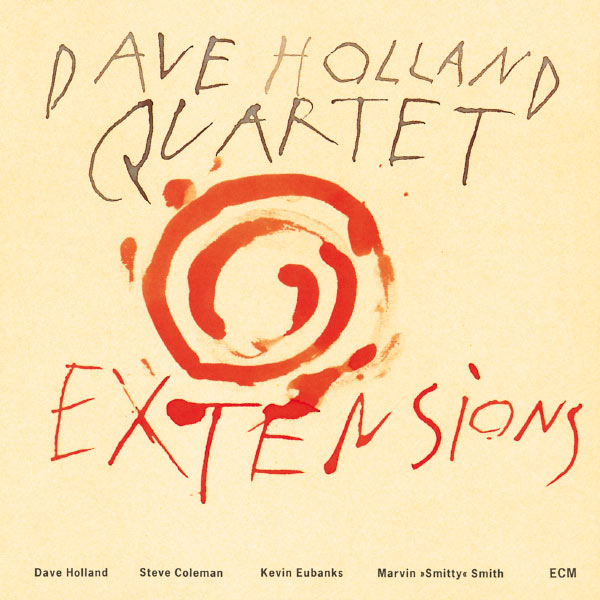
>> Dave Holland Quartet: Extensions (ECM 1410)

Sidsel Endresen: So I Write (ECM 1408)

Sidsel Endresen
So I Write

Sidsel Endresen vocal
Nils Petter Molvær trumpet, fluegelhorn, percussion
Django Bates piano
Jon Christensen percussion
Recorded June 1990 at Rainbow Studio, Oslo
Engineer: Jan Erik Kongshaug
Produced by Manfred Eicher

Sidsel Endresen’s So I Write was the first ECM jazz vocal album I ever bought. While that in and of itself would have been enough to make it special, the music housed within its windswept sleeve made it unquantifiably more so. Just holding it in my hand above the used CD bin from which I’d fished it, I could already feel its shaded vistas spreading through me.

The title track is also the album’s first, and one could hardly dream of a more affecting introduction to this Norwegian chanteuse’s inner life. It is a sound-world in which the word is its own creator, one that utters itself into being in the floating pall of its residual meanings. Accompanied by the staggering palette of drummer Jon Christensen and the punctilious spirals of pianist Django Bates, Endresen travels far and wide along extemporaneous landscapes. “This Is The Movie” bolds and underlines the cinematic qualities of her breathy poetry, flitting through stills like sadness through transient life and tenderly exploring the complementary nature of love. In “Dreamland” she exchanges light for dark, turning a lullaby into a personal mantra in the process. The ever-lyrical horns of Nils Petter Molvær, who comments on every stirring from a respectful distance, bleed into “Words,” which spins from his plaintive salutation a letter of unbridled subtlety. Here we find ourselves embraced by the dangers of dreams and the depths of their promises. This leads us to explore in “Mirror Images” the boundaries of the image as the boundaries between flesh and self.

The mood takes a noticeable turn in the more abstract “Spring,” which separates its eponymous season as if it were a theater curtain, throwing the spotlight of an empty house on to a character whose life moves an idea of retribution through chaos. “Truth” carries this idea further into a purely rhythmic language before the human voice lays its biases on the water’s surface and casts the thrills of illusion into the emotional deep end, where we are met by “Horses In Rain.” Endresen fashions from this image a babbling where metaphor speaks for all, and where Bates’s thematic reflections close the door on this enigmatic date as would a mother exit her child’s room once the bedtime story has worked its magic.

So I Write is a musical gem and the perfect companion to any Norma Winstone album on your shelf. If these are only half the stories told, then we can take great comfort in writing our own remainder.

<< Shankar: Pancha Nadai Pallavi (ECM 1407)
>> Berlin Contemporary Jazz Orchestra: s/t (ECM 1409)

Shankar: Pancha Nadai Pallavi (ECM 1407)

Shankar
Pancha Nadai Pallavi

Shankar double violin, vocals
Zakir Hussain tabla
Vikku Vinayakram ghatam
Caroline talam, sruthi
Recorded July 1989 at Rainbow Studio, Oslo
Engineer: Jan Erik Kongshaug
Produced by Manfred Eicher

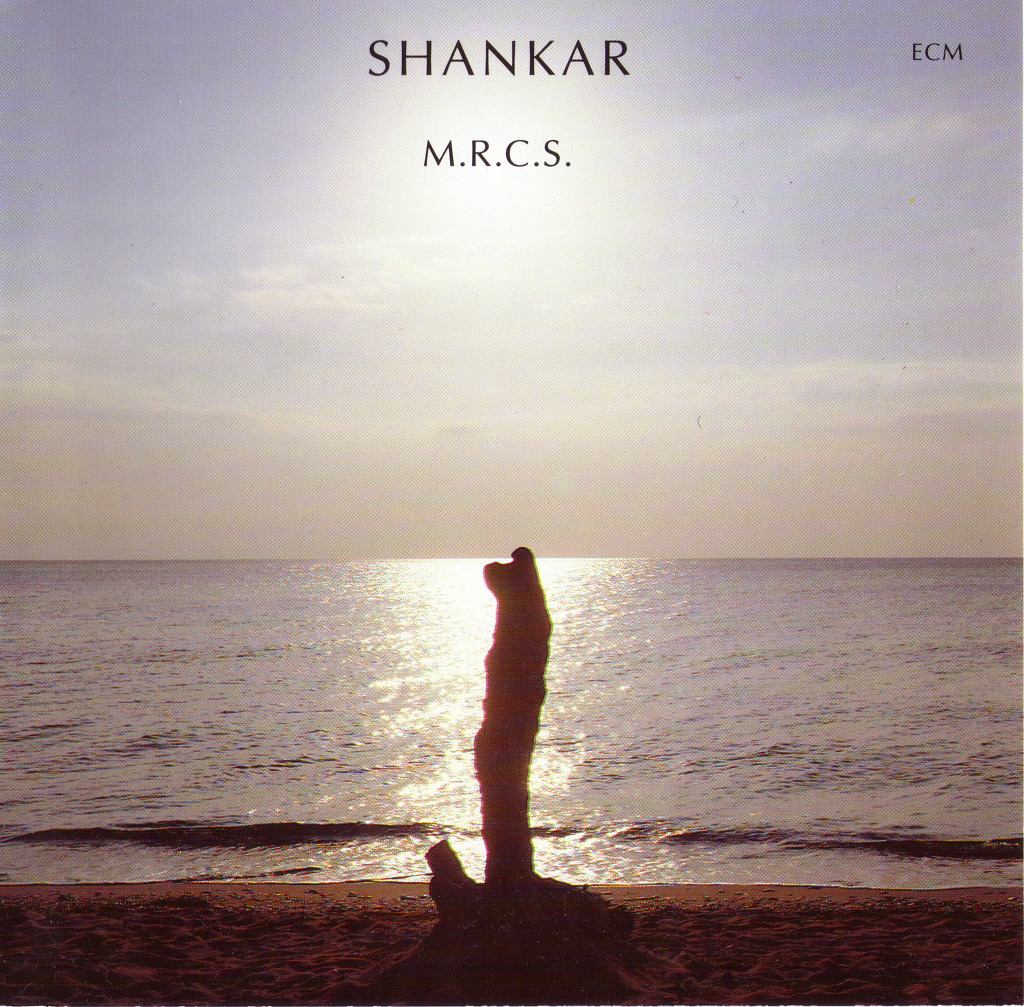
Shankar’s last album for ECM may just be his finest. Pancha Nadai Pallavi shows the violinist at his creative peak and weaves an unforgettable atmosphere. From the solemn cover photograph to the flawless production, it is a perfect package and a fitting label swan song for an association stretching full circle back to the comparable masterpiece that is 1981’s Who’s To Know.

Shankar’s playing, however you look at it, is a language of the utmost depth and beauty. His voice is smoky, arising from those strings like an echo of the inner spirit that animates his craft. This traditional raga features three cycles, the first two of which—the Ragam and the Tanam—foreground the improvisational skills of the soloist, while the concluding Pallavi emphasizes the rhythmic contributions of the percussionists in dialogue. Although Carnatic purists may be put off by Shankar’s modern touches, the music soars in ways that far outsoar its criticism.

Shankar’s sound is a constant balance of skyward uplift and subterranean excavation. From the thrums and strums of his 10-string violin’s lowest utterances to his harmonic-peaked runs, he scales full ladders of octaves in but single exhalations of his creative breath. And although the violin parts are multi-tracked, they shine like facets of the same crystal. His lines hold on to a core tone. No matter how far they waver from it, they are like rivers that both flow out from and back to their sources. In the process they provide a rhythmic drive in the absence of the percussion waiting in the wings—such that once the voices of Zakir Hussain and Vikku Vinayakram do make themselves known, it feels as if they’ve always been there, moving but never audible until now. The dynamics of this expansion alone are enough to dazzle, but with Shankar’s burrowing melodies their effects become inescapable. Moving from passages of blinding speed to lyrical laments at a mere stroke, they glow in a spectrum of colors. On that note, we must not neglect Shankar ally Caroline Morgan, whose drones and timekeeping unfold their inner depths in those brief moments of rest. Her humility rings like the voice of the firmament, stilling us in anticipation of the flights to come and baying into the beautiful call and response that leaves us spellbound at the raga’s finish.

Pancha is, along with the aforementioned Who’s To Know, by far Shankar’s best work on record. It is also an album that most cleanly showcases the capabilities of his custom instrument. One feels its lows in the rib cage, its highs in the farthest reaches of our minds. Through it Shankar sustains a purity of tone, a moral and spiritual center around which he swings the caduceus of his melodies with eyes closed and arms open. He looks into the stars and sees the strings between them not as constellations but as musical notations. And in these he paints the picture of a god-given gift that has left an indelible mark of greatness.

<< Karlheinz Stockhausen: MICHAELs REISE (ECM 1406 NS)
>> Sidsel Endresen: So I Write (ECM 1408)

Aparis: s/t (ECM 1404)

Aparis

Markus Stockhausen trumpets, fluegelhorn
Simon Stockhausen synthesizers, saxophone
Jo Thönes acoustic and electronic drums
Recorded August 1989 at Rainbow Studio, Oslo
Engineer: Jan Erik Kongshaug
Produced by Manfred Eicher

The time has come that you shall remember who you are.
Forever have you been and shall eternally be.
You have come to feel the joy of creation,
to see its beauty and infinitely love all there is.
For all is thyself.
Each moment you create yourself and a thousand worlds around.
Your being is bliss, perfection, and light.
Rejoice, my friend, rejoice!

Aparis was an ephemeral band comprised of trumpeter Markus Stockhausen, his brother Simon (a sound artist and composer), and percussionist Jo Thönes. Although Markus does, of course, bring his characteristic sweep to nearly every stretch he plays, it is Simon whose contributions shine brightest in this atmospheric set of six. In them one may locate a range of influences, spanning the ECM spectrum from Pat Metheny (“Rejoice”) and Terje Rypdal (“Aparis”) to Oregon (“Carnaval”) and a smattering of Jon Hassell here and there for good measure. That being said, the results are fresh and original and bob with a decidedly aquatic sense of temporal space.

The nearly 17-minute title track is by far the most effective. It begins in a cavern of icicles amid looming shadows as Markus’s lone voice oozes from the stone like an afterlife. With the addition of bass and drum lines, steady yet ever ambient, that trumpet jumps through even airier hoops in flanged clothing. A sequencer resolves from the mists, soprano sax in tow. As if to confirm Rypdal’s possible involvement, a synth electric guitar rises toward the end. Next is “Poseidon,” which after an opening state of frenetic group activity launches into a synth-driven ride, a preamble to the expansive territories painted by Markus in the colors of night. “Rejoice” links back to the album’s opening strains, discovering along its winding roads that the journey is already the destination. Distorted recitations over a bed of sonic nails curl themselves into a protective ball and roll into the sun with all the surety of a dreamer awakened, leaving “Peach” to cry with lyrical finality, careening across the horizon with a focused song and impressions of a clear day.

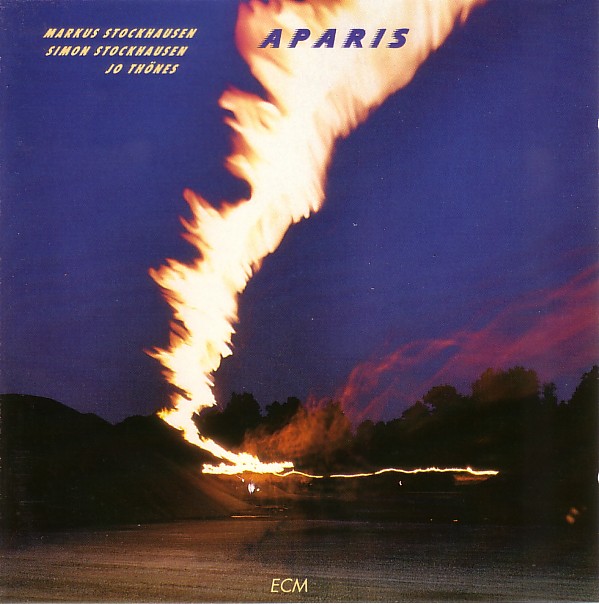
Aparis is not without its missteps (the synth-heaviness of “High Ride,” for example, detracts from its punch), but overall its impressions seeps through you smoothly and at the speed of life. Like the flames on the album’s cover, they bleed from a scar in the air, hanging souls like ethereal laundry. Together, they are a marriage of creationism and evolution in sound.

<< Shankar: M.R.C.S. (ECM 1403)
>> ECM New Series Anthology (ECM 1405 NS)

John Surman: Adventure Playground (ECM 1463)

John Surman
Adventure Playground

John Surman baritone and soprano saxophones, bass clarinet
Paul Bley piano
Gary Peacock bass
Tony Oxley drums
Recorded September 1991 at Rainbow Studio, Oslo
Engineer: Jan Erik Kongshaug
Produced by Manfred Eicher

John Surman’s Adventure Playground is an appendix to Paul Bley’s previous quartet efforts, only now we find them in the company of bassist Gary Peacock and drummer Tony Oxley. And while the session does drip with the same brooding viscosity one would come to expect, the added colors of Oxley enhance the music’s inner states with endless novelty. Take, for instance, the anthemic frenzy he builds in his sole compositional contribution, “Just For Now,” by which he holds smelling salts under the nose of the listener’s attention. And again in Surman’s “Quadraphonic Question,” a lumbering yet somehow airy thing to which the rules of interpretation can only bow in appreciation of their own dismantling, his talents are especially brilliant, describing a host of people and places in bursts of expansive inquiries while managing to give those delicate soprano lines all the room they need to weep.

Not to be outdone, Surman rustles up a fine set of tunes from his own wellspring. Between the utterly gorgeous strains of “As If We Knew” and the nocturnal visions of “Twisted Roots” there is plenty to return to for future listening, while the baritone of “Duet For One” wanders up a long and teetering ladder until it can see above the clouds and, with a hand over the eyes, pinpoint a new destination on the horizon.

The unfathomable smoothness of that baritone is also a defining voice in “Figfoot,” the first of three tunes from Bley, who casts his own two cents with Oxley into an off-kilter bass line. Its rhythmic way thus shown, the music seems regard us with slogging humor. This is a dark swing of a piece with a characteristic tarnish, weathered like the patina of a familiar instrument. Bley hones his focus in “Twice Said Once,” yet another veil of intense and careful spontaneity through which the opaque visions of Surman’s bass clarinet leave us primed for the bluesy slice of gorgeousness that is “Seven.”

Peacock’s “Only Yesterday” may be the album’s plaintive opener, but it feels just as much like its conclusion. From a pianistic shower and tender reeds, it channels a flowing rivulet stained by the pigment of an unknown land. Peacock and Oxley dance somewhere upstream, bringing to their frolic an abiding sense of melancholy. In this percolating world of dreams and mythologies one finds an ever-visible thread running through it all. From this filament one can gather neither beginning nor end, but only the points one may grasp and allow it to lead one where it may. As with the album as a whole, it is a fully formed sphere even before the first note is played, waiting only for the light of our ears to reveal its more surprising topographies.

<< Ralph Towner: Open Letter (ECM 1462)
>> David Darling: Cello (ECM 1464)

Agnes Buen Garnås/Jan Garbarek: Rosensfole – Medieval Songs from Norway (ECM 1402)

Agnes Buen Garnås
Jan Garbarek
Rosensfole: Medieval Songs from Norway

Agnes Buen Garnås vocal
Jan Garbarek synthesizers, percussion instruments, soprano and tenor saxophones
Recorded Autumn 1988 at Bel Studio, Oslo
Engineers: Ingar Helgesen and Ulf Holland
Produced by Jan Garbarek and Manfred Eicher

One can hardly overstate the innovativeness of saxophonist Jan Garbarek. Having started as a strong arm of free jazz impressionism, Garbarek quickly turned to the future by mining the past, regaling the world of recorded music with an historical dimension. The crowning achievement of these efforts remains Rosensfole, for which we put the spotlight on folk singer Agnes Buen Garnås in lush settings of synthesizer, percussion, and tenor and soprano saxophones. These two complementary forces touch their cool torches to a tincture of medieval songs from their native Norway, making for an album that could exist nowhere but on ECM, a label ever at the forefront of vivacious interpretations of antiquities with the languages of the here and now.

Such explorations had by then already manifested themselves in Garbarek’s work, but with Garnås his vision was deepened in an entirely new direction. It is also because of her that we have the current program, which reads like a catalog of her work in the field. The scope of her commitment is clearest in “Innferd,” which comes from none other than the singer’s mother. Her bright calls to power blend the word into image and both into air, filling the listener with countless narrative possibilities. (On that note, one needs hardly a translated word within reach in order to appreciate the evocativeness thereof.) The title song carries forth an especially potent vibe, which is heightened by Garbarek’s attentive percussion and synth dulcimer strains. Like many of the tracks thereafter, its spell breaks all too quickly, leaving us still and in dire need of the nourishment that comes in the 16-minute “Margjit Og Targjei Risvollo.” Here the music heaves with the weight of legend, bringing the freshness of its wounds to bear upon the unsuspecting listener with unwavering drama.

In the wake of this epic statement, “Maalfri Mi Fruve” peaks above the mounting waves in an intimate call and response. This stunner sits at the edge of a towering abyss of life (and a love of the same), segueing us into sonic flowers like “Venelite” and “Signe Lita” that morph into drum-heavy expositions of the plains. The latter, along with the droning “Grisilla,” unlocks its secrets one string at a time, floating freely and with the tinge of a lullaby—its sweetness veneered by a hint of mortality—before riding into the sunset on a steed of light and poetry. “Stolt Øli” gives us an even bolder taste of the salty air, furthering that ride through a cloud-shadowed landscape of crumbling stone castles and widening vistas, while “Lillebroer Og Storebroer” diffuses its gallop with electronic voices surrounding a blacksmith’s beat.

Garnås ends this timeless date with “Utferd,” which yodels across the skies with the surety of a shepherd folding into pasture and melts into Garbarek’s plaintive whale song. The latter’s reeds are similarly understated throughout, providing nary a leading line but thickly drawn chords and ephemeral appendages.

Although Rosensfole may not have caught on so noticeably stateside, it proved to be an eye-opener in Norway, where generations of up-and-coming jazz musicians took it as a window into the neglected corners of their craft. One can still hear its influence in the work of Steve Tibbetts and in crossover acts like Vas. A fitting companion to Trio Mediaeval’s Folk Songs, Rosensfole shows a side of Garbarek’s evocative abilities heard only on his solo albums and, more importantly, has in Garnås introduced many to a voice for the ages.

<< Keith Jarrett: Paris Concert (ECM 1401)
>> Shankar: M.R.C.S. (ECM 1403)

Shankar: M.R.C.S. (ECM 1403)

Shankar
M.R.C.S.

Shankar double violin
Zakir Hussain tabla
Vikku Vinayakram ghatam
Jon Christensen drums
Recorded 1987 and 1989 at Studio Bauer, Ludwigsburg and Rainbow Studio, Oslo
Engineers: Martin Wieland and Jan Erik Kongshaug
Completed and mixed 1989 at Rainbow Studio, Oslo
Engineer: Jan Erik Kongshaug
Produced by Manfred Eicher

Multi-instrumentalist L. Shankar’s fascinating evolution as a musician and composer took yet another intimate turn with M.R.C.S. Dedicated to Shankar’s father, V. Lakshminarayana, it also boasts master percussionists Zakir Hussain (tabla), Vikku Vinayakram (ghatam), and drummer Jon Christensen. The depths of the album’s experiences are forever aquatic, as in the opening “Adagio,” which floats Shankar’s double violin insights on a dark and winding current. Filmic and vivid, its gauche stretches a fine canvas for the pigments that follow. “All I Care” marries the rhythmic edge of “March” (an interlude from Christensen) with Shankar’s cosmic pizzicato and gossamer comet trails, the latter reaching glorious improvisational heights that can only end in fadeout, lest their perpetuity be harmed. The music travels away from us, ever tuneful, into the tabla-infused “Reasons.” Here, Hussain trail-marks a scurrying snare, backing more winged artistry from the leader. The lilting, homespun feeling of “Back Again” unravels from a deceptively simple line a heartfelt wash, as does “Al’s Hallucinations,” in which the melodiousness of Hussain’s tabla enhances the music’s playful melancholy. After the waltz-like and romantic “Sally,” Hussain and Vinayakram carry us on the back of a “White Buffalo” into the sparkle of “Ocean Waves.” For this final breath, Shankar adds a veneer of piano over his reverberant orchestrations, thereby ending this journey where it began: in and of the tide.

Shankar’s sense of melody is endearing and luminous, familiar from the first. Like a great klezmer clarinetist, he weaves a song that is at once mournful and exuberant.

Proof yet again that “fusion” is a misnomer. This is simply wonderful music that need be nothing else.

<< Agnes Buen Garnås/Jan Garbarek: Rosensfole (ECM 1402)
>> Aparis: s/t (ECM 1404)

Bobo Stenson Trio: Serenity (ECM 1740/41)


Bobo Stenson Trio
Serenity

Bobo Stenson piano
Anders Jormin double-bass
Jon Christensen drums
Recorded April 1999, HageGården Music Center, Brunskog, Sweden
Engineer: Åke Linton
Produced by Manfred Eicher

Serenity is the Bobo Stenson Trio’s night and day. With bassist Anders Jormin and drummer Jon Christensen, pianist Stenson has not only carved a niche for himself but has also redefined the tools with which he carves. With this date the Trio takes itself to yet another level, fashioning anew the very material to which those tools are laid. Something in the opening harmonics of “T.” tells us so. Blossoming against percussive footfalls, Jormin dances a tango of shadow and light into cool slumber, the dreams of which are mapped by the cardinal points of the next four tracks (“West Print,” “North Print,” “East Print,” “South Print”), each a magnetic improvisation which draws its directionality not only from the earth but also from the gravity of our emotions. The surest of these attractions brings us into the exigencies of the “Polska of Despair (II).” This chromatic twist never winds into the legs it needs to stand but only dissolves even as it hoists itself up on crumbling melodic crutches. In “Golden Rain” Jormin’s bass emotes as if a tree might sing, dropping fruit to the tune of Christensen’s cymbals as Stenson’s keys take in their surroundings like chlorophyll to sunlight. The nod to Wayne Shorter (“Swee Pea”) that follows sounds more like the rain that precedes it in title, falling as it does with the rhythm of a weeping cloud. And by the time Jormin redraws those paths with a recognizable surety, we accept it not as a resolution but as an amendment to its scattered beginnings in the piano’s fertile soil. “Simple & Sweet” begins with a protracted intro from Jormin, which after two and a half minutes of brilliance guides Stenson into view against an organic flow from Christensen. This is followed by Hanns Eisler’s “Die Pflaumenbaum,” one of the most reflective turns in the album’s passage. Christensen is brilliant on cymbals along the way, with nary a drum in earshot. “El Mayor” (Silvio Rodriguez) smoothes us out into the comforts of another rainy afternoon, threading itself through every droplet with a grace of a prayer and the immediacy of its answering. Jormin stands out yet again, playing almost pianistically, while Stenson proves that in the sometimes mountainous terrain of the ballad he is our most reliable Sherpa. The haunting group improvisation “Fader V (Father World)” is deep to the last drop, beginning inside the piano (as if in the heart) and drawing from it an array of ribbons around the maypole of memory. Yet the pace is contemplative, filled with bittersweet joy. Jormin’s bass rings true like the voice of the past, at once domineering and loving. “More Cymbals” might as well be Christensen’s middle name, though its results forefront only whispering rolls along with Jormin’s pained arco trails. “Die Nachtigall” (Hanns Eisler) is another foray into smoother territories. It brushes its way through space and time like a street sweeper in the mind, quarantining all the refuse of a varicolored life into the sewers—only we follow it through those corroded pipes, past families of rats and dim reflections and out into the ocean where they are reborn along the waves. The rubato smattering of sticks and strings that is “Rimbaud Gedicht” brings us at last to the most awesome track on the record: “Polska of Despair (I)” embodies the perfect combination of propulsive drumming, buoyant bass work (Jormin even pays brief homage to Andersen’s “305 W 18 St” in his solo), and soaring pianism that every trio aspires to. Finally, “Tonus” is classic Stenson. Around a bass line for the ages he weaves vivacious improvisational lines into a braid from which we may wish never to detangle ourselves.

The topography of Serenity is as varied as that of life, speaking to and from the heart of what this outfit is capable of. This record is first and foremost about clarity, second about a distant storm whose image is its soundtrack. In balancing these two forces—circumstance and memory—Stenson and company forge a shining star whose light illuminates everything that we are. It’s easy to let the spell of its lyricism wash over you like a song, but we are reminded that the Trio speaks as much as it sings, bringing life to a vocabulary that can only be uttered at the keyboard, fingerboard, and drum, each traipsing at the edge where words fail.

<< Ensemble Belcanto: Come un’ombra di luna (ECM 1739 NS)
>> Crispell/Peacock/Motian: Amaryllis (
ECM 1742)

Keith Jarrett: Paris Concert (ECM 1401)

Keith Jarrett
Paris Concert

Keith Jarrett piano
Recorded October 17, 1988 at Salle Pleyel, Paris
Engineer: Peter Laenger, Andreas Neubronner
Produced by Manfred Eicher

Arguably the most stunning live recording in Keith Jarrett’s solo archive, the Paris Concert may just surpass its Köln predecessor in the sheer naturalness of its unfolding. The recording consists of three tracks, the first of which is simply dated “October 17, 1988” and clocks in at nearly 40 minutes. The music finds depth in its power to spin a self-contained mythology, in its being a window through which one stares to see bits of self. Over a plodding low F he culls handfuls of nebulae, building towering structures of stone and song, and throwing from them streamers of melodies into the vales below until one of those melodies takes wing by the feathers of sunset. It is soft and pale, able to navigate entire continents with barely a flap, and writes across the sky a message for all: Just listen, and you will see. From a thick octave chain Jarrett hangs heavier and heavier ornaments. The development thereof is rigorous yet caged, seeming to run in place not because it cannot move forward but because it cannot look behind, and blossoms into a sustain-pedaled passage so ineffable that it transcends the boundaries of the concert hall, whispers light into our minds, and holds a finger to the lips of thought—a swansong that begins another life.

Jarrett spins his tapestries as might a skilled filmmaker, at once letting the actors bring their own experience to the project while at the same time guiding their story arc from somewhere off screen. The two epilogues are thus like alternate endings. “The Wind,” by jazz pianist Russ Freeman, opens with a Steve Reichian flourish and glides into a slow and bluesy love affair with shadows. This slow-motion tumble down the rabbit hole of the night ends with the patter of rainfall and leaves us to contemplate what we have just heard. The simply titled “Blues,” on the other hand, takes a standard progression and draws from it colors we never knew it had. It glows at Jarrett’s fingertips, distills the purity of his expressive vision, and gives us the resolution we crave.

A Keith Jarrett solo improvisation is, at its most selfless, a drop into an ocean of feeling far outside the realm of articulation. One feels it in the bones, in the brain, and most importantly in the heart, but always as one part of a thread stretching as far as listeners can see into both the past and the future. We encounter that thread as one might a rainbow: the closer we run toward it, the farther it travels away from us. Only when we look inward do we discover where it begins and ends.

<< Meredith Monk: Book of Days (ECM 1399 NS)
>> Agnes Buen Garnås/Jan Garbarek: Rosensfole (ECM 1402)