Terje Rypdal: The Singles Collection (ECM 1383)

Terje Rypdal
The Singles Collection

Terje Rypdal guitar
Allan Dangerfield keyboards, synclavier
Bjørn Kjellemyr bass
Audun Kleive drums
Recorded August 1988 at Rainbow Studio, Oslo
Engineer: Jan Erik Kongshaug
Produced by Manfred Eicher

Long before ECM released its first remix album (for Nils Petter Molvær’s Khmer), it put out this, its first singles collection. Or so it’s nice to think: the title actually has nothing to do with the content. For their third album, Terje Rypdal & the Chasers instead spit out one of the most transcendent rock albums this side of the Milky Way. So much of that transcendence lies in the bandleader’s characteristic sere. When spurred on by the keyboard stylings of Allan Dangerfield and Audun Kleive’s clear-and-present drumming, he simply can’t go wrong. Yet what truly impresses me about this record is the playing of bassist Bjørn Kjellemyr. His sound, depth, and prowess are flat-out inspiring and constitute the red thread running through this set of 10 blistering cuts. His tight spirals in “Sprøtt” (Crazy), for example, rev up the action into the stratosphere, where Rypdal tills vast climates of thematic information over a nostalgic 80s beat and a Hammond organ so intense it’s almost vitriolic. “Coyote” is another Kjellemyr showcase. Along with the worldly percussion, his thrumming heart animates this track with Steve Tibbett-like expansiveness. The bassist isn’t all winces and head-nods, however, for in “Mystery Man” we find a fat slice of noir gilded in weeping tenderness. Still, he does wind a fuse that Rypdal follows into the passage of “The Last Hero,” lighting it into a hard-edged jam. Not to be outdone, of course, Rypdal cracks his whip with enough force to send us into the next county. The drum- and bass-heavy “U.’N.I.,” for one, is the perfect foil for his ring of fire, and in “Steady” he rides a rollercoaster whose tracks are marked by chromatic footfalls and skipping drums. He also excels in the slower numbers. From the twinkling synths of “Strange Behaviour” and on through the pentatonic infusions of “Somehow, Somewhere” to the final “Crooner Song,” he keens across the airwaves with the conviction of one who knows his emotions fairly and squarely. His provocatively titled opener, “There Is A Hot Lady In My Bedroom And I Need A Drink,” pretty much says it all, for here is a guitarist with a thousand stories to tell. With a powerful sense of development and musical architecture, his tunes are like landscapes razed and re-gentrified with every lick.

If you want to know Rypdal’s strengths as composer, you need look no further than Descendre, but for those who also want to experience the rawness of his talents on the axe, this one’s for you. Prepare to rock out.

<< Keith Jarrett: Personal Mountains (ECM 1382)
>> Stephan Micus: The Music Of Stones (ECM 1384)

Dave Holland Trio: Triplicate (ECM 1373)

Dave Holland Trio
Triplicate

Dave Holland bass
Steve Coleman alto saxophone
Jack DeJohnette drums
Recorded March 1988 at Power Station, New York
Engineer: James Farber
Produced by Lee Townsend

Triplicate is a fantastic (surprise, surprise) trio album that joins bassist Dave Holland with altoist Steve Coleman and rhythmatist Jack DeJohnette. This date’s quintessential opener, “Games,” comes from Coleman’s pen and showcases Holland’s love of play. The man with the upright plan is light on his feet here, DeJohnette even more so, while Coleman brings a chocolaty sound to his playing. Holland gives us his first of four compositions in “Quiet Fire,” which might as well fall under Coleman’s job description, such is the warming depth he elicits. In the wake of these tender considerations, Duke Ellington’s “Take The Coltrane” brings a different fire, this one whipped like cream into soft peaks. Coleman injects a classic energy into this tune, so vivid that we must readjust to Holland, who solos in a relatively quiet space. DeJohnette, on the other hand, kicks up the dust to match. With “Rivers Run” we’re back on the Holland track as he opens with a solo before that soulful alto breathes its magic into the air. Holland settles on a groovy line, picked up by DeJohnette’s cymbals and snared into an engaging roll. What seems a short and sweet ending then segues into a solo from the drummer, thereby inspiring the most spirited playing on the album from his bandmates. After a delicate rendition of “Four Winds,” we transition into Holland’s “Triple Dance.” Coleman winds fluently here, while Holland unseals a fantastic solo of his own. The trio take things down a few notches during DeJohnette’s “Blue,” regaling us with a smooth and tattered tale in which Holland’s understated brilliance shows us once again that he can lie low just as well as he can swing. Coleman likewise reveals the depths of his soul, and continues to do so amid the delicacies of the traditional “African Lullaby,” our final coddling before Charlie Parker’s “Segment” throws us back in the loop for an ecstatic close.

Triplicate is not an in-your-face album but one wrought with careful language. It avoids the danger of expletives in search of a clean melodic line. One imagines that if this album were alive, the audience would be whooping and clapping all the same, but in the studio a certain cleanliness of sound wins over. This has its pros and cons, depending on your preferences, but either way we can step outside of this record knowing we’ve just experienced something joyous.

<< Alex Cline: The Lamp And The Star (ECM 1372)
>> Eberhard Weber: Orchestra (ECM 1374)

Alex Cline: The Lamp And The Star (ECM 1372)

Alex Cline
The Lamp And The Star

Aina Kemanis voice
Jeff Gauthier violin, viola, voice
Hank Roberts cello, voice
Wayne Peet piano, organ
Eric von Essen bass
Alex Cline percussion, voice
Nels Cline voice
Susan Rawcliffe didgeridoo
Recorded September 1987 at Mad Hatter Studio, Los Angeles
Engineer: Geoff Sykes
Produced by Nels Cline and Alex Cline

The Lamp And The Star was the first recording for American drummer Alex Cline as bandleader. At the core of this session is his Quartet Music group, which included twin brother and guitarist Nels, violinist Jeff Gauthier, and bassist Eric von Essen. Joining this already verdant nexus is vocalist Aina Kemanis (whose precise colors had already enhanced past ECM sessions with Barre Phillips and Adelhard Roidinger), pianist Wayne Peet, and cellist Hank Roberts (who added so much to Bill Frisell’s Lookout For Hope). The resulting offering is something just outside the purview of jazz and sits more comfortably under the rubric of chamber suite. This is clear from the prayerful chime that unfolds silence into “A Blue Robe In The Distance.” Like the bell worn around Mona’s neck in Lars von Trier’s The Kingdom, it floats along shores where life and death comingle. This gives way to subterranean soundings from percussion gilded by stalactites. These drip with age and recognize only the language of gravity. We hear the creaking of some vast gate opening out onto a war-torn land where tolls the emptiness of action gone still. A procession of cellos. Darkened veils obscure any intimation of earthly care even as their feet squish into the soil with every step. Their voices intone the litany of an ancient era. Kemanis matches their pace. Is she aware of the blue robe, we wonder. Is she the holder of that bell? She rains drizzle on the thirsty land. Peet’s pianism, meanwhile, curls one key only like a finger at the edge of rhythm. String and voice become inseparable. Do not be mistaken: this is not an exercise in morbidity, for there is something duly thriving and present about the configuration and its intermingling of sound, as if each instrument were its own language vying to be heard and translated across the open plains all share. Thus does Kemanis eschew words, choosing instead to spread her garments and catch the wind while delicate keys buoy her cause. She drinks in every invisible radio wave that inhabits her airspace, breathing out a single bow drawn across gut and wire. The last high note from Gauthier leaves us still, closing its eyes around the dream of “Eminence.” More percussion bubbles from the magma of which the strings are but a melodic fantasy, seeming to spread their delicate hands across a throated vista. The vibration of vocal folds is like an earthquake slowed into discernible pathos. Drums return, flirting with the water’s surface, if not dropping rocks through it, as strings and cymbals bring their delicacy to an organ’s slow-motion undertow. After a vocal line threads the needle of our attention into “Emerald Light,” it recedes for a foregrounding of piano and bass, heard through pellucid veils of strings. They catch the last rays of sunset in a cupped hand of water, sparkling with the memories of a space where love was once born. Bowed gongs touch the mountainous horizon with aurora light in “Altar Stone.” This opens into a tundra where drums hit the ground running with a chain of social conflicts and accords alike in tow and ending in that same private space where the borealis smiles across the sky: a Cheshire cat who needs no longer appear to be known. With the offering thus laid, “Accepting The Chalice” turns inward with piano and cello before the latter gives way to Kemanis, whose strains jump the cliffs amid ocean waves crashing below into hydrated ribbons of reflection.

One of ECM’s most beautiful enigmas.

<< Markus Stockhausen: Cosi Lontano … Quasi Dentro (ECM 1371)
>> Dave Holland Trio: Triplicate (ECM 1373)

Keith Jarrett Trio: Still Live (ECM 1360/61)

Keith Jarrett Trio
Still Live

Keith Jarrett piano
Gary Peacock bass
Jack DeJohnette drums
Recorded live, July 13, 1986 at Philharmonic Hall, Munich
Engineer: Martin Wieland
Produced by Manfred Eicher

Mentioning the Keith Jarrett Trio and virtuosity in the same sentence is like breathing out after breathing in. That being said, none of said virtuosity would mean very much without the potent skeletons around which Jarrett, Gary Peacock, and Jack DeJohnette string their veins and flesh. This particular trio has always laid its performances at the altar of melody, the music’s A to Z, and the respect shows in every moment.

“My Funny Valentine” opens this 1986 date from Munich, where a crowd had the great fortune (let’s get this straight right away) of witnessing one of the finest trio sets in history. Jarrett’s unmistakable intro plows a field of harmonic possibility and hauls its crop through the dazzle of DeJohnette’s peripheral tracings. Jarrett sings with the ecstatic pain of his exposition, unfolding a chip carving of interlocking geometries. A change of angle from an unnamable light source imparts soloed secrets. Another brings us back into the fold of those solemn keys, each a window into another full instrument. In the sprightly rendition of “Autumn Leaves” that follows, Peacock regales like a bird loosed from its thematic cage, spurred ever onward by a crisp snare. DeJohnette and Jarrett share an interplay that most of us could hardly dream of, feeding off each other’s fire around the wick of that perpetual bass. In fact, the more I listen to this trio, the more I go starry-eyed over Peacock. I feel it especially in “When I Fall In Love.” Burnished to perfection by DeJohnette’s brushes, this ballad also finds Jarrett winding just the right amount of tension to make it sing. Which brings us to “The Song Is You.” Jarrett speaks more carefully here, pausing for reflection and putting intelligent expectorations into every new cluster, acting the lit match to DeJohnette’s fireworks. He cuts out amid a dissipation of applause, allowing the rhythm section to tip the scales in its favor, though Jarrett’s return does bring this pot to a raging boil. DeJohnette’s occasional snare hit here is one of the more magical touches of the show.

The second disc begins with a chromatically infused introduction into the smoothness of “Come Rain Or Come Shine.” Peacock takes an early lead, dancing on air into Jarrett’s highflying banks and turns. Things take another slow turn in the Gurdjieff-like “Late Lament.” After an elegiac intro, DeJohnette wipes away the dust of time with his brushes to expose a familiar tale in which Peacock’s soulful and maple-grained steps dance their way into our hearts. Jarrett outdoes himself in “You And The Night And The Music,” which kicks off a 19-minute medley that is an album in and of itself and proves that, for all their sensitivity, DeJohnette and Peacock can swing hard. Jarrett is content in playing string games in the ether for a while before sliding down to earth on a monochromatic rainbow into lush fields of twilight. DeJohnette pulls some microscopic trickery on cymbals as a monotone left hand keeps us in suspension before unfolding “Someday My Prince Will Come.” One of the most remarkable transitions on jazz record. Peacock wraps this sonic present with a florid bow, while Jarrett takes this tune to fresh heights of syncopation. Next, “Billie’s Bounce” achieves an eerie balance of airiness and forward drive and highlights the man with the sticks, popping as many kernels as he can over the open fire of his kit. Last but not least is “I Remember Clifford,” which like a master’s sketch conveys all that it needs to with the merest strokes, slow and sure.

Peacock and DeJohnette are instinctively attuned to every interstice of Jarrett’s architecture. Their unity has arguably never meshed so closely as it does here. It seems impossible that this trio could have ever hit a single wrong note, and one finds nothing but perfection at every turn throughout Still Live. It is, in fact, one of the most magical live recordings in ECM’s annals, both in terms of content and technicality. Jarrett and company know just how to let loose without ever breaking seams. It is this holding together that keeps us wanting more. The Keith Jarrett Trio exemplifies the pinnacle of the art by living the art of the pinnacle.

<< Rabih Abou-Khalil: Nafas (ECM 1359)
>> Bach: Das Wohltemperierte Klavier, Buch I – Jarrett (ECM 1362/63 NS)

Stephan Micus: Twilight Fields (ECM 1358)


Stephan Micus
Twilight Fields

Stephan Micus flowerpots, hammered dulcimer, Bavarian zither, shakuhachi, nay
Recorded November 1987 at Tonstudio Bauer, Ludwigsburg
Engineer: Martin Wieland

Instrumentation is ever at the heart of the Stephan Micus experience. Never a gimmick, it imparts to listeners a sense of organic care that is palpable in every gesture. Of those gestures we get a plethora in Twilight Fields, his second album for ECM proper. In this close-eyed experience, the crowning elements come from a set of tuned flowerpots which, when struck with hand or mallet, produce a xylophonic texture that borders on gamelan. Part 1 spreads its vision like a walk through rice fields, lush and crepuscular. Hammered dulcimers dance above your head like a thousand memories, through which the rasp of a shakuhachi carries a pregnant song. Myriad footsteps walk alongside as you traipse through the otherwise unpopulated expanse of a nubile life, one to which you have strung all manner of concerns and loves and which now unites in a cord of simple possibility. The thrumming energy of that shakuhachi dissipates into Part 2, in which one hears only contact in lieu of movement, sound stepping in for dance with the gentle persuasion of a lullaby. The song returns, this time not a memory but a harbinger of things to come, an oracle bone hollowed out and given vocal shape. It dries and cracks with age yet maintains its splendor. Its golden light leaks between leaves and breathes in their veins. Out of these gonging interiors Part 3 enacts a rite of flowerpotted passage into the strains of Part 4, one of the most beautiful creations Micus has ever recorded. Here it is the nay that sings, at once moonlight and its reflection, the singer and the sung. Its surroundings open up in a hammered flower, lotus-like and iridescent. The shakuhachi’s mournful stag cry in the fifth and final part drops its dipper into a font of forgotten wisdom, scooping out the moon to drink down its cratered light. The wind refracts into a zither’s hum, leading us to the shaded glens of introspection that sustain all art and through which one must pass in order to arrive at the self.

No matter what instrument Micus plays, one can always hear breath running through it. Like the flutes that figure so prominently here, it rests crisply at the edge of some aquatic abyss, every careful step touched by the blade of a forgiving biography.

<< Koch/Schütz/Käppeli: Accélération (ECM 1357)
>> Rabih Abou-Khalil: Nafas (ECM 1359)

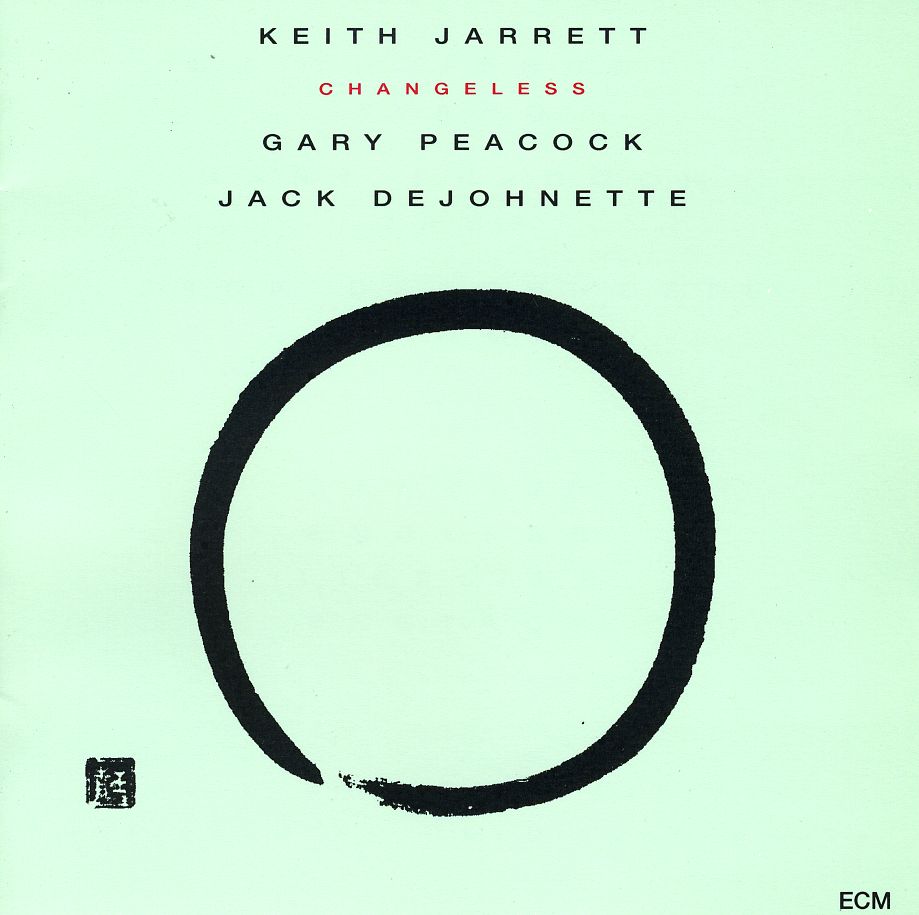
Keith Jarrett Trio: Changeless (ECM 1392)

Keith Jarrett Trio
Changeless

Keith Jarrett piano
Gary Peacock bass
Jack DeJohnette drums
Recorded October 14, 1987 (Denver); October 11, 1987 (Dallas); October 9, 1987 (Lexington); October 12, 1987 (Houston)
Engineer: Tom McKenney
Produced by Manfred Eicher

By the time of this release, Keith Jarrett’s trio with bassist Gary Peacock and drummer Jack DeJohnette was at the height of its creative powers (actually, they started high and simply went higher). One could already hear from their dip into the standards pool that Jarrett’s plenitude of creativity was a force to be reckoned with, if not simply enjoyed, and all the more so in such dovetailed company. That being said, the group was capable of far more than just extending a well-worn tune to a 20-minute diatribe of philosophical proportions. Although Jarrett himself had established quite the reputation as a solo artist, he had only rarely overlaid those transparencies over the topography of his group work. But then there is “Dancing,” the machinations of which open this positively transcendent quatrain of live recordings with a protracted leap of improvisation. As per usual, Peacock sparks the trio’s deepest running flame, and his amplified bass line herein lulls us into a memorable groove. The ostinato feel builds through Jarrett’s grinding left hand, while DeJohnette’s never-cease-to-amazing subtleties draw us in. This energetic yet trance-like state leaves us suitably cleansed for “Endless,” which is one of the most gorgeous things the trio has ever put out. There’s something profound going on here, something that proves the title isn’t just a catchy cue, but rather signals a modus operandi for Jarrett and his cohorts. Peacock’s soloing is revelatory here and spins us into the filmic fade-in of “Lifeline.” With an ear turned inward and his heart beating a versa for every vice, Jarrett floats a flower of resolution down a neorealist canyon. Soil is scarce, though watered all the same by the occasional storms of a hidden life in “Ecstasy.” This aptly titled closer is a tide that simultaneously ebbs and flows, so that the shoreline is forever redrawn.

Perhaps by no coincidence of title, this disc is on par with Changes as a different and sacred side of the trio’s sonorous rites. In some ways these pieces read like Jarrett solos while at the same time being duly enriched by the presence of Peacock and DeJohnette. There is so much to be heard in the experience, and even more to be experienced in the heard.

<< Thomas Demenga: Bach/Carter (ECM 1391 NS)
>> First House: Cantilena (ECM 1393)

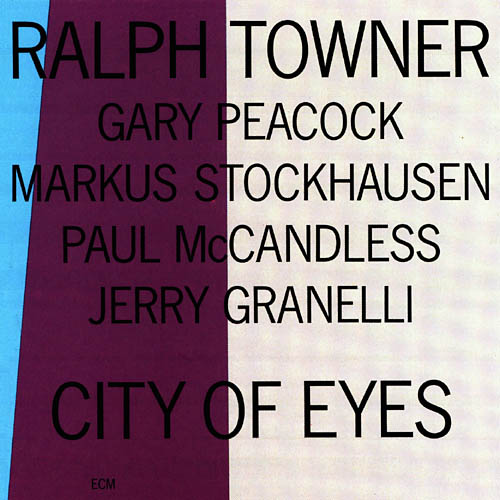
Ralph Towner: City Of Eyes (ECM 1388)


Ralph Towner
City Of Eyes

Ralph Towner 12-string and classical guitars, piano, synthesizer
Markus Stockhausen trumpet, piccolo trumpet, fluegelhorn
Paul McCandless oboe, English horn
Gary Peacock bass
Jerry Granelli drums, electronic drums
Recorded February 1986 at Power Station, New York
Engineer: David Baker
Digitally mixed at Rainbow Studio, Oslo
Recorded November 1988 at Rainbow Studio, Oslo
Engineer: Jan Erik Kongshaug
Produced by Manfred Eicher

While there are, of course, plenty of great pieces to choose from Ralph Towner’s still-growing songbook, I find myself turning more and more to “Jamaica Stopover,” the swinging opener of this late-80s session from the singular guitarist amid a cadre of friends new and old as an introduction to the unenlightened. Picturesque and lively, it is an exemplary showcase of Towner’s melodic (to say nothing of his rhythmic) flair. It is one of a handful of classical solos on City Of Eyes, of which “Janet” is another standout. Each is a snapshot in sound that sings. In addition to Towner’s skills unaccompanied, we are also regaled by a touch of Oregon in the group pieces. These take forms as varied as Towner’s instrumental role, switching as he does from frets to keys a number of times throughout. “Cascades” is perhaps the most successful in this regard. Trumpeter Markus Stockhausen gilds its already fine edges with liquid metal, forging complementary lines to the Jon Hassell-like synthesizers in the background. Stockhausen also dialogues beautifully with Paul McCandless (here on English horn) amid the deft stitching of bassist Gary Peacock. Stockhausen finds himself gilded in turn in the title track. This swell of primal energy sparkles with Towner’s 12 sparkling strings, which carry on through the contemplative solo “Sipping The Past.” Aside from being a lovely blossom in its own right, this piece demonstrates Towner’s talent for shape and architecture. The fullness of these compositional instincts fleshes out into “Far Cry.” This rare trio turn features Towner at both the piano and 12-string and stands as one of his most attractive dreams to date. Drummer Jerry Granelli adds tasteful pointillism to “Sustained Release” before “Tundra” brings us again into Oregon territory, where Stockhausen’s cries speak of an ice age weaving its feathered carpets across the tundra.

The reigning masterstroke of this date, however, has to be “Les Douzilles,” which reprises Towner’s classical against a gallery of spirited ground lines from Peacock. Its sense of movement and emotiveness is deeply performed, and one cannot help but notice the joy that both musicians get out of the interaction. They play as if from behind a sheen of ecstatic nostalgia, Peacock dancing his way through a surprisingly narrow thematic space before settling in for a gentle rejoinder.

There is a rusticity in Towner’s playing that I have always supremely appealing. It is a style unafraid to be a little rough around the edges, for those frays and twangs give the music that much more character. City Of Eyes remains a full portrait of his wide-ranging abilities and is a must-have for any fan.

<< Egberto Gismonti: Dança dos Escravos (ECM 1387)
>> Terje Rypdal: Undisonus (ECM 1389)

Then Comes The White Tiger (ECM 1499)

Red Sun
SamulNori
Then Comes The White Tiger

Red Sun
Wolfgang Puschnig alto saxophone, alto flute
Linda Sharrock voice
Rick Iannacone electric guitar
Jamaaladeen Tacuma bass guitar
SamulNori
Kim Duk Soo changgo, piri, hojok, ching
Lee Kwang Soo k’kwaenwari, vocals, ching
Kang Min Seok buk, ching
Kim Woon Tae buk, ching, bara
Kim Sung Woon komungo, kayagum
Recorded May 1993 at Garak Studio, Seoul
Engineer: Jan Erik Kongshaug
Produced by Wolfgang Puschnig

Look at the sky and pluck a star
Look at the earth and farm the land…
Moon, moon, bright moon, as bright as day
In the darkness this light is our illumination

Like many people I am sure, my first exposure to the world of samul nori was through the 1984 Nonesuch Explorer Series recording Samul-nori: Drums and Voices of Korea.

The group SamulNori, which takes its name from the selfsame style of Korean folk music and was founded in 1978 by Kim Duk Soo as a means of expanding the music’s compass of awareness, combines its namesake’s balance of ritual and humble beginnings with contemporary leanings. Samul nori is at heart a percussive genre. Its four instruments are the jing (large gong), the kkwaenghwari (small gong), the janggu (hour-glass drum), and the buk (barrel drum). Each is its own element—wind, thunder, rain, and clouds, respectively—and brings a fertile sound to bear upon a range of ecologically minded texts, both recited and sung. SamulNori members have worked with, among others, Bill Laswell (a true maverick whose seamless productions were the soundtrack to my late teens) and Kodo, but perhaps most notably with Red Sun, a jazz outfit that was the brainchild of saxophonist and flutist Wolfgang Puschnig and with whom SamulNori had its first meeting eight years prior to this influential record.

The ritual drums and horns of “NanJang (The Meeting Place)” are the ideal start, giving way as they do to Lee Kwang Soo’s recitation of the “Pinari,” a Korean origin myth in verse form. Splashing gongs seem to swirl at our feet, and from them arises the voice of Linda Sharrock (wife of another maverick, Sonny), who explores a panorama of nature and living bounty. Guitarist Rick Iannacone draws a cosmic thread through these rawer beads (not to say that one is purer than the other, for they are all made from the same breath that gives all life to matter, and all matter to life), and steers us into the beauties of “Peaceful Question.” Though it is but an amorphous congregation of gongs and bells nesting a voice born from nature who blurs the lines between human and animal (and in fact shows them to be one and the same), words fail to evoke its splendor. It sounds familiar to us all the same, so that “Kil-Kun-Ak” becomes the percussive sinew connecting that voice to the void from which it has taken shape. It leaps like a fire, finds its stillness of mind in the sharing.

Like a playground swing moving of its own accord, Jamaaladeen Tacuma’s crab-walking bass line in “Hear Them Say” traces a counter arc while Sharrock’s notes tremble amid Puschnig’s starlit branches, singing of self-empowerment in a spider’s web of radial guitar lines. “Piri” changes gears dramatically and takes its name from the double-reed bamboo pipe played here by Kim Duk Soo, who soars on a crane’s back through a flowering rendition of the folk song “Han O-Paek Nyn” (The Sorrows of Five Hundred Years). “Soo Yang Kol (The Valley Of Weeping Willows)” is an equally inspired construction that celebrates the place where the musicians had their first Korean pre-production meeting. It also boasts most arresting sax solo on album. Quieter pastures await us in the electric gyrations of “Flute Sanjo” and in “Komungo,” a wavering solo from guest artist Kum Sung Woon on the zither of the same name. This is followed by the two-part “Full House.” Composed by Tacuma, it brings some groove into the mix and represents the session’s deftest idiomatic blends. Its message of joy, peace, and thanksgiving leads us into “Ariang,” which comes to us as if from a distance, an ancestral song woven anew into the lighted corridor of all life.

I have to admit that, as one who had only heard samul nori outside of any fusion context, it took me a while to understand the sound-world of this project. Yet what at first seems an incongruous meeting of “East” and “West” ends up a genuinely wholehearted attempt to undermine those very arbitrary categories. And in the end, perhaps jazz and samul nori aren’t all that different in what they are trying to achieve, in the language they speak and in the ways they speak it. Its voices enact that same need for dialogue and communication that is at the heart of jazz, and expresses said need through evolution and improvisation. All of this is wrapped up in those voices, and in the saxophonic punctuation that reorders their grammar. This music speaks to us because it tells us a story we already know. It is a story from which we were born, one into which we will be written when we die. A space-time continuum to which profundity need not apply, for it is too lowly to express that from which it hangs.

<< Hal Russell/NRG Ensemble: The Hal Russell Story (ECM 1498)
>> Jan Garbarek Group: Twelve Moons (ECM 1500)

Keith Jarrett: Personal Mountains (ECM 1382)


Keith Jarrett
Personal Mountains

Keith Jarrett piano, percussion
Jan Garbarek tenor and soprano saxophones
Palle Danielsson bass
Jon Christensen drums
Recorded in concert, April 1979, Tokyo
Engineer: Jan Erik Kongshaug
Produced by Manfred Eicher

Despite being recorded in 1979, it would be a full decade before this jewel of a live recording from Keith Jarrett’s unparalleled European quartet (with Jan Garbarek on saxophone, Palle Danielsson on bass, and Jon Christensen on drums) would find itself sleeved and catalogued at last. From note one Personal Mountains paints melodic vistas of great majesty wrapped in a bow of rarified execution. As throughout, Garbarek’s blustery tone in the title opener proclaims themes with crystal-clear diction across the widening sky of Jarrett’s pianism. Jarrett himself takes an early leap in this outing, riding the rhythm section like a thoroughbred into open fields. He turns night into day with every chord, the fullness of his sound accentuated especially by Christensen’s rolling thunder as he unravels wonder after wonder. Yet even as Garbarek works his chromatic magic for the betterment of something profound, Christensen and Danielsson are given no small spotlight in which to shuffle their dialogue into a hollering tumble. Thus are we jettisoned skyward into an unexpected turn of phrase. Garbarek constructs hang gliders of melody in the thick night, every dip a chance to rise again. Meanwhile, Jarrett sews our hearts into the folds of a time unbound, thus moving us smoothly into “Prism.” Our usher this time is Danielsson, who pulls Jarrett’s ballad energy through a brushed corridor. Jarrett has all he needs from Garbarek to burn the midnight oil with a sparkling tapestry of soloing. His gentle cascades then release us into “Oasis” before Garbarek’s sharply inclined theme breaks the waves. Jarrett is again wondrous, spinning the finest spider’s thread into a wheel of adhesive memories. Offset by Christensen’s vibrancy, he and the others forge a vision for all senses. Jarrett invites us all by his lonesome into the aptly titled “Innocence.” Like a candle that barely trembles in the rhythm section’s sleeping breaths, his playing makes string games of moonbeams with the conviction of a dream. Of the latter we hear but a snippet in “Late Night Willie.” This gentle groove—bluesy enough to have Jarrett whooping all the same—gives us a soulful Garbarek and an overall elasticity which hurls us into an even deeper appreciation for the art at hand.

There is something magical about the pairing of Garbarek and Jarrett that brings out the best in both. And with such fine rhythmic support—and, to be sure, Danielsson and Christensen are as much melodicians as they are rhythmatists—one can hardly ask for anything grander. Although this is a live recording, one would hardly know it from the rapt silence that embraces this music until the audience’s applause breaks the spell.

<< Jan Garbarek: Legend of The Seven Dreams (ECM 1381)
>> Terje Rypdal: The Singles Collection (ECM 1383)