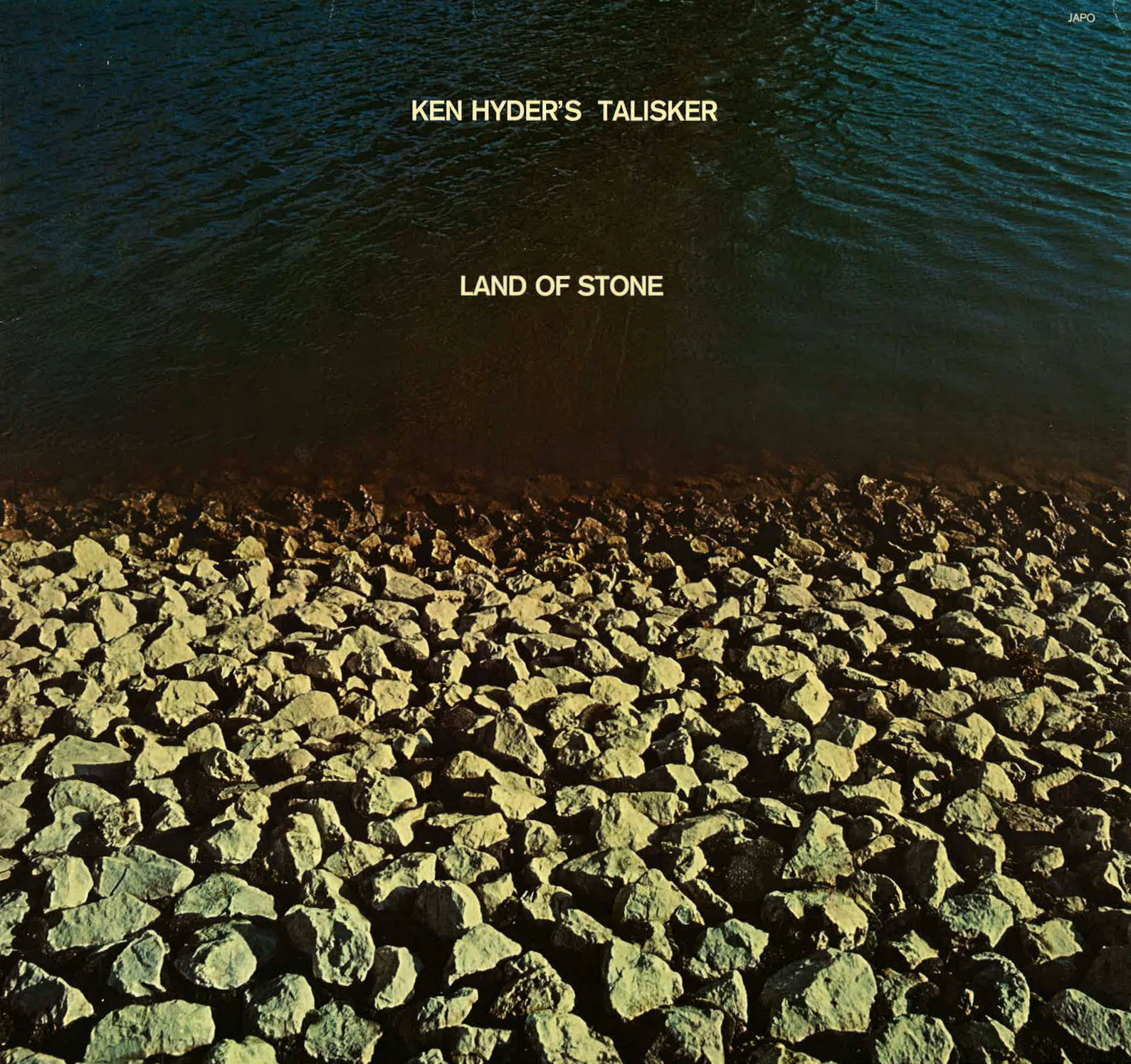
Ken Hyder’s Talisker: Land Of Stone (JAPO 60018)

Land Of Stone

Ken Hyder’s Talisker
Land Of Stone

Ken Hyder drums
John Lawrence bass
Marcio Mattos bass
Davie Webster alto saxophone
John Rangecroft tenor saxophone, clarinet
Ricardo Mattos soprano and tenor saxophones, flute
Brian Eley vocals
Frankie Armstrong vocals
Phil Minton vocals
Maggie Nichols vocals
Recorded April 1977 in London
Engineer Martin Wieland
Produced by Thomas Stöwsand

Over a career spanning more than four decades, Scottish percussionist and vocalist Ken Hyder has developed a strong body of work, though perhaps none so robust as his Talisker outfit. Combining Celtic and jazz influences, Talisker debuted in 1975 with Dreaming Of Glenisla on Virgin Records. Yet as Hyder’s musical interests began to expand to traditional Irish music and further to Asian monasticism, his sound opened itself to a world of possibilities. Enter album the second, Land Of Stone, which found a home on the JAPO label two years later.

“The Strathspey King,” a strangely swinging ode to Scottish master fiddler James Scott Skinner (1843-1927), sets a homegrown tone. Clarinetist John Rangecroft proves to be a vital presence in this increasingly enigmatic session, adding swagger aplenty. Like a young hopeful decked out in fresh threads and money in the pocket, he tricks the heart into thinking that harm is a while away. Hyder’s militaristic drum solo intercepts street-side, as if offering free samples of reality before a chorus of bidders drops into view with its haunting brand of Hebridean choral music in “The Men Of Barra Know How To Drink, But The Women Know How To Sing.” A boisterous and colorful chain, its syllables become actions, teetering like drunken instruments into “Close The Window And Keep It Down.” This likeminded island song is an onomatopoetic excursion into the inner lives of house wares and propriety. The latter quickly disintegrates as bonds loosen their friction and slide from grasp in screeching ululations, courtesy of ECM margin-bearer Maggie Nichols. The color wheel darkens further in “See You At The Mission, Eh, If It’s No’ Full,” in which a brood of instruments strains unison phrasings through an upturned colander. Bass and drums form a knot of support, eyes in a flowing wood grain. In the wake of these dirt-caked fingernails, “Derek Was Only A Bairn” rides into the dawn, a smooth caravan lead by Ricardo Mattos on flute and horse’s trot.

Hyder insists that improvisation was a vital component of Scottish bagpipe playing, and in a tripartite pibroch he explores the crossover from the Highlands to the fringes of American free jazz, dedicating parts respectively to the MacCrimmons (a notable family of pipers), John Coltrane, and Albert Ayler. After a microscopic dialogue between bassists John Lawrence and Marcio Mattos, soprano saxophone masquerades as bagpipe in piercing shepherd’s call. Hints of a jig rise and fall from deeper drones, a sky behind mountain silhouettes. Over the click of cymbal, dense voices weave in and out of earshot, taking solid presence in the loam of memory, to slumber and to molt. The banshees return with gentle persuasions, their ashen hair and earthward grins blistered by the rub of their limbo. Yet with the coming of rhythm they achieve communication somewhere on the other side of fear, ecstatic totems each passing through sea and grain until the wind puts fingers to lips and blows.

Cleaning off the dust of age, Talisker shakes out tunes old and new, and with the chaff pieces together charcoal fields as would a cobbler hammer a sole. Or is it soul? There’s plenty to be had in this land of stone.

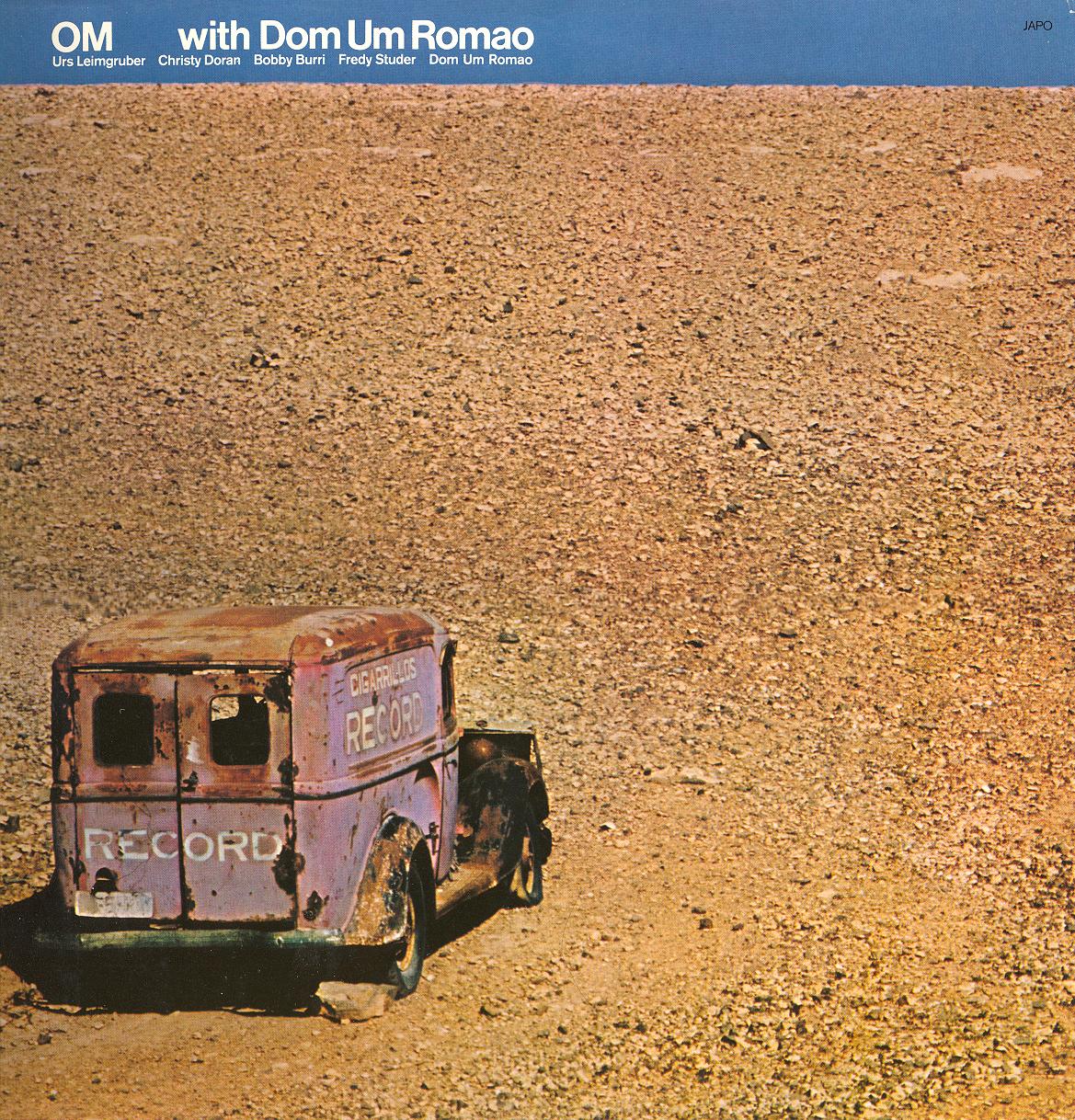
OM with Dom Um Romao (JAPO 60022)

OM with Dom Um Romao

OM with Dom Um Romao

Urs Leimgruber soprano and tenor saxophones, bass clarinet
Christy Doran 6- and 12-string electric guitars
Bobby Burri bass
Fredy Studer drums
Dom Um Romão percussion, berimbau
Recorded August 1977 at Tonstudio Bauer, Ludwigsburg
Engineer: Martin Wieland
Produced by Thomas Stöwsand

Is there a high road? This is the question asked by OM’s third of four albums for JAPO. For its junior effort, the renegade quartet of Urs Leimgruber (reeds), Christy Doran (guitar), Bobby Burri (bass), and Fredy Studer (drums) would seem to hold to a relatively accessible doctrine. But while it is the most groove-oriented in their potent discography—not surprising, given the driving center found in guest artist Dom Um Romão (1925-2005)—the core provided by the legendary Brazilian jazz drummer and percussionist, known for his work with Weather Report, allows a melodic brand of expressive freedom to take shape. The showdown is just as dreamy and feverish as anything OM had ever produced. This atmosphere comes about through the hypnotic effect of a steady pulse, the essence of all ritual. Burri’s “Chipero” opens the doors to a realm of bird and goddess, a forest where waters run shallow but sure. Romão provides the welcoming call, the rest evoking fauna and wounds of expectation. These energies sustain themselves throughout, especially in the two Doran-penned tunes. “Back To Front” swings us farther out into the cosmic stretch by way of some especially colorful picking from the composer, unwrapping a package of candy and strewing its contents over Saturn’s rings. The flow is not without its detours, as evidenced by the stark change of scenery as bass and guitar mellow for a concluding night flight. Doran’s other half is “De Funk,” which churns the butter to even smoother consistency. Romão’s Nana Vasconcelos vibe adds just the right touch of salt to Studer’s metronome. Doran, ebullient as over, can only defer to Burri, who works overtime to keep us in the here and now. Leimgruber’s bass clarinet turns like a jigsaw piece crying for fit and sets up a round of witty exchanges. Nestled among these propulsive journeys, the artful dodge of Leimgruber’s “Dumini” awakens the behemoth of memory in a lanky, sweltering pitch. Because it is the only track to have made the cut for OM’s retrospective album, this collaborative joint is worth checking out for the surrounding paths it lays. OM remains attentive to ebb and flow, an oarless boat reaching shore. What does oxygen breathe?

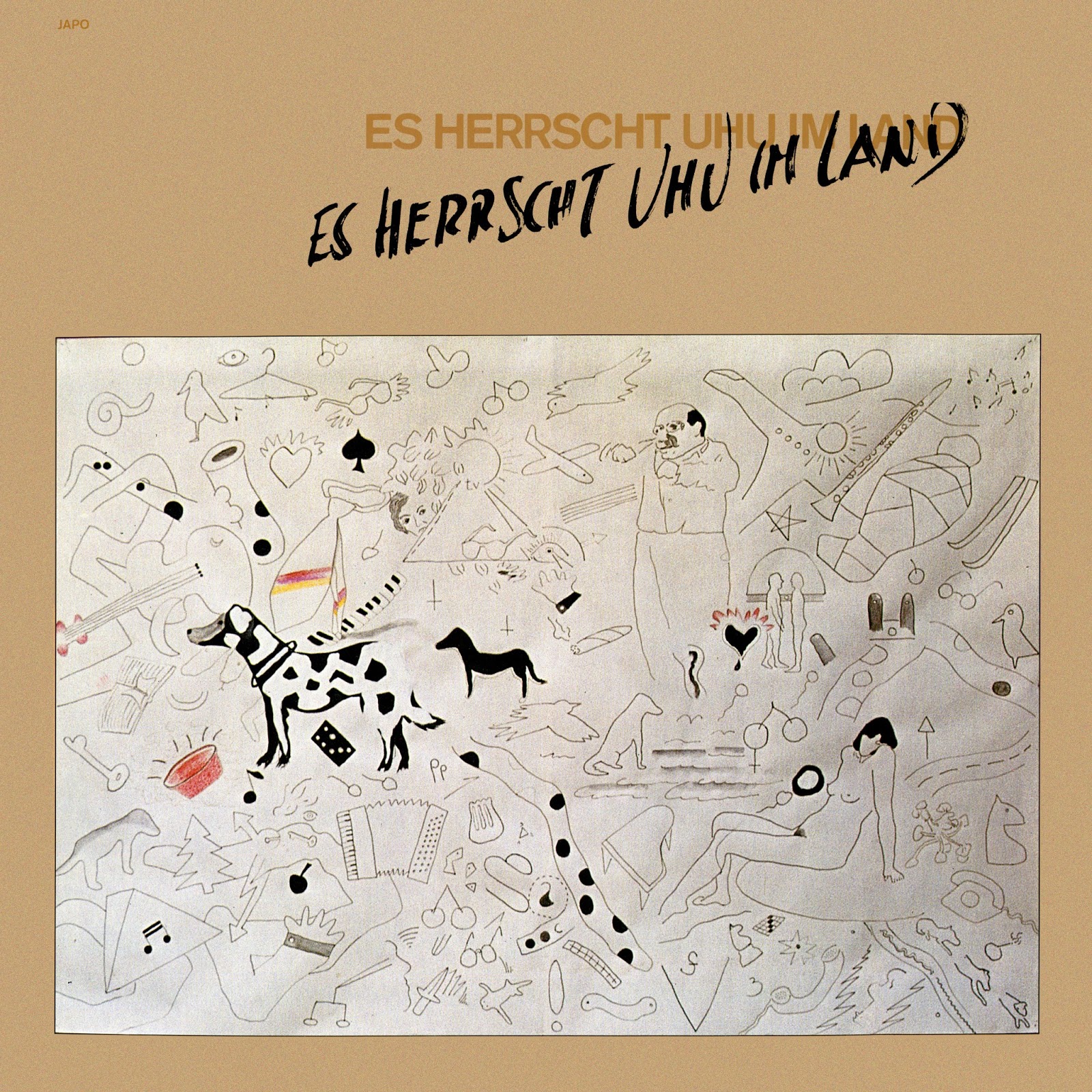
Es herrscht Uhu im Land: s/t (JAPO 60037)

Es herrscht Uhu im Land

Es herrscht Uhu im Land

Christoph Anders voice, guitar, organ
Heiner Goebbels synthesizer, piano, saxophone, voice
Alfred Harth saxophones, bass clarinet, voice
Paul Lovens drums, percussion
Rolf Riehm english horn, alto saxophone, voice
Annemarie Roelofs trombone, violin, voice
Recorded December 9-11, 1980 at Tonstudio Bauer, Ludwigsburg
Engineer: Martin Wieland
Produced by Thomas Stöwsand

This early collaboration from saxophonist Alfred Harth and composer Heiner Goebbels is a telling lens of intersection through which to mine two fascinating careers. Harth will be familiar to ECM devotees as the progenitor of the label’s second album, Just Music, and would go on to release two further albums in other venues before meeting Goebbels in 1975. The two came together musically in a jazz-rock outfit called Rauhreif which, being to neither’s liking, dissolved, leaving these powerhouses itching for freer means of expression. It was in the context of this collaboration that Harth introduced the young Goebbels to the music of Hanns Eisler, which would of course lead to Eislermaterial, his most successful project to date. After connecting the dots for five years as a duo in various German settings, Harth called on the services of an old friend, Thomas Stöwsand, who’d played cello and flute on Just Music and was now headlong into the ECM storm. Stöwsand agreed to produce and welcomed into the studio Chris Anders, Rolf Riehm, and Annemarie Roelofs, each accomplished multi-instrumentalists, and drummer Paul Lovens. Such is the tangled web of Es herrscht Uhu in Land.

In it ideas were already taking shape that would become touchstones for Goebbels’s work, such as “Autobahn,” which meshes rallying songs with a field recording of its eponymous motorway, while “Wertkauf” betrays a less delicate side, sounding like something out of an Otomo Yoshihide free-for-all. The reversed vinyl and crunchy guitar make for a powerful contrast, each groove a cavity waiting for a tooth. “Mahlzeit” is a trembling gift, enacting a sacred touch of tongue to circuit. And one can’t help but uphold the frozen wasteland and creaking wonders of “Durch Den Wald” as a precursor to Stifters Dinge.

Riehm also makes a significant contribution with “Der Main.” Composed around poetry of Friedrich Hölderlin, it thus lays another important keystone in the ECM ethos. This skip through space is like a sonic parlor trick, a knock on the door of memory, a wishful thought. Through a deft admixture of songs, the relay of word to voice moves in an extended meditation. At nearly eight minutes, it towers over the outlying tracks, which average around two minutes each, and underscores the otherwise restless musings therein with a bold cohesion.

The musicians turn air to solid with their touch. Intimate musings, talking brass, laughter, and wires share a bed, rolling in the sheets until something musical takes shape. Each body part becomes a note that in combination with other, activates instrumental ideas. Harth, for one, writhes in soprano-gilded spirals over the song of a hungry whale in “Echter Lachs” and pops the electronic bubble in “Knecht U.” Yet for the most part, the group works as a whole, spitting watermelon seeds out of cartoon mouths in “Ich Nicht Mich Dich” alongside the jackhammer of self-questioning. It pulls us into an underworld of radio signals, waltzing to the beat of a perverse drum (“El Salvador”) and changing channels with the twist of a rein (“Uhu”), all the while feeding voices through a sluice pipe of craft. A spate of translation (“Superbirdsong”), dust for wings and air, and we are in the forlorn wakeup call of “Tilt!” smoking monosyllables until they stain the lungs with honesty.

In this bedtime story for the escaped mind, the main characters are an adroit political insight, a leak in the colonial pen that ruins a fluid takeover with exposition of intent, and a crucible of retrospection. Neither derisive nor derivative, this project takes a good long look at the sandy areas of our consciousness and pours water on them for sandcastles. The water jug drains itself. The water jug waits for no one.

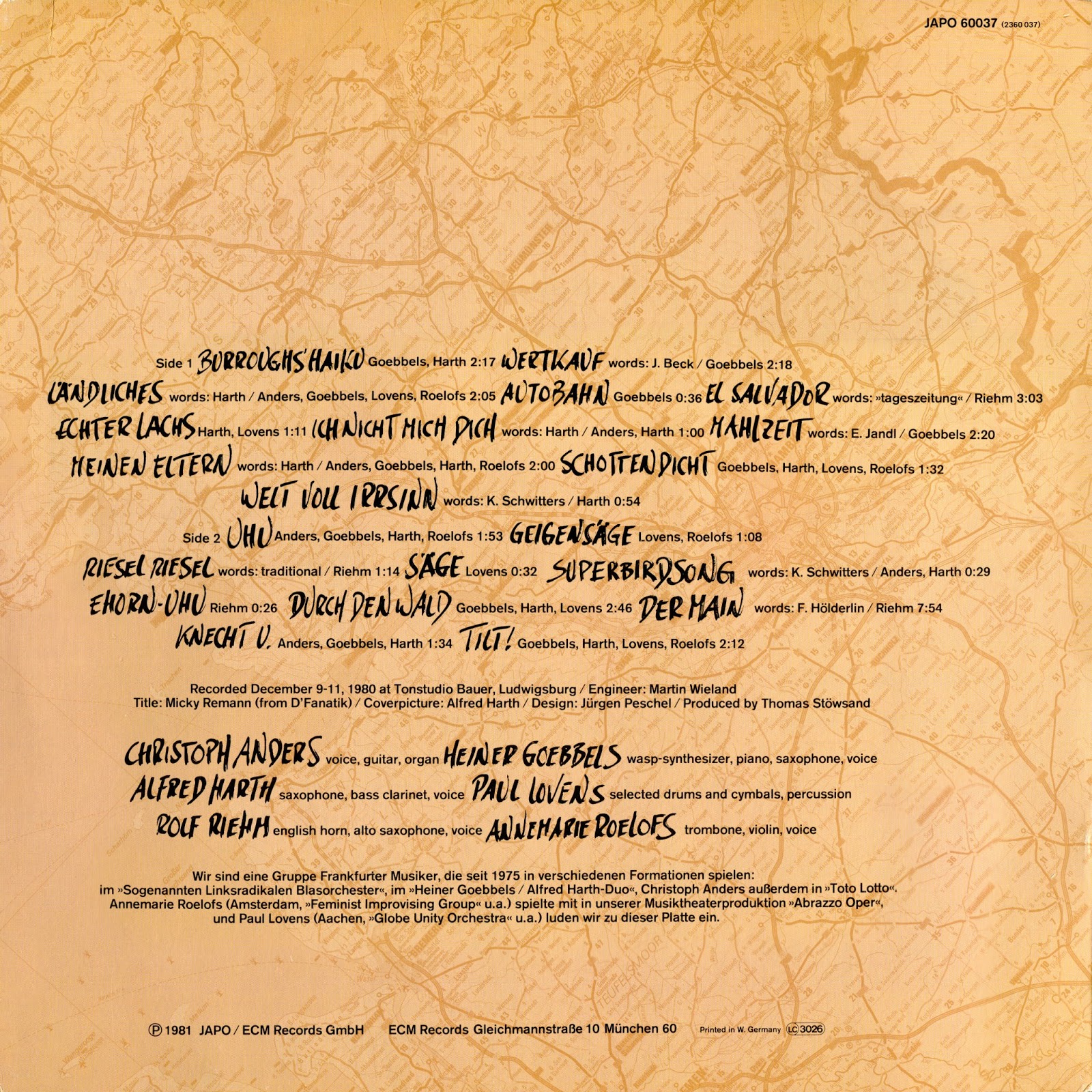
Es herrscht Uhu im Land (Back)
Back cover

Enrico Rava: “Quotation Marks” (JAPO 60010)

Quotation Marks

Enrico Rava
“Quotation Marks”

Enrico Rava trumpet
Jeanne Lee vocal
John Abercrombie guitar
David Horowitz piano, synthesizer
Herb Bushler bass
Ray Armando percussion
Warren Smith marimba, percussion
Jack DeJohnette drums
Finito Bingert tenor saxophone, flute, percussion
Rodolfo Mederos bandoneón
Ricardo Lew guitar
Matias Pizarro piano
El Negro Gonzales bass
Nestor Astarita drums
El Chino Rossi percussion
Recorded December 1973 at Blue Rock Studios, New York
Engineer: Jane…
Produced by David Horowitz and Jack Tafoya
Recorded April 1974 at Audion Studio, Buenos Aires
Engineer: Nello
Produced by Nano Herrera

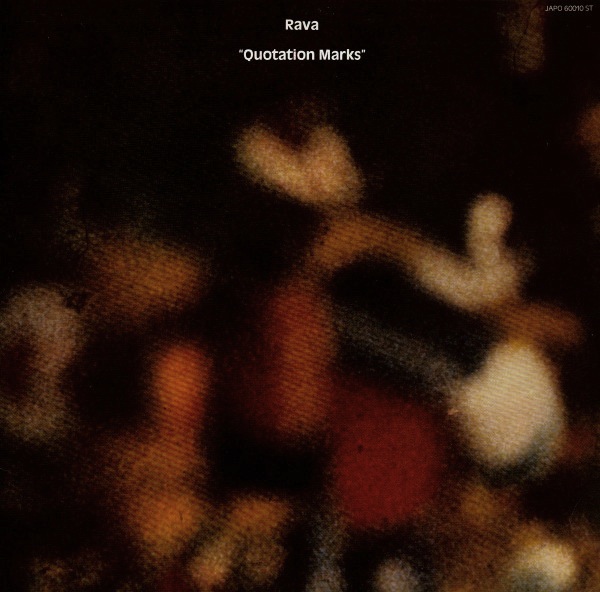
“Quotation Marks” was a milestone for Italian trumpeter, now ECM mainstay, Enrico Rava. In addition to being his first of many projects on Manfred Eicher’s watch, it was his debut as leader. The record blends two sessions into a seamless program. The first (December 1973) went down in New York City, where he was backed by guitarist John Abercrombie, drummer Jack DeJohnette, keyboardist David Horowitz, bassist Herb Bushler, and percussionists Ray Armando and Warren Smith. The second (April 1974) placed Rava in Buenos Aires alongside Radolfo Mederos on bandoneón, Finito Bingert on tenor sax and flute, Matias Pizarro on piano, Ricardo Lew on guitar, and percussionists Nestor Astarita and El Chino Rossi.

Of this fine assembly, Mederos’s sound rings foremost. His lovely bellows open “Espejismo Ratonera” with a lilting air before Pizarro’s smooth pianism flushes its alleys clear for less straightforward melodic explorations. Touches of tango warm the cockles, making for an easy, patient entrance to Rava’s dancing grammar. Youth and joy are obvious in his playing, which by a clever turning of the knob bleeds back into the bandoneón with which the track began. American jazz vocalist Jeanne Lee sings lyrics by Argentine poet Mario Trejo in the “Short Visit To Malena” that follows. It too benefits from studio subtleties, fading in as if we were being escorted from one nightclub to another. We seem to wander in at mid-song and notice the crowd sipping their cocktails, arriving just in time for Rava’s trade-off to Abercrombie. (I cannot help but be reminded at this point, if you’ll forgive the comparison, of “Club Tropicana” by Wham!, which begins outside and plunges the listener into a club atmosphere once the door is opened.) “Sola” throws us headlong into the bounce of the South American band. A flute solo here from Bingert stands as the album’s highlight. Like a light streaking before an open lens, it lingers against the skip of bandoneón and snare. The track fades all too soon, just as Lew catches a tailwind. “San Justo” is another horizontal with dissonant verticals from Mederos and a gritty prison break from Lew. Lee rejoins the cast for the heavenly watercolors of the title track before her cathartic leaps float amid a heady beat of brassy beauty, while in the steady groove of “Melancolia De Las Maletas” she adds flips and dips. All of this gives plenty of ground for Rava to unleash his confidence, handing it over to Abercrombie for a crunchy and edible passage.

We know these musicians are capable of incendiary moves, which renders their restraint (and the occasional burst) all the more intense. Rava especially takes time to introduce himself into nearly every tune. Even those like “Water Kite” cloak him in a deceptively thematic role before asserting his personality at stage center. It is a testament to his maturity as a young player and deference to the talents with which he finds himself. The result is an unspoiled gem in the Rava discography that is more than worth the import price if you can afford it.

…. . ….

As a service to my readers, I’ve taken the liberty of translating the liner notes by Minoru Wakasugi that accompany the 2006 Japanese reissue, especially because the album has since become available far more cheaply via digital download, sans booklet:

Now available for the first time on CD is Italian trumpeter Enrico Rava’s 1973 work “Quotation Marks”, which shuffles together a New York session recorded that same year (tracks 2, 6, 7) and another recorded in Buenos Aires the following.

The story behind the South American session and its journey to CD is as vivid as the music’s colors.

At the very least, we can think of this record as marking the beginning of Rava’s relationship with Latin music. Since the 80s, imprints such as Soul Note (Italy) have boasted similar, richly hued sounds, but among ECM’s productions throughout the 70s there was nothing that so vividly repainted the label’s image. Unable to move about as he’d wished, and in something of a quagmire as he pondered his solo debut, Rava, no doubt inspired by ECM owner Manfred Eicher’s philosophy and the image he’d established, felt this was a good way to go.

Such instability wasn’t unknown to Eicher, as it had defined the young label’s activities thus far. Although that same year saw the production of Jazz a Confronto 14 – Enrico Rava on the Italian Horo label, by then the groundwork had already been laid in a slew of formative records.

And let us not forget his participation in soprano saxophonist Steve Lacy’s 1966 The Forest and the Zoo, also recorded in Buenos Aires. Although that album took him in an entirely unrelated musical direction, Rava’s first South American experience surely stirred the Latin blood lurking within him.

Not long after, he traveled to New York in 1967. In making the transition from the rundown streets of Buenos Aires to those of another metropolis, Rava was baptized in the waters of authentic free jazz. He returned home temporarily, only to find himself back in the Big Apple, by which time seven years had passed. In that period, he’d played with Carla Bley in the pianist-composer’s large-scale project Escalator Over the Hill (1971). Seeing as Bley’s WATT label had direct business relations with ECM, it was perhaps inevitable that Rava would come to know Eicher.

Living in a racial and cultural melting pot like New York placed Rava at world center. It was more than just a dollop of land in the eastern U.S.; it was a crucible of global influences that seeped into every part of the city and led him to Buenos Aires a second time.

He drew up his first South American sketch with Pupa o Crisalide, released on Vista (Italy), known for producing artists like Duško Gojković. Featuring such talents as Italy-based Brazilian percussionist Mandrake, the album was oriented more toward Brazilian fusion than Argentine tango and gained popularity even among the young club crowd. It was also my introduction to Rava.

One can hear from Pupa o Crisalide just how fulfilling his time in Buenos Aires was. He produced quite a few recordings there, and from them a wonderful body of work. “Quotation Marks” was essentially culled from the Vista outtakes.

Uniformity reigns in Pupa o Crisalide. And although the present CD is three recordings in one, laid down in Buenos Aires, New York (alternate takes), and locally in Rome, one can read balance into their triangular interrelationship. The colors are uniform, maintaining as they do a consistent temperature and climate.

On the other hand, it is also a sound-world where, by virtue of its intermingling, warmth and coldness, brightness and darkness butt up against one another, so that their urban commonalities come about through subtle variations. The stability of Pupa o Crisalide, then, no longer applies.

Not that “Quotation Marks” needs it. With Rava’s reverberant blat and tenacity, it obscures melancholy and sordidness, finding among the urban sprawl an inner spiritual world hitherto unseen. It is the same power of spirit that moves the Piazzolla Quintet’s Piazzolla at the Philharmonic Hall New York (1965) and anticipates the “neighborhood music” of Kip Hanrahan (of American Clavé fame) by decades.

None of this means that Rava was necessarily ready to jump the gun as leader, for he inevitably took on the “colors” of his costars, all of whom helped to draw out his magnetic attraction. Nevertheless, he made a huge impression. More than Rava’s skills and such, it was his commitment to a total concept that won listeners over, and the effect was incalculable. The combination with bandoneón was unique at the time, although now it will readily put ECM fans in mind of Dino Saluzzi. It was nothing so original as taking Saluzzi’s unique ambience and meshing it with the unsettling melodies of tango, but still one caught a glimpse of ECM’s innovation for treating the bandoneón as primary actor.

Rodolfo Mederos, who held the key to the South American session, is a bandoneón player of a generation younger than Saluzzi. And while he cherished his instrument as if he’d inherited it from Piazzolla himself, he also formed a rock-leaning band called Generación Cero (Generation Zero), and for a time was involved in activities that would seem to go against the Piazzolla grain. Nowadays we can chalk up these exploits to youthful indiscretion and self-reformation, but we need only look at tango master Osvaldo Pugliese, whose compositions were already heralding a new age of performance, to see their importance.

Ricardo Lew (guitar), Matias Pizarro (piano), and Nestor Astarita (drums), who assisted in Rava’s South American sketches with Mederos, were always looking to attract other local players. Pizzaro in particular was a central figure during this period in promoting and developing “folklorization,” an underground style of Andean fusion. Its effects continue to be an inspiration for modern-day outfits, like France’s Gotan Project, which trace their roots directly to tango. Along with late bombo drummer Domingo Cura (1929-2004), who inspired a reassessment of the genre from behind the scenes, these artists have charted the modernization of Andean music. We may not lay the same claims on “Quotation Marks”, but because we’re unveiling the album at this historical moment, in 2006, it is important to tease out the effects of everything going on around it. (Translation ©2013 Tyran Grillo)


Elton Dean Quintet: Boundaries (JAPO 60033)

Boundaries

Elton Dean Quintet
Boundaries

Elton Dean saxello, alto saxophone
Mark Charig cornet
Keith Tippett piano, marimba, voice, bottle
Louis Moholo drums
Marcio Mattos bass
Recorded February 1980 at Tonstudio Bauer, Ludwigsburg
Engineer Martin Wieland
Produced by Steve Lake and Elton Dean

Late saxophonist Elton Dean (1945-2006) was notable not only for his finely separated fingering and smooth alto playing, but also for giving due attention to the saxello, a soprano variant which has in recent years seen a comeback in production. Sounding like a cross between its cousin and an English horn, its tonal possibilities give this JAPO session a freshness that has a ways to go yet before its expiration date. From 1966-67, Dean played sideman to singer Long John Baldry in the British R&B outfit Bluesology. Incidentally, the band’s piano man, Reginald Dwight, would borrow from Dean’s and Baldry’s names to create a new stage persona as none other than Elton John. As for Dean, he would go on to make a name (keeping his intact) for himself as saxophonist for the Keith Tippett Sextet, Soft Machine (for which he is perhaps best known), and a string of his own groups. The quintet featured here was among the freer of the latter incarnations, and included Tippett on piano and marimba, cornetist (and fellow Soft Machinist) Mark Charig, bassist Marcio Mattos, and South African drummer Louis Moholo.

EDQ
(Elton Dean Quintet, Rome 1980)

Dean takes on all composing duties, save for the group improv “Out Of Bounds.” This one is their creed. Between Tippett’s mysterious vocals and his marimba’s sprightly appearance (its only of the set) to the fantastic puckering from both horns and Mattos’s flint sparks, there’s much to savor. Yet it’s the title track that welcomes the album’s weightiest theme. Saxello and cornet make a piercing duo in this wide rubato river, as they do in the concluding “Fast News,” which, though primarily a cascading pianistic excursion, goads the listener upstream. Said aquatic qualities crystallize, appropriately enough, in the impressionistic “Oasis.” Each cymbal tap is a glint of sun across the selfsame surface. Mattos stumbles to the edge and lowers lips to drink, only to be met by the saxello’s mocking reality. These sere awakenings come to head during the final showdown between survival and stasis, sinking in quicksand with choices intact. The hope we seek comes to us through a glass darkly in “Basho,” which, if not named for the famous Japanese itinerant, at the very least instills a poetry all its own. Again Dean is the leading voice, turning all sorts of somersaults to earn his keep, while Charig gets some face time in the latter half: frayed and shining gold.

The playing on the whole is robust and centered, though Tippett’s sparkling pianism stands out—all the more so for the crisply engineered recording. You certainly won’t find much in the way of swing, however. Each cut sounds like an introduction to a piece that never materializes. This doesn’t mean the music is ill formed. Rather, it emphasizes the openness of its emotional tact. My one complaint is that Charig isn’t given more airtime. He’s clearly an emotionally charged player, but it’s Dean who dominates the scene. Thankfully, both are so arresting that it ultimately matters little. Quality reigns.

OM: Kirikuki (JAPO 60012)

OM
Kirikuki

Urs Leimgruber soprano and tenor saxophones, percussion
Christy Doran guitar
Bobby Buri bass
Fredy Studer drums, percussion
Recorded October 1 and 2, 1975, at Tonstudio Bauer, Ludwigsburg
Engineer: Martin Wieland
Produced by OM

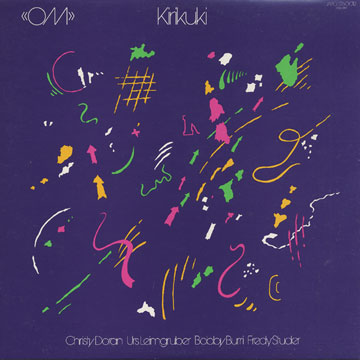
Like its contemporary, the Everyman Band, the Lucerne-based quartet known as OM succeeded in blending rock and free improv idioms to gnarled perfection. Composed of guitarist Christy Doran (Dublin-born but Swiss-raised) and fellow countrymen Urs Leimgruber (reeds), Bobby Burri (bass), and Fredy Studer (drums), the group was an espresso shot in all four careers. ECM has, of course, given just dues with a 2006 retrospective. Still, there’s no better place to get acquainted with OM than through the four complete albums for sister label JAPO, of which this is the first (the fourth, Cerberus, survives fully intact on said retrospective).

Doran is the compositional heart and soul of the set. The only track not penned by him is “Lips” (Leimgruber/Burri), which stands out for its inspired flute playing. Leimgruber sings into the instrument for a bit of polyphonic panache against a gorgeously primal backing, Doran providing industrial touches throughout. Yet it is “Holly” which introduces the album’s distinctly nocturnal sound. Leimgruber’s talents abound here, casting him in the melodic lead from the start. Smoky atmospheres are blown into rings at his lips through a pure, oboe-like soprano. His gorgeous, full highs, complemented by Doran’s crunch, make for an energizing sound and bring their smoothness to the burnished field that is “Sykia.” The buoyant drumming makes this an enchanting epilogue. The color wheel of “Karpfenteich” begins with reedless trio action before launching us horizonward in a lob of flame. More propulsive action from the rhythm section here backs some artful crosstalk between reed and guitar. Yet it is the “Hommage à Mme. Stirnmaa” that takes this cake and bakes another one in its place. From the lovely solo by Duran that starts, it builds to a slightly burnt frenzy, out of which arises a bass of flesh and wires. The tenor solo is like a coda, rough and unleashed, and opens into a percussion solo from Studer, this but the carpet for a grand underwater raga. A masterstroke, and proof enough to seek out OM’s dates in full.

There is something strangely melancholic about the river of Kirikuki. The sunshine is in its sediments.

Rena Rama: Landscapes (JAPO 60020)

Rena Rama
Landscapes

Lennart Åberg tenor and soprano saxophones, percussion
Bobo Stenson piano, percussion
Palle Danielsson bass
Leroy Lowe drums, percussion
Recorded June 1977 at Talent Studio, Oslo
Engineer Jan Erik Kongshaug
Produced by Thomas Stöwsand

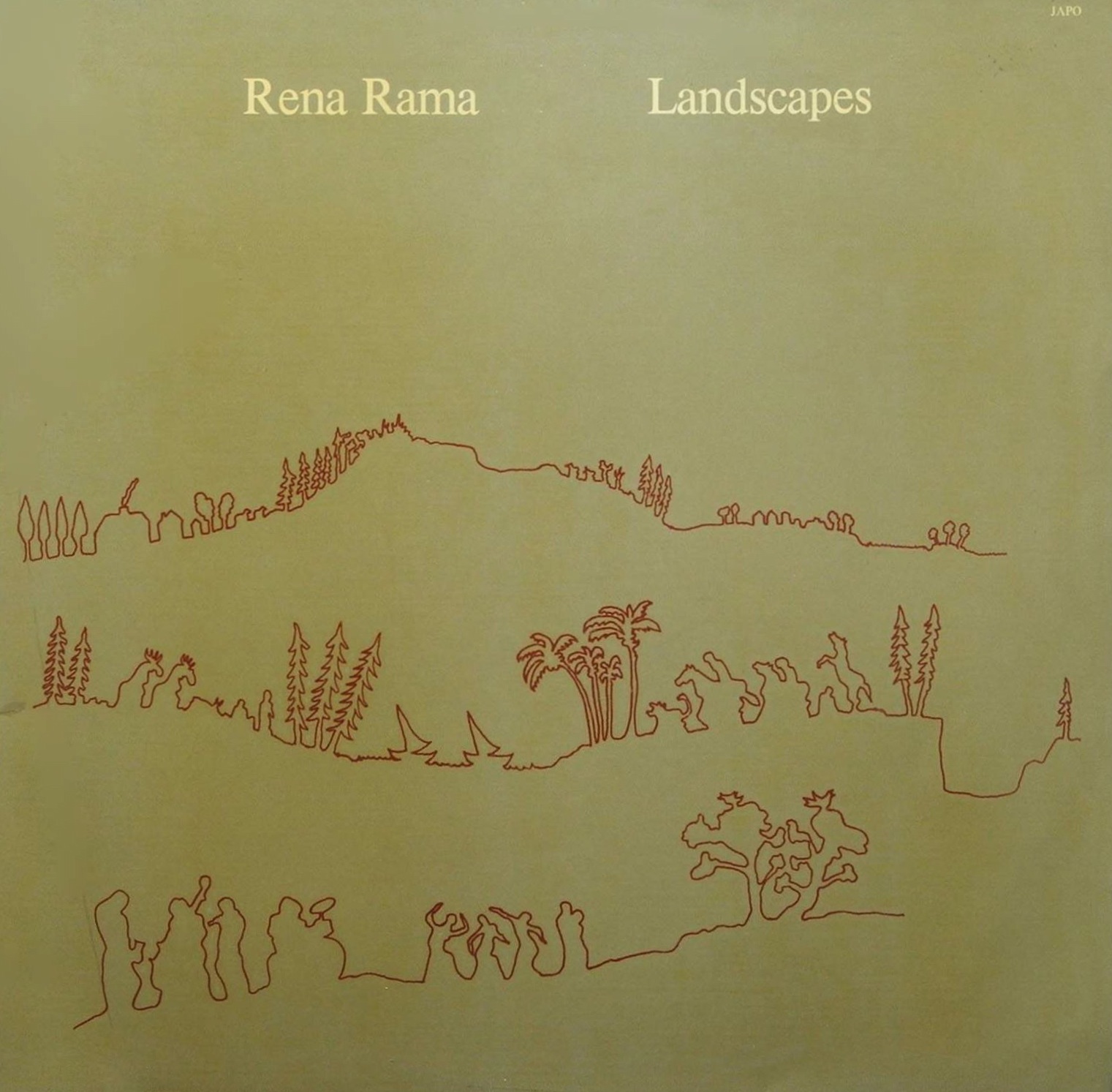
Saxophonist, flutist, and composer Lennart Åberg is among ECM’s sleeper talents. Having graced the label only as sideman to 1994’s Dona Nostra, his brilliance was saved instead for the limited JAPO imprint. On this record he is joined by fellow Swedes Bobo Stenson (piano) and Palle Danielsson (bass), both familiar to ECM listeners. Perhaps not is American drummer Leroy Lowe, who rounds out this incarnation of the quartet known as Rena Rama and played with the group from 1975 to 1983. Born 1944 on a Pittsburg farm, Lowe began playing drums in his high school marching band and later befriended such greats as Billy Hart in his quest for a personal voice. After a two-year period of study at the Berklee School of Music, he joined Otis Redding’s Big Band on tour. The rigorousness of this experience led him to renounce the lifestyle that came with it. In need of recovery, he randomly picked Oslo as a holiday destination and, after some shuffling around, ended up in Sweden, where he sadly died of cancer in 1999…but not before leaving behind a legacy spanning 30+ years. I note Lowe’s background not only because it’s worth telling, but also because it seems indicative of Rena Rama’s aesthetic: it spins a globe and plays whatever its finger lands on.

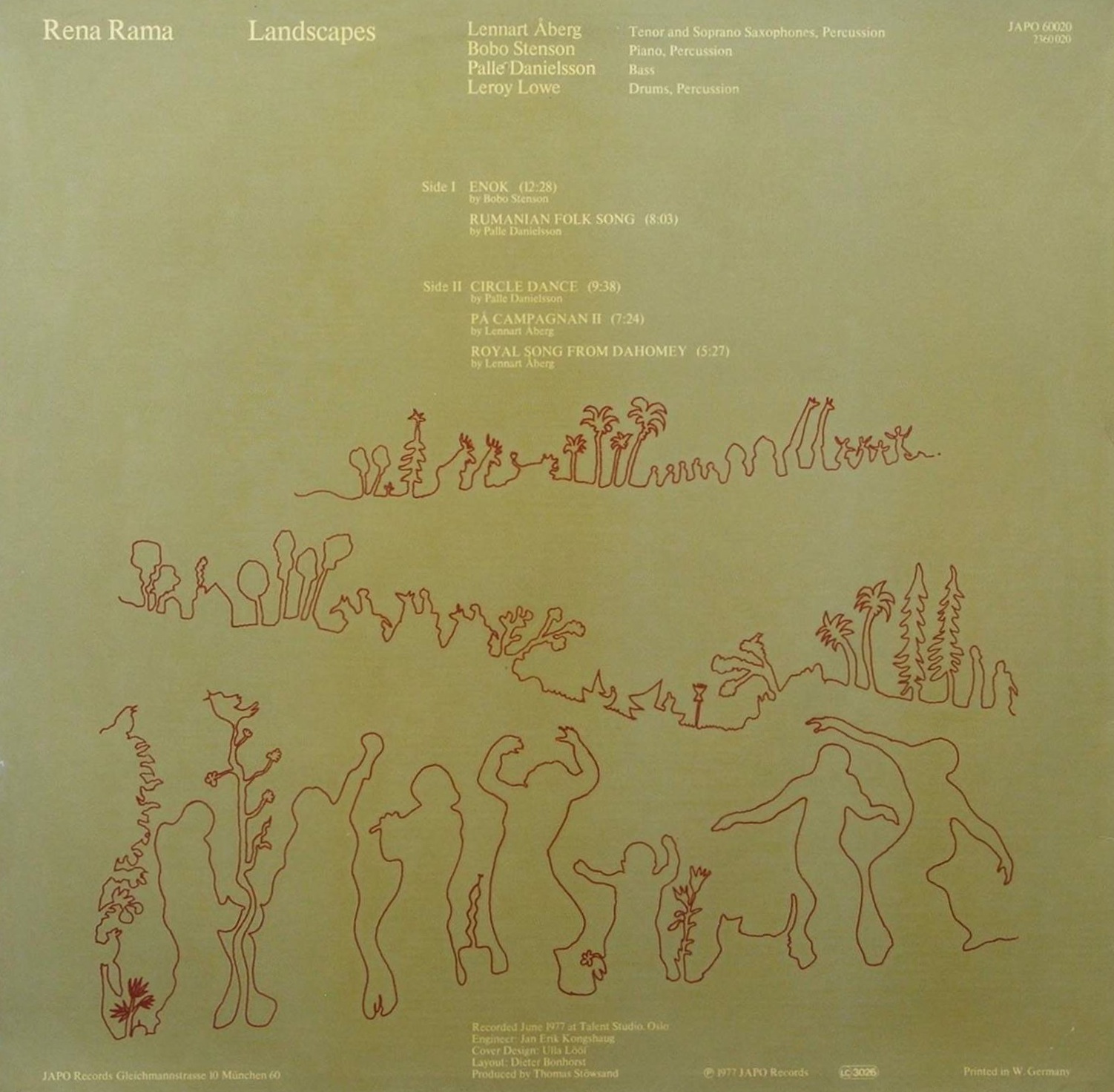
From the drum solo that opens the Stenson-penned “Enok,” it’s clear that Lowe was a moving force in this outfit. Colorful as an ice cream shop’s selection of toppings, he opens a spacious sound together with Stenson’s entrance, to say nothing of Thomas Stöwsand’s engineering, while Danielsson adds good vibes to the growing message. With this skyward energy behind him, Åberg need only open his wings and let the wind do the talking. That powerful tenor sheds its earthly weight in favor of a boisterous key that with its dancing unlocks gurgling leaps of intuition from Stenson. Danielsson offers two tunes. The composer’s darkly melodic intro in “Rumanian Folk Song” kicks into a light groove with Lowe along for the ride—the bed of the quartet’s energy. Stenson again scales the z-axis, landing only to relay his altitude to Åberg’s soprano. The latter, soft and sure, casts a gray spell. Throughout, the contours of the rhythm section are much like patterned cloth, wispy yet boldly imprinted. Stenson gives us the alphabet of “Circle Dance” before Åberg’s tenor puzzles it out into words and sentences. He is happy to wander far afield, knowing the band’s footprints will always catch up. A veritable tributary of invention. The reedman closes out with two compositions of his own. First is the soprano-infused “På Campagnan II,” which threads galleries of needles in single strokes of intuition. The pianism’s frenzied beauty and hip contributions from the rhythm section are surpassed only by Åberg himself. Those same infections spread in “Royal Song From Dahomey.” This caravan of purposeful melodizing is at once cold and warm and rains percussion on us as if in a desert without oasis.

Like most JAPO releases, this is another elusive jewel, but well worth the digging.


Sleeve back

OM: Rautionaha (JAPO 60016)

OM
Rautionaha

Urs Leimgruber soprano and tenor saxophones, bass clarinet, percussion
Christy Doran guitar
Bobby Burri bass
Fredy Studer drums, percussion
Recorded December 1976 at Tonstudio Bauer, Ludwigsburg
Engineer Martin Wieland
Produced by Thomas Stöwsand

The Swiss quartet of OM, which found just the freedom it needed in ECM’s studios for a good decade, flung open the doors with colorful aplomb on Rautionaha, a rare JAPO release. To this early date the group brings a kaleidoscope of shared experience. The sound is appropriately splintered. Guitarist Christy Doran pens the kick-in-the-gut opener, “For Ursi.” Unable to resist the attraction from the get-go, saxophonist Urs Leimgruber colors the twilight with his heady tenor, chaining ladders of virtuosity with attentive form. His gurgling expositions of momentary abandon give Doran just the break he needs to cast a reverberant magic with tails flying. The superb rhythm work from percussionist Fredy Studer and bassist Bobby Burri completes this wall of light. The latter gives us “Stephanie,” his first of two cuts. This meditation of gongs and electronics coalesces into some fine soliloquies from the composer, while the full drumming and six-string picking shimmer like morning sun on the horizon’s lip. The prickly tenor is a bonus. Speaking of which, Leimgruber puts his writing to the test in “Song For My Lady.” Something of a ballad, in it he becomes a crying wayfarer who walks the same circle of self-reflection until there is only music left of the one that produced it. Lifting this ponderous weight off our shoulders is Burri’s title offering, which grows like weed in a groovy embrace. His bass work glows here. Leimgruber opts for soprano, reaching heights of multi-phonic brilliance that no footstool can reach. The effect is nothing short of extraordinary. The quartet ends on a whimsical punctuation mark: a flag without a country, a star without a sky. In the absence of definite shape, we are free to induce our own.

Lennart Åberg: Partial Solar Eclipse (JAPO 60023)

Lennart Åberg
Partial Solar Eclipse

Bertil Lövgren trumpet, fluegelhorn
Ulf Adåker trumpet, fluegelhorn
Jan Kohlin trumpet, fluegelhorn
Håken Nyquist french horn, trombone, fluegelhorn
Stephen Franckevich trumpet (VI)
Lars Olofsson trombone
Sven Larsson bass trombone, tuba
Jörgen Johansson trombone (VI)
Lennart Åberg soprano saxophone, tenor saxophone, alto saxophone
Ulf Andersson alto saxophone, piccolo, flute
Tommy Koverhult soprano flute, tenor flute
Erik Nilsson baritone saxophone, bass clarinet, flute
Bobo Stenson piano, electric piano
Harald Svensson synthesizer (I, IV)
Jan Tolf electric guitar (I, II, III, VI)
Palle Danielsson bass (I-V)
Stefan Brolund Fender bass (I, II, VI)
Jon Christensen drums
Leroy Lowe drums
Okay Temiz percussion (I, II, III)
Recorded September 5-9, 1977 at Metronome Studios, Stockholm
Engineer: Rune Persson, Metronome
Produced by Håken Elmquist

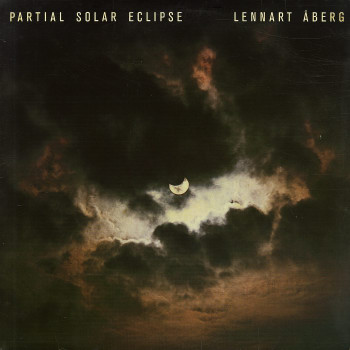
Swedish saxophonist Lennart Åberg assembles a force to be reckoned with for this out-of-print JAPO release. Fronting a 20-piece ensemble that includes early appearances by pianist Bobo Stenson, bassist Palle Danielsson, and drummer Jon Christensen, Partial Solar Eclipse plays out in a six-part suite of epic proportions. The trumpet-led swell of Part I gives way to a groovy bass line amid big band brilliance infused with Brazilian percussion (courtesy of Okay Temiz). A soaring solo from Åberg flirts with the clouds even as it transcends them in fiery sunset. The twinned bass action from Stefan Brolund and Danielsson impels the spirit toward Stenson’s winding finish. Out of these dense beginnings comes a mosaic of hues and textures. From the flanged ground line and backing horns of Part II, which sound like a warped version of “Baby, You’re a Rich Man,” to the oozing finality of Part VI, the album as a whole bursts with a jazz that squeals, “I made it!” Jan Tolf’s guitar work is the conclusive highlight, along with the florid and soulful tenor work of Åberg himself. Between the two we find the Motown edge of Part III, with its radiant flute and oceanic pianism, and the killer baritone work in Part IV of Erik Nilsson, who also unleashes a fabulous bass clarinet solo over the chalky backdrop of Part V.

This is an album that foregrounds itself by foiling the otherworldliness of all that came before. In so doing, it offers the glare of its namesake without the need for glasses. It’s an intense thrill ride, to be sure, but one that offers choice rewards even (if not especially) for those not tall enough to enter.