Jan Garbarek Group: Dresden – In Concert (ECM 2100/01)

Dresden

Jan Garbarek Group
Dresden – In Concert

Jan Garbarek soprano and tenor saxophone
Rainer Brüninghaus piano, keyboards
Yuri Daniel bass
Manu Katché drums
Recorded live October 20, 2007 at Alter Schlachthof, Dresden
Engineers: Gert Rickmann-Wunderlich and Rüdiger Nürnberg
Mixed by Jan Erik Kongshaug (engineer), Jan Garbarek, and Manfred Eicher
Produced by Jan Garbarek and Manfred Eicher

Dresden is monumental for being Jan Garbarek’s first live album. Monumental because, even as his crafted studio creations were capturing the hearts of countless listeners, so too were his performances across Europe and abroad. With his own group, the Norwegian saxophonist had crafted something special, and it was only a matter of time before its fire came through in the form of a less mitigated recording. Although it is unfortunate that Garbarek’s regular bassist, Eberhard Weber, was by this point too ill to join him on stage, he was formidably replaced by Yuri Daniel, interlocking with pianist Rainer Brüninghaus and drummer Manu Katché as if he’d always been among them.

With such an inventory of songs and experience from which to choose, Garbarek might have started in any number of places, but opens this concert with the lovely, free-flowing gem “Paper Nut.” First heard on Song for Everyone, one of two ECM collaborations with Indian violinist L. Shankar, it moves with all the synergy and assurance the present quartet has to offer. In addition to the unforgettable melody, sure to find a place in you the first time you hear it, it showcases some of Garbarek’s purest intonation on record. Clarion and unfalteringly naked, it cuts veins of mineral through the bedrock of jazz into the primal core beyond it.

The next point of reference is 1993’s Twelve Moons, from which the group renews three tunes: “The Tall Tear Trees,” “There Were Swallows,” and “Twelve Moons.” In each, the musicians interlock as listeners as much as players, Daniel’s bass laddering roots while Katché paints in a ritual filigree. The title tune is quintessential Garbarek, who finds himself lifted to new heights by Brüninghaus’s colorations as before riding an unaccompanied solo to finish. Legend of the Seven Dreams, from 1988, also gets a nod with the smoothly executed “Voy Cantando.”

The handful of new material introduced in this double-disc album is cause for celebration. From the forested pianism of “Heitor” to the beat-driven flights of “Nu Bein” (featuring Garbarek on the seljefløyte, or Norwegian overtone flute), there’s much to savor from everyone. Among these tunes is “The Reluctant Saxophonist,” which despite its tongue-in-cheek title (Garbarek’s playing is anything but reluctant) attains the most ambitious heights of the concert.

Non-Garbarek tunes include the pastoral “Rondo Amoroso,” arranged from the piece by Norwegian composer Harald Sæverud (1897-1992), and “Milagre Dos Peixes” (Miracle of the Fishes), written by Brazilian singer-songwriter Milton Nascimento and made famous by Wayne Shorter. Brüninghaus is again outstanding, pushing Garbarek to stronger depths, as also in “Transformations,” one of two remarkable solo interludes that rounds out the set. The other is “Tao,” Daniel’s moment in the sun. Balancing technical flourish with emotional flexibility, it proves him a worthy successor to the Weber legacy.

Dresden is, quite simply, the kind of album that makes one feel good to be alive. A classic before it was even recorded.

Steve Kuhn Trio w/Joe Lovano: Mostly Coltrane (ECM 2099)

Mostly Coltrane

Steve Kuhn Trio w/Joe Lovano
Mostly Coltrane

Joe Lovano tenor saxophone, tarogato
Steve Kuhn piano
David Finck double-bass
Joey Baron drums
Recorded December 2008, Avatar Studios, New York
Engineer: James A. Farber
Produced by Manfred Eicher

As John Coltrane’s original quartet pianist for eight weeks in the early months of 1960, Steve Kuhn is as qualified as anyone to assemble a fitting tribute to one of jazz’s eternal gurus. Despite his monumental significance in the field, ECM has reckoned with the Trane only sporadically—first on Dave Liebman’s Drum Ode and, most recently before this record, on Trio Beyond’s Saudades. Mostly Coltrane is, however, more than homage. It’s just as importantly a full-fledged portrait of the musicians bringing this music to renewed life. Saxophonist Joe Lovano has no pretensions of mimicking the man by whom 10 of the album’s 12 tunes were written or made famous. Bassist David Finck and drummer Joey Baron—the other sides of the Steve Kuhn Trio’s equilateral triangle—complete the group’s finely interwoven sound.

Kuhn, in that way he does, unpacks his solos one breath at a time, so that the considerations of “Welcome” offer a soft mapping of the road that lies ahead. Lovano is at the peak of his sentimentality, while Baron dances around the beat—Paul Motian in disguise. Lovano further threads the needle of “Song of Praise,” in which he tightens his grip on the higher notes like a dancing bird, touching wind one feather at a time until both wings sing in concert.

Kuhn may be the emotional center of the record, but his special sense of ebb and flow allows the crests of his bandmates to glint in the moonlight just as vividly. Lovano is irresistible in his luxuriant, chromatically infused takes on “Central Park West” and “Like Sonny,” while Baron provides gentlest uplift to his tarogato (a nod to Charles Lloyd?) in “Spiritual.” Other highpoints include two of Coltrane’s posthumous tunes: “Jimmy’s Mode” and “Configuration,” the former of which boasts an introspective solo from Finck, while the latter staircases its way into brilliance.

The two made-famous tunes—“I Want To Talk About You” and “The Night Has A Thousand Eyes”—are another remarkable pair. One traces its theme in retrograde, exuding sensuality in a trio-only setting. The other is a brisker tune in which the rhythmic section works a gorgeous telepathy, Finck the heartbeat of it all. Into this fray swoops Lovano like a bird who flies for sheer enjoyment, giant yet light on his feet. Marvelous.

Two more of a distant pair, this by Kuhn, rounds out the set. “With Gratitude” finds the composer solo, singing a song of dedication through his fingers. “Trance,” also solo, brings us full circle to his first ECM release of the same name, looking back in a rolling wave of light, thus signing off on a statement as timeless as the music it embodies.

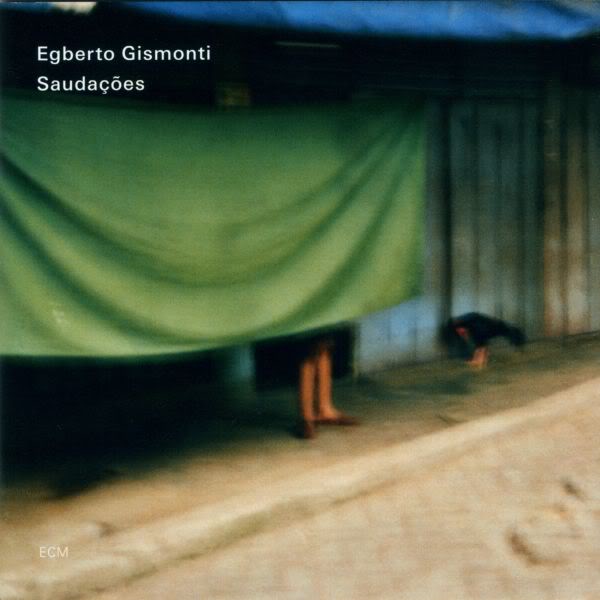
Egberto Gismonti: Saudações (ECM 2082/83)

Saudações

Egberto Gismonti
Saudações

Camerata Romeu
Zenaida Romeu conductor
Alexandre Gismonti guitar
Egberto Gismonti guitar
“Sertões Veredas”
Recorded August 2006, Teatro Amadeo Roldán, Havana
Engineer: Jerzy Belc
Assistant:  Argeo Roque Bernabeu
“Duetos De Violões”
Recorded April and May 2007, Mega Studio and Cecília Meireles Hall, Rio de Janeiro
Engineer: Márcio Gama
Assistant: Guthemberg Pereira
Executive producer: Manfred Eicher

Saudações, of which the title means “salutations,” marks the welcome end of a 12-year ECM hiatus for Egberto Gismonti since 1997’s Meeting Point. Whereas on that record he explored his conservatory training in a set of lively orchestral compositions with Gismonti as piano soloist, the first of this two-disc follow-up consists of Sertões Veredas, a suite in seven parts for strings alone, while the second disc features guitar duets and solos with the composer’s son Alexandre.

Seasoned Gismonti listeners will know what to expect from the program’s latter half. In addition to renditions of classic tunes, including “Lundú,” “Dança Dos Escravos,” and “Zig Zag”—each a bouquet of nimble, sparkling exposition—the duo soars through a veritable résumé of Father Gismonti’s uniquely tender ferocity. From subdued (“Mestiço & Caboclo”) to slipstream (“Dois Violões”), the performances emit a veritable brocade of fire. Alexandre contributes two solos to the program: the gentle, cyclical “Palhaço” (by Egberto) and the original “Chora Antônio.” Alexandre’s animations make them both album must-hears. After a few jagged turns, notably in “Dança,” Egberto ends by his lonesome with the title track, an adroit little bee of a tune that settles in a flower of harmonics.

Gismonti & Son play with freedom of detail, all the while holding fast to an underlying pulse that distinguishes so much of Egberto’s writing. Concentrated as they are, any one of these pieces might expand to an album’s length without loss of potency. In a sense, this is the feeling behind the orchestral suite that begins the album. As always, Gismonti paints a world proper, a landscape of vivid memories, childhood impressions, and mature reflections—all tied together by a love for his homeland and its peoples. Subtitled as a “Tribute to Miscegenation” (Tributo à miscigenação) and played with vivaciousness by Cuba’s Camerata Romeu, it is a heartfelt tribute to—and preservation of—times and places clearly dear to him, all intermingling in a new continent.

The cornucopia of influences from which he has drawn is already apparent in the first movement, of which the spirit remains very much rooted in the composer’s guitaristic panache (even his pianism, heard elsewhere, turns the keyboard into an enormous, fretted instrument). More than the instrument’s mechanics, its immediate tactility carries over into the scores, which sound like magnified string quartets. Gismonti’s attention to the orchestra’s lower end is especially robust, the double basses providing pulse, melodic undertow, and soil for botanical riches above ground. The occasional cello line acts as a link between dynamic extremes, leaving the violins to pollinate, as they will. Each movement is a suite of its own, moving from high to low, slow to fast, loud to soft in a heartbeat. The most obvious references are to Stravinsky (Part IV), John Adams’s Shaker Loops (Part V), and even the romantic touch of a Mendelssohn (Part VI), leaving the final part, an ode to folk traditions and dances, to bask in the resolution of camaraderie.

Speaking of attention, Saudações is recorded with just the right balance of intimacy and mountainous space. Peak slope into a valley of riches, each more scintillating than the last. A treasure trove for Gismonti fans. Even more so for newcomers. Either way: leave your shoes at the perimeter and step into the circle as you are.

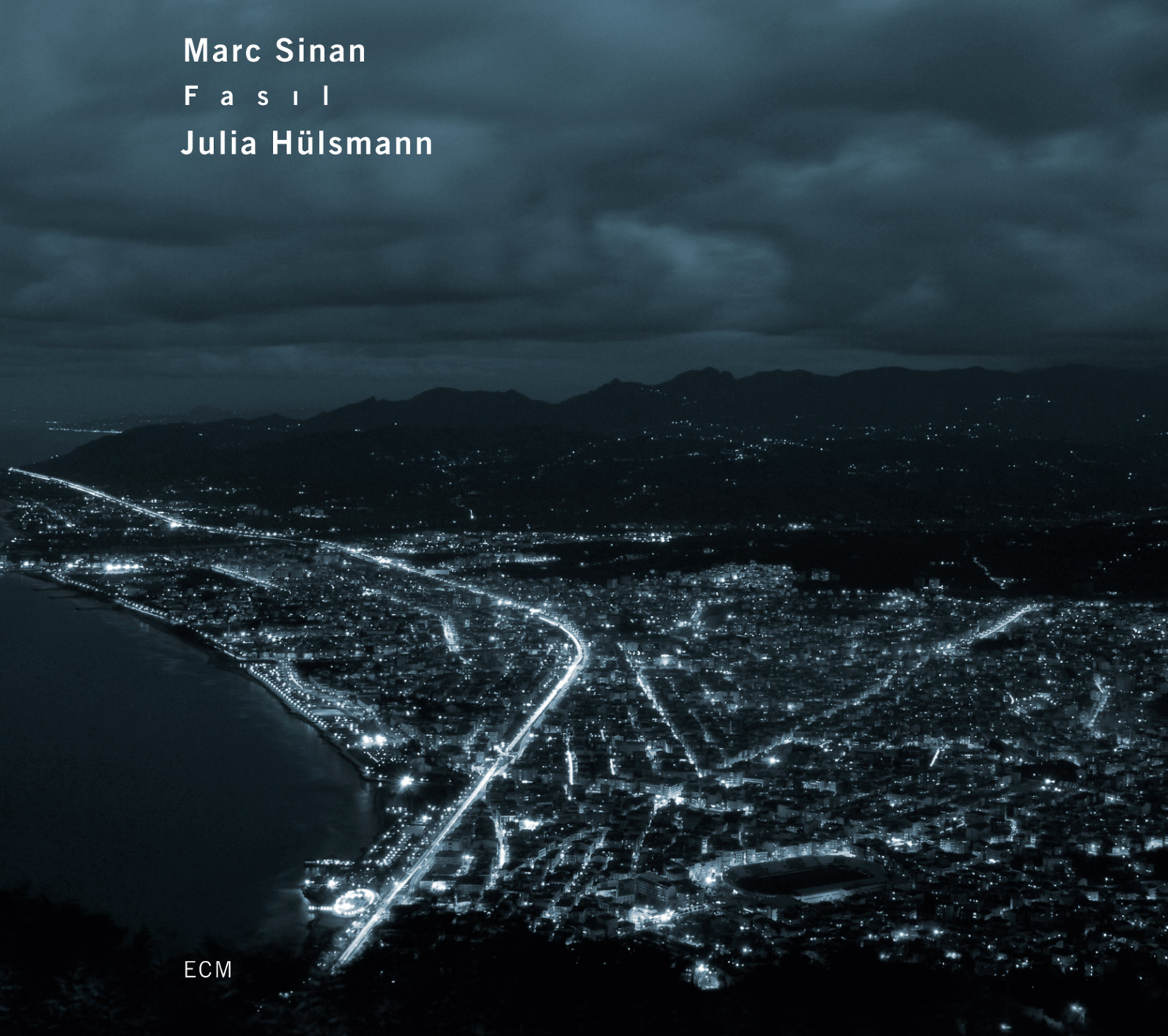
Marc Sinan/Julia Hülsmann: Fasıl (ECM 2076)

Fasıl

Marc Sinan
Julia Hülsmann
Fasıl

Marc Sinan guitar
Yelena Kuljic vocals
Lena Thies viola
Julia Hülsmann piano
Marc Muellbauer double-bass
Heinrich Köbberling drums, percussion
Recorded March 2008 at Rainbow Studio, Oslo
Engineer: Jan Erik Kongshaug
Produced by Manfred Eicher

Guitarist and composer Marc Sinan, recently of the (sadly) European-only release Hasretim, made his ECM debut with Fasıl, an album of enduring originality and refinement. The title refers to a suite form used in both classical and modern Ottoman ensemble music, and which here would seem to nod in both directions. It’s almost unfortunate that the Turkish word should so closely resemble the English “facile,” for the music here is anything but superficial. By way of comparison, one might pair it with Jon Balke’s SIWAN, as Balke illuminates and draws out likeminded ethnomusical connections with care.

Siwan’s own fasıl tells the story of ‘Ā’ishah bint Abī Bakr (613/14-678), youngest and favorite wife of the Prophet Muhammad. In this fresh musical context, her sentiments twirl and float by turns along a river’s current of rhythmic libations. Librettist Marc Schiffer weaves into those sentiments influences ranging from the Qur’an to ancient Persian poetry in search of common ground. Pianist Julia Hülsmann’s trio with bassist Marc Muellbauer and drummer Heinrich Köbberling—the subject of such later albums as The End of a Summer and Imprint—flexes the project’s instrumental spine. They are joined by violist Lena Thies, Sinan on guitar, and the Serbian-born, Berlin-based singer Yelena Kuljic in the role of ‘Ā’ishah.

The album begins, as does any fasıl performance, with an instrumental “Peshrev,” which lowers us gently into the waters of this emotionally dynamic world. It is a world of comfort and challenge, a quilt of geographical distances made immediate by design. Other traditional movements include iterations of the taksim, an improvisational interlude which unspools purple braids from Hülsmann’s interpretive fingers. Through these run the finer threads of Sinan’s flamenco-esque strumming and Thies’s spirited bowing. Sinan augments these with two movements based on transcriptions of an imam (Islamic cantor) he recorded while conducting research for this project in Turkey. “Sure 6/51” and “Sure 81 Taksimi” revolve around Hülsmann’s rhythm section, guitar and viola taking respective turns in the lead.

Yet it is by virtue of Kuljic’s portrayal of ‘Ā’ishah that the album comes into its own. Beginning with the drawing of desire that is “This Bloody Day” and ending with the affirmative “You Open My Eyes,” her voice sheds light by which to see. She explores themes as wide-ranging as agency and politics (“Taking Leave”), the body as landscape (“The Last Night”), and, couched in the album’s most entrancing melody, the intertwining of lives under Heaven (“The Dream”). Sinan rocks a lovely fulcrum in the latter through a smooth, jazzy core, and lends his flexible architecture to “The Struggle Is Over,” carving a sliver of moon into the sky.

All in all, these are songs of holdings on and lettings go. The instrumental elaborations are thoughtful (and thought-provoking), unraveling richly dyed sacraments in sound. At their heart is a song entitled “The Necklace.” It is a pivotal moment, both in the lives of its characters and of this cycle as a whole. It refers to story recounted in the Qur’an, in which ‘Ā’ishah, during one of Muhammad’s desert raids, is mistakenly left behind when she goes looking for a lost necklace and returns to camp to discover that her caravan has departed without her. She is found by a nomad under Muhammad’s employ named Sufwan and taken to the next campsite, only to be met with gossip of infidelity. Unbelieving of these rumors, Muhammad takes his wife’s word on faith (albeit after a revelation from Allah confirms her innocence), and her accusers are summarily punished. It speaks volumes about a woman whose strength thrived in her resolve, in her resistance to a world of men, and in her refusal to let her integrity fade into the dunes.

Dino Saluzzi Group: El Valle de la Infancia (ECM 2370)

El Valle de la Infancia

Dino Saluzzi Group
El Valle de la Infancia

Dino Saluzzi bandoneón
José Maria Saluzzi guitar, requinto guitar
Nicolás “Colacho” Brizuela guitar
Felix “Cuchara” Saluzzi tenor saxophone, clarinet
Matias Saluzzi electric bass, double bass
Quintino Cinalli drums, percussion
Recorded March-May 2013 at Saluzzi Music Studio, Buenos Aires
Production coordination: José M. Saluzzi
Recording engineer: Néstor Díaz
Mix and mastering: Stefano Amerio
Album produced by Manfred Eicher

Over the past three decades of his association with Munich-based ECM Records, Argentine bandoneón virtuoso Dino Saluzzi has built a new home, but through his output on the label has traced so far back down his old roots that with El Valle de la Infancia (The Valley of Childhood) he might at last have reached the center of the earth. Playing once again with his “in-house” band, last heard with slightly different personnel on 2006’s Juan Condori, he emotes seamlessly with brother Felix on reeds, son José on guitars, and nephew Matías on electric and upright bass. Guitarist Nicolás Brizuela and percussionist Quintino Cinalli round out the extended family portrait. As ever, Dino’s humble beginnings (his father worked on a sugar plantation and played the bandoneón in his spare time before becoming a noted composer himself) manifest themselves in every note, and he credits them with freeing his creative approach. Dino’s mastery is thus so organic that to name it as such barely renders a sketch of his capabilities, as evidenced by this latest excursion. As it turns out, the valley of his childhood is a bountiful place to be.

The program of Infancia juxtaposes standalone pieces alongside compact suites, all of which blend into a meta-narrative dotted by contemplative pauses. At its core, the music (mostly by Dino himself) thrives on warm, impressionistic feelings, so that whenever the band does cohere, the effect is dazzling. “Sombras” welcomes new listeners to one of the most recognizable sounds in all of modern South American music, and old listeners to a familiar, paternal squeeze of the shoulder. The title means “shades” and connotes a mission statement Dino has been crafting since he first laid hands on bellows. His bandoneón exhales magic so potent and with such familiarity, one would swear to have been born in the presence of its melodies. After an intimate introductory sweep, José’s guitar (occupying the mid-left channel) opens its currents and inspires Father Saluzzi to low-flying surveys. Cinalli’s brushed drums (there’s nary a stick to be discerned on the album) lighten the weight of their memory.

Biological linkages strengthen in “La Polvadera” and “A mi Padre y a mi Hijo” (For My Father and Son), each a coming together of such thematic clarity as to whisk the heart away on a cloud. Brizuela’s picking (mid-right channel) contrasts verdantly with José’s nuanced flutter and sway. The two guitarists combine beautifully over butterfly-kissed snare and cymbals in “Churqui.” Cinalli’s rhythmic details make the scenography all the more believable. His patter may be that of rain one moment, the next of a magician who excels in misdirection.

The album’s mini-suites usher in colors from adjacent plains, where crops give way to the tilling of a new generation. Ranging from two to five parts each, the suites cover a range of emotional stirrings and interpret tunes by a handful of late Argentine folk singer-songwriters among Dino’s own. Moods vary accordingly. From the dissonant rainforest activity and droning resolution of “Urkupiña” to the guitar-driven medley that is “La Fiesta Popular,” motifs find their way through thickest forest and driest riverbed alike. Even “Tiempos Primeros,” which nods deepest toward folk traditions, balances images of sleeping and waking in the final curlicue of wind.

The tripartite “Pueblo” captures the band at its purest shade yet. Its introductory guitar solo (“Labrador”), written and played to angelic perfection by José, preludes a nocturnally realized “Salavina,” the most famous zamba (not to be confused with samba) of Mario Arnedo Gallo (1915-2001). The subtle unity forged therein carries over into Part III, the quietly majestic “La Tristecita” by Ariel Ramírez (1921-2010). As throughout the album, each instrument holds its own in equal measure, serving the depth of restraint over the allure of drama. That said, Felix’s tenor casts an inescapable spell: jazzy, gritty, and tasting of soil. All of which labors to remind us that even the most ethereal prisms of art extract their light from the embers of that which came before.

(See this article as it originally appeared in RootsWorld online magazine, where you may also hear samples.)

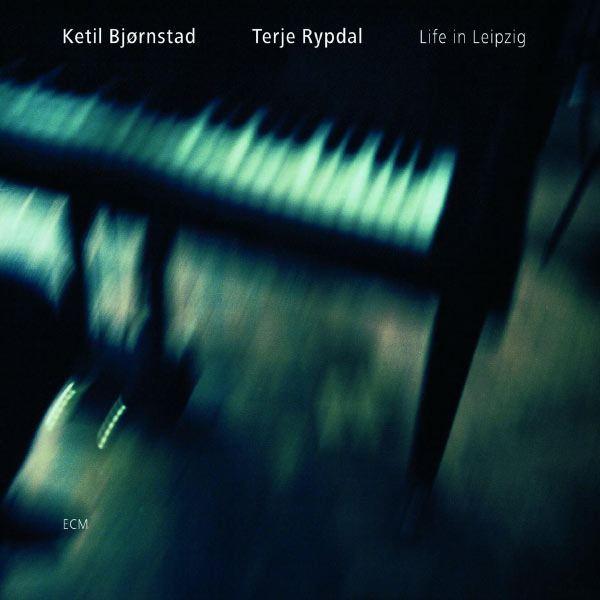
Ketil Bjørnstad/Terje Rypdal: Life in Leipzig (ECM 2052)

Life in Leipzig

Life in Leipzig

Ketil Bjørnstad piano
Terje Rypdal guitar
Recorded live by MDR, October 14, 2005 during the Leipziger Jazztage
Engineer: Matthias Sachers
Produced by Christian Cerny

Pianist Ketil Bjørnstad and guitarist Terje Rypdal present a parallel universe to the former’s duo recordings with cellist David Darling. Despite having performed with Rypdal more than any other musician, Bjørnstad makes here his album debut with Rypdal as a duo. Recorded live at Leipzig’s Opera House in 2005, this document finds both musicians unmasked and in prime lyric form. They are also more focused and impactful in their playing, needing only to listen to each other and to the muses guiding them to sing.

With a Bösendorfer piano at his fingertips, Bjørnstad elicits a heavier sound not heard on previous projects. “The Sea V” thus begins the set in rather dark territory for Bjørnstad, whose lyricism tends to skim the waterline. Only now it scours the ocean floor, a ghost from some ancient wreckage clawing silt and coral into musical rebirth. The pianism gradually turns into sparkle, while Rypdal’s fire remains untainted by the waves—if anything, enlivened by them. Thus the album offers its first of a handful of reprises from The Sea, including also Nos. II and IX. Both overflow with aching nostalgia, the mode of speech between the duo so heartwarming that you’d swear you’ve heard it before, even if for the first time. The latter tune treats us to some rare strumming from Rypdal for a webbed, Bill Frisell-like effect.

Other tracks link back to further group collaborations. From Bjørnstad’s Water Stories we get the utterly fragile “Flotation And Surroundings,” for which Rypdal’s subdued, mid-heavy whispers bob like petals on water, while Bjørnstad dips into some crisp, jazzy playing that takes a page out of Keith Jarrett’s vast book. This in turn elicits from Rypdal a crispness of his own as he carves out a fiercely melodic solo. “By The Fjord” comes by way of The Light. Originally written for voice, it gains even truer vocal quality by virtue of Rypdal’s introspection. His is a physiological bed made up in sheets of gold.

The guitarist’s own Skywards gets props with “The Pleasure Is Mine, I’m Sure.” There or here, it is a luscious and soaring thing, equal parts muscle and fragrant breeze. Two references to If Mountains Could Sing also put Rypdal in the spotlight. The overlapping guitars of “Le Manfred / Foran Peisen” whip up a fiery solo replete with grungy delays. This is a profound moment in the program, and a bursting foray into Rypdal’s cosmology. Fan favorite “The Return Of Per Ulv” closes out the concert in a spirited version. This has a different quality with only a piano to back it. One can almost see it relegated to the corner of a nondescript tavern, even as it blasts its message across tundra and sand. Rypdal’s soloing takes this one to new heights…and depths.

Three standalones round out the set. “Easy Now,” excerpted from Rypdal’s Melodic Warrior, receives an astonishing treatment. Rypdal navigates its chordal landscape with his eyes closed and his pick telepathically attuned to every change in wind. And a fragment of Edvard Grieg’s “Notturno,” a short piano solo with slightest shadows, shifts into a short piece by Bjørnstad entitled “Alai’s Room,” another solo so pretty that might have upset the balance had it been any longer. It offers just enough reprieve.

Even at its most sensitive, the duo maintains an epic quality to its playing. About as good as it gets from either man, and a sheer joy to have them—and no one else—together at last.

Ketil Bjørnstad: The Light (ECM 2056)

The Light

The Light

Randi Stene mezzo-sopran
Lars Anders Tomter viola
Ketil Bjørnstad piano
Recorded February/March 2007 at Rainbow Studio, Oslo
Engineer: Jan Erik Kongshaug
Mixed by Jan Erik Kongshaug, Ketil Bjørnstad, and Manfred Eicher
Produced by Manfred Eicher

“Longing itself is a pledge that what we long for exists.”
–Karen Blixen

Ketil Bjørnstad has left a nuanced yet indelible trail through ECM’s forest, leading to the beacon that is The Light. The more he creates, the less ornamental his music becomes, so that here we have distilled melodies and grander human themes that can breathe. Subtitled “Songs Of Love And Fear,” this album is essentially his second for the label as nominal leader, following 1993’s Water Stories. And while many subsequent collaborations, including his classic sessions among the “Sea” quartet (with David Darling, Terje Rypdal, and Jon Christensen), have rendered water his theme par excellence, now he treads the currents of an equally fundamental force of life.

As any Bjørnstad listener knows, the Norwegian pianist and composer has always had a flair for clear and evocative melodies, and fans will surely find their expectations well met in this album’s two song cycles. The strength of this record, then, lies in its personnel. Bringing new depth to the Bjørnstad aesthetic are singer Randi Stene’s and violinst Lars Anders Tomter, the second of whom adds a dash of reality to the dreamlike qualities of the piano-voice telos. Indeed, these songs would seem to reference the great lieder of European art music in spirit, albeit by means of a more translucent architecture.

Bjørnstad’s Fire Nordiske Sanger (Four Nordic Songs) represent three decades of writing, performing, and refinement. It is, perhaps, no coincidence that the Norwegian word for “four” should mimic the English “fire,” for that is indeed the type of inner glow brought to every verse. The personal feel of “Grensen” (The Border) sets the tone. Written for his wife’s 50th birthday in 2006, it is the most recent of the four songs and reads like a love letter. “Sommernatt Ved Fjorden” (By The Fjord), on the other hand, was written in 1978 and has since become, much to the composer’s surprise, a favorite on the Norwegian pop charts. Imagistic contrasts also abound, as between the rustically inflected “Natten” (The Night), in which the viola takes on a narrative role, and the cinematic “Sommersang” (Summer Song), which follows the emotions of its protagonist—the song was, in fact, written for Stene—with the precision of a tracking shot.

The album’s remainder and title piece sets eleven poems by John Donne (1572-1631). While the vagueness of Donne’s poetry has always been key to its appeal, here it is leveled by the music’s even keel, balancing absence with substance and stillness with life.

In songs like “A Valediction: Of Weeping,” “The Dream,” and “The Prohibition,” the words teeter between surrender and command, while in “Air And Angels,” “Love’s Alchemy,” and “Break Of Day,” love assaults the eyes like two transparencies of the same image bumped slightly askew. Nevertheless, the connective spirit of Bjørnstad and Tomter holds on to a vision of unity in the shadow of Stene’s voice, especially in their instrumental interlude, “Lamentoso.”

Moments of unity abound elsewhere. “The Flea” is both one of Donne’s most intriguing poems and receives here an equally vivid melodic treatment. “A Nocturnal Upon St. Lucy’s Day, Being The Shortest Day” is a morsel of comparable skill, weighted by the pall of a long winter, that finds its renunciations answered in “The Sun Rising,” in which rooted pianism evokes the grip of Donne’s passions. Finally, “A Hymn To God The Father” points to the poet’s devout core, where faith in heavenly blessing wraps his fears of death until they dissolve. This is where the album’s light truly shines through, exploring through prayer a love secluded from a world that would pick it clean if given the chance.

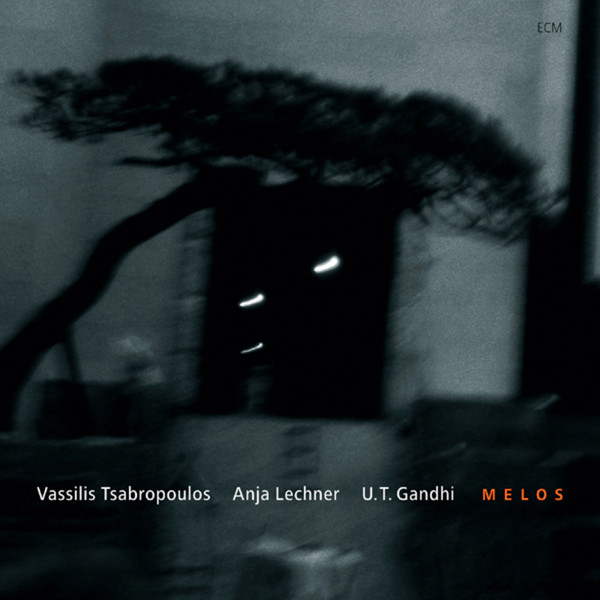
Tsabropoulos/Lechner/Gandhi: Melos (ECM 2048)

Melos

Melos

Vassilis Tsabropoulos piano
Anja Lechner violoncello
U. T. Gandhi percussion
Recorded June 2007, Auditorio Radio Svizzera
Engineer: Stefano Amerio
Produced by Manfred Eicher

The second album from Greek pianist Vassilis Tsabropoulos and German cellist Anja Lechner, would seem to be a sequel to Chants, Hymns and Dances, but is in many ways a restructuring of that same cosmos rather than a parallel universe to it. The music of G. I. Gurdjieff again provides the heliocenter around which the compositions of Tsabropoulos and fragments of Byzantine hymns coalesce into planets and satellites, respectively. Drummer U. T. Gandhi, making his sophomore ECM appearance following his label debut with the Dino Saluzzi Group on Juan Condori, adds new colors to the project.

The title of Melos refers to the arrangement of notes into a discernible tune (hence: melody), and in this respect its contents succeed beautifully. The title track starts the album with an all-encompassing embrace. Lechner navigates Tsabropoulos’s delicate ostinato in such a way that, even as the pianist continues exploring the ripple effect of her measured silence, when the cello reprises the theme, it does so newly fortified with sacred energy. This feeling of chant, meditation, and return suffuses all that follows, so that mellower songs (for that is indeed what they are) and livelier dances become yin and yang to the program’s overall equilibrium. At its most heartbreakingly lyrical, as in the two so-called “Songs Of Prosperity” and “Song Of Gratitude,” the music retains a bright antiphony throughout. Even “Simplicity,” a piano solo of great solemnity, shines with life force.

Tsabropoulos’s notes often rise like smoke from the swinging censer of Lechner’s bowing, growing especially animated in “Reflections” and its counterpart, “Reflections And Shadows.” At around two minutes each, these lively miniatures compresses an entire history’s worth of joy into vibrant, spinning cores. Such characterization holds truer in the trios, where Gandhi’s contributions feel wedded to every underlying impulse. His cymbals crest ebony waves in the exquisite “Gift Of Dreams,” expand to a broader percussive palette in “Promenade,” and attain broadest harmony in the jazzier “Vocalise.” For “Tibetan Dance,” the first of three strategically positioned Gurdjieff tunes, he adds a distinctly soft touch, and likewise imbues “Sayyid Dance” with the delicate propulsion of a Manu Katché joint. “Reading From A Sacred Book,” on the other hand, unfurls a percussionless banner, pointing to Keith Jarrett’s own reading on the seminal Sacred Hymns, making it all the more appropriate that the present album should end with the title “In Memory,” in which is encoded a shaded smile of gratitude.

The atmosphere of Melos should be of particular interest to fans of The Sea and, even more so, The River. Not because this album has a particularly aquatic feel, but because its combination of sounds and textures yields comparable atmosphere. In addition to its clarity of engineering, Melos is notable for the ordering of its tracks. Just when the music becomes too pretty, it recedes into a shadow or twisted cavern (cf. “Evocation”), where it meditates on the irregularities of life and this fragile world supporting them.

(To hear samples of Melos, click here.)

Norma Winstone Trio: Distances (ECM 2028)

Norma Winstone Trio
Distances

Norma Winstone voice
Glauco Venier piano
Klaus Gesing bass clarinet, soprano saxophone
Recorded April 2007 Artesuono Recording Studios, Udine
Engineer: Stefano Amerio
Supervision: Guido Gorna
Editing and mixing: Stefano Amerio and Manfred Eicher
Produced by Manfred Eicher

German reedist Klaus Gesing and Italian pianist Glauco Venier join the ECM roster for the first time in an astonishing trio album with veteran singer and lyricist Norma Winstone. Whereas in her past efforts for the label Winstone used her voice as much as a melodic tool as an agent of song, here she steeps the listener in a richly textured feeling not experienced since her 1987 masterpiece, Somewhere Called Home.

“Distance” sets the stage not only thematically, but also musically. The tune is by Venier, whose gentle ostinato exudes an atmosphere that is as weightless as Winstone’s lyrics are gravid. The whispers of Gesing’s bass clarinet complete this portrait of a subterranean world run dry. A prologue to an album of prologues.

Venier further pens “Gorizia” and “The Mermaid.” The former is a halting and wordless waltz that dissolves like ink in water, while the latter is another lyrical bird’s nest. Winstone and Gesing respectively provide words and music for “Drifter” and “Giant’s Gentle Stride,” both adaptive verses that sweep through the composer’s gorgeous reed work with ease. Winstone deepens the circle in “Remembering The Start Of A Never Ending Story,” set to the music of pianist Hubert Nuss. What begins as a play of light and glass finds solace through the soprano’s wide-flung window. In the haunting “Ciant,” Winstone sings words by Italian director Pier Paolo Pasolini to the tune of Erik Satie’s Petite Ouverture à danser, the peaks and valleys of which become interchangeable, each the yin to the other’s yang.

Winstone and her telepathic trio also reverse-engineer popular songs to an elemental sort of understanding. The Cole Porter chestnut “Every Time We Say Goodbye,” for one, pairs her and Gesing’s soprano to stunning effect. Moving like wings in concert, the duo reads the wind as Venier follows their birdlike shadow. Their version of Peter Gabriel’s “Here Comes The Flood” shines even brighter. Against a backdrop of palpable color, its celestial interpretations and earthly ruminations combine with the precision of a chamber music ensemble.

Finishing off the album’s eclectic stride is “A Song for England,” which finds the trio improvising on a Caribbean calypso, with words by Jamaican-born writer Andrew Salkey. The bass clarinet’s rhythmic support buoys a purely melodic Winstone before switching over to discernible lyric amid a shower of whimsy.

Distances is an album one wishes could go on and on. That said, its compactness offers plenty to rediscover on repeat listening. Combinations like this happen only rarely, and Winstone’s puzzle comes out of the box completed, glued together, and glowing with atmosphere. Hers is a voice that sings not because it must be heard by the world, but because it must itself hear the world. It speaks only of what it has known.