Silent Dominions: Walking the Path with Upshaw and the ACO

Australian Chamber Orchestra
Richard Tognetti artistic director
Dawn Upshaw soprano
Guest musicians for Winter Morning Walks:
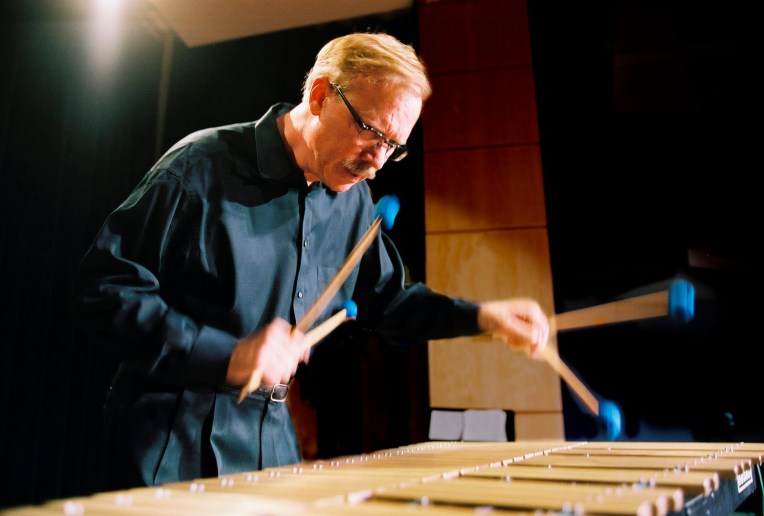
Scott Robinson clarinets
Jay Anderson bass
Frank Kimbrough piano
Bailey Hall, Cornell University
April 27, 2012
8:00 pm

Since 1975, the Australian Chamber Orchestra has built a reputation for adventure. For this we can thank longtime director Richard Tognetti, whose eclectic programming has brought the orchestra back on its feet, lending every performance a dynamic edge that few chamber ensembles can match. For Friday’s performance at Bailey, which capped off a successful academic year for Cornell’s premier concert venue, the already phenomenal outfit was joined by soprano Dawn Upshaw, whose voice turned every word sung into a morsel of sonic caramel.


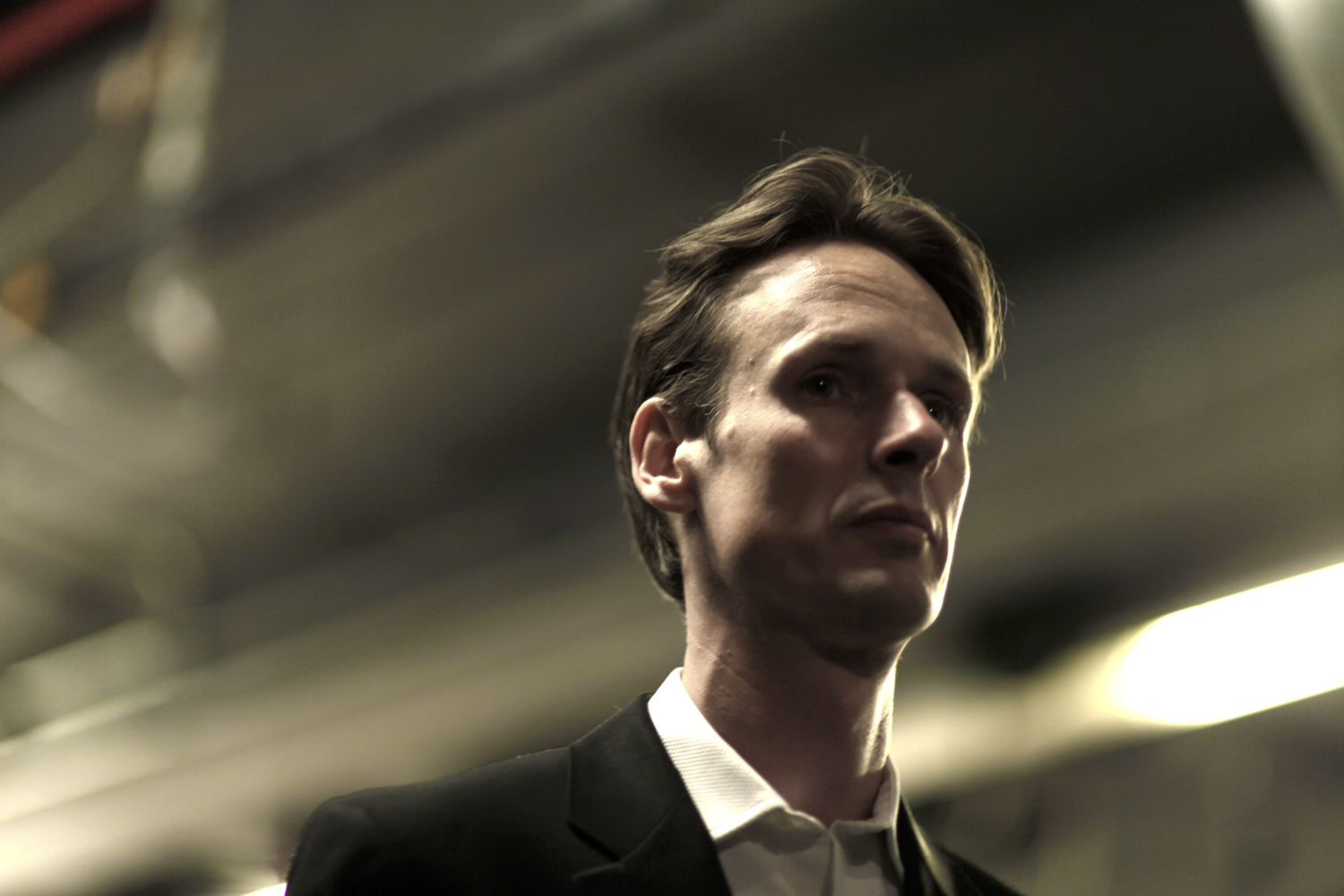
Upshaw

Yet before she even took the stage, I was overjoyed to discover that the ACO was to start us off on a bold foot with selections from George Crumb’s Black Angels. This work was something of a touchstone in my formative explorations of twentieth-century music, and to hear it live at last was thrilling. It may or may not have been the most perplexing facet of the concert for those unfamiliar with the opening blast of Threnody I: Night of the Electric Insects. Horror fans will have recognized it from the 1973 classic, The Exorcist. Yet as I imagine was clear from the reaction of Friday’s audience—which began with a few chuckles of surprise (mingling with some, like mine, of nostalgic recognition) and ended with sighs of wonder—Crumb’s sound-world is less about fear and more about the music hidden in our shadows. The precision of the score also means that the Black Angels experience is carefully marked: we can trust in the composer’s obsessions.

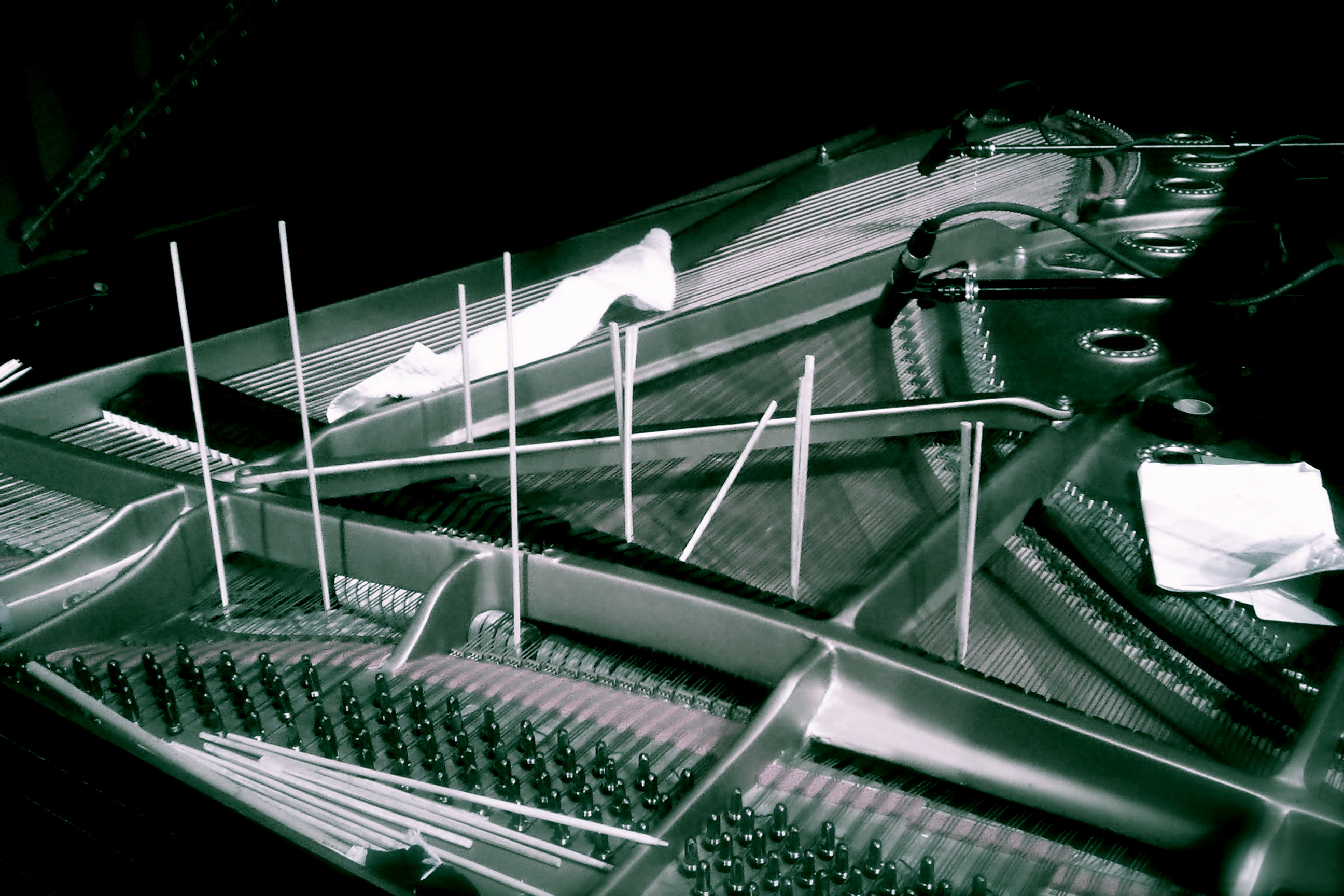
The Five Pieces for Strings of Anton Webern, into which selections from Black Angels were shuffled, may on paper seem a curious weave. Yet as pairings before—with Shostakovich, Fauré, Stravinsky, and, most profoundly, Bach—have shown, the young Darmstadter’s music lends itself to a wide range of company, whose works provide windows, if not mirrors, of interpretation. From the sinewy, ghostly chasms of the opening movement to the whispered conversations of the last, the Five Pieces strike a balance all their own. The fourth and fifth, however, couched one of the evening’s most transcendent turns in the form of Crumb’s God-music, the beauties of which seemed to win over even the most resistant traditionalists. The movement featured tuned crystal glasses, each filled with water and bowed to ethereal effect while a cello wept in solitude, suspended from the stars in a sky blinded by battle smoke and wasted lives. It cried like an operatic scene change, revealing something in the night which can only be played but never sung, lest the voice lose itself in its own spell.

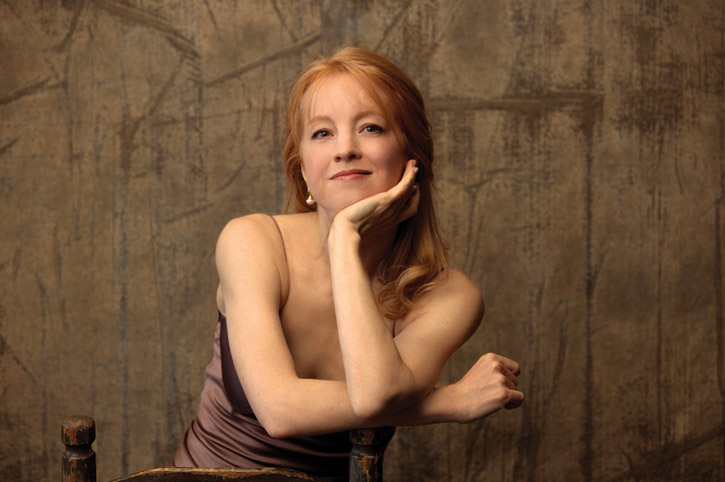
In light of this startling prelude, Maria Schneider’s Winter Morning Walks, written for Upshaw, was like a massage after a grueling work week. For this Schneider drew on the poetry of Ted Kooser, whose unassuming Americana went down like sunset. Improvisation literally took center stage in the form of a jazz trio comprised of clarinet, bass, and piano. The wintry whip of the air struck us in the opener as the trio folded itself into the orchestral batter—a mere taste of the confections to follow. Schneider’s mastery of her palette became evident in the second song, “When I switched on a light,” which evoked the fluttering of moths on the piano’s dampened strings. A similar panache was to be found in the swirls of “I saw a dust devil this morning” and later in the incessant gales of “Our finch feeder,” the latter describing a group of birds struggling against the wind in the name of sustenance. Yet it was the third, “Walking by flashlight,” which was the evening’s highlight. This piece was cinematic to the utmost: an early-morning walk, animals peering out from the bushes at a protagonist who describes his circle of light on the ground as “the moon on a leash.” Lovely improvisations from pianist Frank Kimbrough made the experience all the more sweeping. From the first, one could see the concentration on Upshaw’s face as she attuned herself to every mood and image. Her unparalleled diction and deferential temperament broke the fourth wall and then some, and in the jazzy lows of “Spring, the sky rippled with geese” we were especially amazed by the depth of her range.

Schneider

My inaugural encounter with Upshaw was through her benchmark Nonesuch recording of Samuel Barber’s Knoxville: Summer of 1915. The work remains a personal favorite, and I can only say that the unfettered pastoralism of Schneider’s settings inspired anew what I heard in that first listening. These sentiments flowed logically into the three German lieder that followed intermission. In Robert Schumann’s Mondnacht (Moonlight), Upshaw seemed to bind Heaven and Earth with the power of her voice, while the two songs by Franz Schubert—Geheines (Secret) and the notorious Der Tod und das Mädchen (Death and the Maiden)—contrasted buoyant, flirtatious energy with the darkness of mortality. The latter’s low D rang soulful and true, ending the singer’s tenure for the night on a trail of liquid mercury.

In light of this, Arnold Schoenberg’s Verklärte Nacht (Transfigured Night) turned dusk into midnight. Named after the selfsame poem by Richard Dehmel, its unsung words draw us back to Kooser: “Two people are walking through a bare, cold wood; / the moon keeps pace with them and draws their gaze.” All the drama of a Wagner opera was compressed in this work for strings into a droplet of darkness falling in slow motion amid knots of evening cloud. Between every inhalation and exhalation the orchestra drew a chain of sometimes-overwhelming consummations. Each harbored something of the next, wandering sparkling meadows with moonlit footsteps amid a changing landscape of rustlings and baying winds. In spite of the title, some of Schoenberg’s brightest writing can be found here, and its slow build from stasis into infinity is one of the defining transformations of modern music. The ACO gave it heartrending justice.

Tognetti and company bring a crisp and earthly sound to everything they lay a bow to, and during the encore they drew the shades on their fiery passions with a haunting rendition of Astor Piazzolla’s pensive tango, Oblivion. Yet it was Upshaw whose voice rang clearest in my mind as I left the hall. I couldn’t help but recall the words she sang in the final song of Schneider’s cycle: “This morning the sun stood / right at the end of the road / and waited for me.” So, too, did the shining, life-affirming star of her gift wait for us at the end of this long and winding series, embracing us warmly and with hope on an unseasonably cold evening.

(See this article in its original truncated form at the Cornell Daily Sun.)
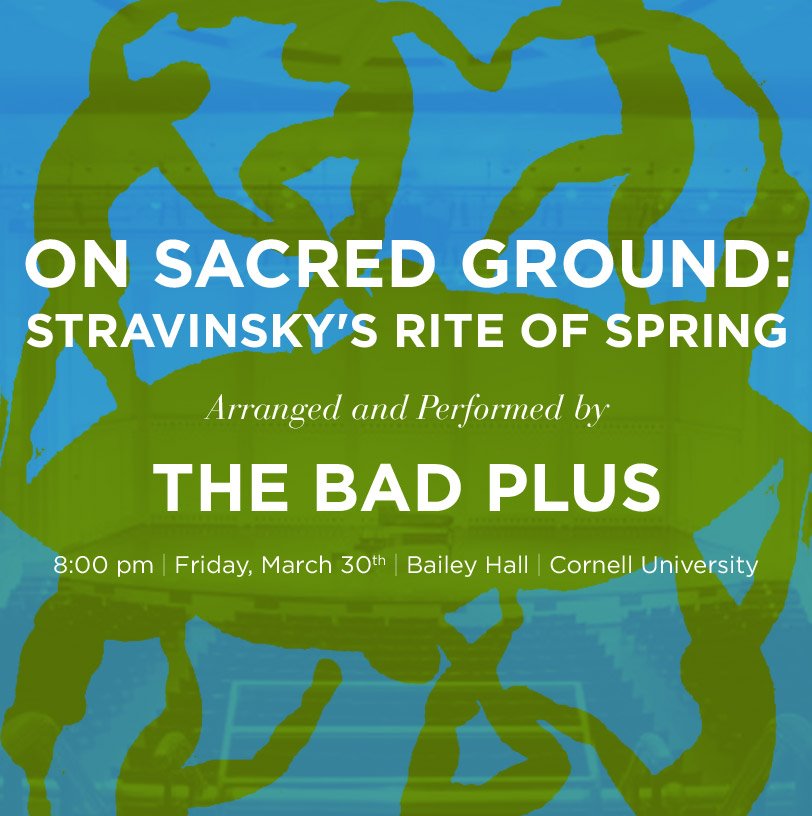
Rite On: The Bad Plus Take on Stravinsky and More

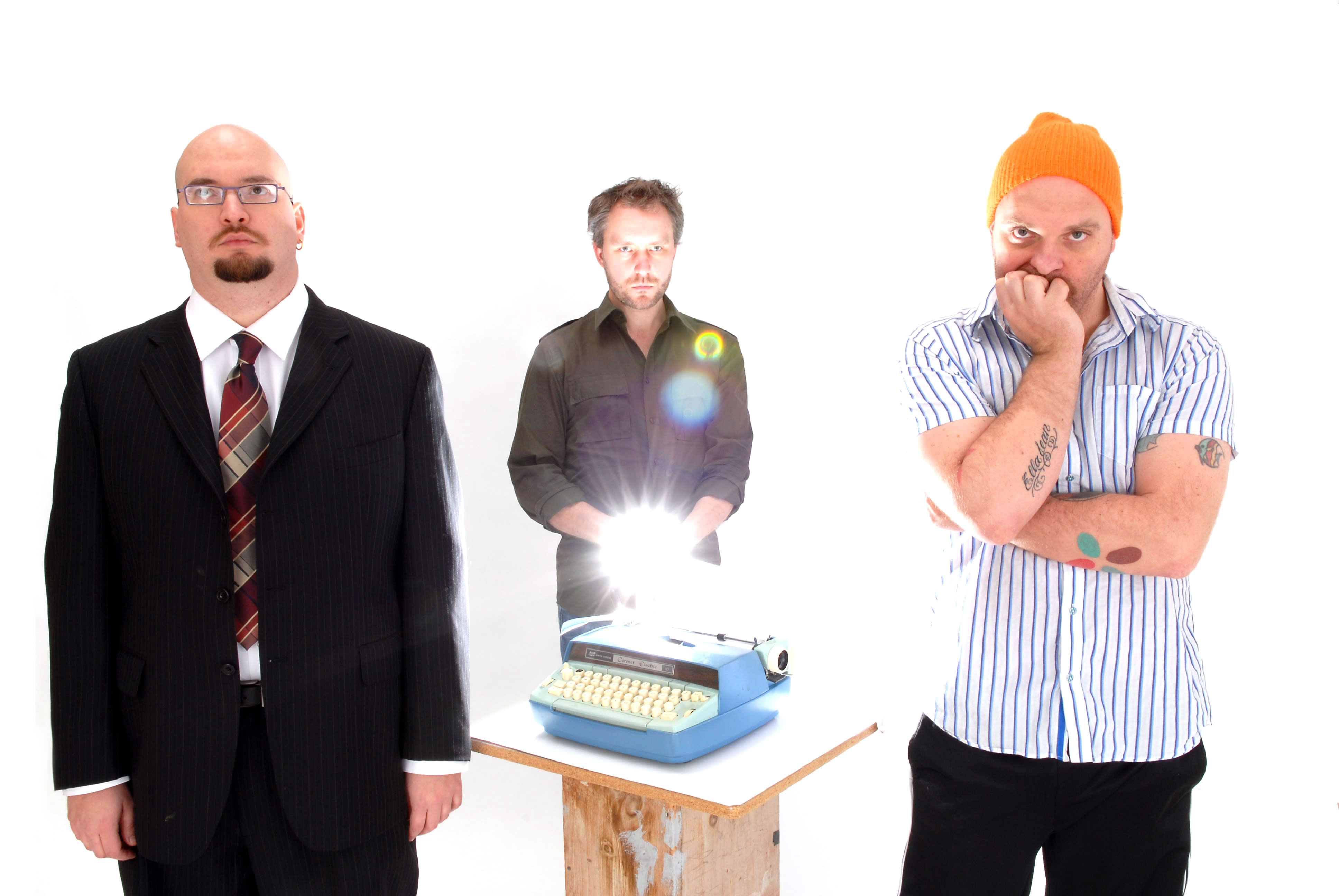
As a reviewer, my job is twofold: 1) to introduce artists to those who may not be familiar, and 2) to wax informative on the art they bring to studio or stage. The latter comes naturally. The former is where my pen begins to drag. Sure, I can mosey on over to any number of online bios and tell you that bassist Reid Anderson, pianist Ethan Iverson, and drummer Dave King—known collectively as The Bad Plus—have been wowing the discerning listener since the group’s 2000 redux. Sprung from the bedrock of Minneapolis (with Iverson’s biographical thread stretching back to neighboring Wisconsin), TBP lay their matches to a wealth of fuses, including a heaping portion of group originals and a smattering of enticing sidelines drawn from the popular canon. TBP now bring their latest project, “On Sacred Ground,” a reimagining of Igor Stravinsky’s The Rite of Spring, to Cornell’s Bailey Hall.

But does any of this tell you who Iverson, Anderson, and King really are? If you weren’t at the show (in a word: invigorating), then what service can these words glowing on your screen possibly bring to transient eyes? We can be thankful, then, that TBP is not the kind of outfit to hide behind publicity in lieu of interacting with fans, other musicians, and the errant reviewer whose starry considerations need not sugarcoat the already inexpressible. Out of graciousness and an abiding interest the spontaneity of open conversation (and what is jazz if not?), TBP participated in a Composer’s Forum on campus the afternoon of.


“Where are we in this?” posed King in reference to the band’s initial approach to Stravinsky. The transparency of their trial and error, of their frustration over and acceptance of the music, was refreshing. Of course, many words were spilt over the Classical vs. Jazz question, but by the end of the 90-minute discussion the trio had mopped them all up with one sentiment: “It’s honest to us.” They weren’t acting, King went on to say, but simply “playing our music.” Thus engaged, the band could discard the quibbles of classical expectations in favor of a feeling, of a kick and a smile, and steep both stage and audience in “the obviousness of how good everything is,” which is for them the heart of jazz.

It comes as no surprise that King was so adamant about integrity, for one imagines his challenge in the Stravinsky nexus to be the greatest of all: How does one bring out the rhythmic challenges inherent in Rite without coming across as “square”? Their solution was to approach these challenges from the inside out, laying the piece down before imagining what they could do with it. Working from the piano four hands arrangement, they began to see the Stravinskian tools they’d already been using in their own. Anderson expanded these sentiments by making a case for irreverence. In not being beholden to particulars, they could be true to the piece in a fundamental way. What was there, beyond and within the score at hand? How did their assimilation fit and what could they hear in it? To play a high concept piece like Rite, they realized, one needs to be an improviser. Score one for the away team.

Yet even with the orchestral peel and improvisational feel, how does one bridge the gap? Iverson’s answer: chamber jazz offers the guarantee of always hearing a voice. Consequently, instrumentation was not so much an issue. More important was maintaining faithfulness to a sense of communal spirit through the composer’s art. In this vein, Iverson admitted to a preference for older jazz recordings, which read for him more like folk music. In other words: freely. The goal in taking Rite was to give shape to those notorious rhythms in an attempt to move something forward.

Despite the lore surrounding its shocking 1913 premier, it was less the music and more the choreography (in combination with other social factors) of Stravinsky’s defining opus that induced the infamous riot that ensued. And sure, the structures are complex, the dissonances still formidable, but one would hardly have known it by the sheer exuberance with which TBP played it, for its outside-the-box aesthetic proved to be a smooth fit for the band’s avant-garde proclivities.

The performance was further enhanced by snazzy lighting design from architect Cristina Guadalupe and video from filmmaker Noah Hutton (all of these were cued in real-time response to the musicians). The imagery added an arguable dimension. On the one hand, it provided some moments of illustration, while on the other I found that it distracted from the decidedly acoustic processes unfolding before us. Either way, I appreciated those moments when sound and image fused well—in particular, in the movements of dancer Julie Worden, whose filmed body brought a taste of Nijinsky to “The Sacrifice.” Also effective was the opening sequence, a teetering journey through a melting winter landscape amid a collage of what sounded like manipulated scratchy LPs of Rite’s famous opening bassoon (familiar to anyone who’s seen Disney’s Fantasia and its churning creation sequence). Only now the bassoon line was intoned through the piano’s harp strings, toying with its own galactic edges in a swirl of resonant chains.

All of which made the band’s implosive entrance all the more exhilarating. The boom of that unified hit showed us just how dynamic a piano trio can be. Right off the bat, Anderson’s bass was a clear winner, especially in the distinctive refrains shared with Iverson. His slinking phrasings foreshadowed the more incendiary moments of cohesion, even as Iverson spread his fingers wide to capture every nuance he could. With King their language was even more lucid, and as a unit they translated the muddiness of it all with gritty, tactile clarity. Indeed, the presence of drums proved to be a guiding force in the fusion before us, seeming at once to react to and dictate the goings on.

TBP captured the freshness of a first hearing, such that even (if not especially) those of us familiar with the score could nod anew at the novelties therein. The shadows loomed somehow darker, the exuberances somehow brighter. And when the projection screen rose to bathe the audience in a vivid red light for the final dance, we were fully hooked in to the vibe they’d so diligently communicated.

TBP’s sacred ground was exactly that: a hallowed moment of music history poured into a bed of firewalking coals, still glowing. The playing was as gushing as the season it sought to evoke. The ultimate success, then, was whether or not the listener liked The Rite of Spring to begin with (my wife, for one, does not, but nonetheless appreciated the care and immediacy of the interpretation). One can only hope that those hearing it for the first time will have found doors newly opened.

“Thank you, that was a song by Igor Stravinsky,” said Anderson after this marathon introduction. With the ice of that intensity now broken by laughter, the band was ready to show us a different facet of its honesty, for now it was time to put away the music and dive into some originals.

First on tap was a jog around the memorable bass line of “Giant” (off their 2007 joint, Prog), which enchanted with its leapfrogging tenderness. Now in the absence of film, the cinematic qualities of these three talents came shining through with unstoppable vigor, glittering behind the veneer of Iverson’s downright oceanic pianism, riding a crescent moon’s arc into dreamland. This was the first of three tunes penned by Anderson, whose “Big Eater” (see 2003’s These Are The Vistas) rushed headlong into Iverson’s pointillist cascade, while the title cut off their latest, Never Stop, made for a fitting encore. With its hip lyricism and head-nodding charm, it was the perfect pick-me-up to let us down into the night.

Before the standing O, we were treated to two blasts of energy from King. The newish mosaic of staggered vistas and wild pianism that was “Wolf Out” made for a fitting window into its composer’s art. “1972 Bronze Medalist” (a touchstone of the TBP repertoire) was another colorful groove—machine music for the intelligent programmer.

Iverson’s contribution came in the form of “Re-Elect That.” This skittering romp off the beaten politic was like a tight fist uncurled finger by reluctant finger and sprinkled with gunpowder. It also sported King’s best solo of the night—a delicate, breathy thing of brushes and sensitivity—before ending on a John Jacob Jingleheimer Schmidt kind of fadeout.

The requisite cover came from the songbook of Aphex Twin, whose masterful “Flim” opened the trio to some of its most exciting territories. Those first notes had not a few gasping with recognition, leading into more of King’s superbly detailed visions, including a notable moment that found him pulling at the snare wires to get that unmistakable card-shuffling effect toward the end.

A house on fire? Hardly. More like a fire that needs no house to gain purchase. The moment is The Bad Plus’s kindling.

Striving for a Perfect Soul: Indonesian Shadow Puppetry Comes to Cornell


(photo source: Buda Wayang)

Purbo Asmoro
Gamelan Mayangkara
Bailey Hall, Cornell University
March 14, 2012
8:00 pm

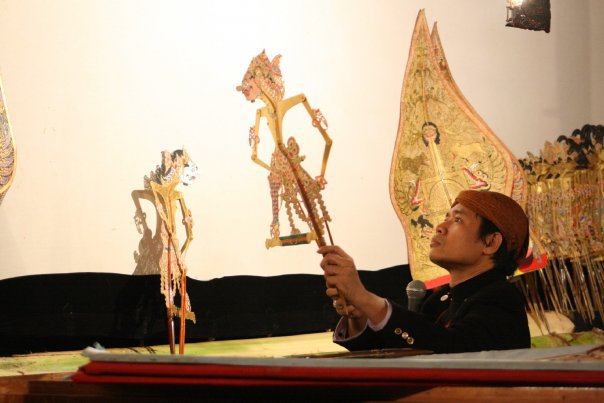
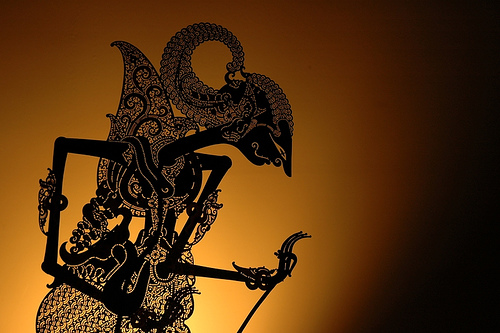
“I’m just happy to create,” says Purbo Asmoro, a living treasure of the art of Indonesian shadow puppetry. Born in East Java in 1961, Purbo embodies not only the legacy behind his immense skill—the performances of which are called wayang kulit—but he is also one of the art’s most creative practitioners. As a dhalang, or master of shadows, his duty is threefold: direction of the gamelan ensemble that accompanies his singing and the action it describes, recitation of dialogue and story, and manipulations of the puppets themselves. Not surprisingly, Purbo comes from a long line of puppeteers whose traditions he has expanded. His innovations span the gamut from the practical (he designs some of the sets used during performance, composes, and choreographs) to the political (by, for instance, introducing leading female characters in an attempt to equalize gender relations in this otherwise male-dominated tradition).


Asmoro

Audience members were treated to an overture as they walked into the venue—calls and responses over a drone provided by the Gamelan Mayangkara, an ensemble of gongs, percussion, and voices under the masterful direction of Wakidi Dwidjomartono. The sounds were as lulling as they were exciting, putting us in a frame of mind unlike anything experienced in Bailey Hall this season. Some were perhaps surprised to notice that we were behind the screen where the shadows work their magic. This practice has come about due to spectatorship in Indonesia, where audiences prefer to admire the beauty of the puppets themselves. To compensate, the shadows were shown by a clever projection on the left half of a large screen above the stage. The screen’s right half revealed another surprise in the form of a simultaneous translation by Cornell alumna Kathryn Emerson ’83, who typed in real time as Purbo worked his vocal stylings. Every performance has variations and this method is the only way they can be shared abroad. The fact that Emerson is the sole person in the world qualified to do this underscored the privilege of being there.

A rousing hit of gamelan and drums introduced us to the story proper. Our sorrowful protagonist was Arjuna, one of five brothers featured in the Indian Sanskrit epic, the Mahabharata. Banished to a forest for his immoral behaviors, Arjuna finds solace in meditation and reflects on the error of his ways. He rejects his past and desires instead to become of use to the world.


Arjuna
(photo source: Indonesia Impressions)

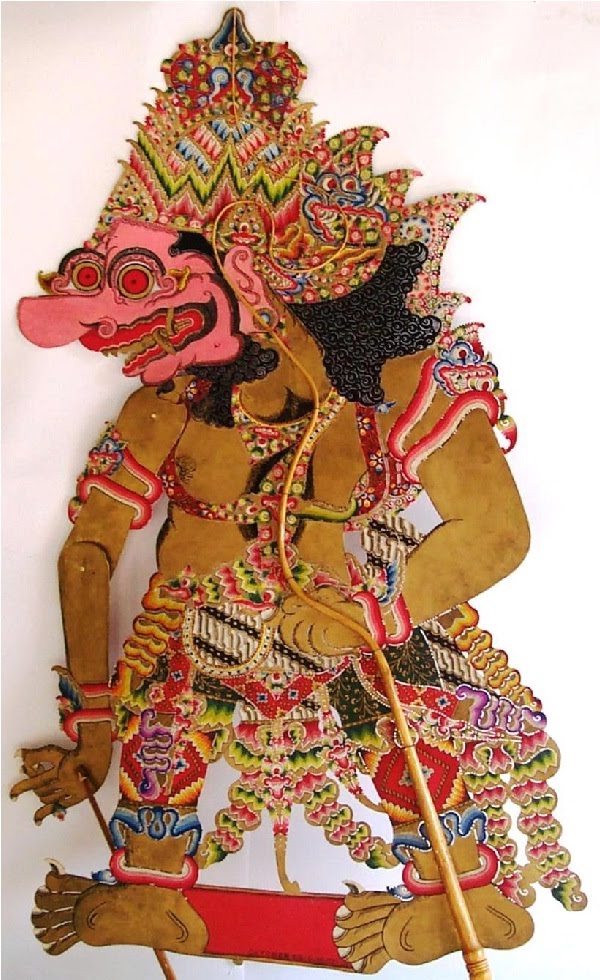
Meanwhile, Niwatakawaca, a malicious ogre king possessed of arrogance as unwieldy as his name, professes his love for the goddess Supraba. As he repulses us with his dreams of attaining her, he engages in a “generic macho dance that ogres do.” His advisors warn him against this infatuation. “A horse can’t marry a duck,” informs one. “The poor duck. Think about it.” Adds another, in a juxtaposition of bawdy humor and insight characteristic of Purbo’s delivery, “Do you really love her, or do you just want to control her?” Niwatakawaca pays them no heed and vows to accomplish the impossible by conquering the heavens and taking Supraba for himself, yet none other than Arjuna stands in his way. Before sending his troops heavenward, Niwatakawaca demands the mortal be brought to him.


Niwatakawaca

The ensuing battle scenes brought out a wonder in all and were infinitely more thrilling than any clash on screen or stage. To this end, Purbo kept the action sonically rich with the clanging of the keprak, metal plates played by the feet for the sake of emotional punch and as a means of signaling the gamelan players to match his timing.

Facing certain death amid this clamor, the gods call upon Arjuna, but first test him with three temptations, all of which he passes. Arjuna is promised great rewards for his dedication and battles with Niwatakawaca, using Supraba to bring out his weakness: an amulet in the roof of his mouth that becomes exposed when he laughs with pleasure at the seeming success of his conquest, only to fall prey to Arjuna’s arrow.


Supraba

In between all of this was a comic interlude. Utilizing only a fraction of the usual 60+ minutes, Purbo showed off his improvisational flair with a few good-natured jabs at Cornell (“founded on a lonely hill in the middle of nowhere”) and its gorges (“which now have fences”). These, along with a surprise appearance by an Obama puppet (“Look at his shoes,” says a groveler. “Made in Indonesia?”), had us laughing at every turn before Purbo waxed thankful on the efforts of those without whom wayang would never have been “something for the world to own.”


(photo source: Village Voice blog)

In context Purbo’s performances can last for hours, sometimes through the night, and I doubt anyone in attendance would have complained had he done so. In this regard he is clearly a holistic thinker who takes his audience into consideration: everything from the sounds to the visuals must fit like wing to bird, and beyond like bird to sky. And although between performances at home and abroad Purbo teaches at the Indonesian Institute of Arts, I would venture to say that his performances are equally instructive in what they say about life. In his own words: “The mission of wayang is to present moral messages. The entertainment aspect adds spice to the moral aspect, the main values in life: loyalty, heroism, messages for good.”

(See this article in its original form at the Cornell Daily Sun.)
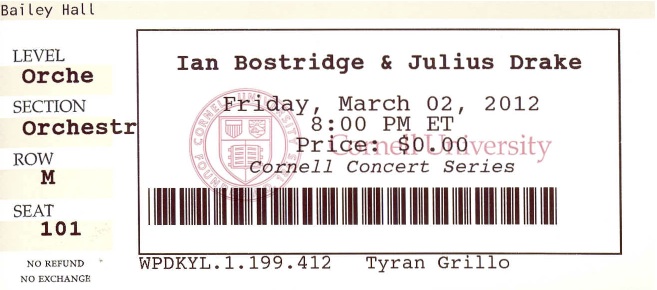
A Walk in the Magic Garden: Bostridge and Drake Bring Lieder to Bailey

Imagine yourself as the protagonist in poet Heinrich Heine’s Ich wandelte unter den Bäumen (“I wandered among the trees”). You’ve been wandering through a forest, your only companion grief over an unrequited love. Suddenly, a “little word” flittering in the trees, a simple utterance that pulls the wool of the past over your eyes. You wonder how the birds know it, why they torment you so. They sing:

“A young woman once passed by,
She sang it again and again,
And we birds snatched it up,
That lovely gold word.”

You feel the sparkle, ironic and stabbing, of every rounded syllable. You are pressed by the weight of their diction. Only then do you realize that you’ve been sitting in a concert hall with a flock very much of your kind. The voice comes not from the trees but from English tenor Ian Bostridge, who looms almost as tall as one, onstage at Cornell’s Bailey Hall.


Ian Bostridge

Although Bostridge started out as an aspiring physicist who also wrote a seminal book on witchcraft before devoting his life path to singing in 1993, his audiences would be the last to refute that his command of, and interest in, either physics or witchcraft has waned. To wit, his accompanist of choice for we fortunate Friday few was Julius Drake. An in-demand recitalist and professor at London’s Royal Academy of Music, Drake maintains an alchemical interest in Robert Schumann and in German lieder, or art songs, both of which fuse together via the composer’s setting of the poem above, one of nine by Heine in the op. 24 Liederkreis (Circle of Songs). Written in 1840, a period known as his Year of Song, the cycle bears dedication to his wife, Clara. Despite its passionate origins, the Liederkreis tends to fall by the wayside of Schumann’s monumental Dichterliebe, though one can hardly deny the mastery with which piano and voice share their creative duties in both. Schumann blends folk idioms and a flair for the programmatic, into which Bostridge and Drake pour over twenty years of collaborative experience.


Julius Drake

During this performance it was clear that for Bostridge the sounds of words are as important as their meanings. Throughout the Liederkreis and the quartet of Dichterliebe apocrypha that preceded it he fashioned a living, breathing persona that was as chameleonic as the sentiments he so punctiliously enunciated, while Drake matched his depth gesture for gesture. Both artists found themselves surpassed only by the lyricism of Schumann, whose adorations blossomed before our ears in the passions of Lehn’ deine Wang’ (“Rest your cheek”) and the sweetness of Berg’ und Burgen schaun herunter (“Mountains and castles look down”), the latter contrasting starkly with the morose Es treibt mich hin (“I’m driven this way, driven that”), the fiendish difficulties of which Bostridge navigated with apparent ease. Artistic witchcraft was also in order for Mein Wagen rollet langsam (“Slowly my carriage rolls”), during the middle stanza of which he sang an internal thought as if it were his own. Not to be outdone, Drake’s pianism cast its share of enchanting spells, as in the brightness of Morgens steh’ ich auf und frage (“Every morning I awake and ask”) and the chromatic sweeps swirling like smoke from a breeze-blown candle throughout Mit Myrten und Rosen (“With Myrtle and Roses”).


Robert and Clara Schumann

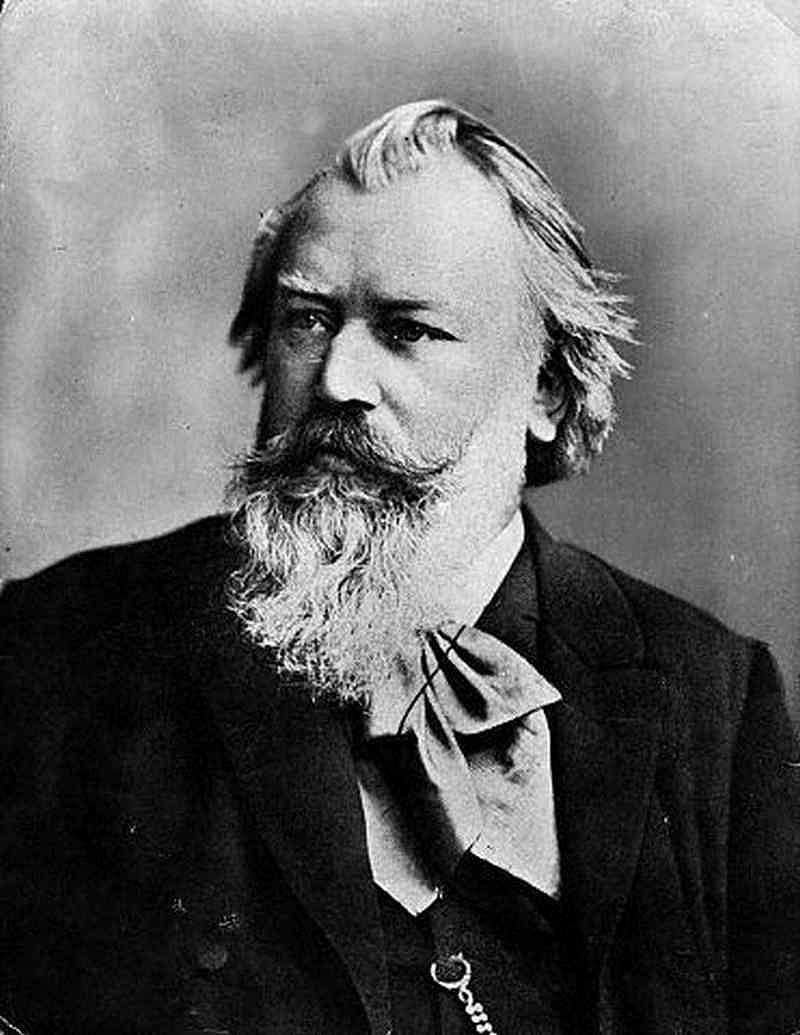
While Bostridge and Drake were obviously comfortable with Schumann, much of the evening’s treasure was buried in the relatively uncharted maps of Johannes Brahms, in whose poetics they steeped the program’s first half. With a life-affirming, if not transformative, energy Brahms’s songs made for a fitting introduction to anyone not familiar with the lieder tradition from which he is so often excluded, typically dominated as it is by Franz Schubert, Hugo Wolf, and Schumann himself. For one, he favored the words of “minor” poets—a downfall in an art built from the text up. This and his disinterest in grand cycles pegged him as something of an outsider. Yet Brahms saw no necessary correlation between great music and great poetry. Each was its own melody. As with Schumann, whom Brahms much admired, folk motifs were an important touchstone and sometimes led him boldly where his contemporaries dared not tread.


Johannes Brahms

His was, and continues to be, a music filled with worlds that don’t so much collide as pass through one another. From the mighty gales of Auf dem Kirchhofe (“In the churchyard”) and on through the Chopinesque backcloth of Der Gang zum Liebchen (“The way to the beloved”) to the raging seas in Verzagen (“Despair”), the pianism was of a vastly different order, with the result that Bostridge pushed himself to engage every facet of its relief. This resulted in an unexpected hiccup during a high reach in Geheimnis (“Secret”). Yet even this did nothing to detract from what was for this listener the most awe-inspiring song of the program (if anything, it broke a tension that threatened to sweep us away entirely), and may explain the marked determination with which he dove into the set’s most turgid waters—notably, Alte Liebe (“Old Love”) and O kühler Wald (O cool forest).

Due perhaps to Brahms’s rich keyboard writing, Drake’s interpretive nuances were most effulgently realized here. He was at once impressionistic and exacting like a carver’s tool, but always playing the words at hand. The lushness of chording in his right hand atop the rising arpeggios of his left in the concert’s opener, Es träumte mir (“I dreamed”), assured us that the best accompanists also know how to sing. Bostridge was reverently aware of this. One could see it in the way he looked into the distance between verses, as if watching the Steinway’s notes mingling with his own over the horizon. He interacted with the piano, now resting on it like a poet’s tree, now at an intense moment breaking free from its pull.

Oftentimes the more careful one is, the more conservative one becomes. In the case of these two performers, however, care seems to have bred nothing but expressive potential. In this respect Bostridge sings as might a Shakespearean actor surrender to a soliloquy—which is to say, by stepping outside the self and into the landscape of another space and time. His ego flees like the poetry from his lips, even as he shows us the vitality of the body in the singing of lieder, its centering and de-centering, its bows and cringes, and in all the winged commitment required to make every syllable fly. Drake, meanwhile, proves himself supremely attuned to every color change, and stands respectfully poised on the edge of drowning. He listens to the voice just as the voice listens to itself, intoning with the wavering realism of a reflective surface.

We return to Heine, in whose beauties we find ourselves lost:

In the magic garden wander
Two lovers, silent and alone;
The nightingales are singing,
The moon is shimmering.

So sings the now familiar voice, no longer birdlike but nonetheless profoundly arboreal. Bostridge takes us fearlessly into that garden and shapes its flora and fauna, each more magical than the last for the Midas touch of his vocal presence. Said garden is his gift to us, a place to which we can always return when remembering this night.

(See this article in its original form at the Cornell Daily Sun.)
Fred Frith and Annie Lewandowski: An Improvisation

Fred Frith guitar
Annie Lewandowski piano
Barnes Hall, Cornell University
February 29, 2012
8:00 pm

This is what it feels like to close one’s eyes and listen to the shadows for the first time:

Feet bare and prayerful. They tremble on either side of the divide. Turn the radio dial to a frequency where life pours in through the cracks, they seem to say, and you will find in the draw of a bow (whose memories of cracked whips whistle in the distance) a chance to hear the change in your pocket as if it were inside your skull. Place a forest of fingers in the sand and you have only kernels to show for your treasure hunting. It’s not as if one need crack open a tooth to find the nail on the chalkboard, for in each arid stretch there was a music so beautiful it might have knocked you right out of your adolescent skin. The instrument sprouts leaves, adds to its own skeleton with every spontaneous preparation. Those gestures, they come back. The march, the very rhythm of it, has substance. It drips like sap, filling crusted buckets only when left to its own devices. A koto-like thing amplified and stretched to another shore, it cries with the force of a crane in soaring flight. It reverses time even as it drags its own reflection by the magnet on the end of its golden tail. The winds still carry a scent: village candles, bite of tower bell, snuff of horse’s mane. The radio crackles again, speaking as might a mother who has forgotten a lullaby and cannot sleep for all the unrequited attempts swirling behind her eyelids. He plays with light and lights with play. A thousand beams for a thousand children, each the bearer of gifts for hungry wayfarers. Our radio loves us to pieces, hugs us so hard it puts us back together. The sounds of repair are the speech of the broken. Clouds spin into a sea of gray, the stairs a blanket of norms duly obscured. Heat whispers through rips in the mirage: “There is a grain for every hope. Why do you tread here?” A messenger of the plains runs into view, bringing with it tales of pasture and a looping caprice. He taps the edge of the bark and teaches the termites to sing. A spate of talk, a bird’s living wish rewound back to the egg. The beak crunches into flour and is baked into a pastry of careening, listless messages.

Intermission is a word invented by psychics in their sleep with an agenda geared toward interruption. The missions, yes, are hearable, but the “inter”-ness of it is lost to our idle chatter, which tries to unravel everything that has been spun. An obsession, to be sure, throughout which the mind desires silence yet at which we cringe to find the words. What is improvisation but the absence of tongues? There are battles in places we will never visit, and far more visits to places where battle will never be waged. I can smell the ice.

Stairs walking up themselves: that’s what I feel, at least. For whatever is to be made by holding our looking glasses to our ears, this is it. Someone gallops away. We are left, subtracted from one. An animal breathes, decidedly mechanomorphic. Can you speak without also whispering? The piano tells us no: the latter is always hidden in the former. She touches the breeze, clips the hilltops with her wingtips, and showers the land with a promise of elastic. A footstep felt from the inside. The delicacies of our harshest gestures creased until the paper becomes softer than breath. The bottle has a tune to uncork, and in it lies a metallic question. He blinks his eyes as she squeezes hers. Pulling blades of grass from their communities becomes an act of self-destruction. Spindles of willow reaching skyward, forgetting the fires that have long since abandoned them. Masks switch places where the sun has touched them (the cheeks, forehead, and nose) and hold fast to where the moon (lips, eyes, throat). Only the burnished reflection tells us from where its life has sprung. Unscrewing the lid, she dumps out water and mouths, folktales and tracts of yesteryear, each the first of its kind to have suffered the iniquities of a printed score. Thus freed, they dance a path’s worth of steps on overgrown earth. He traces the edge of a language; she transcribes her own on surfaces desirous of fadeout. Every grandmother’s hum of an afternoon crashes outward. Run a fingernail along the ridges of your cochlea, and you will come closest to recreating what has transpired. But you must do it alone, where only ghosts can blow out the candles melting in your hallway. Sounding the pulse like sugar, it distills the spirit of the thing by never repeating itself.

Through the Fog: A Contact Live Report from Birdland

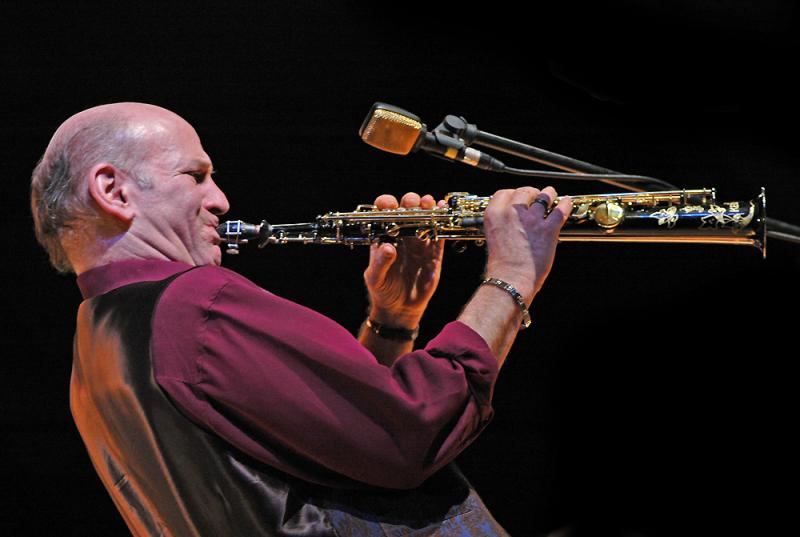
Dave Liebman soprano and tenor saxophones
John Abercrombie guitar
Marc Copland piano
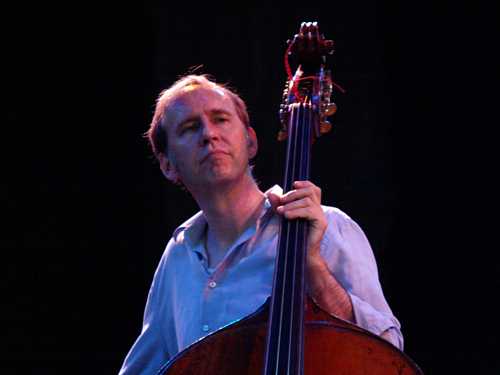
Drew Gress bass
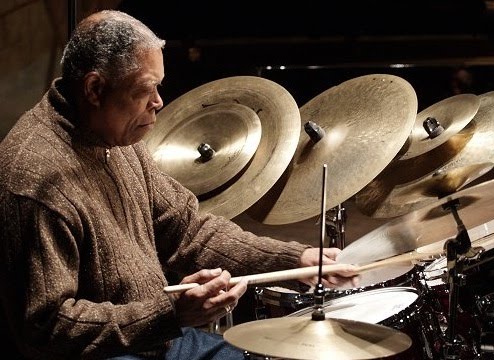
Billy Hart drums

Birdland, New York City
February 10, 2012
11:00 pm

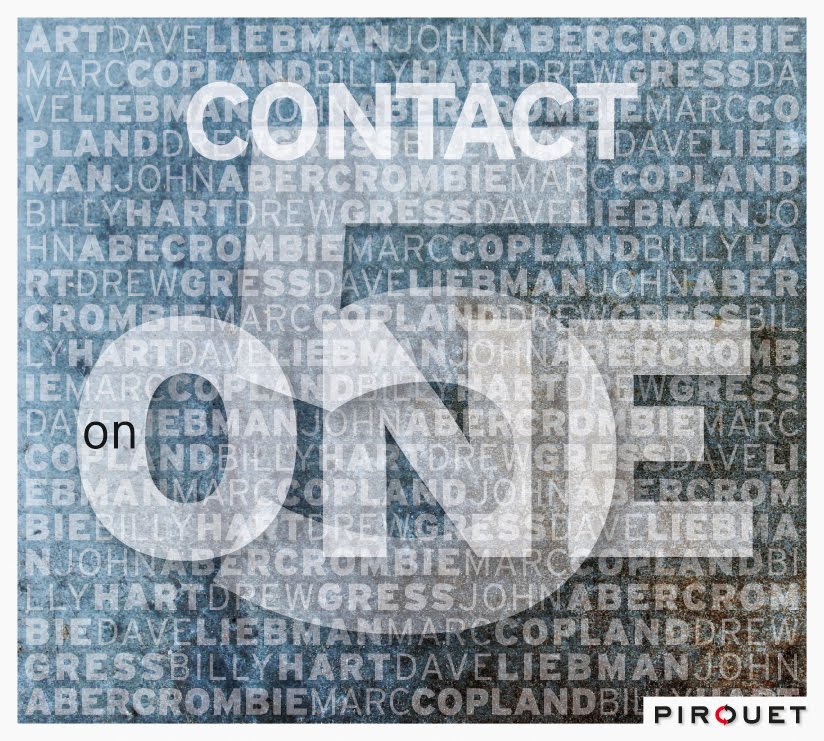
Contact is as appropriate a name as one might come up with for saxophonist Dave Liebman’s newish outfit. This star-filled quintet—in which he joins forces with guitarist John Abercrombie, pianist Marc Copland, bassist Drew Gress, and drummer Billy Hart—practices what it preaches, bringing a surprisingly permeable sound to bear upon equitably spread writing and performing. Once the group took to the stage at Birdland last Friday night, Abercrombie quipped on the name, assuring us it had nothing to do with the Jodie Foster film of the same name. Then again, he added, such a connection might prove valid as they develop their interactions over time. If this show was any indication, I am inclined to agree, for most intriguing were the dramatic developments it underwent over the course of its four long tunes.

Liebman’s soprano, at once flute- and trumpet-like, was the first to catch our ears as it danced through a tentative midrange guitar in “Soundup” (Abercrombie), also the opener of the group’s 2010 Pirouet album, Five On One. Hart set a precedent of color for the night with his glottal cymbals, while Gress’s well-tuned fingers brought an omnipresent depth. Abercrombie’s first solo was buoyant, if conservative, and seemed to end just as it was flapping its wings. Copland was almost inaudible at first, preferring, it seemed, to linger like a trembling breath. Liebman’s bubbling gestures, on the other hand, sprouted a wealth of chromatic foliage. Every note had its own tone, shaped by a rare breadth of embouchure. Once he and Abercrombie receded, Copland at last came to the fore. Spearheading some lovely trio action, he brought out the classic core that moves the heart of all of these musicians. Notable was the way in which he unraveled the number’s tightly woven themes, making the rejoinder all the more comforting.

“Footprints” (Shorter) arose out of a quiet eddy in which Liebman swam limberly on tenor, fading in and out, as he did throughout the set, like an ear selectively attuned to stillness. Abercrombie was visibly more comfortable in his solo this time around. He moved with a hum of wincing energy, seeming to first define a branch then trail from it like a spider from a thread of web. Copland kept his hands quite close for his turn, as if tied by one of those very threads to some hope through foggier days. Hart was the real star here, dialoguing on the light fantastic with the rest of the band in vast, metallic exchanges.

If the winds of improvisation had only begun to blow before, in “Childmoon Smile” (Copland) they now whistled through the trees of the audience with the insistence of a dream. The tune’s composer regaled us with a lush solo, gilded by Hart’s bronze, before Liebman dovetailed his soprano to the emerging carving. Gress evoked Gary Peacock in his solo, while Copland sparkled like a watery surface in soft focus. Hart’s brushes were at once ice and sand, brought to life with a kiss of warmth. After leaving the quiet vessel of Abercrombie’s solo, Liebman saw fit to ply more cosmic territories. Copland added his characteristic impressionism to the cubist splendor of Liebman, who enchanted with the most innovative solo of the night before Copland wrung out another verdant splash to close.

Abercrombie led us down an abstract path to “Blues Connotation” (Coleman), which kicked off the set’s final cerebral groove. Liebman was superb on tenor here, moving in clusters and high-flying loop-de-loops, echoed by Abercrombie at every catch. Both scaled and slid through this melodic plane like an uninterrupted game of Snakes and Ladders. Gress flickered like a candle in fast forward before Copland crept in from the periphery. Then, it was just he and Gress taking us into blissfully unexpected territories, uniting in moments that elicited gasps of admiration from the audience. Hart reprised his locomotive charm and unmasked a solo like an origami figure unfolding and refolding itself by fire alone. The final stretch went down like a swig of Jameson.

Liebman plays at the speed of thought. He allows for space, vital and alive, drifting in and out of the ear like an idea does the mind. His playing is something beyond melody, yet entirely devoted to it. Copland’s inventiveness is limitless, and in such a rich setting he had more enough to work with. Abercrombie was fluid as ever, though it seemed to take him a while to warm up to the feeling of the moment, and it a great pleasure to finally see Gress and Hart in concert, for the two of them provided a penetrating elasticity that was subtly surprising. Here is a band that really listens, and we can only give the same in return.

Listening to the Wind: Moran/Holland Duo Live Report

Jason Moran / Dave Holland Duo
Barnes Hall, Cornell University
January 28, 2012
8:00 pm

Sometimes a performance can change your life. Equally rare is the performance that brings life to change. To those fortunate enough to be in the intimate confines of Barnes Hall last night, the latter is in tall order. The performers need no introduction (for the curious, my pre-concert report is here), and perhaps they prefer it that way, for when they take to the stage they deflect attention from themselves by first paying deference to one another. Yet even before our rapt attention and respectfully placed woops fill the room, the stage itself has told us all we need to know. Between towers of speakers and amplifying equipment, two instruments: a freshly tuned Steinway and a prone bass. Moran’s chair, which he brings wherever he can, sports clean, modern lines, while Holland’s trim yet deep instrument seems to hold countless histories in its burnished surface. Already there is a conversation happening, as if to confess the music before the artists actualize it.

And actualize it they most certainly do. Rather than kick off the concert with bang, however, they start with a touching homage to the great Sam Rivers, with whom both Moran and Holland had the opportunity to work and whose recent passing was felt deeply by all who knew him. To feel his spirit living on like this is a joy to witness. With the gentle cascade of a frozen waterfall in spring thaw—appropriate for this unseasonably warm winter—the gentle strains of “Beatrice” go straight to the heart, from the heart. Between Moran’s crisp pointillism and Holland’s smooth hibernations, one finds hard-won balance. Each note leaves an aftertaste of affection.

Holland and Moran follow up with an offering apiece. Holland’s paints some of the broadest sonic vistas of the set, twisting his virtuosity into a solved Rubik’s cube. Alongside this powerful chunk of expressiveness, Moran’s “Gummy Moon” reads like a bedtime story (and by no coincidence, for the title reflects his children’s mispronunciation of the classic Goodnight Moon). Beneath Holland’s monotone, the piano man unpacks terse chording into a majestic tale of starlit travel. A breath and a pause, and we’re off to a whole new gig as Duke Ellington’s neglected “Wig Wise” ushers us into the center portion of the show. The duo share a smile and a nod, welcoming us into something as timeless as the thematic material at their fingertips. Moran is a whirlwind of ideas, though both musicians’ flair for ecstatic performance is in full evidence here.

After a ballad so smooth one would swear the house lights dimmed out of sympathy, the unmistakable zigzag of Holland’s classic “Four Winds” further strengthens the Rivers connection. Moran explores some of the more turgid recesses of this well-aged tune, even as Holland stomps his way through a storm of brilliance. As with all the music they play, they take this number not only to new heights, but also to new depths.

Next, Holland provides one of the concert’s highlights in his “Hooveling.” Meant to evoke one’s navigation through a New York City crowd, it twists and turns with a deftness so hip it almost hurts. Moran listens right there with us, enjoying the talents of one who commands at the solo bass like no other, before turning an eye to something bygone, a tender farewell that only presages the second tribute of the night in Paul Motian’s “Once Around the Park.” As Holland lovingly explains before they play, Motian frequented the jogging path around the reservoir at Central Park. It was during one such running session that the tune came to him. And indeed, we can feel the chill city winds passing from the piano through the bass’s arboreal footwork. A fitting tribute to a human being of profound melodic insight.

Before the duo close with improvisations on a familiar Thelonious Monk theme, they lay the nostalgia on thick with “Twelve,” a tune once taught to Moran by his teacher Jaki Byard. The result is a veritable train ride through a landscape of nodding heads.

With these two, jazz isn’t just an art form. It’s a warm hearth in the cold. Moran is a hopeful player, always looking ahead to whatever light may be on the horizon. His right hand is a water strider of expression that widens its purview at every turn. Now a chromatic jester, now a paternal force, it engages the left with insistence and verve. Holland, too, strikes a happy medium between wildness and diction. In spite of his ever-wandering fingers, he is nothing if not selective. He chooses his lows carefully, as does Moran his highs, and each of his harmonics feels like a drop of innocence in a conflicted world. He can bring that wincing twang to bear with the best of them, but more often wants to talk with us rather than at us. Both Moran and Holland make every repetition novel and exciting. Like souls lost in the beauty of a memory that threatens to fade in a harsher present, they seek to record everything they see—not for posterity, but for the invaluable ardor of the moment.

If you were unable to get a ticket, or simply found out about this special performance too late, fear not, for you needn’t have been there to feel its effects. Those energies are still out there, running rampant like a Rivers soprano line, if not slinking stealthily like a Motian brushstroke, into the most hidden recesses of our consciousness. Just listen, and you might hear them in the wind.

Playing it like it is: Jason Moran and Dave Holland take to the Barnes stage at Cornell

Comedian Hannibal Buress tells it straight: “People say, ‘I’m just taking it one day at a time.’ You know who else is? Everybody. That’s how time works.” And maybe that’s how jazz works, too. It’s a daily process, an ever-expanding diary of life experience that everybody’s being written into. Its pages ruffle and shuffle, rhyme in real time, bend and tear, yet through it all retain a cover as distinct and as battered as our Real Books. Every once in a while, a musician comes along who tapes up the binding, slaps on a new nameplate, and calls it fresh. Pianist Jason Moran is one such musician, one who knows there’s no past without a future. Bassist Dave Holland is another, one who knows there’s no future without a past. Though far from strangers, having been involved together in latter’s Overtone Quartet since 2009, as a duet they offer a rare chance to see two consummate artists in dialogue.

“My first opportunity to work with Dave,” says Moran in an e-mail interview, “was as a sub for Steve Nelson in his Quintet. This was the first time Dave’s quintet music was played with a piano, so it was quite a big space to fit in. Dave is an extremely supportive player. Meaning he is both a fantastic captain and a deck hand.” Yet the Houston native, who celebrates his 37th birthday this month, has spent much of his career rocking the boat. With influences ranging widely, from Thelonious Monk to Sol LeWitt, the avenue of his playing is lined with all manner of architectural styles. In addition to being one of the most important jazz pianists of his generation, he’s a thinker and, above all, a father. When I ask him about how he’d like to be remembered, he says, humbly, “That my children loved me, and that I taught them how to love.”

The title of his major debut, I think, says it all: Soundtrack to Human Emotion. It’s a philosophy to live by for someone who uses emotions as a writer might lay verbs on the page. From his jump outside the box with the immortal Sam Rivers on Black Stars (Holland also worked with Rivers on the seminal 1972 joint Conference Of The Birds) and on through to a trio session for the ages with Chris Potter and the late Paul Motian on Lost In A Dream, he has painted a veritable gallery of life-driven moods and impressions. Moran is also an educator. He teaches at the New England Conservatory of Music, where he places no small value in passing on ideas and conversations: “Young players should follow their heart. And if the music takes over their life, let the music lead the way, as there is so much to discover.” A harbinger of things to come, to be sure. Then again, why wait when you can experience it for yourself?

Most thumbnail sketches of Dave Holland, now 65, will include the requisite cameo by Miles Davis, in whose band the young bassist’s voice came to prominence. As a bandleader in his own right, the voice is so inimitable that those same sketches have since become a blur of dazzling color. To hear him in any group setting, one would never suspect—and rightly so—that he felt anything less than admiration for the talents he has enlisted over the years. His larger ensembles, beginning with the Quintet on 1984’s Jumpin’ In for ECM and expanding more recently to the Octet and beyond on his own Dare2 Records, have proven to be hotbeds for progressive thinking in the genre. Holland also redrew the upright landscape with 1978’s Emerald Tears, joining a growing roster of unaccompanied albums for an instrument all too often relegated to the rhythm section. There’s an enormous difference between playing solo and playing a solo. And while the lone piano is a relative mainstay in jazz recordings, Moran’s 2002 contribution, Modernistic, managed to make a comparably original statement: here is one who listens.

Indeed, listening is what these men do best. Whether it’s to themselves or to one another, their craft welcomes us to share in a compassion so hip that your head is already nodding before note one. Theirs are open, melodious hearts, and we are honored in their presence to step into an intimate circle where sound and peace walk hand in hand, taking it—you guessed it—one day at a time.

Jason Moran and Dave Holland will be performing at Cornell University’s Barnes Hall in Ithaca, New York this Saturday, January 28, at 8:00 pm. Tickets are sold out, but be sure to check back with me here at “between sound and space” for the post-concert report. The full Moran interview is below.

How do you define the power of a standard?

The power of a standard lies within how good it sounds when out of the hands of it’s original composer.

Can you tell us a little more about your classical background and how that fits into what you do at the keyboard?

My technique is where most of my classical background reveals itself. My first Suzuki method teacher was Yelena Kurinets. She had a very strict vision about what piano technique is, and that has helped keep my hands in good form, knock on wood.

When you’re on point, really feeling it, what is your state of awareness? Do you disconnect or plug in? Do you leave us behind or take us with you?

Well, I think it’s a combination of both disconnecting and connecting. I like to think of it as simultaneously talking and listening to someone. It’s the balance of those things. The audience is always on the ride. And as with all riders, some like to wear no seatbelt, some ride in the bed of a truck, some water-ski, and some simply look out of the window.

Tell us about working with Dave Holland for the first time. Will you be approaching the duo set any differently than your work with the Overtone Quartet?

My first opportunity to work with Dave was as a sub for Steve Nelson in his Quintet. This was the first time Dave’s quintet music was played with a piano, so it was quite a big space to fit in. Dave is an extremely supportive player. Meaning he is both a fantastic captain and a deck hand. So if I want to make a sharp left turn with the boat, he’s pulling the line quickly to help change the course. Given his extensive history, there won’t be much that will throw him off. So, we love having our musical dialogue shift languages.

You are clearly dedicated to passing along your passion and energy to the next generation. How has teaching informed your playing? What do you think is most important for younger players to understand as they grow into jazz, and vice versa?

Teaching allows me to hear the concerns of the next generation of musicians. Their concerns allow me to tailor my teaching methods to them. I continue to be a student myself, so I feel like we are all in the same boat, and we are all on the front line. As for my playing, I think having to discuss my methods so frequently, I realize I need to practice what I preach. Young players should follow their heart. And if the music takes over their life, let the music lead the way, as there is so much to discover. Most of all, young players need to study themselves, and secondly study the history.

Which artists, musical or otherwise, make you shake your head in wonder and think, “I’ll never get there”?

Bach.

What do you get from working with other musicians? What do you think they get from you?

This music is built around community. It works best when you work well with others. It’s more a life lesson than a musical one. Have respect for people and their ideas, and work with them. I’m not sure what they get from me, but “energy” is the term I keep telling myself.

How did you react to Paul Motian’s recent passing?

Paul was a fixture in NY, so it’s very different without him occupying the city. He let everyone in. Wonderful man.

Being an ECM nut, I adore your presence on the Athens Concert with Charles Lloyd and Maria Farantouri. How did you become involved in this fantastic project, and what was it like working with two such distinct legends at the same time?

I’ve been with Charles for almost 5 years, and it is an ongoing process. He shares so much knowledge with his band, and he shares his community as well. In one breath Maria gives us the history of vocal music. It’s all circular, as we like to say.  

When the day comes that you lay down your last note, how would you like your contributions to be remembered?

That my children loved me, and that I taught them how to love.

Who are you listening to these days?

Sam Rivers and Henry Threadgill. Sam also passed recently. For many years, he and Dave were very close. A wonderful catalog of music has been left behind. I’m working on a Henry Threadgill celebration. And lastly, I’ve been listening to a lot of comedy, and am loving Hannibal Buress.

Describe what jazz means to you in one word.

I can’t, so I won’t.

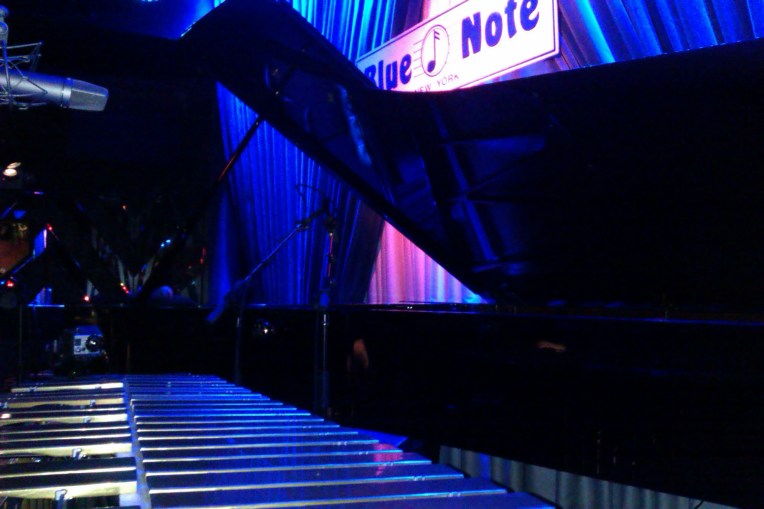
“A Confusion of Fusions” – Chick Corea/Gary Burton Live at Blue Note

Chick Corea and Gary Burton with the Harlem Quartet
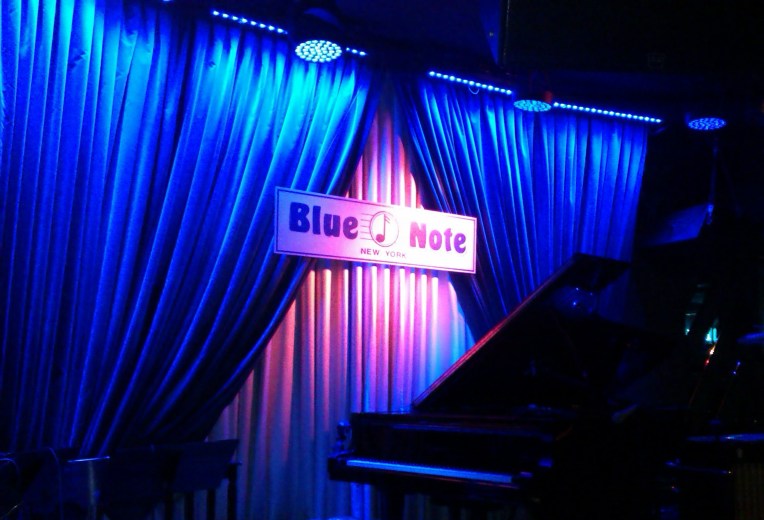
Blue Note Jazz Club, New York City
Sunday, November 13
8:00 pm

Chick Corea piano
Gary Burton vibraphone
The Harlem Quartet
Ilmar Gavilan violin
Melissa White violin
Juan Miguel Hernandez viola
Paul Wiancko cello

Setting the stage

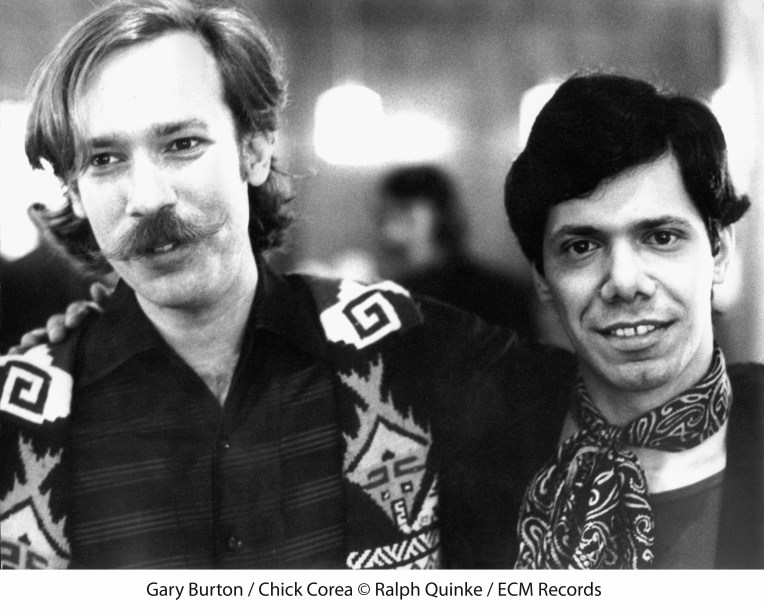
The year is 1959. A young Chick Corea, just out of high school and newly arrived in New York City, quits Columbia University after only one month and immerses himself in the City’s sixties Jazz scene, its second golden age. In the coming years he makes a name for himself, and his exuberant playing soon catches the ears of Miles Davis, Stan Getz, and many others. Jump to the 1972 Berlin Jazz Festival, where his fingers join the mallets of Gary Burton on record for the first time. So begins a musical partnership that has spun nothing but gloriousness ever since and brings us to 2011.

Burton and Corea

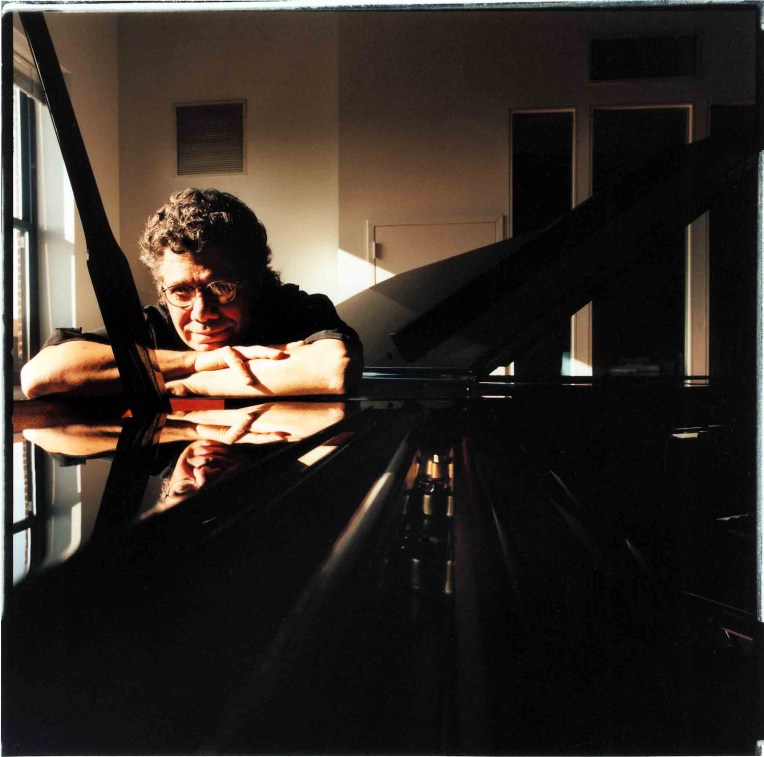
“The vibe is just conducive to making music,” says Corea of the Blue Note, a venue of personal choice for years, and where he now celebrates his 70th birthday with a month-long series of concerts. If anything, his flames burn brighter, bringing characteristic verve to every shade of his pianism: dynamic, utterly precise, and sparkling to the last drop. The Corea/Burton alignment is world-renowned, a boon to ECM and to the field as a whole for decades, and hopefully for decades yet.

The energy here at Blue Note is kept to a soft boil, every laugh seemingly exaggerated by anticipation. Tables are tightly packed, and one shares them with strangers, who by the end of the night leave their mark for having shared in such bliss. Our six-seat arrangement abuts the very front of the stage. It is my first time to this hallowed institution, and being in proximity to such avid Jazz fans, and to the music we’ve all come to witness, it feels good to be alive.

Tonight, Corea and Burton are joined by the Harlem (String) Quartet for a concert preview of their new Chamber Jazz collaboration, Hot House (due out on CD in February 2012). While on the surface this may seem like an unusual combination, in fact both Burton and Corea have already explored such crossovers. Burton was the first to do so when, after he and composer Samuel Barber had been toying with the idea for some time, he refashioned the mold with his Seven Songs For Quartet And Chamber Orchestra in 1973, then later with Corea himself on 1983’s Lyric Suite For Sextet and again on The New Crystal Silence (released 2008 on Concord). With such a varied palette from which to choose, the results promise to be extraordinary.

And indeed, extraordinary hardly begins to describe the sounds that wash over us once Corea and Burton take to the stage, made all the more so by the tasteful amplification and reverb. “Love Castle” kicks off the first of three duets, each a different glint from the same well-polished jewel. From chord one, we find ourselves wrapped in an expansive intimacy that only decades of collaborative playing can bring to bear. Burton is downright acrobatic on those gradated strips of metal and brings a cool fire to every lick he elicits from them. The duo takes a cue from Art Tatum in “Can’t We Be Friends.” Lush syncopations that would provide hours of head-scratching for many a frustrated player only give Burton further excuse to stretch his arms before applying his lightning runs to a crowd-pleasing rendition of “Eleanor Rigby,” in which Corea digs deep over a lithe ostinato.

Corea and Burton are both very personable, doing their utmost to make the crowd feel right at home between songs. Corea quips requisitely about cell phones and bids us to talk freely during the show as the Harlem Quartet makes its entrance. It is something of a dramatic one, as cellist Paul Wiancko navigates the narrow human corridor with his charge held carefully above our heads.

After a bit of tuning (more on this below), we’re off on two adventures from the aforementioned Lyric Suite. The quartet seems like a trampoline in “Overture,” sending piano and vibes flying into the neoclassical shades of “Waltz.” Here, Wiancko provides some welcome pizzicato on the way to a rosy finish. The quartet intros a shapely version of “’Round Midnight” as Corea jumps into the thematic deep end, leaving his partner to walk along the surface above. Last is a new Corea original entitled “Mozart Goes Dancing.” Burton’s flights are particularly noteworthy in this economical dialogue.

When both of these players perform, they appear so utterly focused on their task that one wonders how they connect so seamlessly. Corea’s answer: one need only serve the music and style will “take care of itself.” (This is exemplified in his penchant for conducting or clapping along from the bench whenever his hands aren’t on the keys.) Whatever the method behind their brilliance, it is the compatibility of their intentionality—the simple yet profound choice of where to place a note—that brands their synergy into the brain. They don’t so much trade places as constantly flit in and out of time, turning on a dime from supremely lyrical, almost elegiac passages, to head-nodding grooves. Such contrasts are like big bangs in miniature, each the potential for a new solar system of sound.


Harlem Quartet

And what of the Harlem Quartet? This seems to be the question of the night, for while these fresh-faced and spirited musicians clearly bring oodles of passion to the table, they are given little to work with in Corea’s often stilted arrangements. They are also, I feel, unfairly slighted by Corea and Burton’s last-minute encoring of the classic “La Fiesta,” which, though a powerful conclusion, keeps the faithful foursome on stage awkwardly for a good ten minutes while the two old-timers everyone has come to see weave their spell. (On that note, I strongly urge readers to hop on over to the Harlem Quartet’s homepage and take a gander at their many projects and inspiring commitment to outreach.)

There was, however, an unforgettable moment before the Lyric Suite selections commenced when, after taking their seats, the quartet took a minute or two for a tuning session. During this, Corea and strings spun some free improv that was, ironically, the most fruitful connection displayed between the two halves of the stage during the show, and perhaps territory they might explore in the future beyond the otherwise peripheral role assigned to them. Burton and Corea are such fully minded players already that one is hard-pressed to find any gaps in need of filling. How does one add more wind to a tempest?

In the end, the Corea/Burton experience, regardless of its augmentations, has never been at heart about blending idioms, but rather about exchanging them. In that exchange, one hears an ever-changing conversation, and we are lucky to have been a part of it on this balmy spring night. To walk through their sonic forests is to feel one’s feet on the earth, where soundtracks flitter through dusty, cobwebbed pathways of memory like Corea’s famous mouse. In traveling through these spaces, one finds the windows still crystal and silent, wiped clean from years of pressing our ears up against them.