Living Vividly: The Music of Autumn’s Grey Solace

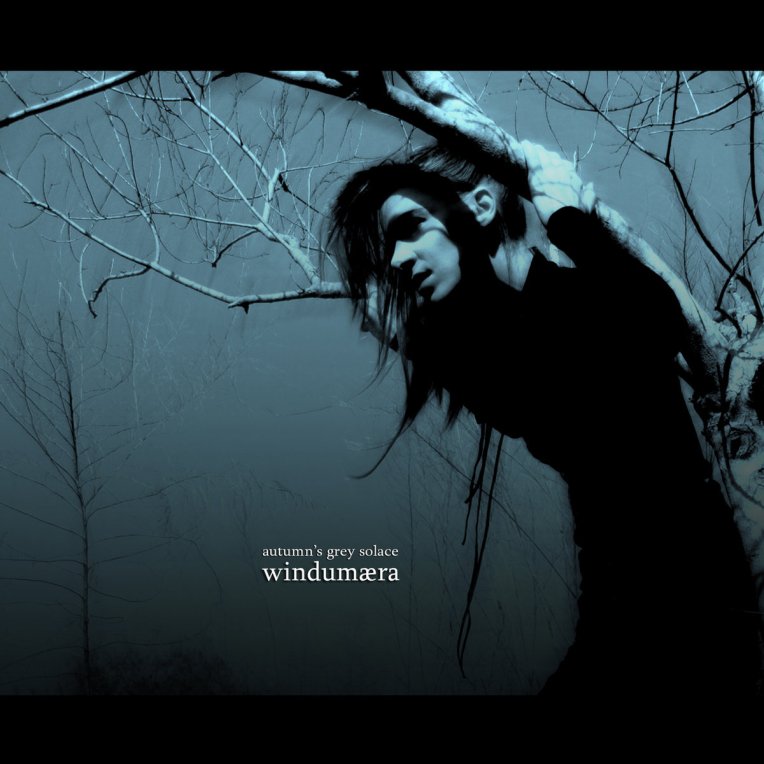
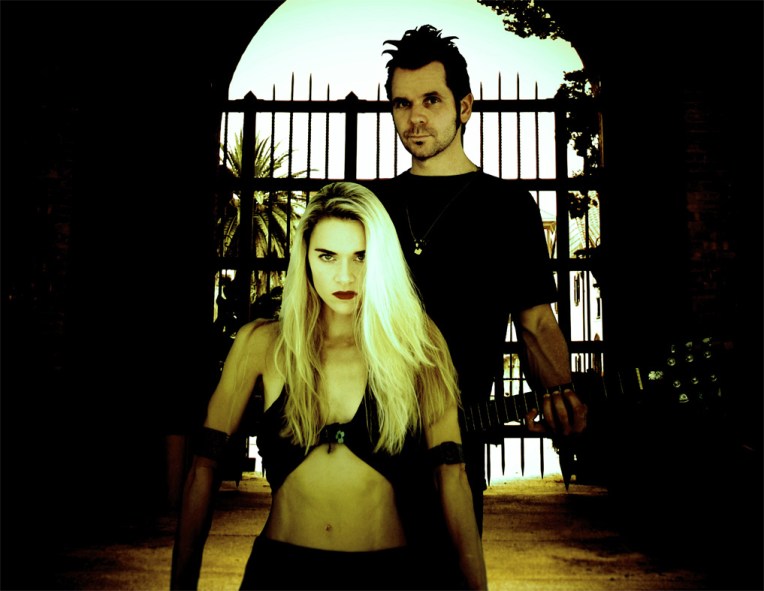
Since the release of Within The Depths Of A Darkened Forest in 2002, vocalist Erin Welton and multi-instrumentalist Scott Ferrell have been conjuring some of the most ethereal spells in the history of the craft. As Autumn’s Grey Solace, they hang notes from immense rafters, each a stage light that knows exactly where, and at what level of intensity, to illuminate the listener’s soul. Over the years, the duo has charted a trajectory of pivot-points, emerging from that ancestral forest into the brighter futures of 2006’s Shades Of Grey and 2008’s Ablaze. In 2011, at the height of their association with Projekt Records, Welton and Ferrell transitioned into Eifelian, which Ferrell tells me marked the beginning of a change in the band that crystallized in Divinian the following year and in Monajjfyllen thereafter. While the earlier albums constituted self-contained worlds, the latter two feel like a new skeleton fleshed by their self-released latest, Windumæra.

Exploring the music of AGS is like awakening yourself to beauties you never knew slumbered inside you. At the center of this galaxy is a gathering of light by which is obliterated your darkest fears. It’s a visceral, celestial body that thrives on language, melody, and the generative force of which we all partake in being born. Such metaphors are more than the hyperbole of this longtime listener, reflected as they are in the band’s approach to songwriting. It’s easy, for example, to detect a Cocteau Twins influence in their sound, and see the ways in which the duo has nurtured it to bear hybrid fruits. But less obvious inspirations lurk beyond it. “We are also influenced by some of the popular music of a period of time from the late sixties to the late eighties,” says Ferrell. “There was a time when pleasant sounding music was actually popular, unlike the last couple of decades.” We might take this to mean either that AGS is returning to some nostalgic origin story or enhancing a neglected musical turn in humble service of a new one. Whichever way we choose to interpret their sound, its purpose is clearly to connect, not alienate.

And so, while it would be easy to see Windumæra as a highly original clarification of the Cocteau Twins ethos, it draws just as much from music that has yet to be written, of which we are granted prophetic glimpses. The album’s name connotes “echoing” in Anglo-Saxon, a language featuring heavily in the song titles. “It’s a dead language,” says Ferrell of the Anglo-Saxon choice, “poetic and intriguing.” Dead though it may be, it lives vividly throughout Windumæra.
Windumæra

As Welton’s voice shines through the title song’s channels like sun through mist-kissed foliage, it navigates by an internal moonlight for which it requires only the star of Ferrell’s sensitive arrangement to glow. Ardent fans and newcomers alike will appreciate the height of Welton’s voice in relation to the patchwork of guitars below. She is an overseer, an eagle from whose mouth falls water and flora for an arid world. As in the album’s final benediction, the hymenopteran “Ymbe,” she evokes wings and honeyed consciousness.

Lyrically speaking, AGS has always balanced the prosaic and the poetic, but here strengthens that contrast, and thereby its invitation to indulge in the nuances of circumstance. In this respect, and beyond those connections listed above, I would venture to say the duo shares far more in common with the troubadours of the European Renaissance, plying their sonic trade across a continent that, while familiar, nevertheless pulls us into unimaginable new oceans.

Hence my confusion over AGS being so often misperceived as a “goth” outfit (in the most stereotypical sense, I mean), when in fact they seem as far a cry as one can get from the connotations of morbidity such a term may imply. For me, their music has always been a positively life-affirming search for beauty. Ferrell agrees: “We don’t associate our music with evil at all. Our mission is to create something beautiful and to console ourselves and others with music.” And if anything, consolation is at the very heart of Windumæra. We hear it in the pulsing bass line of “Sláhhyll,” which finds Welton delivering personal wisdoms as if they were materia in need of an alchemist. The synth-guitar arpeggios of “Belle” take shape just as clearly, if only more architecturally, as if inside a clock tower whose every strike purges us of a traumatic memory. Even the more subterranean tunes like “Asundran” open themselves as books in hopes of being read. As ever, Welton displays an uncanny ability to rise above her surroundings with acuity, turning hardship into ecstasy and filament.

This feeling of willful metamorphosis is perhaps the album’s central message. When I ask Ferrell about it, he says, “I like for each listener to interpret it in their own way but I would say this album has themes of freedom, expression, energy, and beauty.” With sometimes so little to hold on to in this expanse, I also wonder whether they compose their songs based on direct experiences, as part of a fantasy world, or both. Ferrell’s answer: “When I compose music, it’s way out there in a fantasy world. Erin’s vocals tend to be a combination of experiences and imagination.” Within this triangulation, it’s all the listener can do to draw a reliable map, because one wants to take into account every blade of grass and pebble. The healing energies of “Swíþfram” extend that triangle into a prism.

Because this album so deeply rewards the subjective mind, I uphold “Axa” as its pinnacle. It is a touch of vapor, a walk over rainbow bridges from solitude into communion with nature. Named after a river and meant to evoke its flowing currents, the song came together in the studio as it was being written. In contrast to “Hærfestwæta,” the autumnal associations of which recall the band’s name, it turns the ice of a painful experience into the liquid of transcending it.

Every moment of this music stems a place of genuine love, gratitude, and respect, a reflection of the souls that have found each other in this populous world to sing. The personal cocoon spun around the music is what makes it such a privilege to know. We might gaze at photos or watch videos, but until we close our eyes to the practical human concerns of their creation, these songs will not truly speak to us. They are to be embraced on their own terms, as if each were a finite entity in an infinite continuum. All of this shows in the gratitude from which they arise.

Windumæra finds AGS at the cusp of something deeper and more significant than anything the band has ever forged. It has superseded skin, flesh, and bone and placed a fingertip on the rhythms of a less tangible heart. Still, Ferrell sees yet another change on the horizon: “I think it’s the final album of the style we’ve been exploring on the last few albums and we’ll be drifting into new territory in the future.” Wherever that territory may be waiting, it has been a sublime comfort to listen to AGS’s evolution, and to know that there is still an era’s worth of moon nocturnal to be drunk in potions of expectation.

(For more information on this and other Autumn’s Grey Solace albums, please visit the band’s website here.)
AGS

Two Elliott Sharp reviews for The NYC Jazz Record

Tranzience

Coming up on four decades as composer and performer, New York’s Downtown deacon Elliott Sharp is at a creative peak. Tranzience documents four semi-recent chamber pieces, the earliest being Approaching the Arches of Corti (1997). Scored for four soprano saxophones (the New Thread Quartet of Geoffrey Landman, Kristen McKeon, Erin Rogers and Zach Herchen) and making use of Steve Lacy’s “leg-mute” technique, it sounds at times like a congregation of geese, at others a pipe organ running out of air, and leans nicely into 2008’s Homage Leroy Jenkins. Alongside clarinetist Joshua Rubin and pianist Jenny Lin, violinist Rachel Golub evokes the scrapes and squeals of the legendary dedicatee, whom Sharp counts, along with the larger AACM family, among his early influences. Venus & Jupiter (2012) features the ensemble Either/Or conducted by Richard Carrick and Sharp himself on electroacoustic guitar. Around a pulsing piano, this largely improvised masterwork spins a drone of strings, brass, winds and percussion drawing even more explicitly from the AACM well. The 2013 title composition features the JACK Quartet (Chris Otto, violin; Austin Wulliman, violin; John Pickford Richards, viola; Jay Campbell, cello), who recently brought their talents to bear on The Boreal (Starkland, 2015). Where that recording employed bows strung with ball-bearing chains, here the musicians use so-called “tube bows” fashioned from aluminum in addition to the standard hair. The music is consistently inventive across its 28-minute duration and inhabits a sound world that can only be described as nanotechnological.

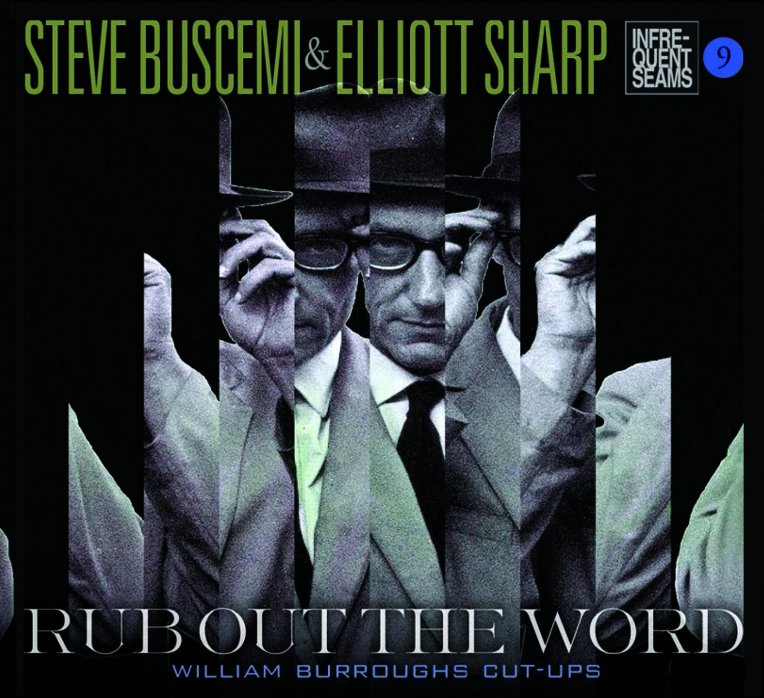
Rub Out The Word

To this solar system, Rub Out The Word may seem like a distant satellite, but its heart shares the same blood. Here Sharp (on guitar and electronics) joins actor Steve Buscemi (of Reservoir Dogs and Fargo fame) to celebrate the writings of Beat Generation guru William S. Burroughs in one of the most delicious spoken word recordings to come out in recent memory. Not only for Burroughs, who managed to make even the most abstract streams of consciousness feel coherent, but also for Buscemi’s adenoidal charm and Sharp’s accompaniment, which, like the words, evokes a viral network that responds to, even as it anticipates, hidden messages in the texts. Said texts are quintessential Burroughs, threading needles of incontrovertible (if sometimes perverse) cynicism through a social cloth he understood in ways few others of his generation did. “The use of cut-up is a key,” narrates Buscemi and one can’t help but feel that he and Sharp embody this very aesthetic in their collaboration. What follows is a string of meditations on writing, obsession, evil, bureaucracy, war, morality, human interactions and the occasional nod to silence thrown in for good measure. This is no naked lunch, but a fully clothed dinner after which dessert is served raw and dripping. And while it may not appeal to straightahead jazz heads, anyone who has enjoyed Sharp’s fantastic voyage (no small task with a discography of over 300 albums) for any length of time is sure to be enthralled.

(This article originally appeared in the September 2016 issue of The New York City Jazz Record, of which a full PDF is available here.)

Kayhan Kalhor review for RootsWorld

My latest review for RootsWorld online magazine is of an atmospheric collaboration centered around kamancheh virtuoso Kayhan Kalhor, who ECM listeners may recognize as half of Ghazala. This album is sure to be of particular interest to ECM fans. Click the cover to read more and hear samples.

Hawniyaz

Lines for Ladies: Live!

Lines for Ladies

This live album from HGBS Blue Records documents the final performance of a two-week tour in 2014 by the ensemble known as Lines for Ladies. Special guest Sheila Jordan acts, in her words, as the band’s “spiritual mother,” shepherding in a younger generation of voices spreading their cohesive harmonies across canvases both familiar and new. To be sure, Kirstin Korb (bass/vocals), Anne Czichowsky (vocals), Sabine Kürlich (vocals/alto sax), and Laia Genc (piano/vocals) share more than the stage with Jordan. They carry on her alluring—or, as one song here would put it, “Delicious and Lovely”—tradition of jazz song as storytelling. Jordan has spent a lifetime and more perfecting her fashion of delivery, and among these women she is as a sun to the stars. Whether paying tribute to her Native American roots in the chant with which she opens “The Moon’s a Harsh Mistress” or unfolding a 13-minute mission statement in the largely adlibbed “Sheila’s Blues,” she churns emotion until it becomes soft as butter. “I sing the blues ’cause I paid my dues,” she croons, humbly failing to mention the profits she has reaped from subsequent dividends.

Likewise, the depths and breadths of Jordan’s spiritual children are not to be taken lightly. Czichowsky appends fresh, self-penned lyrics to standards “Killer Joe” and “Idle Moments” to delightful effect. The former song, suitably rebranded as “Ladies’ Show,” asserts its femme power in a male-dominated genre, while the latter highlights Czichowsky’s vocal trumpeting against Genc’s smooth pianism. Czichowsky relays with Kürlich’s French in a bilingual rendition of “I Wish You Love (Que reste-t-il de nos amours).” The two singers harmonize even more deeply in the above-mentioned “Delicious and Lovely,” a Kürlich original that boasts slick time changes and instrumental qualities all around.

Korb is ever the anchor of this set, and provides some of the strongest philosophies the performance has to offer. Between the Chet Baker-inspired vocalese of “But not for Me” and her duet with Jordan in “Dat Dere,” she brings audible smiles to everything she touches. Nowhere more so than in her original “Something to Celebrate,” which honors her fateful move to Denmark—where she has, since 2011, become a force of nature in the local jazz scene. Genc unravels many of the tune’s finer implications at the keys, reveling (as she does throughout the album) in every twist and turn.

Most wonderful (and unforgettable) about the record is the level of joy brought to every upbeat groove and downtempo swing alike. These are human beings who truly love what they do. Their passion is multifaceted, practiced as preached. And couldn’t we use a little more of that in today’s world?

Two Aaron Parks reviews for The NYC Jazz Record

In the summer of 2014, Aaron Parks held a ten-week DIVA (Danish International Visiting Artists program) residency in Denmark. By then, at the age of 30, the American pianist had already achieved an independent sound, but on these two albums arising from his Danish tenure he thrives on the unsolvable riddle of collaboration.

When Parks released his 2013 disc of solo improvisations (Arborescence, ECM), he earned knee-jerk comparisons to fellow pianist and ECM stalwart Keith Jarrett. Yet while their styles could hardly be more different, they do have one thing in common: a genuine respect for melody. It’s this sense of song and structure that balances Parks’ youthful optimism with patience.

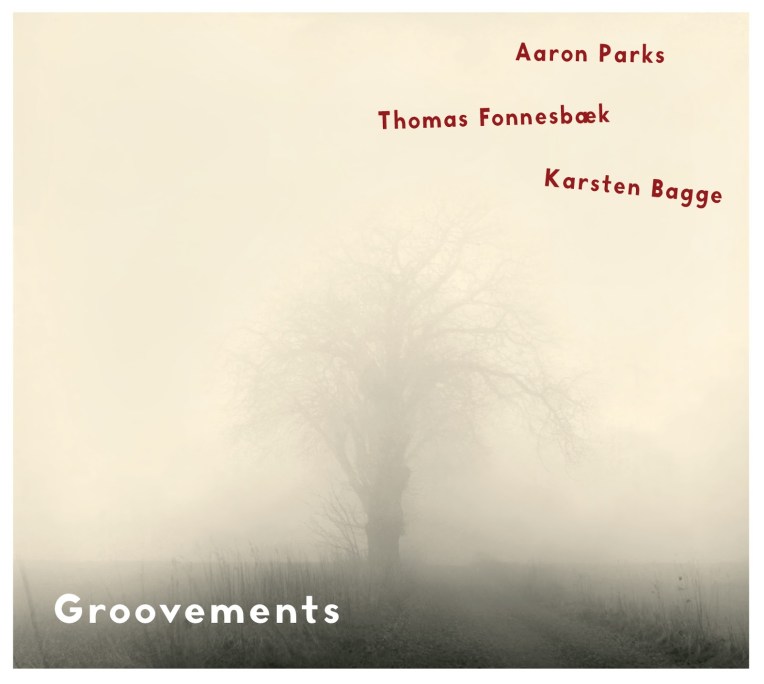
Groovements

On Groovements, he shares a studio with bassist Thomas Fonnesbæk and drummer Karsten Bagge. Despite being the first time this trio had recorded together—playing tunes written especially for this session, no less—these virtual strangers make for a cohesive mesh.

As if in service of that point, the group improvisation “Shapes ‘n’ Colors” is among the more seamless tracks. No less groovy than its satellites, the tune hits all the right pressure points and is every bit as flexible as Parks’ distinctly New York-ian “Elutheria.” Fonnesbæk and Bagge contribute two originals apiece, the former’s “Winter Waltz” and “Forever This Moment” being special vehicles for the composer’s artistry while the latter’s “Alcubierre’s Law” and “A Rabbit’s Tale,” not surprisingly, capitalize on the rhythmic core. The trio does bare its traditional chops, however, when handling the swing of Cedar Walton’s “Bolivia” and evergreen “You And The Night And The Music” with tact. Even the two surprises, Bruce Springsteen’s “I’m On Fire” and Danish classical composer Carl Nielsen’s “Tit Er Jeg Glad,” proceed with confident logic.

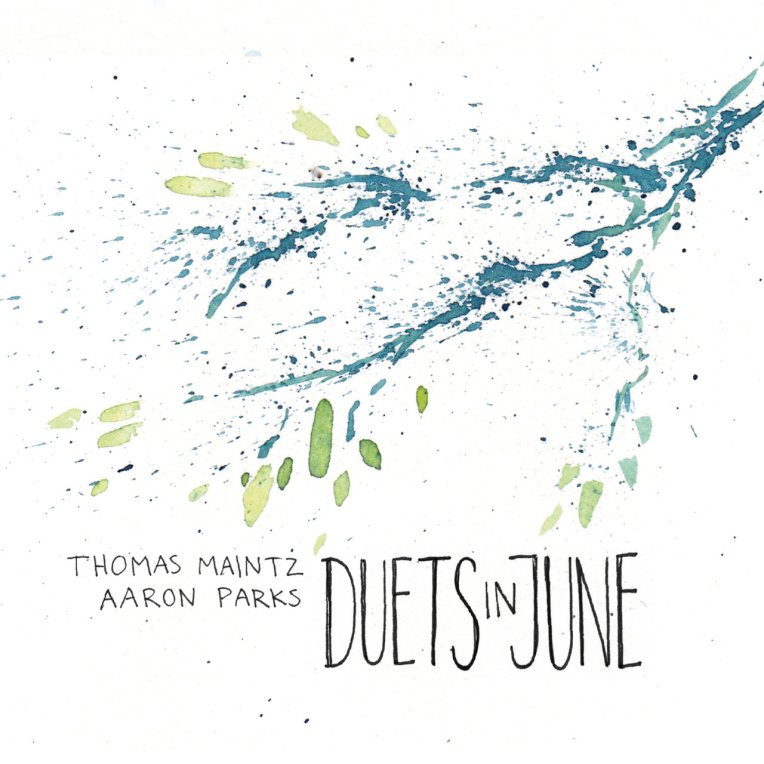
Duets in June

Duets in June would seem to be the more intimate project on paper, but its unusual combination of guitar and piano reaches more broadly and adventurously, the pepper to Groovements’ salt.

Much credit goes to guitarist Thomas Maintz, who wrote all the music except for three improvisations. The latter are the highpoints of this date—exercises in unforced seeking from two musicians who don’t just react to, but converse with each other. Where the drunken “Absinthe” and photorealistic “East Village Waltz” are tongue-in-cheekily illustrative, “Six String Levitation” (featuring Parks on melodica) and ambient “Please Hum (A Hymn)” offer more cerebral delights. Maintz speaks most lucidly through his acoustic baritone guitar, as on “Nude in Red Armchair,” in which his adaptability comes to the fore. All that said, it is Parks whose underlying feel for mood and message rings truest. Whether singing at the keys in “Secret Hallway” or going solo for “Riddles Dressed in White,” he understands that tenderness in music is more than a pantomime. It’s a way of life.

(This article originally appeared in the July 2016 issue of The New York City Jazz Record, of which a full PDF is available here.)

Matt Borghi & Michael Teager: Illuminating through Shadow

While feeding your eyes, why not feed your ears:

Guitarist Matt Borghi and saxophonist Michael Teager turn gasses into solids. Their process, however, goes beyond chemistry and physics, drawing as they do from a less definable well that some might call inspiration, others spirit, and still others ether. Separately, they have broadened their cartographies across continents. As a duo, they form their own by tender volcanism.

I spoke via e-mail with the musicians, both of whom were grateful in sharing their time and wisdom to illuminate the drift they have manifested. When I asked them to describe their relationship, Borghi likened it to a “combined meditation,” by which two become one through their non-traditional overlap. Teager, for his part, sees what they’re doing as a “contemplative improvised music,” forged not through a simple meeting of instruments but a more rhizomatic, orchestral sensibility.

While on paper their credits imply rock or jazz lineages, with respect to their instruments Borghi and Teager rest in a world apart. Despite a self-professed love/hate relationship with the guitar, Borghi manages to distill magic from its strings through an array of digital effects, but also, more importantly, an unrestricted approach. “That’s why I like improvisation so much,” he says. “It’s a constant exploration. Sometimes you find gold, sometimes you don’t, but each time you start there’s the possibility of hitting something that’s musically profound.” Teager, having more experience as an improviser, has overcome the challenge of owning his reeds, saying, “As a saxophonist in a stylistic continuum, I’m on my own island when it comes to our music. The name I get most often is Jan Garbarek, and while I do like Garbarek’s playing (particularly with Keith Jarrett), I don’t have a deep knowledge of his catalogue. (He’s my ECM blind spot, partially intentionally.) I try not to listen to other ‘ambient’ saxophonists too much. There are so few of us, and the last thing I want is to subconsciously encroach on another’s territory.”

If anything may be compared, it’s Teager’s likeminded patience for notecraft. To be sure, he has found a beautiful comfort in Borghi’s elastic netting, one in which he more often reacts than dictates in a real-time space that privileges atmospheric over egotistic expression. It’s a dynamic evinced in the 2013 album Convocation. Though an unscripted narrative, it develops from the title reverie to a slow-motion ballad (“Discern Descent”) with inchoate coherence. “Nebula Divide,” on the other hand, operates on a more cosmic scale, changing from monochrome to color and back again along an epic flight path. Such titles, among them also “Constant Apex,” help visualize the music’s ethos in all its asymptotic blush.

Convocation

For me, the most evocative drop takes shape in “Precipice.” Borghi wrenches an organic pulse from his guitar, like a light signaling a lone wayfarer from far off, while Teager echoes its promise of shelter in a darkening sky. I can’t help, if from the title alone, be reminded of a performance I once experienced of Japanese butoh dancer Min Tanaka, who barely moved a few inches from a wall over the course of an hour, as if standing on a cliff in contemplation of suicide. Though not so morbid, here the feeling is one of suspension, embraced by the grandeur of creation.

If my association suggests anything, it’s that these sounds welcome any interpretations listeners might bring to the table. The same is reflected in the artists of influence lurking in the background. Just as Borghi cites Claude Debussy, Pink Floyd, and Harold Budd as vital touchpoints in his growth, Teager’s range from Dave Liebman and Charles Lloyd to Richard Wagner and Smashing Pumpkins. And while you may not necessarily detect any of these on the surface, an emotional affinity lances them all.

So it is with 2014’s Shades of Bending Light, wherein mixtures born of experimentation yield integral new structures. “Joyce’s Fanfare” begins at dawn, flowing with the tide between binary chords, while Teager builds his wingspan one feather at a time. A similar approach—spreading the seeds and listening to them grow—blossoms through all that follows.

Shades of Bending Light

Whether in the desolation of “Daisy Chain” or the rhythmic fantasy of “Weird Minor,” or even the farewell energy of “Blue Sky Fades,” an environmental residue stays behind to remind us of what transpired. The album is, further, an enmeshment of contradictions. Teager lights up layers of gray and mist in “Watch Over” with virtuosic runs, even as Borghi tempers his searching with diffuse endpoints. And in “Nightdrive,” which feels like an orphaned folktale hitchhiking along a runway of solitude, one may feel a bodily connection taking place. Even the album’s title track, which despite being its longest feels like its most ephemeral, is as intimate as it is boundless.

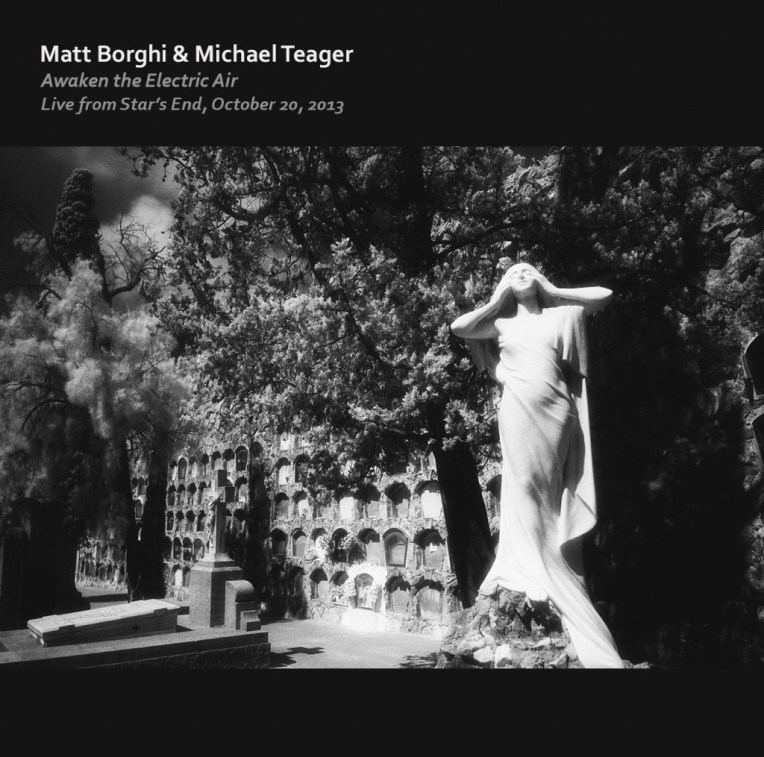
The merging of these polar forces hints at their ultimate unity, as made even clearer in 2014’s Awaken the Electric Air. Played as a late-night (4-5am) radio broadcast for WXPN in Philadelphia, it references some Convocation material with lucidity and openness of heart. Ever the transient traveler, Teager’s saxophone pulls the very horizon like a blanket before slumber, his modal sopranism in “Bed of Ash / Coda” being especially moving.

Awaken the Electric Air

The album’s live setting gives the now-familiar motif of “Nebula Divide” (paired with “Somnolence”) and, like the title track, feels sacred by sheer virtue of audibility. Lit by heightened awareness, the paths before listeners remain visible even when the final torch is extinguished, as its smoke continues to guide us by the wrists into dimensions beyond.