Two Aaron Parks reviews for The NYC Jazz Record

In the summer of 2014, Aaron Parks held a ten-week DIVA (Danish International Visiting Artists program) residency in Denmark. By then, at the age of 30, the American pianist had already achieved an independent sound, but on these two albums arising from his Danish tenure he thrives on the unsolvable riddle of collaboration.

When Parks released his 2013 disc of solo improvisations (Arborescence, ECM), he earned knee-jerk comparisons to fellow pianist and ECM stalwart Keith Jarrett. Yet while their styles could hardly be more different, they do have one thing in common: a genuine respect for melody. It’s this sense of song and structure that balances Parks’ youthful optimism with patience.
Groovements

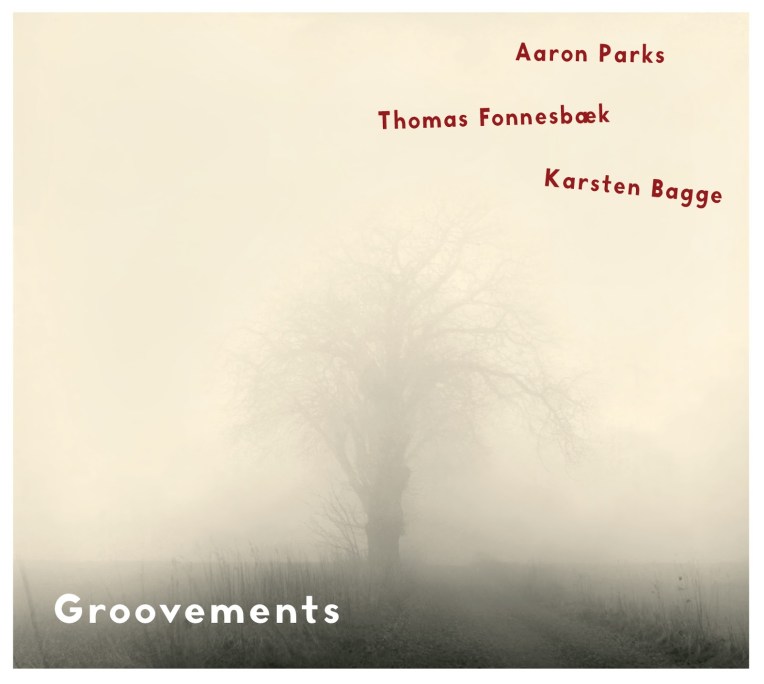
On Groovements, he shares a studio with bassist Thomas Fonnesbæk and drummer Karsten Bagge. Despite being the first time this trio had recorded together—playing tunes written especially for this session, no less—these virtual strangers make for a cohesive mesh.

As if in service of that point, the group improvisation “Shapes ‘n’ Colors” is among the more seamless tracks. No less groovy than its satellites, the tune hits all the right pressure points and is every bit as flexible as Parks’ distinctly New York-ian “Elutheria.” Fonnesbæk and Bagge contribute two originals apiece, the former’s “Winter Waltz” and “Forever This Moment” being special vehicles for the composer’s artistry while the latter’s “Alcubierre’s Law” and “A Rabbit’s Tale,” not surprisingly, capitalize on the rhythmic core. The trio does bare its traditional chops, however, when handling the swing of Cedar Walton’s “Bolivia” and evergreen “You And The Night And The Music” with tact. Even the two surprises, Bruce Springsteen’s “I’m On Fire” and Danish classical composer Carl Nielsen’s “Tit Er Jeg Glad,” proceed with confident logic.
Duets in June

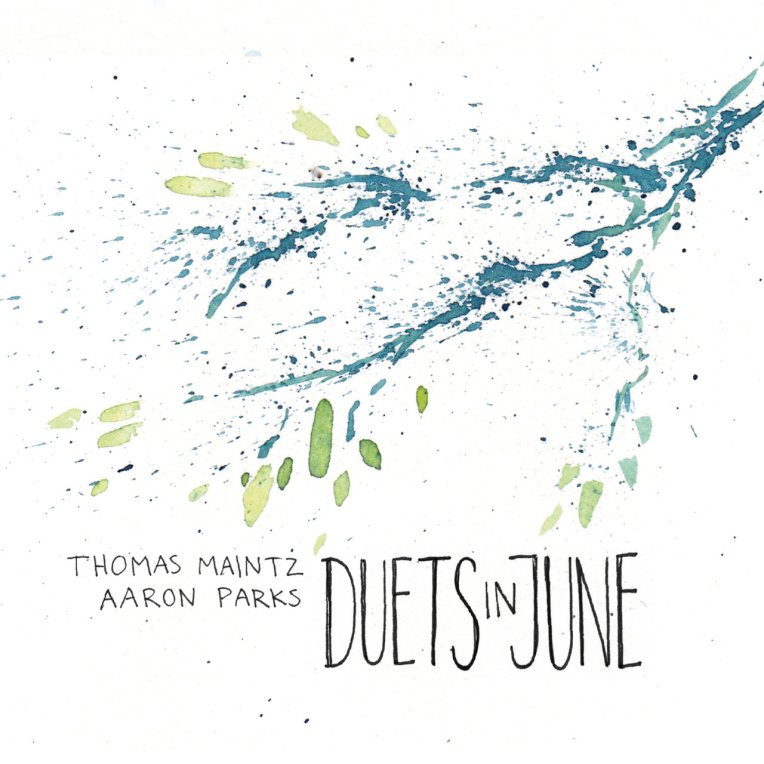
Duets in June would seem to be the more intimate project on paper, but its unusual combination of guitar and piano reaches more broadly and adventurously, the pepper to Groovements’ salt.

Much credit goes to guitarist Thomas Maintz, who wrote all the music except for three improvisations. The latter are the highpoints of this date—exercises in unforced seeking from two musicians who don’t just react to, but converse with each other. Where the drunken “Absinthe” and photorealistic “East Village Waltz” are tongue-in-cheekily illustrative, “Six String Levitation” (featuring Parks on melodica) and ambient “Please Hum (A Hymn)” offer more cerebral delights. Maintz speaks most lucidly through his acoustic baritone guitar, as on “Nude in Red Armchair,” in which his adaptability comes to the fore. All that said, it is Parks whose underlying feel for mood and message rings truest. Whether singing at the keys in “Secret Hallway” or going solo for “Riddles Dressed in White,” he understands that tenderness in music is more than a pantomime. It’s a way of life.

(This article originally appeared in the July 2016 issue of The New York City Jazz Record, of which a full PDF is available here.)
Matt Borghi & Michael Teager: Illuminating through Shadow

While feeding your eyes, why not feed your ears:

Guitarist Matt Borghi and saxophonist Michael Teager turn gasses into solids. Their process, however, goes beyond chemistry and physics, drawing as they do from a less definable well that some might call inspiration, others spirit, and still others ether. Separately, they have broadened their cartographies across continents. As a duo, they form their own by tender volcanism.

I spoke via e-mail with the musicians, both of whom were grateful in sharing their time and wisdom to illuminate the drift they have manifested. When I asked them to describe their relationship, Borghi likened it to a “combined meditation,” by which two become one through their non-traditional overlap. Teager, for his part, sees what they’re doing as a “contemplative improvised music,” forged not through a simple meeting of instruments but a more rhizomatic, orchestral sensibility.

While on paper their credits imply rock or jazz lineages, with respect to their instruments Borghi and Teager rest in a world apart. Despite a self-professed love/hate relationship with the guitar, Borghi manages to distill magic from its strings through an array of digital effects, but also, more importantly, an unrestricted approach. “That’s why I like improvisation so much,” he says. “It’s a constant exploration. Sometimes you find gold, sometimes you don’t, but each time you start there’s the possibility of hitting something that’s musically profound.” Teager, having more experience as an improviser, has overcome the challenge of owning his reeds, saying, “As a saxophonist in a stylistic continuum, I’m on my own island when it comes to our music. The name I get most often is Jan Garbarek, and while I do like Garbarek’s playing (particularly with Keith Jarrett), I don’t have a deep knowledge of his catalogue. (He’s my ECM blind spot, partially intentionally.) I try not to listen to other ‘ambient’ saxophonists too much. There are so few of us, and the last thing I want is to subconsciously encroach on another’s territory.”

If anything may be compared, it’s Teager’s likeminded patience for notecraft. To be sure, he has found a beautiful comfort in Borghi’s elastic netting, one in which he more often reacts than dictates in a real-time space that privileges atmospheric over egotistic expression. It’s a dynamic evinced in the 2013 album Convocation. Though an unscripted narrative, it develops from the title reverie to a slow-motion ballad (“Discern Descent”) with inchoate coherence. “Nebula Divide,” on the other hand, operates on a more cosmic scale, changing from monochrome to color and back again along an epic flight path. Such titles, among them also “Constant Apex,” help visualize the music’s ethos in all its asymptotic blush.

Convocation

For me, the most evocative drop takes shape in “Precipice.” Borghi wrenches an organic pulse from his guitar, like a light signaling a lone wayfarer from far off, while Teager echoes its promise of shelter in a darkening sky. I can’t help, if from the title alone, be reminded of a performance I once experienced of Japanese butoh dancer Min Tanaka, who barely moved a few inches from a wall over the course of an hour, as if standing on a cliff in contemplation of suicide. Though not so morbid, here the feeling is one of suspension, embraced by the grandeur of creation.

If my association suggests anything, it’s that these sounds welcome any interpretations listeners might bring to the table. The same is reflected in the artists of influence lurking in the background. Just as Borghi cites Claude Debussy, Pink Floyd, and Harold Budd as vital touchpoints in his growth, Teager’s range from Dave Liebman and Charles Lloyd to Richard Wagner and Smashing Pumpkins. And while you may not necessarily detect any of these on the surface, an emotional affinity lances them all.

So it is with 2014’s Shades of Bending Light, wherein mixtures born of experimentation yield integral new structures. “Joyce’s Fanfare” begins at dawn, flowing with the tide between binary chords, while Teager builds his wingspan one feather at a time. A similar approach—spreading the seeds and listening to them grow—blossoms through all that follows.

Shades of Bending Light

Whether in the desolation of “Daisy Chain” or the rhythmic fantasy of “Weird Minor,” or even the farewell energy of “Blue Sky Fades,” an environmental residue stays behind to remind us of what transpired. The album is, further, an enmeshment of contradictions. Teager lights up layers of gray and mist in “Watch Over” with virtuosic runs, even as Borghi tempers his searching with diffuse endpoints. And in “Nightdrive,” which feels like an orphaned folktale hitchhiking along a runway of solitude, one may feel a bodily connection taking place. Even the album’s title track, which despite being its longest feels like its most ephemeral, is as intimate as it is boundless.

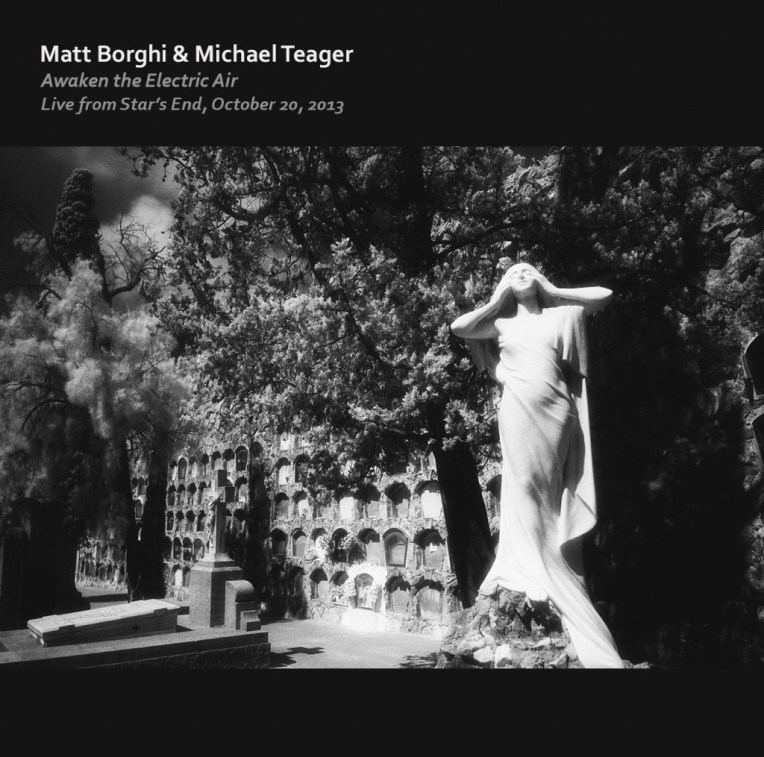
The merging of these polar forces hints at their ultimate unity, as made even clearer in 2014’s Awaken the Electric Air. Played as a late-night (4-5am) radio broadcast for WXPN in Philadelphia, it references some Convocation material with lucidity and openness of heart. Ever the transient traveler, Teager’s saxophone pulls the very horizon like a blanket before slumber, his modal sopranism in “Bed of Ash / Coda” being especially moving.

Awaken the Electric Air

The album’s live setting gives the now-familiar motif of “Nebula Divide” (paired with “Somnolence”) and, like the title track, feels sacred by sheer virtue of audibility. Lit by heightened awareness, the paths before listeners remain visible even when the final torch is extinguished, as its smoke continues to guide us by the wrists into dimensions beyond.

Two new reviews for All About Jazz

My latest non-ECM reviews are of two vastly different albums, both worthy of your attention. The first is Julian Julien’s Terre II, which has something of a Debussy-meets-jazz-in-a-dark-alley vibe, while the other is by the extraordinary young jazz pianist Megumi Yonezawa, who rides a wave of praise from Jason Moran into her leader debut, A Result of the Colors. Click the covers below to read on…

Terre II

A Result of the Colors

John Zorn: Flaga

Flaga

Eight tunes from The Book of Angels make up Flaga, the 27th installment in a series exploring the parallel opus to John Zorn’s popular Masada series. His interpreters this time are pianist Craig Taborn, bassist Christian McBride, and drummer Tyshawn Sorey. “Machnia” puts listeners into the thick of things, highlighting the playing as much as Zorn’s prolific gift for melody.

What would appear to be a triangular relationship in theory turns into a pyramidal one in practice. The atmosphere is joyful and exciting and finds each musician grabbing the wheel in succession with idiosyncratic vigor. It’s a formula that leads to consistent piquancy in the remaining tunes, if at times dulled by the compactness of the engineering, which suffocates tunes like “Peliel” and “Katzfiel.” Other places it works beautifully, however, as in “Shiftier.” Here Taborn balances sacred and secular impressions, launching into his solos with territorial wanderlust. But not even a few misfires at the mixing board can reign in a double take on “Talmai,” of which the landscape is vast and the rhythm sectioning robust.

As may be expected in anything branded Zorn, abstractions are never too far away. Their wonders enliven “Katzfiel” and “Rogziel,” the latter recalling its composer’s fascination with the cartoon music of Carl Stalling. In this respect, the trio allows the spirit at hand to take the music where it needs to go, even if, like sand in an hourglass, every particle of improvisation eventually funnels into a steady passage of time. Which is not to say that reveries are absent: “Agbas” and “Harbonah” show sensitivity in kind, the latter an atmospheric gem that draws an arco bass thread through a stormy patchwork of piano and cymbals, teasing out the indestructible heart of the whole enterprise.

The way these veterans ease into and out of such eclectic themes is masterful, yielding a fresh take on Zorn that may just be the standout disc of the series and one that reasserts his position in the modern jazz canon.

(This article originally appeared in the June 2016 The New York City Jazz Record, of which a PDF of the full issue is available here.)

Mahsa Vahdat review for RootsWorld

My latest review for RootsWorld online magazine is of Mahsa Vahdat’s The sun will rise, a Norwegian coproduction that follows the Iranian singer unaccompanied in various locations around the world. A moving album about the power of song. Click the cover to read on and hear samples.

The sun will rise