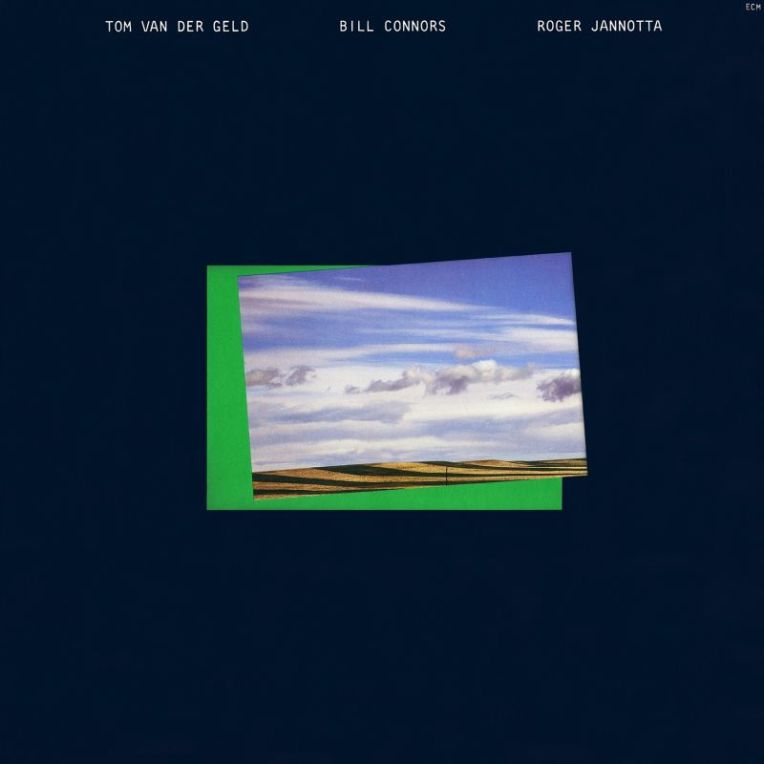
Tom van der Geld: Path (ECM 1134)

ECM 1134

Tom van der Geld
Path

Tom van der Geld vibraharp
Bill Connors guitars
Roger Jannotta flute, soprano saxophone, oboe
Recorded February 1979 at Tonstudio Bauer, Ludwigsburg
Engineer: Martin Wieland
Produced by Manfred Eicher

Path brings together guitarist Bill Connors (fresh off a stint with the Jan Garbarek Group on Photo With…), Carla Bley Big Band regular Roger Jannotta on winds, and vibraphonist Tom van der Geld for a network of pellucid improvisations entwining the barest of compositional skeletons. Connors’s twangy steel drops us immediately into an ethereal sound-world with “One,” mediating a pleasant conversation between flute and vibraphone. Thus begins a kaleidoscope of duets, trios, and quartets (the latter courtesy of some non-intrusive overdubbing). Mallets provide a resonant trunk in “Eevee,” from which branches Connors’s crisp foliage, all of it animated by the breath of a majestic flute. This blends smoothly into the pastels of “Joujou,” where familial nostalgia abounds. The title of “Michi” is Japanese for “path,” which makes it the title track by way of translation. Jannotta switches to soprano sax in this new enigmatic territory, landmarked by gossamer flags and empty way stations, before fluting a veil of Aeolian sounds over our ears. “Joys And Sorrows” works stretches our heartstrings and plucks each with the gentility of a raindrop on a spider’s web. Two ghostly guitars shine inside its nocturnal halo of vibes, bisected by soprano with a comet’s grace.

Like a meteor shower, one spends a long time waiting for excitement in Path, only to realize that the pregnant darkness to which one has held such rapt attention harbors far greater wonderment. As one of ECM’s most transparent statements, this positively exquisite album is an easy candidate for president of the label’s Bizarrely Out of Print Club. Find it any way you can and be moved, as you will.

<< John Abercrombie Quartet: Arcade (ECM 1133)
>> Jan Garbarek Group: Photo With… (ECM 1135)

Michael Galasso: Scenes (ECM 1245)

1245Michael Galasso
Scenes

Michael Galasso violin
Recorded October 1982, Tonstudio Bauer, Ludwigsburg
Engineer: Martin Wieland
Produced by Manfred Eicher

Born in Louisiana in 1949, Michael Galasso picked up his first violin at age 3. After debuting with the New Orleans Philharmonic at 11, he went on to forge a unique and fascinating career. As a longtime collaborator of Robert Wilson, he composed incidental music for a host of renowned productions, including an award-winning 1998 staging of Strindberg’s A Dreamplay, in addition to being involved in numerous sound installations in museums worldwide. Many will have encountered him as the film scorer for Wong Kar-wai’s In the Mood for Love, and most recently for Martin Provost’s Séraphine, but far too few have heard him on his own terms, divorced from the images he describes.

For his first solo album, Galasso gives us nine numbered “Scenes,” each the facet of an unfathomable jewel. It is an album to which I often played my violin by ear, trying to gain inner sight to its deeper complexities. And indeed, beyond its charming Philip Glassean veneer heaves a pair of expansive lungs that expel far more than they take in. The album has the feeling of a home recording, multi-tracked and with minimal processing applied. Despite being meticulously composed, it is also spontaneous in feel and refreshingly non-perfectionist. Some lines don’t quite sync up, as if what we hear were just a potent coincidence. From the hauntingly enigmatic (Scenes II and VI) to the whimsical (Scene III), we are privileged to stroll through this modest gallery of sound. Scene IV stands out with its boldly syncopated lead and subtle harmonizing. Others, like Scenes VII and VIII, tremble with incidental potential, seeming to spring forth from an as yet unrealized mise-en-scène. But it is the final Scene that remains closest to my heart, for its utter simplicity draws from a groundswell of bliss. Not unlike the solo work of Paul Giger, it has a magic all its own, an uncompromising sense of direction that can never be thwarted once it holds you.

Scenes is more than a soundtrack without images. Not unlike the shadow on the cover, its chapters are disembodied. We see only their negative selves, and hear only the sounds that animate them.

<< Jack DeJohnette’s Special Edition: Inflation Blues (ECM 1244)
>> Lester Bowie: All The Magic! (ECM 1246/47)

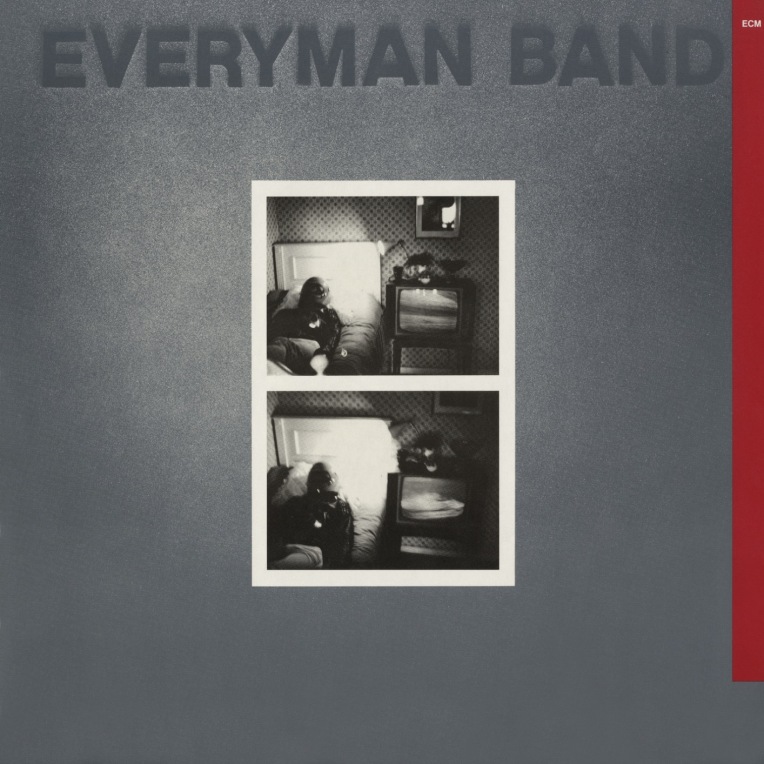
Everyman Band: s/t (ECM 1234)

ECM 1234

Everyman Band

Michael Suchorsky drums
David Torn guitar
Bruce Yaw bass
Marty Fogel saxophones
Recorded March 1982 at Talent Studio, Oslo
Engineer: Jan Erik Kongshaug
Produced by Manfred Eicher

What began as Lou Reed’s backing in the seventies stepped out on its own as Everyman Band, recording this self-titled debut for ECM in 1982. If a group is only as good as its musicians, then the name is a contradiction: not everyone possesses the firepower of Michael Suchorsky on drums, David Torn on guitar, Bruce Yaw on bass, and Marty Fogel on saxophones. The latter brings his idiomatic flair with three originals. Torn steals the show in “Lonely Streets,” a smoldering trek through nocturnal fires and other hidden conflagrations. Fogel spikes this punch with his own choice poisons. Yaw keeps up at every turn of phrase, and keeps us “On the Spot” with a memorable bass line, around which Fogel herds Torn’s flock in tight circuits. “Fatt Blatt” weighs in with a heavy tenor solo before the quartet pulls its best funk off the rack in a monochromatic swing. Yaw has his moment in the sun before diving back into the vamp with a vengeance.

Torn hones in with two clicks of his own. “Morals in the Mud” opens the album with a bang, his Strat popping the bubble of our attention with a neon pin, while “The Mummy Club” gives off an airier vibe. A slap bass distinguishes this wobbly palate-cleanser from the rest, as Fogel surfs Torn’s mighty chordal crashes with finesse. Suchorsky and Yaw churn out one tune apiece. “Japan Smiles” has a deeper, headier sound and features some fantastic bass/sax interaction. “Nuclear Suite,” on the other hand, is less direct, and speaks in tongues over a vast dynamic breadth. The appearance of a soprano sax lightens the load considerably. Playful, jaunty rhythms abound, overturning post-apocalyptic rubble for clues to a hidden past. Torn elbows his way through with an incisive solo. Like a slingshot of light into the evening sky for want of a meteor shower, it trails with unnaturally prolonged fire.

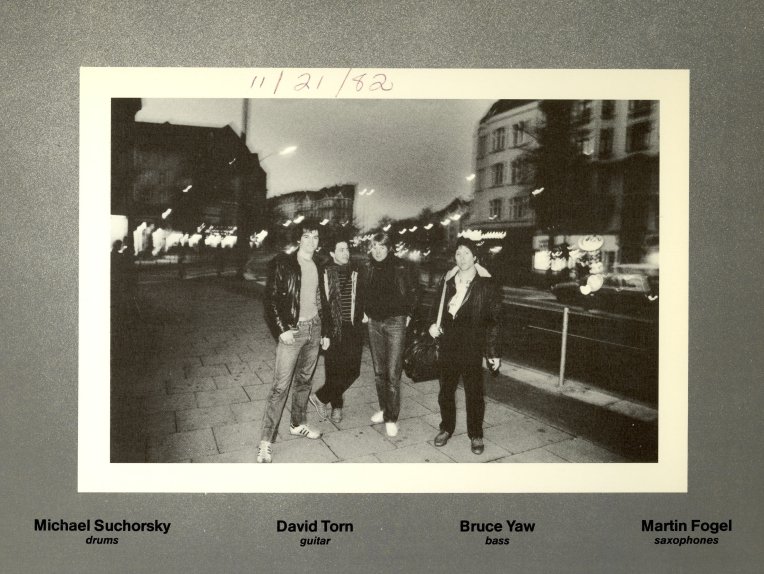
Everyman Band
(Photo by Ralph Quinke)

This album is an all-around solid effort brimming with guttural, after-midnight sounds that are iconic of the very era they tear to shreds. The band’s style is both distant and in our faces. The group shot on the back of LP jacket says it all: a relatively clear foreground lights the naked streets against an impossibly distorted backdrop in a single instantaneous image.

<< Chick Corea: Trio Music (ECM 1232/33)
>> Hajo Weber/Ulrich Ingenbold: Winterreise (ECM 1235)

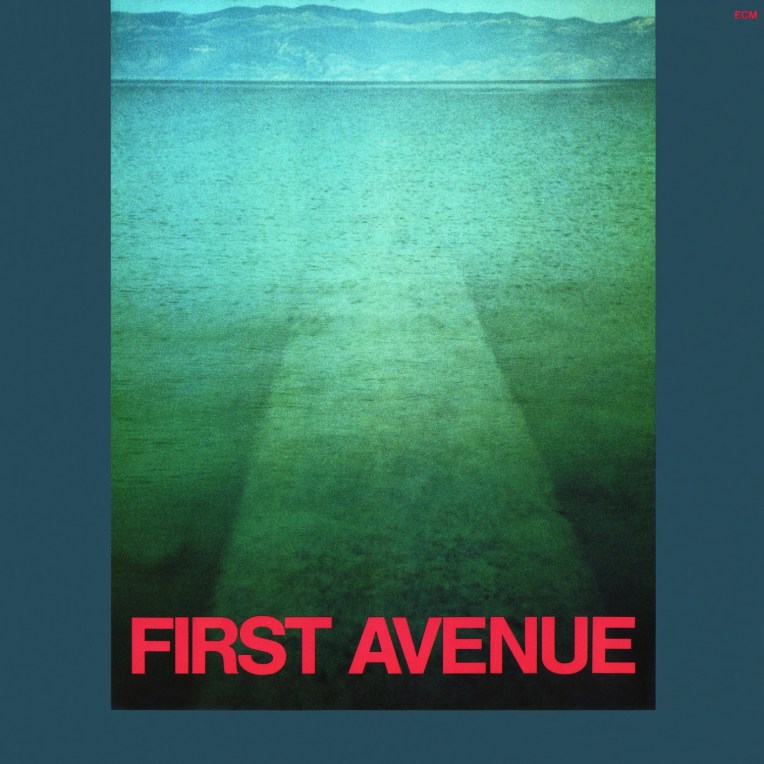
Goodhew/Jensen/Knapp: First Avenue (ECM 1194)

ECM 1194

First Avenue

Denney Goodhew alto saxophone, flute, bass clarinet
Eric Jensen cello
James Knapp trumpet, fluegelhorn, waterphone
Recorded November 1980 at Tonstudio Bauer, Ludwigsburg
Engineer: Martin Wieland
Produced by Manfred Eicher

“Our procedure is to simply begin.”
–James Knapp

Bringing together reedman Denney Goodhew, cellist Eric Jensen, and horn player James Knapp, First Avenue is a ghostly outlier in the ECM backlist. The project germinated within the American Contemporary Dance Company, which paired spontaneous incidental music with indeterminate movement on stage. As the trio began to branch out and perform as a group, they soon made their way into the studio for this enigmatic session. The pieces have no titles outside of “Band One,” “Band Two,” etc., and perhaps anything more would only be a distraction.

The haunting cries of a waterphone make their first of two appearances on the label (the other courtesy of Marilyn Mazur on Elixir) by way of introduction. From this, we encounter a spacious flowering of alto sax, cello, and horn, sounding much like a Gavin Bryars ensemble piece in its developmental arc. Some tracks (Bands Two and Seven) employ an echo effect which, though dated, is put to utmost creative use here, swirling into a spiral in which the original utterance ceases to exist. Band Three boasts as many overdubbed cellos in a clustered, reactive agitation, while Five is a beautiful piece for two overdubbed saxophones. The latter’s chromatic and lively syncopation make for a most engaging interlude to the overall denser flow. Band Four is more playful, yet somehow regretful, feeling like the soundtrack to a mental breakdown, Darren Aronofsky-style—each hiccup from the cello another pill popped, each horn blast another memory compromised.

Loops and delays abound in the album’s second half. Band Six paints a particularly fluid image of fluted beginnings and muted menageries. Bass clarinet and fluegelhorn bleed darker hues into a cello’s growls and other subterranean minutiae. Each ascendant line drapes its shadow from a barely visible line in a modest exhibition of pellucid musicianship and seamless changes of register. The echoed sax in Band Eight almost sounds as if it were being played backward as undulating cello lines keep it airborne. Abandon builds to stratospheric heights before fading in a final dissolve.

These are supremely harmonic, spacious improvisations that ply the ear with questions that are their own answers. This is intimate, far-reaching, and supremely accessible music drawn from a synergistic wellspring of talent. A more than pleasant surprise as yet unburned in CD form.

<< Surman/DeJohnette: The Amazing Adventures Of Simon Simon (ECM 1193)
>> Shankar: Who’s To Know (ECM 1195)

Eduard Brunner: Dal niente (ECM New Series 1599)

Eduard Brunner
Dal niente

Eduard Brunner clarinet
Recorded October 1995, Propstei St. Gerold
Engineer: Peter Laenger
Produced by Manfred Eicher

Swiss clarinetist Eduard Brunner has appeared on such ECM albums as Kurtág’s Hommage à R.Sch. and Kancheli’s Caris Mere. With this fine disc, at last he gives his instrument its due glory in the spotlight, or should I say the shadows. Brunner’s extended technical precision and superb breath control amount to a humble program of contemporary selections that are all about the destination. Virtuosity is merely a means to getting there.

Isang Yun’s Piri is an extended saturnine call. It is as if the clarinet itself takes in and expels its own breath without human assistance. One could hardly ask for a more fitting introduction neither to the album’s sound-world nor to Brunner’s instrumental acuity. A longtime part of his performance repertoire, Piri instigated a friendship between performer and composer that lasted until Yun’s death in 1995. Dark sustained tones lead into flashes of light, which echo through the lofty ceiling of Propstei St. Gerold in nimble footsteps. The piercing quality of long-held notes gets behind the skull and awakens the brain. In those notes are cradled exquisite overtones for the careful ear. The piece’s many glissandi, mocking vocal qualities, and overblowing tell a potent dedicatory tale. As a “prayer” to incarceration (the travails of which Yun was no mere observer), its thread continues to hold strong.

Written for Brunner’s teacher Louis Cahuzac, Igor Stravinsky’s well-regarded Three Pieces for Clarinet Solo introduces some of the instrument’s lower timbers. With these, the music becomes more rhythmically discernible. We begin to feel agitation and weightiness, much in contrast to Yun’s relatively ethereal traumas. Brunner appends to this Stravinsky’s previously unpublished Piece for Clarinet Solo, jotted in the margin of a telegraph in April of 1917 and dedicated to Pablo Picasso.

The highly malleable Domaines pour clarinette seule of Pierre Boulez gives Brunner ample room in which to flex his melodic muscles. Equal parts rest and work, these twelve short pieces thrive in half-breathed reverie.

While Karlheinz Stockhausen’s In Freundschaft exists in versions for many solo instruments, in its present incarnation its birdsong-like qualities are enhanced. This potent dose of sunshine starts off delicately enough, played as if on separate instruments. Every note seems to peek around a corner and scamper before it is found out. A brilliant composition and evocation thereof.

Giacinto Scelsi’s Preghiera per un’ombra gives us another interior monologue. Veiled in its titular shadow and structured by the composer’s enchanting idiosyncrasies, it is suffused with marked changes in emotional climate.

The title of Helmut Lachenmann’s Dal niente (Intérieur III) means “Out of nothing.” And indeed, much of the music consists of forced air with mere hints of notes. Depressed keys plunk like marbles on a frozen lake, while the occasional note screeches above the solace. The sound is downright saxophonic, made all the more so for its metallic undertone. Each breath is different than the last, and shows Brunner’s command even further.

The album is meticulously conceived. The first half is structured around ambulatory bodies, minds, and personalities, while the latter half is more “spiritual” and descriptive. The music wiggles past our expectations, sharing with us its nightmares and fantasies alike. Brunner’s style reminds me very much of Heinz Holliger’s (as a point of reference, his oboe rendition of Piri can be heard on Lauds and Lamentations), for he brings a similar sense of depth and technical attention to his playing. Dal niente sets a challenging bar for contemporary clarinet recordings, one not to be surpassed in the foreseeable future.

<< György Kurtág: Musik für Streichinstrumente (ECM 1598 NS)
>> Jean-Luc Godard: Nouvelle Vague (ECM 1600/01 NS)

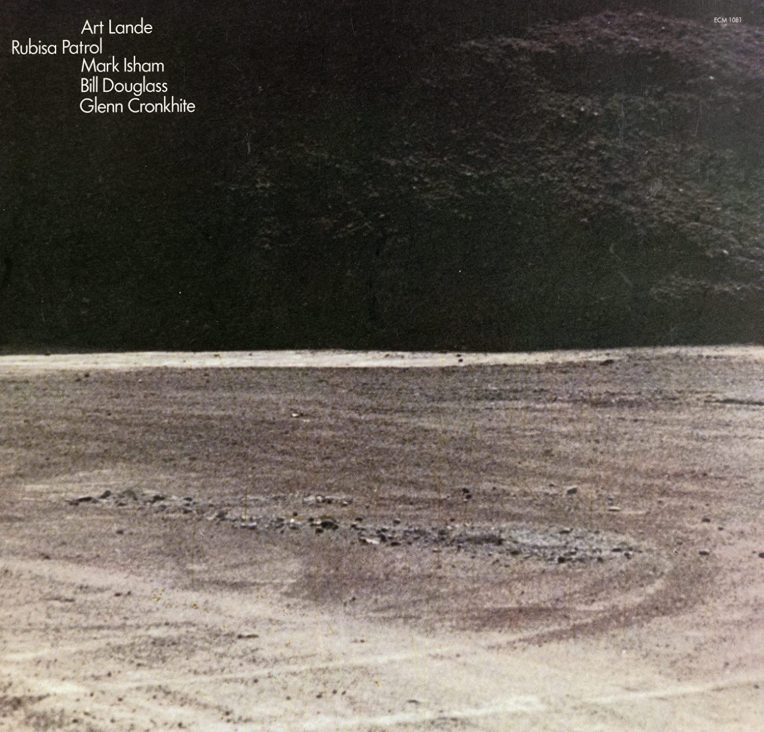
Art Lande: Rubisa Patrol (ECM 1081)

ECM 1081

Art Lande
Rubisa Patrol

Art Lande piano
Mark Isham trumpet, fluegelhorn, soprano saxophone
Bill Douglass bass, flute, bamboo flute
Glenn Cronkhite drums, percussion
Recorded May 1976 at Talent Studio, Oslo
Engineer: Jan Erik Kongshaug
Produced by Manfred Eicher

With Art Lande’s Rubisa Patrol, ECM took a step in a much-heralded direction, one that pushed the scope of its reach even farther. An album like this proves there is no one sound for the label, but only many through which both musicians and listeners develop deeply personal connections, recollections, and changing identities. The vibrancy of its moods remains as potent as it was three-and-a-half decades ago. With Lande at the keys, Mark Isham (very much in a Kenny Wheeler mode) on horns and soprano sax, Bill Douglass on bass and flutes, and Glenn Cronkhite on drums and percussion, the results can only be magical. The opening strains of “Celestial Guests–Many Chinas” introduce the dizi, a Chinese bamboo flute, to the ECM instrument bank. Its clarity cuts through our expectations and embraces us with its immediacy. From behind this arresting tonal horizon arises a blazing sun of percussion and lyrical horns. Lande makes things complete by dropping his own potent melodies into this auditory tincture. The veil is lifted with “Romany.” Watching like a pair of eyes scanning an empty landscape in hopes of movement, it discloses the inner trepidation of an unstable politic. Our allegiance is broken and reformed again with the klezmer-like inteisity of “Bulgarian Folk Tune.” Throughout its enthralling single minute, we cannot help but be moved by its tightly executed energies. “Corinthian Melodies” is another stunning reworking of traditional sources. Here, those resilient fibers are spun into even thicker cords, allowing Isham and Douglass more traction in their solos. Anyone missing the groovier side of things gets just that in the piano-bass interplay of “For Nancy,” in and out of which Isham weaves with the deftness of a hummingbird, sampling nectar where it may until it vanishes in a spray of raindrops. “Jaimi’s Birthday Song” and it reprise feature a duet of flute and piano in two relaxed Red Lanta-esque messages. The latter of these leads us to “A Monk In His Simple Room,” bicycling through thematic material with a leisurely panache in this lavish closer.

A magical album from start to finish, Rubisa is an exercise in atmosphere. Lande captivates on all levels and seems to bring out nothing short of the best in his fellow musicians. And while the label has no shortage of fine horn players, on this recording we get an especially fluid example of the craft through Isham’s unmitigated wanderings. With its nods to folk elements and host of other influences, this makes for a fitting companion for the more recent Kuára.

<< John Abercrombie/Ralph Towner: Sargasso Sea (ECM 1080)
>> Arild Andersen: Shimri (ECM 1082)

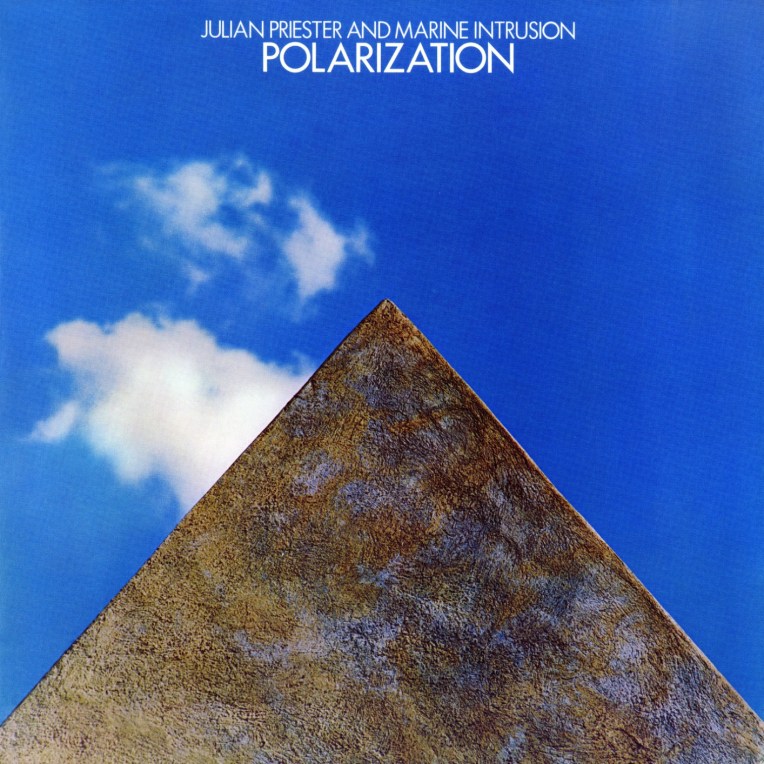
Julian Priester and Marine Intrusion: Polarization (ECM 1098)

ECM 1098

Julian Priester and Marine Intrusion
Polarization

Julian Priester trombone, string ensemble
Ron Stallings tenor and soprano saxophones
Ray Obiedo electric and acoustic guitars
Curtis Clark piano
Heshima Mark Williams electric bass
Augusta Lee Collins drums
Recorded January 1977 at Tonstudio Bauer, Ludwigsburg
Engineer: Martin Wieland
Produced by Manfred Eicher

The trombone is the viola of the brass world. It is arid, languid, and also incredibly beautiful in its range and melodic honesty. And on Polarization, Julian Priester’s ECM follow-up to his 1973 Love, Love session, we get more of that gorgeous depth than we could ever ask for.

The first three tracks form a unified whole. “Polarization” (Priester) begins with two overdubbed trombones improvising in a lofty space. We get some wonderful staccato technique in the left channel, and a wealth of implied energy all around. As the right-hand trombone fades, we hear the slightest indication of drums at the cut’s tail end, of which “Rhythm Magnet” (Priester) fleshes out every audible detail. Synthesized strings lend expanse while bassist Heshima Mark Williams lays down a gorgeous, almost Bill Laswell-like mysticism, albeit with an added twang and sharper features. Ray Obiedo weaves a slack guitar into the mix, and as the horns settle in to their respective stations, the piano lets out a final exaltation. “Wind Dolphin” (Bruce Horiuchi) begins with a cluster of drums. From this, we get a flowing run from brass and flanged guitar. The band breaks into a powerful free-for-all, marked by a “laughing” trombone and piano. “Coincidence” (Obiedo) is a piece for trombone, acoustic guitar, and piano, as beautiful as it is short. “Scorpio Blue” (Curtis Clark) arises from a solo trombone as drums lift the piano skyward into rolling flights of fantasy. The final track, “Anatomy Of Longing” (Curtis Clark), aside from having one of the best titles I’ve encountered in a long time, brings on the funk with electric guitar ornamenting the already fine calligraphy of the brass. And just when you think the music is over, it drips into a simmering sax solo over a pellucid piano and cymbals before the bass line returns with its undeniable insistence. The sax reels while the electric guitar squeals in joy over the thematic reinstatement before hurtling itself forward into an enthralling solo of its own. A smooth nightcap to a phenomenal outing.

While not as consistent in texture as Priester’s earlier effort, Polarization delivers in its many moods and emotional travels. The musicians don’t so much feed off as feed into one another, nourishing a delicate conversation in which agreement is the norm. Their harmonies are tender, the synergy relaxed and intuitive, acute yet soft around the edges. The recording is superb, the resonance at once immediate and expansive.

Unlike its predecessor, this one is still out of print.

<< Pat Metheny: Watercolors (ECM 1097)
>> Taylor/Winstone/Wheeler: Azimuth (ECM 1099)

Michael Naura/Wolfgang Schlüter: Country Children (ECM 2305 803 SP)

Michael Naura
Wolfgang Schlüter
Country Children

Michael Naura piano
Wolfgang Schlüter vibraharp, marimba
Recorded June 1977 at Radio Bremen
Engineer: Dietram Köster
Produced by Peter Schulze

Oftentimes, when pouring through the back catalogue of any label’s out-of-print releases, one stumbles on a few clunkers before arriving at any forgotten monuments. In my listening experiences thus far, ECM has flipped this dynamic considerably, offering a wealth of musical history to explore and appreciate. Among the ruins, however, is this humble little project, lost to the age of the label’s brief SP imprint, which lasted all of three albums. Country Children brings together pianist Michael Naura, whose music graces most of this set, and Wolfgang Schlüter. Originally trained as a drummer before a knee injury led him to mallet instruments, Schlüter cites Lionel Hampton (who he heard live in Berlin in 1952) and Milt Jackson as early influences. After a stint with the Michael Naura Quintet, which dissolved due to Naura’s illness, he played with the NDR Bigband for three decades. Since then, he has focused on teaching and remains one of Germany’s most formative vibraphonists.

“Ballade für eine Silberhochzeit” is a lush opener, almost the shadow of Gershwin’s “Summertime.” Over a beautiful two-chord ostinato, vibes dance exuberantly in a tightly restricted space, but with resplendent melodic freedom. “Schlafen” is a heavily improvised stem with the occasional blossom of composed material. Whereas its heavily convoluted beginnings might elsewhere seem a turgid dream from which one awakens into consonant resolution, here they imply the opposite: an opening of eyes within in sleep’s promised dream. “Take Us Down the River” is more exuberant, much in the vein of Keith Jarrett in the throes of a re-imagined standard. “Argentina” is alive with urban energy, a subdued elegy for remembered villages and mountains. The piano here is paired with a sprightly marimba, making for a drier and more evocative sound.

A flip of the record to Side B brings us to one of the most heartfelt renditions of Krzysztof Komeda’s theme from “Rosemary’s Baby” you are ever likely to hear. This is followed by the title track, which feels steeped in an unnamed nostalgia. “Sad Queen” is another stunner, and my favorite among the album’s originals. “Variation auf »Abendlied«” is dedicated to Peter Rühmkorf, the highly influential German writer whose voice appears alongside Naura and Schlüter in the first two ECM SP titles. It is another lovely offering, consolatory in its gentle persuasion, a track of subtle boisterousness filled with an abiding energy. The final track, “Call,” ends the album on a bittersweet note.

These musicians are like two halves of the same instrument. Their collaborations are beautifully conceived and executed, and make for a fitting complement to such likeminded pairings as Chick Corea and Gary Burton. It’s a wonder this album has yet to be reissued. I would think that, especially with the nod to Komeda, it would fit snugly alongside François Couturier’s Nostalghia and Tomasz Stanko’s Litania. This is a gorgeous and wide-ranging album, one equally fit as the background to other activities or for relaxed deep listening. An unsung gem, and easily one of my top picks currently vying for freedom from the ECM vault.

Alfred Harth: This Earth! (ECM 1264)

Alfred Harth
This Earth!

Alfred Harth tenor, alto and soprano saxophones, bass clarinet
Paul Bley piano
Trilok Gurtu percussion
Maggie Nicols voice
Barre Phillips bass
Recorded May 1983, Tonstudio Bauer, Ludwigsburg
Engineer: Martin Wieland
Produced by Manfred Eicher

This Earth! represents Alfred Harth’s second ECM appearance, supporting a stellar cast of musicians that includes Barre Phillips on bass, Paul Bley at the keys, Trilok Gurtu on percussion, and the inimitable Maggie Nicols doing what she loves. The words are by Vicky Scrivener, which could easily be a pen name for Nicols herself—such is the immediacy with which the words seem to pour from her lungs.

“Female Is The Sun” is the album’s anthem. Structured around a counterpoint of bass clarinet and pianistic asides, its skeleton comes to life through Nicols’s animations. Each verse hoists us deeper into the sky, until we begin to feel the heat of that “old gold woman” who oversees our every waking moment:

The earth’s hot eye reels
fenced
and groans before
vestal temperament

The piano and bass in “Relation To Light, Colour and Feeling” are like two adjacent houses. Between them, a sagging clothesline, from which wordless songs, doubled by sax, hang in the breeze of a balmy afternoon. Words await us at the end, each a folded cloth, a swaying branch, a chirping bird.

Luxurious mezzotints and shades
glowing wash of tones

A percussive introduction opens us to the fabulous spoken word performance of “Studying Walk, A Landscape.” Nicols carries us along with her unpretentious tugs, inscribing the scenery with tightened, almost saxophonic squeals. There is an urban whimsy to be found here, refreshing but also tinged by world-weary bitterness. Phillips also has a lovely solo in this whimsical track with heft and shape.

A wish, relief from a circle

In “Body & Mentation,” piano and bowed bass engage Harth’s tenor with bright energy. Gurtu spreads his palms wide through these aural veins, Harth tracing with a palmist’s care. Their interplay vacillates: a few steps from Gurtu, a few expulsions from Harth. Each move forward italicizes the piece’s sentence structure, closing on an elegiac statement from Bley.

Love’s tug –
our barge;
sweet clamorous tidings
on the unique
journey backwards
to progression.

“Energy: Blood/Air” reveals the album’s most porous textures. Over a tightly knit ostinato, Harth breathes life into Nicols, who skims a poem’s surface before slipping into protracted improvisation. Bley floats a light solo over our heads, gathered up amid a handful of bass.

Today she sits
in the angled skies…
lowering lids
at the blushing
earth.

The “Three Acts Of Recognition” that follow slip a contemplative card into this highly charged deck as Harth’s tender yet robust tenor ladles sound into our silence. Some well-chosen reverb lends a throated quality his song. Overtones mingle as piano chords lay down new ground for every self-aware step. A pause. Bley reaches into his instrument, plucking and strumming strings directly, while Harth spins molecules in the air. Another pause. We return to the keyboard, flowing through to the end.

Between the clean
and tender sheets
we’ll hear us out.

“Come Oekotopia” crackles in rain sticks and cymbals, drawing bass from the soil. Harth improvises over Phillips’s nimble strumming. His long-held note midway through is one of the album’s highlights. Percussive bells diffuse this energy. Nicols makes a phonemic cameo at the end.

The mind streams
to pulse
relinquishing

Her subsequent recitative in “Waves Of Being” offsets a gorgeous solo from Bley, who cannot help but raise his own voice in the flare of the moment. Phillips’s bass is bright and bleeds into Gurtu’s string of metal (gongs), wood (sticks), and exoskeletons (shells). Harth’s bass clarinet bubbles with finality, fading into a sustained pluck of piano strings.

Accapella
flourishing
descants…
Acoustically
tonic.

“Transformate, Transcend Tones and Images” shows Nicols in fine melodic form. As the album’s last image, seems to thrive at its center. Nicols adlibs the remainder, as if to dissolve these impressions just enough so that no one can claim them. “Woman in a violet tail-coat,” she sings, “blows her soul-blue sax on south bank.” But we never hear that sax. Instead, we get a string of unrecorded words:

…translate…
…transcend…
…transform…

leading us into the unknown discoveries of the journey ahead.

Harth is an attentive player who writes without erasing, sings without opening his mouth, exhales without hypocrisy. His notes are often shared on This Earth!, but he is never the mimic. Among this session’s band mates, Gurtu proves to be a particularly interesting choice. His cymbal-focused work adds the illusion of a full kit without the overbearing weight thereof. Bley and Phillips, on the other hand, are unmistakably present. Yet Nicols’s voice is the real poetry of the album. She transcends the words she sings even as she inhabits them, bringing genuine physicality to their contours.

Another out-of-print gem, its elusiveness makes it all the more visceral an experience once it finds its way to your turntable.

<< Terje Rypdal/David Darling: Eos (ECM 1263)
>> The George Gruntz Concert Jazz Band: ’83 Theatre (ECM 1265)