Evan Parker Electro-Acoustic Ensemble: Toward the Margins (ECM New Series 1612)

Evan Parker Electro-Acoustic Ensemble
Toward the Margins

Evan Parker soprano saxophone
Barry Guy double-bass
Paul Lytton percussion, live-electronics
Philipp Wachsmann violin, viola, live electronics, sound processing
Walter Prati live electronics, sound processing
Marco Vecchi live electronics, sound processing
Recorded May 1996, Gateway Studios, Surrey
Engineer: Steve Lowe
Produced by Steve Lake

What’s given:
If ECM had a musical attic, it would sound like Toward the Margins. Not to imply that the Evan Parker Electro-Acoustic Ensemble’s debut is filled with unwanted or forgotten things, but that it exists toward the margins of a human life, its shed skins stacked like boxes above our heads, waiting for a breath to blow the dust away. Parker has been with ECM almost since the beginning, having first appeared on The Music Improvisation Company and subsequently on Gavin Bryars’s After the Requiem, among others. An abiding interest in electronics as an improvisational medium led him to the present project, which draws from disparate disciplines bonded by an infatigable spirit of sound production.

What’s taken away:
Grating strings first clear out the rafters, shafting like light from behind a broken cloud. Parker’s soprano scratches gently at their back. Grumblings and sampled ether flutter and churn, tripping down sand-covered stairs like a creature covered with feet, so that it is always standing no matter how it lands. Compartmentalized echoes share their cubicles with shallow utterances of deeper assignments. Barry Guy’s double bass ties its strings into a tangle of self-awareness as Parker trembles within his own computer-augmented aftershocks. Like a flock of geese in overdrive, he burns in the upper atmosphere before he dares dream of land. Melody is but an afterthought to the sputtering multitudes, caught in the welcoming stare of an unwanted stranger. The overall sound is subdued yet robust. It inhabits the crawlspace of our dreams. The haunting final track lingers in our bones, long after the silence comes, animating a body whose only fear is cogency.

What’s left behind:
Parker is the rare musician who treats improvisation as composition—not so much an offering to the aleatoric gods as a vocabulary articulating its real-time derivations. His saxophonic work is high but far from mighty. He listens more than he plays, as the musicians faithfully tune themselves to a radio signal only they can hear. Washes of precipitation and other climatic changes stipple these aural landscapes, leaving Andy Goldsworthy-like rain shadows in their wake. Sometimes he rolls through rough detours, kicking up sparks and gravel; other times he hovers like an appraising insect, every note a kaleidoscopic cell unfolded into the whole of its vision. As the title makes unabashedly clear, this is an asymptotic experience with nowhere to hide but our ears, and there it burrows, hibernating until the next thaw.

<< Ralph Towner: ANA (ECM 1611)
>> The Hilliard Ensemble: A Hilliard Songbook (ECM 1614/15 NS
)

Jack DeJohnette’s Directions: Untitled (ECM 1074)

ECM 1074

Jack DeJohnette’s Directions
Untitled

Jack DeJohnette drums, tenor saxophone
John Abercrombie electric and acoustic guitars
Alex Foster tenor and soprano saxophones
Mike Richmond bass, electric bass
Warren Bernhardt piano, electric piano, clavinet, cowbell
Recorded February, 1976 at Talent Studios, Oslo
Engineer: Jan Erik Kongshaug
Produced by Manfred Eicher

With Untitled, Jack DeJohnette’s Directions popped a jazz milestone into ECM’s prolifically expanding oven, and it still smells as fresh as the day it was baked. Building off DeJohnette’s robust intro to the 14-minute “Flying Spirits,” a compelling quintet completed by guitar (John Abercrombie), bass (Mike Richmond), sax (Alex Foster), and keyboard (Warren Bernhardt) makes for an aerial interweaving of complementary signatures. The band kicks up a whirlwind of activity, leaving DeJohnette’s delicate applications to rustle like the last stray leaves blowing down the road, out of sight but ever in mind. “Pansori Visions” is an eccentric duet of hand drums and detuned guitar, slack strings sounding like the amplified offspring of a koto and a human voice. Not coincidentally, the title refers to a traditional Korean art form of often-satirical storytelling, also to the accompaniment of a single drummer. “Fantastic” is just that, its colorful percussive accents giving way to some infectious saxophonic action. In spite of the killer title, “The Vikings Are Coming” unfolds like something straight out of Pat Metheny’s Watercolors session, again striated by fluent reeds. “Struttin” evolves into a rather punchy face-off between saxophone and guitar, refereed superbly by DeJohnette. The only victory to be had is in the brief but bitter groove as it closes in resolute harmony. Bernhardt’s “Morning Star” begins with a duet of piano and acoustic guitar, the latter always one step behind. From these dream-like beginnings come a pronounced rhythm section and more melodic fortitude from alto. Capping off this invigorating set is “Malibu Reggae,” which slinks like a drunken dancer in slow motion, its delightfully kitsch keyboard gnawing at the edges of our curiosity with a familiar burn. A tune that would have sat easily among John Zorn’s Naked City abstractions in their heyday, it’s a whimsical ending to a powerfully direct album, ever blushing with hints of its own enigma.

These compositions—all but “Morning Star” are by DeJohnette with or without his collaborators—are bright, resilient, and vociferous. Having stood the test of three-plus decades, they will easily hold up to three more, and then some. And while our leader captivates with his usual kinesis, Foster’s vocal modulations and the unobtrusive support network of Abercrombie/Bernhardt/Richmond make this one for the ages. When you’ve had enough blues for one day, Untitled is as good a pick-me-up as you could ask for. A prime candidate for reissue.

<< Pat Metheny: Bright Size Life (ECM 1073)
>> Jan Garbarek: Dansere (ECM 1075)

Terje Rypdal: After The Rain (ECM 1083)

ECM 1083

Terje Rypdal
After The Rain

Terje Rypdal electric and acoustic guitars, string ensemble, piano, electric piano, soprano saxophone, flute, tubular bells, bells
Inger Lise Rypdal voice
Recorded August, 1976 at Talent Studio, Oslo
Engineer: Jan Erik Konghaug
Produced by Manfred Eicher

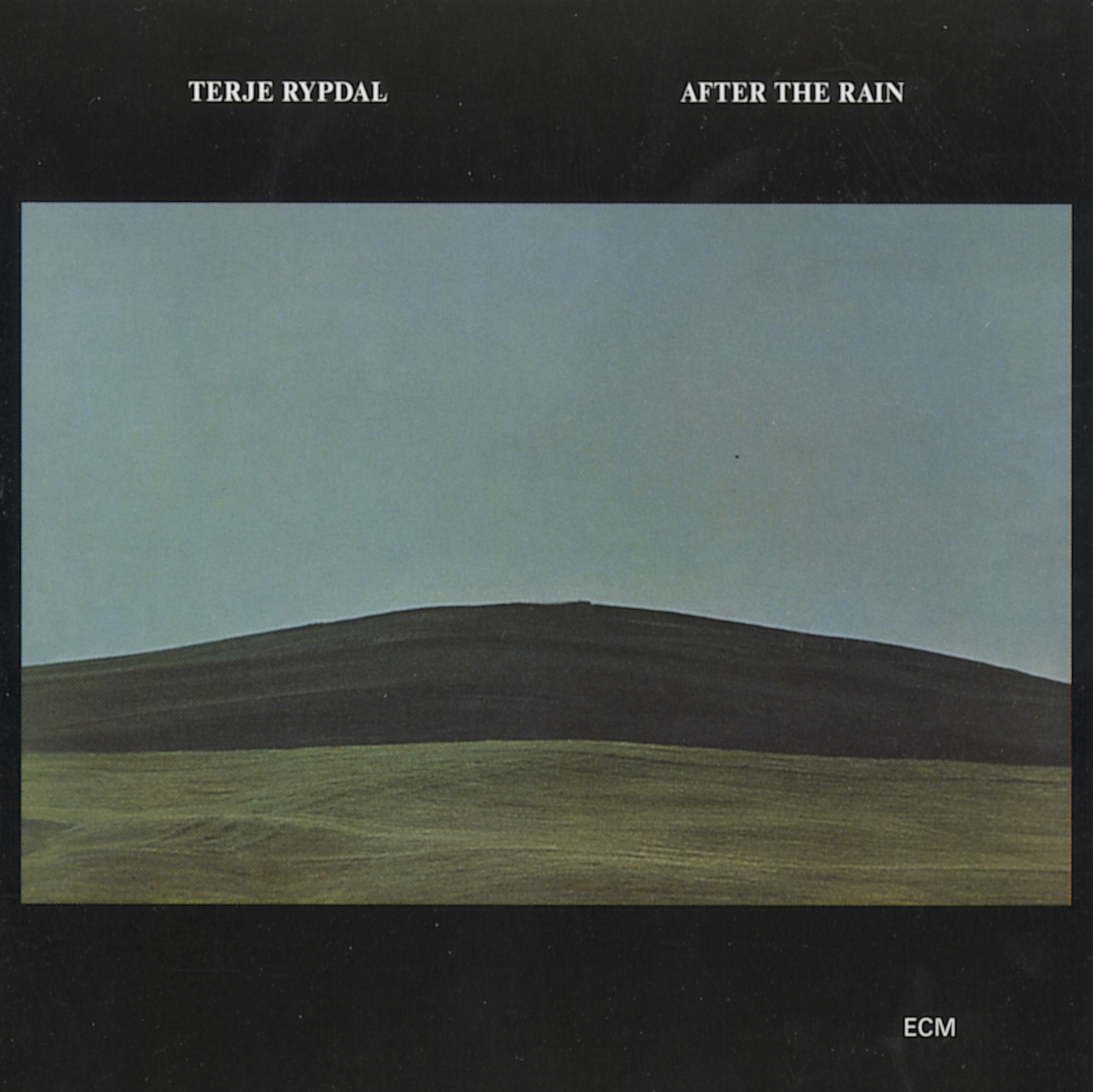
With an incendiary initiation on Jan Garbarek’s Afric Pepperbird, and after successfully leading far-reaching experiments like his first self-titled project and the plush Whenever I Seem To Be Far Away, Terje Rypdal opened a new door for ECM when he stepped into the studio to record perhaps his most intimate statement to date. In spite of their brevity, the ten tracks on After The Rain flow in a single 38-minute ode to the almost painful depths of life’s greatest joys. Rypdal overdubs every instrument himself, with his then-wife, vocalist Inger Lise, providing the occasional organic touch. Shielded by a holy trinity of intimacy, sincerity, and fearlessness, Rypdal plunges with open eyes into the darkest eddies of his emotional waters. An electric keyboard provides much of the album’s supportive breadth, as in the heavily flanged gem that is “Air.” Rypdal gives us a rare acoustic taste in “Now And Then,” and in “Wind” an even rarer flute solo. The title track breathes in a cloudless sky, Rypdal’s electric cello-like in its weighted grace. Wind chimes complete the illusion of the cover art’s open plain. A string of vignettes, among them the utterly poignant “Little Bell,” leads us to “Like A Child, Like A Song,” bringing its hands together in humble elegy.

Hanging words such as “atmospheric,” “evocative,” or “lyrical” on this Christmas tree would only topple it in a shower of withered needles. One might say the title refers not to the music itself, which if anything feels drenched, but rather to its lingering effects. I sometimes imagine the synthesizer here as a substitute for an unavailable orchestra, the presence of which would have created an entirely different, Eberhard Weber-like, experience. As it is, its sedation lends a potent archival ascendency and distills the soaring solos within. Rypdal’s keening guitar percolates through the album’s semi-porous cloth like sunlight through the veil over a face of one who has seen the world only through the wavering screen of tears, and never in the clarity of day. It is a style of playing that falls even as it rises. At his profoundest moments, Rypdal inspires a humbling lack of vocabulary with which to describe what one hears. In which case, After the Rain is filled with silence.

<< Arild Andersen: Shimri (ECM 1082)
>> Eberhard Weber: The Following Morning (ECM 1084)

Richard Beirach: Eon (ECM 1054)

ECM 1054

Richard Beirach
Eon

Richard Beirach piano
Frank Tusa bass
Jeff Williams drums
Recorded November 1974 at Generation Sound Studios, New York
Engineer: Tony May
Produced by Manfred Eicher

Eon was the first album under the New York-born Richard Beirach’s name, and arguably still his best. Its balance of rhythm, melody, and reflection epitomizes the piano trio format, and nowhere more so than “Nardis” (Davis/Evans), the 14-minute epic that opens this set of six progressively far-reaching tunes. ECM listeners may recognize its lovely vamp as performed by Ralph Towner on his unparalleled Solo Concert of 1979. Here, it glows under a full and vibrant touch. Beirach keeps his fingers busily engaged, while allowing his rhythm section some glorious airtime, winding down like a rock band extending power chords, only here in a more intimate space in which that prolonging becomes not a dramatic farewell but the acceptance of a new beginning. “Places” (Dave Liebman) is an effervescent piano solo with all the romanticism one might expect from such a consummate musician. It also gives us a preview of his solo album Hubris, which would be soon to come. “Seeing You” (Tusa/Beirach) continues in much the same vein, but reintroduces the smooth glide of brushed drums and bass. A subtle rhythmic acuity and free and easy interplay suspend the listener in a swaying hammock of nostalgia. Block chords burrow through the title track with a hint of dissonance before flowering in calmer pastures. Fair, extended performances make this the culmination of the album’s surrounding gestures. Sentiments build into ecstasy before a final sprinkling from piano and cymbals is flicked into darkness like water from glittering fingertips. “Bones” at last puts more sticks to skin as Beirach recedes for tearful bass solo, hitting the occasional accent to keep us chordally ground. “Mitsuku” closes us out in style with a gratifying promise.

An easy album to get lost in, for at its gates one sees no need for maps.

<< Michael Naura: Vanessa (ECM 1053)
>> Gary Burton/Steve Swallow: Hotel Hello (ECM 1055)

Michael Naura: Vanessa (ECM 1053)

ECM 1053

Michael Naura
Vanessa

Michael Naura piano
Wolfgang Schlüter vibraphone, marimba, percussion
Eberhard Weber bass
Joe Nay drums
Klaus Thunemann bassoon
Recorded September 1974 at Windrose Studios, Hamburg
Engineer: Martin Wieland
Produced by Michael Naura

Lithuanian-born Michael Naura is a German pianist, editor, and journalist. Capitalizing on a range of influences, from George Shearing to Horace Silver, his successful self-titled quintet LP of 1963 made him a household name in hard bop. If the benefit concerts arranged after his being diagnosed with polyserositis the following year are any indication, his brief absence caught many in its ripples. Central to Naura’s cadre in his formative years as recording artist was vibraphonist Wolfgang Schlüter, whose presence is keenly felt throughout Vanessa, his first and only album for ECM proper (he did release another, Country Children, as part of the label’s short-lived SP series). Even though last year saw Naura’s efforts recognized with a WDR Jazz Prize lifetime achievement award, this album remains etched in vinyl.

Naura’s set of six opens its eyes in the electric piano and marimba strains of “Salvatore.” The unmistakable electrobass of Eberhard Weber provides just enough ground for Klaus Thunemann’s stellar bassoon improvisations. This gorgeous opener sounds more like John Zorn’s Electric Masada on sleeping pills than anything else. The energy peters out over time and seems to trip on its own intentions, opening up a subtle improvisatory space in the process. From these murky depths arises the track’s thematic beginnings, passionately recapitulated with some superbly realized drumming from Joe Nay, amid a flanged wash of familiarity. “Hills” bustles like lunch hour in Burtonville, though it’s Weber’s nimble fingers that make it the album’s highlight. The next tune lumbers playfully like its titular “Baboon,” all the while emoting an intrinsic self-assurance. Thunemann adopts a vocal quality that is anything but primitive in a three-minute aside that’s sure to bring a smile to your prehensile lips. The title cut reaffirms Schlüter’s reign, billowing through the night like a curtain at an open window, where once wavered the silhouette of a love no longer here, and at which now stands the one left behind. Moments of synchronicity hint at a fleeting union shared under cover of neon and subterranean steam. The serrated contours of “Listen To Me” contrast alluringly with its straight-edged neighbors. Vibes thread the whole, culminating in a sustain-pedaled echo. Ultimately, the bassoon abstractions and soloing of the elegant “Black Pigeon” prove Thunemann to be the star performer of an altogether commendable group of musicians.

A rare video of the group from 1974:

The only downside to the album is its sometimes weak recording mix. One can almost feel the marimba solo in “Salvatore,” for example, being tweaked into the foreground (compare this with the more equitably balanced “Listen To Me”). Should a reissue ever be in the works, as I hope it will be, a remastering will also be in order. Nonetheless, a keeper if you can track down one of these hot pink, fishnet sleeves.

<< Steve Kuhn: Trance (ECM 1052)
>> Richard Beirach: Eon (ECM 1054)

Dave Liebman: Drum Ode (ECM 1046)

ECM 1046 CD

Dave Liebman
Drum Ode

Dave Liebman soprano and tenor saxophones, alto flute
Richard Beirach electric piano
Gene Perla basses
John Abercrombie guitars
Jeff Williams drums
Bob Moses drums
Patato Valdez congas
Steven Satten percussion
Barry Altschul percussion
Badal Roy tablas
Collin Walcott tablas
Ray Armando bongos
Eleana Steinberg vocal
Recorded May 1974, Record Plant, New York
Engineer: Jay Messina
Produced by Manfred Eicher

“Drums and drummers. For me, they’ve been the moving force and inspiration, a reason to live, and celebrate life through playing music. Thanks to the men who play the drums. This music is dedicated to you.”
–Dave Liebman

It was the summer of 1997. I was fresh out of high school and settling into my new life at Goddard College (of Phish fame) in Plainfield, Vermont. The transition was sudden, but I was fortunate enough to have been placed in the music dorm, where dwelled lovers of all things audible. Late one night, during an emotionally exhausting orientation week, I was awoken by a sound coming from downstairs. Rubbing the sleep from my eyes, I descended to the common room to find my dorm mates deep in the throes of an impromptu drum circle. Congas, djembes, pots, tabletops, human bodies: everything was fair game. With nothing but a tin cup and a spoon at my disposal, I joined in with cathartic joy. I don’t think any of us remember how long the session went on after that (I’m not sure we even slept). Sadly, the school itself wasn’t what I had expected. After a long conversation with the group, I decided to return home and incubate for a year. Although this taxing decision eventually put me on a straighter academic path, I do think fondly of the profoundly attuned synergy we of the musical persuasion had forged in those dense seven days surrounded by the region’s denser foliage. Since coming across Dave Liebman’s seminal Drum Ode in reissued form, I have rediscovered something of that physical feeling of surrender one so rarely gets from a laser scanning a concealed silver disc.

Piggybacking on this success of Lookout Farm, Liebman surrounds himself with likeminded company. The rhythmic core of the 1973 joint remains intact, with a minus here and some additions there. The dedicatory introduction of “Goli Dance,” quoted above, leaves no mystery as to the album’s philosophical goals. “Loft Dance” comes closest to reenacting my anecdotal experience, and counts among its actors an animated Richard Beirach on electric piano, a lively John Abercrombie on guitar, and Liebman himself laying down some infectious rhythms of his own. The playing is baked to a crisp, and scathingly uplifting. Gene Perla deploys a heavy anchor, offset by the whimsy of whistles, all of which tethers the soloing to its immediate territory. “Oasis” is the odd one out for its vocal cameo, courtesy of Eleana Steinberg. A beautifully soulful sax solo is rendered all the more so for the songstress’s curious presence, her uneven edges and off-key honesty a sobering foil to the otherwise instrumental sound. Liebman lights a veritable box of matches in “The Call,” a revelatory pyramid with Bob Moses and Jeff Williams at its bottom corners. Its martial snares and echoing sax are the heart and soul of the album, hands down. “Your Lady” (an oft-neglected page from the Coltrane songbook) darkens the mood with a rain-drenched bass and nocturnal soprano sax. “The Iguana’s Ritual” continues in the same vein, save for the noticeable additions of electric guitar and the soothing grace of Collin Walcott’s tabla. Here, atmosphere becomes the primary melody. A trebly bass then ushers in a raunchier solo from Abercrombie and a kinetic finish from Liebman. A fluttering of guitar harmonics begins the end in “Satya Dhwani (True Sound).” Flute and tabla expand the sound further, carrying us out on an enigmatic path to stillness.

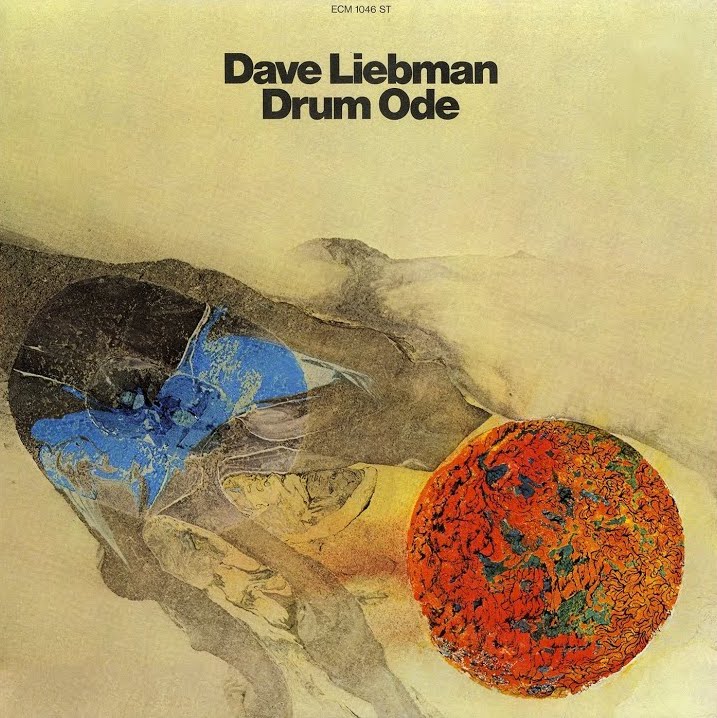
ECM 1046 LP
Original cover

The contrast in covers between the original vinyl and the CD could hardly be greater. The latter’s block list of names, while typographically pleasing, obscures the vibrant colors that said roster produces. One look at the former, however, reveals all in a single perusal: a brilliant sun, cradled in the arid landscape of its own desires, has found a voice where shadows intersect, and waits to share it with any in search of oasis.

<< Terje Rypdal: Whenever I Seem To Be Far Away (ECM 1045)
>> John Abercrombie: Timeless (ECM 1047)

Terje Rypdal: Whenever I Seem To Be Far Away (ECM 1045)

Terje Rypdal
Whenever I Seem To Be Far Away

Terje Rypdal electric guitar, guitar
Sveinung Hovensjø 6- & 4-string basses
Pete Knutsen mellotron, electric piano
Odd Ulleberg French horn
Jon Christensen percussion
Südfunk Symphony Orchestra
Mladen Gutesha conductor
Recorded 1974 in Oslo and Ludwigsburg
Engineers: Jan Erik Kongshaug and Martin Wieland
Produced by Manfred Eicher

This laconic yet lasting statement from Terje Rypdal marked the Norwegian guitarist’s third ECM appearance as composer and leader. Its crucible continues to yield an enticing tincture of prog-rock and classical stylings for the weary musical mind. The reverberant French horn that animates “Silver Bird Is Heading For The Sun” betrays nothing of its cooption by a punchy g/d/b constituent. Floating on a well-aged mellotron, it bows out gracefully as Rypdal rolls in like a fuzzed haze. Sveinung Hovensjø’s robustly amplified bass carries its surrounding weight beautifully, and continues to do so for the album’s duration. Languid relays between guitar and horn coalesce at the piece’s muscular conclusion. In “The Hunt,” we get a heftier dose of percussion, courtesy of the one and only Jon Christensen. Thus begins a brightly syncopated journey filled with plenty of dynamic movement. All of which makes the title piece that much more affecting. A lone cello becomes our only introduction into its slow 18-minute wave of orchestral bliss. Oboe and clarinet usher in the encroaching stillness with subdued attention. Only during a climactic peak does Rypdal make his presence known, as if born from the nexus of violins trailing off into the darkness (a section that perhaps foreshadows Gavin Bryars’s After the Requiem). This switch from external to internal register seems to caress some distant shore, much like the waters of the album’s cover. We wait for dusk, only to realize that the night has never left us.

Whenever I Seem To Be Far Away is an album in infrared, a silent face whose expressions make infinite use of a limited palette. Rypdal is one of the few hybridizers whose creations become something outside of themselves. His soloing wrenches from its present surroundings as many handfuls of melody as it can before fading into the solace implied at the album’s genesis. And I cannot stress enough how fantastic the bass sounds throughout, its steady tone stabilizing like an iron cable. In it, we hear our own gravidity made audible, touching its lips to a temple of sound with a following of one.

<< Julian Priester: Love, Love (ECM 1044)
>> Dave Liebman: Drum Ode (ECM 1046)

Gary Burton: Seven Songs For Quartet And Chamber Orchestra (ECM 1040)

1040 X

Gary Burton
Seven Songs For Quartet And Chamber Orchestra

Gary Burton vibraharp
Michael Goodrick guitar
Steve Swallow bass
Ted Seibs drums
NDR-Symphony Orchestra
Michael Gibbs conductor
Recorded December 1973 in Hamburg
Engineer: H. Ruete
Produced by Manfred Eicher

If one were to draw a line between the ensemble aesthetics of Eberhard Weber and Keith Jarrett, then one might plot the compositions of orchestral jazz legend Mike Gibbs somewhere along the way. Born in 1937 in what was then Southern Rhodesia, and a graduate of Boston’s Berklee College of Music, Gibbs has laid down a musical path as diverse as his travels. On Seven Songs for Chamber Orchestra, one gains vision of a mind looking not so much to cross over into uncharted waters as to expand the inclusivity of jazz’s already broad topography. At the heart of this project is Gibbs’s most famous student, the inimitable Gary Burton, who presents a lovingly realized program of his mentor’s own design. “Nocturne Vulgaire” sets the album’s plaintive tone with a groundswell of strings, into which Burton drops his mercurial sound. This delicate blend of mallets and bows continues unabated in “Arise, Her Eyes” (Steve Swallow), the only non-Gibbs number on the album. Mick Goodrick’s steady strums and Ted Seibs’s cymbal-heavy drumming make the most of the tender “Throb,” as Burton’s vibes glow like phosphorescent blood in the piece’s ambulatory body. “By Way Of A Preface” spins the album’s densest song. Its abstract beginnings carry over into a gorgeously perpetual solo from Goodrick, while Swallow makes his memorable mark in the pensive confines of “Phases.” The vast open fields that underlie “The Rain Before It Falls” give way to the chromatic wonders of “Three,” in which Burton and Goodrick’s relays emerge with all the inevitability of a final word.

This is a dream album for admirers of both Burton and Weber, combining as it does the former’s dulcet precision and the latter’s lush arrangements, and is therefore well worth tracking down (a CD-reissue is long overdue). Burton’s ability to carry a tune to fruition is only enhanced by Gibbs’s affected settings, which hardly make a dent in their emotional reserves. If jazz is about discovering the integrity of every lifted voice, then certainly Seven Songs rises from its murky waters with just a few of many unheard treasures.

<< Dave Liebman: Lookout Farm (ECM 1039)
>> Jan Garbarek: Witchi-Tai-To (ECM 1041)

Dave Liebman: Lookout Farm (ECM 1039)

ECM 1039

Dave Liebman
Lookout Farm

Dave Liebman soprano, tenor saxes, alto c flute
Richard Beirach electric, acoustic piano
Frank Tusa electric, acoustic bass
Jeff Williams drums
John Abercrombie acoustic, electric guitar
Armen Halburian percussion
Don Alias congas, bongos
Badal Roy tablas
Steve Sattan tamburine, cowbell
Eleana Sternberg voice
Recorded October 10/11, 1973 at Generation Sound Studios
Engineer: Tony May
Produced by Manfred Eicher

Saxophonist, flutist, and all-around wunderkind Dave Liebman—who only last year received an NEA Jazz Masters lifetime achievement award for his tireless efforts in music and instruction—made his ECM debut with Lookout Farm, his first of only two albums for producer Manfred Eicher as leader (the other being the enthralling Drum Ode; he would also guest on Steve Swallow’s Home some six years later) and a trendsetter for fledgling improvisers seeking their voices in the seventies and beyond. Here, he is joined by a telepathic ensemble that includes regulars Richie Beirach and John Abercrombie, in addition to a pointed percussion section. Abercrombie’s quasi-flamenco arpeggios open the evocative “Pablo’s Story.” Liebman leads in on flute, establishing an intimate flywheel from which is spun a most democratic mosaic of intersections, solos, and rhythmic ecstasy. Liebman (switching to soprano sax) and Beirach provide the skeleton of the track’s flexible physiology. An intuitive pattern of tension and release ensues, thus maintaining a solid unity throughout. Frank Tusa’s understated yet richly emotive bass lines bring out a vital inner depth, and one can hardly remain static during the hand-drummed interlude. “Sam’s Float” introduces a more hardened sound, cut to the core by Leibman’s alto squeals and Abercrombie’s biting electricity. The 24-minute “M.D./Lookout Farm” closes this humble set of three. The first half turns down the lights with its elegiac piano and tender reeds, while the title half transports us with Jeff Williams’s downright flammable drumming.

A spectacular sense of curiosity would seem to be de rigueur in Liebman territory, its infectiousness inescapable. This is a milestone album, not only for the liberating musicianship and timeless sounds, but also for its production value. With Lookout Farm, Eicher channeled the reverberant specter that has haunted the label’s sound ever since, and with it an entirely new way of listening emerged.

A pilgrimage for the ECM enthusiast.

<< Art Lande/Jan Garbarek: Red Lanta (ECM 1038)
>> Gary Burton: Seven Songs For Quartet And Chamber Orchestra (ECM 1040)