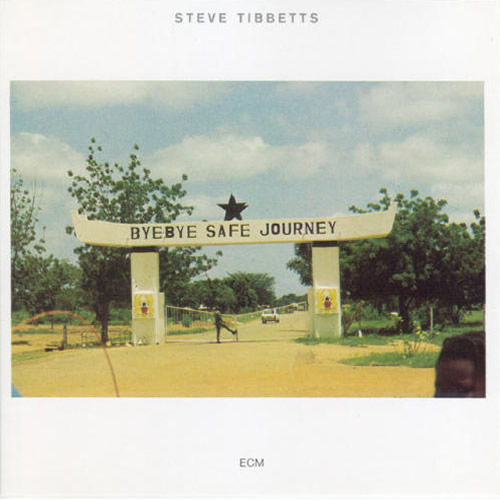
Steve Tibbetts: Safe Journey (ECM 1270)

Steve Tibbetts
Safe Journey

Steve Tibbetts guitars, kalimba, tapes
Marc Anderson congas, steel drum, percussion
Bob Hughes bass
Tim Weinhold vase
Steve Cochrane tabla
Recorded 1983 in St. Paul, Minnesota
Engineer: Steve Tibbetts
Produced by Manfred Eicher

Guitarist Steve Tibbetts exploded our view when ECM introduced the world to the adroit textures of Northern Song. He did so again with “Test,” the doorway onto the enlightening path that winds through Safe Journey. Don’t let its initial stirrings fool you into slumber, for you are sure to be jolted by a guitar that seems to scrape the walls of its harmonic enclosure and expose the burnished paneling within. From humble genesis to almost frightening expanse: this is Tibbetts’s MO. With a minimal assortment of instruments in his coterie, he excavates eras’ worth of sediment. Note the stunning passage where his electric gets caught in echoing loops, while its second self solos over the remnants of what it once was. Such splitting of voices is another trademark, as are the contrasts of “Climbing.” In this quiet cave, Tibbetts sits cross-legged with a kalimba in hand, letting its plunking droplets of sound gild the surrounding stalagmites. Curiously, this track feels less like climbing and more like burrowing. Similarly, the delicacies of “Running” feel like a closing of eyelids, behind which the only feet to touch ground are those of an unfinished dream. A sparkling acoustic guitar, a touch of steel drum and sitar, and the patter of footsteps like rain through a children’s rhyme pull a shade of darkness that plunges us into “Night Again.” Here, the programmatic title holds true in the vastness of sound Tibbetts elicits from his strings as he weaves a lullaby against mounting starlit percussion, for neither does the night abide by arbitrary delineations of territory and bodily space. Eventually, the guitar cuts out, leaving the drone to “solo,” as it were, drifting like the Northern Lights into melodic aftereffects. “My Last Chance” is a swath of nostalgia filigreed by a promising future and opens us to the moral intensity of “Vision.” Tibbetts makes some of the most effective use of taped music one is likely to encounter in a band setting, and especially here. His electric cries like a voice from a cracked egg, breaking with the dawn into blinding intensity, seeming to hold its breath before every note is expectorated. “Any Minute” is another fragile design that wavers in ghostlike existence, never quite resolving the memories so fully fleshed out in “Mission.” Running on the gentle propulsion of a spiritual engine, “Burning Up” humbles itself before a smoldering backdrop, where only the trails of fleeting human figures “Going Somewhere” tell us where we might safely tread home. And it is in the tinkling of starlight that we finally come face to face with our destination, which has been ourselves all along.

With such distinct shades of ambience—all activated by an intuitive sense of ebb and flow—and a incredible group of musicians to give it life, this music glints anew every time. Tibbetts is the perennial traveler whose rucksack contains only the freedom of possibility.

Oh, to have been there, at a record shop when this album first came out. If what I feel now is any indication, I can only imagine the depth of its impact.

Wondrous to the nth degree.

<< Dave Holland Quintet: Jumpin’ In (ECM 1269)
>> Pat Metheny: Rejoicing (ECM 1271)

Ulrich Lask: Sucht+Ordnung (ECM 1268)

Ulrich Lask
Lask 2: Sucht+Ordnung

Ulrich Lask alto and tenor saxophones, computer programming
Meinolf Bauschulte drums, electronic percussion
Maggie Nicols
Sigrid Meyer narration
Monika Linges narration
Recorded January 1984 at Tonstudio Bauer, Ludwigsburg
Engineer: Martin Wieland
Produced by Ulrich P. Lask and Meinolf Bauschulte

I must confess to having a soft spot for Mr. Ulrich P. Lask, whose brief flirtations with ECM have been forgotten under a pile of subsequent beauties. This whimsical little oddity continues where his initial outlier dropped off a flat earth. In such a post-apocalyptic Elliot Sharp-like sound-world, Lask and company can only retrace the urban nightmare that so haunted the waking life of its predecessor. Yet where Lask the first benefited from the boggling virtuosity of vocalist Maggie Nicols, Lask the second suffers from too little of it. What we get instead is a lighter, more capricious chain of German narration over spiky soundtracks. Morphological anxieties still run rampant, as in “Mamamerika,” and Lask’s reed work cuts intriguing enough chains of deformed handholding figures from the pessimistic shadows of “Erfolgreich Und Beliebt,” as it does in all the instrumentals, but only when Nicols rises from the primordial soup of “Ordnung” does the album hit its stride. Like some spastic, panting experiment, breath and electronics make for glowing concoctions from hereon out. The freestyle sparring of “None The Wiser” and gritting teeth of “Kleine Narkosen” are standouts, as are the vocal vampirism and deft arrangement of “Sigi Sigi.” And even as ghostly lips nip at our backs, after this puree of angst and ennui we finish with a taste of hope in “Sucht.”

Lask 2 is worth listening to at least once and is yet another example of a recording that breaks the mold into which ECM criticism is so often poured. Like the voice in “Freie Mädchen Arbeiten Im Hafen” that laughs at her own aplomb, this head-scratching detour on the label’s quest for silence spits in its own face, so that any insult you might throw its way will have to contend with a sheen of self-derision. Worth finding if your face prefers to wear a smile.

<< Chick Corea: Children’s Songs (ECM 1267)
>> Dave Holland Quintet: Jumpin’ In (ECM 1269)

Rainer Brüninghaus: Continuum (ECM 1266)

Rainer Brüninghaus
Continuum

Rainer Brüninghaus piano, synthesizer
Markus Stockhausen trumpets, fluegelhorn
Fredy Studer drums
Recorded September 1983 at Talent Studio, Oslo
Engineer: Jan Erik Kongshaug
Produced by Manfred Eicher

For his second ECM album as leader, keyboardist Rainer Brüninghaus sidestepped the Eberhard Weber nexus in favor of this unique trio outfit with trumpeter Markus Stockhausen and drummer Fredy Studer, with whom he recorded a few albums on through the early nineties. Though none of the musicianship will have you bowing down in worship, the compositions are the real strength of the album. The lush spread of synths and horns in “Strahlenspur” welcomes us into the sort of affirmative warmth that one would expect from Pat Metheny, while the icy backdrop of “Stille” moves far more contemplatively through Stockhausen’s gently unfurling banners. The title track shuttles Brüninghaus’s fine pianism through a loom of drums in the album’s shortest but most uplifting passage. The airy “Raga Rag” is by contrast, at 11 minutes, the longest. As might an airplane’s white trail, it heals slowly like a cut across the sky’s blue skin. The superb trumpeting sets Brüninghaus off on an ethereal tangent, the heel of every winged step nipped by Studer’s intuitive timekeeping. “Schattenfrei” is another short and sweet dialogue, and leaves us well informed to navigate the final expectorations of “Innerfern” with confidence. Each new turn bleeds into an uncharted solar system. From the saccharine yet uplifting ornamentation of a flanged sequencer to Stockhausen’s careening off into the farthest reaches of the universe, it is a transcendent way to end things.

Brüninghaus’s style and ECM’s production values feel like old friends, and in so being welcome us into their friendship in the listening. One need only pick up this thoughtful album to join their circle.

<< The George Gruntz Concert Jazz Band: ’83 Theatre (ECM 1265)
>> Chick Corea: Children’s Songs (ECM 1267)

Barre Phillips: Call me when you get there (ECM 1257)

Barre Phillips
Call me when you get there

Barre Phillips solo bass
Recorded February 1983 at Tonstudio Bauer, Ludwigsburg
Engineer: Martin Wieland
Produced by Manfred Eicher

I’ve said it before, but Barre Phillips is one of ECM’s brightest stars, though one would never know it by the solemnity of his genius. Glowing with a pale fire that can be drawn only in cosmic pigments, his sound-world on Call me when you get there throbs as if Michael Galasso and David Darling had fused into a collaborative quasar. The opening “Grants Pass” would seem to have been written in the margins of Steve Reich’s Different Trains, and works its gentle magic under the toenails of our foothold. Played on resonant multi-tracked instruments, this track stands as one of Phillips’s finest. Each shade of harmonic interplay forms a new glyph before our ears and eyes, proving once again just how cavernous the bass really is. This wistful trail leads us to the “Craggy Slope,” an uneven climb into heavily eroded terrain, occasionally punctuated by the fluid twang of the waters that wrought it into existence, and ending surprisingly in an almost baroque denouement. And on that edge we linger, dancing the slow-motion jig of “Amos Crowns Barn” before following the anonymous stirrings beyond “Pittmans Rock.” But when we jump, we land on “Highway 37,” caught in a stampede of tumbleweeds. Here, the bass sounds more like a ball of twine wound around a rubbery core, expanding into some looming paternal guitar, hunchbacked from old age. “Winslow Cavern” bubbles like the molten rock of a volcano before taking shape in the aptly titled “River Bend,” which plucks and scrapes its way through a serpentine journey. And as we take shelter in “The Cavern,” we discover that the only promise of life that awaits us outside its darkness is “Brewstertown 2,” a nightmarish backcountry town with an impending tornado etched into its background.

We can add this album to the modest yet potent shelf of solo bass recordings begun with Dave Holland’s as-yet-unsurpassed Emerald Tears. A masterpiece in the Phillips discography and one well worth the plunge for those who’ve yet to dare.

<< Charlie Mariano: Jyothi (ECM 1256)
>> Oregon: s/t (ECM 1258)

Charlie Mariano and The Karnataka College of Percussion: Jyothi (ECM 1256)

Charlie Mariano
The Karnataka College of Percussion
Jyothi

Charlie Mariano soprano saxophone, flute
R. A. Ramamani vocals, tamboura
T. A. S. Mani mridangam
R. A. Rajagopal ghatam, morsing, konakkol
T. N. Shashikumar kanjira, konakkol
Recorded February 1983 at Tonstudio Bauer, Ludwigsburg
Engineer: Martin Wieland
Produced by Manfred Eicher

Since 1964 the Karnataka College of Percussion has been committed to its mission of expanding awareness of Indian Classical (especially Carnatic) music. Part of this outreach has involved a number of jazz-oriented and fusion projects through which the institution has spread its affirmative message. Thus do we come to this intriguing, if seemingly forgotten, collaboration with American saxophonist Charlie Mariano, who left us in 2009 at the age of 86. The result is a fluid and respectable blend of cultural signatures that transcends any ties to genre in favor of a purely emotive experience. The voice of R. A. Ramamani figures prominently, as in the ruminative opening track, titled simply “Voice Solo.” She traces long stretches of landscape, one hill at a time, where the dry rolling plains offer up their secrets for the reward of rain. Her prayers are bifurcated through overdubbing, lending both a smile and a promise to the title. In this diffusely lit portal we find only further portals. In “Vandanam” we are regaled with tales of old by Mariano’s rolling flute, gilded by the pleasant jangle of the kanjira and mridangam. Ramamani’s ululations walk hand in hand with flute for a unified sound. “Varshini” and “Saptarshi” are smooth and graceful spaces in which voice is both cause and effect. Mariano’s soprano is a voice in and of itself, caught in flurries of percussion and passionate resolutions. These lively stops give way to the interweaving lines of reed and voice in “Kartik,” which closes on some transportive drumming from T. A. S. Mani on mridangam. Lastly is “Bhajan,” featuring doubled voice and a palpable communication with the beyond. As the drums anchor us, so too do they spring forth to those less definable stretches of land, where only the human voice can wander in its ephemeral laudation, threaded by the twang of the morsing (Indian jaw harp) and dancing a slow and careful surrender.

Without neither pretension nor ulterior motive, Jyothi is a delicacy in the ECM catalogue and a careful coming together of thought and performance to be taken as it comes…and goes.

<< Keith Jarrett Trio: Standards, Vol. 1 (ECM 1255)
>> Barre Phillips: Call me when you get there (ECM 1257)

John Surman: Such Winters of Memory (ECM 1254)

John Surman
Such Winters of Memory

John Surman baritone and soprano saxophones, bass clarinet, recorder, piano, synthesizer, voice
Karin Krog voice, Oberheim ring modulator, tamboura
Pierre Favre drums
Recorded December 1982 at Talent Studio, Oslo
Engineer: Jan Erik Kongshaug
Produced by Manfred Eicher

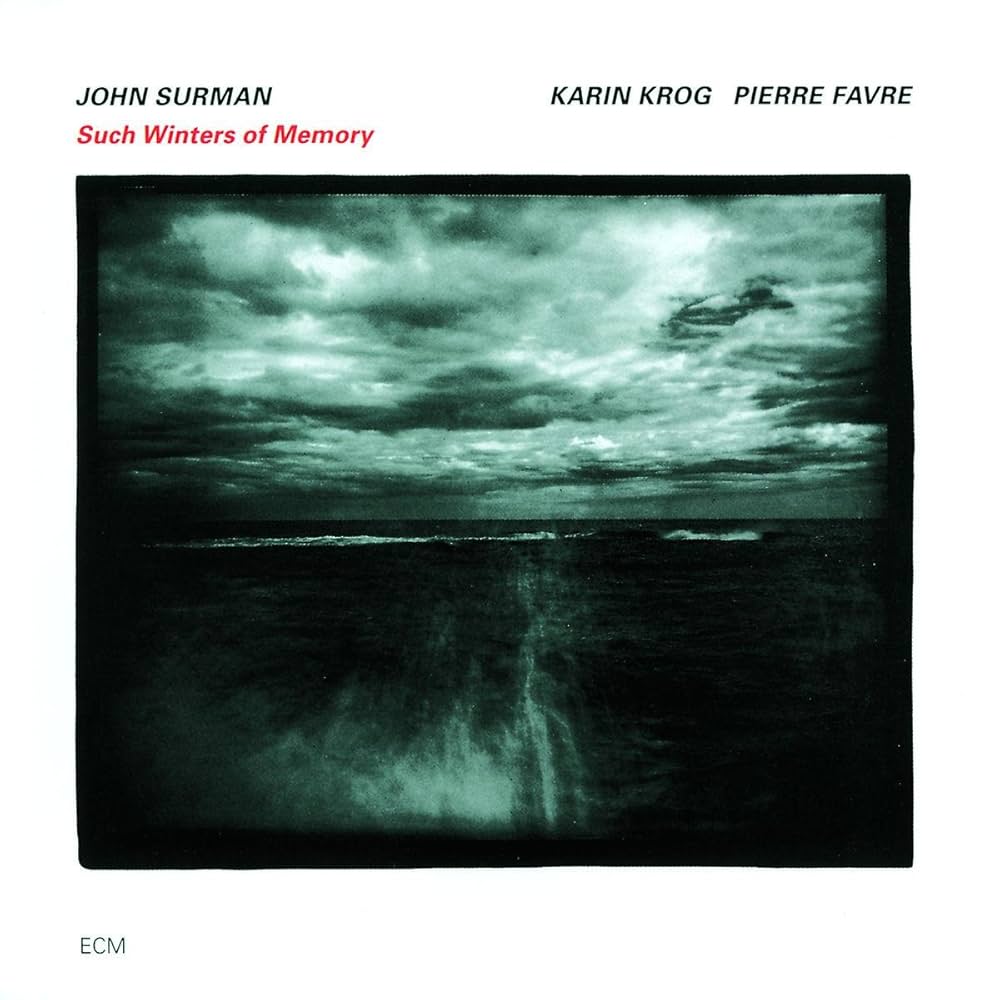
Walking into a John Surman album is like wearing a blindfold. The remarkable reedman provides just enough sensory information to orient us. At times claustrophobic, at others airy and spatial, each composition and improvisation alike seem knitted by the same needle. On Such Winters of Memory, he is joined by percussionist Pierre Favre and vocalist Karin Krog for a calm and collected session sure to please admirers of his solo work. The drones of “Saturday Night” are like a chain of limpid pools from which Surman draws mercury lines. Out of these dreams comes “Sunday Morning,” which reprises the sequencer of “Nestor’s Saga” that would play such a key role in albums to come. Where the electronics were cold and windy at the start, here they are warm, still, and brimming with daybreak. Surman makes the baritone saxophone sing here like no other, and with it he renders even the most contrived surroundings into a strangely organic whole. Decidedly jazzier contours await us in “My Friend,” a loosely woven braid of voice and bass clarinet. Thus uplifted, we float through “Seaside Postcard 1951” on a jet stream of soprano whispers and glittering cymbals, content to be “On The Wing Again” through the approaching dusk. There we linger in monochrome, like the album’s cover, somewhere between steam and cloud. After the solo piano sweetness of “Expressions,” we are left to ponder the adhesive raga of “Mother Of Light / Persepolis,” following an echoing recorder across piped horizons.

Surman is a musician of gentle persuasion and even gentler philosophy. One can always count on an immersive experience, Such Winters of Memory being but one carefully brushed example. And while one may be hard-pressed to see into the autobiographical details of these titles, at least in their articulation one gets an immediate sense of the environments they so meticulously render into graspable sound.

<< Pat Metheny Group: Travels (ECM 1252/53)
>> Keith Jarrett Trio: Standards, Vol. 1 (ECM 1255)

Ralph Towner: Blue Sun (ECM 1250)

1250

Ralph Towner
Blue Sun

Ralph Towner 12-string and classical guitars, piano, synthesizer, French horn, cornet, percussion
Recorded December 1982 at Talent Studio, Oslo
Engineer: Jan Erik Kongshaug
Produced by Manfred Eicher

If there were ever any doubts as to Ralph Towner’s consummate abilities, though one would need to travel far to encounter them, they can only have been put to rest with the release of Blue Sun. A near highpoint in Towner’s extensive discography, it might have shared the summit of 1980’s Solo Concert were it not for a few frayed threads. Towner’s compositions are already so harmonically dense in their solo form that other instruments merely externalize what is already so internally apparent to them, so that the intimate pickings of “The Prince And The Sage,” “Mevlana Etude,” and “Wedding Of The Streams” hover most clearly before our ears. At the same time, there is something skeletal about his playing that cries for flesh. Not for want of completeness, nor out of lack, but rather through the his balance and inward posture, a flower-like duplicity that embraces both blooming and wilting in the same breath.

Among the potpourri of instruments that Towner plays here, his Prophet 5, while nostalgic, sometimes gets in the way. It seems unnecessary, and evokes more the novelty of using one when his talents on so many other acoustic options were readily available to him. These “unnatural” sounds turn a concave sound into a glaringly convex one. “C.T. Kangaroo” in particular, while playful enough, jumps out as an anomaly in the album’s otherwise majestic mood. The lack of guitar also renders it incongruous. Elsewhere, however, synth textures do blend nicely, as in the floating pianism of the opening title track, and in “Rumours Of Rain,” to which a French horn adds vocal depth. “Shadow Fountain” also makes adept use of electronic textures, bubbling like water on a sunny day.

Towner fans will want to check this one out for sure, but newbies may want to hold off.

<< Harald Weiss: Trommelgeflüster (ECM 1249 NS)
>> Dino Saluzzi: Kultrum (ECM 1251)

Harald Weiss: Trommelgeflüster (ECM New Series 1249)

1249

Harald Weiss
Trommelgeflüster

Harald Weiss percussion, voice
Recorded September 1982 at Tonstudio Bauer, Ludwigsburg
Engineer: Martin Wieland
Produced by Manfred Eicher

Looking at the title of Harald Weiss’s only album for ECM, which means “Drum Whisper,” leaves us with no mysteries regarding what we are about to hear. This simplicity of purpose is characteristic of a composer whose modest discography has sadly left him little represented outside of his native Germany. As percussionist, vocalist, writer, and actor, Weiss brings a love of the theater to his performance style and world, which here is overrun with a thousand bare feet along the dusty earth. Weiss is also well traveled, and from his widely cast net hauls a wealth of local influences onto the vessel of his craft. And so, while flashes of Ramayana re-creation and Peking opera paint Trommelgeflüster as a disjointed pastiche, in the context of this recording these references take on a life of their own. Each percussive cell circles itself into an Ouroboros of change in a larger chain of being. Between the steel drummed steps and melismatic chants of Part I and the darker territories of Part II, which begin as if an offshoot of “Lucifer’s Farewell” from Karlheinz Stockhausen’s Samstag aus Licht before spreading into a diffuse palette of outbursts and whistling dreams, Weiss renders something intensely organic toward the concluding twang, steady and distant like a jaw harp in the mouth of providence.

A wonder of an album that defies categorization in the most pleasant way, Trommelgeflüster has the makings of a ritual, even as it uses itself as a stepping-stone into non-ritual realities, where regularity is but the dream of a nomadic soothsayer. The music skirts the edges of consciousness, even as it plumbs the depths of wakefulness.

Weiss is the recipient of numerous awards, and was just coming into prominence when Manfred Eicher decided to put him into the studio. The result is an intriguing session, and an artist, not be overlooked.

<< Charlie Haden: The Ballad Of The Fallen (ECM 1248)
>> Ralph Towner: Blue Sun (ECM 1250)

Lester Bowie: All The Magic! (ECM 1246/47)

1246_47

Lester Bowie
All The Magic!

Lester Bowie trumpet
Ari Brown tenor and soprano saxophones
Art Matthews piano
Fred Williams bass
Phillip Wilson drums
Fontella Bass vocals
David Peaston vocals
Recorded June 1982, Tonstudio Bauer, Ludwigsburg
Engineer: Martin Wieland
Produced by Manfred Eicher

“This is for you, Louie.”

For his second ECM album as leader, the late trumpeter and all-around wise guy Lester Bowie presented us with this intriguing twofer. The A session is dominated by two longer cuts. The first, “For Louie,” is an ode to Satchmo to end all odes. Clear and present trumpeting wails and jackknifes against the fluttering keys of Art Matthews (who also enlivens the runaround of Bowie’s “Spacehead”) as soul man Ari Brown finger-paints with his charcoal tenor. As if that weren’t enough to whet your appetite, vocalists Fontella Bass, Bowie’s wife and co-writer of the hit “Rescue Me,” and her younger brother David Peaston lay on the gospel. Incidentally, the b-side to “Rescue Me” was a song called “Soul of the Man,” and this is exactly what we hear. The school band feel of Albert Ayler’s “Ghosts” then haunts us only briefly before plunging us into the album’s second major opus. The “Trans Traditional Suite” is a sultry nod to transience in a rolling tide of brushed drums and cascading piano. This opens halfway through into a free-for-all of convoluted joy, as if to flesh out these songs’ essential message to embody in sound what it claims through word. Brown’s tenor solo speaks loudest here. The band caps things off with a legato version of “Let The Good Times Roll.” Bowie spits fire, fluttering and soaring by turns alongside that same heady tenor. Bass and Peaston reappear, matching Bowie’s penchant for humor tit for tat.

The B session, though bound by the same spirit, couldn’t be more different in execution from its counterpart. Here we find Bowie in a 35-minute solo excursion that reveals his artistry in the flesh. From the flying harmonies of the two Organic Echoes (for which he plays into an open piano) and the tongue-in-cheek ceremony of “Dunce Dance,” and on to the experimental whimsy of “Thirsty?” (in which he blows as if through a drinking straw) and “Miles Davis Meets Donald Duck” (exactly what it sounds like), Bowie abides by a richness of color that is uniquely his own. Other highlights include the church bell sweep of “Almost Christmas” and the affectionate “Deb Deb’s Face.”

This album is so rich that you may not feel a need to listen to it often, but when there’s room for it, it’s sure to hit the spot and then some.

<< Michael Galasso: Scenes (ECM 1245)
>> Charlie Haden: The Ballad Of The Fallen (ECM 1248)