Denny Zeitlin/Charlie Haden: Time Remembers One Time Once (ECM 1239)

1239 X

Denny Zeitlin
Charlie Haden
Time Remembers One Time Once

Denny Zeitlin piano
Charlie Haden bass
Recorded live at Keystone Korner, San Francisco, July 1981
Engineer: Robert Shumaker
Produced by Manfred Eicher

Recorded in the intimate confines of San Francisco’s legendary Keystone Korner, Time Remembers One Time Once brings together the insight of bassist Charlie Haden and the Bill Evans-esque keys of Denny Zeitlin. Zeitlin is that rare breed of musician who holds down a stable and highly regarded day job—in his case, as a clinical professor of psychiatry—while managing to keep abreast of the jazzier side of life. Now in his early seventies, Zeitlin is still going strong in both the office and the studio. Although these lives would seem utterly separate—as a musician he goes by “Denny,” while as a professional he is known as “Dennis”—Zeitlin finds an abiding passion in both. And indeed, after the vampy, kalimba-like intro of Haden’s “Chairman Mao,” we find intimations of both in the soft thrum of its therapy. Haden makes for an ideal partner in this regard, as with each return he plays with our expectations, working his magic with a ceremonious smolder. Like its title, “Bird Food” (Coleman) scatters itself along the ground of our sonic attention and nibbles at it in thematic piles. The joining of this duo creates some the most sweeping sounds here. In the wake of such uplift, the tenderness of an old standby, “As Long As Their’s Music,” is magic to the ears. Laying down his smooth pianism over a pulpy firmament of bass, Zeitlin cradles us with paternal care into the arms of the title track. This goes down just as smoothly, like the honeyed tune that it is, and walks to the beat of its own heart. A gossamer precursor to Jasmine, “Love For Sale” is another lozenge of goodness. Haden brings his liturgical magic to the slow-moving cadenza that is his “Ellen David,” while Coltrane’s “Satellite” pairs gorgeously with another old-timer, “How High The Moon.” Luiz Eça’s “The Dolphin” also goes down easy, leaving us with nothing but a clean aftertaste from this unsung slice of ECM pie.

We all know that Haden can do no wrong, yet after listening to this out-of-print recording (though it is available digitally) it’s clear that neither can Zeitlin. A discovery to be treasured time and again.

<< Dave Holland: Life Cycle (ECM 1238)
>> Meredith Monk: Turtle Dreams (ECM 1240 NS)
Pirchner/Pepl/DeJohnette: s/t (ECM 1237)

Werner Pirchner / Harry Pepl / Jack DeJohnette

Werner Pirchner tenor vibes, marimba
Harry Pepl ovation guitar
Jack DeJohnette
 drums
Digitally recorded on a Sunday afternoon in June 1982 at Tonstudio Bauer, Ludwigsburg
Engineer: Martin Wieland
Produced by Manfred Eicher

Vastly under-recognized malleter and composer Werner Pirchner sharing the same studio with guitarist Harry Pepl and drummer Jack DeJohnette? What could go wrong? Quite a bit, unfortunately. The opening “Africa Godchild” starts intriguingly enough, seeming to creep from the soil like an awakening locust. Pirchner describes with his marimba the feelers of a friend testing the air and finding only the welcoming glow of sunrise, while DeJohnette’s tom-heavy drumming calls forth the swarm. Yet despite these evocative beginnings, Pepl’s Ovation soon becomes distracting, and the chorus effect applied to it makes its chording sound perpetually out of tune. When soloing, however, it sounds fantastic, as the force of the playing cuts through the warble that constricts it. In “Air, Love and Vitamines,” the guitar again feels out of place, despite the lovely improvisatory stretch from Pirchner’s vibraphone. “Good-bye, Baby Post” fares little better, and Pepl’s crackling solo is too little too late. He shows admirable melodic acuity in the closing “Better Times In Sight,” but is once more undermined by the amping, which would have benefited greatly from a cleaner treatment.

This unusual collaboration could have been something special. Technical criticisms aside, its major stumbling block comes from the musicians’ lack of communication. Each draws a sphere that only seems to intersect tangentially with the other two. This might have been a gem of a recording had only Pirchner and DeJohnette been there to lay it down. In a catalogue as vast as ECM’s, one can hardly be surprised to encounter a forgettable effort now and then. Sadly, this may be one of them.

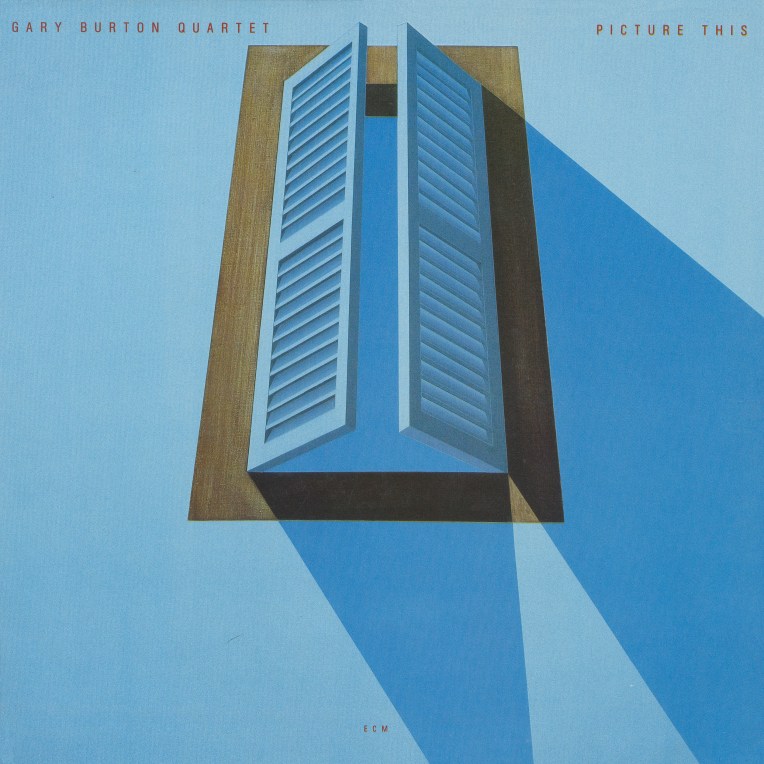
Gary Burton Quartet: Picture This (ECM 1226)

ECM 1226

Gary Burton Quartet
Picture This

Gary Burton vibraharp
Jim Odgren alto saxophone
Steve Swallow bass guitar
Mike Hyman drums
Recorded January 1982 at Columbia Recording Studios, New York
Engineer: Stan Tonkel
Produced by Hans Wendl

As I listened to Picture This for the first time, spring had just begun, and the music could hardly have been more fitting. Like an animal emerging from hibernation, its joyous frolics resonate in heart and mind with equal wit. Burton’s breath of fresh air is easy on the ears, never bogging us down with overly intellectual presumptions. For this transient quartet, he finds himself fronting a trio comprised of Jim Odgren on alto sax, Steve Swallow on bass, and Mike Hyman on drums. The mingling throughout from the two leads makes for some evocative motives and adds a curl to every letter written.

Burton never ceases to captivate, for here is a musician who is so—if you will excuse the pun—vibrant on his own terms, yet allows balance to flourish wherever he may be. Take, for instance, this new spin on the Carla Bley classic “Dreams So Real,” on which his presence is so integral yet so unassuming that at times one hardly notices, providing as he does only those key anchors needed for Odgren’s lithe restraint, only to unleash a primary force when soloing. This is the first of a few dips into the work of Burton’s favorite composers. Another, even deeper, plunge comes in the form of “Waltz.” This spindly Chick Corea tune cycles through far more rhythmic variations than its rudimentary title would indicate, and also sports a leapfrogging solo from Swallow that is by far the album’s highlight. Swallow also makes fine work of “Duke Ellington’s Sound Of Love” (Charles Mingus), where his lyrical sway is flexible enough to support both Burton’s superbly attenuated malleting and Odgren’s beautiful reed work. The latter makes a winner out of “Tanglewood ’63” and lends itself to the saxophonist’s own two offerings, “Tierra Del Fuego” and “Skylight,” both gifts of pure delight wrapped in bright melodic bows.

Burton has uncovered some of the most potent melodies in ECM’s dense and knotted trees. Every strike of his mallet is like a woodpecker, revealing that which only the most attuned ears can hear.

<< Dewey Redman Quartet: The Struggle Continues (ECM 1225)
>> Keith Jarrett: Concerts – Bregenz/München (ECM 1227-29)

Ulrich Lask: Lask (ECM 1217)

ECM 1217

Ulrich Lask
Lask

Ulrich Lask alto saxophone, synthesizer
Meinolf Bauschulte drums
Maggie Nicols voice
Recorded November 1981 at Tonstudio Bauer, Ludwigsburg
Engineer: Martin Wieland

“Not many people see the wisdom in madness.”

Take a little Mr. Bungle, mix in some Elliot Sharp, add a dash of Claudia Phillips, and you may just get something akin to this strikingly outlandish rarity from 1982. The voice of Maggie Nicols is the solder that holds everything together, while Ulrich Lask’s laser-like sax and labored synth weave an industrial spell at every turn of the set’s assembly line. The bubbly electronics of “Drain Brain” spray-paint the malaise of a post-punk modernity, where duties and obligations engage one another in a rather debilitating tango with the children’s rhyme “Rain, rain, go away.” Our core confrontations are laid out on the dissecting table of the “Tattooed Lady,” whose multiphonic screams burrow into the urban web of ignorance that clothes us in prescription. This brings us to the album’s reigning highlight. “Kidnapped” is a tongue-in-cheek yet visceral autobiographical experiment about woman who is snatched away for the sole purpose of recording “that new-fangled…funny music with a beat” in ECM’s Ludwigsburg studio. Lask manages to keep pace with the boggling skitters and saxophonic squeals of Nicols, who stretches these enchantments well into “Should We, Geanie?” This speculative exercise in authoritarianism looks at social relations through a glass darkly as neither catalysts nor inhibitions, but rather as tattered newspapers stuffed into the human dichotomy, exploitable only through the vocal act. Thus does the stormy narrative of “Unknown Realms” transform maternity into ancestral longing. Here, the landscape is treated like an entity, a plane where inception is breathlessness, breathlessness is signal, and signal is song. Walking hand in hand with the “Poor Child,” we find a klezmer-like essay on worldly power and the lone citizen just trying to make ends meet on a puddle-splashed street corner. But when we pull our pockets out to cartoonish lengths, we find, as prophesied in “Too Much – Not Enough,” that the generative force of all meaning is its very emptiness.

Lask might seem like an anomaly in the ECM catalog, when really it stays true to the label’s ever-adventurous spirit. Dementia as the new art, or art as the new dementia? You decide.

<< Pat Metheny Group: Offramp (ECM 1216)
>> Steve Tibbetts: Northern Song (ECM 1218)

James Newton: Axum (ECM 1214)

ECM 1214

James Newton
Axum

James Newton flutes
Recorded August 1981 at Tonstudio Bauer, Ludwigsburg
Engineer: Martin Wieland
Produced by Manfred Eicher

Composer, flutist, and conductor James Newton is about as renaissance as renaissance men get. Currently a professor in the Department of Ethnomusicology at UCLA, Newton seems always to be looking for ways to expand his knowledge. And while his command of repertoires may be staggering, a humble primacy of the body has ever been at the heart of his activities. Breath, movement, and time trace zones of sonic blossoming in his music, to the point where one cannot help but visualize the bodywork of his many recorded performances. Out of a discography going on 60 albums, we might point to 1982’s Axum, his only for ECM, as a seed. Its fantastic range of colors comes together in an enduring piece of sonic archaeology.

Half of the album is drawn from overdubbed territories, where bass and alto flutes share the air with their concert cousin. Within the first minute of “The Dabtara,” we already get a sense of Newton’s idiomatic breadth, as flickers of modern jazz blend into a backdrop of medieval piping. Thus does Newton find unity in division. Among the more mirthful turns is “Addis Abada,” which sounds like some form of worship through which one breaks from the self on the way to belonging. Another turn of the kaleidoscope brings into focus the title track, a veritable symphony of multiphonic splendor. “The Neser,” however, is the most accomplished here. With a Debussean elegance fringed in shadow, Newton hangs every melodic intention in the air like some vast ornamental mobile turned by forces unknown.

The five solo pieces constitute more than just the other half of Axum. Rather, they stick to the palate in a pleasing mingling of flavors. Utilizing a wealth of extended techniques and saturnine divinations, Newton is at one moment descriptive (“Mälak ’Uqabe”) and self-multiplying (“Choir”), at another lithe (“Feeling”) and intensely personal (“Susenyos And Werzelya”). The album’s prismatic center is found in the gnarled pathways of “Solomon, Chief Of Wise Man.” Here, we find ourselves face to face with distant calls that are, while ancestral, undeniably of the future. We listen to these sounds from the confines of our privacy, be they circumscribed by headphones and wires or by the larger spaces of our homes. Yet in doing so we find a broader path along which to place our feet. This is this sense of transit that Newton brings, each flutter charged by a nascent realization awakening of daybreak. Even as it shrugs off the blanket of night, it cannot help but see itself reflected in the mirroring sky, where only memories dance in lieu of lived experience. Keeping one eye on the past, these meditations walk sideways, hoping that we might do the same…on our own time.

<< Steve Kuhn Quartet: Last Year’s Waltz (ECM 1213)
>> Steve Reich: Tehillim (ECM 1215 NS)

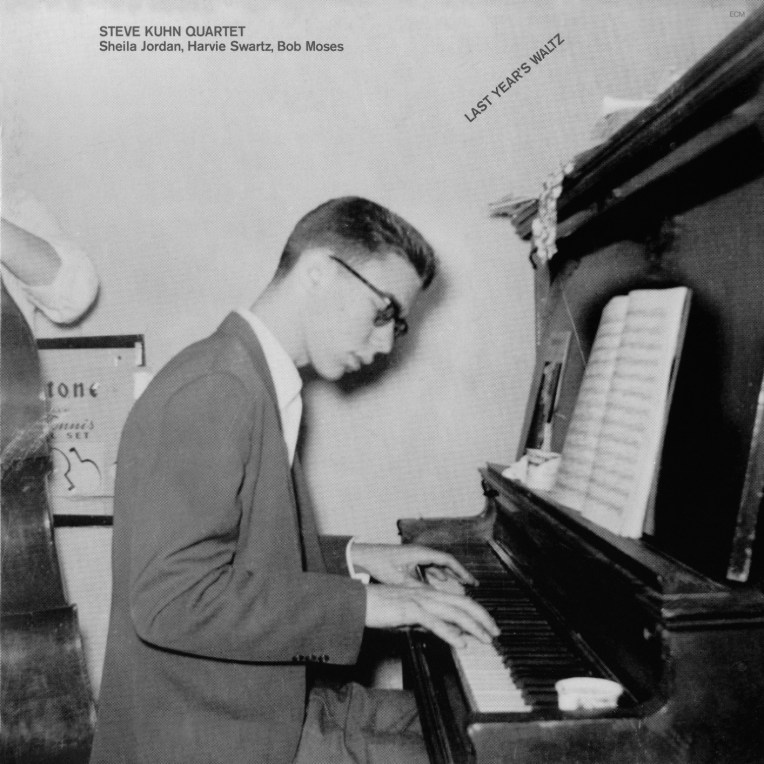
Steve Kuhn Quartet: Last Year’s Waltz (ECM 1213)

ECM 1213

Steve Kuhn Quartet
Last Year’s Waltz

Steve Kuhn piano
Sheila Jordan voice
Bob Moses drums
Harvie Swartz bass
Recorded live, April 1981, at Fat Tuesday’s, New York City
Engineer: David Baker
Produced by Robert Hurwitz

Last Year’s Waltz has everything a great live jazz album should: a present feel, gobs of atmosphere, and, oh yeah, Sheila Jordan. Right off the bat, interplay from Bob Moses and Harvie Swartz kicks us into wakefulness in “Turn To Gold.” Gilded by Kuhn’s indeed alchemical but always punctual pianism, this dose of smoothness is sure to please. Kuhn brings a montuno flavor to “The Drinking Song,” which is deepened by Jordan’s diaristic musings, both expository and speculative, and boasts enough woops from her band mates to keep our blood at a constant boil. The title track is a languid trickle that quickly crackles into a melodious and cinematic punch bowl. The key to unlocking the set’s inner secrets is “The Fruit Fly,” which, in both title and execution, evokes Chick Corea’s blissful optimism. Downright wondrous pianism and omnipotent drumming make this the instrumental standout (the solo piano “Medley” runs a close second). Kuhn works his magic through “The Feeling Within,” weaving a luxurious carpet for Jordan’s vocal footsteps. Two standards—a decidedly upbeat rendition of “I Remember You” and the virtuosic scat-fest that is “Confirmation”—and the bittersweet yet crowd-pleasing tune “The City Of Dallas” (Steve Swallow) complete this living portrait of a group in its prime. As the recording fades, members of the crowd shout, “More!”

I second that.

Not only does Last Year’s Waltz show us Jordan at her best, but its explosive energy and archival importance make it by far Kuhn’s finest quartet joint of the 80s. A reissue is a must.

<< Art Ensemble of Chicago: Urban Bushmen (ECM 1211/12)
>> James Newton: Axum (ECM 1214)

Ralph Towner/John Abercrombie: Five Years Later (ECM 1207)

1207 X

Ralph Towner
John Abercrombie
Five Years Later

Ralph Towner classical and 12-string guitars
John Abercrombie acoustic guitar, 12-string electric guitar, mandolin
Recorded March 1981 at Talent Studio, Oslo
Engineer: Jan Erik Kongshaug
Produced by Manfred Eicher

John Abercrombie is unique among guitarists in that whenever he becomes enraptured his sound becomes neither louder nor more pronounced but becomes somehow mysterious, liberated. Ralph Towner, on the other hand, revels in the crackling ruptures that so characterize his playing. Yet these roles seem reversed in this follow-up to the duo’s Sargasso Sea. A far more fragile carnation than its predecessor, it seems to forego the usual bag of tricks in favor of something more, as the album’s title would imply, reflective. This is especially apparent in the three improvisations with which the set list is dotted, and nowhere more so than in “Late Night Passenger,” where Abercrombie’s laddered filaments provide stunning berth for the other’s muted, jangling starlight.

As for composed pieces, Towner offers three, Abercrombie two. Among the former’s, the all-acoustic “Half Past Two” is a vibrating rib cage of biographical energies, and the most comely track on the album. The attraction continues with “Caminata” and on through the whimsy of “The Juggler’s Etude.” Abercrombie’s “Child’s Play” pairs electric and classical for a complementary sound, Towner’s shallower accents the caps on Abercrombie’s resonant stalks. Child’s play it may be in name, but in execution it is anything but. Yet it is in “Isla” that the reverie reaches new depths, the musicians’ negotiation of lead and backing effortlessly egalitarian. Such reciprocity is the keystone that keeps this arch from crumbling.

<< Gallery: s/t (ECM 1206)
>> Lande/Samuels/McCandless: Skylight (ECM 1208)

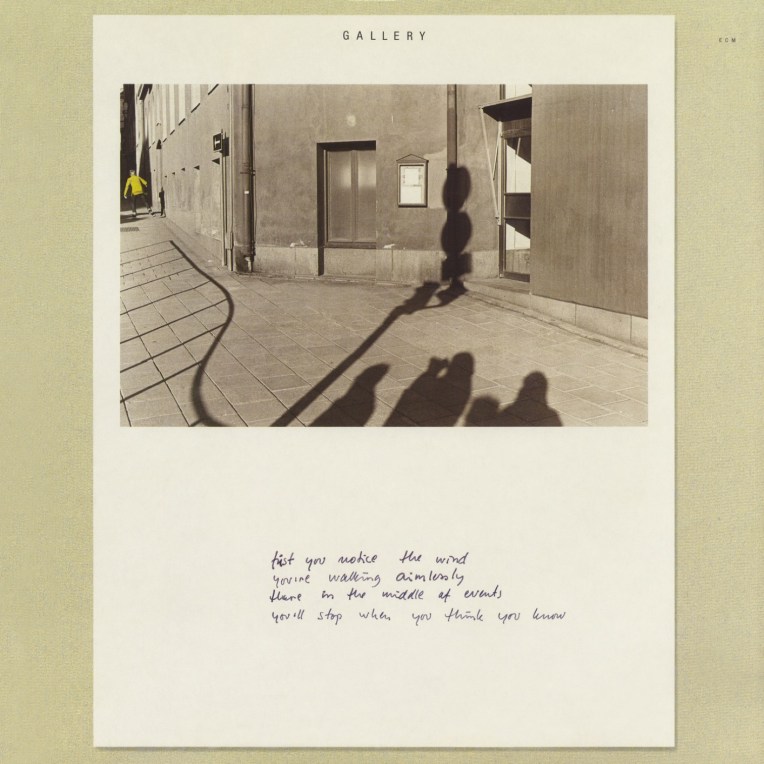
Gallery: s/t (ECM 1206)

ECM 1206

Gallery

David Samuels vibraharp, percussion
Michael DiPasqua drums, percussion
Paul McCandless soprano saxophone, oboe, english horn
David Darling cello
Ratzo Harris bass
Recorded May 1981 at Sound Ideas Studio, New York
Engineer: David Baker
Produced by Manfred Eicher

Another enigmatic outlier in the land of the as-yet-to-be-reissued, Gallery follows in the tender footsteps of First Avenue. Its talents are immediately sent skyward in “Soaring,” where the sprightly vibes of Dave Samuels find complement in bassist Ratzo Harris and cellist David Darling, both of whom roll off Michael DiPasqua’s delicate snare and cymbals like words from a poet’s tongue. Darling takes some of the album’s most gorgeous improvisatory turns here. His fluid lines continue in “Prelude,” a duet with Samuels that shares the same breath with “A Lost Game.” The latter is transitory, not unlike the album as a whole, playing out especially in the rhythmic crosspollination between vibes and drums, slung ever so delicately by the bass’s curves. Paul McCandless lays the gold foil of his own beauties with a soprano sax solo that takes this configuration to greater heights, surpassed only by the reflective cello that follows. “Painting” sounds like a Gavin Bryars ensemble piece, unfolding into the remnants of a Morton Feldman dream before awakening in the harmonic contract of a “Pale Sun.” On then does the “Egret” drop us in limpid vibrations, where only a hushed “Night Rain” shows us the final trail.

As the album’s title indicates, this music offers a row of artful images. Yet rather than guide us through a linear passage of creative relics, it brings that passage to us, so that we need only observe…and listen.

<< Old And New Dreams: Playing (ECM 1205)
>> Ralph Towner/John Abercrombie: Five Years Later (ECM 1207)

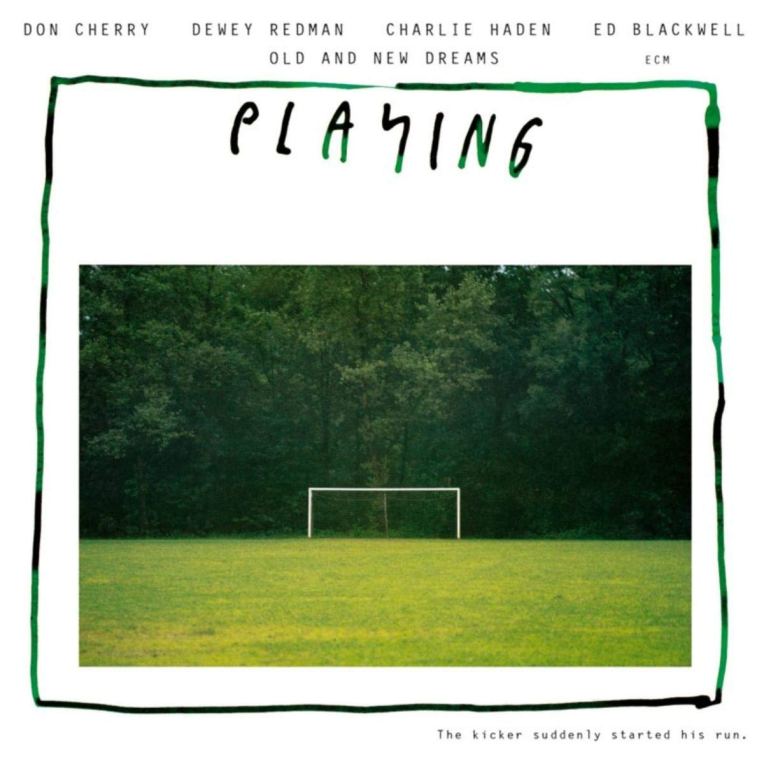
Old And New Dreams: Playing (ECM 1205)

ECM 1205

Old And New Dreams
Playing

Don Cherry trumpet, piano
Dewey Redman tenor saxophone, musette
Charlie Haden bass
Ed Blackwell drums
Recorded live, June 1980, Theater am Kornmarkt, Bregenz (Austria)
Engineer: Martin Wieland
Produced by Manfred Eicher

This fantastic set, recorded live in Austria, is the place to start for anyone wanting a glimpse into the attic of Old And New Dreams. The playing is on point, the crowd riled, and the stakes high. From that first lively jump into “Happy House,” one of three extended Ornette Coleman tunes, we are plunged into the group’s quintessential sonic parameters. Lithe syncopations from Dewey Redman relate to Ed Blackwell’s drumming like family, while the free-flowing trumpeting of Don Cherry loosens its grip on predictability for a style that is utterly devoid of pretense and ever eager to communicate. Charlie Haden’s melodious plasticity completes a formula that carries through to the last drop. Just listen to the gut-wrenching tenor solo in “New Dream,” the liquid horns and percolating toms of “Broken Shadows,” where Redman’s musette also unfurls for a fantastically CODONA-like sound, and tell me there isn’t something special going on here.

Cherry drops a groovy hit of his own with the pointillist “Mopti,” of which the infectious pianism from the composer and attuned percussion delight. Redman contributes “Rushour,” the album’s most incendiary flush. The incredible saxophonism and expansive lyric trumpeting spread their joys far and wide. The title track comes from the hand of Haden, around whose spine horns weave like a medical caduceus before being lobbed back into their familiar station like ping-pong balls at the ready.

Considering the heft of talents assembled here, the results are weightlessly executed. This shows not weakness or lack of fortitude, but the maturity everyone brings to the sonic table. This is a solid date from musicians who know the business inside and out, and then some. About as good as it gets. Reissue, anyone?

<< Egberto Gismonti: Sanfona (ECM 1203/04)
>> Gallery: s/t (ECM 1206)