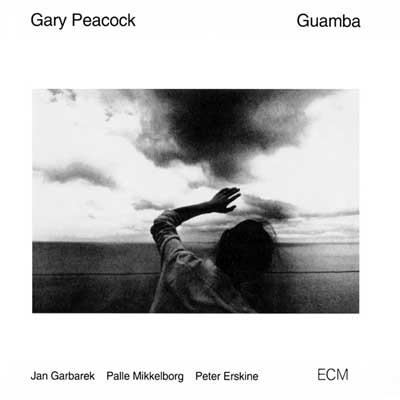
Gary Peacock: Guamba (1352)

Gary Peacock
Guamba

Gary Peacock bass
Jan Garbarek tenor and soprano saxophones
Palle Mikkelborg trumpet, fluegelhorn
Peter Erskine drums, drum computer
Recorded March 1987 at Rainbow Studio, Oslo
Engineer: Jan Erik Kongshaug
Produced by Manfred Eicher

Despite the fact that bassist Gary Peacock has emoted some of the liveliest passages in his long stint with the Keith Jarrett trio, as frontman he has always shown us the merciful heart that moves him. Listen to the eponymous opener of Guamba, and you hear not the rhythmist but a parent tendering a lullaby for his sleeping child. Only after this Escherian staircase in sound is Peacock joined by his session mates—Jan Garbarek on tenor and soprano saxophone, Palle Mikkelborg on trumpet and fluegelhorn, and Peter Erskine on drums—for “Requiem,” which lulls us into a low-slung saddle of bass and drums before Garbarek’s razor-sharp agitations sober us. Yet Garbarek also shows great sensitivity on this date, bowing out for the beguiling trio of “Celina” and crackling with Mikkelborg over a smooth grounding in “Thyme Time.” In this upbeat number, Erskine takes the lead amid a brocade of drum computer accents. Peacock takes us aside again at the start of “Lila.” His steps are watered by droplets of cymbal, every strum a burgeoning shoot spreading Garbarekian flowers, and nourished by Mikkelborg’s sunshine. Erskine delights yet again with his delicate precision, and with the variegated rhythms that lure us into “Introending.” Peacock dances here amid a string of horns, making for a fantastic ride on par with the subtle grooves of Manu Katché. We end in a bed of “Gardenia,” another solo around which our leader’s band mates slide with utmost care. Garbarek has hardly been gentler, giving Mikkelborg more than enough canvas across which to bleed watercolor into the final exhalation.

<< Marc Johnson’s Bass Desires: Second Sight (ECM 1351)
>> Dave Holland Quintet: The Razor’s Edge (ECM 1353)

The Bill Frisell Band: Lookout For Hope (ECM 1350)

The Bill Frisell Band
Lookout For Hope

Bill Frisell electric and acoustic guitars, banjo
Hank Roberts cello, voice
Kermit Driscoll bass
Joey Baron drums
Recorded March 1987 at Power Station, New York City
Engineer: James Farber
Produced by Lee Townsend

Listening to Lookout For Hope is like wandering into a windblown cowboy town. The dirt is bare, save for the errant tumbleweed that dares set twig in this dustbowl. You wander past the Sheriff’s office. A poster hangs outside the door:

WANTED
FOR ARMED ROBBERY OF GENRE

BILL FRISELL
REWARD: MUSICAL LUXURY

And indeed, Frisell has run off with many a stagecoach prize, fashioning each into a personal politic of twisted charm.

On this, another seminal effort on ECM’s Touchstones, Frisell continued to chart his inimitable sound. The wordless vocals of Hank Roberts in the album’s title opener waver like something from the dream diary of Pat Metheny, with whom Frisell shares much insofar as it is almost impossible to listen to either guitarist without seeing epic films of vivid imagery. But make no mistake about feeble comparisons: Frisell is the only dude on this ranch. From his gentle entrance, we know that his is an axe that melts, revealing thematic contours in negative space. He frees melodies from the chopping block and lets them bump into one another as they will. Roberts’s sinewy cello is a no-brainer. As it extends its forked tongue from this sonic bayou, defenestrating itself in a blissful unraveling, it lands smack in the molasses of “Little Brother Bobby,” where with easygoing persuasion it rocks like a back porch chair before stumbling on through the banjo-infested prophecy of “Hangdog” and into the crystalline vision of the album’s capstone, “Remedios The Beauty.” And where “Lonesome” is a raw slab of Podunk beauty that glistens with Frisell’s acoustic, “Melody For Jack” is a dream tunnel into a trio of miniatures before the warm fuzziness of “Alien Prints” plays us out with understated panache.

Lookout For Hope is a walleyed world replete with hokey profundity and slack jaws. Like a good Stephen King novel, it gets under our skin even as it nourishes it. The titular lookout seems but a toothpick of a shadow on the horizon. But no matter, for by the time the final note has run away we’ve already found our hope.

<< Zakir Hussain: Making Music (ECM 1349)
>> arc Johnson’s Bass Desires: Second Sight (ECM 1351)

Edward Vesala: Lumi (ECM 1339)

Edward Vesala
Lumi

Esko Heikkinen trumpet, piccolo trumpet
Pentti Lahti alto and baritone saxophones, flutes
Jorma Tapio alto saxophone, clarinet, bass clarinet, flute
Tapani Rinne tenor, soprano saxophones, clarinets
Kari Heinilä tenor, soprano saxophone, flute
Tom Bildo trombone, tuba
Iro Haarla piano, harp
Raoul Björkenheim guitar
Taito Vainio accordion
Häkä bass
Edward Vesala drums, percussion
Recorded June 1986 at Finnvox Studios, Helsinki
Engineer: Risto Hemmi
Produced by Manfred Eicher and Edward Vesala

Take a moment to wander the art of Morten Haug, whose cover photograph (one of ECM’s best) is a gateway into what’s to come. Like Edvard Munch’s The Scream mummified, it silences that which is already silent, and in so doing unleashes a slow torrent of organic music. As the rain of Iro Haarla’s harp trickles through the branches of “The Wind,” picking away the last crumbs of our disbelief, we are able to ease into the careful telepathy this ensemble braids together. Thus blown of our dust, we meditate in “Frozen Melody,” which, though it may begin in stillness, melts with every rendered note. “Calypso Bulbosa” is a rougher diamond, freshly unearthed, the grunge of an electric guitar still clinging to every clouded knurl. Birdcalls and flightless reeds share the same forest, twisting into all manner of distorted reflections. After sailing through the elliptical orbits of the “Third Moon,” we reach the title track, which indeed brings light to bear, cloud-shafted and wavering. The saxophone work here, and in the “Camel Walk” (Vesala’s own “Donkey Jamboree”) that follows, is gorgeous, watery, silted. “Fingo,” no dissimilarly, sounds like a Bill Frisell tune blended in a sonic food processor with Dino Saluzzi spice and a dash of late-night cabaret. A brilliant inclusion. The album’s briefest spit comes in “Early Messenger,” and brings us “Together” in the full-circle closer, interlacing creative fingers in the full dark of finality.

Another puzzling masterpiece from Vesala. Savor it as you will.

<< Mark Isham/Art Lande: We Begin (ECM 1338)
>> Thomas Demenga: Bach/Holliger (ECM 1340 NS)

Terje Rypdal & The Chasers: Blue (ECM 1346)

Terje Rypdal & The Chasers
Blue

Terje Rypdal electric guitar, keyboards
Bjørn Kjellemyr electric and acoustic bass
Audun Kleive drums, percussion
Recorded November 1986 at Rainbow Studio, Oslo
Engineer: Jan Erik Kongshaug
Produced by Manfred Eicher

Terje Rypdal, Bjørn Kjellemyr, and Audun Kleive continue where they left off on Chaser with this equally memorable set. Blue is not a companion album, however. It is the yin to the other’s yang: on the surface they are solid teardrops of color, but closer listening reveals an eye of one in the other. Swiveling in at a mere 90 seconds, “The Curse” provides an alluring introduction that fades all too quickly into the bass-driven groove of “Kompet Går.” Rypdal may run like a melodic rat with his tail on fire at first, but soon paints the sky with cool winds in a free anthem of strings and rhythms. These last are ever an audible undercurrent to what’s going on above the surface. Their analog warmth lends particular comfort to “I Disremember Quite Well,” where it is enhanced by a hum of bass. Rypdal’s inescapable lyricism is the calm before a quiet storm that rains liquid flame into the cauldron of “Og Hva Synes Vi Om Det.” Every utterance of the bass is like a bubble of lava popping, every echo a dying bird going down in smoke. Even the drum machine in “Last Nite” somehow enchants us, holding on to Rypdal’s feathered back as he peaks above the clouds in denial of the deserts below. The title track lowers us slowly on the bass’s thickly wound strings, Rypdal the melodic bait on this hook, twirled like a ribbon around the finger of a forgetful deity. “Tanga” gets us back into the swing of things with a catchy vamp, even as Rypdal works a magical mood far away. This excursion grinds to a halt in a crunchy solo before “Om Bare,” a solo punctuated by outbursts from synth, casts us into the sea.

Essential for the Rypdal fan.

<< Keith Jarrett: Book Of Ways (ECM 1344/45)
>> Gidon Kremer: Edition Lockenhaus Vols. 4 & 5 (ECM 1347/48 NS)

Norma Winstone: Somewhere Called Home (ECM 1337)

Norma Winstone
Somewhere Called Home

Norma Winstone voice
John Taylor piano
Tony Coe clarinet, tenor saxophone
Recorded July 1986 at Rainbow Studio, Oslo
Engineer: Jan Erik Kongshaug
Produced by Manfred Eicher

After her stunning contributions to ECM via the enigmatic outfit known as Azimuth, jazz vocalist Norma Winstone broke out, or should I say broke in, her solo career with Somewhere Called Home. Joined by pianist John Taylor and Tony Coe on clarinet and tenor saxophone, she lends her sympathetic draw to the canonic tree while also hanging it with her own lyric adornments to the music of Egberto Gismonti, Ralph Towner, and Kenny Wheeler. The finished session is burnished to a dim reflection of yesteryear.

From the first measured steps of “Café,” Taylor’s gentle snowflakes and Coe’s fluted reeds are perfect companions. This is a song, like so many, of people and places intersecting in romances as fleeting as the words they’re built upon. The title track is a geodesic shape of ebony and ivory, splashed with the prismatic light of Winstone’s lilting phrasings. Patterns of loneliness emerge, seeking in the human voice the solace from which our pain also arises, and through which we purge the very same. Taylor and Coe run off, hand in harmonic hand, rushing through the wilds of memory, leaving Winstone to paint the veil of winter in “Sea Lady” with a translucent river of spring, where love flows into an ocean of forgetfulness. “Some Time Ago” opens with a mournful cry from Coe, dropping us talon-first into a sky of childhoods. Every chord from Taylor is a wisp of cloud, gone too soon in a dragon’s breath. Winstone spins the mythology of love into a jewel of hope that shines only in the sunlight of the future. She waits, breathing in the world so that she might exhale the promise of another morning, of another kiss, of another embrace. The delicate impressionisms of “Prologue” and “Out Of This World” recall at once the French symbolists and Manuel de Falla’s Psyche. Coe enchants with every flap of his virtuosic wings, lending his ethereal tenor to “Celeste.” This bittersweet exploration of songcraft catches up to us like an ancestral figure. Every breath of the sax is like that figure’s movements, by turns flesh and shadow, and brought to active life by the erosion of the high note, which chips away like a welding torch at the resolve of our solitude. “Hi Lili Hi Lo” takes comfort in the fact that in order to fall in love, one must jump, blindfolded, from a great height indeed. With “Tea For Two,” we at last get the assurance of a lover’s arms cradling not just our bodies, but also our souls. That gorgeous tenor returns for a final heave, ending where it all began, folded in the origami of time.

Winstone washes away the clothing of every sentiment, exposing the naked flesh of words. Her melodies swim in life’s tormented sea, compressing the universe into a salty teardrop of pure expression. While this date may not be for everyone, it is for me another candidate for inclusion in ECM’s Top 10. A profound, meditative masterpiece that will grow as you do.

<< Meredith Monk: Do You Be (ECM 1336 NS)
>> Mark Isham/Art Lande: We Begin (ECM 1338)

Keith Jarrett Trio: Standards Live (ECM 1317)

Keith Jarrett Trio
Standards Live

Keith Jarrett piano
Gary Peacock bass
Jack DeJohnette drums
Recorded July 2, 1985 at the Palais dis Congrès Studios de la Grand Armée
Engineer: Martin Wieland
Produced by Manfred Eicher

Take one look at the thoughtful cover art of this seminal Keith Jarrett release, and you’ll gain immediate insight into what makes his trio click. Each curvaceous line brings a lifetime of movement, of study, and of passion to bear on the music at hand. And with these six standards resurrected to such profound levels, there’s nothing not to like.

Just let the groove of “Falling In Love With Love” have its way, and the quicksand of the trio’s genius has you by the heart. Jarrett is in his element, crying his way through sibilant improvisatory arcs. Peacock surfaces for an engaging solo, Jarrett watching from the sidelines with duly attentive chording before sharing an intuitive stichomythia with DeJohnette. Peacock grabs the spotlight again in “The Old Country,” in which piano and drums spread a subtle launching pad for his low yet adroit flights. Jarrett builds on these, dancing on air through every motivic change before putting the starlight back into “Stella By Starlight.” Ever the sonic chameleon in a world of primary colors, he achieves the musical equivalent of alchemy once his ever-faithful rhythm section dashes in its own mysterious elements. A magnetic bass solo draws DeJohnette’s cymbals like iron filings before ending in a forgiving embrace. “Too Young To Go Steady” receives an absorbing treatment, the band whipping up a soft peak that melts smoothly into resolution. Next is a spirited version of “The Way You Look Tonight,” which unpacks oodles of bliss and shows the trio form at its finest. A whoop-worthy solo from DeJohnette forms an enlivening bridge to the vamp, playing us out into “The Wrong Blues,” which does everything oh so right.

While all the tunes on this album are classic, the untouchable performances make them doubly so.

Beyond recommended.

<< Kim Kashkashian/Robert Levin: Elegies (ECM 1316 NS)
>> Stephan Micus: Ocean (ECM 1318)

Jon Hassell: Power Spot (ECM 1327)

Jon Hassell
Power Spot

Jon Hassell trumpet
J. A. Deane percussion, alto flute
Jean-Philippe Rykiel keyboards
Michael Brook guitar
Richard Horowitz keyboards
Brian Eno bass
Richard and Paul Armin RAAD electro-acoustic strings
Miguel Frasconi flute
Recorded October 1983 and December 1984, Grant Avenue Studio, Ontario
Assistant  engineering: David Bottrill and Roman Zack
Produced and engineered by Brian Eno and Daniel Lanois

American composer and trumpeter Jon Hassell is best known for his music of the Fourth World, which he describes as “coffee-colored classical.” The definition becomes clearer once you immerse yourself in the sounds of Power Spot. Hassell’s career is as varied as his education. A student of both Karlheinz Stockhausen and Pandit Pran Nath, he is known for overlooking idiomatic barriers in favor of something far broader. Nath left an indelible mark in Hassell, who turned to the master’s voice for guidance in his own playing. His unmistakable tones are achieved by singing into the instrument, thereby drawing clusters of sounds from a single exhalation. This recording is significant for a number of reasons, not least for indicating a moment in sonic history in which the electro-acoustic universe was beginning to spin some of its richer, more majestic galaxies. The music on Power Spot radiates like a supernova waiting patiently for the traction of celestial bodies to fan its clouds away, revealing softly spinning globes of breath and vapor. With such evocative titles as “Wing Melodies” and “The Elephant And The Orchid,” one feels almost overwhelmed by the range of possible imagery. And yet, like any question of mode or genre thereof, these words disappear behind the music’s waterfall.

At first listen the album may seem to blend into a broad wash of sound, but lean in closer and you begin to hear the details emerge. The title track is perhaps the most potent, opening this portal to a wellspring of beats and train whistles. Brian Eno’s amphibian bass slithers through a pond of liquid mercury, fading into the gaseous darkness from which it sprang. Otherworldly connotations are bound to reveal themselves, and nowhere more so than in “Passage D.E.,” which sounds like the soundtrack to a documentary of some undiscovered planet. Notable also is “Miracle Steps,” where live percussion provides marked contrast to the synthetic overlay, drawing in the process the album’s most beautiful cartography.

Power Spot is one protracted aerial view, a bubbling primordial soup of circuits and blips, funneled through such progressive sense of direction and atmosphere as only Hassell can activate. Unlike much of the knob-turning to grace the many electronic albums of the 80s, its sound is strikingly effusive and organic. In this ocean, one finds that the light of life shines brightest on the inside. It is a light that no clouds can obscure, a light that no darkness can close its eyes around. It is a journey of transience, of transport, of futurism and antiquity, of none of these things. Influential? More than words can say. Just listen to Paul Schütze’s Stateless, or the works of countless others who’ve clearly drunk from the Hassell font.

A perfect specimen.

<< Lester Bowie’s Brass Fantasy: Avant Pop (ECM 1326)
>> Gary Burton Quintet: Whiz Kids (ECM 1329)

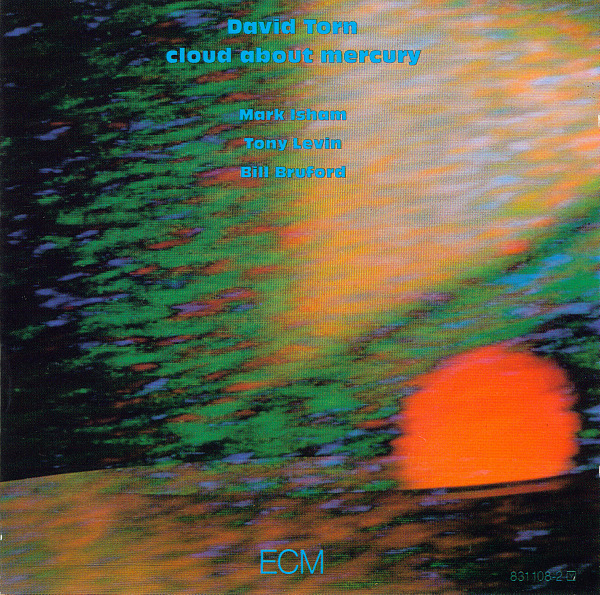
David Torn: cloud about mercury (ECM 1322)

David Torn
cloud about mercury

David Torn guitars
Mark Isham trumpets, synthesizer
Tony Levin bass
Bill Bruford drums, percussion
Recorded March 1986 at Audio International, London
Engineer: Andy Jackson
Produced by Manfred Eicher

Guitarist David Torn defines jazz fusion, proving that the genre is more than add and stir. With cloud about mercury he made his most personal statement to date. The album sounds like many things: a sweep of Steve Tibbetts dimensions, a Jon Hassell think piece, a tree with many cultural branches, a spider’s web in sound. Torn roams freely throughout these territories, shouldering a vast load of thematic material. The opening wash of heaven that is “Suyafhu Skin…Snapping The Hollow Reed” condenses much of that material, letting fall a quiet storm of continental activity. Detuned guitars and a bubbling synthesizer part the way for Tony Levin’s grounded bass lines and trumpeter Mark Isham’s sustained flights, while drummer Bill Bruford chases after, somehow keeping pace. Next is “The Mercury Grid,” another engaging rhythm piece that boasts Isham in a Molværian mode. Torn flexes acrobatically here, swinging from every branch of this sonic corridor. The curiously titled “3 Minutes Of Pure Entertainment” is a mid-tempo groove that again features soaring guitar. Torn’s fractal precision speckles “Previous Man,” which begins with two guitars before engaging drums and synth bass in staggered syncopations. The likeminded “Network Of Sparks: The Delicate Code” sets off an intriguing chain of electric events, all the more enigmatic for their brevity. Which brings us to “Network Of Sparks: Egg Learns To Walk…Suyafhu Seal,” a warm, gelatinous mosaic that slices the night into ribbons like light through a window blind, rendering empty space into a virtual stairway by curls of cigarette smoke.

cloud about mercury represents a pinnacle of Torn’s craft and is must-have for the adventurous.

<< John Abercrombie: Getting There (ECM 1321)
>> Gavin Bryars: Three Viennese Dancers (ECM 1323 NS)

Chick Corea: Trio Music, Live In Europe (ECM 1310)

Chick Corea
Trio Music, Live In Europe

Chick Corea piano
Miroslav Vitous bass
Roy Haynes drums
Recorded September 1984 in Willisau and Reutlingen
Engineer: Martin Wieland
Produced by Manfred Eicher

In 1983 the Keith Jarrett trio was just getting on its feet. That shadow would prove to be a difficult one to step out of in the coming decades. But if anyone could have thrown a light onto it, it was Chick Corea, who, along with bassist Miroslav Vitous and drummer Roy Haynes, emoted a live recording for the ages. Corea seems to have done much soul searching in the 70s, and on this set one hears his chrysalis crackle with uncontainable vivaciousness. After his warm intro, “The Loop” kicks off the band’s deep combinatory powers with fortitude. Vitous is a joy to experience, his rich, oblong sound surrounding us like a wooded glade, brought to the life by the rustlings of Haynes’s snare and the trickling sunlight of Corea’s keys. “I Hear A Rhapsody” cocks its ear toward rapture. Lost along the winding staircase of its motive, it is a while before we realize these musicians have been keeping us in sight all along. We are reminded of this with every shift, and in the way Corea draws Haynes into whimsical conversation. “Summer Night / Night And Day” gives us the album’s first double-header, Vitous fluttering his wings in ways few others can. From this upbeat wonder, the trio transitions seamlessly into its inverse, seeming to fill every gap in the former’s carving with glorious relief. The second double-header tears a page from the Scriabin playbook with “Prelude No. 2,” making for one of Corea’s most beautiful stretches of internal life ever committed to disc. This bleeds into the staggered breathing of “Mock Up.” Vitous solos us through “Transformation,” while “Hittin’ It” pours the light on Haynes. Eicher has done us a service in including these, for, as so often happens in jazz recordings, long solos are either cut or curtailed. Yet here they are fully fledged elements in the album’s molecular pathways. We end on “Mirovisions,” which writes an arco bass across soaring pianism before diving hawk-like into the Valley of the Groove. A colorful unraveling follows, marked by flashes of buoyancy against a thoughtful backdrop.

A perfect album from Alpha to Omega, this is one of ECM’s finest and a delightful new addition to my Top 10. Invigorating to the last.

<< Dino Saluzzi: Once upon a time – Far away in the south (ECM 1309)
>> John Abercrombie: Current Events (ECM 1311)