Oregon: s/t (ECM 1258)

Oregon
Oregon

Paul McCandless reeds, flute
Glen Moore bass, violin, piano
Ralph Towner guitar, piano, synthesizer
Collin Walcott sitar, percussion, voice
Recorded February 1983, Tonstudio Bauer, Ludwigsburg
Engineer: Martin Wieland
Produced by Manfred Eicher

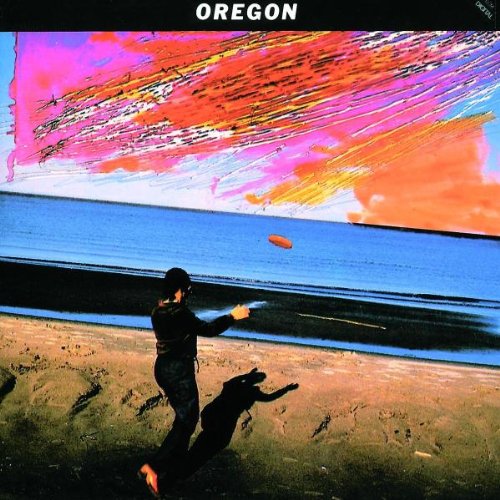
By the time of this self-titled ECM debut, the collective known as Oregon had firmly established its uncategorizable sound on a host of recordings for Vanguard. From the cover photograph, which stands as one of the more confounding choices in ECM history, those unfamiliar with Oregon would probably never guess that the music it sleeves could be so ethereal. Oregon finds the group still in its original incarnation with Paul McCandless, Ralph Towner, Glen Moore, and Collin Walcott (in one of his last sessions with the group before his life was tragically ended in a 1984 car crash).

The opening chords of “The Rapids” render some of the album’s more compositionally minded passages (the others being McCandless’s “Beside A Brook” and two pieces from Moore, of which the winged “Arianna” stands out). And yet, while rays of light shoot from McCandless’s soprano, the music’s percussive colors are what really hold our attention. Oregon doesn’t so much cross into as over idioms, as exemplified to pointillist effect in the droning “Beacon.” These sustained emotions continue later in “Skyline,” before carrying us into “Impending Bloom,” the rhythms of which burst like an organic ancestor of Aphex Twin’s “Alberto Balsalm.” It also constitutes a meta-descriptive statement for Oregon’s musical process, where the idea of profusion is but a memory on the slope toward a different kind of light. It moves with the persistence of a small locomotive, soprano saxophone flirting with the snake of smoke above it. The evocative “Taos” is another highlight, so adroitly negotiating as it does subterranean thrums with high flutes. The crepuscular guitar and wayfaring bass clarinet of “There Was No Moon That Night” form yet another.

I must confess that, despite Oregon’s legendary status, I was only recently introduced to their music via this recording. A magical experience. As I understand it, those more well-versed than I in Oregon lore tend to look down upon this album, so who knows how my relationship with it might change as I begin to familiarize myself with the more classic material. Whatever may come, I know I’ll always appreciate this date for having shown me the way.

<< Barre Phillips: Call me when you get there (ECM 1257)
>> Jan Garbarek Group: Wayfarer (ECM 1259)
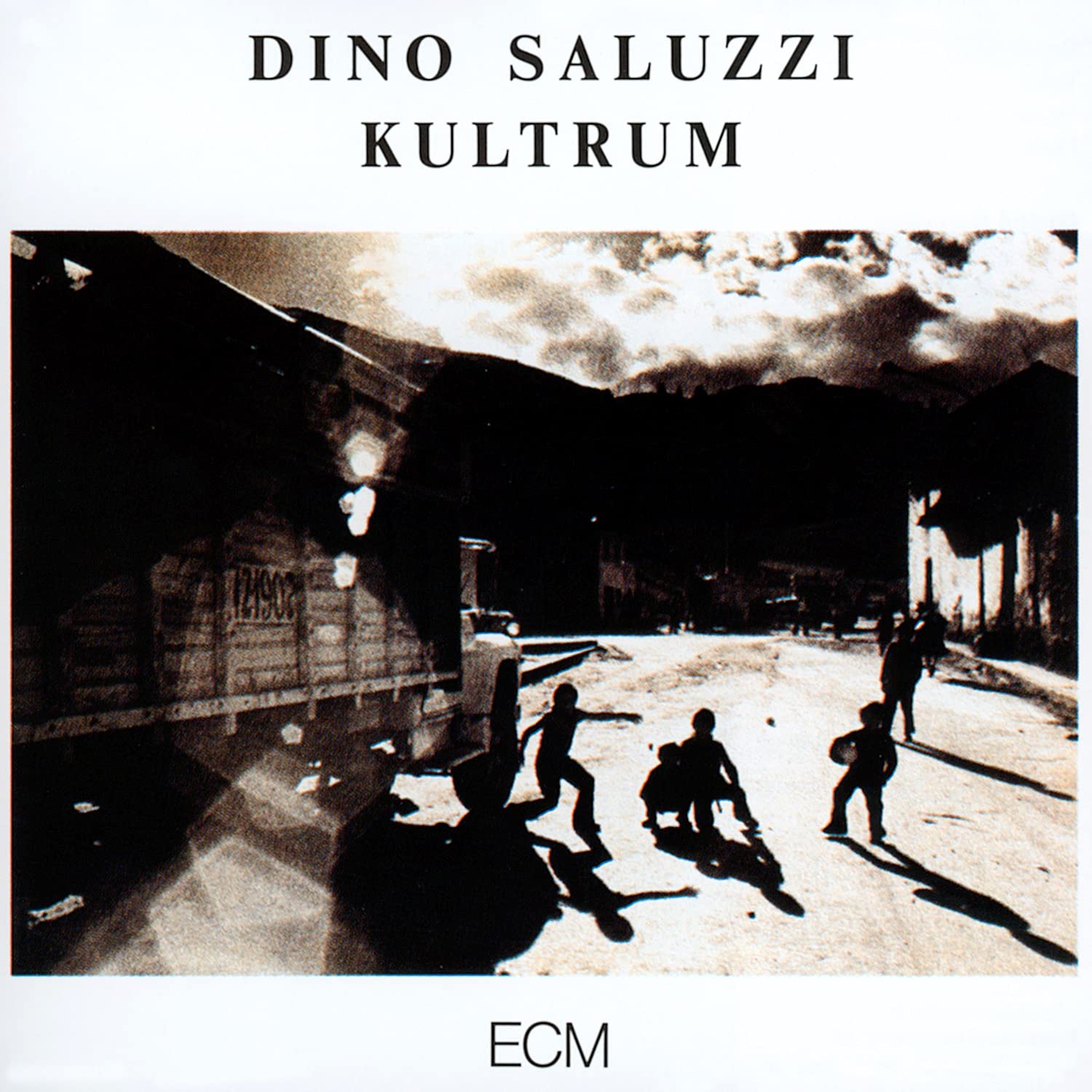
Dino Saluzzi: Kultrum (ECM 1251)

Dino Saluzzi
Kultrum

Dino Saluzzi bandoneón, voice, percussion, flutes
Recorded November 1982 at Tonstudio Bauer, Ludwigsburg
Engineer: Martin Wieland
Produced by Manfred Eicher

This album, not to be confused with the ECM New Series effort of the same name, was Dino Saluzzi’s first for the label. Using only his two hands, the bandoneón master brings out the multifarious qualities of his instrument as no other can. In this music we feel decades upon decades of history compressed into every squeeze of the bellows, and find ourselves surrounded by yearned-for lands and traditions. Into these we are ceremoniously welcomed through “Kultrum Pampa – Introducción Y Malambo” (Introduction And Malambo). Flute and drum draw us out from the cave of our ignorance and into the rising dawn, where nothing but an open circle awaits us with the promise of life. A voice chants, lifting a feather with every word and dropping it into our memory. We disavow the codes that divide our skins and minds, that bind our resolve to ideology, that whisk away our honor and truth to false idols. This blending of chant and song enhances the sacredness of both. It is one of three longish pieces on the album, which include the stunning “Agua De Paz” (Water Of Peace), one of the most gorgeous Saluzzi has ever recorded, and the rushing current of “El Rio Y El Abuelo” (The River And The Grandfather), in which he brings his veritably orchestral sound to mountainous light. There are moments in this piece that, especially around the 3:10 mark, sound exactly like the penultimate fade of Erkki-Sven Tüür’s Illusion. Such unintended moments of confluence merely hint at the reach of Saluzzi’s playing. Similarly, the handful of shorter pieces on Kultrum seem to flirt with their own watery reflections, coming to a head in the three-part suite “Ritmo Arauca” (Arauca Ritual). This life cycle is woven in earth and ice by a shuttle of elemental percussion. What was once the ceremony now becomes all-knowing life, a landscape where towering figures mingle with those too small to imagine, where the wind and the sunlight share a common yarn, where the elevation of a human life depends solely on how it falls. Again, Saluzzi’s voice emerges alone, as much soothsayer as it is curious child. Fans of Ken Fricke’s Baraka will also recognize here the shared Andean roots of Inkuyo’s “Wipala.” At last, “Pasos Que Quedan” (Steps That Stay) calls us back into the smoke where we began, where only our selves await, purified by sky and song in “Por El Sor Y Por La Lluvia” (For The Sun And For The Rain).

This album proves Saluzzi’s value not only as a musician, but also as a living heart of which music is blood. He is a master in the truest sense, which is to say that he pours forth through his instrument, as his instrument, showing us that the only way down his musical path is to close our eyes and let our feet guide us. Without question, one of ECM’s top 10 of all time.

<< Ralph Towner: Blue Sun (ECM 1250)
>> Pat Metheny Group: Travels (ECM 1252/53)

Miroslav Vitous: Journey’s End (ECM 1242)

1242 X

Miroslav Vitous
Journey’s End

Miroslav Vitous bass
John Surman soprano and baritone saxophones, bass clarinet
John Taylor piano
Jon Christensen drums
Recorded July 1982 at Talent Studio, Oslo
Engineer: Jan Erik Kongshaug
Produced by Manfred Eicher

Although bassist Miroslav Vitous never quite achieved the brilliance of his work with Weather Report, he did produce some intimations of it in the studio as he embarked on a solo career. Much of that old spark still flares on Journey’s End. “U Dunaje U Prešpurka,” in which he spins from a Czech folk song motif a cosmic sound with drummer Jon Christensen and reedman John Surman on bass clarinet, proves most fortuitous, as Surman builds enigmatic, freestanding structures atop constantly shifting tectonic plates. The quartet’s palette is broadened with the addition of John Taylor on keys, and under whose guidance the album’s titular journey really begins to take off. Christensen’s urgency carries across a deep flavor, only accentuated by its surroundings, and left to trace the piano’s tracks. “Only One” features its composer on electric bass, pairing nicely with Surman’s unmistakable baritone. Surman himself offers two tunes, flying high with his soprano in “Tess” before reprising the baritone in the sprightly “Paragraph Jay,” which also showcases Vitous’s dexterous versatility. We also get a vibrant group improvisation in “Carry On, No. 1” before Taylor closes us out with his soprano-led “Windfall.” This forward-thinking piece brings us full circle and finds in every turn of phrase the key to unlocking unknown futures. 

With sweeping brushwork the music on Journey’s End manages to be at once painterly and spontaneous, describing vast landscapes with but a flick of the sonic hairs. A lovely addition to any Vitous or Surman fan’s shelf.

<< Bill Frisell: In Line (ECM 1241)
>> Walcott/Cherry/Vasconcelos: CODONA 3 (ECM 1243)

Don Cherry & Ed Blackwell: El Corazón (ECM 1230)

Don Cherry
Ed Blackwell
El Corazón

Don Cherry pocket trumpet, piano, melodica, doussn’gouni, organ
Ed Blackwell drums, wood drum, cowbell
Recorded February 1982 at Tonstudio Bauer, Ludwigsburg
Engineer: Martin Wieland
Produced by Manfred Eicher

Two powerful proponents of the avant-garde—Don Cherry and Ed Blackwell—bare their tender souls on this set for trumpet and drums. While on paper this looks like an unusual combination, one thinks nothing of it once they start playing. Blackwell’s approach to his kit is melodic enough to carry its own, and the superb engineering gives him a wide berth, ensuring that every element has its place. Cherry’s sidelong glances into piano, melodica, and organ, meanwhile, provide plenty of traction in the duo’s more adventuresome tunes. Blackwell slips only into samplings of rat-a-tat-tat sumptuousness, favoring instead headlong flights into innumerable and equally favorable directions. The opening cluster of tunes is calm but never restrained. Allowed to go where it may, it swings and stomps in the same fluid motion. On trumpet, Cherry works in arcs, while on piano he finds solace in sharper angles. The melodica-infused “Roland Alphonso” carves its delicate reggae lines into a pathway toward the more monochromatic “Makondi,” a brief incantation led by kalimba, which sweeps silently under Blackwell’s solo in “Street Dancing” before reemerging in “Short Stuff.” The latter sets off another trio of interlocking themes, cinched by Cherry’s clear-as-day trumpeting, and bringing us to  “Near-In.” This enchanting kalimba solo, dedicated to Blackwell’s daughter, debunks the myth of thumb pianos as touristy curios left unplayed on our shelves by laying its potential thick across common misconception. Cherry ends on a high note, literally, with “Voice Of The Silence,” a gentle yet declamatory trumpet solo, drawn into trailing threads by a tasteful appliqué of reverb. A rather heavenward ending to an otherwise firmly rooted chain of scenes.

Like sugarcane stripped of its husk, this is immediate music, pared down to its fibrous core, and in some ways feels like a child of CODONA taking its first well-formed steps into a sonic life. In the end, it’s really Cherry who provides the rhythmic impetus for this collaboration, and Blackwell the lead. Such comfortable switching out of roles is central to their message of liberation and expression.

<< Keith Jarrett: Concerts – Bregenz/München (ECM 1227-29)
>> Eberhard Weber: Later That Evening (ECM 1231)

Mike Nock: Ondas (ECM 1220)

ECM 1220

Mike Nock
Ondas

Mike Nock piano
Eddie Gomez bass
Jon Christensen drums
Recorded November 1981, Talent Studio, Oslo
Engineer: Jan Erik Kongshaug
Produced by Manfred Eicher

How can one not marvel at Mike Nock’s Ondas? Drawing as much from Keith Jarrett as Bill Evans, and in the enviable company of Eddie Gomez and Jon Christensen no less, the sadly overlooked New Zealander left us with one of ECM’s most enduring documents at a time when the label was really getting its bearings. Nock’s pianism gives the illusion of distance, even when up close and personal, as if it were some long shadow, the feet of which are obscured by the horizon. It is also a magnifying glass of vast insight.

Central to this circumscribed detail is the 16-minute opener, “Forgotten Love.” Before a lacy ostinato it unfolds a sheet of paper as landscape, sketching fleeting affections and unrequited maybes. This sets Gomez up for a moth-like solo, as earthbound as it is winged, which then blends into the piano’s left hand. The right, meanwhile, stumbles off and returns with recollections of its travels, each framed by the thinnest of photographic borders. Christensen’s characteristic cymbals patter like rainfall across the title track and on through “Visionary,” in which he also foregrounds a touch-and-go snare. Yet against such a sweeping backdrop, these gestures forget their search for a groove and look more ponderously at where their feet are already planted. Plaintiveness thrives in “Land Of The Long White Cloud” and reveals the set’s most cinematic moments. Nock’s turns of phrase gnarl into a lichen-covered network of roots through which an insectile bass crawls, leaving a melodic honey trail for us to follow in its wake. With such a solemn road behind us, we open ecstatic “Doors” to our final destination.

While Nock may not carry the weight of some of ECM’s more widely recorded movers and shakers, one can hardly begin to quantify the wealth of impressions he leaves behind. This is not music to get lost in, but music that gets lost in you.

Another essential date from the 80s.

<< David Darling: Cycles (ECM 1219)
>> Adelhard Roidinger: Schattseite (ECM 1221)

Steve Tibbetts: Northern Song (ECM 1218)

1218 X

Steve Tibbetts
Northern Song

Steve Tibbetts guitars, kalimba, tape loops
Marc Anderson congas, bongos, percussion
Recorded October 26-28, 1981, at Talent Studio, Oslo
Engineer: Jan Erik Kongshaug
Produced by Manfred Eicher

With Nothern Song, Steve Tibbetts made his ECM debut and introduced listeners to what remains one of the label’s most enchanting, if slowly unfolding, maps. The cover seems to tell us everything: silhouettes of islands superimposed on the journey that takes us to them, as if the dream of arrival were potent enough to burn itself across the rearview mirror of our lives. Tibbetts leaves a trail of quiet footprints easily obscured by “The Big Wind,” yet whose direction is not so easily forgotten. With circumpolar affinity and a sensitivity that is for all intents historical, Tibbetts traces the borders of our lives in “Form.” His shimmering guitar finds spirit in Marc Anderson’s verdant whispers. “Walking” continues in very much the same vein, only this time with a more pronounced wash of 12-string steel that eventually lifts us into an “Aerial View.” And because so much of the Northern Song experience is above ground, we are able to slip more intensely into the meditations of “Nine Doors / Breathing Space,” throughout which strings creak like an old house, if not an old body.

Tibbetts lavishes his instruments with respect, strumming them as he might harps of glacial light. In them we hear diaries, voices, and ideas that need never completed to say everything they need to say. And every delicate application of Anderson’s percussion carries us deeper into the overgrowth before we emerge, forever changed, in the dwindling sunlight. This album is an ocean, and we the birds who range its waters.

<< Ulrich Lask: Lask (ECM 1217)
>> David Darling: Cycles (ECM 1219)

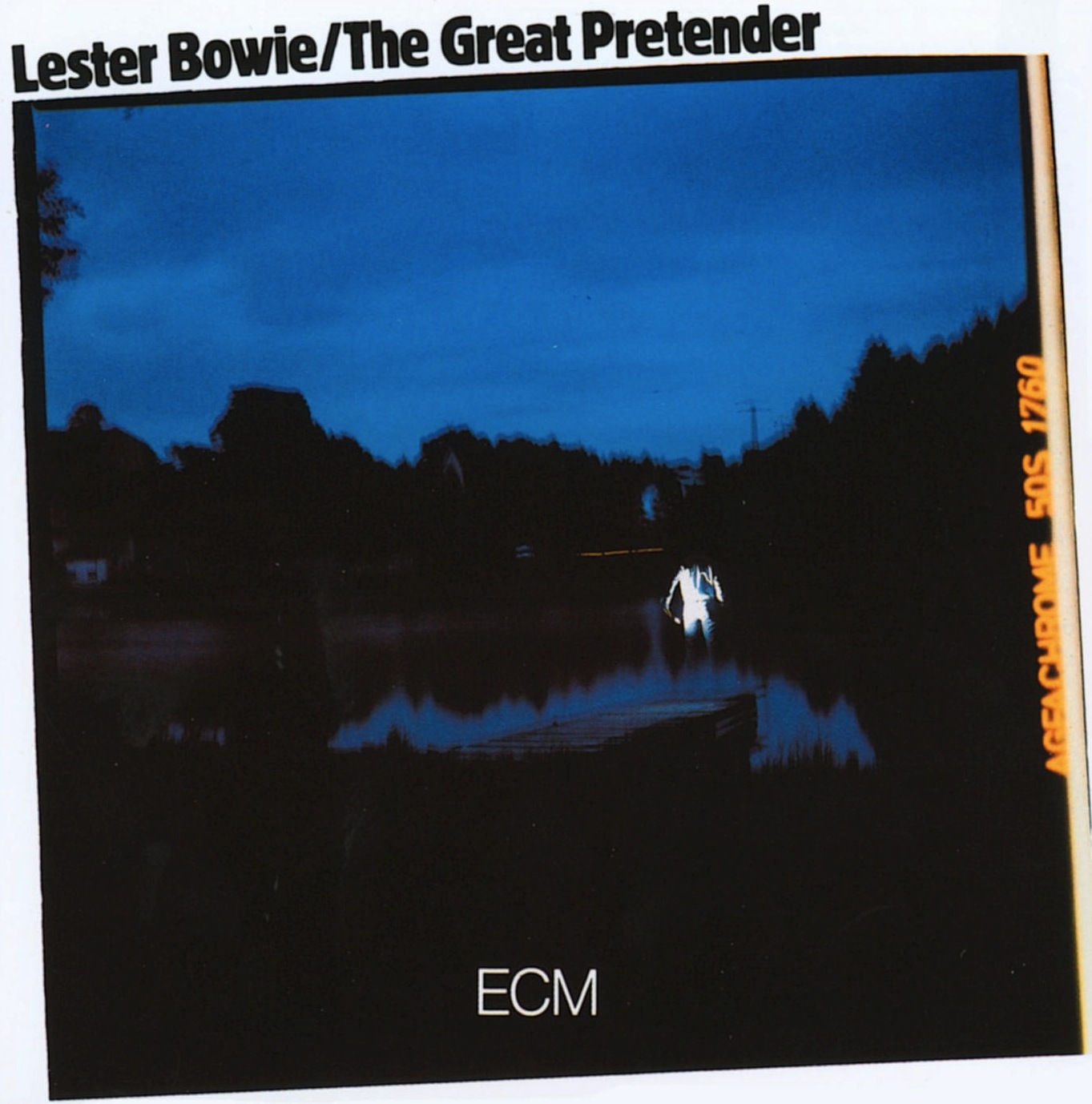
Lester Bowie: The Great Pretender (ECM 1209)

Lester Bowie
The Great Pretender

Lester Bowie trumpet
Hamiet Bluiett baritone saxophone
Donald Smith piano, organ
Fred Williams basses
Phillip Wilson drums
Fontella Bass vocal
David Peaston vocal
Recorded June 1981 at Tonstudio Bauer, Ludwigsburg
Engineer: Martin Wieland
Produced by Manfred Eicher

The title cut on Lester Bowie’s The Great Pretender comes of course from The Platters, the influential vocal group whose other hits, “Only You” and “The Magic Touch,” catapulted the group’s success through the rock n’ roll charts of the 1950s. Bowie’s investment in popular music’s connections to jazz set him a world apart. Second perhaps only to 1978’s The 5th Power, his debut for ECM as leader works wonders with its namesake. Where the original opens with quiet fortitude, this massive 17-minute rendition does so even more, the pianism of Donald Smith breathing a soulful mist upon a landscape that sometimes swirls with unanticipated gales. Fontella Bass and David Peaston are our doo-wop backups, their presence making the music that much more phenomenal. From Hamiet Bluiette’s heady baritone solo to the swampy rhythm section, Bowie has plenty of gum to chew in his horn.

No Bowie experience is complete without an inoculation of whimsy, and this we get in his rendition of “It’s Howdy Doody Time.” Phillip Wilson’s bright snare and Bowie’s fluttering elaborations share the air with Smith’s long slides. These morph into an evocative Fender Rhodes in “When The Doom (Moon) Comes Over The Mountain,” a wild chase backed by Fred Williams’s popping electric bass and the late-night sprawl of Bowie’s blatting. What begins as an overused Latin riff in “Rio Negroes” quickly transforms into a foray of architectural proportions secured by solid improvisational beams. Rich bass lines and rim-work carry us out in style. “Rose Drop” again looks through a glass playfully, only this time with a deeper drop. The tinkling of toy piano sparkles in Bowie’s waning sunlight, overflowing with half-remembered sentiments, each a photograph pasted in a scrapbook like no other.

Lester Bowie is like the moon. His is a field that waxes and wanes, haunting us with intimations of a distinct face, even as it harbors a dark side that we never get to see, except through the grace of studio technology, which allows us a glimpse the deeper intimations of his craft. We get this most readily in “Oh, How The Ghost Sings,” which from the evocative title to its flawless execution rings with the after-effects of a temple bell, the actual striking of which we never hear, and ends on a protracted, distant wail.

The material on The Great Pretender is all great and lacks a single pretender, and has been deservedly consecrated among ECM’s Touchtones.

<< Lande/Samuels/McCandless: Skylight (ECM 1208)
>> Gary Peacock: Voice from the Past – PARADIGM (ECM 1210)

John Surman/Jack DeJohnette: The Amazing Adventures Of Simon Simon (ECM 1193)

ECM 1193

John Surman
The Amazing Adventures Of Simon Simon

John Surman soprano and baritone saxophones, bass clarinet, synthesizer
Jack DeJohnette drums, congas, electric piano
Recorded January 1981 at Talent Studio, Oslo
Engineer: Jan Erik Kongshaug
Produced by Manfred Eicher

When reviewing jazz albums, I tend to abbreviate the word “saxophone” as “sax.” Yet somehow, when describing the music of John Surman, only the full spelling seems appropriate, for he as well as anyone fleshes out the inner architecture of the instrument in whatever form it may assume in his proficient hands. One might say likewise about drummer Jack DeJohnette, whose array of talents fully arches the backbone of the eight originals and one folk tune (the arboreal “Kentish Hunting”) on this curiously titled album. A delicate sequencer washes over us first in “Nestor’s Saga (The Tale of the Ancient)” along with bass clarinet amid awakening drums. Such tonal contrasts are a running thread through “Merry Pranks (The Jester’s Song),” “The Pilgrim’s Way (To The Seventeen Walls),” and the lumbering “Within The Halls Of Neptune.” Like some lost klezmer dream, floating on illumined clouds, these tunes step over vast plains before setting foot upon mountaintops. The finest moments are to be found in the soprano work, featured to varicolored effect in “The Buccaneers” and most engagingly in “Phoenix And The Fire.” DeJohnette holds his hands to the pianistic fire in “Fide Et Amore (By Faith And Love),” each chord a glowing ember beneath the bare feet of Surman’s baritone. “A Fitting Epitaph” mixes two drops of clarity for every one of forlornness and leaves an airy aftertaste in the sequencer’s final rest. This first in a continuing collaboration between two of ECM’s finest has aged well and is a good place to start on this intriguing duo.

<< Rypdal/Vitous/DeJohnette: To Be Continued (ECM 1192)
>> Goodhew/Jensen/Knapp: First Avenue (ECM 1194)

Jan Garbarek & Kjell Johnsen: Aftenland (ECM 1169)

ECM 1169 2

Aftenland

Jan Garbarek tenor and soprano saxophones, wood flute
Kjell Johnsen pipe organ
Recorded December 1979 at Engelbrektskyrkan, Stockholm
Engineer: Jan Erik Kongshaug
Produced by Manfred Eicher

If improvisation is a form of meditation, then meditation is also a form of improvisation. In being at peace with what one plays, one lives it.

Jan Garbarek is, of course, one of ECM’s longest standing composers and saxophonists, yet he is first and foremost a spectacular improviser who often manages to reach farther than (I imagine) even his own expectations in touching new melodic concepts. Paired with the Spheres-like church organ of Kjell Johnsen, he plumbs the depths of spiritual and physical awareness in a way that few of his albums have since. Here more than anywhere else, he shapes reverberation into its own spiritualism, exploring every curve of his surrounding architecture, every carved piece of wood and masonry.

The title track opens with a viscous solemnity, ever in shadow, while “Syn” reaps even more intense crops from the ethereal harvest it has sown. A trio of miniatures clustered around the session’s center reaches even more intimately into its heartbeat. “Kilden” seems to drip from the chapel ceiling like a weeping fresco. Garbarek unveils the rare recorders for a more playful exchange in “Spill.” “Iskirken” grips the heart with its piercing keen, dividing cloud and rain with the light of grief that shines like no other in times of greatest darkness. Lastly, the hurdy-gurdy drone of “Tegn” strings a delicate safety net for Garbarek’s robust defenestration.

This album predates his later Officium project by fourteen years, but is in parts just as effective in its vaulted evocations of hidden chants and invisible voices. At times, it also reminds me of the Licht/Haino/Hamilton/MLW one-off, Gerry Miles, only with less turbulent folds.

This is a pensive album, an unsung classic in the Garbarek oeuvre, filled with more than enough revelations to lodge a place in your musical heart.

<< Reich: Octet / Music for a Large Ensemble / Violin Phase (ECM 1168 NS)
>> Haden/Garbarek/Gismonti: Folk Songs (ECM 1170)