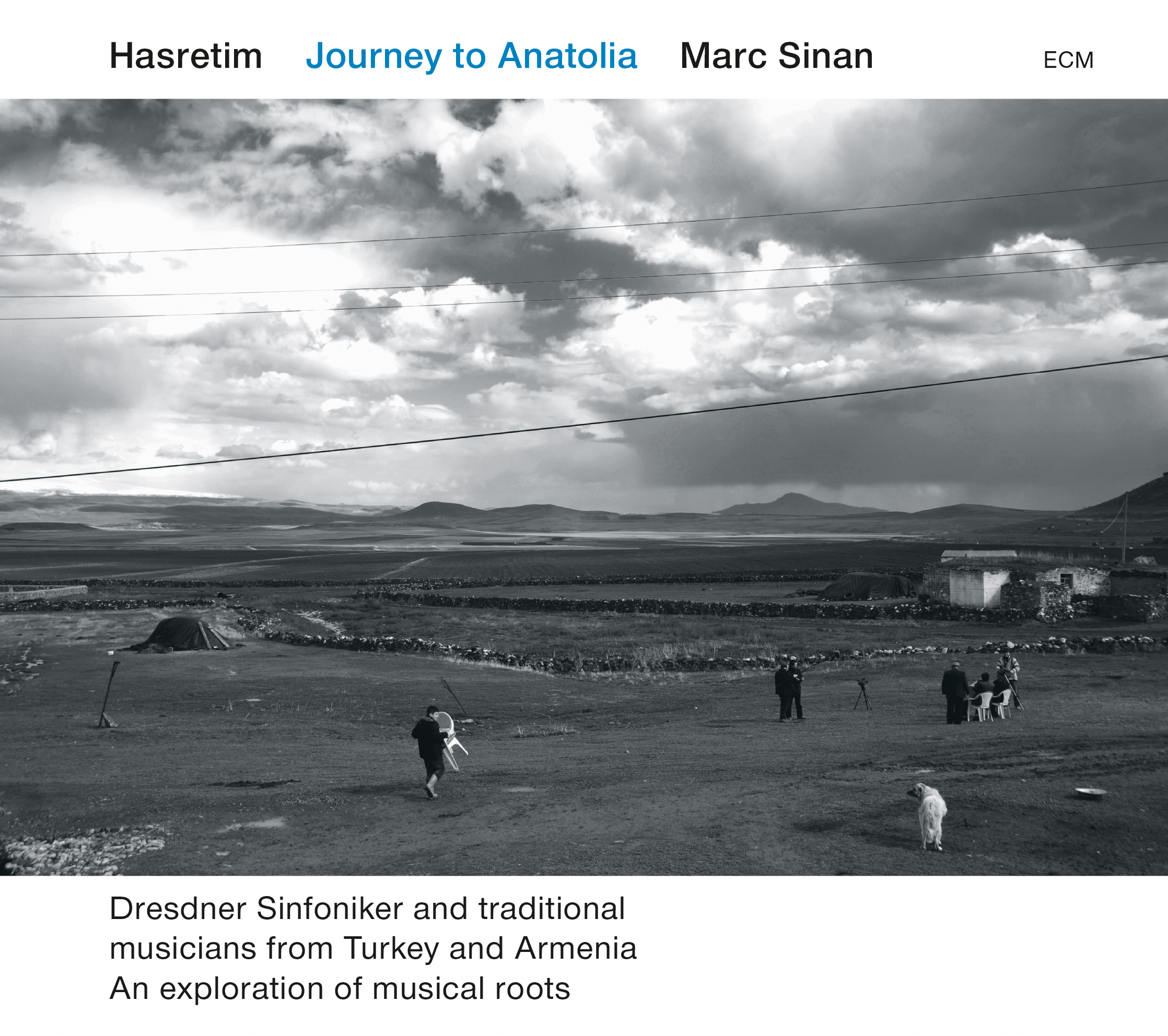
Marc Sinan: Hasretim – Journey to Anatolia (ECM 2330/31)

2330/31 X

Marc Sinan
Hasretim – Journey to Anatolia

Marc Sinan music, guitars, idea, concept and production
Traditional musicians from Turkey
Mustafa Boztüy
darbuka, framedrum
Güç Başar Gülle oud
Ömer Can Satır kaval
Onur Şentürk kemençe
Erdem Şimşek bağlama
Traditional musicians from Armenia
Araik Bartikian duduk, zurna
Vazgen Makaryan duduk, zurna
Andrea Molino arrangement, conductor (DVD only)
Jonathan Stockhammer conductor
Markus Rindt idea, concept and production
CD recorded live July 2011 at Schleswig Holstein Musikfestival by Volker Greve and Holger Schwark
“Prolog” recorded December 2012 at MIAM Istanbul by Can Karadogan
Mastering: Volker Greve
DVD recorded Ocobter 2010 at Festspielhaus Hellerau
An ECM Production

Classical guitarist Marc Sinan, born in 1976 to a Turkish-Armenian mother and a German father, has over the past two decades attracted increasing demand as a soloist and collaborator, and dedicates his output to softening divides between genres, eras, and cultures. Hasretim represents the most significant evolutionary leap in his career as a composer. The result of a commission by Hellerau – European Center for the Arts Dresden and the Dresdner Sinfoniker, this video-musical journey traces Sinan’s heritage along the Black Sea coast to the Armenian border. More than that, it’s an invaluable archive of life and song on the Anatolian plateau, which he explored together with Dresdner Sinfoniker artistic director Markus Rindt in 2010. During the trip, Sinan was saddened to find that the preservation of folk music so prevalent elsewhere (viz: the Baltic states, Hungary, and Greece) was lacking in Turkey. Consequently, he took Hellerau’s commission as an opportunity to address the discrepancy, pooling a storehouse of traditional musicians and incorporating their art into a large-scale, contemporary piece of his own design. “I was quite nervous,” writes Sinan of the recording process. “Unlike musical field research, our project demanded much more than simply documenting the current state of the Turkish musical tradition regardless of its artistic merit. We were on a treasure hunt and would only rest once we stumbled upon something truly special.” As connections grew, so too did the availability of choice musical talent and the opportunity to capture it for posterity. Once satisfied with his bank of original recordings, to them Sinan introduced what he calls “decisive, subjective elaborations” in the form of both through-composed and improvised material.

Hasretim was originally conceived as an installation piece, with videos of these unrecognized Turkish troubadours (many of whom must balance their musical lives with working ones) projected onto five towering vertical screens at stage rear. Before them plays an assembly of European classical musicians augmented by traditional specialists from Turkey and Armenia. The latter bring their expertise to a veritable portrait of Asia Minor in sound as the oud, kaval, kemençe, bağlama, duduk, zurna, and frame drum hold their own alongside strings and winds. It is to ECM’s credit that its release should encompass both the audio on CD and the visual on an accompanying DVD. For while the music stands alone as a welcoming experience, to see the musicians (live and recorded) in their element, along with segues of candid scenes from Istanbul and beyond, brings out the project’s reach in most immediate terms. Both versions feature essentially the same personnel, with the notable exception of conductors: Jonathan Stockhammer directs the CD version, recorded live at the Schleswig Holstein Musikfestival, while Andrea Molino, also the project’s musical arranger, handles the DVD performance, recorded at Festspielhaus Hellerau.

As indicated by the title, which means “I’m yearning” or “My desire,” Hasretim is a search for roots. Yet it’s also a spray of new foliage in the towering branches, nourished by Sinan’s unique ear for montage. The album is bookended by a “Prolog” and “Epilog.” One is a menagerie of harmonics, blips, and whispers that tightens like a spring, while the other pieces together footage of nearly all the recorded musicians in a chain of reprisals, ending as it began: with an attunement that spans multiple geographies.

Within this frame are five distinct “Tableaux,” each named after a Turkish city or, in the case of “Tableau II – Yayla,” for the mountain pastures where an old man (Haci Ömer Elibol) plays the end-blown kaval while his sheep animate the background. His call, for that is what it becomes in Sinan’s contextualization, inspires some upbeat interweaving. In contrast to the dark fiddling of “Tableau I – Ordu,” which details the face of singer Asiye Göl across all five screens, it more fully includes itself in the musical goings on.

Indeed, voices resound clearest throughout the program, even if certain instrumentalists do stand out for their charisma. There is Hüsseyin Altay on the tulum (Turkish bagpipe), joined by droning brass; the unforgettable Ismail Küçük, who sings and bows his kemençe in “Tableau III – Trabzon” from the back seat of a car, thus underscoring the film’s road movie feel; the duet of Ömer Parlak on kaval and Mesut Kurt (along with Göl, the youngest of those featured) on kemençe; and in “Tableau IV – Erzurum” the rhythmically savvy Aşik Eminoglu accompanying himself on the bağlama to invigorating effect. This same Tableau also cradles “In Memory of Vahide,” a 10-minute duduk duet that interpolates shadows into light. All of this buoys “Tableau V – Kars” as the most compositionally unified vision of live elements (especially in the percussion) and descriptive archival work.

In absence of any background information, one might never know that Sinan witnessed firsthand a loss of connection among contemporary Turkish musicians to their rich heritage, or that their art needed recovery in this regard. Neither was the counterpoint lost on him between the boisterous people and their peaceful, sometimes dreary, settings. Such contrast of medium and message informs every frame and staff of this multimedia treasure trove. Although awarded a special prize by the German Commission for UNESCO for its “inspiring and experimental confrontation between different cultures,” Hasretim is less about experiment than experience and anything but a confrontation. Rather, it is a book to which each new witness adds a page.

(See the article as it originally appeared in RootsWorld online magazine, where you may also hear samples.)

<< Galina Ustvolskaya: s/t (ECM 2329 NS)
>> Stefano Bollani/Hamilton de Holanda: O que será (
ECM 2332)

Stephan Micus: Snow (ECM 2063)

Snow

Stephan Micus
Snow

Stephan Micus douss’n gouni, duduk, maung, gongs, tibetan cymbals, bavarian zither, sinding, steel-string guitar, hammered dulcimers, charango solo, nay, bass duduk, voices
Recorded 2004-2008 at MCM Studios
Produced by Manfred Eicher

For his 18th ECM meditation, German multi-instrumentalist Stephan Micus goes deeper into his travels, into his technique, and into himself. Among his usual bevy of means, the Armenian double-reed duduk—last heard on Towards the Wind—is now a central energy field, its song a balance to the cold. “I’ve always regarded snow as the essence of magic,” notes Micus in this album’s press release, and his impressionistic view of one of nature’s most enigmatic phenomena shines through with a glow all its own. The title track likewise harbors many warm bodies, despite the wintry theme. Two doussn’gouni (a West African harp that Micus debuted on Desert Poems), along with various gongs and cymbals, give the duduk a gentle berth for travel. Guided by breath, not oar, its intense presence rides toward frosty shores, singing of the ice as gateway and kissing the land with its solemnity. Also retained from Desert Poems is the sinding, another West African harp that blends with steel-string guitar, hammered dulcimers, and an ever-growing chorus of voices in “Sara.”

The duduk continues its tender mission across a “Midnight Sea” (accompanied here only by Bavarian zither) and into the arms of “Madre.” The latter speaks further in the language of strings and mallets, and both mix the reeds spatially, so that notes scale from left to right as they ascend. The album’s final track, “Brother Eagle,” features the bass duduk. Along with two sinding and fifteen voices, its near-ghostly sound feels spun from the very earth of which it chants. This marriage of glitter and darkening cloud, of moonlit sailing and glorious dream journeying, advances its subterranean walkabout lead by shadows toward the promise of sunrise.

Making its debut at Micus’s fingertips is the charango, an Andean double-stringed ukulele popularized by Argentine composer Gustavo Santaolalla. “Nordic Light” is a solo for the instrument, which in this context sounds more like some miniature koto that evokes its aurora with understated flame. Another solo begins “For Ceren and Halil” before being joined by seven more charangos, duduk, nay, sinding, and five hammered dulcimers in an eddying current of leaves and time until they reach the waterfall that makes one of them all. The album’s sole remainder is “Almond Eyes” (11 voices, steel-string guitar, maung), which offers some of Micus’s most impassioned singing yet.

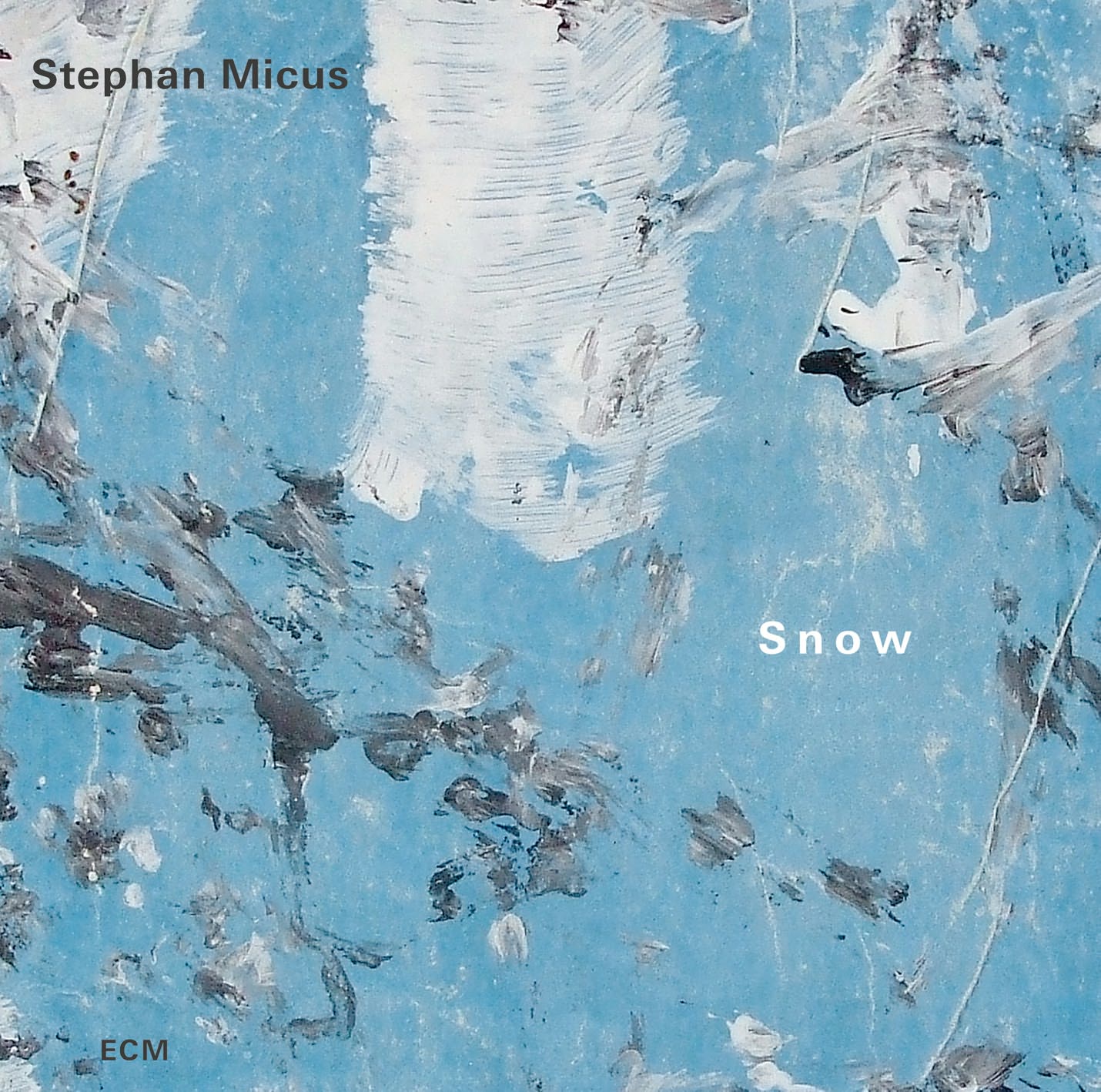
It bears noting that the cover of Snow was painted by father Eduard Micus (1925-2000), a gestural painter who shaped his medium as his son shapes sound. It’s a naked glimpse into the musician’s upbringing, and proof that life is indeed a river that, once frozen, simply awaits the thaw of another realm.

<< Andy Sheppard: Movements in Colour (ECM 2062)
>> Enrico Rava: New York Days (
ECM 2064)

Savina Yannatou & Primavera en Salonico: Songs Of An Other (ECM 2057)

Songs Of An Other

Savina Yannatou
Primavera en Salonico
Songs Of An Other

Savina Yannatou voice
Kostas Vomvolos qanun, accordion
Yannis Alexandris oud, guitar
Kyriakos Gouventas violin, viola
Harris Lambrakis nay
Michalis Siganidis double-bass
Kostas Theodorou percussion, double-bass
Recorded October 2007 at Sierra Studios, Athens
Engineer: Yannis Baxevanis
Edited and mixed by Manfred Eicher, Yannis Baxevanis, Kostas Vomvolos, and Savina Yannatou
Produced by Manfred Eicher

Songs Of An Other marks the third point of contact between Greek singer Savina Yannatou, along with Primavera en Salonico, and ECM. The program is more geographically varied than ever and emphasizes the interpretive prowess of its musicians. Much of that prowess breathes through Primavera’s superb control, for while the album boasts moments of sportive extroversion, it upholds the music first and foremost as a model for emancipation.

Indeed, Songs Of An Other shows this collective at both its most animated and its most delicate, oftentimes within the same song. Both the slack-stringed “Za lioubih maimo tri momi,” which comes by way of Bulgarian Macedonia, and “Radile” (from Greece) run the line of straight-up folk and all-out jam. In the latter vein, two new tunes based on Greek sources add another line to the project’s résumé. “O Yannis kai O Drakos” is a dragon-slaying song replete with fanciful colorations, paroxysmal gasps, and subtly frenetic bassing. “Perperouna,” a call for rain, explores the gravelly pits of Yannatou’s voice, embraced by the windy brine of nay and kalimba, all moving in a Celtic knot of rhythm toward an adlibbed comet’s tail. Even the “Albanian lullabye” becomes a ritual of ululations and incantations, honing a mysterious and strangely accessible edge.

For much of the album, however, the musicians tread a delicate path, adapting to every dip in Yannatou’s tightrope along the way. From the dulcet “Smilj Smiljana” (Serbia) to the Italian olive-harvester’s song “Addio amore,” they emote lucidly. Combinations of flute, violin, and accordion cloud like ink in water in “Sassuni oror” (Armenia); dances take the night by the hand in “Dunie-au” (Kazakhstan); and the 16h-century Yiddish traditional “Omar hashem leyakoyv” is practically translucent in sentiment.

The greatest accomplishment of Songs is the fullness with which it romanticizes, as is clear in “Sareri hovin mermen” (Armenia). Given the “Eastern” feel, one might easily read into it an alluring sway. Likewise, “Ah, Marouli,” a Greek song about sponge-divers on the island of Kalymnos, sashays with seeming invitation. And yet, these arrangements are so emotionally (and physically) complete that they hardly need even these words to convey to the uninitiated listener the magic of their self-assurance. And that’s the thing: every step and element of this audible alchemy is as lucid as the light that illuminates the talents of these fine instrumentalists, Yannatou tracing them all the while as a wave might shape an Aegean breeze.

<< Ketil Bjørnstad: The Light (ECM 2056)
>> Dans les arbres: s/t (
ECM 2058)

Tsabropoulos/Lechner/Gandhi: Melos (ECM 2048)

Melos

Melos

Vassilis Tsabropoulos piano
Anja Lechner violoncello
U. T. Gandhi percussion
Recorded June 2007, Auditorio Radio Svizzera
Engineer: Stefano Amerio
Produced by Manfred Eicher

The second album from Greek pianist Vassilis Tsabropoulos and German cellist Anja Lechner, would seem to be a sequel to Chants, Hymns and Dances, but is in many ways a restructuring of that same cosmos rather than a parallel universe to it. The music of G. I. Gurdjieff again provides the heliocenter around which the compositions of Tsabropoulos and fragments of Byzantine hymns coalesce into planets and satellites, respectively. Drummer U. T. Gandhi, making his sophomore ECM appearance following his label debut with the Dino Saluzzi Group on Juan Condori, adds new colors to the project.

The title of Melos refers to the arrangement of notes into a discernible tune (hence: melody), and in this respect its contents succeed beautifully. The title track starts the album with an all-encompassing embrace. Lechner navigates Tsabropoulos’s delicate ostinato in such a way that, even as the pianist continues exploring the ripple effect of her measured silence, when the cello reprises the theme, it does so newly fortified with sacred energy. This feeling of chant, meditation, and return suffuses all that follows, so that mellower songs (for that is indeed what they are) and livelier dances become yin and yang to the program’s overall equilibrium. At its most heartbreakingly lyrical, as in the two so-called “Songs Of Prosperity” and “Song Of Gratitude,” the music retains a bright antiphony throughout. Even “Simplicity,” a piano solo of great solemnity, shines with life force.

Tsabropoulos’s notes often rise like smoke from the swinging censer of Lechner’s bowing, growing especially animated in “Reflections” and its counterpart, “Reflections And Shadows.” At around two minutes each, these lively miniatures compresses an entire history’s worth of joy into vibrant, spinning cores. Such characterization holds truer in the trios, where Gandhi’s contributions feel wedded to every underlying impulse. His cymbals crest ebony waves in the exquisite “Gift Of Dreams,” expand to a broader percussive palette in “Promenade,” and attain broadest harmony in the jazzier “Vocalise.” For “Tibetan Dance,” the first of three strategically positioned Gurdjieff tunes, he adds a distinctly soft touch, and likewise imbues “Sayyid Dance” with the delicate propulsion of a Manu Katché joint. “Reading From A Sacred Book,” on the other hand, unfurls a percussionless banner, pointing to Keith Jarrett’s own reading on the seminal Sacred Hymns, making it all the more appropriate that the present album should end with the title “In Memory,” in which is encoded a shaded smile of gratitude.

The atmosphere of Melos should be of particular interest to fans of The Sea and, even more so, The River. Not because this album has a particularly aquatic feel, but because its combination of sounds and textures yields comparable atmosphere. In addition to its clarity of engineering, Melos is notable for the ordering of its tracks. Just when the music becomes too pretty, it recedes into a shadow or twisted cavern (cf. “Evocation”), where it meditates on the irregularities of life and this fragile world supporting them.

<< Robert Schumann: The Violin Sonatas (ECM 2047 NS)
>> Nik Bärtsch’s Ronin: Holon (
ECM 2049)

Marilyn Mazur/Jan Garbarek: Elixir (ECM 1962)

Elixir

Elixir

Marilyn Mazur marimba, bowed vibraphone and waterphone, hang, bells, gongs, cymbals, magic drum, log drum, sheep bells, Indian cowbells, udu drum, various drums and metal utensils
Jan Garbarek tenor and soprano saxophones, flute
Recorded June 2005 at Sun Studio, Copenhagen
Engineer: Bjarne Hansen
Produced by Manfred Eicher

As resident percussionist of the Jan Garbarek Group for 14 years, Marilyn Mazur enlivened every path set before her with dynamism and panache. On Elixir, she delineates her own compass and invites Garbarek on a journey of organic play, thus yielding a composite sketchbook of improvised solos, duos, and multitracked collages.

Each of the album’s 21 tracks is an iceberg’s tip. Only the penultimate “Winter Wish” exceeds four minutes, and with it the waterline. This and other such evocative titles as “The Siren In The Well,” “Mountain Breath” (which sounds like an eagle dreaming of a whale), and “Bell-Painting” afford imaginings for the wayward listener fortunate to wander into these territories. The latter title is especially appropriate, for Mazur is very much a painter whose palette is her instrument. From a kit that spans the globe, she chooses only the most appropriate pigment for each image. Be it the splash of a Chinese gong (cf. “Creature Walk” and “Talking Wind”), the pulse of hand on taut skin (“Mother Drum”), or the resonant metals of “Pathway,” she reverse engineers gold into its base components and treats each as if it were just as precious. Her solos speak to the heart because they speak to the earth: the two are one in the same.

Her duets with Garbarek both open (“Clear”) and close (“Clear Recycle”) the program. The Norwegian saxophonist’s rasp brings out the light of Mazur’s subterranean designs and with it illuminates their innermost dances. Colors reveal themselves accordingly in the sheer variety of instruments. Whether by hang drum or waterphone, cymbals or flute, their groove magnifies the great within: foot to earth as soul to sky. Through them run the ley lines of the plains, singing and free. Like the track from which the album gets its name, they feed an incantation of which verses come and go like clouds, if only to remind us that the sky above never goes away, for that is where we will go when our bodies bend over in silence.

<< Keith Jarrett: Radiance (ECM 1960/61)
>> Gacinto Scelsi: Natura Renovatur (
ECM 1963 NS)

Steve Tibbetts: Natural Causes (ECM 1951)

Natural Causes

Steve Tibbetts
Natural Causes

Steve Tibbetts guitars, piano, kalimba, bouzouki
Marc Anderson percussion, steel drum, gongs
Recorded 2008 in St. Paul
Engineer: Steve Tibbetts
An ECM Production

If ever there was a case for quality over quantity, Steve Tibbetts is it. A full eight years after A Man About A Horse, the Minnesotan guitarist returns with his most intimate statement yet. Alongside percussionist Marc Anderson, collaborator of over three decades, Tibbetts crafts a geography so inward-looking that it becomes a parallel world. Tibbetts originally flirted with the idea of releasing Natural Causes as one single track. Were such the case, listeners would feel no less aware of its science. Either way, its 13 tracks are not variations on a theme, even if they do play with the theme of variation. He calls them, rather, “complex little cathedrals,” building them as he does stone by stone, if not string by string. Indeed, his trusted 12-string guitar is possessed of something divine, its frets pared down to almost nothing over years of playing, so that fingers glide freely.

In a rare turn, Natural Causes is nearly all acoustic and accordingly finds Tibbetts playing piano, kalimba, and bouzouki to flesh out the palette. In addition to these, he employs a midi interface, by which he triggers samples of gongs and metal-key instruments collected during his travels. Of these, “Lakshmivana” is the fullest integration of plugged and unplugged. Told in the language of prayer—i.e., of human artifice embracing sacrality—it is an astonishing meditation that is only deepened by the story told in “Chandogra.” Here the periphery is barely noticeable. Instruments peek from the shadows, seemingly incidental, and fade at the instant of regard.

From the back-porch motif that introduces “Sitavana,” the album’s gateway, and through the burgeoning field that follows toward the solo “Threnody,” it’s obvious that Tibbetts’s attention to detail has grown like the preceding metaphor. His playing, mellifluous as ever, establishes global reach with tracks like “Padre-Yaga,” in which Anderson’s hand drumming leaves trails on the beaten plains. It develops, as does the album as a whole, in distinct cells, every pause linking the body to the less tangible impulses that make fingers ache for the fretboard.

There is an almost keening quality to Tibbetts’s portamento. “Attahasa,” for one, is a tree shedding spores. For another, “Sangchen Rolpa” wavers on the precipice of some great abyss. Across that expanse Tibbetts extends brief, tender bridges, paved with inner fire. Between them, the album’s groundswells reveal texture and breadth.

Although this is Tibbetts’s most inward-looking record, it is also his farthest reaching. His art is as honest as the landscapes that inform it, changing form and color as he moves from one riverbank to the next. Whether you choose to walk with him or listen upon him from above, just know there is a home for you here to which you may always return.

<< András Schiff: Encores after Beethoven (ECM 1950 NS)
>> Eleni Karaindrou: Elegy of the Uprooting (
ECM 1952/53 NS)

Stephan Micus: on the wing (ECM 1987)

on the wing

Stephan Micus
on the wing

Stephan Micus sattar, mudbedsh, classical guitar, nay, shō, hné, suling, Tibetan cymbals, gongs, hang, 14-string guitar, steel string guitar, shakuhachi, mandobahar, sitar
Recorded 2003-2006 at MCM Studios

For his 17th ECM album, multi-instrumentalist and world traveler Stephan Micus maps further paths along soft geographical borders. Whereas on his last trek, 2004’s Life, Micus sprouted vines around a Japanese Buddhist kōan, here the voice of the man behind the means comes through his playing rather than his singing. The narrative arc is yet firm beneath his step, even if its location remains undisclosed at the final breath. Indeed, breath is by no means less operative herein, flowing as it does through a wealth of reed instruments, including the Iraqi mudbesh, the Egyptian nay, the shō (Japanese mouth organ), the Balinese suling, and the Burmese hné. From them issue the voices of this 10-part suite of sentiment, from which a peaceful core unspools.

Much of the music occurs in intimate settings. Part 1, from which the album gets its name, threads the mudbesh through two droning sattar, a bowed instrument favored by the Uyghurs of western China. As is his way, Micus obscures the origins of these instruments by floating them on idiosyncratic currents. The wind of the mudbesh captures spirit and pulls it through tree leaves, each a feather trembling on a skeleton without direction or need, floating and falling in an unwritten cycle. “Winterlight” bolds the underlying silt with three sattar, trembling like a dream that clings to the body in a scrim of frost. There is something medieval, even Nordic, about the sound that leaves wolven footprints in snow. A sleek form trudges along the riverbanks, eyes glistening with a gold that can never be obtained without destroying the soul. And so, it hides behind a cloak of dawn, the tender glow of which outshines even the rarest mineral treasure.

“Gazelle” follows with a pairing of nay and classical guitar. The latter, for all its lilting hold on pitch, becomes koto-like in Micus’s hands. It seems to embody the comfort of a life lived on the ground, while the nay circles overhead in search of possible dangers in the open plains. Resigned to those dangers, its heart beats on, anticipating the moment when it will no longer sound its drum. In that alertness there is harmony, a certain calmness of mind that casts itself to the elements of which it is but a shred. This is not, despite my attempts at wording, a purely descriptive track. Its title, like all on the album, is a stepping-stone toward less overt associations.

Forces build through the reed-thickened “Blossoms in the Wind” (for 2 sattar, shō, 3 hné, and 2 suling) to the fulcrum of “The Bride.” One of two larger “ensemble” pieces (this for Tibetan cymbals, Korean gong, Burmese gong, 3 hang, 14-string guitar, steel string guitar, mudbesh, shakuhachi), its reed work draws folding lines across the sky in preparation for its origami transformation. The breathy shakuhachi slides its way into frame center, even as it magnifies the edges in kind. Thus united, the flutes ride waves of without fear, their sole cargo a dowry of ether.

“Ancient Trees” lessens the forces with 6 shakuhachi, 2 sattar, and 4 mandobahar (a rare Indian stringed bass) even as it seeds possibilities. Here the shakuhachi is the agency of the drone, climbing trees like stairways into cloud. “In the Dancing Snow” again fronts the shrill mudbesh, now over 3 sattar, in a dance of ice and flame.

In the shadow of such greatness, the intimacy of “The Gate” is astonishing. This sitar solo is decades in the making, for it would take as long before Micus felt comfortable enough to commit something like this to record, and shows the fruits of his efforts to tame its overwhelming web by paring it down to two strings. Every bend holds a key to entry and ushers the listener into a world of ghosts with lingering attachments, each with a story endlessly repeated in the hopes that someday, someone will hear it and grant peace. It is further proof that Micus’s most powerful pieces are unaccompanied. That said, we are left with the album’s second major expanse, “Turquoise Fields” (2 steel string guitars, 3 hné, 2 suling, 3 sattar, 3 nay), which is an astonishingly immersive experience. As strums of guitar shift like wind through barley, a chain of solos from sattar and high reeds marks the transfusion point between the sacred and the profane. Last is “Morning Sky,” a congregation of five hné in a dance of farewell, but also of greeting. Which is to say that it welcomes us even as it sends us on our way.

<< John Surman/Howard Moody: Rain On The Window (ECM 1986)
>> Valentin Silvestrov: Bagatellen und Serenaden (
ECM 1988 NS)

Savina Yannatou & Primavera en Salonico: Sumiglia (ECM 1903)

Sumiglia

Savina Yannatou
Primavera en Salonico
Sumiglia

Savina Yannatou voice
Primavera en Salonico
Kostas Vomvolos accordion, qanun, kalimba
Yannis Alexandris tamboura, oud, guitar
Michalis Siganidis double-bass
Kyriakos Gouventas violin, viola
Harris Lambrakis ney
Kostas Theodorou percussion
Recorded May 2004 at Rainbow Studio, Oslo
Engineer: Jan Erik Kongshaug
Produced by Manfred Eicher

Two years after the release of her ECM leader debut (although really a preexisting live recording repackaged as such), Savina Yannatou returns with her first album recorded under the label’s auspices at Rainbow Studio in Oslo. Sumiglia is at once a departure from and a deepening of the Greek singer’s extraordinary gifts, bound by nothing save her own imagination. Flanked as always by Primavera en Salonico, a band of dynamic expressive power, Yannatou graces another characteristically eclectic program of folk songs. Her voice is like a head of hair: thicker in some places, thinner in others, containing a wealth of reflections and colors, but always rooted and growing. Her wisdom is thus animated, blowing in winds from a thousand isles.

In spite of the studio comforts, one experiences Sumiglia as if a live recording, pulsing as it does with only thinly mitigated vibrancy. Like its predecessor, this album begins with a violin solo—a modest introduction that betrays nothing of the ensuing profusions. “Evga mana mou” thus opens with a nod to Yannatou’s homeland, a bridal song of farewell to family and friends. Adopting a tone that is delicate as a butterfly yet sharp as the bird that hunts it, the singing navigates a droning landscape with free surety. Other Greek songs include the tender, spring-like “Yanno Yannovitse” and the beautifully arranged “Ela ipne ke pare to,” which walks with a light kalimba step and a slight Arabic curl, further proving that sometimes the most bone-humming singing is that which is on the verge of fadeout. Within this frame, listeners are whisked away on a carefully sequenced journey. From the droning of Spain (“Muineira”) through the forests of Ukraine (“Ta chervona ta kalinonka”) to the twists of Albania (“Smarte moj”), there’s something for nearly everyone to grasp along the way.

Regardless of the roles she adopts, Yannatou remains painterly and self-aware. In the Moldavian song “Porondos viz partjan,” for one, she takes on the voice of an orphaned child, her evening wanderings matched step for step in arco starlight. In the Sicilian “Terra ca nun senti,” for another, she darts through mazes of war-weary angst. Other flybys of the Mediterranean yield the gravelly, fairytale affectations of “Orrio tto fengo” and the whimsical romanticism of “Sta kala lu serenu,” both from Italy. A stopover in Corsica in the album’s title track draws Yannatou’s voice like a thick rope through darkness, heaving histories and mysteries in equal measure. We feel that depth of mourning for times past.

The album’s delights take us inland and beyond. “Sedi Yanna,” a well-known Bulgarian folk song, receives an invigorating treatment, with just the exact amount of lilt and forward motion. It is also a perfect representation of the band’s clarity, which despite the density of its execution remains crystal clear. The lyrical fire of “Ganchum em yar ari,” from Armenia, warms us to “Tulbah.” This last is a Palestinian song that shows the Primavera at its chameleonic best. Whether riding the wave or swaying to the rhythm of calmer currents, the band adapts.

In addition to its many other virtues, Sumiglia is yet another feather in the cap of engineer Jan Erik Kongshaug. Known, of course, for his spacious treatments of various jazz configurations, here he brings an immediacy that serves the music as much as it serves us. A bravura showing from every angle.

<< Paul Motian Trio: I Have The Room Above Her (ECM 1902)
>> Bobo Stenson Trio: Goodbye (
ECM 1904)

Stephan Micus: Life (ECM 1897)

Life

Stephan Micus
Life

Stephan Micus bagana, Balinese and Burmese gongs, Bavarian zither, bowed bagana, dilruba, dondon, kyeezee, maung, nay, shō, Thai singing bowls, Tibetan chimes, Tibetan cymbals, tin whistle, voice
Recorded 2001-2004 at MCM Studios

Life takes its inspiration from a Zen Buddhist kōan. The function of a kōan, or riddle, is to test one’s resolve in the face of doubt, the latter born from overdependence on worldly logic (think “What is the sound of one hand clapping?). The goal is not to “solve” but to become the riddle. In this particular kōan, a monk and his master discuss the meaning of life, and through his usual array of diverse instruments and singing (here entirely in Japanese), Micus does just that. He becomes what he performs. Distinct to the riddle of life is its elliptical reasoning: it begins and ends with the same answer. Micus chooses to express this distillation by moving from complex to barest arrangement.

Micus listeners will know many of the instruments through which he speaks: Bavarian zithers, shō (Japanese mouth organ), Thai singing bowls, nay, Tibetan chimes and cymbals, and the sarangi-like dilruba. For Life he adds to his palette the maung (Burmese gongs) and the bagana, an Ethiopian lyre that produces a uniquely entrancing buzz by way of leather strips threaded between its strings.

Narration One And The Master’s Question
A monk, looking for the essence of life, left his monastery at a young age to travel through China. After many years, on his return to the monastery, his old master asked him, “What is this life?”

The bagana extends the album’s thickest spokes, and through its subterranean chirring sets the wheel slowly spinning. Mouth organs cross canvas like floating-world clouds, allowing just enough of the scene to take shape before our eyes, that our ears might take in the Micus voice, magnified ten times over. Despite the wheel metaphor, in this cycle there is no center, only a diffuse matrix of breath and contact. An Irish tin whistle unspools its birdlike call by means of a language that is as ephemeral as its understanding of eternity. The voices grow, turning into feet whose steps—indicated by Bavarian zithers—seek a horizon of intimate hope.

The Temple

Like its namesake, this instrumental interlude for (for 5 Thai singing bowls, 2 dilruba, and 2 nay) expresses serenity through perception of barest movement, the force of which is at once cause and effect of a lone figure’s presence. The nays and arco draws turn like lily pads on water, held by unseen tethers as the atmosphere holds a cloud.

Narration Two
The monk said…

Twelve chanting voices, again embracing the buzzing bagana, bear their peace in unison, thus giving space to:

The Monk’s Answer
“When there are no clouds over the mountain the moonlight penetrates the ripples of the lake.”

Here the drone of six dilruba interacts with the voice, authorial but not proselytizing, transcendent but self-aware. The monk’s words bid the listener to look within in order to be without.

Narration Three
The master became angry and said…

The master’s neurological impulses, each a pylon of the mind standing guard over itself, are vocally expanded. Their collective power sweeps a giant yet gentle hand across land and ocean water.

The Master’s Anger
“You are getting old, your hair is gray, you have just a few teeth left and still you have no understanding of life.”

The catharsis of this moment, a cut in the skin of contentment, marks the voice’s tail with jangling footsteps. Through crash of cymbal and beat of drum, internal conflicts are made external and crushed by soles of passing strangers.

Narration Four
The monk lowered his eyes, tears streaming over his face. Finally he asked his master…

The voices, now numbering 17, reach their grandest magnification. These are the album’s droning lungs, etched into being by the bagana, now bowed, in cavernous antiphony. All of which leads us back to:

The Monk’s Question
“What is this life?”

Accompanying himself on Balinese and Burmese gongs, Micus sings more tenderly and with greater resonance, wavering as if a reflection on moonlit pond.

The Sky

Evoked through the solo shō and drawn in wisps vapor, the sky unfolds but also tucks into its deepest indigo.

The Master’s Answer
“When there are no clouds over the mountain the moonlight penetrates the ripples of the lake.”

Hence, the solo voice which ends things by beginning them. Taking comfort in the emptiness of response, the words melt into pure sound, taking with them all the care that would hold us back.

<< Manu Katché: Neighbourhood (ECM 1896)
>> Valentin Silvestrov: Silent Songs (
ECM 1898/99 NS)