Jan Garbarek/Ustad Fateh Ali Khan & Musicians from Pakistan: Ragas and Sagas (ECM 1442)

Jan Garbarek
Ustad Fateh Ali Khan
Musicians from Pakistan
Ragas and Sagas

Ustad Fateh Ali Khan voice
Jan Garbarek soprano and tenor saxophones
Ustad Shaukat Hussain tabla
Ustad Nazim Ali Khan sarangi
Deepika Thathaal voice
Manu Katché drums
Recorded May 1990 at Rainbow Studio, Oslo
Engineer: Jan Erik Kongshaug
Produced by Manfred Eicher and Jan Garbarek

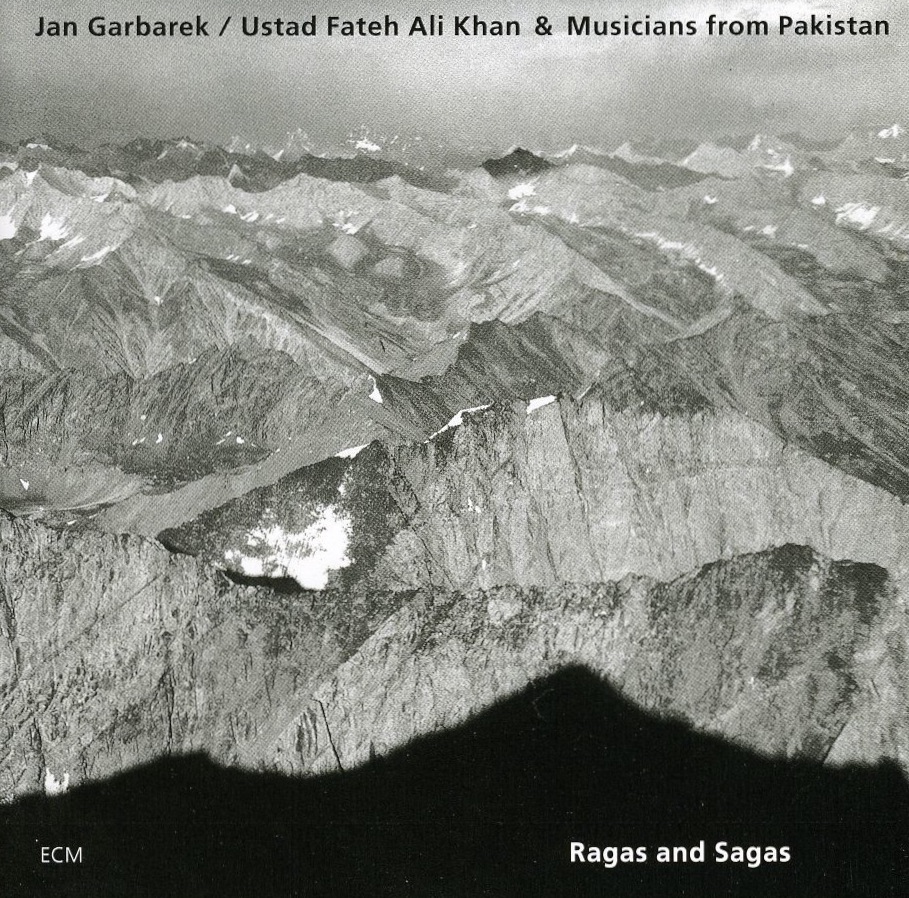
With Ragas and Sagas, Norwegian saxophonist Jan Garbarek surely turned not a few heads by collaborating with legendary Pakistani vocalist Ustad Fateh Ali Khan (not to be confused with Nusrat). With attuned support from sarangi, backing vocals, tabla, and a fairly young Manu Katché, this album fulfills every promise it makes on the cover alone. The tremulous waters of “Raga I” are enough to prove this point. This utterly selfless meditation shapes the listener’s spirit by inhabiting it with lines spun from a higher power. The sarangi’s raw S-curves pair beautifully with Garbarek, who remains graceful and restrained, serving each moment as it comes. “Saga” brings the latter’s electronics to bear upon Khan’s vocal spreads. Unfortunately, their brilliance, hanging like a water droplet from a spider’s thread, is sometimes drowned out by that powerful tenor. This is only a minor quibble in the face of the album’s constant wonders. In any case, any such imbalances are immediately rectified in “Raga II.” Pulling a percussive vocal thread from the floating sarangi, this lovely journey imparts equal weight (if not lightness) to every musician, though the voice of Deepika Thathaal as it weaves in and out of view is notable for its counterpoint to Garbarek’s ethereal adlibbing. Khan’s ululations are indescribably beautiful and are sure to transport you to places unknown yet comforting. “Raga III” is another well-unified piece, showing Garbarek’s chameleonic abilities in full swing, while “Raga IV” kicks up the dust to dizzying spiritual heights.

Ustad Fateh Ali Khan is a treasure, and this appearance, as ECM listeners have come to expect, is a carefully calculated one. Gone are the tired clichés and empty synergies of other such projects. This album also represents yet another evolution in Garbarek’s tonal biology, and is one of the finest examples of “world fusion” you are likely to come across, leaving us with a mind meld of sweeping proportions. Purists from any angle will want to give this one a chance.

<< Keith Jarrett Trio: The Cure (ECM 1440)
>> Garbarek/Vitous/Erskine: StAR (ECM 1444)
Anouar Brahem: Barzakh (ECM 1432)

Anouar Brahem
Barzakh

Anouar Brahem oud
Béchir Selmi violin
Lassad Hosni percussion
Recorded September 1990 at Rainbow Studio, Oslo
Engineer: Jan Erik Kongshaug
Produced by Manfred Eicher

This album marks the beginning of an ongoing and fruitful relationship between Tunisian oud master/composer Anouar Brahem and the ECM label. From the exhilarating solo “Raf Raf,” we know we are in the presence of someone whose sense of touch, rhythm, melody, and atmosphere speaks straight to the heart from the mind of a visionary. This first track puts us into a time and place where only melody speaks, and the sands of time flow like blood in an infinitely chambered heart. The title track introduces the violin of Béchir Selmi, whose tender ribbons bind volumes. Brahem unfurls a ponderous firmament for which Selmi strings the clouds together in a necklace—a smile arcing across some divine collarbone. So begins a mournful, loving diatribe of sand and air. The synergy of this trio is honed to a golden edge in “Parfum De Gitane,” which exemplifies the album’s organic progression from soliloquy to chorus, and which is couched by two solo excursions from percussionist Lassad Hosni. These float us down the river of “Kerkenah,” which again spreads its warmth wide.

A tapestry of colors fills out the album, including the lullaby-like “Sadir” and “Hou,” as well as the fresh energies of “Ronda” and “Sarandib.” Brahem shines most, however, in the solo pieces, of which “La Nuit Des Yeux” is an incredibly programmatic example that works at the level of fantasy. And in “Le Belvédère Assiége” we find in the intimate confines of that hollow body a shelter for all of us, where the sustenance of “Qaf” is given on a sonic platter as ephemeral as the drink that nurtures us from its plane.

Barzakh balances itself on the fulcrum of tradition, in the process bidding us to follow the lessons of the every day.

<< Christopher Bowers-Broadbent: Trivium (ECM 1431 NS)
>> Bach: Das Wohltemperierte Klavier, Buch II – Jarrett (ECM 1433/34 NS)

Stephan Micus: Darkness And Light (ECM 1427)

Stephan Micus
Darkness And Light

Stephan Micus dilruba, guitar, kortholt, suling, ki un ki, ballast-strings, tin whistle, balinese gong, sho
Recorded January/February 1990 at MCM Studios and Studio Giesing, München
Engineer: Tom Batoy

Listening to a Stephan Micus album is always like taking a journey through darkness and light, and so it is no wonder that his fourth album for ECM should bear that very title. The sarangi-like tones of the dilrubi of Part 1 open up a pathway that is indeed by turns bright and shaded. The path is circular, leading forever back to where it began, as if to say, “Birth and death issue from the same step.” From this mouth agape we get the insular sutras of guitar. Its chain of arpeggios carries in its arms a bouquet of memories and rests it in the crook of a tree, where it plays for the sake of Nature. From that whispered cove arises a mermaid holding a bow at the edge of a string. With every splitting of voice we are veiled in deeper solitude. Mournful songs shape a still heart, hanging on to certain threads longer than others. The guitar helps us to nourish ourselves with what remains in its chamber, stenciling the periphery with every pluck and unearthing in the afterlife all that is yet to come. Even in the absence of a bow, we feel our voices continuing to spin novel draws in the ether.

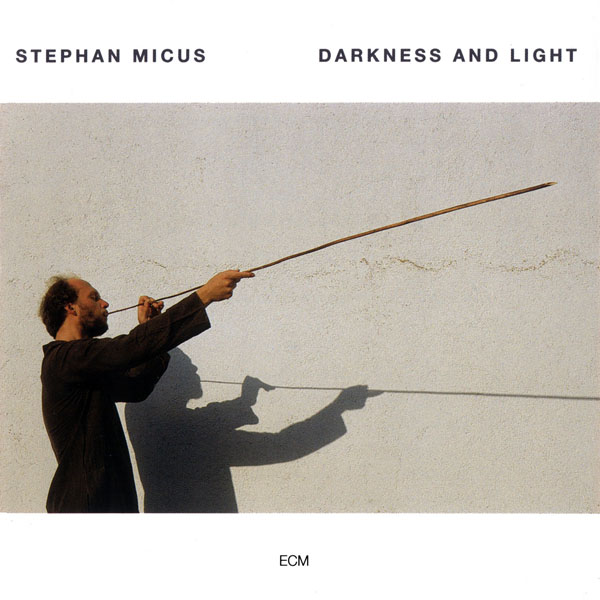
Part 2 takes a rawer approach to the dilrubi, giving rise to the call of the ki un ki, the Siberian cane trumpet pictured on the album’s cover. Played by inhaling, it sounds like a combination between a Theremin, a split and blown grass blade, and an elephant calling out to the cosmos. Part 3 scrapes the edge of darkness on its climb toward a trembling song. A flute cries as if in dialogue, two lovers parted on either side of the Milky Way unifying at last in a hopeful vein, tracing light back to the nebula that birthed them both.

Darkness And Light is as fleeting as its message, transparent as water and betraying its presence only through reflections. Still, its elemental forces sweep us away in the depth of Micus’s human touch, such that when they stop, one feels they might linger forever.

<< Paul Giger: Alpstein (ECM 1426)
>> Egberto Gismonti Group: Infância (ECM 1428)

Anja Lechner and Vassilis Tsabropoulos: Chants, Hymns and Dances (ECM New Series 1888)


Chants, Hymns and Dances

Anja Lechner cello
Vassilis Tsabropoulos piano
Recorded December 2003, Festeburgkirche, Frankfurt am Main
Engineer: Markus Heiland
Produced by Manfred Eicher

The enigmatic sound-world of G. I. Gurdjieff (c.1877-1948) made its first appearance on ECM via the spirited renditions of pianist Keith Jarrett. Now another wizard at the keyboard, Vassilis Tsabropoulos, joins kindred spirit cellist Anja Lechner for a redrawing of old maps alongside the newly discovered continents of Tsabropoulos’s own stilling compositions around Byzantine hymns. The result is less a hybrid and more of a conversation across (and of) time. Harmonically a simple world, it elides the trappings of the social, forging its own divine concept in the grip of ideological binds. Some, like Chant from a Holy Book, build up in intensity as might a raga, spinning from humble beginnings a sustained lyricism that speaks with the language of afterlife. Others maintain that humility throughout, as in Prayer. Tsabrapolous’s approach to these free-floating motives is gently improvisational, and yet the star of every note seems to hold its place in the music’s nightfall. In Duduki, for one, we hear in the pianism a potency of such fragile proportions that Lechner’s cello seems to weep with the passion of a last dance.

The album’s heart also renders a portrait of Tsabrapolous’s, as he gives us his own bridging melodies in the wilting graces of Trois Morceaux après des hymnes byzantinshas. In these Lechner’s exquisite tone glows, threading an emotional line as one might find in an Eleni Karaindrou soundtrack. The playful undertones of Dance then give way to Chant, which is closest to its surroundings in mood. Although elegiac, it is bright with textless voices. More Gurdjieff rounds out program, of which the highlights are the evocative Assyrian Women Mourners and its sister piece, Woman’s Prayer.

Anyone who enjoyed Jarrett’s earlier take on the shape of things will find plenty to open the mind further on Chants. I can hardly imagine an album better suited for ECM’s pioneering programming. It is a quiet, unassuming space that takes nothing for granted, granting as it does all that it has ever received.

Shankar: Pancha Nadai Pallavi (ECM 1407)

Shankar
Pancha Nadai Pallavi

Shankar double violin, vocals
Zakir Hussain tabla
Vikku Vinayakram ghatam
Caroline talam, sruthi
Recorded July 1989 at Rainbow Studio, Oslo
Engineer: Jan Erik Kongshaug
Produced by Manfred Eicher

Shankar’s last album for ECM may just be his finest. Pancha Nadai Pallavi shows the violinist at his creative peak and weaves an unforgettable atmosphere. From the solemn cover photograph to the flawless production, it is a perfect package and a fitting label swan song for an association stretching full circle back to the comparable masterpiece that is 1981’s Who’s To Know.

Shankar’s playing, however you look at it, is a language of the utmost depth and beauty. His voice is smoky, arising from those strings like an echo of the inner spirit that animates his craft. This traditional raga features three cycles, the first two of which—the Ragam and the Tanam—foreground the improvisational skills of the soloist, while the concluding Pallavi emphasizes the rhythmic contributions of the percussionists in dialogue. Although Carnatic purists may be put off by Shankar’s modern touches, the music soars in ways that far outsoar its criticism.

Shankar’s sound is a constant balance of skyward uplift and subterranean excavation. From the thrums and strums of his 10-string violin’s lowest utterances to his harmonic-peaked runs, he scales full ladders of octaves in but single exhalations of his creative breath. And although the violin parts are multi-tracked, they shine like facets of the same crystal. His lines hold on to a core tone. No matter how far they waver from it, they are like rivers that both flow out from and back to their sources. In the process they provide a rhythmic drive in the absence of the percussion waiting in the wings—such that once the voices of Zakir Hussain and Vikku Vinayakram do make themselves known, it feels as if they’ve always been there, moving but never audible until now. The dynamics of this expansion alone are enough to dazzle, but with Shankar’s burrowing melodies their effects become inescapable. Moving from passages of blinding speed to lyrical laments at a mere stroke, they glow in a spectrum of colors. On that note, we must not neglect Shankar ally Caroline Morgan, whose drones and timekeeping unfold their inner depths in those brief moments of rest. Her humility rings like the voice of the firmament, stilling us in anticipation of the flights to come and baying into the beautiful call and response that leaves us spellbound at the raga’s finish.

Pancha is, along with the aforementioned Who’s To Know, by far Shankar’s best work on record. It is also an album that most cleanly showcases the capabilities of his custom instrument. One feels its lows in the rib cage, its highs in the farthest reaches of our minds. Through it Shankar sustains a purity of tone, a moral and spiritual center around which he swings the caduceus of his melodies with eyes closed and arms open. He looks into the stars and sees the strings between them not as constellations but as musical notations. And in these he paints the picture of a god-given gift that has left an indelible mark of greatness.

<< Karlheinz Stockhausen: MICHAELs REISE (ECM 1406 NS)
>> Sidsel Endresen: So I Write (ECM 1408)

Shankar: M.R.C.S. (ECM 1403)

Shankar
M.R.C.S.

Shankar double violin
Zakir Hussain tabla
Vikku Vinayakram ghatam
Jon Christensen drums
Recorded 1987 and 1989 at Studio Bauer, Ludwigsburg and Rainbow Studio, Oslo
Engineers: Martin Wieland and Jan Erik Kongshaug
Completed and mixed 1989 at Rainbow Studio, Oslo
Engineer: Jan Erik Kongshaug
Produced by Manfred Eicher

Multi-instrumentalist L. Shankar’s fascinating evolution as a musician and composer took yet another intimate turn with M.R.C.S. Dedicated to Shankar’s father, V. Lakshminarayana, it also boasts master percussionists Zakir Hussain (tabla), Vikku Vinayakram (ghatam), and drummer Jon Christensen. The depths of the album’s experiences are forever aquatic, as in the opening “Adagio,” which floats Shankar’s double violin insights on a dark and winding current. Filmic and vivid, its gauche stretches a fine canvas for the pigments that follow. “All I Care” marries the rhythmic edge of “March” (an interlude from Christensen) with Shankar’s cosmic pizzicato and gossamer comet trails, the latter reaching glorious improvisational heights that can only end in fadeout, lest their perpetuity be harmed. The music travels away from us, ever tuneful, into the tabla-infused “Reasons.” Here, Hussain trail-marks a scurrying snare, backing more winged artistry from the leader. The lilting, homespun feeling of “Back Again” unravels from a deceptively simple line a heartfelt wash, as does “Al’s Hallucinations,” in which the melodiousness of Hussain’s tabla enhances the music’s playful melancholy. After the waltz-like and romantic “Sally,” Hussain and Vinayakram carry us on the back of a “White Buffalo” into the sparkle of “Ocean Waves.” For this final breath, Shankar adds a veneer of piano over his reverberant orchestrations, thereby ending this journey where it began: in and of the tide.

Shankar’s sense of melody is endearing and luminous, familiar from the first. Like a great klezmer clarinetist, he weaves a song that is at once mournful and exuberant.

Proof yet again that “fusion” is a misnomer. This is simply wonderful music that need be nothing else.

<< Agnes Buen Garnås/Jan Garbarek: Rosensfole (ECM 1402)
>> Aparis: s/t (ECM 1404)

Stephan Micus: The Music Of Stones (ECM 1384)


Stephan Micus
The Music Of Stones

Stephan Micus shakuhachi, tin whistle, stone chimes, resonating stones, voice
Elmar Daucher resonating stones
Günther Federer resonating stones
Nobuko Micus resonating stones
Recorded 1986 at Ulm Cathedral
Engineer: Martin Wieland

Elmar Daucher’s resonating stones have haunted me since I first heard them on Klangsteine-Steinklänge (released 1990 on ProViva). While not conceptually unique (stone instruments, notes Micus, have at least a 2500-year history), Daucher’s playable sculptures nevertheless speak with voices all their own. They are, as anyone familiar will tell you, enchanting enough on their own terms, but to hear them in the context of Stephen Micus’s visceral melodies is to hear them as the source of some nameless creation. For the most part Micus has had free reign in recording for and submitting his work to ECM producer Manfred Eicher, who commits the material to disc as an acolyte might transcribe a master’s words. But for this project he took a rare dip into the pool of collaboration along with his wife Nobuko, Günther Federer, and Daucher himself all playing resonating stones. Add to these Micus’s unique instrumental prowess in the reverberant embrace of Germany’s Ulm Cathedral, and the results are as profound as they are extraordinary.


Micus and Daucher at Ulm Cathedral

The stones come alive in Part 1. Their voices hum through the listener’s bones. A shakuhachi begins its bird-like dip from the heavens, touching its wings to freedom. In its song one finds a cave, never knowing what will be heard, for under the cover of that night there is but a single voice calling (or is it weeping?) for someone. Two hands hold a song of water, turning it like a teacup held high in the absence of ceremony for the gods to drink. The shakuhachi then becomes a woodland creature who knows the trees well enough to skip through the branches blindfolded. The striking of the stones in Part 2 therefore startles with a blast of light. With the delicate force of a prepared piano or gamelan it is at once metal and flesh. One feels within it a sense of coming together through falling apart, a slow dissolve into unity at a molecular level. Part 3 introduces a penetrating tin whistle, and with it a feeling of windswept plains and distant shorelines, the continued gonging of the stones like cow bells in the pastures. Underlying rhythms carry over into Part 4, embracing an elemental sound in their tectonic heart, in which every seismic shift carves a new glyph of experience. Part 5 is a shakuhachi solo, tremulous and breaking. Spun of cloud and snow, it is a crane’s inner life unfolding before the dawn. Micus lets his throat unspool at last in Part 6, making music out of the very air around him. Which brings our attention to the one uncredited stone sculpture in all of this: the very cathedral itself, which has collected and preserved the footprint of every note played and which imparts its histories to us in an everlasting whisper.

<< Terje Rypdal: The Singles Collection (ECM 1383)
>> The Hilliard Ensemble: Perotin (ECM 1385 NS)

Shankar: nobody told me (ECM 1397)

Shankar
nobody told me

Shankar double violin, vocals
V. Lakshminarayana violin, double violin, vocals
Ganam Rao vocals
Zakir Hussain tabla
Vikku Vinayakram ghatam
Caroline vocals, tamboura
Recorded 1989 at The Complex, Los Angeles
Engineer: Billy Yodelman
Produced by The Epidemics (Shankar & Caroline)

After the uncharacteristic misstep that was The Epidemics, Shankar returned to his roots with nobody told me and showed us that his flair for Carnatic vocals is almost as deeply fleshed as his improvisational gifts on the double violin. And while he has never quite recaptured the magic of Who’s To Know, that same generative spirit is present here in every gesture of his bow. The recording is far more intimate than anything else he has put out. For that reason alone it bears repeated listening and the nuances that repetition brings to each new experience. He is also accompanied by some staggering talents, among them V. Lakshminarayana (father of the venerable L. Subramaniam and pioneer of the Indian violin, he died the year following this session), Zakir Hussain on tabla (who, if you’re reading this, probably needs no introduction), and ghatam master Vikku Vinayakram. The session is rounded out by vocalists Ganam Rao and Caroline, the latter of whom also provides the foundational tamboura drone throughout.

The most heartening moments are to be found between Lakshminarayana and Shankar, whose exchanges in the opening Chittham Irangaayo constitute a spiritual conversation to which the listener can only nod. From tender beginnings, their stichomythia of the rustic and the laser-like opens into a broader language as the rest join in the fray. Shankar emerges from this milieu with beautifully articulated chording and pizzicato accentuations in turn before bowing his way into a rousing finish. Vocals predominate the Chodhanai Thanthu that follows. The unrestrained cadences therein bring us to the root of this music, which at its best floats straight from the body and into the heart of the divine. Only with the introduction of percussion and violin do words step out onto the histrionic stage, taking us by the hand into the brief yet inescapable Nadru Dri Dhom ­Tillana, a fitting end to a raw and impassioned document of collective music-making.

<< Misha Alperin/Arkady Shilkloper: Wave Of Sorrow (ECM 1396)
>> Charles Lloyd: Fish Out Of Water (ECM 1398)

Stephan Micus: Twilight Fields (ECM 1358)


Stephan Micus
Twilight Fields

Stephan Micus flowerpots, hammered dulcimer, Bavarian zither, shakuhachi, nay
Recorded November 1987 at Tonstudio Bauer, Ludwigsburg
Engineer: Martin Wieland

Instrumentation is ever at the heart of the Stephan Micus experience. Never a gimmick, it imparts to listeners a sense of organic care that is palpable in every gesture. Of those gestures we get a plethora in Twilight Fields, his second album for ECM proper. In this close-eyed experience, the crowning elements come from a set of tuned flowerpots which, when struck with hand or mallet, produce a xylophonic texture that borders on gamelan. Part 1 spreads its vision like a walk through rice fields, lush and crepuscular. Hammered dulcimers dance above your head like a thousand memories, through which the rasp of a shakuhachi carries a pregnant song. Myriad footsteps walk alongside as you traipse through the otherwise unpopulated expanse of a nubile life, one to which you have strung all manner of concerns and loves and which now unites in a cord of simple possibility. The thrumming energy of that shakuhachi dissipates into Part 2, in which one hears only contact in lieu of movement, sound stepping in for dance with the gentle persuasion of a lullaby. The song returns, this time not a memory but a harbinger of things to come, an oracle bone hollowed out and given vocal shape. It dries and cracks with age yet maintains its splendor. Its golden light leaks between leaves and breathes in their veins. Out of these gonging interiors Part 3 enacts a rite of flowerpotted passage into the strains of Part 4, one of the most beautiful creations Micus has ever recorded. Here it is the nay that sings, at once moonlight and its reflection, the singer and the sung. Its surroundings open up in a hammered flower, lotus-like and iridescent. The shakuhachi’s mournful stag cry in the fifth and final part drops its dipper into a font of forgotten wisdom, scooping out the moon to drink down its cratered light. The wind refracts into a zither’s hum, leading us to the shaded glens of introspection that sustain all art and through which one must pass in order to arrive at the self.

No matter what instrument Micus plays, one can always hear breath running through it. Like the flutes that figure so prominently here, it rests crisply at the edge of some aquatic abyss, every careful step touched by the blade of a forgiving biography.

<< Koch/Schütz/Käppeli: Accélération (ECM 1357)
>> Rabih Abou-Khalil: Nafas (ECM 1359)