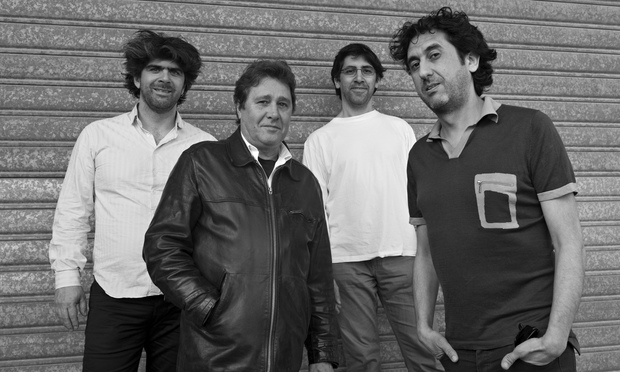
Michael Mantler: The Jazz Composer’s Orchestra Update (ECM 2391)

Mantler Update

Michael Mantler
The Jazz Composer’s Orchestra Update

Nouvelle Cuisine Big Band
Christoph Cech conductor
Michael Mantler trumpet
Harry Sokal tenor saxophone
Bjarne Roupé guitar
Wolfgang Puschnig alto saxophone
David Helbock piano
radio.string.quartet.vienna
Bernie Mallinger violin
Igmar Jenner violin
Cynthia Liao viola
Asja Valcic cello
Recorded live August 30/31 and September 1, 2013 at Porgy & Bess, Vienna, Austria
Engineer: Martin Vetters
Mixed and mastered October and December 2013 at Studios La Buissonne, Pernes_les_Fontaines, France
Engineers: Gérard de Haro and Nicolas Baillard
Produced by Michael Mantler
An ECM Production in collaboration with Porgy & Bess, Vienna

Trumpeter and composer Michael Mantler began the Jazz Composer’s Orchestra in the mid-1960s with Carla Bley as a larger outlet for radical jazz interventions. Having just arrived in New York City as a young man from Vienna, Mantler was raring to float his ideas among musicians—Pharoah Sanders, Cecil Taylor, and Don Cherry among them—who cared. In an interview with Steve Lake printed in this album’s booklet, he stresses the tightly knit community of free jazz at the time. The scene was small, he recalls, “and most everybody knew and worked with each other, having formed a kind of bond through necessity, since we were involved in a music that was commercially totally unviable and often even quite disliked by the mainstream audience and critics alike.” While digitizing old JCO scores in 2012, he saw a chance at renewal and The Jazz Composer’s Orchestra Update was born. The new pieces—penned 1963-69 and revised in 2013—are sheep in wolves’ clothing, each precisely notated but with room to spin wool of improvisation.

MM

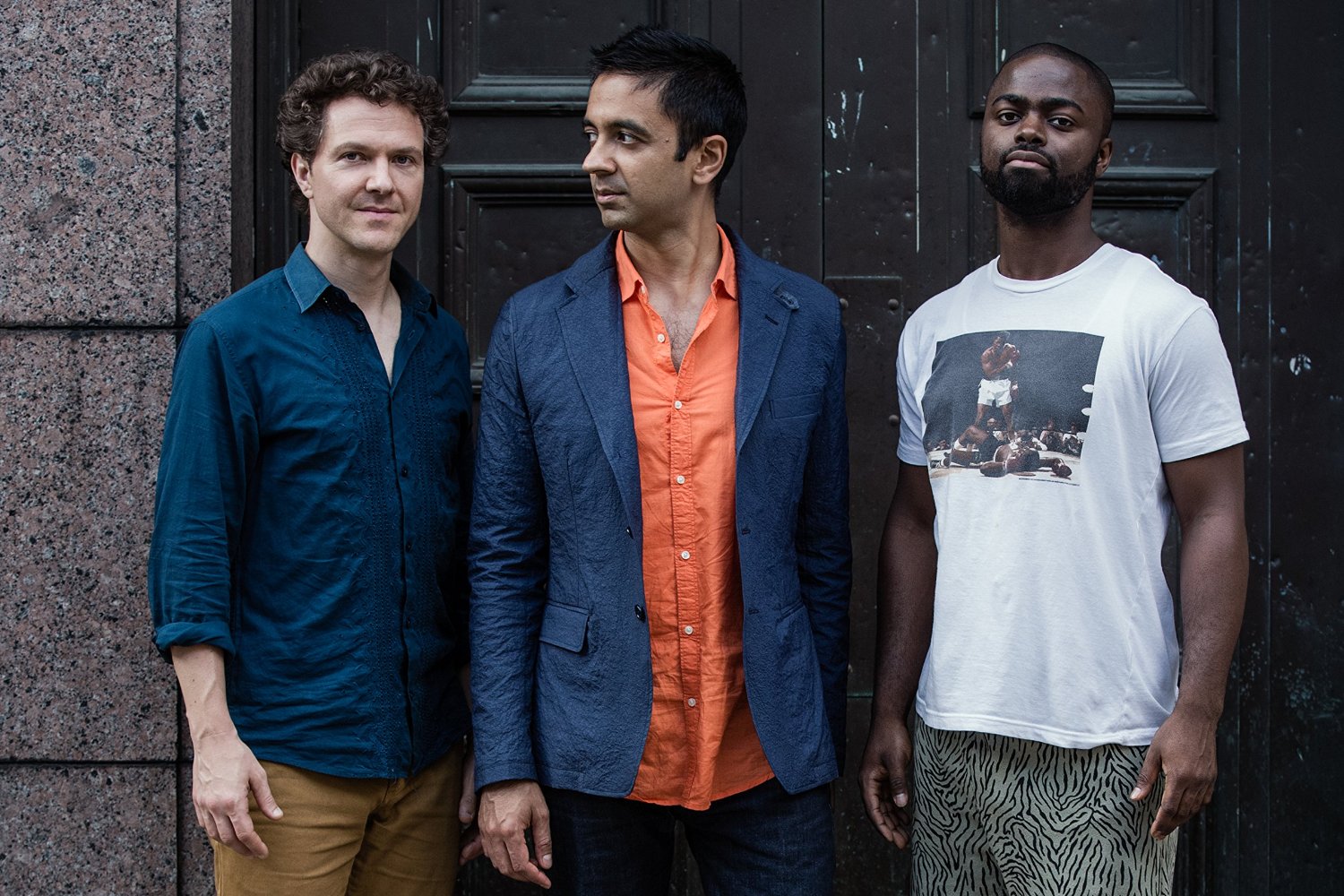
Mantler has always been one for forthright atmospherics, and these pieces are no exception to that tendency. If anything, they embody it to the fullest. Aiding in the reshuffling are guitarist Bjarne Roupé (last heard on Mantler’s For Two), altoist Wolfgang Puschnig, tenorist Harry Sokal, pianist David Helbock, the radio.string.quartet.vienna, the Nouvelle Cuisine Big Band under the direction of Christoph Cech, and the composer himself on trumpet. Mantler is, in fact, the featured soloist of Update One, which introduces a slightly dissonant and reactive world of sound. Because the big band cuts such a complex figure in the studio, muscling its way through a chain of through-composed cells, each “Update” may be distinguished by its soloist(s). While all the musicians here are well suited for the job, Roupé is a natural-born Mantler interpreter. His gestures cut like a razor across Updates Eleven and Part 1 of Twelve, both of them bursting with roots in a gnarled sort of grandeur.

The main reedmen are likewise exceptional. Sokal’s tenor flips a coin of thunder and soul in Update Eight, landing once on each side in the name of night. Puschnig’s alto, rides a wave somewhere beyond even those extremes in Update Ten, crashing on a vacant shore and leaving only a tender solo from bassist Manuel Mayr to show for having been there. Update Five lodges both saxophones in a briar patch of architectural impulses as the brass section blasts its messages with faith. The radio.string.quartet.vienna adds a dab of brooding to the palette in Update Nine. Violent expectorations, flowering pizzicati, tinkling cymbals, bright piano, clarion trumpet, and dim sonorities from the horns all enhance the strings’ flexibility as spider-web anchors bowing in the wind. Update Six, meanwhile, boasts crepuscular descriptions from Helbock at the keys, while Mantler returns in his barnacled shell.

The last two tracks form an unspoken diptych, with “Update Twelve Pt. 2 (Preview)” going all in with its round of spotlights, and “Update Twelve Pt. 3” taking the opposite route in a skeletal motif, ending where it might also have began: with a thesis statement. It’s an enjoyable reminder that Mantler’s pieces, while consummate in execution, are forever malleable in form, markers along a trail like no other on ECM grounds.

(To hear samples of The Jazz Composer’s Orchestra Update, click here.)

The Jazz Composer's Orchestra Update

Kenny Wheeler: Songs for Quintet (ECM 2388)

Songs for Quintet

Kenny Wheeler
Songs for Quintet

Kenny Wheeler flugelhorn
Stan Sulzmann tenor saxophone
John Parricelli guitar
Chris Laurence double bass
Martin France drums
Recorded December 2013 and mixed September 2014 at Abbey Road Studios, London
Engineer: Andrew Dudman
Assistant: Toby Hulbert
Mastering: Frank Arkwright
Produced by Manfred Eicher and Steve Lake

The late trumpet/flugelhorn virtuoso and composer Kenny Wheeler was one of jazz’s most beloved musicians and every album he recorded for ECM was an event to be savored—and now more than ever with Songs for Quintet. Wheeler’s last recording nestles some classics in mostly newer material and is a departure for the label in being recorded at London’s legendary Abbey Road Studios, where he is joined by longtime friends tenor saxophonist Stan Sulzmann, guitarist John Parricelli, bassist Chris Laurence, and drummer Martin France.

KW

Given the way that “Seventy-Six” eases its way into the heart, you can be sure this is a Wheeler record. Like “The Long Waiting” later in the set, it rests on a foundation of bass and guitar, on which the band builds its togetherness. Within this mesh, Parricelli slings his guitar solo like a comfortable leather bag that conforms to the body from years of regular use. In both tracks, Sulzmann’s tenor is another remarkable voice, shadowing Wheeler’s own lyrical fronting without stepping on their toes. In fact, he and the rest are in obvious deference to their leader’s coolness.

Two blasts from the past, buffed to a reflective shine, enrich the album with their inclusion. “Old Time,” last heard as “How It Was Then” on the 1995 Azimuth album of the same name, is among the groovier numbers. Sulzmann and Wheeler share soaring harmonies over some prime rhythm sectionining: France an ambassador of finesse and Laurence of nimble eccentricities. And one of ECM’s finest jazz albums of all time, Angel Song, gets a nod in “Nonetheless,” a deserving self-tribute now shed of its shadows in the presence of brighter cymbals and guitar. Sulzmann’s wings catch thermal after thermal in a space that Wheeler might once have claimed on Gnu High. The saxophonist’s true standout track, though, is “Sly Eyes,” a luscious tango that is all the wiser for its bassing. “Pretty Liddle Waltz” is another robust dance.

The cryptically titled “1076” is champagne in a bottle, by which is christened a scuttling vessel. Like “Jigsaw,” its elements interlock seamlessly. The latter tune is slick in that distinctly Wheelerian way and spotlights a musician with a lot on his mind. By his gentle yet forthright tone, Wheeler serves no pretense but the down-home profundity of his vision. Even as his younger sidemen paint sunbursts overhead, he is content to strip his cottage and repaint its walls in variations of that same comfortable shade. In keeping with the rural theme, “Canter No. 1” begins with a relaxed bass solo, from which Wheeler spins an enchanting story. Each chord change becomes a rope swing in his hands as he suspends his peerless language over childhood rivers toward fuller throttle.

Not only is this as fine a swan song as one could hope for; it’s also fantastic album in and of itself. Were one to approach it not knowing the personnel involved, it would sound just as poignant, for its strength lies first and foremost in the writing: a mark of greatness, if ever there was one.

(To hear samples of Songs for Quintet, click here.)

Chris Potter & Underground Orchestra: Imaginary Cities (ECM 2387)

Imaginary Cities

Chris Potter
Underground Orchestra
Imaginary Cities

Chris Potter tenor and soprano saxophones, bass clarinet
Adam Rogers guitars
Craig Taborn piano
Steve Nelson vibraphone, marimba
Fima Ephron bass guitar
Scott Colley double bass
Nate Smith drums
Mark Feldman violin
Joyce Hammann violin
Lois Martin viola
Dave Eggar cello
Recorded December 2013 at Avatar Studios, New York
Engineer: James A. Farber
Assistant: Tim Marchiafava
Mixed October 2014 by Manfred Eicher, Chris Potter and James A. Farber
Produced by Manfred Eicher

Chris Potter has been deservedly recognized as a superlative musician and soloist, but he will just as likely go down in history as one of the great jazz composers of his time. Having already proven himself in that capacity with The Sirens, Potter continues his relationship with the only label with vision deep enough to realize his own. The title of Imaginary Cities evokes Italo Calvino’s invisible ones, and like the Italian magical realist’s vignettes depicts the same space from different angles of time and perspective. Bringing life to this masterpiece are the musicians of his Underground Orchestra. Essentially an expansion of his Underground quartet with guitarist Adam Rogers, pianist Craig Taborn, and drummer Nate Smith, the current project adds to that nexus bassists Fima Ephron (on electric) and Scott Colley (on upright), vibraphonist and Dave Holland Quintet colleague Steve Nelson, and a string quartet headed by violinist Mark Feldman.

The album’s torso is the title suite in four parts. Beginning with the sparkle of “Compassion,” moving through the propulsive “Dualities” and “Disintegration,” and ending with “Rebuilding,” Potter applies pigment to a formidable cityscape indeed, beyond which the bandleader’s sidemen and -women unroll ocean until an entire globe’s worth of water is given a chance to reflect it. Strokes of brilliance to listen for are Rogers’s constellatory riffs (especially in the far-reaching Part 4) and the string quartet writing of Part 2 (in which Nelson’s marimba also makes a multifaceted splash within a pizzicato frame). Through it all, Potter’s saxophones carve lines in the water like the fins of benevolent sharks. He unpacks his solos with the intuition of an experienced traveler and, especially by the sopranism of Part 3, emotes in an honest, straightforward tone.

The peripheral yet no-less-integral outliers of the program beget some of Potter’s most advanced playing on record. Of these, “Lament” is a most worthy introduction. Colley’s contributions on bass to the same are duly expressive and feed off arco strings without draining their atmosphere, from which emerges Potter’s tenor only after a lush prologue. His patient reveal is genius and thwarts our over-allegiance to the man at stage center. Between the angular “Firefly” (remarkable for Ephron’s bass guitar solo) and the Bartók-inspired “Shadow Self” (marked by Feldman’s unmistakable violin and Potter’s bass clarinet), exist lips locked in a smile, and which in the concluding “Sky” leave their kiss marks on the clouds.

Potter practices a trifecta approach, meaning that he eases into his themes and that, no matter how far his fingers travel in improvising around them, he always keeps home base in plain sight. His is a music of the here and now. It needs only you to guide it into the future.

(To hear samples of Imaginary Cities, you may watch the EPK above or click here.)

Anna Gourari: Visions fugitives (ECM New Series 2384)

Visions fugitives

Anna Gourari
Visions fugitives

Anna Gourari piano
Recorded October 2013, Historischer Reitstadel, Neumarkt
Engineer: Stephan Schellmann
Produced by Manfred Eicher

I do not know wisdom—leave that to others—
I only turn fugitive visions into verse.
In each fugitive vision I see worlds,
Full of the changing play of rainbows.
Don’t curse me, you wise ones. What are you to me?
The fact is I’m only a cloudlet, full of fire.
The fact is I’m only a cloudlet. Look: I’m floating.
–Konstantin Balmont, 1903

In 2012, pianist Anna Gourari made her ECM debut with Canto Oscuro, a diurnal recital of such imagination that it begged a sequel. Only Visions fugitives is, despite its modern vintage, more of a prequel, for it opens more of her heart than ever to the listener’s privilege. The title composition by Sergei Prokofiev (1891-1953) is his opus 22 and marks a sensitive turning point in the prolific Russian composer’s oeuvre. Written between 1915 and 1917, the clarity of its 20 miniatures is in full evidence. But as David Nice observes in his biography of Prokofiev, the Visions fugitives also reveals “a new and more disturbing vein of the dynamic malice found in the early piano pieces as well as a more elusive sadness,” and these Gourari elicits with her detailed touch.

Prokofiev seems never to have intended the Visions as a set (the composer himself played no more than a handful in one sitting), but in listening to them as such, one cannot help but notice what Paul Griffiths in his liner text rightly calls their “family resemblances.” And while the title connotes fleeting things, there is something unusually indelible about their impressions. Closer to linked verse than haiku, the suite coheres by virtue of its consistent intimacy. It is, of sorts, an anti-sonata endowed with illustrative prowess, each movement so perfectly flavored that it needs no side dishes: a veritable tapas tasting of thematic subjects, of which only two exceed the two-minute mark. The opening dichotomy sets a tone of blissful regret that, like a pile of shorn wool, is pulled and spun into workable thread. Internal variations work in such a way that each piece, marked only by its tempo, seems a reflection of the one that precedes and a predictor of the one that follows. You may find yourself drawing connections to other composers (No. 8, for example, marked “Comodo,” feels a bit like Satie), but the phenomenological presence of Prokofiev’s score is such that one need hardly reach far to find purchase in between the lines. Some, like Nos. 7 (Pittoresco) and 18 (Con una dolce lentezza), may be incredibly pretty, but resist the plunge into full-on impressionism. Others, like No. 4, 5, 9, 15, and 19 are virtuosic standouts, but speak in tongues of escape over flourish. And in the twentieth Gourari finds a contemplative doorway waiting for her.

AG

At two minutes and forty-six seconds, the Fairy Tale in f minor by Nikolai Medtner (1880-1951) may look like filler material in theory, but in practice it acts as a vibrant ligament at the program’s center. Composed in 1912 as part of Medtner’s opus 26, it is a prime example of his skazki, or “tales,” a genre of his own making. One may project any number of scenes onto its imaginary folk setting, but these ears detect a forest of seasons: the wind combing through trees in spring, the fragrant foliage of summer, the decay of autumn, and the whisper of snowfall in winter. With these transformations in mind, we turn lastly to Frédéric Chopin (1810-1849) and his opus 58 Sonata No. 3 in b minor of 1844. In the opening Allegro and subsequent Scherzo, Gourari is an artful dodger, the adept inhabitant of an otherwise empty castle. She walks through walls and transcends chambers as simply closing the eyes. She pushes through memories of pomp and circumstance, emerging from them trailing a single thread of transcendence, by which she stitches virtuosity to its shadow. The formidable Largo is a more brooding affair with a funereal quality but sheltering a hope realized in the triumphant Finale before burrowing into the reset of hibernation. Declamation, not proclamation.

Returning to Griffiths, who notes, “In integrating, however, Chopin also disintegrates,” we might lay the same claim about Gourari’s selections. This recital is a step inward, a dissolution of self into pure music that, once unleashed, takes on a life…and death…of its own.

(To hear samples of Visions fugitives, click here.)

Pablo Márquez: El Cuchi Bien Temperado (ECM New Series 2380)

El Cuchi Bien Temperado

Pablo Márquez
El Cuchi Bien Temperado

Pablo Márquez guitar
Recorded May 2012, Auditorio Radiotelevisione svizzera, Lugano
Engineer: Markus Heiland
Produced by Manfred Eicher

Even if The Well-Tempered Pig sounds far more appetizing in Spanish than it does in English, Pablo Márquez’s second album for ECM is an extraordinary achievement. The titular “Cuchi” (an ancient Quechua word meaning “pig”) was the sobriquet of one Gustavo Leguizamón (1917-2000), a composer, musician, lawyer, and pedagogue from the northwestern Argentine city of Salta. Salta is renowned for its musical heritage and is named for the same province that gave us Dino Saluzzi, who followed in Cuchi’s footsteps. Márquez describes Cuchi’s zambas (folk dances) as quintessential markers of Salta’s culture. Having grown up singing so many of them (they are, he explains, always accompanied by poems), Márquez was ideally suited to arrange them in a spectrum of 24 keys akin to, and inspired by, Bach’s monumental Well-Tempered Clavier. Although this album’s press makes further allusion to Debussy, Ravel, Stravinsky, and Schoenberg, the listener would do well to absorb this music without intervention of a comparative filter.

PM

Although Cuchi’s zambas take up the lion’s share of the program, the songlike vidalas, few as they are, reveal his truest heart. Opener “Coplas des Tata Dios” is a shimmering vidala-baguala, tinged with folkish hues and broken by the occasional tambora (rhythmic tapping at the base of the guitar strings). It seems to emerge from the fog of obscurity into the lucid here and now, and like so many of the pieces assembled here is intensely evocative. A single strum can reveal a shy glance through an open window, and the ghosts of a love that has yet to pass beyond it. Other instances of this form include “Chaya de la albahaca,” which plays with dissonant clusters and scraping of fingernails, and “Canción del que no hace nada,” which ends the album. But before we reach that bittersweet farewell, we are treated to an audible banquet like no other. Less represented dance forms such as the courting bailecito and exuberant carnavalito yield cavorting motifs and elastic strumming, while the three more compactly syncopated chacareras sprinkle the path with technically brilliant puzzles.

All of these aspects and more permeate the masterful zambas, which at Márquez’s touch serve as benchmarks of their form. In cinematic terms, they range from interior shot (“Zamba del carnival”) and soft-focus dream sequence (“Zamba de Lozano”) to flashback (“La cantor de Yala”) and close-up (“Zamba para la Viuda”). Also like an effective film, the music’s character development strengthens over a soundly engineered narrative arc and saves the best for later in “Zamba soltera” (this would be the love scene), “Zamba del pañuelo” (its enervating afterglow), the starkly realized “Maturana,” and “Chilena del solterón.” The latter is indicative of the entire set, pausing for breath and gathering new inspiration before rejoining the waves.

If Márquez were a painter, he would of course have his way with a brush, but would be especially skilled with a palette knife. With rigid elements he is able to render softness and structure in equal measure. As he recalls for an interview printed in this album’s booklet, Cuchi was fond of saying that “the ultimate accolade for an artist is that people think his work is anonymous.” But we can be thankful that, thanks to the efforts of guitarist, engineer, and producer, such anonymity may be harder to come by and will only enhance the wonders therein.

(To hear samples of Ei Cuchi Bien Temperado, click here.)

Anja Lechner/François Couturier: Moderato cantabile (ECM New Series 2367)

Moderato cantabile

Moderato cantabile

Anja Lechner cello
François Couturier piano
Recorded November 2013, Auditorio Radiotelevisione svizzera, Lugano
Engineer: Stefano Amerio
Produced by Manfred Eicher

After honing their simpatico relationship at the core of the Tarkovsky Quartet and as part of Maria Pia De Vito’s Pergolesi Project, cellist Anja Lechner and pianist François Couturier step naturally as a duo into a temple of wonders on Moderato cantabile. Over the years, ECM has carved an unparalleled subgenre of cello-piano recordings, notably the collaborations of Ketil Bjørnstad/David Darling and Vassilis Tsabropoulos/Lechner, and it’s impossible to imagine this album having ever come about without those predecessors. Fans of especially the latter project, which shares Lechner’s mellifluous bow, will encounter fascinations galore in Couturier’s deeper impulses. This album takes the very best of those projects and spins it into a world all its own, one in which we are seated as honored guests at the head of the table. Distinguishing the current duo’s music from the rest are the organicity of its approach and blossoming sense of development. The result is no less meditative, but adds to its contemplations the temperance of flame.

Lechner Couturier

Although not arranged in the following way, one may treat the program concentrically, moving from outward from Komitas, one of three composers named on the album’s cover, which neglects to mention Couturier’s own contributions (in keeping, one imagines, with the classical billing as a New Series release). The Armenian priest’s Chinar es has about it a dervish quality, calligraphing hypnotism in the twirl of receptive bodies. Its combination of piano arpeggios and seamless cello threading indicates an aesthetic mind-meld between the two musicians, who are responsible for all of the arrangements heard here.

While the cello is so often thought to be the most vocal of the symphonic strings, making it sing in the way Lechner does is no small task. She is resolute in her approach to the melodies of Greek-Armenian philosopher G. I. Gurdjieff, famously transcribed by way of oral transmission to begin with. Cellist and pianist use their complementary masteries to pair hymns and dances in a tessellation of leaves and sky. Gurdjieff awakens like the sun lifting its eyelid over the horizon and extends his spirit-seeking ways through a magnifying glass. There is, too, the Night procession, in which the cello seems to emerge from the piano itself, whispering of charcoal before there is fire. Gurdjieff’s No. 11 dovetails into Catalan composer Federico Mompou’s Fêtes lointaines no. 3, thus creating a chromatic masterpiece in a realm of shadow so deep that it can only speak in light.

Subsequent Mompou selections feel as much like poetry as song, each with a sense of joy and belonging. Tracing parabolic arcs into dance, the strength of Lechner’s technique brings out the songlike heart of this music as well beneath Couturier’s low-flying melodizing. Whether gracing the streets of the Música Callada or scenes of Mompou’s first published work, the Impresiones intimas, theirs is an ocean of churning memory in which the buoys of experience are many and reliable.

Couturier’s own pieces are as beautiful as they are surprising. Soleil rouge surveys a pointillist field of ideas, switching masks over rhythmic double stops from cello, while the duo scales its highest evocative cliff in Papillons, for which they consolidate their artistic toolkit in service of the image. Voyage finds the composer spinning a helix of chords beneath Lechner’s floating crosshatch before they detour through individual veins of rumination. Lechner’s pizzicati blot out stars one by one, until only the moon is left to dance.

The connections of these musicians are special not only with each other, but also with ECM. The love and appreciation that went into this album’s production is discernible at any given moment, and those fortunate enough to bask in its rewards will not be disappointed.

(To hear samples of Moderato cantabile, you may watch the EPK above or click here.)
Stefano Bollani: Joy In Spite Of Everything (ECM 2360)

Joy In Spite Of Everything

Stefano Bollani
Joy In Spite Of Everything

Mark Turner tenor saxophone
Bill Frisell guitar
Stefano Bollani piano
Jesper Bodilsen double bass
Morten Lund drums
Recorded June 2013 at Avatar Studios, New York
Engineer: James A. Farber
Mixed March 2014 in Lugano by Manfred Eicher, Stefano Bollani and Stefano Amerio (engineer)
Produced by Manfred Eicher

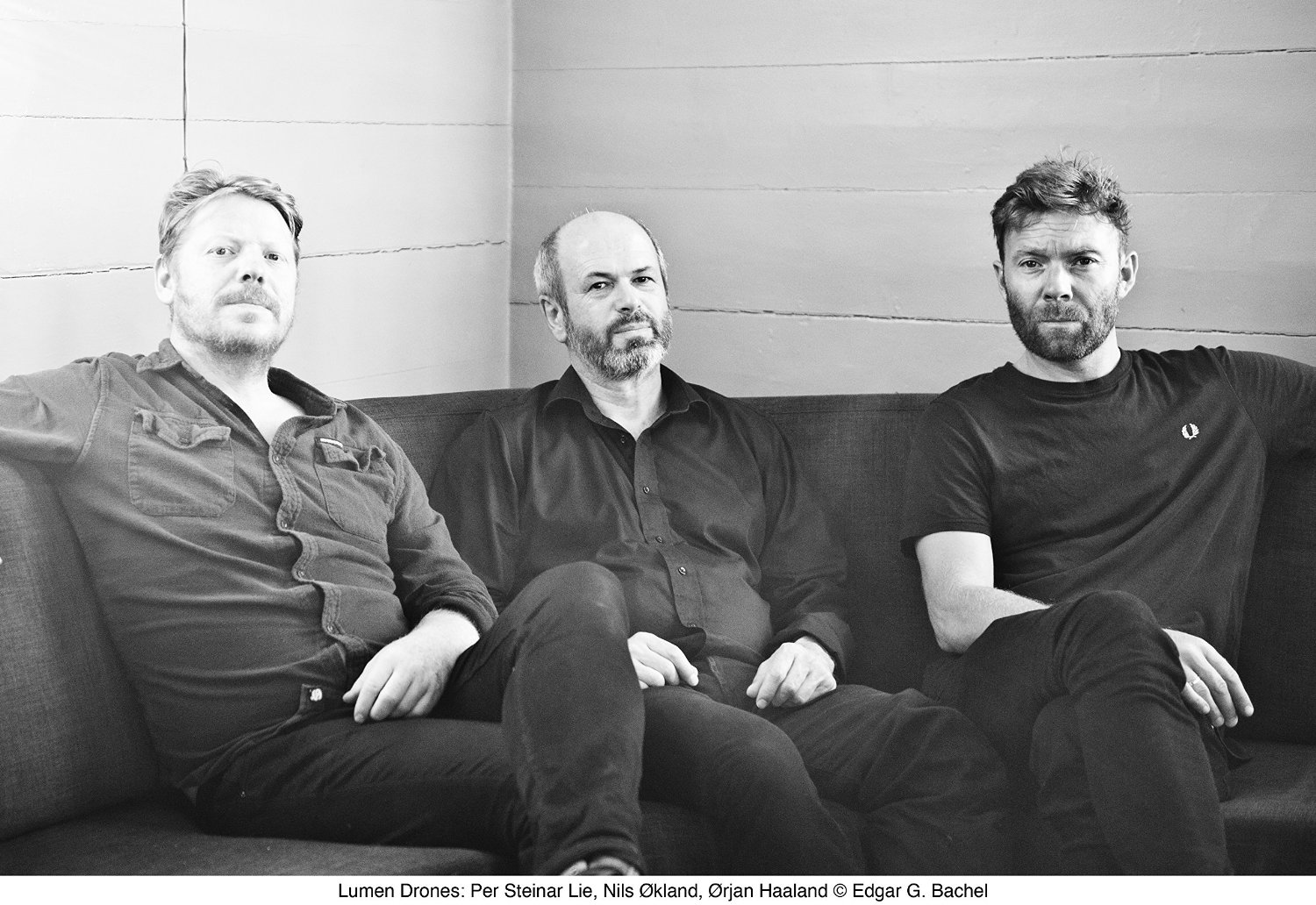
“You just go and you see what happens.” This is how pianist Stefano Bollani describes jazz in its purest form. And because so much happens on Joy In Spite Of Everything, his latest for ECM, you’ll want to return to it time and again to puzzle through its many twists and turns. The band is accordingly something of an ad hoc congregation. The album documents the first time that saxophonist Mark Turner, guitarist Bill Frisell, bassist Jesper Bodilsen, drummer Morten Lund, have ever been in the same room, and with their charismatic leader armed at the helm with nine original tunes, the results are spectacular.

Bollani band

Bollani never ceases to impress with the underlying consistency of execution he brings to even the most disparate music. His ballads glow by virtue of an inner fire, while his up-tempo numbers breeze coolly on by. But the new sound of “Easy Healing” may be something of a surprise. One half-aware listen, and you might swear it was an outtake from Charles Lloyd’s Voice In The Night. The instrumental combination—and within it Frisell’s John Abercrombie-esque picking, Bollani’s kaleidoscopic solo, and Bodilsen’s brief unpacking—in tandem with the closely miked engineering puts you in the center of it all.

Slow dances are hard to come by this round, but find a worthy ambassador in Turner, who graces two of the album’s most reflective sides: “Les Hortensias” and “Vale.” His soulful unpacking of the first, a gorgeous rubato picture brushed as finely as the drums, is by far the album’s highlight, while the second weaves its solos through a gnarled forest. Turner is, of course, just as comfortable on the hot plate, leaving his wheels on the runway of “No Pope No Party” with no intention of ever coming down. And as Lund balances power and sensitivity, Frisell walks a tightrope of his own between melodic defiance and evolution. The guitarist further shares moonlight with Bollani throughout “Ismene,” which would seem to evoke a fairy frolicking along the cusp of a leaf-cupped pool but which might just as well be a love song.

A sprinkling of other tunes rounds out the set. Bollani’s nimble fingers clutch the spotlight of “Alobar E Kudra.” Its angular groove is most representative of the album’s name. “Teddy” is a happy-go-lucky duet for guitar and piano that might seem out of place were it not so brilliantly executed. And the title track is the fleetest of them all, throwing the circle back on Lund, who shuffles the deck at every turn of this trio excursion.

I was delighted to encounter “Tales From The Time Loop,” which names a 2003 book by David Icke. Having read and listened to almost everything ever written by the world’s most controversial author, I couldn’t help but smile to see him referenced on an ECM record. Of the many theories put forth by Icke, his vision of a holographic universe is one of the more intriguing, and finds a musical equivalent in these smooth travels (this album’s title further echoes his message of infinite love). Every cell of the rhythm section’s bustling interactions suggests infinitely more within, setting up a chain of arresting illusions. Bollani’s very presence reminds us of why we arrived in the first place: to go and see what happens.

(To hear samples of Joy In Spite Of Everything, you may watch the EPK above or click here.)

Tre Voci: Takemitsu/Debussy/Gubaidulina (ECM New Series 2345)

Tre Voci

Tre Voci

Marina Piccinini flute
Kim Kashkashian viola
Sivan Magen harp
Recorded April 2013, Auditorio Radiotelevisione svizzera, Lugano
Engineer: Markus Heiland
Produced by Manfred Eicher

When is it really over? What is the true end? All borders are as if with a stick of wood or with the heel of a shoe driven into the earth. Until then…here is the border. All that is artificial. Tomorrow we’ll play another game.
–Francisco Tanzer, trans. J. Bradford Robinson

Tre Voci are violist Kim Kashkashian, flutist Marina Piccinini, and harpist Sivan Magen. Following a 2010 debut at the Marlboro Music Festival, the trio solidified its identity as such and came to ECM with this program of three works. Although disparate in geographical origin, each connects to the others by instrumentation and, above all, integrity of spirit. More than the unique combination, however, it is the supreme, interlocking level of ability in each musician that makes this disc such a pleasure to behold.

TV

The program opens with the reflection of a reflection: And then I knew ’twas Wind by Tōru Takemitsu (1930-1996). The Japanese composer’s illustrative genius is in full effect in this garden of painterly delights, from its opening sprinkle of raindrops to its closing fractals of coincidence. Although the instruments are inseparable partners in the worlding of this piece, and must be equally attuned to what Jürg Stenzl in his liner notes calls the “almost calligraphic precision” of Takemitsu’s score, the harpist must be especially aware of the palette at hand. Magen articulates a veritable ecosystem of harmonics, glissandi (produced by sliding a fingernail along a string), and timbral variations. One can almost feel the quiver of leaves shedding the weight of raindrops in the afterglow of a storm. From this scene, flute and viola emerge not like the fauna of stereotypical impressionism, but rather like the flora drinking in all the nourishment. The viola becomes, then, a natural navigational instrument, a magnetized sliver in a forested compass. Despite sounding sometimes like a single player, for the most part Kashkashian and Piccinini walk their solitary paths. Like some bucolic dream gone dark, however, not all is sunshine and roses, as emphasized by the distinctive pathos of their interpretation. Here is the leaf magnified, revealing infinite others within.

Given Takemitsu’s admiration for Claude Debussy (1862-1918), the latter’s Sonata for flute, viola and harp makes for a most suitable companion. As Debussy’s penultimate composition (succeeded only by the Sonata for violin and piano) before he succumbed to cancer, it shows both maturity and vulnerability. Over the course of three distinct yet interconnected parts, it develops with such tactile beauty that one is hard-pressed to find a hook of any size from which to hang an ornament of criticism. Part I opens in a river’s flow such as only Debussy can devise. With their unpretentious, relaxed treatment thereof, Tre Voci quickly overturn the notion that impressionism equals lack of clarity. The flute blends into the viola, and together they empty into a vivid ocean. Part II is recognizable by its cyclical motifs. If the first was an awakening, this is nature in the raw. Part III rests on a fulcrum of harp, teetering atop some of the trio’s subtlest descriptions, and the tipping point of its sportive, declamatory ending would be echoed 11 years later (1926) in Manuel de Falla’s Concerto for harpsichord, flute, oboe, clarinet, violin and cello. If anything, this sonata is about physics, as is the piece that follows.

Sofia Gubaidulina’s Garten von Freuden und Traurigkeiten (Garden of Joys and Sorrows) is this album’s crowning achievement. The progression of its introductions quivers with sobering anxiety until the trio’s dynamic range is nearly exhausted. The viola tends toward harmonic whispers, while harp and flute take more direct routes toward their melodic destinations. This is not to say that the piece is a goal-oriented one. Rather, it thrives on the value of distortion. Much like Gubaidulina’s quartets it favors skeleton over muscle, and through the creaking of its joints seeks harmony in ashen reveries and broken things. It ends with a recitation, in German, of a poem by Francisco Tanzer: not the universe in a raindrop, but a raindrop in the universe.

(To hear samples of Tre Voci, click here.)

Ketil Bjørnstad: Sunrise (ECM 2336)

Sunrise

Ketil Bjørnstad
Sunrise

Kari Bremnes vocal
Aage Kvalbein cello
Matias Bjørnstad alto saxophone
Bjørn Kjellemyr double bass
Hans-Kristian Kjos Sørensen percussion
Ketil Bjørnstad piano
Oslo Chamber Choir
Egil Fossum conductor
Recorded April 2012 at Rainbow Studio, Oslo
Engineer: Jan Erik Kongshaug
An ECM Production

A bird of prey is trapped
deep inside me. Its talons
have ripped into my
heart, its beak has
driven itself into my chest,
and the beating of its wings
has darkened my sanity.

Norwegian pianist-composer Ketil Bjørnstad seems to be in one of the most creative phases of his career. Increasingly, he has turned to the human voice as an expressive outlet for his ever-songlike writing, and it was only a matter of time that those forces should reach the level of a choir, a medium for which he was asked to write music in commemoration of the Nordstrand Musikkselskap Choir’s 70th anniversary in 2011. Having already engaged with the life of Edvard Munch in his 1993 literary biography Historien om Edvard Munch and set the painter’s neglected words to music on the album Løsrivelse, he naturally returned to those same texts for Sunrise. Yet Bjørnstad’s self-styled cantata is more than the portrait of an artist. It is an affirmation of light.

Munch wrote flashes of prose in preparation for many of his paintings. Bjørnstad characterizes the texts chosen for this monumental work as dealing unanimously with existentialist dilemmas. In addition to Munch’s paratextual writings, Bjørnstad was intimately acquainted with his 1909 mural The Sun, under which the young pianist saw many greats play at Oslo’s University auditorium, the Aula, where it hung. In that painting, notes the composer, “one can clearly discern the degree to which Munch struggled with and against the forces of life, and how deeply and endlessly he yearned for enlightenment and reconciliation.” The same holds true for the music he has written into its aura.

The Sun

Most attractive about Sunrise is its breadth of idiomatic conviction, which is most vividly clarified in the four songs written for singer Kari Bremnes, with whom Bjørnstad worked on the aforementioned Munch cycle. She is joined by Bjørnstad at the keyboard, alto saxophonist Matias Bjørnstad (no relation, it seems), and bassist Bjørn Kjellemyr on “Moren” (The Mother), which depicts the haunting scene of a young boy who holds his mother’s hand in anticipation of going outside but is blinded by the light of spring once they open the door. Bremnes’s oaken alto lends heart to every word it envelops. In the montuno-flavored “Stupet” (The Cliff), for instance, she evokes a jagged cliff and the dangerous ocean churning below like a death wish. The naturalness of her shading lends intuitive dimensionality to the near-pop groove of “De fineste nerver er rammet” (The Most Delicate Nerves are Affected) and a lover’s wicked thoughts in “Åpent vindu” (Open Window), for which cellist Aage Kvalbein provides the lamplight and Bjørnstad a certain temptation beneath the floorboards.

Turning to the sections for choir gets us into some potentially divisive territory. Bjørnstad is clearly not a choral writer, as attested by the fact that the vocal arrangements were done by Egil Fossum, who also conducts the present recording. Certain sections are more memorable than others, such as “En rovfugl har satt seg fast i mitt indre” (A Bird of Prey is Clinging to My Inner Being), which opens the entire cantata with the unlikely ante of a steel drum, courtesy of percussionist Hans-Kristian Kjos Sørensen. Like a warped church carillon as heard through the screen of memory, it breeds a prayerful cello to greet the dawn. The choir opens its lips to greet the titular bird, which traps itself in the chest but which by the grace of song is placated by God’s azure stare. Subsequent moods and images range from the apocalyptic [“Alfa og Omega” (Alpha and Omega)] to the frivolous [“Livets dans” (The Dance of Life)]. Other elements feel more derivative, such as the hints of Samuel Barber’s famous Adagio in “Adskillelsen” (The Separation).

More interesting to consider are Munch’s sentiments, revealing as they do a conflicted mind desirous of peace, splashing color across the human psyche as if it were the truest canvas. In “Intet er lite” (Nothing is Small) is nestled his meta-statement: Nothing is small, nothing is large. / We carry worlds inside us. Words to live by for both the painter and his thoughtful composer. Wordless singing beneath the cello’s commentary accentuates an underlying yearning. Even the jazzier inflections of “Joden elskede luften” (The Earth Loved the Air) enhance the starkness of Munch’s inner world, a place where trees uproot themselves and turn into human beings: Everything is alive and in motion. / Even at the center of the Earth / there are sparks of life. This leaves us to bask in the promised “Soloppgang” (Sunrise), which unites musicians and singers in an optimistic flourish that is hard to come by in Bjørnstad’s work.

Overall, there is a rustic, hymnal quality to the choruses, which suits the material well enough. More exciting, however, are the three “Recitatives” and “Intermezzos” signposting the program. The former elicit some of Bjørnstad’s most unchained playing on record in bursts of cathartic free improvisation, while the latter weave the piano into melodic shadows of cello or saxophone, each a thread gathered from an open wound and spun into new flesh. Like the protagonists of “Som i en kirke” (As if They Were in a Church), they reveal a gravid awareness of mortality, seeing creation as a church unto itself, and nature as God’s tabernacle.

(To hear samples of Sunrise, click here.)