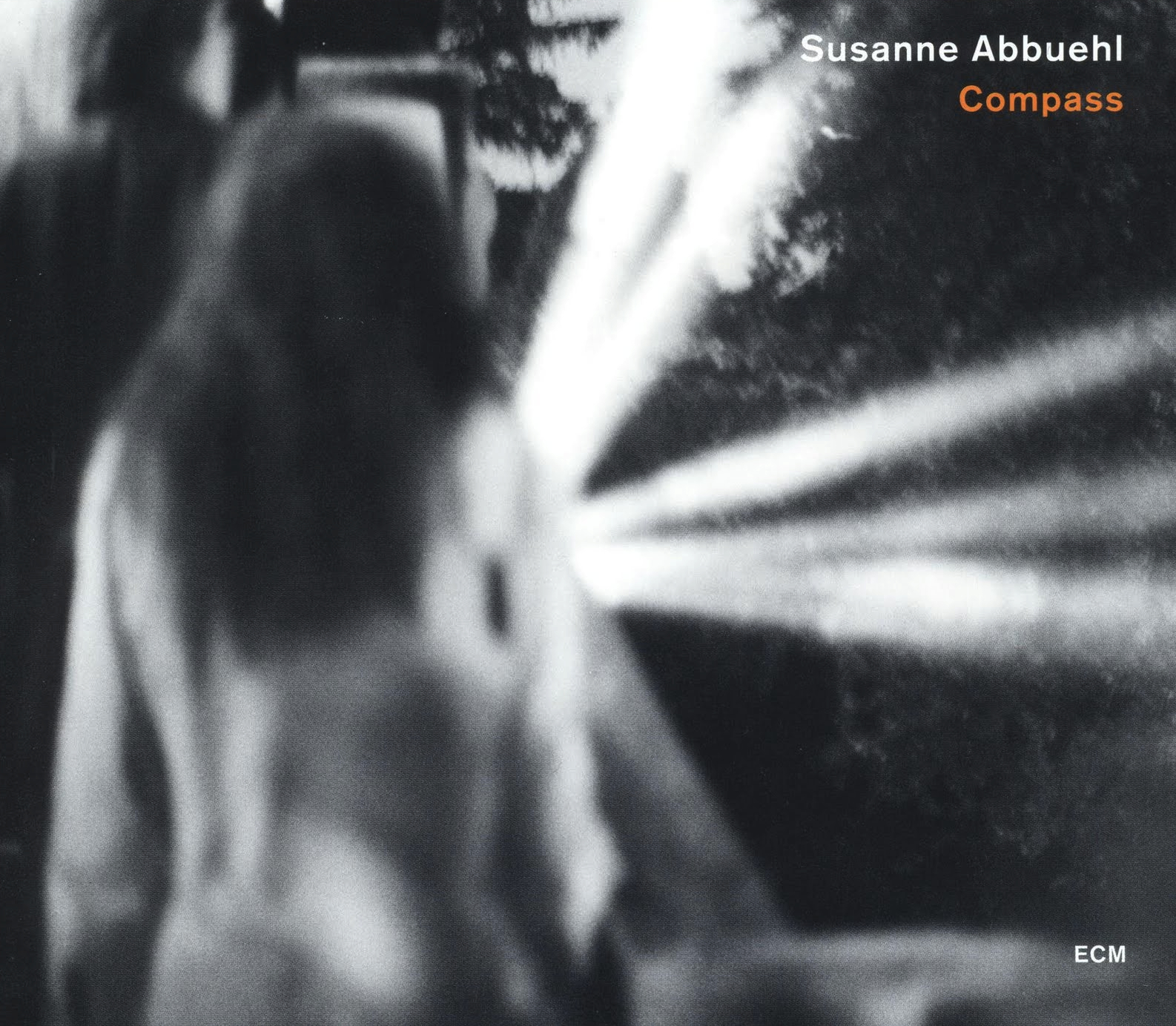
Susanne Abbuehl voice Wolfert Brederode piano Christof May clarinet, bass clarinet Lucas Niggli drums, percussion Michel Portal clarinet (on two tracks)
Recorded January 2003 and October 2004 at Rainbow Studio, Oslo
Engineer: Jan Erik Kongshaug
Produced by Manfred Eicher
Leave dreams to the dreamers That will not after, That song and laughter Do nothing move. –James Joyce
Compass is more than the title of Susanne Abbuehl’s sophomore ECM album. It is also a physical manifestation of the singer’s artistry. The compass guides with a needle fluid and true, trembling at the slightest change in direction to indicate north. Aiding Abbuehl in this navigation is pianist Wolfert Brederode, clarinetist Christof May, and drummer Lucas Niggli over a span of 12 songs. The number implies a compass of a different register—the clock—and grander others—the solar system, and by extension the Milky Way (hence, perhaps, the cover of her label debut, April)—which dictate the sweep of the clock’s hands with such precision that mortal instruments can only sample a simulacrum of their taste.
That said, Abbuehl’s originality in a planetary system of so-called “jazz vocalists” spins like an instrument celestial, an undiscovered body whose reflection shines through the introductory telescope of “Bathyal.” The words and music are her own, emerging from a primal bass clarinet, dark as the sun is bright, as a vessel down the piano’s river run. The feeling of water, overwhelming enough to drown out the noise of the world, carries also a promise of depth in nature, its tickling spray a mist of love. “Do not run just yet / Do not hide,” she implores: less a challenge to the listener than it is to her own emotions, without which the album’s remainder would fade along with the salmon in their streams.
Two selections—“Black Is The Color…” and “Lo Fiolairé”—from Luciano Berio’s Folk Songs are subjected to unique investigation. The words are carried along by a rather different current, this of charcoal in the form of two clarinets (Michel Portal provides the second reed). In her bare renditions, Abbuehl underscores the power of melodies to overcome the means of their expression. Tied in a braid of lyrical hair, their elements grow along an ebony trail of origins in strands of night and shadow. The Berio inclusion hints at a less obvious connection to the poetry of James Joyce, whose words the Italian composer set to music in 1953, as does Abbuehl for the new millennium. Here she draws inspiration from the same collection, 1907’s Chamber Music. These revivals come in the form of “The Twilight Turns From Amethyst,” “Bright Cap And Streamers,” and “In The Dark Pine-Wood.” In them lies another version of the album’s eponym: as color wheel in the painter’s hand (yellow, as Abbuehl sings later in William Carlos Williams’s “Primrose,” is not a color, but is among other things a shadow). Their circadian approach to worldly being bleeds through the clarinet’s fleshy overlap, a call for unity through real-time calculations of difference. Brederode’s keyboard—the ever-present messenger, the mournful traveler who finds beauty in rest—carves a hovel in every tree along the way, until only a shell of the journey remains. Joyce breathes also through “Sea, Sea!” This song from Finnegan’s Wake outlines a bridge, a meeting of souls across unfathomable expanse, and weaves a basket of alliterations against Niggli’s earthen percussion.
Chinese poet Feng Menglong of the late Ming dynasty rises from the deep in “Don’t Set Sail,” a love poem that is about as hopeful as the waves it fears—although with Brederode behind her, Abbuehl needs no oars. This song pairs hauntingly with the last track, which in having brought us over water now keeps us from it, under threat of storm and chop. A potent metaphor for the solitary heart. Sun Ra’s “A Call For All Demons” unearths deeper loneliness, washed in mercury, while “Children’s Song No. 1,” comes from Chick Corea’s landmark collection of piano miniatures, turns the Tarot card over to reveal a bluebird’s Empress flight.
Although “Where Flamingos Fly” is a jazz standard (the album’s only), it feels the least familiar in the present company. Its distance is emphasized by the soulful clarinet, of which the rasp of breath and wood runs its fingers along the edge of every utterance. Like the album as a whole, it finds in its source a new seed to sprout. In light of this, to call Abbuehl’s arrangements understated would itself be an understatement. Sparse though they are, their awareness of negative space is as thick as the pitch that holds the stars in place.
John Surman soprano and baritone saxophone, bass clarinet Jack DeJohnette drums, piano London Brass Recorded live June 2001 Queen Elizabeth Hall, London
Recording engineers: Steve Lowe and Ben Surman
Mixed January 2002 at Rainbow Studio, Oslo by Jan Erik Kongshaug, John Surman, and Manfred Eicher
Executive producer: Manfred Eicher
Free and Equal, John Surman’s furtherance of intermingling genres, is its own animal. Under its original title of That’s Right, it was the culmination of a 2000 festival commission and premiered in October that same year. The performance recorded for ECM comes from 2001, giving the work some time to incubate, as did subsequent mixing in Oslo’s Rainbow Studio under the direction of its composer, engineer, and producer.
Nods to classical and jazz modes are a clear and present danger throughout, for the purpose of their coexistence is not to mash them into some new hybrid but rather to flag their common goal: namely, to move listener and performer alike. Surman is joined by drummer Jack DeJohnette (also on piano) and classical stalwarts London Brass in an atmospheric tour de force that departs considerably from such previous experiments as Proverbs and Songs. The instrumentation alone would seem to imply a big band experiment à la Surman’s robust work with John Warren (see The Brass Project), but such is not the case. Neither should the DeJohnette connection, already well honed on Invisible Nature, foster misperceptions of what’s going on here. For as Surman paints the canvas with his soprano oils amid the swells of “Preamble,” it’s clear that freer considerations are at play. DeJohnette’s pianism, heard only occasionally on disc, proves descriptively apt in the follow-up “Groundwork,” which loops bass clarinet through trumpet in an evolving macramé of melody. Here, as elsewhere, Surman finds seemingly impossible paths for his improvisations through growing mazes of gold. Such balancing of the minimal and complex is no small task, and the establishment of that balance highlights their mutuality. It is in this spirit, perhaps, that DeJohnette doesn’t pick up his drumsticks until ten minutes into the album, working into “Sea Change” with the crash of surf in his cymbals, the heave of ocean waves in the brass choir at his back. His moments of abandon are thus kept within sight.
Soloists among the London players strengthen the marrow of this nine-part suite. The tuba soliloquy that opens “Back and Forth,” for one, gives an edible sense of textural contrast. Punctual and enlivening, it signals the first in a series of hardenings and dissolutions, from which trombone throws streams of light and draws Surman’s low reed into an invigorating trio with skins. Likewise, “Fire” traces the multifarious paths of its namesake through a modified trio of drums, trumpet, and bass clarinet. The latter continues its coppery speech in “Debased Line” with a nostalgia and restlessness of spirit that embodies Surman’s passion as a musician. “In the Shadow” evokes Paul McCandless in its sopranism, which floats over a relatively aggressive waltz in the background and sparks an ensemble-wide reaction in the title portion. Virtuosity is on full display as Surman looses his wilder side and fuels DeJohnette’s closing protraction. The drummer cracks many dams in the “Epilogue,” emptying into an open sea of well-earned applause.
Filled with exciting music that creates and maintains its own standard, Free and Equal represents an evolutionary leap in Surman’s compositional thinking. His uncanny ability to be at once joyful and mournful in a single arpeggio has elsewhere never been so explicit. It is music that begs for dancers or the flicker of a cinema screen—a vast, organic machine that runs on the promise of another listen.
Stephan Micus acoustic guitar, nay, sarangi, voice, flowerpots, spanish guitar, Bavarian zither, suling
Recorded January 1981 at Ibiza Sound Studio and October 1981 at Tonstudio Bauer, Ludwigsburg
Engineers: Manfred Ballheimer and Martin Wieland
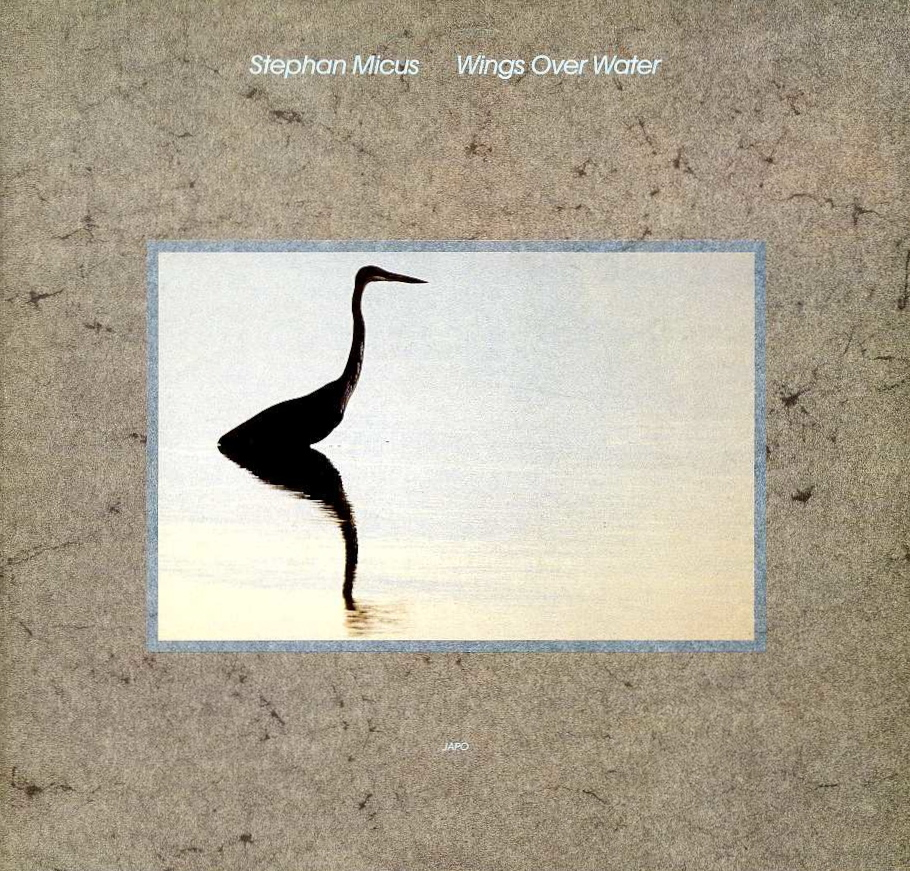
Wings Over Water is the third of five JAPO outings—the most by any artist on ECM’s sister label—by Stephan Micus. Featuring a rare turn by the intrepid multi-instrumentalist on that most quotidian tool of accompaniment, the guitar, it spins a web of enchantment across six numbered parts.
Part 1 uses the guitar to anchor that very web, its strings flexing before a soul-piercing tongue. The ney (an end-blown flute of the Middle East featured prominently in Micus’s work across the decades) is the breath behind it, a servant of the molecules swimming through its porous tunnel. These encirclings open a space into which the listener might step. Thus surrounded in the comfort of these repetitions, s/he may find that the ney’s improvisational flights have similarly taken solace within. Every rhythmic lapse is a micro-phase of organic awareness, attuned to said listener, to the perfect imperfection of things, which like the bird framed in the album cover photograph is austere yet warped in reflection. Gazing and gazed upon, it is self-sufficient, fragile as wind.
Part 2 gives insight into Micus’s unique approach to the sarangi, which in taking on such percussive function provides undulating waves for Micus’s voice and stretches arcs of flight over a ceramic pulse of flowerpots.
Part 3 rises from the mountains through the rusticity of a Spanish guitar and holds in its hands a dimly lit star, hewn in mineral and soil. The guitar becomes an agent of solace, its sound a meditation on meditation—two mirrors held soul’s distance apart and compounded by the interest of infinity. Flowerpots lend their pacing to the skeleton, marrying Sephardic and Southeast Asian influences by way of natural ligaments. The piece ends as it begins: in hermetic garments, tattered yet resilient to the elements, in fact becoming an element unto itself.
Part 4 is a spiritually unbound ney solo, an avian dream that remembers when sustenance was easier to come by, when one could freely roam the air currents to find all that was needed.
Part 5 is an open letter written in the language of flowerpots to the very cosmos. Its paths are as vast and unknowable as Nazca lines, a runway for the ether, embodied in ney and mapped by less visible instruments. Beats rise above the waterline, the breath an unbroken promise of sailing.
Part 6 unfolds, like Part 3, with hints of Andalusian soil. Joining Spanish guitar with Bavarian zither, it unleashes sweeping gardens of profusion, which then quiet to support the lilt of a suling (Indonesian bamboo ring flute) and with it sink into the ocean of forgetting.
An expressly visual journey that skips across rice paddies, this music moves as water strider on pond, and leaves in its wake the promise of a good harvest. It is a vestibule from the rain, a haven where bodies stretch in anticipation of sun.
Abdullah Ibrahim piano
Recorded live on October 22, 1969 at Jazzhus Montmartre, Copenhagen
South African pianist-composer Abdullah Ibrahim (born Adolph Johannes Brand), still performing at the time of this 1969 live album under the moniker “Dollar” Brand, unleashed a mastery so enticing on African Piano, it’s a wonder that any of the folks at the club where it was recorded had the resolve to treat it as background to their dining. By the same token, reinforcement of that fact by constant ambient noises renders Ibrahim’s performance all the more sacred by contrast.
Amid a sea of chatter, cleared throats, and sudden intakes of breath, he breaks the surf with the gentle yet hip ostinato of “Bra Joe From Kilimanjaro,” working meditative tendrils into the bar light. Over this his right hand brings about an explosive sort of thinking that spins webs in a flash and connects them to larger others. With clarion fortitude, he drops bluesy accents along the way: a trail of crumbs leading to “Selby That The Eternal Spirit Is The Only Reality.” Ironically (or not), this is the most solemn blip on the album’s radar and blends into the ivory tickling of “The Moon.” Here Ibrahim’s heartfelt, dedicatory spirit comes to the fore, proving that, while technically proficient, he possesses a descriptive virtuosity that indeed evokes a pockmarked surface lit in various phases, harnessing sunlight as if it were skin in dense, vibrating harvest. The kinesis of this tune is diffused in the tailwind of “Xaba,” which then flows into “Sunset In Blue.” Ibrahim’s ancestral awareness is clearest here. The level of respect evoked for both the dead and the living lends a ritualistic quality by virtue of tight structuring, which despite hooks at the margins flies freely in its magic circle. “Kippy” is a smoother reverie with flickers of flame. A beautiful amalgam of measures and means, it slips an opiate of reflection into its own drink. After this, the intense two minutes of gospel and downward spirals that is “Jabulani—Easter Joy” takes us into “Tintinyana,” thereby crystallizing the album’s flowing energies. Tracks bleed into one another: they runneth from the same cup, their spiritual resonance deep and true.
African Piano is a gorgeous, thickly settled album, but one that is always transparent when it comes to origins. Such is the tenderness of Ibrahim’s craft, which speaks with a respect that transcends the sinews, muscles, and eardrums required to bring it to life. It finds joy in history, connecting to it like an Avatar’s tail to steed.
Herbert Joos fluegelhorn, bass, bass recorder, bamboo flute, mellophone, trumpet, alto horn, vibes
Recorded July 1973 at Tonstudio Bauer, Ludwigsburg
Engineer Carlos Albrecht
Produced by Herbert Joos
The Philosophy of the Fluegelhorn is Herbert Joos’s first of two albums for ECM’s sister label JAPO, the second being Daybreak. Where the latter was a lyrical, if longwinded, excursion, the former is something of a meta-statement for the German renaissance man—not only because he plays a bevy of overdubbed instruments, but also because its freer detailing gives pause over the sheer depth of realization.
The title track draws us into the outdoors, where field-recorded birds—and, among them, Joos’s horn—populate the trees with temporal awareness. Sibilant breath and popping bamboo flutes share the entanglement: the rhizomatic spread of Joos’s becoming-animal. Following this undulating prelude, “The Warm Body Of My True Love” opens the stage, a halved and hollowed whole. The nature of this soliloquy must be sought out in stirrings of life, excitations of molecules, and less definable physical properties. The horns are trembling, universal. “Skarabäus II” is of similarly finite constitution, navigating passage into darker dreams and adding to those horns a string’s uncalled-for response to the question of existence. Braided offshoots of trumpet fly around one another, each carrying its own flame of obsession. Next is the smooth and sultry “Rainbow.” Tinged by the alcoholic sunset of vibes, it is a hangover not yet shaken for want of the altered perspective. The squealing litter of horns that is “The Joker” segues into “An Evening With The Vampire.” Bathed in the sounds of nine arco basses, it enacts a morose ending to an otherwise luminescent session. Its sul ponticello screams recall George Crumb’s Black Angels and spin the echo-augmented horn like a chromatic Ferris wheel until the breath stops.
If you’ve ever been curious about Joos but didn’t know where to start, then by reading this you’ve already put your hand on the knob. Just turn it.
Jack DeJohnette drums, cymbals, gongs Pierre Favre drums, cymbals, gongs Fredy Studer drums, cymbals, gongs Dom Um Romão percussion, gongs David Friedman flat gongplay, vibes, marimba, crotales George Gruntz gongs, keyboards, synthesizer, crotales
Recorded September 20, 1977 at Wally Heider Studios, Los Angeles
Engineer: Biff Dawes
Mixing: Georg Scheuermann and Manfred Eicher
Producer: Robert Paiste
Late Swiss composer, multi-instrumentalist, and artistic director George Gruntz (1932-2013) left behind a long and fruitful trail, one that intersected with ECM twice: once for the label proper as Theatre and before that for JAPO in the form of Percussion Profiles. The eminently influential Gruntz assembles here a veritable Who’s Who of the rhythmic circuit at the time of its recording (1977): namely, Jack DeJohnette, Pierre Favre, Fredy Studer, Dom Um Romão, David Friedman, and Gruntz in the architect’s chair on synths and keyboards. The project speaks less to Gruntz’s big band experiments than it does to his classical roots. Dedicated to Paiste brothers Robert (who also produces) and Toomas, the piece is a bona fide percussion concerto that approaches its performers as equal elements in a larger chemistry.
The piece is divided into six Movements, each illuminating a facet of the whole. Movement 1 introduces the pleasant blending of registers—from twinkles to full-throated calls—that defines the album’s broad trajectory. Like the sun on a cloudy day, its light shines variedly: sometimes in floods, sometimes in winks and flashes, but always with a clear conscience. There is a sensitivity of expression here that tells the stories of chamber music in the language of the Serengeti. Movements 2 through 4 bring out a veritable bouquet of fragrances: briny ocean (laced with intimations of birdsong and splashes of electronic marginalia), undercurrents of metal and oil, and resonant drones share a path toward the masterful “Movement 5.” This last opens in a vocal flower, which cups in its petals a sparkling array of notions and potions. The histrionic ways of this piece make it a beguiling standout, akin to Marion Brown’s Afternoon Of A Georgia Faun. Here is where the visuality of his medium is most apparent. If this record is a house, this movement enacts a thorough cleaning of its basement. Rusted tools and unused others share conversations of things past. Stuck between the water-damaged photographs and listless rodents are fortuitous becomings, blips and dots and dashes, sputtering pipes and creaking infrastructure. These are the feelings within, the memories of which “Movement 6” is a snare-inflected shadow, a spacy ride through keyboard textures and xylophoned exeunt.
Those who admire the work of Edgard Varèse will find much to sink their teeth into in Percussion Profiles, which begs repeated, unaccompanied listening, if only for its level of detail. A memorable rung on the JAPO ladder, and worth the climb to get there.
Adventurous ECM listeners will undoubtedly be familiar with Joe and Mat Maneri. The father and son team were known for offering their uncompromising microtonal adventures without fear, expectation, or agenda. The music sang with a voice within a voice. Although Joe has sadly passed from this realm, his relentless passion and pursuit of knowledge live on in his recorded work and in the endeavors of his multi-talented sons. Among that progeny stands Abe Maneri, a musically unquenchable soul who has been quietly making independent recordings for years on his own quest for sonic truth.
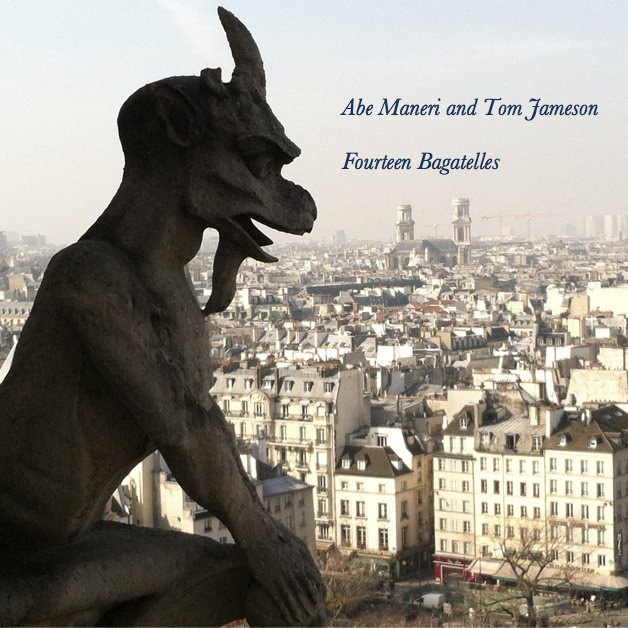
Music has followed Abe, as Abe has followed music, his entire life. An instrumental renaissance man, he plays violin, cello, piano, recorders, guitar, percussion, clarinet, and also sings. Collaborations have placed him alongside likeminded sound-seekers, including Jessica Jones, Sabir Mateen, Assif Tsahar, and John Medeski, not to mention Joe and Mat themselves. On his latest, Fourteen Bagatelles, Abe is joined by longtime friend and guitarist Tom Jameson. Recorded in Abe’s home studio, the project develops a profound direction in an artist of already broad-ranging interests.
The bagatelle is a short musical selection, typically for piano, with an etudinal, airy feel. It doesn’t reach out and grab so much as caress the listener with intimations of larger mythologies. The form began with Beethoven and its suitcase has received stickers from such other composers as Smetana and Bartók along the way. Abe would be the last to place his efforts among them, but there’s no reason why we shouldn’t accept Fourteen Bagatelles as a worthy contribution to the ever-growing canon of the genre. The album is, regardless of its ancestry, one of deep listening that builds a discursive blend of jazz and classical elements out of “semi-improvised forms.”
Although Abe’s hats are as varicolored as the talent with whom he has performed, consistent in his work ethic is a staunch commitment to bringing out the human element of music making. This is especially true of the new album. Abe tells me as much during a recent phone interview:
“As a musician, in general—and perhaps this comes from my father’s tradition—one of the most important parts of constructing music is honesty of expression. There was a pervasive emotion Tom and I were trying to express, something a little bleak but not entirely hopeless. Often lost in the contemporary dialogue is the human component, and so we consciously set out with no other agenda than to make the best music we could make.”
Indeed, Tom’s soft anchorage in “Melodica and Guitar #1” (all tracks are so named for their combinations, with Abe playing the first listed instrument, Tom the second) is the firmament against which Abe dips his ladle into the horizon. So begins an experience of great beauty and tact, an evocation of places where one can feel caught, certain of some emotional sediment just below the waterline of form. Given its melancholic tinge, these bagatelles more readily recall Valentin Silvestrov’s, which have a mournful undercurrent yet remain true to the essence of their space. It’s a soft reminder that “airy” doesn’t necessarily mean emotionally vapid. “There’s a lot of control that goes into making something seem light,” Abe agrees, “and I think that’s the characteristic. I’m thinking about Haydn and Mozart, both of whom wrote an enormous amount of music which seemed ‘light’ yet in which there is incredible tension, sustained beauty, and control. It’s powerful because you can experience it as background music or as something more complex, depending on how you listen.”
Abe’s words make me think about my recent foray into yoga, a practice which requires unseen control in order to maintain its economy of movement. Mind and body resist the holds, storms brewing in every muscle, but eventually you learn to overcome it (or, rather, become it) and enter into a new self-awareness.
“I can relate to that,” Abe responds. “I think of the melodica tracks in particular, so different from the music I normally do, in which I am freely releasing energy into the air. Playing with Tom takes a certain level of restraint and actually there’s more energy happening within my center that’s not being released in the same kind of push, but it’s being released nonetheless. There’s a unique tension in playing with him. I find myself holding all the ideas in before letting them out. It’s more strategic.”
In light of this, “Melodica and Keyboard” Nos. 1 & 2 sound like fairytales, touched by wind and water and played as if recited. The first is a winding stair into an attic where a single window affords the intermittent blink of a lighthouse. Every sweep leaves a trail along the floor, marking the development of a solitary thought. This heavenly track is the apotheosis of the project. Keyboards creep into a few others, notably twice with guitar in gestures interludinal (“Keyboard and Guitar #2”) and of quieter luminescence (“Keyboard and Guitar #1”). The latter ends a mostly bronzed program with hints of silver. I ask Abe about sequencing.
“It was really constructed and labored. The first track was one of the first things we recorded. There were a few like that which were just obvious in terms of placement, and they worked better the more we sat with them. The last track was always going to be the last track. And from there, it was about logically getting from Track 4 to Track 14, thus forming an organic 45-minute piece.”
Taking this album at the surface level, one might say that Tom is only an accompanist, but with each listen his melodic contributions, his equal level of communication, becomes obvious. Tom is, in a way, the tree to Abe’s cherry blossoms, falling in sheets of pink. Abe elaborates:
“In some ways with Tom there’s a lot of push and pull. For the most part, each of our methods of improvisation and playing do stem from very different mentalities. Tom reasons out complicated passages before coming to the table—at least with guitar, which is not his first instrument. It’s more like orchestration than accompaniment, and my job is to find the best tension within it. We have been playing one way or another for nine or ten years. After a while, it didn’t matter which instruments we played; it was clear we were the same people.”
The lion’s share of the album is realized through combinations of various recorders and guitar. Those with soprano, despite their higher pitches, are actually the most earthly, each a cavern of wingbeats. There is also an elasticity to these tunes that gives them great endurance. The alto foregrounds relatively distorted reflections, which nevertheless retain their shape and open our ears to lessons of pattern recognition. In them are distant, pastoral memories. Tenor and bass recorders make one appearance apiece, moving from elliptical arpeggios and Renaissance accents to a grammar that is almost gloomy in its parsing.
The greatest comfort of Fourteen Bagatelles is that, by the end of its mesmerizing, lyrical dream, listeners can take comfort in the fact they were awake all along. This album is a flashlight in the dark, a means to an end, which is but another beginning. It is for this reason that, pressing PLAY for another go, I find my thoughts wandering to Abe’s father. I distinctly remember the first time I heard Angles of Repose and the new language it was espousing—a language that, although one I’ll never speak, I can at least attempt to translate. I can’t help but conclude with a question about what Joe passed on to him.
“It affects everything. In terms of how I play music, it would be crippling to do anything in relationship to someone that good. It was hard in many ways and took me years to even have the guts to call myself a musician. It took adulthood and separation in order to find my unique voice underneath but I’m also afraid of where I come from and what I learned. Anytime I’m playing, I’m cognizant of the joy of learning music early, of being exposed to radical concepts of improvisation, but he was also an extremely knowledgeable human. His level of knowledge was just so advanced. On the other hand, he was extremely kind and listened very intently, never pushing anyone from what they loved to do. Anytime I’m playing, there are always different voices of Joe that permeate my sensibilities. For one, there is the teacher of harmony. Then there was the Joe Marneri Quartet Joe. Then there was the religious Joe, who had a whole other way of talking. And then there was Joe my dad. The teacher, the radical, the man of God, and dad. Each of these encourage and discourage in different ways. A lot of my determination comes from not thinking about that too much and in being proud of who I am, making music just plain different from that legacy but also coming from it.”
And has he changed as a musician since becoming a father himself?
“It’s had the most positive effect. Almost everything I do is done within that great irony of parenthood: having one twentieth of the free time but making the most of that time, which becomes more focused. Nothing has played more of a role in my creative life, funnily enough, than having no time. It gives you a sense of purpose and direction, imparts an energy, a freshness of purpose.”
It is a purpose we can feel in every note. The cycle continues.
(To order Fourteen Bagatelles and more, check out Abe Maneri online here.)
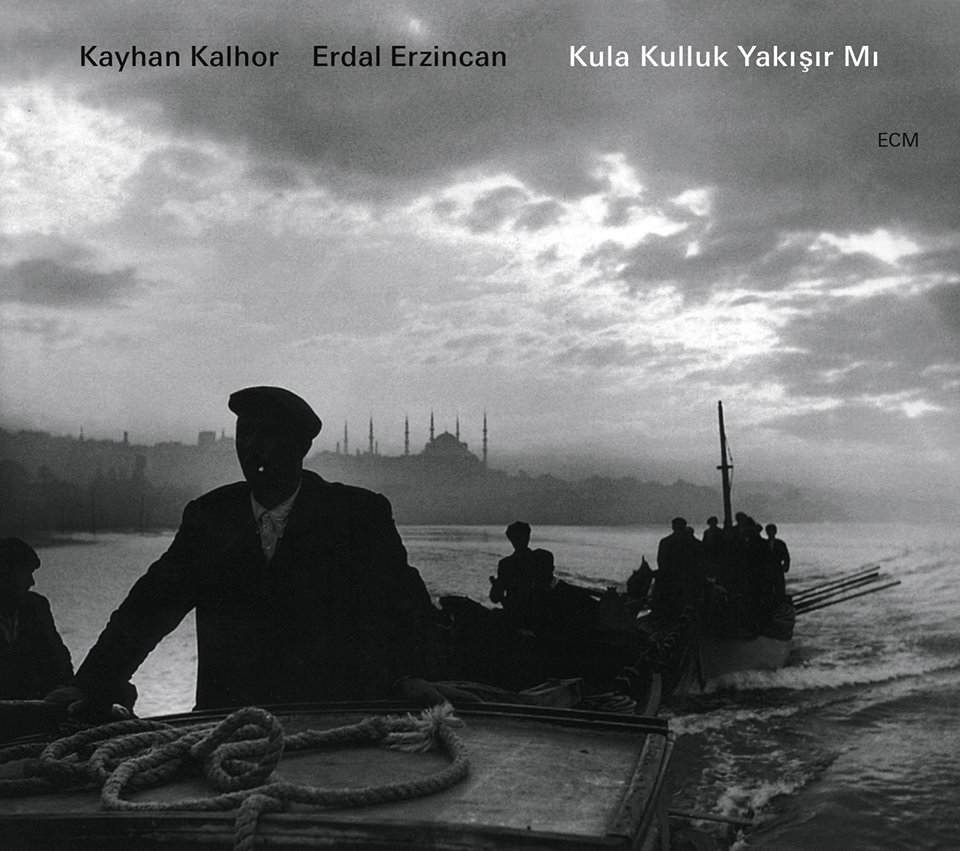
Kayhan Kalhor kamancheh Erdal Erzincan baglama
Recorded live February 2011 at Bursa Ugur Mumcu Sahnesi by Emre Teke
Album produced by Manfred Eicher
In his book Global Minstrels: Voices of World Music, author-musician Elijah Wald describes Kayhan Kalhor, Iranian master of the kamānche (spiked fiddle), as a “one-man cultural ambassador.” As revealed in that same text, Kalhor educates as intensely as he plays, peddling music not as cultural snake oil but as an opportunity to cross divides. Through his collaborations with such influential acts as the Kronos Quartet and Yo-Yo Ma’s Silk Road Ensemble, he has continued to hone his sense of global community. Yet none of his journeys have taken him as far as those with Anatolian virtuoso Erdal Erzincan, whose lithe touch on the bağlama (a Turkish long-necked lute) has proven fire to his smoke. The result of their joint ambassadorship is an exchange of musical interests, passions, and respect in selfless conversation.
Their first collaboration, 2004’s The Wind, introduced a duo that could not only think out loud, but also feel out loud. On that landmark document the heritages of both musicians bore hybrid fruit, with behind-the-scenes assistance from musicologist Ulaş Özdemir, in a program that was equal parts thematic portaging and free sailing. From that debut arose an ongoing collaboration, which on Kula Kulluk Yakışır Mı offers hungry listeners plenty more to digest. This follow-up shares its title, which translates as “How unseemly it is to follow anyone slavishly,” with a folk song by Muhlis Akarsu, a modern bağlama hero whose life tragically ended in the 1993 Sivas Massacre. True to Akarsu’s steadfast character, slavishness is farthest from the reality of this performance, recorded live in Turkey in early 2011.
(Photo by Todd Rosenberg)
On Kula Kulluk Yakışır Mı, Kalhor and Erzincan deepen their mutual interest in improvisation, sprouting five spontaneous leaves from traditional branches in an hour of uninterrupted playing. The first of those improvisations opens to the bağlama’s unique insistence, its oud-like twang foiling the rasp of Kalhor’s horsehairs before shifting into the folk song “Allı Turnam.” This juxtaposition of the unplanned and the internalized sets the pattern.
Although the improvised portions are distinct from their evergreen counterparts, both draw upon the remembered and the unknown. Classical standbys like “Deli Derviş” and the title track inspire cheers of approval and recognition from the audience. At key moments, the musicians get swept up in the power of it all, building from simple elements to powerful abandon. “Daldalan Barı” is a notable highlight of the concert’s first half in this regard, especially for the way in which Kalhor reaches skyward with his notes in the final stretch. Yet the duo saves its most transcendent moment for last when it blends a revisiting of “The Wind” into the multi-part “Intertwining Melodies,” the latter of which braids Persian and Turkish strands in a masterful summation.
With a single gesture, Kalhor and Erzincan manage to turn the “e” of “effect” into an “a,” filtering the golden light of their encounter into a musical experience so physical it would sprout legs and run if it could. These two sages embrace order, even as they convey the chaos of things, turning night into day.
(See this article as it originally appeared in RootsWorld online magazine. To hear samples of Kula Kulluk Yakışır Mı, click here.)
Dear readers: As you may or may not know, I dabble in photography whenever time permits. I’ve just updated my photography site, In a landscape, with photos from the past year, some of which I took in Munich during my ECM sojourn. Hope you enjoy.









 Between Sound and Space: ECM Records and Beyond