Abdullah Ibrahim piano
Recorded live on October 22, 1969 at Jazzhus Montmartre, Copenhagen
South African pianist-composer Abdullah Ibrahim (born Adolph Johannes Brand), still performing at the time of this 1969 live album under the moniker “Dollar” Brand, unleashed a mastery so enticing on African Piano, it’s a wonder that any of the folks at the club where it was recorded had the resolve to treat it as background to their dining. By the same token, reinforcement of that fact by constant ambient noises renders Ibrahim’s performance all the more sacred by contrast.
Amid a sea of chatter, cleared throats, and sudden intakes of breath, he breaks the surf with the gentle yet hip ostinato of “Bra Joe From Kilimanjaro,” working meditative tendrils into the bar light. Over this his right hand brings about an explosive sort of thinking that spins webs in a flash and connects them to larger others. With clarion fortitude, he drops bluesy accents along the way: a trail of crumbs leading to “Selby That The Eternal Spirit Is The Only Reality.” Ironically (or not), this is the most solemn blip on the album’s radar and blends into the ivory tickling of “The Moon.” Here Ibrahim’s heartfelt, dedicatory spirit comes to the fore, proving that, while technically proficient, he possesses a descriptive virtuosity that indeed evokes a pockmarked surface lit in various phases, harnessing sunlight as if it were skin in dense, vibrating harvest. The kinesis of this tune is diffused in the tailwind of “Xaba,” which then flows into “Sunset In Blue.” Ibrahim’s ancestral awareness is clearest here. The level of respect evoked for both the dead and the living lends a ritualistic quality by virtue of tight structuring, which despite hooks at the margins flies freely in its magic circle. “Kippy” is a smoother reverie with flickers of flame. A beautiful amalgam of measures and means, it slips an opiate of reflection into its own drink. After this, the intense two minutes of gospel and downward spirals that is “Jabulani—Easter Joy” takes us into “Tintinyana,” thereby crystallizing the album’s flowing energies. Tracks bleed into one another: they runneth from the same cup, their spiritual resonance deep and true.
African Piano is a gorgeous, thickly settled album, but one that is always transparent when it comes to origins. Such is the tenderness of Ibrahim’s craft, which speaks with a respect that transcends the sinews, muscles, and eardrums required to bring it to life. It finds joy in history, connecting to it like an Avatar’s tail to steed.
Herbert Joos fluegelhorn, bass, bass recorder, bamboo flute, mellophone, trumpet, alto horn, vibes
Recorded July 1973 at Tonstudio Bauer, Ludwigsburg
Engineer Carlos Albrecht
Produced by Herbert Joos
The Philosophy of the Fluegelhorn is Herbert Joos’s first of two albums for ECM’s sister label JAPO, the second being Daybreak. Where the latter was a lyrical, if longwinded, excursion, the former is something of a meta-statement for the German renaissance man—not only because he plays a bevy of overdubbed instruments, but also because its freer detailing gives pause over the sheer depth of realization.
The title track draws us into the outdoors, where field-recorded birds—and, among them, Joos’s horn—populate the trees with temporal awareness. Sibilant breath and popping bamboo flutes share the entanglement: the rhizomatic spread of Joos’s becoming-animal. Following this undulating prelude, “The Warm Body Of My True Love” opens the stage, a halved and hollowed whole. The nature of this soliloquy must be sought out in stirrings of life, excitations of molecules, and less definable physical properties. The horns are trembling, universal. “Skarabäus II” is of similarly finite constitution, navigating passage into darker dreams and adding to those horns a string’s uncalled-for response to the question of existence. Braided offshoots of trumpet fly around one another, each carrying its own flame of obsession. Next is the smooth and sultry “Rainbow.” Tinged by the alcoholic sunset of vibes, it is a hangover not yet shaken for want of the altered perspective. The squealing litter of horns that is “The Joker” segues into “An Evening With The Vampire.” Bathed in the sounds of nine arco basses, it enacts a morose ending to an otherwise luminescent session. Its sul ponticello screams recall George Crumb’s Black Angels and spin the echo-augmented horn like a chromatic Ferris wheel until the breath stops.
If you’ve ever been curious about Joos but didn’t know where to start, then by reading this you’ve already put your hand on the knob. Just turn it.
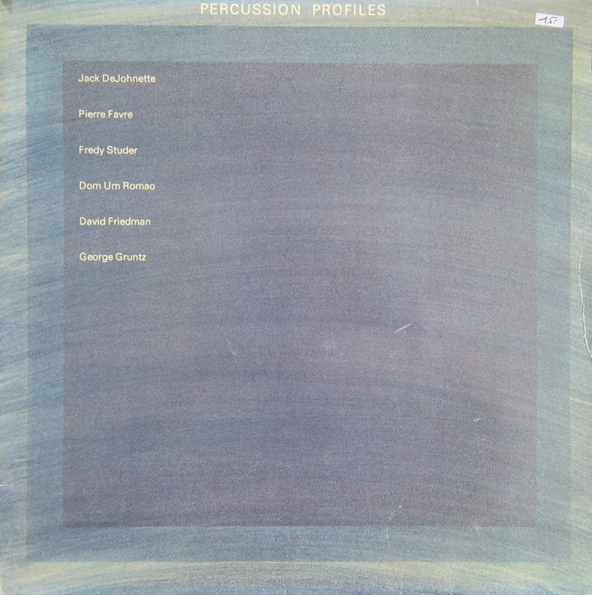
Jack DeJohnette drums, cymbals, gongs Pierre Favre drums, cymbals, gongs Fredy Studer drums, cymbals, gongs Dom Um Romão percussion, gongs David Friedman flat gongplay, vibes, marimba, crotales George Gruntz gongs, keyboards, synthesizer, crotales
Recorded September 20, 1977 at Wally Heider Studios, Los Angeles
Engineer: Biff Dawes
Mixing: Georg Scheuermann and Manfred Eicher
Producer: Robert Paiste
Late Swiss composer, multi-instrumentalist, and artistic director George Gruntz (1932-2013) left behind a long and fruitful trail, one that intersected with ECM twice: once for the label proper as Theatre and before that for JAPO in the form of Percussion Profiles. The eminently influential Gruntz assembles here a veritable Who’s Who of the rhythmic circuit at the time of its recording (1977): namely, Jack DeJohnette, Pierre Favre, Fredy Studer, Dom Um Romão, David Friedman, and Gruntz in the architect’s chair on synths and keyboards. The project speaks less to Gruntz’s big band experiments than it does to his classical roots. Dedicated to Paiste brothers Robert (who also produces) and Toomas, the piece is a bona fide percussion concerto that approaches its performers as equal elements in a larger chemistry.
The piece is divided into six Movements, each illuminating a facet of the whole. Movement 1 introduces the pleasant blending of registers—from twinkles to full-throated calls—that defines the album’s broad trajectory. Like the sun on a cloudy day, its light shines variedly: sometimes in floods, sometimes in winks and flashes, but always with a clear conscience. There is a sensitivity of expression here that tells the stories of chamber music in the language of the Serengeti. Movements 2 through 4 bring out a veritable bouquet of fragrances: briny ocean (laced with intimations of birdsong and splashes of electronic marginalia), undercurrents of metal and oil, and resonant drones share a path toward the masterful “Movement 5.” This last opens in a vocal flower, which cups in its petals a sparkling array of notions and potions. The histrionic ways of this piece make it a beguiling standout, akin to Marion Brown’s Afternoon Of A Georgia Faun. Here is where the visuality of his medium is most apparent. If this record is a house, this movement enacts a thorough cleaning of its basement. Rusted tools and unused others share conversations of things past. Stuck between the water-damaged photographs and listless rodents are fortuitous becomings, blips and dots and dashes, sputtering pipes and creaking infrastructure. These are the feelings within, the memories of which “Movement 6” is a snare-inflected shadow, a spacy ride through keyboard textures and xylophoned exeunt.
Those who admire the work of Edgard Varèse will find much to sink their teeth into in Percussion Profiles, which begs repeated, unaccompanied listening, if only for its level of detail. A memorable rung on the JAPO ladder, and worth the climb to get there.
Adventurous ECM listeners will undoubtedly be familiar with Joe and Mat Maneri. The father and son team were known for offering their uncompromising microtonal adventures without fear, expectation, or agenda. The music sang with a voice within a voice. Although Joe has sadly passed from this realm, his relentless passion and pursuit of knowledge live on in his recorded work and in the endeavors of his multi-talented sons. Among that progeny stands Abe Maneri, a musically unquenchable soul who has been quietly making independent recordings for years on his own quest for sonic truth.
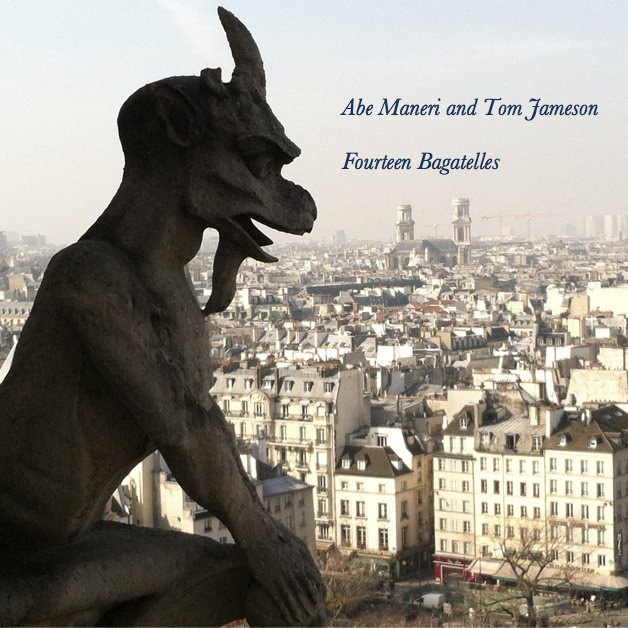
Music has followed Abe, as Abe has followed music, his entire life. An instrumental renaissance man, he plays violin, cello, piano, recorders, guitar, percussion, clarinet, and also sings. Collaborations have placed him alongside likeminded sound-seekers, including Jessica Jones, Sabir Mateen, Assif Tsahar, and John Medeski, not to mention Joe and Mat themselves. On his latest, Fourteen Bagatelles, Abe is joined by longtime friend and guitarist Tom Jameson. Recorded in Abe’s home studio, the project develops a profound direction in an artist of already broad-ranging interests.
The bagatelle is a short musical selection, typically for piano, with an etudinal, airy feel. It doesn’t reach out and grab so much as caress the listener with intimations of larger mythologies. The form began with Beethoven and its suitcase has received stickers from such other composers as Smetana and Bartók along the way. Abe would be the last to place his efforts among them, but there’s no reason why we shouldn’t accept Fourteen Bagatelles as a worthy contribution to the ever-growing canon of the genre. The album is, regardless of its ancestry, one of deep listening that builds a discursive blend of jazz and classical elements out of “semi-improvised forms.”
Although Abe’s hats are as varicolored as the talent with whom he has performed, consistent in his work ethic is a staunch commitment to bringing out the human element of music making. This is especially true of the new album. Abe tells me as much during a recent phone interview:
“As a musician, in general—and perhaps this comes from my father’s tradition—one of the most important parts of constructing music is honesty of expression. There was a pervasive emotion Tom and I were trying to express, something a little bleak but not entirely hopeless. Often lost in the contemporary dialogue is the human component, and so we consciously set out with no other agenda than to make the best music we could make.”
Indeed, Tom’s soft anchorage in “Melodica and Guitar #1” (all tracks are so named for their combinations, with Abe playing the first listed instrument, Tom the second) is the firmament against which Abe dips his ladle into the horizon. So begins an experience of great beauty and tact, an evocation of places where one can feel caught, certain of some emotional sediment just below the waterline of form. Given its melancholic tinge, these bagatelles more readily recall Valentin Silvestrov’s, which have a mournful undercurrent yet remain true to the essence of their space. It’s a soft reminder that “airy” doesn’t necessarily mean emotionally vapid. “There’s a lot of control that goes into making something seem light,” Abe agrees, “and I think that’s the characteristic. I’m thinking about Haydn and Mozart, both of whom wrote an enormous amount of music which seemed ‘light’ yet in which there is incredible tension, sustained beauty, and control. It’s powerful because you can experience it as background music or as something more complex, depending on how you listen.”
Abe’s words make me think about my recent foray into yoga, a practice which requires unseen control in order to maintain its economy of movement. Mind and body resist the holds, storms brewing in every muscle, but eventually you learn to overcome it (or, rather, become it) and enter into a new self-awareness.
“I can relate to that,” Abe responds. “I think of the melodica tracks in particular, so different from the music I normally do, in which I am freely releasing energy into the air. Playing with Tom takes a certain level of restraint and actually there’s more energy happening within my center that’s not being released in the same kind of push, but it’s being released nonetheless. There’s a unique tension in playing with him. I find myself holding all the ideas in before letting them out. It’s more strategic.”
In light of this, “Melodica and Keyboard” Nos. 1 & 2 sound like fairytales, touched by wind and water and played as if recited. The first is a winding stair into an attic where a single window affords the intermittent blink of a lighthouse. Every sweep leaves a trail along the floor, marking the development of a solitary thought. This heavenly track is the apotheosis of the project. Keyboards creep into a few others, notably twice with guitar in gestures interludinal (“Keyboard and Guitar #2”) and of quieter luminescence (“Keyboard and Guitar #1”). The latter ends a mostly bronzed program with hints of silver. I ask Abe about sequencing.
“It was really constructed and labored. The first track was one of the first things we recorded. There were a few like that which were just obvious in terms of placement, and they worked better the more we sat with them. The last track was always going to be the last track. And from there, it was about logically getting from Track 4 to Track 14, thus forming an organic 45-minute piece.”
Taking this album at the surface level, one might say that Tom is only an accompanist, but with each listen his melodic contributions, his equal level of communication, becomes obvious. Tom is, in a way, the tree to Abe’s cherry blossoms, falling in sheets of pink. Abe elaborates:
“In some ways with Tom there’s a lot of push and pull. For the most part, each of our methods of improvisation and playing do stem from very different mentalities. Tom reasons out complicated passages before coming to the table—at least with guitar, which is not his first instrument. It’s more like orchestration than accompaniment, and my job is to find the best tension within it. We have been playing one way or another for nine or ten years. After a while, it didn’t matter which instruments we played; it was clear we were the same people.”
The lion’s share of the album is realized through combinations of various recorders and guitar. Those with soprano, despite their higher pitches, are actually the most earthly, each a cavern of wingbeats. There is also an elasticity to these tunes that gives them great endurance. The alto foregrounds relatively distorted reflections, which nevertheless retain their shape and open our ears to lessons of pattern recognition. In them are distant, pastoral memories. Tenor and bass recorders make one appearance apiece, moving from elliptical arpeggios and Renaissance accents to a grammar that is almost gloomy in its parsing.
The greatest comfort of Fourteen Bagatelles is that, by the end of its mesmerizing, lyrical dream, listeners can take comfort in the fact they were awake all along. This album is a flashlight in the dark, a means to an end, which is but another beginning. It is for this reason that, pressing PLAY for another go, I find my thoughts wandering to Abe’s father. I distinctly remember the first time I heard Angles of Repose and the new language it was espousing—a language that, although one I’ll never speak, I can at least attempt to translate. I can’t help but conclude with a question about what Joe passed on to him.
“It affects everything. In terms of how I play music, it would be crippling to do anything in relationship to someone that good. It was hard in many ways and took me years to even have the guts to call myself a musician. It took adulthood and separation in order to find my unique voice underneath but I’m also afraid of where I come from and what I learned. Anytime I’m playing, I’m cognizant of the joy of learning music early, of being exposed to radical concepts of improvisation, but he was also an extremely knowledgeable human. His level of knowledge was just so advanced. On the other hand, he was extremely kind and listened very intently, never pushing anyone from what they loved to do. Anytime I’m playing, there are always different voices of Joe that permeate my sensibilities. For one, there is the teacher of harmony. Then there was the Joe Marneri Quartet Joe. Then there was the religious Joe, who had a whole other way of talking. And then there was Joe my dad. The teacher, the radical, the man of God, and dad. Each of these encourage and discourage in different ways. A lot of my determination comes from not thinking about that too much and in being proud of who I am, making music just plain different from that legacy but also coming from it.”
And has he changed as a musician since becoming a father himself?
“It’s had the most positive effect. Almost everything I do is done within that great irony of parenthood: having one twentieth of the free time but making the most of that time, which becomes more focused. Nothing has played more of a role in my creative life, funnily enough, than having no time. It gives you a sense of purpose and direction, imparts an energy, a freshness of purpose.”
It is a purpose we can feel in every note. The cycle continues.
(To order Fourteen Bagatelles and more, check out Abe Maneri online here.)
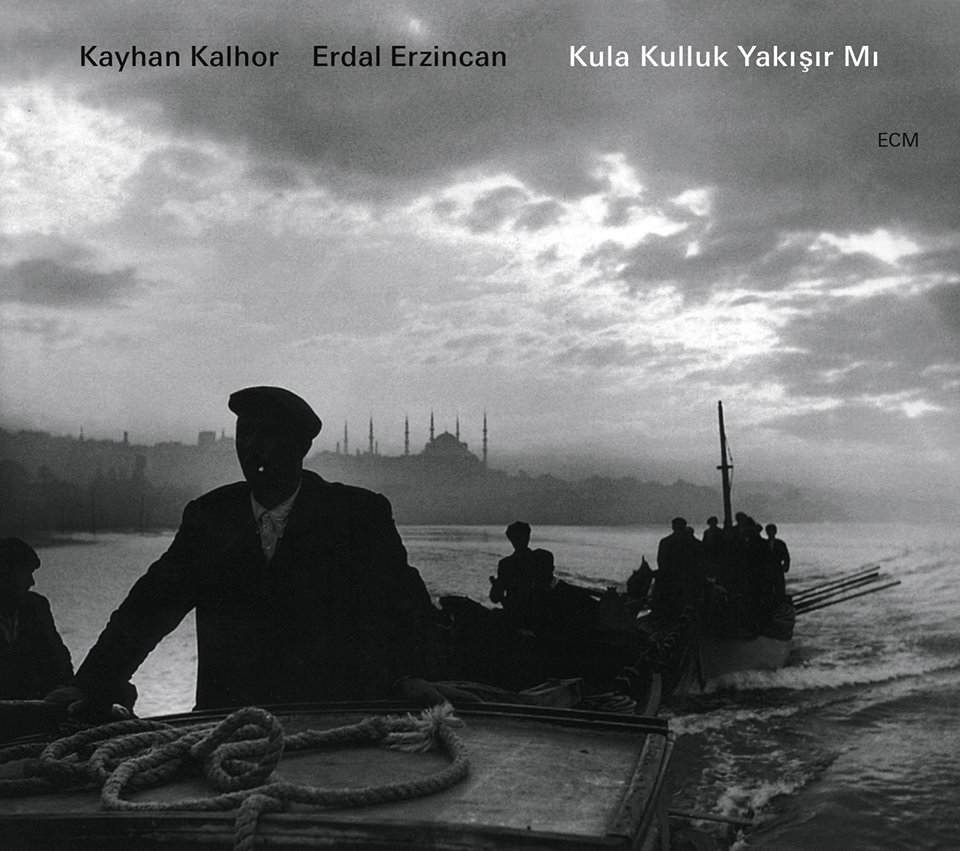
Kayhan Kalhor kamancheh Erdal Erzincan baglama
Recorded live February 2011 at Bursa Ugur Mumcu Sahnesi by Emre Teke
Album produced by Manfred Eicher
In his book Global Minstrels: Voices of World Music, author-musician Elijah Wald describes Kayhan Kalhor, Iranian master of the kamānche (spiked fiddle), as a “one-man cultural ambassador.” As revealed in that same text, Kalhor educates as intensely as he plays, peddling music not as cultural snake oil but as an opportunity to cross divides. Through his collaborations with such influential acts as the Kronos Quartet and Yo-Yo Ma’s Silk Road Ensemble, he has continued to hone his sense of global community. Yet none of his journeys have taken him as far as those with Anatolian virtuoso Erdal Erzincan, whose lithe touch on the bağlama (a Turkish long-necked lute) has proven fire to his smoke. The result of their joint ambassadorship is an exchange of musical interests, passions, and respect in selfless conversation.
Their first collaboration, 2004’s The Wind, introduced a duo that could not only think out loud, but also feel out loud. On that landmark document the heritages of both musicians bore hybrid fruit, with behind-the-scenes assistance from musicologist Ulaş Özdemir, in a program that was equal parts thematic portaging and free sailing. From that debut arose an ongoing collaboration, which on Kula Kulluk Yakışır Mı offers hungry listeners plenty more to digest. This follow-up shares its title, which translates as “How unseemly it is to follow anyone slavishly,” with a folk song by Muhlis Akarsu, a modern bağlama hero whose life tragically ended in the 1993 Sivas Massacre. True to Akarsu’s steadfast character, slavishness is farthest from the reality of this performance, recorded live in Turkey in early 2011.
(Photo by Todd Rosenberg)
On Kula Kulluk Yakışır Mı, Kalhor and Erzincan deepen their mutual interest in improvisation, sprouting five spontaneous leaves from traditional branches in an hour of uninterrupted playing. The first of those improvisations opens to the bağlama’s unique insistence, its oud-like twang foiling the rasp of Kalhor’s horsehairs before shifting into the folk song “Allı Turnam.” This juxtaposition of the unplanned and the internalized sets the pattern.
Although the improvised portions are distinct from their evergreen counterparts, both draw upon the remembered and the unknown. Classical standbys like “Deli Derviş” and the title track inspire cheers of approval and recognition from the audience. At key moments, the musicians get swept up in the power of it all, building from simple elements to powerful abandon. “Daldalan Barı” is a notable highlight of the concert’s first half in this regard, especially for the way in which Kalhor reaches skyward with his notes in the final stretch. Yet the duo saves its most transcendent moment for last when it blends a revisiting of “The Wind” into the multi-part “Intertwining Melodies,” the latter of which braids Persian and Turkish strands in a masterful summation.
With a single gesture, Kalhor and Erzincan manage to turn the “e” of “effect” into an “a,” filtering the golden light of their encounter into a musical experience so physical it would sprout legs and run if it could. These two sages embrace order, even as they convey the chaos of things, turning night into day.
(See this article as it originally appeared in RootsWorld online magazine. To hear samples of Kula Kulluk Yakışır Mı, click here.)
Dear readers: As you may or may not know, I dabble in photography whenever time permits. I’ve just updated my photography site, In a landscape, with photos from the past year, some of which I took in Munich during my ECM sojourn. Hope you enjoy.
Mariinsky Theatre Orchestra
Ignat Solzhenitsyn, Conductor October 7, 2013
Bailey Hall, Cornell University
8:00 pm
The Mariinsky Theatre Orchestra knows how to fill a hall both with people and with sound. Although it boasts a long history, during Monday night’s performance all one could think about were the precious moments at hand. Guest conductor Ignat Solzhenitsyn held the podium like a controlled tempest, injecting just the sort of energy expected of the all-Russian program. The palette at his disposal was accordingly rich with contrast. Smooth yet sometimes-rustic strings meshed with a superb wind section (the true litmus test of any such orchestra), while clarion brass mediated between the two with equal shares of rough and smooth.
Indeed, brass was foremost on the menu in the appetizer: Night on Bald Mountain. Modest Mussorgsky’s 1867 symphonic poem, the first of two in the concert’s first half, was originally titled St. John’s Night on the Bare Mountain and intended to evoke a gathering of witches on that same pagan holiday. Performed in full only posthumously, it was a relative outlier on the concert stage until it famously appeared in Disney’s Fantasia during the penultimate scene of unrequited souls. Such associations remain glued to the piece’s architecture and only served to heighten the opportunity to experience it in person, allowing concertgoers to indulge in their own associations. Its spiraling brilliance and instantly recognizable theme shook Bailey Hall to its core with all the threat of the tornado watch that had been hovering over Ithaca that same afternoon. It was tempting to hold fast to the piece’s backstory, but as the music went on, its motifs growing more distorted with every iteration, it begged to be taken on its own terms.
The same could be said about the rendition of Sergei Rachmaninoff’s Isle of the Dead. Penned in 1909, it was inspired by an engraved reproduction of Arnold Böcklin’s eponymous 1886 painting. The result was a dreamlike concert experience. What became obvious hearing it live, and in such capable hands, was that Rachmaninoff had successfully added a Z-axis of time to the painting’s X and Y of image and atmosphere. The end effect was, despite the dynamic curve, quiet resignation. One must know unrest, it seemed to say, in order to seek rest eternal.
The concert’s pre-intermission programming could not have been accidental, for Rachmaninoff himself conducted the 1909 world premiere of Isle of the Dead in Moscow alongside his Second Symphony and Mussorgsky’s Night on Bald Mountain. More novel, perhaps, was pairing these with the Fifth Symphony (1937) of Dmitri Shostakovich. One can hardly walk through writings about Shostakovich without stepping in the oppressive regime under which he lived. To be sure, he completed his Fifth at the peak of Stalinist Terror, thereby marking his return to the concert hall after a period of creative lockdown (Stalin had denounced the composer as a kink in the machine of Soviet spirit). Musicologists continue to hone from these details a dual-edged sword: Was Shostakovich being patriotic or snide? Does the piece leave us with hope or cynicism?
Yet hearing it “cold,” as it were, one begins to appreciate the variety of signatures in the opening Moderato alone. From the call-and-response of its awakening to its massive punctuation marks toward closure, there was much to admire in being face to face with this symphony. The MTO heightened the Mahlerian qualities of the second movement, a caricature of waltzes boasting many thematic handoffs. The third movement—forever one of the deepest statements in all of 20th century music—was all the more a requiem. It spun a false security by means of string-heavy, cornucopian pathos and haunting tremolos before the concluding Allegro burst onto the scene like a frantic mother in search of a lost child. With sweeping panache and urgency, it brought about triumph with sarcastic grandeur.
Whatever anyone might think about the politics surrounding and embedded in Shostakovich’s score, the MTO reminded listeners that such music is ultimately about the tension of extremes. One must therefore take caution in folding so much moroseness into the batter of Russian music. Such a proposition, of course, softens when we learn that even Igor Stravinsky called Rachmaninoff “six feet two inches of Russian gloom,” but anecdotal and circumstantial evidence do not a lasting message make. Lost in all of this is the music itself, sitting like Rodin’s thinker on an unwavering question: How long before a piece of music can be divorced from the context of its creation and take on a life of its own? Regardless of the answer, this performance was further proof that the power of orchestral music lies not in the strength of its ideological underpinnings, but in the immediacy of its invitation.
(See this article as it originally appeared in the Cornell Daily Sun.)
With the posting of my latest review (Always Let Me Go by the Keith Jarrett Trio), I have reviewed the first 800 albums in the ECM catalogue. These, combined with the numerous random others I have reviewed from later on, leave me with only about 250 more to go before I reach synchronicity with the label’s tireless releasing. As I progress toward that goal, so far three and a half years in the making, I want to reiterate my sincere gratitude for those who’ve stuck with me this long. Along the way, I’ll continue chipping away at the JAPO albums, of which 17 out of 41 remain. Onward I go!
Keith Jarrett piano Gary Peacock double-bass Jack DeJohnette drums
Recorded April 2001 at Orchard Hall and Bunka Kaikan, Tokyo
Recording Engineer: Yoshihiro Suzuki
Produced by Manfred Eicher and Keith Jarrett
Keith Jarrett is infinity with two hands. Few have ever molded the keyboard into such prosthesis of expression. Yet while he and his nonpareil cohorts—bassist Gary Peacock and drummer Jack DeJohnette—have repeatedly proven affinity for expanding, sometimes breaking down, the borders of many a jazz standard, relatively miniscule in the trio’s archive is its entirely unscripted output. And while we have gotten tastes of that archive in such albums as Inside Out and Changeless, this double-disc release is formidable for being, from start to finish, purely in the moment. One of the beauties of the album, recorded live in Tokyo over two nights, is that the longer pieces (upwards of 35 minutes) are actually the most concentrated, while the briefer ones (the shortest being under four minutes) are spacious and flossy.
At 32 minutes, “Hearts in Space” is a vivid example of the former. Jarrett opens the pathway with some galactic patterning indeed, which his rhythmatists then re-craft into a drum-infused satellite, its circuits frantic yet pure. The bassist is, in fact, the fulcrum of this opener, although Jarrett and DeJohnette do more than simply lob quasars of activity over him. Together these three strands form a braid stronger than the sum of their parts. Through their art, the surrounding air becomes enigmatically complete, so that even as the mood brightens onto a smoother avenue, where Jarrett has crushed the gravel so finely that the shocks of presumption no longer need bounce, one can still feel the storm in the calm. With Peacock’s intimate scaffolding behind him, Jarrett perseveres through some swing into a spontaneous standard, leaving a tailwind to inhale its absence.
Jarrett exhales “The River” with rearview mirror tilted anew. His glassine block chords and trailing chromatics weave a reverie so holy, tender, and mild that it sings without words. Following naturally from this is “Tributaries,” which paints with DeJohnette’s cymbal droplets, Peacock’s broad ripples, and Jarrett’s fairy-steps an image of mythical cast. The musicians’ trembling glitters like gold at the bottom of the Rhine, describing it not as temptation or curse, but out of a love of ignorance, of travel and movement. DeJohnette’s toms ease us onto the spiritual angles of this scene in arching ritual, tightening even as they loosen in shimmering afterglow. The drummer leads further in “Paradox,” pouring copious amounts of bourbon onto Jarrett’s jagged rocks while Peacock savors every sip with mmms of approval. An inherent free spirit works its way through the fissures here especially, manifesting as audible smiles.
Another pianistic reverie rises and falls throughout “Waves” like the chest of personified time. Peacock creeps into frame, his bass neck a periscope in search of land. This it finds, lured by the sun-glitter of cymbals. Once ashore, the trio hits the sand running, gathering provisions and making shelter in the blink of an eye. The end effect, although illusory, bleeds in tectonic shifts and opens dynamic memories across genres and histories. This summary approach takes deepest root in DeJohnette’s explosive wellsprings and rat-a-tatted closing statements and brightens his torch in the consonant admixture of children’s riddles and adult solutions that is “Facing East.” Its island hopping ways spill over into “Tsunami,” which like its eponym begins with imperceptible bubbles and curling undercurrents. By the time one realizes its proportions, its power cannot be avoided. So it crashes, leaving stillness and piles of grief. In the aftermath is “Relay,” a buoyant circumscription of energy that, by virtue of its dotted boundaries, leaves the trio free to roam inwardly to heart’s content where the external world will not allow.
Always Let Me Go may not be to everyone’s liking, but it was undoubtedly gifted with everyone in mind. In it are the dreams of a gentle giant, together a fraction of some unquantifiable composition. Although the giant may stir, the spell is never broken. It waits for that window of slumber to open and welcome us to the fold of its light.








 Between Sound and Space: ECM Records and Beyond