Bobo Stenson Trio: Goodbye (ECM 1904)

Goodbye

Bobo Stenson Trio
Goodbye

Bobo Stenson piano
Anders Jormin double-bass
Paul Motian drums
Recorded April 2004 at Avatar Studios, New York
Engineer: James A. Farber
Produced by Manfred Eicher

Bobo Stenson’s trio projects have brought a host of eclectic programs to fruition in ECM’s choicest studios. Like label mate Tomasz Stanko, the Swedish pianist’s repertoire is a balancing act of adventure and return. As with the follow-up, Cantando, the present session draws from classical sources (Henry Purcell’s flavorsome “Music For A While”), protest songs (Vladimir Vyotsky’s “Song About Earth,” here something of a meta-statement), standards (Stephen Sondheim’s “Send In The Clowns” and the title tune by Gordon Jenkins), and Latin American music. All of this and more, including new material by Stenson and bassist Anders Jormin, in addition to some tried and true from drummer Paul Motian. Goodbye is the first recorded meeting of these three greats, who comb the pelt of the cosmos until it glistens.

Whether by stick or by brush, Motian’s touch is meticulously impressionistic, reactive, and aware. His slipperiness is recognizable from the first quiver of the Sondheim classic. He adds so much patina to its well-polished surface, locking rough into smooth like the teeth of a zipper. Those unmistakable brushes continue to beguile in “Alfonsina,” which comes from the pen of Argentine composer Ariel Ramírez. We feel more than hear Motian as he blends into Stenson’s exquisite pianism with all the selflessness of a shadow. Only in the fourth track, “There Comes A Time” (Tony Williams), does he change over to sticks. Hooked on Jormin’s arm, he elicits a certain sweetness, fleeting as mist at sunrise. For his own tunes, “Jack Of Clubs” and “Sudan,” he overturns melodic warmth in spades and dips into resolution as might a painter into crimson. These share in the album’s concluding spate of briefer numbers, along with Stenson’s “Queer Street” and Jormin’s “Triple Play”—both tantalizing.

The bassist enlivens the set with three further tracks, shifting from the stark poetry of “Seli” to the more flexible “Allegretto Rubato” at the flick of a wrist. It is “Rowan,” however, that regards the listener most enigmatically. It lives below the water’s surface, gazing at its own reflection until it can no longer swim. Stenson weeps here with the viscosity of a maple tree. Of that tree, the leaf that is Ornette Coleman’s “Race Face” swings freely, making the jive sound so easy when in truth we can hardly comprehend the paths taken to get here.

Regardless of length, every bit of this moody and often-melancholic set feels complete. This is a jazz of evaporation; not the work of a trio but the feeling of another climate.

Bobo Stenson Trio: Cantando (ECM 2023)

Cantando

Bobo Stenson Trio
Cantando

Bobo Stenson piano
Anders Jormin double-bass
Jon Fält drums
Recorded December 2007 at Auditorium Radio Svizzera Italiana, Lugano
Engineer: Stefano Amerio
Produced by Manfred Eicher

After the epic statement that was Serenity, the Bobo Stenson Trio reshuffled not only its personnel (Jon Fält replaces Jon Christensen, by way of Paul Motian, on drums) but also its sources. Cantando takes these changes in stride, as is clear from the swish and sparkle that unwrap “Olivia.” The opener is by Cuban songwriter Silvio Rodríguez, whose left-leaning politics find traction in the haunting backpedaling toward the end, gelling in wordless spirit like a lake in winter. Astor Piazzolla’s “Chiquilín de Bachín” dips again into Latin American material. This is Fält’s moment, as he brings a painter’s awareness of color and nuance to bear on a groovy ride. Yet Jormin is the head and tail of this Ouroborous, adding much with his amplified amethyst sound. Overall, he is an even more defining presence than usual, ever evolving his navigation of Stenson’s winding turns of phrase. As composer, the bassist offers two tunes. “M” is the more swinging of the two, while “Wooden Church” spins a matrix of liturgical and secular impulses, especially in his solo, which scuttles through the walls like a mouse who knows his way blind. Jormin shines further in the loosened fray of Stenson’s night throughout “Pages,” which culls four of seven pieces freely improvised in the studio. Curious and enchanting, they give rare insight into the art at hand.

Cantando rounds out with a handful of tributes. “Don’s Kora Song” gives props to the late Don Cherry, whose far-reaching sense of mood and timing translate well into Stenson’s world. His mechanical yet intuitive precision in the left-hand ostinato reminds us that all music has a heartbeat. The obscure Ornette Coleman tune “A Fixed Goal” betrays its tongue-in-cheek title in a series of moving targets, of which Jormin’s are the blurriest. Nestled snug against a forward-thinking take on the standard “Love, I’ve Found You” is Alban Berg’s “Liebesode.” A sarangi-like intro evokes stretches of dunescape before the piece’s thick description balances the raw and the cooked in delicious proportion. Last is “Song Of Ruth.” Written by the late Czech composer Petr Eben and recorded here just two months after his passing, it follows wherever gravity may lead. It pulses on forested borders, cut from the cloth of the earth by rivers and footpaths. So veracious is it that it might as well be called “Song Of Truth.” The album contains two versions, a variation of which closes the set, most forthcoming in its philosophies and clothed in the iridescence of its will. Brilliant.

One can always count on Stenson to outdo himself, and this time is no different. He consistently pulls the listener in fresh improvisatory directions, all of which blossom as supply as ever in the spacious engineering, courtesy of Stefano Amerio in Lugano. This trio, in every incarnation, is a book unto itself: over time the binding relaxes but remains intact. All of which gives metaphorical strength to “Pages,” smelling still of the glue that holds them together.

(To hear samples of Cantando, click here.)

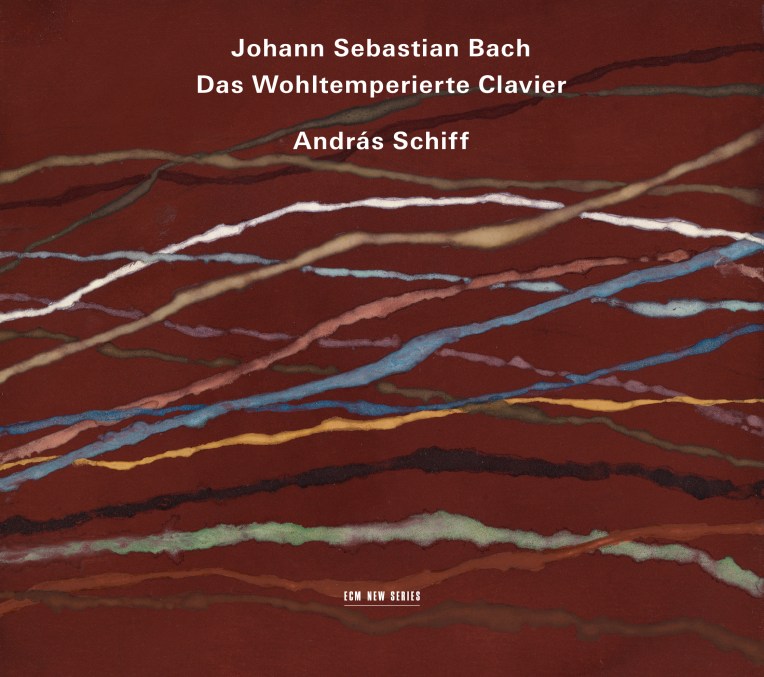
Bach: Das Wohltemperierte Clavier – Schiff (ECM New Series 2270-73)

2270-73 X

Johann Sebastian Bach
Das Wohltemperierte Clavier

András Schiff piano
Recorded August 2011, Auditorio Radiotelevisione svizzera, Lugano
Engineer: Stephan Schellmann
Produced by Manfred Eicher

Johann Sebastian Bach’s The Well-tempered Clavier is more than a magnum opus. It’s an origin story. Practically speaking, it houses a prelude-fugue couplet for each of the 24 major and minor keys, twice over. Dated 1722 and 1742 respectively, Books I and II are the subjects of two earlier ECM New Series recordings by Keith Jarrett, while pianist Till Fellner has lent his shadows to Book I. Jarrett made the bold decision to record Book I on piano and Book II on harpsichord, thereby giving discernible substance to the two decades that separate them. Fellner’s poignant rendition is only half completed, and it remains to be seen whether the rest will reach market. Until then, label devotees have another.

In his marvelous liner notes, Paul Griffiths characterizes the WTC as “one of the central thoroughfares of western music.” He goes on to speak of prelude and fugue as gate and path or, another way, “Things in The Well-Tempered Clavier always come in pairs, but pairs that, unlike butterfly wings, display an essential asymmetry, if an asymmetry that will sound inevitable, even natural.” Doubtless, this asymmetry is inevitable, for it is the pollen that keeps Bach’s fields fragrant. As a renowned veteran of the composer, András Schiff dusts decades of return into these flora. For him the question is not whether to approach them as studio recording or as performance, because for him the two are inseparable. “To me, Bach’s music is not black and white; it’s full of colors,” he asserts. As in the cover art by Jan Jedlička, the music crosses lines in a deepening network of variation.

Schiff concludes his portion of the booklet with a note on pedal use—or, in his case, total lack thereof. The music is all the freer for it, the affectation a potent expressive tool. Like a digital photographer reverting to manual, Schiff’s process gives vision to its subject with meticulous care. Whether or not this creates a “purer” sound is entirely subjective, though one can hardly fault the sincerity of his choice, for indeed the pedal is often fantasy’s servant. In its place is a tasteful reverb, lacquered at Lugano’s Auditorio Radiotelevisione svizzera under the watch of engineer Stephan Schellmann.

Eschewment of pedal shortens the distance between attack and delay, making it more akin to human speech. Already, in the C major Prelude of Book I, we feel a linguistic touch speaking through those famous arpeggios as Schiff makes of the piano a syllabic organ, no mere percussive machine. His ability to distinguish palatal colors becomes further apparent in the A-flat major Prelude. Schiff’s hands-only approach lends pop and shine to the faster movements, and to the slower adds emotional weight. It also makes the rhythmic complexities glow. Whether the playful grinds of the C minor and C-sharp minor Fugues or the balance of taste and virtuosity of the D major Prelude, the relationship between medium and message becomes, again, inevitable the more one listens.

Perhaps most illuminating in this regard is the equal partnership of the left and right hands. Listen, for instance, to Schiff’s handling of the C-sharp minor Fugue ground, which folds words into sentences and sentences into stories, or the coalescence achieved in his E minor Prelude. From epic carriage to dulcet tickling, such nuances sweep the landscape free of its weeds. Other moments, like the F-sharp major Prelude, are the espresso in a latte universe. Also noteworthy are the extended trills, which Schiff varies to suit the mood at hand. Twirling like maple propellers at one moment (G minor Prelude) and methodically slow the next (F-sharp minor Fugue), they hold us captive at any speed.

Brilliant execution of the C major Prelude and C-sharp minor Fugue stand out in Book II, sounding at least like three hands. The sheer volume of intimacy in the D-sharp minor Prelude draws a comparable spiral of creative focus, and the famous F minor Prelude enchants, ghostly but tangible. The F-sharp major Prelude is yet another notable. This Schiff manages beautifully, shifting with perfect pacing between the dotted eighth-sixteenth couplets and moving into strings of sixteenths in this 3/4 piece. Likewise, his downward chromatic steps in the A minor Prelude are intuitively realized. The final Prelude and Fugue in B minor scintillate with new beginnings and good tidings. Thus, Schiff has locked us into Bach’s prism (especially in the E minor Prelude of Book II) with the precision of a Spirograph wheel and has held us there until the design can no longer repeat itself.

Happiness theorists believe that we become habituated to surpluses of pleasure or positive stimulation, to the point where even the most meaningful activities lose the value they once held. Bach’s WTC noshes on time with the same measured reflection that the iconic shepherd chews on his wheat stalk. In that idle motion is a world of temperament whose secrets will never be fully disclosed. Listening to this music today, it is easy to imagine how different our world is from the time in which it was written. The beauty of Schiff’s performance and Bach’s insightful writing is that, despite the potential infinitude of performances the score invites, at its heart is a survival instinct that will never falter so long as life walks this earth.

(To hear samples of this album, click here.)

Selected Signs, I – An ECM Anthology (ECM 1650)

Selected Signs Ia

Selected Signs, I – An ECM Anthology

The essential, as the cover of ECM’s first true compilation so quietly proclaims, may no longer be visible, but it sure is audible. Unlike the classical New Series Anthology, which took an unexpected dip into ECM proper, here the label’s formative mining of (mostly) European jazz idioms (and idiom-breakers) fills in the clothing it was born to wear. Although one might expect a collection from a catalogue already so vast to span its then-28-year history, amazingly all of its tracks come from albums released in 1997, a critical year for all involved.

The disproportionate amount of material from Tomasz Stanko indicates his importance to the label (the Polish trumpeter has left one of the deepest genetic impacts on ECM’s evolution), if not also the label’s importance to him, for producer Manfred Eicher has extended such loving welcome to his formidable talent. It sparks no wonder, then, that the brooding, sweeping gestures of “Svantetic” (from Litania) should heave their weight from the start. Despite being played by a septet, the feel of it is characteristically hermetic. Like an eyelid weighted with sleep, “Morning Heavy Song” (from his quartet’s Leosia) plunges us into a thick pianistic fog. Another private sketch in charcoal, it places notes where footprints might otherwise have been and lifts us from the shadowy lullaby of “Sleep Safe And Warm” (also from Litania) like the final corner of a jigsaw puzzle destined to be incomplete.

Significantly or not, many of the anthology selections come from early on in their respective albums. As such, they breathe with storytelling power, and nowhere more so than in the bandoneón master Dino Saluzzi’s touching “Gorrión” (from his trio effort Cité de la Musique). This biological excursion was written for Jean-Luc Godard, who has in the past drawn from Saluzzi, among other ECM artists, for his intuitive soundtracks. It is not only air that courses through Saluzzi’s bellows, but also soil, family, and time. Guitarist Ralph Towner, another artist of inward renown, gives the only other solo performance in “Tale Of Saverio” (ANA). It is also cinematic, for like a Bergman film it clicks along at a ghostly pace and finds in its own reflection the arrival of memory, naked and fractured.

Ukraine-born pianist Misha Alperin’s “Morning” (North Story) cages a chamber jazz aesthetic, though its textures become rather dense as the other instruments join him, applied like foundation to give those splashes of color a surface on which to ruminate. In the humid atmosphere he creates, stillness becomes a fairytale. “Hyperborean / Patch Of Light” (Hyperborean) is a classic from Norwegian bassist Arild Andersen’s archive, one of ECM’s strongest. For all its classical associations and wandering lines, it puts a truth to heart. Like a bird with eyes closed, Andersen’s bass knows where it’s going long before wind touches feather. Percussionist and longtime Jan Garbarek collaborator Marilyn Mazur gets a brief nod in “Creature Talk” (Small Labyrinths), a twittering flyby of rainforest that lands us at the feet of the totem carved in “Desolation Sound” (Canto), a deep introduction to American tenorist Charles Lloyd’s moving art. His twilight is strong, his breath dancing from satellite to satellite. “Siegfried And Roy,” by the Michael Cain Trio (from the overlooked Circa), is another fleeting piece of chamber jazz. It is a slow pounce, a leaning of the head, a nocturne that never makes its way into recall.

Next are the keening wonders of the Joe Maneri Quartet in a haunting take on “Motherless Child” (In Full Cry), which turns the familiar spiritual into a DNA helix of healed bones. An illness surrounds these masters, for which Maneri’s reed is the cure. Kenny Wheeler’s drum-less Angel Song project gets due attention with “Past Present.” Threaded by the delicate metronome of bass and strung by hand through guitar, its memorable theme speaks in a language only it can, its breath a sunset turned into wine and poured down the throat of a dream. Jack DeJohnette’s vital contributions take shape in “Free Above Sea” (Oneness). This richly detailed piece showcases the drummer’s melodic brilliance, enhanced here by piano and icy guitar. The anthology concludes (or does it begin?) with the title track from Nothing Ever Was, Anyway, an all-Annette Peacock program featuring pianist Marilyn Crispell, bassist Gary Peacock, and late drummer Paul Motian. This is jazz flung into a wormhole and re-spun as it emerges, a body so unaware of itself that it soars.

Selected Signs creates its own sound story, the story of a label and its heartbeat, of a producer and his vision—a vision that sees as it hears. This being but a cross-section of a single year in ECM’s 40+ history, imagine what the others hold in store…

<< Michael Mantler: The School Of Understanding (ECM 1648/49)
>> Roscoe Mitchell: Nine To Get Ready (ECM 1651
)

András Schiff: Schubert C-major Fantasies (ECM New Series 1699)

Schubert Fantasien

András Schiff
Franz Schubert C-major Fantasies

András Schiff piano
Yuuko Shiokawa violin
Recorded December 1998, Schloss Mondsee
Engineer: Stephan Schellmann
Produced by Manfred Eicher

It is tempting to say that the music of Franz Schubert (1797-1828) was ahead of its time. In the words of pianist András Schiff, “Schubert has such modernity—perhaps his time has only arrived now.” When encountering the 1822 “Wanderer” Fantasy for the first time, the characterization would seem to fit like a tailored suit. And yet, if we track its subsequent influence on composers as diverse as Liszt and Ligeti, it becomes clear that he was a composer of his moment, and it is this moment to which so many listeners have returned in their own wanderings. It might, then, be more accurate to say, “Modernity has such Schubert.”

In the first half of this recital disc for ECM, Schiff flows through the piece’s technical challenges like a river through a forest. As remarkable as this is, more intriguing are the ways in which he navigates its emotional mazes, for as a Schubert interpreter Schiff prefers poetry to drama. He gives requisite oomph to the magisterial introduction and from it elicits rounded gestures implying acres of pasture at a single touch of key. Yet his most commanding moments are the gentlest. Almost as still as mirrors, they reflect the leaf-patterned light that seeks them. Pulling away the vines, Schiff smells the moss, fecund with mystery. Knowledge of Schubert’s all-too-brief life inflects these passages darkly. From the spectral to the colloquial, the “Wanderer” spans the gamut of responses to landscape, though the Beethovenian desperation in the final fugue is undermined by an intermittent restraint that may sit oddly with fans of benchmark recordings like Richter’s or Pollini’s. Still, a resplendent sign-off gives the piece a total shape that is Schiff’s own.

His wife, violinist Yuuko Shiokawa, joins her partner for Schubert’s Fantasy D934, also in C major. Published posthumously in 1850, its proper score rested dormant beneath the recital stage until the 1930s. Emerging in a ghostly whisper, Shiokawa draws a spider’s thread through the piano’s microscopic tides. This is the dream to the former fantasy’s waking, made manifest through the strains of an inviting dance. Shiokawa brings appropriate balance of airiness and strident romanticism to what is arguably some of Schubert’s most beautiful writing. She partners well with the piano as a parallel voice—neither competing nor unified. Shiokawa also handles the technicalities with grace, particularly during a delightful passage that floats pizzicato in cascading undulations from Schiff’s fingers. Another flowery conclusion, if more succinct than the last, again closes the circle with confidence.

The recording here is noticeably soft in texture, heavy in the lower register. The combination sucks a bit of wind from Schubert’s sails in portions, especially in the finale of the “Wanderer.” Both Fantasies remain purest in their introductions and in their quieter turns. Such issues aside, with these two pieces Schubert shows that perhaps all music is fantasy.

<< Dave Holland Quintet: Prime Directive (ECM 1698)
>> Jan Garbarek/The Hilliard Ensemble: Mnemosyne (ECM 1700/01 NS
)

Dave Holland Quintet: Prime Directive (ECM 1698)

Prime Directive

Dave Holland Quintet
Prime Directive

Dave Holland double-bass
Robin Eubanks trombone
Chris Potter soprano, alto and tenor saxophones
Steve Nelson vibraphone, marimba
Billy Kilson drums
Recorded December 10-12, 1998 at Avatar Studios, New York
Engineer: James Farber
Produced by Dave Holland

Chris Potter replaces Steve Wilson as reedman in this follow-up to the Dave Holland Quintet’s Grammy-nominated Points of View. The band’s tremendous communication and obvious joy embolden a strong set of nine tracks, five of which come from Holland’s pen, starting with the title. The addictive rhythms are quintessential Holland and usher us into a sound-world that one hardly wants to leave. In this respect, drummer Billy Kilson rules the roost from start to finish. Working seamlessly with Holland as Potter and trombonist Robin Eubanks cast nets over Steve Nelson’s liquid crystal vibes, he engenders a pollinated groove without fail. Kilson further inspires his band mates to step up their rhythmic game, as in “Jugglers Parade,” which boasts a fine example of Holland’s ability to embolden even the most upbeat solos through an inborn lyrical power (not to mention some lovely sopranism from Potter on the recharge), and “Down Time,” the closing trio number with Eubanks in the lead. Potter takes up Kilson’s call most creatively in “Looking Up,” as does Nelson in an epic solo. The smoky rejoinder from Eubanks morphs into a percolating extravaganza and recedes for a quiet yet robust solo from Holland. The leader-bassist seems to deliver a caravan track in every session, and this time around “Make Believe” is it. A sandy and romantic excursion, it spreads the night sky like paper, across which Potter inscribes a love letter to the art of improvisation.

Holland’s coconspirators offer a tune each. Eubanks steals the show with his fireside dance, “A Searching Spirit,” pulling out a bubbling yet punchy solo, while Nelson gallivants through Kilson’s inescapable groove. The alto touches on the downswing foreshadow Potter’s equally upbeat “High Wire.” Nelson sweeps back with his forlorn “Candlelight Vigil,” which feels like an epilogue, a coda, an honest sigh. Kilson bows out here, while Holland picks up his bow for some fluid talk. The drummer returns on his “Wonders Never Cease,” which from a soulful intro by way of Holland looses a stream of inspired beats.

Prime Directive is a listener’s gift, wrapped and tied with a bow, and a viable contender for Holland’s finest ECM session.

<< John Dowland: In Darkness Let Me Dwell (ECM 1697 NS)
>> András Schiff: Schubert C-major Fantasies (ECM 1699 NS
)

Kenny Wheeler: A Long Time Ago (ECM 1691)

A Long Time Ago

Kenny Wheeler
A Long Time Ago

Kenny Wheeler flugelhorn
John Taylor piano
John Parricelli guitar
Derek Watkins trumpet
John Barclay trumpet
Henry Lowther trumpet
Ian Hamer trumpet
Pete Beachill trombone
Richard Edwards trombone
Mark Nightingale trombone
Sarah Williams bass trombone
David Stewart bass trombone
Tony Faulkner conductor
Recorded September 1997 and January 1998 at Gateway Studio, Kingston
Engineer: Steve Lowe
Produced by Evan Parker

A Long Time Ago takes another dip into the oceans explored on trumpeter-composer Kenny Wheeler’s Music For Large & Small Ensembles. Yet where that disc moved diaristically from one paragraph to another in an organic stream of consciousness, here the slant is toward Wheeler the essayist, toward his understanding of jazz as a space of melancholy theses.

At the album’s core is pianist John Taylor (whose years of experience with Wheeler in their Azimuth outfit with Norma Winstone bear clear fruit), guitarist John Parricelli (an eclectic talent whose dream of playing with Wheeler was at last realized with this recording), Derek Watkins (one of this project’s prime instigators), and Wheeler himself, who opts exclusively for flugelhorn. Aside from Taylor, there is no percussionist on the roster; only a sizable band of trumpets, trombones, and bass trombones. The resulting sound is multifarious, deep, and quintessentially Wheelerian.

Wheeler is a reassuring protagonist, and as he steps into the verdant morning fields of the album’s eponymous suite, painterly and brimming with feeling, he weaves a nostalgic tapestry of diamonds and circles. Between the lush arrangement and the synergistic nexus maintained by Taylor and Parricelli, the tone is generally somber and wood-grained. This does not, however, keep Wheeler from coloring outside the lines as the mood strikes him. These bright, squealing breaches are all the more vivid for their intermittence. “One Plus Three,” of which a second version ends the set on its most somber note, boasts further abstract moments in a distinct, naked voice.

If the album as a whole feels elegiac, then this feeling is brought home tenfold in “Ballad for a Dead Child,” a dirge which after a funereal intro opens into expansive duetting from Wheeler and Taylor. As the horns at large blend back in, they combine the here with the hereafter. While on a lonely train ride through twilit landscape in “Eight Plus Three,” the lively dream of “Alice My Dear” cracks its first smile. It is a smile of appreciation that sends positive energy into “Going for Baroque.” The latter has the quality of a royal fanfare and reveals the Renaissance sources that have long inspired Wheeler’s pen. It is also a vaulting segue into the “Gnu Suite,” which finds material from Wheeler’s ECM debut, Gnu High, dramatically re-imagined.

Wheeler is the photographer who, in a digital age, still prefers to step into a dark room, close the door, and let his music develop. His images embrace imperfections as a means of balancing all that is in focus. And so, while this is an album for brass lovers at heart and deserves a spot on any ECM collector’s shelf right next to the Surman/Warren Brass Project, it is also a prime example of how sound can transcend its means and become its own story.

<< Gudmundson/Möller/Willemark: Frifot (ECM 1690)
>> Eleni Karaindrou: Eternity and a Day (ECM 1692 NS
)

Gudmundson/Möller/Willemark: Frifot (ECM 1690)

Frifot

Frifot

Per Gudmundson fiddle, octave fiddle, Swedish bagpipes, vocal
Ale Möller mandola, natural flutes, hammered dulcimer, folk harp, shawm, vocal
Lena Willemark vocal, fiddle, octave fiddle, wooden flute
Recorded September 1998 at Rainbow Studio, Oslo
Engineer: Jan Erik Kongshaug
Produced by Manfred Eicher

When I smile my face shines like
Sunlight glittering on the water’s surface,
But when I cry my face is like
A dark pine forest under a cloudy sky.

Frifot are Per Gudmundson, Ale Möller, and Lena Willemark, the holy trinity of Swedish folk revivalism. The name means “footloose,” a word that locates their effortless playing in a realm of dance. Much of that spirit comes through in the handful of diptychs scattered throughout this epic self-titled program. These embody layered juxtapositions of sonority and exposition, of comet and tail, rushing through eons at the touch of plectrum and bow. Of them, the intimate pairing of “I hela naturen / Mjukfoten” (In All Nature / Light-foot) is an album highlight, its Robin Williamsonian waves flowing into the mandola’s rich speech acts. “Silder” (Still Waters), an ode from Willemark’s pen, glitters by kindred harp light and reaches out through the lighter “Bingsjö stora långdans.” From the uplifting polskas of fiddle-hunter Sjungar Lars to the brooding shores of “Om stenen” (The Stone), one feels a tireless will at work. The latter’s text by Swedish poet Bengt Berg paints it true: “Listen to the sound of the sun sinking into the lake.”

Surrounding all this merrymaking is deeply considered soil that takes first nourishment in the a cappella “Abba fader” (Abba Father), a song once preserved only in the memory of Baltic islanders whose Swedish ancestors emigrated to the Estonian coast during the Middle Ages. One hears earthen harmonies in the musicians’ voices, the gravel and scrape of time as it leaves its scars. A hammered dulcimer and rustic fiddle cradle “Stjärnan” (The Star), which evokes the miracle in Bethlehem, holding ancient vigil for those with a willing ear. “Tjugmyren” is composed of herding calls. The nasal, almost Bulgarian-sounding singing shows Willemark’s range of height and density. Calling through windswept grain, she plants her feet in the soil and grows where she stands. “Kolarpolskan” (The Charcoal-burner’s Polska) is another herding tune, this one more uplifting and with a bit of a Sephardic twist.

The listener hardly needs names to feel the stories. This is especially true in “Hemvändaren” (The Homecomer), which from hopeful beginnings spins a tale of bittersweet reunion and attempts to answer how one carries the hardships in the context of the resolution toward which they are endured. Another example of the album’s programmatic acuity is the agitated brushwork of “Fåfänglighet” (Vanity), while Gudmundson’s “Drömsken” (The Dreamer) evokes softer crosscurrents of instrumental expression. Yet another is “Skur Leja.” Written by Möller, it tells of a magically virtuous maiden whose purity puts not so virtuous men in their place and through its telling achieves a tense drama of flesh and intrigue. Other evocative standouts include “Metaren” (The Lazy Fisherman) and “Roligs Per-låtar,” a play on motives of itinerant fiddler and entertainer Roligs Per Persson.

As always, Willemark’s voice rings dependably through this cosmos with a palette like the very planet from which it springs: a swirl of blues, greens, and whites. The accompaniment is so much more than that, flapping as it does with all the conviction of a bird of prey even as it nestles, gentle as a lamb, in pasture. Notable also is the attention paid to selection and song order. Its flow runs deeper than a river in the thirstiest of land.

<< Heiner Goebbels: Surrogate Cities (ECM 1688/89 NS)
>> Kenny Wheeler: A Long Time Ago (ECM 1691
)

Jan Garbarek: RITES (ECM 1685/86)

RITES

Jan Garbarek
RITES

Jan Garbarek soprano and tenor saxophones, synthesizers, samplers and percussion
Rainer Brüninghaus piano, keyboard
Eberhard Weber bass
Marilyn Mazur drums, percussion
Jansug Kakhidze singer and conductor
Tbilisi Symphony Orchestra
Bugge Wesseltoft additional synthesizer and electronic effects, accordion
Recorded March 1998
Engineer: Jan Erik Kongshaug
Produced by Manfred Eicher

Our light is a voice.
We cut a road for the soul,
for its journey through death.

RITES is without question Jan Garbarek’s magnum opus. If not for the simple fact that it spans one and a half hours over two discs, it mines the deepest ores in the saxophonist-composer’s already vast oeuvre and polishes them just enough to let their colors speak. Every melody is a new stratum, a vein in the rock with a story to tell. The initiation begins with the cinematic title track. Accented by a light dusting of field recordings (taken during Garbarek’s travels in India), it follows a deep bass pulse and warm synths along an aerial view of mountainous terrain…barren, misty, and free. An eagle traverses these plains, the one who has seen it all: from ocean through volcanic eruption to solidification, from inhabitation through migration to desertion. Garbarek’s soprano peals like the lone survivor calling out to that eagle. The call goes unheeded. The eagle carries on, carrying nothing. In desperation, the survivor resigns himself to what must be and what never can. “Where the rivers meet” unspools his wayfaring in reverse, the last hopeful stage of a trek that brought him into the clearing. Like salmon leaping from the water, motives catch a glint of sun before they splash back into river’s flow. In that turgid reflection struggles the natural scope of “Vast plain, clouds,” where bassist Eberhard Weber leaves only the shadows of seedlings by way of drooping, willowed lines.

Garbarek flips back through the pages to his past with a haunting rendition of his quintessential “It’s OK to listen to the gray voice.” Its brushed cymbals and bubbling pianism invite us to look at our own lives anew. Keyboardist Rainer Brüninghaus provides epic touches to “So mild the wind, so meek the water” and “Her wild ways,” both of which give insight into the survivor’s maturation, while “It’s high time” brings us into the night of revelry that embraced his conception, further to the seat of his ancestry. The youthful candor of his discoveries, the newness of his faith, surprises one whose soles still bleed from the long journeys. And so, he bids, “Song, tread lightly,” cradling his own birth in a night vision.

The second disc thus replaces the survivor with a diary of things intangible. Here we come to know the profundity of joy. The memorable balance of “One Ying for every Yang” posits Garbarek and Weber against a shifting synth backdrop of liquid texture, while “Pan” and “Evenly they danced” enable likeminded playfulness. “Malinye” (written by, and offered in memory of, Don Cherry) is a distant carnival, an atmosphere emphasized in “The white clown,” which works its twisted spell in service of a childhood dream.

Two notable cameos come to us in the form of “We are the stars,” featuring the Norwegian youth choir Sølvguttene in a setting of a Passamaquoddy (Native American) poem, and another setting of Galaktion Tabidze’s “The moon over Mtatsminda” by Georgian composer Jansug Kakhidze. A tireless advocate of Giya Kancheli’s music, Kakhidze offers voice and baton in kind, conducting the Tblisi Symphony Orchestra in a heartrending song that hangs on a silver thread. This song is a rite unto itself, a window into cultural understandings that weave themselves into tapestries of experience until one day a tug sets off their colors just so. In light of this, “Last rite” rings prophetically. Though essentially a reprisal of the opening track, it elides the reed. With the survivor’s call now gone, we are left with a choice: implore the passing eagles in our lives for assistance or move on until we find what awaits us.

<< Ketil Bjørnstad/David Darling: Epigraphs (ECM 1684)
>> Veljo Tormis: Litany To Thunder (ECM 1687 NS
)