Keith Jarrett: Vienna Concert (ECM 1481)

Keith Jarrett
Vienna Concert

Keith Jarrett piano
Recorded July 13, 1991 at the Vienna State Opera
Engineer: Peter Laenger
Produced by Manfred Eicher and Keith Jarrett

“I have courted the fire for a very long time, and many sparks have flown in the past, but the music on this recording speaks, finally, the language of the flame itself.” So writes Keith Jarrett in the liner notes to a stunning account of his solo improvised performance at the Vienna State Opera in July of 1991. In expressing as much, Jarrett articulates what is so difficult to articulate: that intangible source from which he gathers the energy to emote so freely at the keyboard.

Part I begins in solitude before a clearly rapt audience. Its sweet and comforting lullaby draws a paternal curtain around a prelude for the rolling dream to come. Jarrett digs his left hand into the soil, planting with his right a prairie’s worth of flowers, weeds, and wildlife. It is a plodding journey whose trail is brought about by many feet pulled from the muddy undertow and spun from threads of almost obsessive reflection. The comportment of this music plunges deeper even as it arches its neck ever skyward, arms lost and wings gained. Knowledge of how to use those wings is what Jarrett seems after, for the moment he sets feet to ground, he makes of the world a runway for the soul, tumbling his way into learning. His fingers dance in circles, kicking up a cyclone of activity and opening into a sweeping aerial view. He breaks apart the sun and shows us its inner shadows. In the end: only triumph and rapture, a body torn in two to unify the above and below, showing a harp-like touch in those final breaths. Like an expertly shucked cob of corn, it owes its life to weathered hands and grains hungry for mineral earth.

Part II is more suspended, forlorn and characterized by a watery, Byzantine touch. Jarrett plays the piano here as if strumming it, weaving a fairytale’s spell, light through a window whose glass is molten and alive. Tracing smiles through the sky in a swing built for tintinnabulation, he brands a sunset dotted and dashed by recollection. Quiet houses on the horizon, children’s laughter long-faded between them. Sticks that once were swords hunch into gnarled canes. Jarrett’s unfolding flower reaches its peak of sonic pollination and blends into a folk song from afar, from deep within, from inside and outside, from no one and all of us.

At some point, I’ve learned to stop comparing every Jarrett solo concert to the Köln. If the imagery it inspires in me is any indication, each is its own story. His is not a creative life spent climbing a single peak, but one that, by its end, will have left a landscape filled with them for as far as the eye can see.

<< Heiner Goebbels: SHADOW/Landscape With Argonauts (ECM 1480)
>> Meredith Monk: Facing North (ECM 1482 NS)

John Surman/John Warren: The Brass Project (ECM 1478)


John Surman
John Warren
The Brass Project

John Surman saxophones, alto and bass clarinets, piano
Henry Lowther trumpet
Stephen Waterman trumpet
Stuart Brooks trumpet
Malcolm Griffiths trombone
Chris Pyne trombone
David Stewart bass trombone
Richard Edwards bass trombone
Chris Laurence bass
John Marshall drums, percussion
John Warren conductor
Recorded April 1992 at Angel Studios, London
Engineer: Gary Thomas
Produced by John Surman and Steve Lake

John Surman makes an indelible statement with The Brass Project, for which conductor John Warren leads a fine set of ensemble interpretations of the English saxophonist’s engaging compositions. The result is an album of many moods, beginning with the pensive horns and bass clarinet mesh of “The Returning Exile” and ending with the likeminded haunts of “All For A Shadow.” The filling is equally rich, boasting such deftly realized swings as the Wheelerian “The New One Two,” of which Part 2 showcases Surman’s uplifting soprano work. With the grace of a falcon, he navigates the great brass divide, casting a far-reaching shadow with his outstretched wings. That same soprano mesmerizes in “Mellstock Quire/Tantrum Clangley,” which despite its quiet sheen enables the album’s most spirited playing. The Brass Project is not without its surreal moments, as in the burnished drones of “Spacial Motive,” but for the most part we get such groovier shades as “Wider Vision” (a.k.a., baritone chocolate) and some straightforward balladry in “Silent Lake.”


Original cover

As with the last, the arrangements here explore the full benefit of Surman’s music with the musicians at hand and give us unique insight into the mind of an artist who never ceases to grow. Fans of his solo work wanting to branch out: look no further.

<< Thomas Demenga: J. S. Bach/Sándor Veress (ECM 1477 NS)
>> Jens-Peter Ostendorf: String Quartet (ECM 1479 NS)

Miroslav Vitous/Jan Garbarek: Atmos (ECM 1475)

Miroslav Vitous
Atmos

Miroslav Vitous double-bass
Jan Garbarek soprano and tenor saxophones
Recorded February 1992 at Rainbow Studio, Oslo
Engineer: Jan Erik Kongshaug
Produced by Manfred Eicher

For me, Jan Garbarek excels in his more intimate and intensely collaborative settings, and this date with Miroslav Vitous makes for some fine synergy indeed. Vitous takes light steps, if with heavy intent, through the introductory “Pegasos.” Garbarek, meanwhile, is content in hanging his throaty songs from high rafters. Like its eponymous animal, this music and all that follows is a mythic blend of strength and finesse, joining feathery appendages to a robust body that soars wherever it may. “Goddess” treads more carefully and seems to regress even as it grows, achieving a balance of proportion between body and mind, transcending the plains even as it plants its feet to the earth’s core. Vitous elicits some lovely percussiveness here, drumming his bass to send Garbarek on a lyrical scouting journey. The rhythmic ruminations continue in “Forthcoming,” giving the saxophonist all the inspiration he needs to dig deep and pluck out the ponderous jewel that is the title track. Here we encounter some beautiful thoughts from soprano, threading the ever-growing loom of Vitous’s strings. A captivating track that takes a delicate swing of its melodic compass into a direction of utter stillness. Unfortunately, “Time Out” (Parts I and II) detracts from the album’s tender atmosphere. Its horn-blasted interjections are grossly out of place. In between them, however, is “Dirvision,” a heart-tugging solo from Vitous that precludes two meditative numbers to close.

All in all, despite a brief misstep, a fascinating and worthy excursion from two far-reaching talents. How fortuitous to have them both here, telling stories timeless and sincere.

<< Terje Rypdal: Q.E.D. (ECM 1474)
>> The Hilliard Ensemble: Walter Frye (ECM 1476 NS)

Terje Rypdal: Q.E.D. (ECM 1474)

Terje Rypdal
Q.E.D.

Terje Rypdal electric guitar
Borealis Ensemble
Christian Eggen conductor
Recorded August (Q.E.D.) and December (Largo) 1991 at Rainbow Studio, Oslo
Engineer: Jan Erik Kongshaug
Produced by Manfred Eicher

Quod erat demonstrandum (Latin: “which was to be demonstrated”) traditionally denotes the completion of a mathematical proof or philosophical argument. As Terje Rypdal’s opus 52, however, it seems to mark the start of one. The 36-minute work for electric guitar and chamber ensemble is, on the surface, a hard sell. Jazz purists may be perplexed by its chamber music abstractions, while the classical side of the fence may find it lacking in innovation. In the absence of expectation, however, one encounters an unpretentious and atmospheric work of sometimes startling beauty. The 1st movement sets a deceptive tone. Its abstract conglomeration of strings and winds flits through the trees like a Cheshire cat. The 2nd movement, however, introduces Rypdal’s electric, which sings amid a brassy swell of delirium into the 3rd movement. His labyrinthine keening works especially well here while the insistent strings build tension. The deep rumblings of the 4th, however, open like the gates of an alluring netherworld, where orientation is a bluff, grained like a hoarse voice in the echo chamber of time. This seems to be the center of all the activity we have endured—all the more so when we contrast it with the hulking 5th movement, which juxtaposes edges rounded and serrated, cacophonous and nearly silent, gilded by Rypdal’s reversed guitar and flung into a molten pit of scrapes and scrambles. To this, Rypdal appends his Largo, op. 55, a 17-minute stretch that further maps the subterranean concerns of Q.E.D.’s 4th movement. The composer’s ever-mournful song blasts its heat waves through the chest with the insistence of a dragon yet the gentility of a feather caressed against the cheek of one’s preconceptions.

A curious and multifaceted thing, Q.E.D. is filled with mysterious rewards for those patient enough to seek them out. By no means where one should start with Rypdal, but nevertheless a competent blip on ECM’s eclectic radar.

<< Heinz Holliger: Scardanelli-Zyklus (ECM 1472/73 NS)
>> Miroslav Vitous/Jan Garbarek: Atmos (ECM 1475)

Keith Jarrett Trio: Bye Bye Blackbird (ECM 1467)

Keith Jarrett Trio
Bye Bye Blackbird

Keith Jarrett piano
Gary Peacock bass
Jack DeJohnette drums
Recorded October 12, 1991 at Power Station, New York
Engineer: Jay Newland
Mastered by Jan Erik Kongshaug
Executive producer: Manfred Eicher

Seeing that Keith Jarrett, Gary Peacock, and Jack DeJohnette all once shared a stage with Miles Davis early on in their careers, it’s no wonder that they should step into New York’s Power Station studio, where the trio first took shape, for this classic tribute session. Recorded just 13 days after the Prince of Darkness’s passing, Bye Bye Blackbird sits above the rest for its sheer profundity of expression. The Keith Jarrett Trio is, of course, not an outfit to take itself lightly: with an average track length of over eight minutes, we can rest assured that every tune will be carried to conclusions far beyond our reckoning.

The title opener welcomes us into a nostalgic world, glimpses of what it must have been like to work with Miles. The high-end musings into which the music evolves speak to the ecstasy that any such musician must have felt at those moments of ethereal access. One cannot help but notice how energetic, for the most part, this session is. Between the swinging “Straight No Chaser” and “Butch And Butch,” there’s more than enough to get excited about. Jarrett is as fine as ever, singing his way through every spiraling change like a child skipping into the magic of “Summer Night.” Here, Peacock plays with a more consolatory air, allowing a tear or two before the 18.5-minute group improv “For Miles” lifts wheels from tarmac. After a spate from DeJohnette and a lush pianistic flowering, the cloud cover of our lingering grief fades with each new shift. The inescapable “I Thought About You” then brings us into the excerpted “Blackbird, Bye Bye,” closing us out with a kiss and a sigh.

Yet for me, the brushed beauties of “You Won’t Forget Me” ring most authentically. A reflective solo from Peacock buoys Jarrett, who stretches his own veils across the stars, cupping an entire city in his hands and keeping all who dwell within it warm against the chill of remorse. We will indeed not ever forget him.

A note on production. The sound of this recording is distinctive—compressed and sere. I imagine it was recorded with very little preparation, and the fact that it was later mastered by Jan Erik Kongshaug indicates an absence of engineers when the tracks were laid down. This gives the music an archival ring, reaching back to the atmosphere of the 60s, without which nothing on this heartfelt album would have existed. Whether calculated or not, I appreciate the throwback. One can feel this music on the verge of exploding, looking respectfully, distantly, and with deference to the past. Suitably recorded for a moment-in-time sort of feel, it is like the capsule of a bygone era unearthed in a silent world.

<< Krakatau: Volition (ECM 1466)
>> Dmitri Shostakovich: 24 Preludes and Fugues (ECM 1469/70 NS)

Krakatau: Volition (ECM 1466)

Krakatau
Volition

Raoul Björkenheim guitars, shekere
Jone Takamäki tenor saxophone, krakaphone, toppophone, whirlpipe
Uffe Krokfors acoustic bass
Alf Forsman drums
Recorded December 1991 at Rainbow Studio, Oslo
Engineer: Jan Erik Kongshaug
Produced by Steve Lake

After the blazing kick in the seat of Matinale, my expectations for Krakatau’s ECM debut were high. But from the whirlpipes and ritualistic drums that open “Brujo” I realized that expectations have no place in a sound-world like this. Guitarist Raoul Björkenheim, tenor man Jone Takamäki, bassist Uffe Krokfors, drummer Alf Forsman: the four enfant terribles of this outfit play like nobody’s business, adding to their milieu self-made instruments like the throaty, frog-like toppophone and the krakaphone, a long-lost cousin of the didgeridoo. From the get-go, Björkenheim’s smoky enigmas unleash dreams of furtive energy, leaving us wanting more and getting it in the title track. This one drios a rough tenor into scurrying drums before squeegeeing out an equally gut-wrenching guitar solo, which plants us on a straight shot toward the ethereal “Nai.” Takamäki rips the night again in “Bullroarer,” setting off a free jazz extravaganza I can only describe as gorgeous. “Changgo” gets psychoanalytic on us, turning the gears of a giant jack-in-the-box that never pops, but rather brings out hidden anticipations. And by the time we’ve passed through the wall of sound that is “Little Big Horn,” we are ready for anything the final cut, “Dalens Ande,” might have to offer. Another stunning set from some of ECM’s most underappreciated outliers, Volition is dripping with exactly that. The sonic equivalent of a double shot, save this one for a depressing day and it will be sure to pick you up. Then again, it might send you down the rabbit hole.

<< Charles Lloyd: Notes From Big Sur (ECM 1465)
>> Keith Jarrett Trio: Bye Bye Blackbird (ECM 1467)

Ralph Towner: Open Letter (ECM 1462)

Ralph Towner
Open Letter

Ralph Towner classical and 12-string guitars, synthesizer
Peter Erskine drums
Recorded July 1991 and February 1992 at Rainbow Studio, Oslo
Engineer: Jan Erik Kongshaug
Produced by Manfred Eicher

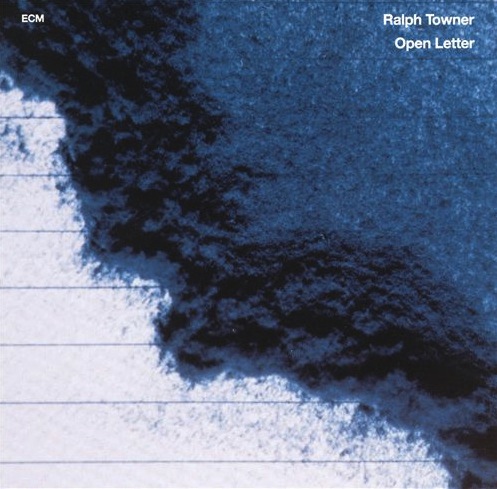
It might be tempting to dismiss this Ralph Towner effort as New Age fluff, but the music is so gorgeous that any such considerations fall to the wayside. Yet the wayside is precisely where Towner sets his sights, which is to say that his interest lies in edges where musical idioms meet. He explores these lines, not unlike the blotted cover, with an ease of diction at the fret board that is recognizable and comforting. Drummer Peter Erskine shares the bill, but Towner adds a few synth touches for broader effect, as in “The Sigh,” which opens the session in a cleft of fluid energy.

There are two sides to this album. One is resplendent, exemplified in the congregation of 12-string and cymbals that is “Adrift.” This resonant vessel shares waters with “Magic Pouch” and “Alar” (a tympani-infused concoction that is one of Towner’s finest), both of which blossom in a tropical climate and funnel their tide-swept secrets into “Magniola Island.” Any possible tourist traps therein are elided by Towner’s ever-imaginative picking.

The other side comes through Towner’s solos. The jazzy riffs of “Short’n Stout” pair well with the intimate geographies of “Waltz For Debby,” while the blissful “I Fall In Love Too Easily” lobs us into the goodness of “Nightfall.”

Towner is as astute as ever in his execution. Whether it’s a standard or his own musical vision, we get the feeling that everything he plays is an open letter.

<< Edward Vesala/Sound & Fury: Invisible Storm (ECM 1461)
>> John Surman: Adventure Playground (ECM 1463)

Louis Sclavis Quintet: Rouge (ECM 1458)


Louis Sclavis Quintet
Rouge

Louis Sclavis clarinets, soprano saxophone
Dominique Pifarély violin
Bruno Chevillon bass
François Raulin piano, synthesizer
Christian Ville drums
Recorded September 1991 at Rainbow Studio, Oslo
Engineer: Jan Erik Kongshaug
Produced by Manfred Eicher

Rouge is the magical label debut from clarinetist and soprano saxophonist Louis Sclavis, fronting here a group whose unity betrays an innocence honed to a galactic edge.

The album is an organically connected unit, a suit of sights and sounds working in concert toward a vastness that outstrips them all. I cannot help, from the vantage point of retrospection, draw certain musical connections throughout this hour-long journey. First are the Edward Vasala-like touches of “Kali la nuit,” which like the enigmatic drummer paints a veritable field whose constellations are marked by the hoof-prints of wild horses. Tales of war and tradition intermingle until they become one unbreakable braid, contrasting visceral screams with old-school togetherness. One then encounters the specter of minimalism in “Reeves,” which seems fed through a kaleidoscope filled with shards of Philip Glass. These are merely an exploratory introduction to the intense electric violin of Dominique Pifarély, who stirs the drink until there’s only ice left in the glass. A heady piano trio fills out the backdrop all the while with a glittering appliqué of finely wrought support. “Les bouteilles” is perhaps the most eclectic. With head nods ranging from John Surman (in its exquisite attention to melodic and technical detail), Steve Reich (in the string playing), and Pat Metheney (in the exuberant close), it’s a fantastic ride.

These comparisons do nothing to rob Sclavis of his originality, for he casts a shadow from a distinct angle of mind and experience. As in the dawn-drenched threads of “One,” he draws his craft through varicolored needles. His flair for the programmatic is also notable, as in “Nacht,” in which bassist Bruno Chevillon folds his alchemy into the batter of the evening sky, baked to a crisp by distant stars and glazed with a sugary free jazz concoction courtesy of drummer Christian Ville. “Reflet” is an even starrier affair, one of many celestial moments in the album’s remainder, all of which find rest in “Face Nord.” Like a rewound VHS tape, this highly cinematic track spools back through climax, tragedy, romance, and into an innocent beginning. This we find fleshed forward in “Yes love,” the album’s last, stringing us across pianist François Raulin’s web of emotional power, innocence, and honesty—the tenets by which this groups lives, breathes, and plays.

<< Anouar Brahem: Conte de L’incroyable Amour (ECM 1457)
>> Veljo Tormis: Forgotten Peoples (ECM 1459/60 NS)

Anouar Brahem: Conte de l’incroyable amour (ECM 1457)


Anouar Brahem
Conte de l’incroyable amour

Anouar Brahem oud
Barbaros Erköse clarinet
Kudsi Erguner ney
Lassad Hosni bendir, darbouka
Recorded October 1991 at Rainbow Studio, Oslo
Engineer: Jan Erik Kongshaug
Produced by Manfred Eicher

After a memorable ECM debut with Barzakh, Anouar Brahem recorded this even more memorable sophomore effort one year later. Carrying over percussionist Lassad Hosni, Brahem welcomes Turkish musicians Kudsi Erguner on ney and Barbaros Erköse on clarinet. Erköse, a gypsy music specialist, adds rich colors to an already dense palette, weaving tethers that pull us into tender worlds. His duets with Erguner (“Etincelles” and “Peshrev Hidjaz Homayoun”) stand out as some of the album’s most flowing. The title track brings the patter of clay drums, weaving a gorgeous ney into our vision. (The melodies and rhythms here put this listener immediately in mind of the song “I Love You” from Omar Faruk Tekbilek’s album One Truth.) Captivating. Erguner shines again in “Diversion.” Slaloming through every drummed pillar with the conviction of a bird in search of prey and yet with the delicacy of an angel avoiding such violence, he brings a sense of history to every lilting gesture. “Nayzak” revives the clarinet amid oud and drums for a stunning taste of mountains and the plains. The album’s meat, though, comes in Brahem’s unaccompanied storytelling. From the dawn chorus of “L’oiseau de bois” and invigorating virtuosity of “Battements,” through the tender air “Le chien sur les genoux de la devineresse,” and on to “Epilogue,” there is unimaginable depth of yearning in every twang and strum.

This album is all about the composition, stripped to the barest essentials of melodic craft and burrowing straight into the marrow of our past lives.

<< Eleni Karaindrou: The Suspended Step Of The Stork (ECM 1456)
>> Louis Sclavis Quintet: Rouge (ECM 1458)