Of Beautiful Boys and Elegant Girls: A Review and Interview with Tessa Souter

She looked at me with intensity. “It is the gift of the great,” she went on, and the sound of her low voice seemed to have the accompaniment of all the other sounds, full of mystery, desolation, and sorrow, I had ever heard—the ripple of the river, the soughing of the trees swayed by the wind, the murmurs of the crowds, the faint ring of incomprehensible words cried from afar, the whisper of a voice speaking from beyond the threshold of an eternal darkness.”
–Joseph Conrad

(photo by Richard Conde)

Anglo-Trinidadian songstress Tessa Souter has been called a “vocal butterfly.” The comparison stands, but deserves elucidation. It is not simply that words seem to flutter from her lips with all the shimmering delicacy of a Blue Morpho, but also that she spreads sentiments like pollen across a veritable field of musical touch points. Her diction lilts with natural care, as might a windblown leaf or feather, yet her sense of melody reveals such profound commitment to clarity that our meager analogies begin to break down once we let ourselves get carried away. And yet who can help it, when she splits the compass in so many directions that we wish we could chase after them all?

Souter’s career began in writing, through which she established a voice. On paper her words were already singing. She officially dropped that voice in the roiling pond of the New York City music scene in 1999, where she has been beguiling audiences ever since. As a newcomer to said scene and the varicolored jazz it nurses, I came to Souter’s magic in a roundabout way when, after reviewing a performance at which she was also present, she e-mailed me with her compliments. Thus it was through our shared appreciation of the art of live music-making that I first discovered her string of studio pearls. With a kindness and openness that all would do well to follow, she welcomed me into a sound-world where countless others have traveled. These are not journeys from which one returns unchanged, but through which one grows through her singular narrative power.

As you read on to my reviews of her first three albums, I encourage you to click open her website and let its samples wash over you.

Listen Love
Tessa Souter vocals
Mark Berman piano
Freddie Bryant guitar
Miles Okazaki guitar
Essiet Essiet bass
Chembo Cormiel percussion

Souter begins this, her self-produced debut, with a nod to Norma Winstone (one of jazz’s few comparable voices), whose lyrics to Jimmy Rowles’s “The Peacock” only enhance the lushness of a lone voice, swept along by graceful pianism. Like its namesake’s tail fan, aesthetic pleasures provide the practical function of gathering and directing sound, that we might better match its rhythms. Traversing love’s more painful avenues, Souter guides us to Pat Martino’s “Willow,” using her own lyrics to unravel the protection of its shade. Nature and passion tighten, yearning for someone with whom to share its undiscovered vistas. “Caravan” glistens with Sephardic curves as it works its spell somewhere between sleeping and waking, laying its constellation bare, one star at a time. After these darker considerations the title song from Jon Lucien urges us into happier oases, where Souter’s gorgeous ad-libbing lights up the night with dance. Here, as throughout, the sparse arrangements allow her all the sky she needs to unfurl. The album’s tenderest surprise comes with “Fragile.” The Sting tune reconnects with its ancient heart, winding in a slow descent into life’s deepest limitations. Souter then offers her intimate original, “You Don’t Have To Believe.” Its almost conversational language again casts Nature as a force that both brings lovers together and keeps them apart. On a planet where storms comingle with peace, we must remember such things about ourselves. After the voice-and-drum duet of “Daydream,” we are stirred into the cocktail of Antonio Carlos Jobim’s “Insensatez.” Threaded by the chatter of woodblock and improvisations, it is the memory we hold dear as we step through the waters of “Left Alone” and onto neo-soul shores of Pharoah Sanders’s “The Creator Has A Master Plan.” A positive note, to be sure, on which to end an album of tense ups and downs, tying threads into a unified line, sustained like her final perfect high into that cloud where rainbows hide in the shadows of adoration.

Nights of Key Largo
Tessa Souter vocals
Joel Frahm tenor and soprano sax
Kenny Werner piano
Romero Lubambo guitar
Jay Leonhart bass
Billy Drummond on drums

Nights of Key Largo is a love letter to love letters—in this case, thirteen standards, whose contours tremble with renewal in her breath. From the Braziliana of “The Island” to Souter’s drop-dead gorgeous rendition of John Lennon’s “Imagine” (just listen and feel it), this Japan-only release builds upon the instrumental telepathy of its predecessor with even more pronounced solos and interaction between musicians. Bassist Jay Leonhart is especially notable, lending as he does a pure alchemical touch to such cuts as “Moon Dance” and “Close Enough for Love,” the latter a smooth and sultry dip into nocturnal waters, where sleep is as far from those who want to dream as touch is from those wish to love, and yet in which the promise of passion lingers. A breathy rendition of “The Look of Love” finds Souter, accompanied only by Kenny Werner at the keys, mending this fragile melody into something unbreakable. Werner excels further in “All or Nothing at All” and in the title number, which sounds like something that might soundtrack a cruise dining room while also plunging us overboard into a complex ocean of resolute affections. Yet his prettiest vibes emote from “Night of the Carnival,” which contends with “Moon and Sand” as the album’s crowning jewel, made all the more sparkling by Joel Frahm’s soprano. Frahm also solos beautifully on (and with) “Slow Hot Wind,” while guitarist Romero Lubambo adds his patent touches to “You Only Live Twice” and “So Many Stars,” drawing threads in both to every lonely soul looking for escape in a universe that is two parts darkness to every flash in the proverbial pan of love. Not to be forgotten, Billy Drummond is the album’s heartbeat. With a palette as colorful as Souter’s, he brushes his fingers through the hair of songs like “I’m Glad There is You” with a tenderness to match. Like the album as a whole, he paints in swaths of dazzling minutiae.

Obsession
Tessa Souter vocals
Jason Ennis guitar
Gary Wang bass
Conor Meehan drums
Victor Prieto accordion
Todd Reynolds violin
Ansel Matthews backing vocals

As soon as those first licks of “Eleanor Rigby” caress our ears, we know that on Obsession we are in for the most eloquent and mature Souter experience yet. Color me shocked if anyone has turned a Beatles cover into something more enchanting. Once we hit Nick Drake territory on “River Man,” if not already, we begin to see the themes Souter loves so dearly. Its conflation of the organic and the emotional is a meta-statement, a cascade of words as fluid as her fantastic session band. And as the title track twists and turns, carried to awesome fruition by a sure vocal line and the ever-descriptive solos of Jason Ennis (a standout), we realize that sometimes our most life-changing moments are those most bittersweet. Sheila Jordan would be proud. Urged by a propulsive rhythm section, Cream’s “White Room” gets a soaring treatment. A groove for our age, it once again proves Souter’s ability to revitalize the cover. Her honeyed meringue tops Gary Wang’s flowery bass lines in “Afro Blue Footprints” and “Make This City Ours Tonight” as if they were made for one another. Obsession works in contrasts, as between the brooding introspection of “Crystal Rain (Sun Shower) and the heavenward glance of “Empty Faces (Vera Cruz),” but Souter’s originals are reason enough to become familiar with this album.  “Now and Then” floats on Victor Prieto’s watery accordion, laying down a path where the sunlit past and the moonlit present stroll hand in hand toward reconciliation. And let me be the last to undermine “Usha’s Wedding” with my paltry expressions, for however we may choose to characterize that which must be heard to be understood, in the end that naked voice is the angel who promises a vessel waiting to carry every last one of us into loving arms.
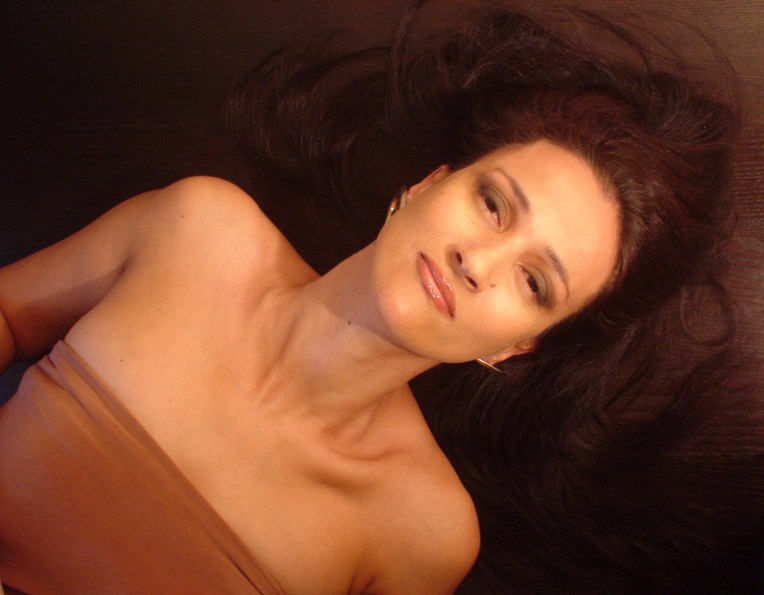
(photo by Janis Wilkins)

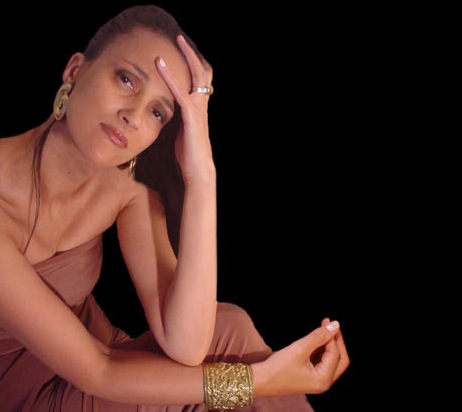
As of this writing I have yet to experience Souter live, and so for the moment I can only listen from afar. In attempt to bridge that listening gap, she kindly took time out of her busy schedule (having just returned from a successful Russian tour) to answer my questions via e-mail:

Your voice is clearly at the center of every song. How do you combine it so selflessly with other instruments and their players? Is this a relationship of tension? of harmony? of conversation? of painting?

Hmm, well, I really love listening to the other instruments being played by wonderful musicians. And I played the guitar and sang during my formative years, so maybe I like to create a space for the other instruments, too, just naturally.

I remember my art teacher talking about “tension” and how every work of art had to have it. So I guess there is that element, too: the question of, is it going to work out, or will we fall off the tightrope. Holding your breath.

And sometimes it is a conversation. I love to make loose arrangements that give the instrumentalists the space to create within them. I don’t like to say, “It has to go exactly like this.” I want to know what YOU have to say, what YOU feel about it. I want to hear them play what that story—of love lost, of a newborn, of new love, whatever—makes them FEEL. And that will make me hear it differently.

And sometimes it is—as you put it—like painting, but with two of you working on the same canvas, without having to tell each other in words where to put the brushstrokes. I was knocked out when I first started singing jazz at how musicians who have never even laid eyes on each before can get together and make music that sounds like they’ve been a band for years, even sometimes making the same hits in the same places. Like dancing with a stranger perfectly. It means everyone has to be really listening to each other, not playing by rote, but listening and responding.

Not a few of your songs begin with voice alone. I often think I could listen to them unaccompanied, as the expressive power of your voice carries the emotional contents therein with ease. For example, in the track “Daydream,” the single conga drum that accompanies you seems to saunter forth from within the shadows of your voice rather than adding something that was never there. The single guitar in “Left Alone” is the same. In relation to my first question, how do you see your voice as an entity? Is it a fully formed life, or one that is always learning from its surroundings?

Gosh. What a hard question. Well, the unaccompanied thing…I sang a lot unaccompanied when I was a teenager. In my early teen marriage I spent a lot of time alone and singing was my solace. I would spend all day in the house, singing entire songs that I would mean every word of, mostly long folk songs with stories that had beginnings, middles, and endings, about sailors going off to sea never to be seen again, or bereft maidens, or married women falling in love with local young men and it all ending in tears (usually death-by-husband).

As for fully formed or learning from its surroundings, the voice is always learning and absorbing. Every experience you have eventually comes out in your voice. I think I noticed that first about 25 years ago after a friend died, and the very next time I sang, it was a slightly different voice, it seemed to me.

When listening to your music, I hear a range of possible influences. One who comes to mind is Susheela Raman. Has she in any way played a part in your musical path?

Someone else said that to me about eight years ago on a gig in London. I’d never heard of her so I researched online and bought her CD Love Trap. I like it but it was/is not an influence—obviously, because I heard her long after I was singing like that.

But following on a bit from the previous answer, we might be similar people. Sort of foreign (my father was black, and my mother white) in England, where we were vaguely “other.” So perhaps we are drawn to similar expressive styles. But I think she is Tamil and consciously strove to identify musically with that part of herself and had a Tamil singing teacher who taught her that style, whereas my music just seemed to come out of me like that.

That isn’t to say I don’t have influences. I always described my style as kind of jazz with a twist of Middle Eastern and Indian, and then a few years ago I bought some of the music I was listening to in my youth—Pentangle and Fairport Convention—and I REALLY heard the influence of that music. I guess you could call it Celtic folk-rock. I realized that Celtic music has that Middle Eastern influence, using those same Phrygian scales.

I also identified very strongly with Spain for various reasons as a teenager and young adult, so that’s in there, too. And England, where I grew up, is very multicultural, so you hear all these different kinds of music all around you and I guess you absorb it.

I don’t know why I love that Phrygian thing, I just do. Maybe because it is somehow simple, easy to move around in, and yet emotionally complex. But when I hear it in its pure form, it is also a bit one-dimensional for me. It’s not enough somehow to stick to one very distinct style of music. But jazz is so open you can take a myriad of influences, put them all in a big pot with some Captain Beefheart, Frank Zappa, Soft Machine, and a dash of Carmen Jones, and out comes…you.

When I first started singing in public and learning jazz songs ten years ago, a very good friend of mine, who is a wonderful singer (Mansur Scott), would always say to me, “Tell your story. Don’t worry about it being jazz or not.” That was very good advice. I don’t think you should try to be anything except yourself. People are always telling me at gigs that they feel like they know me, and they actually DO, because that’s what I’m giving them. You can’t copy another singer, because you can never BE that person with that person’s experiences. It will always be fake.

Your songs are intensely evocative. Each is the feeling, the joys and sadness, of a place. When singing, do you feel that you are in those places? Do you wish to put the listener there from a distance, or do you want to share in that experience right there alongside the listener?

I don’t think, “Oh, this song is about this or that.” Not in a conscious way. Not once I know it. It might have been inspired by an experience initially, but once I know it (whether I wrote it or someone else did) I just literally feel it without thoughts. It’s wordless. Evocative more than literal. So even though songs might have words, their job is to, along with the melody, create the mood.

I used to be crazy about the writer Joseph Conrad and I was always amazed by how he could use really beautifully descriptive LANGUAGE to express something WORDLESSLY. The real thing he was saying was there in between the lines. I think that’s what music does. I also like that you can write a lyric or a song about something very specific, and if you don’t tell an audience what it means it will mean something completely different to them.

But yes, I do want listeners to experience the emotion with me, even if it is a different story for them. Definitely not at a distance. When I first started singing I liked that, unlike my former job, writing (which required a certain distance, not to mention having to be alone in a room to do it), music was like injecting yourself into people and getting an instant response.

Growing up always feeling “other” gives you a yearning to connect. And that is one of the things I love about music. It makes you feel connected, both as a listener and a performer.

I feel like I’m hearing about myself when you describe solitary songs as a coping mechanism through trying times, for I have often found that, even at life’s lowest points, the voice can never be contained. What is it, do you feel, about singing that has such restorative power?

I think it is so visceral. Your whole body is engaged, it’s very sensual (as in engages all your senses) and somehow the voice expresses, even without words, feelings that sometimes I don’t know I’ve even been feeling. Feelings that don’t even have names. It gets them out into the open somehow. A great exercise sometimes is to let a feeling be expressed with sounds that you haven’t planned in advance, unlike what happens with a song you already know. In fact, I think that’s how I compose.

The more people come in contact with your music, the more you have been given opportunities to tour in new and unexpected places. What lessons does the act of travel bring to bear upon your musical experiences?

When I had my first concert in Russia—at the Moscow International Performing Arts Center in 2007—I was terrified that no one would understand me and that they would want me to sing all standards. A friend who’d already played in Russia said, “No, they’ll love you as you are! Do your regular stuff.” So I chanced it, and it was actually perfect. In fact, I was shocked that at Cream’s “White Room” people started applauding and shouting “Brava!” pretty much as soon as I had sung the first line. So I suppose the ultimate lesson I’ve learned is that the best thing you can give to an audience, wherever it is, is yourself.

Some might say you are bold in the cover songs you choose, that no one needs yet another version of the tried and true. Yet I find your versions of classics like “Eleanor Rigby” and “White Room” to be spectacular. These are, of course, great songs in their own right, but you turn them into personal statements. What is it about them, first of all, that captures your attention, and how do you decide to pluck these particular jewels from among countless others?

I personally love music that is familiar but different. I think for audiences it can be a doorway to other music. “Eleanor Rigby” came about when I was singing in Japan on a hotel gig for two months. I was walking home from the shops one day in the rain and that ostinato pattern came to me and I ran into my apartment and played it on my toy piano. It was so simple I performed it that night and the Brazilian percussionist I was playing with sang long tones underneath it and it just worked. I cut out some of the lyrics and changed the form to make it tell the story of two people who are in love but never tell each other. I call it my song version of the movie Remains of the Day. For “White Room” I did an arrangement with guitarist John Hart originally. It was kind of Brazilian and I scatted over a simple intro of descending chords and John came up with that fabulous ending that unexpectedly stops dead on the 5. Then just before we recorded Obsession Jason re-did the arrangement so that it had more of an African feeling in the playing, but without changing the chords and keeping John’s ending. I love that song because it reminds me of my brother when we were totally into Cream as teenagers. All my song choices have a reason.

Can you talk about the differences in production between these three albums? There seems to be a progression between them, from the intimacy of Listen Love to the full-blown flower of Obsession. How did the sound of each album emerge?

Listen Love is two demos put together. I made a quick demo in 2000. I had no money so I went in and said, look this is all I have, what can I do with it, and we did four songs, including mixing, in a few hours. It was very organic. I think the reason it sounds intimate is that it was just the two of us in someone’s home studio. Then the other songs were recorded in 2002. Honestly, finances more than anything kept that album sparse. But that is actually one of the things I liked about it. I was the producer so it was very hard work, listening over and over. But all the artistic decisions were entirely mine, which I also like—even though it’s harder physically, in a way.

Nights of Key Largo was recorded in two days with barely any rehearsal, and no band rehearsal. Those songs were mostly chosen because the record label wanted a certain tempo and style. So, working with that, I thought about songs I could mean, learned some new ones, spent about two hours with Kenny Werner upstate to go over some of them and had a separate two-hour rehearsal with Jay Leonhart and Romero Lubambo at my house, and then we all went in and recorded.

Obsession was a bit different because I had been singing the songs for years and just wanted to get it down before I moved on to new material. It was a lot more thought-out than any of my other CDs. We rehearsed, even! And we’d been playing together for a year, so it was more of a band and everyone contributed ideas to the final album.

The most recent CD, Beyond the Blue, which is coming out this May, is different again. Classical songs with my lyrics to nine of them, made into jazz with an incredible band of jazz titans that got together over two days with no rehearsal and made magic happen with repertoire most of which they had never laid eyes on until that day. I think because of that it feels completely fresh to me. And everyone really had to listen to everyone else and maybe that inspired them all the more. Normally I can’t listen to my own CDs but I listen to this one just to marvel at their playing. This is my favorite CD so far.

Before this one, I think I’d always had a special soft spot for Listen Love. Okay, I still have a soft spot for it, partly due to the repertoire. I have to STOP myself singing “The Creator Has A Master Plan” and I still sing “You Don’t Have To Believe” on almost all my gigs.

Love is a very spiritual thing. In what ways do your religious views flow in and out of your songs?

I think everything I am flows in and out of my songs. I just did a tour with a friend and we talked about the fact that who you are is how you play—for good or ill. I don’t think I have any religious views, as such. I am one of those “spiritual but not religious” types. But I am totally inspired by Love, yes.

What was it like working with Mark Murphy? In what ways did that experience leave its mark (no pun intended)? What were his greatest words of wisdom?

He had so many! It was wonderful working with him. He would make me do things I didn’t want to do like scat, to get me off needing to be “Mrs Perfect.” He’d question your motivation for things—like holding a note: was that in the service of the song, or was that just to show off how long you could hold a note? And he was so supportive. He’d come to my gigs with huge bunches of flowers and say I was his “star” and just be like the sun shining on me, really. I love Mark very much and feel absolutely blessed to have been mentored by him. And of course his singing is itself a lesson. You can hear his influence in practically every male singer under 50. He is so in the moment. So connected. His timing is perfect, even on ballads, maybe especially on ballads. And he always gave great advice. Like when I went through this terrible phase of having unbelievable stage fright, which lasted about six months. I finally asked him what to do about it and he said, “Just remember it’s not about you. Your job is to make these people who have come to see you feel good. They just want to have a good time. That’s it!” It cured me instantly.

Has anyone ever told you that s/he started singing because of you?

Some have. Mostly people who have read my book Anything I Can Do You Can Do Better. I still get letters from people who have read it. I’ve no idea how they hear about it. But I love those letters. Then I feel the book did its job.

What has been your most gratifying experience with a fan?

I think what is most gratifying is that so many people who started out as “fans” have become real friends. If I had to pick one thing, it’s that the then four-year-old daughter of a friend was so insistent on Listen Love being played whenever they drove anywhere that the car with the CD player in it was called “the Tessa car.” And a friend in San Francisco just wrote to tell me that her four-year-old has to play Obsession before she goes to sleep every night and the other day just sighed, “I love Tessa!” But I don’t think I could single out one experience. Of course it’s always great when someone comes up in tears and tells you how touched they were. Or, as happened the other day, when a teenage boy in Belarus tells you that they want to play with you one day and that you are “magic” and they “don’t have words to describe.” Or when strangers come back and pay again to hear you the second night, too. Or when people have said that the tone of my voice makes them feel calm. Or that it is healing. I’ve actually had a few people tell me that Listen Love got them through a depression and one woman who loved music until she got hit with depression said it was the only CD she could bear to listen to for six months, until she got better. It’s like Mark Murphy said, that’s your job.

The blossoming of your art is a real testament to the power of music to triumph over adversity. What advice do you have for those facing solitude, who feel there is no one who cares for them?

I have to say I have never felt that there is no one who cares for me. I have a lot of wonderful friends. But I’ve been depressed, of course, and, when I felt in the absolute depths I used to force myself to go to open mics. It always cured me. So sing! Or draw, or write. Anyway, EXPRESS! Or get lost in something else—a movie, a novel, listening to music, supporting a friend, going to a concert. That can be super helpful. I went to hear a friend sing once when I was in a terrible space, and it totally flipped me—lastingly. I don’t sing the blues myself, but listening to Marlena Shaw sing the line about how she put her head on the train track, “and then I thought, hang on, I haven’t paid for the hat!” or BB King sing, “I gave you seven children and now you want to give them back!” never fails to cheer me up. The great thing about the blues is that it’s always got a sense of humor.

Lastly: What is your favorite color and what does it remind you of?

Gold-sequin gold. It’s so warm and sparkly. It’s summer.
(photo by Janis Wilkins)

Keith Jarrett: Paris Concert (ECM 1401)

Keith Jarrett
Paris Concert

Keith Jarrett piano
Recorded October 17, 1988 at Salle Pleyel, Paris
Engineer: Peter Laenger, Andreas Neubronner
Produced by Manfred Eicher

Arguably the most stunning live recording in Keith Jarrett’s solo archive, the Paris Concert may just surpass its Köln predecessor in the sheer naturalness of its unfolding. The recording consists of three tracks, the first of which is simply dated “October 17, 1988” and clocks in at nearly 40 minutes. The music finds depth in its power to spin a self-contained mythology, in its being a window through which one stares to see bits of self. Over a plodding low F he culls handfuls of nebulae, building towering structures of stone and song, and throwing from them streamers of melodies into the vales below until one of those melodies takes wing by the feathers of sunset. It is soft and pale, able to navigate entire continents with barely a flap, and writes across the sky a message for all: Just listen, and you will see. From a thick octave chain Jarrett hangs heavier and heavier ornaments. The development thereof is rigorous yet caged, seeming to run in place not because it cannot move forward but because it cannot look behind, and blossoms into a sustain-pedaled passage so ineffable that it transcends the boundaries of the concert hall, whispers light into our minds, and holds a finger to the lips of thought—a swansong that begins another life.

Jarrett spins his tapestries as might a skilled filmmaker, at once letting the actors bring their own experience to the project while at the same time guiding their story arc from somewhere off screen. The two epilogues are thus like alternate endings. “The Wind,” by jazz pianist Russ Freeman, opens with a Steve Reichian flourish and glides into a slow and bluesy love affair with shadows. This slow-motion tumble down the rabbit hole of the night ends with the patter of rainfall and leaves us to contemplate what we have just heard. The simply titled “Blues,” on the other hand, takes a standard progression and draws from it colors we never knew it had. It glows at Jarrett’s fingertips, distills the purity of his expressive vision, and gives us the resolution we crave.

A Keith Jarrett solo improvisation is, at its most selfless, a drop into an ocean of feeling far outside the realm of articulation. One feels it in the bones, in the brain, and most importantly in the heart, but always as one part of a thread stretching as far as listeners can see into both the past and the future. We encounter that thread as one might a rainbow: the closer we run toward it, the farther it travels away from us. Only when we look inward do we discover where it begins and ends.

<< Meredith Monk: Book of Days (ECM 1399 NS)
>> Agnes Buen Garnås/Jan Garbarek: Rosensfole (ECM 1402)

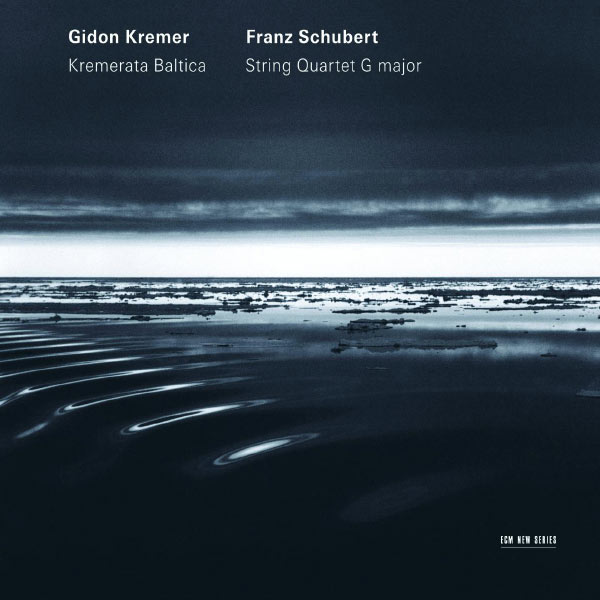
Gidon Kremer/Kremerata Baltica: Schubert – String Quartet G major (ECM New Series 1883)


Gidon Kremer
Kremerata Baltica
Franz Schubert
String Quartet G major

Kremerata Baltica
Gidon Kremer violin and conductor
Victor Kissine orchestration
Recorded July 2003, Pfarrkirche St. Nikolaus, Lockenhaus
Engineer: Peter Laenger
Produced by Manfred Eicher

As a tireless champion of new interpretations of the old, the ever-adventurous Gidon Kremer has over the years forged a lasting relationship with, above most others, the music of Franz Schubert. One can only imagine, then, the excitement he must have felt when he learned of composer Victor Kissine’s having finished a string orchestral version of Schubert’s G-major String Quartet (op. posth. 161, D 887). The arrangement of this notorious masterpiece at first seems to embody a curious double bind, for while it certainly enhances the music’s dramaturgical spectrum, it simultaneously softens the edges thereof. The result is a rounded idol of the original. And yet, like a piece of glass that has been worn down by river’s flow or ocean’s tide, it takes on a new shape, becomes a jewel in the hands of a child, a glint of light noticeable even in an already vast and glowing population.

From the five seconds of silence that begin every ECM album made in the last 20 years, the orchestra emerges with a mounting proclamation that immediately justifies the means. Amid the dance of major and minor that ensues, the occasional soliloquy, like that of the pizzicato-ornamented cello in the opening movement, rings all the clearer. Here one must also note the Kremerata Baltica’s honed dynamic control, by which, despite the youthful magnitude of its combined forces, the music’s ruptures are allowed to sing with all the philosophy of their emptiness. Magisterial tempos give greater lift to the score and throw us into its spirals with swooning regard. The Andante enacts a veritable play of shadows, comporting its thematic actors with Beethovenian stagecraft. The cello reemerges as a voice with one foot behind closed eyes and one outside of them, and fades tear-like into the relatively brief Scherzo, where skittering motives place many a deft footstep through an agitated waltz before reworking the flames, only now more scintillating, in the final Allegro, which gallops its way through pages of light and shadow, leaving us to ride its ripple effect back into the open silence from which it awakened.

This project has Kremer written all over it. From his never-superfluous gildings to even the cover photograph (entitled “Heading for the North Pole” and taken by the man himself in 1990), Kremer has given his all to the finished product. This has nothing to do with ego, but with a reverence for Schubert, whose heart he and his entourage draw with the care of an anatomist. Kissine’s arrangement likewise allows us to hear the beating of this heart through a steady flow of melodic blood. And the sound? Wondrous. A sequins without the kitsch.

As I listen to this album it is snowing outside, yet the ground is warm enough to melt the snow on contact, giving the illusion that every flake continues to fall through the earth. I cannot help but map this sensation onto what I am hearing, for even as this music touches us it continues to fall through our skin and into a place in our minds where footsteps will never mar its confection.

Charles Lloyd Quartet: Mirror (ECM 2176)


Charles Lloyd Quartet
Mirror

Charles Lloyd tenor, alto saxophone, voice
Jason Moran piano
Reuben Rogers double bass
Eric Harland drums
Recorded December 2009 at Santa Barbara Sound Design
Engineer: Dominic Camardella
Produced by Charles Lloyd, Dorothy Darr, and Manfred Eicher

Charles Lloyd is that rare artist who one can say truly grows with every recording, and I would venture that Mirror finds him at one of many pinnacles in a career that thankfully shows no signs of abating. As part of the same quartet that wowed us on the live recording Rabo de Nube, Lloyd is joined by Jason Moran on piano, Rueben Rogers on double bass, and Eric Harland on drums for the outfit’s first studio session.

The title of this latest studio effort is no accident. As Lloyd himself once said in an interview with Greg Burk of his musical break between 1969 and 1989, “I went to work on myself, so that I would be more equipped to serve the Creator and music and mankind, and I had to face the mirror of my own inadequacies.” And indeed on this date we hear him contemplating his own reflection, the ways in which it speaks back to him with the unmistakable voice of that Tennessee tenor.

As has become increasingly clear through the years, Lloyd’s heart lies in tradition. We hear this not only in the affect of his presence, but also in his interpretation of standard repertoire. Beyond the obvious technical abilities required to pull this off with the consistency that he does, he also posses the uncanny talent to compress every tune into his marrow and live it before ever putting reed to lips. And through this handful of traditions he carries us from the mosaic of beautiful fragments in “Lift Every Voice And Sing,” where Moran’s stained glass solo glows by Harland’s feathered light, and into “The Water Is Wide,” where Moran shines again in a fully loaded groove: the exuberance of a gospel singer with head thrown back in glory, stitching the pathos of faith one patch at a time. Lloyd’s delicacy in “Go Down Moses” is duly inspiring and leaps into well-trodden arenas of stratospheric wisdom as the quartet achieves an enviable coalescence, the percussion especially colorful. Yet for me the session’s jewel drops into our hands in “La Llorona,” a stepwise lament in which Lloyd allows himself to falter at carefully placed expectorations, cracking like a tear-ridden voice in prayer. Stunning.

“I Fall in Love Too Easily” opens the doors widest to a field planted by Moran’s petal-by-petal profusion, and leaves us well primed for two Thelonious Monk joints. Where Lloyd flits like a butterfly possessed in “Monk’s Mood” (against the smoothest pianism of the set, no less), he turns like an oblong waterwheel through a river of affection in “Ruby, My Dear,” a more rubato affair in which Moran’s octave splits ring heartfelt and true. “Caroline, No” gives us a taste of the Beach Boys years, drawing its motif at an angle while Lloyd soliloquizes on the pleasures of contortion. And let us not forget the wellspring of his own pen. From the depths of “Desolation Sound” to the magic of “Being And Becoming, Road To Dakshineswar With Sangeeta,” Lloyd the composer regales us with wordless incantations—that is, until the the nine-minute “Tagi,” for which he blesses the studio with a retelling of Bhagavad Gita scripture (the title is “Gita” reversed and means “sacrifice”) before tracing a line up to the sun.

Lloyd always begins and ends with the breath, tracing a circle of life. His is energy classic, wood-grained yet with a fine metallic sheen. Like the cover photograph, this is music that has nothing to hide regarding the means of its creation, lays it all out in the oneness of things, where light and shadow share a thematic dance. Let this album be your mirror, and your story will begin the moment you open your soul and look.

Bobo Stenson Trio: Reflections (ECM 1516)

Bobo Stenson Trio
Reflections

Bobo Stenson piano
Anders Jormin bass
Jon Christensen drums
Recorded May 1993 at Rainbow Studio, Oslo
Engineer: Jan Erik Kongshaug
Produced by Manfred Eicher

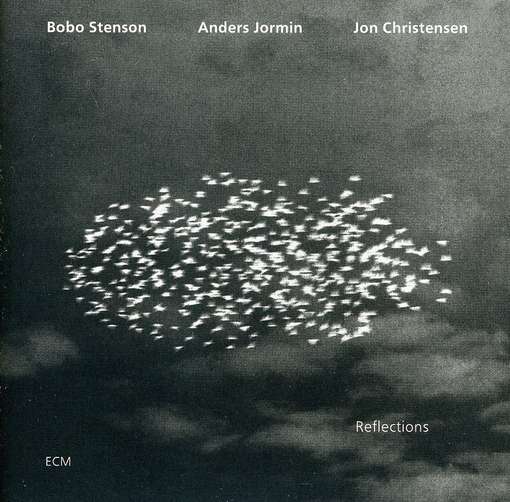
While not every cover photo necessarily gives insight into its album, the sleeve of the Bobo Stenson Trio’s Reflections reveals something at the heart of this music: light. The first time I laid eyes upon it, I swore I was looking at a flock of birds in the clouds. Closer inspection revealed, of course, one of the title’s more obvious meanings. If this little guessing game revealed anything to me, it was that what I was about to hear would feel the same: at once sky below and earth above.

And where better to begin than in the leader-penned “The Enlightener,” which paints an aerial view of territories he will soon explore with long-lost brothers Anders Jormin (bass) and Jon Christensen (drums). Stenson keeps his left hand entrenched in a haunting monotone here, giving ample ground for the right’s erratic yet ever-purposeful flights, achieving somewhere along the way a transcendence one hears perhaps only in the Keith Jarrett Trio at its best.

George Gershwin’s “My Man’s Gone Now” provides our first dip into the pool of standards. Like a bird jumping from branch to branch before finally settling where it will make its nest, Stenson binds drumsticks with bass strings and makes a home. His playing can thus be very dense at times, and to ensure that we don’t get pulled under, Jormin gives us a refreshing change of bass in two compositions. “NOT” opens with a lyrical gesture from Jormin against mere tracings of piano and cymbals before locking into a lumbering groove, which is mixed to bold consistency by a wider pianistic embrace. The agitated reverie of “Q,” however, sports the finest moment in the set in Jormin’s flowering solo.

After the frothy runs of Stenson’s “Dörrmattan,” we are treated to a breathtaking rendition of Duke Ellington’s “Reflections in D.” Stenson treads almost stealthily here down a path of Tord Gustavsen-like balance, taking the tune to a cosmic level before closing with two more of his own: “12 Tones Old” (another bass vehicle in which notes crawl like spiders content in their webs) and “Mindiatyr.” This last is one of his most impressionistic, beginning in cascades supported by some lovely arco bass, which then hones itself into the buzzing exuberance of a spirit setting out on its first journey. Christensen’s enviable rhythm work plays us out alongside a Byzantine flourish from the keys. 

Listening to Stenson’s navigations is, I imagine, what a magician feels when fooled by another magician—which is to say that just when you think you know all the ins and outs of the craft, someone comes along and brings you back to the youthful joy that first lured you into it. One feels so much in everyone’s playing on Reflections, as if it were already living inside us and needed only six hands to give it voice.

This date is a dream come true. Thank your lucky stars you can hear while awake.

<< Garbarek/Brahem/Hussain: Madar (ECM 1515)
>> Jon Balke w/Magnetic North Orchestra: Further (ECM 1517)

Tigran Mansurian/Kim Kashkashian: Monodia (ECM New Series 1850/51)


Tigran Mansurian
Kim Kashkashian
Monodia

Kim Kashkashian viola
Leonidas Kavakos violin
Münchener Kammerorchester
Christoph Poppen conductor
Jan Garbarek soprano saxophone
The Hilliard Ensemble
David James counter-tenor
Rogers Covey-Crump tenor
Andreas Hirtreiter tenor
Gordon Jones baritone
Recorded November 2001, Himmelfahrtskirche Sendling, München and January 2002, Propstei St. Gerold
Engineers: Stephan Schellmann and Peter Laenger
Produced by Manfred Eicher

When the shadow of the sash appeared on the curtains it was between seven and eight oclock and then I was in time again, hearing the watch. It was Grandfather’s and when Father gave it to me he said I give you the mausoleum of all hope and desire…
–William Faulkner, The Sound and the Fury

Monodia represents the invaluable efforts of violist Kim Kashkashian to bring Armenian composer Tigran Mansurian onto the world stage. During this journey of discovery she was fortunate enough to have found in Manfred Eicher the ideal partner to ensure that this exposure be done properly and with the utmost respect. The composer’s homeland may not be visible in the flow of information that saturates mainstream media, but it is intensely audible in this landmark recording of a music and a culture that demands to be heard by virtue of the fact that it demands nothing at all.

Kashkashian brings her inimitable talents to bear upon “…and then I was in time again, a viola concerto written in 1995. The title comes from Faulkner, whose inky nooks harbor shades of meaning whereby the light of experience comes to be similarly refracted through the prism of the mind. Kashkashian’s harmonic whispers usher us into a world in which the viola not only sings, but also speaks. Through a sometimes-tortured narrative, Kashkashian externalizes the music’s inner life through her fearless translational abilities. The orchestra’s lower registers are favored here, so that the violas echo Kashkashian en masse, thereby drawing a genealogical thread from Allegro to Lento in a twin birth of lament and knowledge. As throughout, peace is hard to come by even in the absence of the occasional high-pitched interjections, each a sketch of histories long atrophied.

If we began rooted in time, in the Concerto for violin and orchestra (1981) we are left to fend far outside of it. After the earthy tones of the viola, the violin hangs from a much thinner thread, ever poised on the brink of a sudden fall. The soloist here is Leonidas Kavakos, who begins, as violin concertos are wont to do, somewhere above our heads. Kavakos underscores the solitude that permeates the score, emerging like an orphaned cub taking his first tentative steps across the forest floor. Sunlight works its way through the mists, spreading its fingers wide between the branches and coaxing the world back to life. The opening motive, while inaugural in its first appearance, is a powerfully disruptive force when it returns halfway through the piece. Its violence and fear spawn a thousand voices singing with agitated lyricism. Low strings sweep us under a watery carpet before spitting us out onto the shores of something oddly familial.

This sense of lineage continues in the 1999 Lachrymae for soprano saxophone (played here by Jan Garbarek) and viola. The patterns traced here are not unlike those on the CD’s cover, meeting as they do in a rosette of mystical curves through human rendering. Like an incantation, the music’s implications far exceed its means, for in the lingering echoes of this piece we can hear our own tears hoping for the curing touch of moonlight. A quintessential New Series piece from two of ECM’s finest musicians.

Lastly is Confessing with Faith (1998), for which Kashkashian is joined by the Hilliard Ensemble in evoking texts by St. Nerses the Graceful (1102-1173). The gut-wrenching depth of her playing here must be heard to be appreciated, and with the Hilliards its secrets become even more complex. One can’t help but feel that the voices are being spun from the same threads, as if to more fully flesh out that which already resides in the instrument. Once countertenor David James breaks from the gloomy waves, he dances with the viola in a lithe display of melodic inertia. Agitated tremolos enlarge the feeling of solitude, letting in a spirited round: one river overtaking another in a bed of tenors. James is resplendent in his delicate high lines from which hang the piece’s final mobiles. The viola is given the final word, which feels more like the first, drawing out a double stop as if it were a pair of lungs about to pray.

Sing a new song to Him who rose,
First fruits of life of them that sleep.


Alexander Lonquich: Plainte calme (ECM New Series 1821)


Plainte calme

Alexander Lonquich piano
Recorded January 2002, Radio Studio DRS, Zurich
Engineer: Peter Laenger
Produced by Manfred Eicher

A year and a half after debuting with the label on Odradek, German pianist Alexander Lonquich stepped into the studio to record Plainte Calme, his first solo recital for ECM. Lonquich is a player of dialogues: between himself and the music, between himself and himself, between the music and itself. Balancing a remarkably delicate touch with a strong attack when needed, his playing throughout this all-French program bodes well in the session’s rounded engineering.

The Impromptusof Gabriel Fauré (1845-1924) provide listeners with the most earthbound motifs on which to train their ears. Written between 1882 and 1909, these were never conceived of as a set, a fact underscored by their being scattered throughout the program. Although they incorporate influences from Chopin and from mentor Saint-Saëns, these pieces bear echoes in a chamber very much their own. Beyond the obligatory descriptor of “impressionistic” I am wont to attach to such music, there is an undeniably filmic energy therein. One can almost hear horse carriages and lovers’ talk, unaccompanied but for the whisper of their own song. Affection pours through every section with the temerity of a field mouse, while at the same time rolling itself down hills of youth into some of the composer’s most unadulterated expressions of joie de vivre on record—Lonquich’s performances thereof punctilious and perfect.

The 1929 Huit Préludes pour piano of Olivier Messiaen (1908-1992) was a discovery for me. This treasure was his first published work, written during his student days at the Paris Conservatoire. Already the synaesthetic composer was experimenting with color, which he splashes almost Pollock-like into a monochromatic world. One encounters a more weathered feel in comparison to the surrounding works, each a fresco in a monument which, though scarred by the passage of time, in its own way has become more beautiful, more like itself. Even at this early stage Messiaen folds every pleat with a reverence and sensitivity beyond his years. Yet there is far more than shadows and contemplation going on in this tapestry. There is also animation, the twisting and turning of life itself in all of its dramatic changes, though always ending as if to undermine that drama as but an illusory skin to stillness.

In light of these denouements, the formidable Gaspard de la Nuit of Maurice Ravel (1875-1937) feels like a bucket of dreams poured into the mind’s eye. This early work was written in 1908 after poems by Aloysius Bertrand and reflects the persistence of a composer who, as a student of Fauré at the Conservatoire in 1896, was famously expelled due to his inability to write an “adequate fugue.” Unfazed, he continued to sit in on Fauré’s class and honed what would become his hallmarks, which one notices to hardly greater effect than here. “Ondine” takes the most transcendent approach to the medium, seeming to stitch with an angel’s hair atmospheres of such rippling grace that one can only feel them below the skin, trembles of anticipation that are their own rewards. We find ourselves knee-deep in an inimitable sort of magic, growing into a quicksand of caresses in “Le Gibet,” while in “Scarbo” we are thrown into a new journey that leads us up the spiral staircase of the final Fauré Impromptu, at the top of which waits the destiny living inside all of this music: namely, the need to close eyes, spread wings, and jump.

Lonquich treats every note like its own voice in the grander unity of the choir, as it were, and brings an almost philosophical edge to his painterly renditions. He can sound like two musicians, one the light of the sun and the other its warmth. His sound bounces off the lockets of maidens in distant tower windows, their dreams of music suspended from the forests through which many a knight has traveled. Their voices come to us only now, at last requited in the body of an instrument that has never quite sung like this before.

One of the finest solo piano records on the New Series thus far.

Ingrid Karlen: Variations (ECM New Series 1606)

Ingrid Karlen
Variations

Ingrid Karlen piano
Recorded January 1996, Schloßbergsaal, Freiburg
Engineer: Peter Laenger
Produced by Manfred Eicher

Swiss pianist Ingrid Karlen makes her ECM debut with Variations, of which the program is as provocative as the title is vague. Beyond variations in the traditional sense, these are, rather, mise-en-abymes of abstractions. Or so they might at first aural glance seem, for within these sometimes troubling clusters of false starts breathes a unity at once organic and contrived. Anton Webern’s Variations for Piano, op. 27 (1935/36) is the primary example, for the only variations they seem to engender stem from that which cannot be notated. These pieces behave as might a solo violin sonata, jumping fluidly and bow-like through their ephemeral 12-tone links. They are the anti-motif, a stretch of childhood unable to be sifted.

If these constitute the program’s foundation, then Valentin Silvestrov’s Elegy (1967) is its hollow keystone. Dedicated to ECM regular Alexei Lubimov, this sonic egg is just that: indestructible when pushed from both ends, yet vulnerable to the slightest variation of pressure at its middle. Not unlike the program as a whole, its open spaces are there for us to project our desires and expectations in a space where they will not be judged.

Petrograd-born composer Galina Ustvolskaya is channeled to us via two pieces which, though they make up more than half of the album’s playing time, are selfless constructions. In both the Sonata No. 3 (1952) and the Sonata No. 5 (1986), the sheen of declaration quickly fades in interrupted washes of high/low contrasts hugging a forlorn middle register. Karlen stretches both like freshly dyed cloth in a stream, occasionally beating them against a rock for emphasis. Only at such moments do we realize the heights to which we have ascended. The gentility leading up to these thrashings is all the more swooning for its being whittled at by a blade of intense virtuosity. Ustvolskaya’s music inhabits a fascinating middle ground, neither melodic nor indecipherable, lying somewhere between the permanence of the scar and the ephemerality of the suture.

Where else to end but at the beginning? Pierre Boulez’s Douze notations pour piano (1945) is the composer’s Opus One and reason enough to experience this recital. The sheer depth of dramaturgical whimsy in these little sketches makes for a thoroughly engaging experience, which I can only imagine blossoms a hundredfold at the keyboard.

This daring recital is not the first I would recommend among the growing number available on ECM. This is not a critique, but simply a word of caution to the faint of heart. Still, no matter how convoluted the music becomes, it is never cloudy or obscure. The brilliance of Karlen’s program is to be found in her shaping of negative space, in precisely what is not being played. It is into this extra-musical aspect where I believe she wants to draw our ears. And if we are willing to join her, we might very well find sunlight where only shadows seem to roam.

<< Charles Ives: Sonatas for Violin and Piano (ECM 1605 NS)
>> Wheeler/Konitz/Holland/Frisell: Angel Song (ECM 1607
)

Thomas Demenga plays J. S. Bach/B. A. Zimmermann (ECM New Series 1571)

Thomas Demenga
J. S. Bach/B. A. Zimmerman

Thomas Demenga cello
Thomas Zehetmair violin
Christoph Schiller viola
Recorded February/July 1995
Engineer: Terje van Geest
Produced by Manfred Eicher

There is a time for everything,
and a season for every activity under heaven.

Cellist Thomas Demenga continues his Bach project by juxtaposing the Baroque master’s d-minor Suite No. 2 with the work of Bernd Alois Zimmermann (1918-1970), one of the most important non-Darmstadters after World War II. As ever, Demenga makes a convincing argument for the pairing (interestingly enough, most of the criticism of Demenga’s project sees the Bach as filler). In this case, Zimmermann is something of an effortless choice, for his fondness of quotation and respect for tradition were at the heart of his artistry. His approach to time in this regard was particularly significant, drawing on intersections of influence through a wide range of trends and idioms.

Thus do we find ourselves in the comforting waters of Bach’s generative whispers from the moment we dive in. For this performance Demenga adopts the approach of a viola da gamba player (to greatest effect in his raspily inflected Courante). This sound draws out the music’s inherent gaseousness, in which one feels something dark and cosmic taking shape. Demenga’s notecraft ensures that every molecule feels connected through a legato of silence. He digs as deep as he can for those distinct Bach lows, plows double stops as if they were fertile fields, and maintains subtle independence of line in the Sarabande. He bows the Menuets as if with shadows, then elicits one of the finer renderings of the Gigue I’ve yet heard, striking a fine balance between jubilation and regret.

The boldness of this architecture may seem an ill fit to Zimmermann’s sonatas, which despite their meticulous scoring also call for an improvisatory approach. This puts the musician in a potentially compromising space, though if anyone is up to the challenge, it’s Demenga. Many of Zimmermann’s works were considered unplayable when first written, the Cello Sonata of 1960 not least of all. Drawing from his usual pool of spatial and temporal concerns, the piece moves beyond the Romantic notion of cello as vox humana and into the realm of speech, action, and embodiment. In his liners, Demenga notes a particularly difficult passage in the first movement, which encompasses three distinct time-layers: “while the upper voice, played on the bridge, produces a continuous ritardando, the middle one is the most striking, because of its very large range and numbers of notes played pizzicato, and then the lowest, played on the nut of the bow, sounds like a scarcely perceptible accelerando.” Despite its brevity, unpacking the finer implications thereof took Demenga weeks to perfect.

That said, like all walls it can be, and is, overcome in such a way as to render those difficulties invisible and meaningless. It is a testament to his playing that the potentially distracting technicalities of this music become vital mechanisms to their own forgetting. In addition, the more the music progresses, the more one realizes that its virtuosity stems not only from the obvious difficulties, but more importantly from the way the performer must treat every cell as its own motivic entity while maintaining a sense of continuity (as in the “Fase” movement). Between the boldly intoned opening and the ethereal resolutions of “Versetto” we feel the cellist walking the edge of our Umwelt, stitching a morpheme for every step like a bead into patchwork.

Before this we are treated to two nearly intriguing sonatas. The Violin Sonata of 1951 was written after the composer’s concerto for the same. Demenga’s conceit is strengthened by a B-A-C-H cipher and likeminded spirit (notably in the Toccata). From the Paganini-esque heartbeat to the dramatic pizzicato slap that closes it, this is a tapestry of musical lines that is sure to delight. Christoph Schiller makes delicate work of the 1955 Viola Sonata thereafter and undoes a few of the frays left dangling. Subtitled “To the song of an angel,” the one-movement sonata was written in memory of the composer’s daughter Barbara, who died soon after her birth. This self-characterized “chorale prelude” is based on Gelobet seist Du Jesu Christ and tracks a pseudo-scientific journey of private inquiries. At times the instrument duets with its own implications, while at others it shatters itself into a hundred pieces.

This program is about nothing if not intimacy. Not only by virtue of the solo repertoire—Zimmermann himself believes the solo to be the only way by which one may access an instrument’s “almost inexhaustible power”—but also because of the way in which that repertoire speaks through the hands of such capable musicians. This is no-frills playing of music that, while at times distorted, rings forever crystalline in our memory of it.

<< Eleni Karaindrou: Ulysses’ Gaze (ECM 1570 NS)
>> Dave Holland Quartet: Dream Of The Elders (ECM 1572)