AM 4: …and she answered: (ECM 1394)


AM 4
…and she answered:

Wolfgang Puschnig alto saxophone, alto flute, hojak, shakuhachi
Linda Sharrock vocals
Uli Scherer piano, prepared piano, keyboards
Recorded April 1989 at Rainbow Studio, Oslo
Engineer: Jan Erik Kongshaug
Produced by Manfred Eicher

Four years before stepping into the studio to record the Korean crossover project Then Comes The White Tiger alongside the influential SamulNori, saxophonist and flutist Wolgang Puschnig and vocalist Linda Sharrock stepped into ECM’s Rainbow Studio with pianist Uli Scherer as AM 4 for an equally unusual project. Blending poetry and Nordic folk roots with jazz and subtle instrumentation, …and she answered: is as open-ended as the colon of its title. Sharrock captivates wherever she is featured in this project, though perhaps nowhere more so than in the opening “Streets And Rivers” (am I the only one who is reminded of Ani DiFranco’s “Buildings and Bridges”?), which parallels the pathos of life and the literatures through which we seek to divide it. Its synthesizer undercurrent and Jon Hassell-like blips unfurl a pathway for Pushcnig’s breathy alto, both matched by Sharrock’s languorous diction. The following track is as haunting as its title. “And She Answered: ‘When You Return To Me, I will Open Quick The Cage Door, I Will Let The Red Bird Flee’” paints a wide landscape populated with Puschnig’s animal cries. Through these horns a muted piano string drops its heavy footfalls and spins from its wool a yarn of darkness. All of this time in the field, as it were, leaves us open to a wrenching interpretation of Ornette Coleman’s “Lonely Woman.” Here Sharrock is like a catalyst for instrumental change, leaving Puschnig and Scherer to navigate the channels of her words with a cartographer’s exactitude (the two likewise shine in the duo cut “Bhagavad” and in “Far Horizon”). This is one of two standards to creep into the mix, the other being a pointillist rendition of “Over The Rainbow,” which enchants with wisps of the familiar in an otherwise distant wash of flute and echo. Puschnig turns inward with “The Sadness Of Yuki.” The lipped strains of the shakuhachi thread the piano like time itself. We catch only flashes of imagery: a girl’s face, a bleak and oppressive house, an existence destined for ghostly things, as might be spoken through the aphasia of “Oh!” The latter brings the most rhythmic elements to bear on this eclectic set, and speaks to us through the shawm of its gamelan-encrusted interior. All of which leaves us alone with the intoned question in “One T’une,” of which gongs and air are a way of life.

ECM has thankfully made this overlooked release available through digital download, and it bears seeking out for those wanting to step off the label’s beaten path.

<< First House: Cantilena (ECM 1393)
>> Bach: Goldberg Variations – Jarrett (ECM 1395 NS)

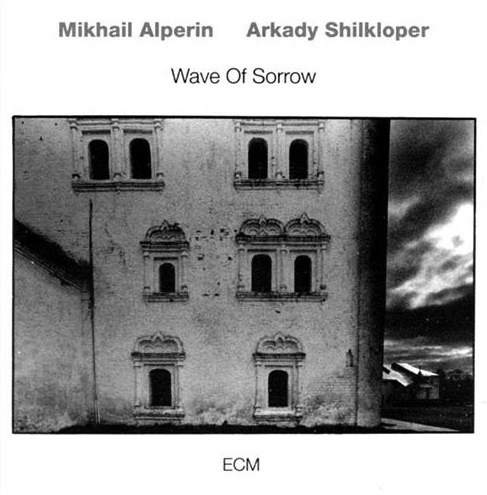
Misha Alperin/Arkady Shilkloper: Wave Of Sorrow (ECM 1396)

Misha Alperin
Arkady Shilkloper
Wave Of Sorrow

Misha Alperin piano, melodica, voice
Arkady Shilkloper French horn, jagdhorn, fluegelhorn, voice
Recorded July 1989 at Rainbow Studio, Oslo
Engineer: Jan Erik Kongshaug
Produced by Manfred Eicher

With Wave Of Sorrow, Misha (then Mikhail) Alperin began what has proven to be a fruitful relationship with ECM. Though the Ukraine-born pianist has but a modest discography on the label, each recording brims with the folklore of his sensitivity. Since this date he has spun a telepathic relationship with trumpeter Arkady Shilkloper, and the results on this duo album are as unique as their players. Alperin offers a set of ten original compositions, each, in spite of the intimate arrangement, a grand and sweeping thing. Not unlike label mate Richie Beirach, his architecture is ambitious in its scope and clarity yet rarely deviates from the warm embrace that births it. One hears this in the opening “Song,” to which Shilkloper adds the bay of a hunting horn. Like many of the pieces that follow, it smacks of tradition even as it shines with modern interpretation. Yet this is also a world of shadows, for in the title piece (one of the most affecting melodica solos you will ever hear) we can intuit a web of tortured histories and only hints of the happiness that may unravel it. Shilkloper arrives toward the end bathed in ECM’s plush reverb, seeming to hang from the tail of Alperin’s breathy comet like a child of the night. Still, this date is not without its fun. “Unisons,” for example, casts the two musicians in a decidedly vocal mold as they rap and tap their way through a cathartic romp. “Poem” similarly allows Shilkloper to come out of his lyrical shell into a full-blown dance. Alperin also offers up a few piano solos, of which “Prelude in Bb minor” is the most evocative—a shaft of moonlight through which the dust of a wanderer’s journey casts its sparkle. Other highlights include the simple yet ingenious motivic arcs of “Short Story” and Shilkloper’s distant mutes in “Miniature.”

The contradiction of the album’s title is that so much of the music springs to its feet, all the while harboring a matrix of oppression and exile. We hear this especially in the solo “Epilogue.” The atmosphere is dim yet also sparkling, as if it were a harsh present slumbering behind the illusory veil of a memory, fond and forever lost.

<< Bach: Goldberg Variations – Jarrett (ECM 1395 NS)
>> Shankar: nobody told me (ECM 1397)

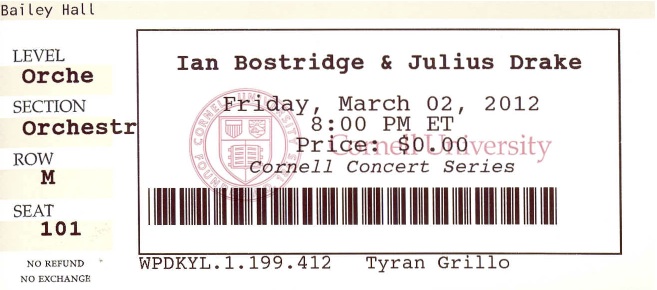
A Walk in the Magic Garden: Bostridge and Drake Bring Lieder to Bailey

Imagine yourself as the protagonist in poet Heinrich Heine’s Ich wandelte unter den Bäumen (“I wandered among the trees”). You’ve been wandering through a forest, your only companion grief over an unrequited love. Suddenly, a “little word” flittering in the trees, a simple utterance that pulls the wool of the past over your eyes. You wonder how the birds know it, why they torment you so. They sing:

“A young woman once passed by,
She sang it again and again,
And we birds snatched it up,
That lovely gold word.”

You feel the sparkle, ironic and stabbing, of every rounded syllable. You are pressed by the weight of their diction. Only then do you realize that you’ve been sitting in a concert hall with a flock very much of your kind. The voice comes not from the trees but from English tenor Ian Bostridge, who looms almost as tall as one, onstage at Cornell’s Bailey Hall.
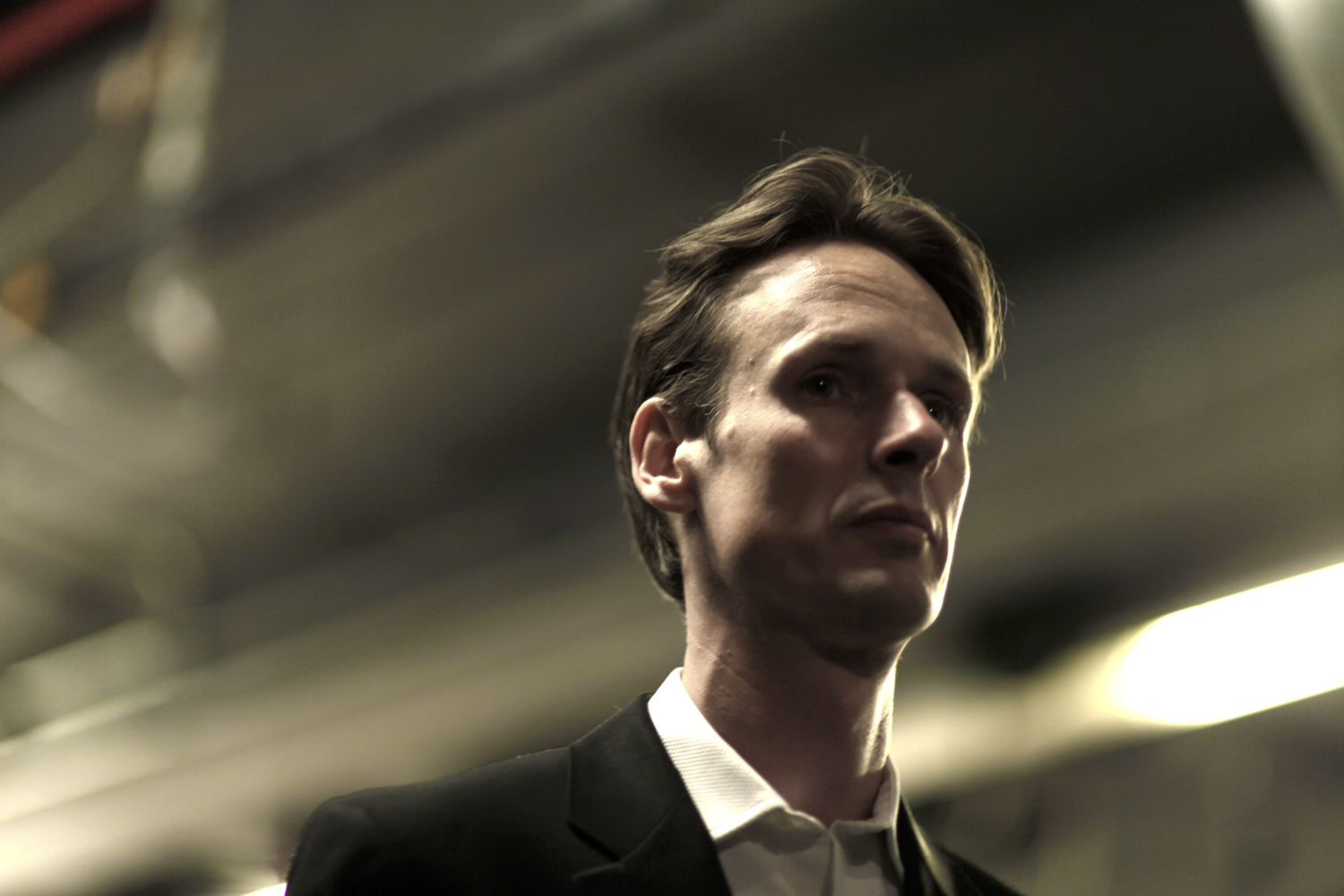

Ian Bostridge

Although Bostridge started out as an aspiring physicist who also wrote a seminal book on witchcraft before devoting his life path to singing in 1993, his audiences would be the last to refute that his command of, and interest in, either physics or witchcraft has waned. To wit, his accompanist of choice for we fortunate Friday few was Julius Drake. An in-demand recitalist and professor at London’s Royal Academy of Music, Drake maintains an alchemical interest in Robert Schumann and in German lieder, or art songs, both of which fuse together via the composer’s setting of the poem above, one of nine by Heine in the op. 24 Liederkreis (Circle of Songs). Written in 1840, a period known as his Year of Song, the cycle bears dedication to his wife, Clara. Despite its passionate origins, the Liederkreis tends to fall by the wayside of Schumann’s monumental Dichterliebe, though one can hardly deny the mastery with which piano and voice share their creative duties in both. Schumann blends folk idioms and a flair for the programmatic, into which Bostridge and Drake pour over twenty years of collaborative experience.


Julius Drake

During this performance it was clear that for Bostridge the sounds of words are as important as their meanings. Throughout the Liederkreis and the quartet of Dichterliebe apocrypha that preceded it he fashioned a living, breathing persona that was as chameleonic as the sentiments he so punctiliously enunciated, while Drake matched his depth gesture for gesture. Both artists found themselves surpassed only by the lyricism of Schumann, whose adorations blossomed before our ears in the passions of Lehn’ deine Wang’ (“Rest your cheek”) and the sweetness of Berg’ und Burgen schaun herunter (“Mountains and castles look down”), the latter contrasting starkly with the morose Es treibt mich hin (“I’m driven this way, driven that”), the fiendish difficulties of which Bostridge navigated with apparent ease. Artistic witchcraft was also in order for Mein Wagen rollet langsam (“Slowly my carriage rolls”), during the middle stanza of which he sang an internal thought as if it were his own. Not to be outdone, Drake’s pianism cast its share of enchanting spells, as in the brightness of Morgens steh’ ich auf und frage (“Every morning I awake and ask”) and the chromatic sweeps swirling like smoke from a breeze-blown candle throughout Mit Myrten und Rosen (“With Myrtle and Roses”).


Robert and Clara Schumann

While Bostridge and Drake were obviously comfortable with Schumann, much of the evening’s treasure was buried in the relatively uncharted maps of Johannes Brahms, in whose poetics they steeped the program’s first half. With a life-affirming, if not transformative, energy Brahms’s songs made for a fitting introduction to anyone not familiar with the lieder tradition from which he is so often excluded, typically dominated as it is by Franz Schubert, Hugo Wolf, and Schumann himself. For one, he favored the words of “minor” poets—a downfall in an art built from the text up. This and his disinterest in grand cycles pegged him as something of an outsider. Yet Brahms saw no necessary correlation between great music and great poetry. Each was its own melody. As with Schumann, whom Brahms much admired, folk motifs were an important touchstone and sometimes led him boldly where his contemporaries dared not tread.
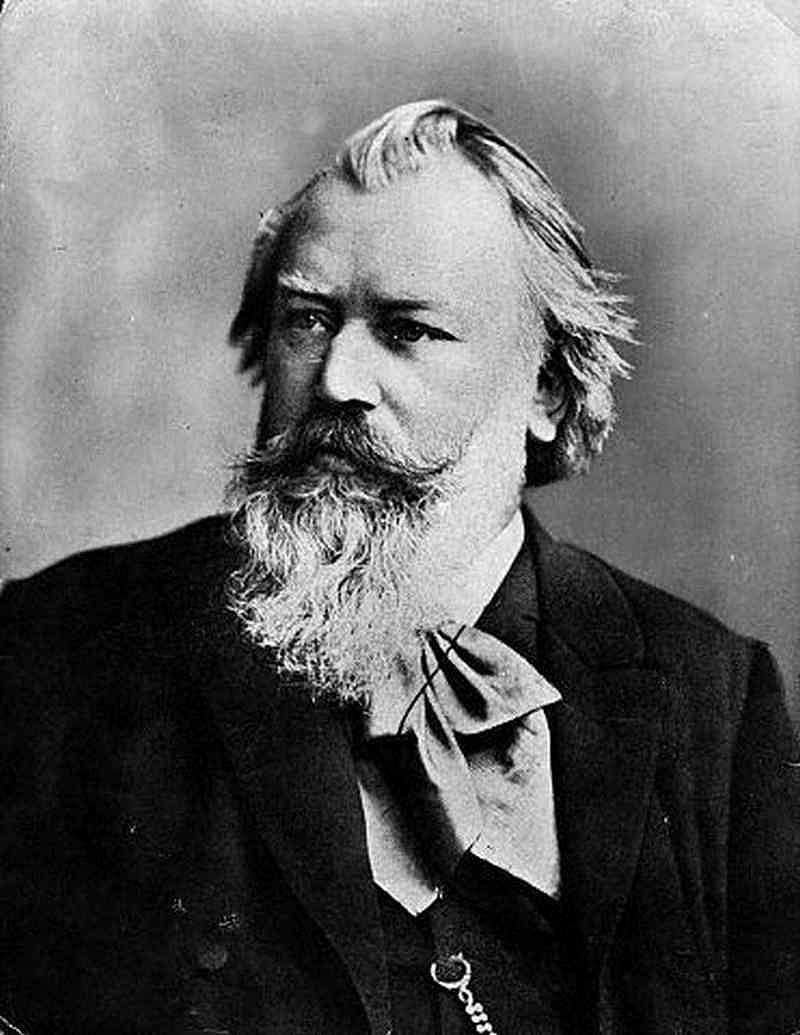

Johannes Brahms

His was, and continues to be, a music filled with worlds that don’t so much collide as pass through one another. From the mighty gales of Auf dem Kirchhofe (“In the churchyard”) and on through the Chopinesque backcloth of Der Gang zum Liebchen (“The way to the beloved”) to the raging seas in Verzagen (“Despair”), the pianism was of a vastly different order, with the result that Bostridge pushed himself to engage every facet of its relief. This resulted in an unexpected hiccup during a high reach in Geheimnis (“Secret”). Yet even this did nothing to detract from what was for this listener the most awe-inspiring song of the program (if anything, it broke a tension that threatened to sweep us away entirely), and may explain the marked determination with which he dove into the set’s most turgid waters—notably, Alte Liebe (“Old Love”) and O kühler Wald (O cool forest).

Due perhaps to Brahms’s rich keyboard writing, Drake’s interpretive nuances were most effulgently realized here. He was at once impressionistic and exacting like a carver’s tool, but always playing the words at hand. The lushness of chording in his right hand atop the rising arpeggios of his left in the concert’s opener, Es träumte mir (“I dreamed”), assured us that the best accompanists also know how to sing. Bostridge was reverently aware of this. One could see it in the way he looked into the distance between verses, as if watching the Steinway’s notes mingling with his own over the horizon. He interacted with the piano, now resting on it like a poet’s tree, now at an intense moment breaking free from its pull.

Oftentimes the more careful one is, the more conservative one becomes. In the case of these two performers, however, care seems to have bred nothing but expressive potential. In this respect Bostridge sings as might a Shakespearean actor surrender to a soliloquy—which is to say, by stepping outside the self and into the landscape of another space and time. His ego flees like the poetry from his lips, even as he shows us the vitality of the body in the singing of lieder, its centering and de-centering, its bows and cringes, and in all the winged commitment required to make every syllable fly. Drake, meanwhile, proves himself supremely attuned to every color change, and stands respectfully poised on the edge of drowning. He listens to the voice just as the voice listens to itself, intoning with the wavering realism of a reflective surface.

We return to Heine, in whose beauties we find ourselves lost:

In the magic garden wander
Two lovers, silent and alone;
The nightingales are singing,
The moon is shimmering.

So sings the now familiar voice, no longer birdlike but nonetheless profoundly arboreal. Bostridge takes us fearlessly into that garden and shapes its flora and fauna, each more magical than the last for the Midas touch of his vocal presence. Said garden is his gift to us, a place to which we can always return when remembering this night.
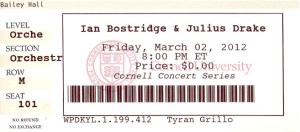
(See this article in its original form at the Cornell Daily Sun.)

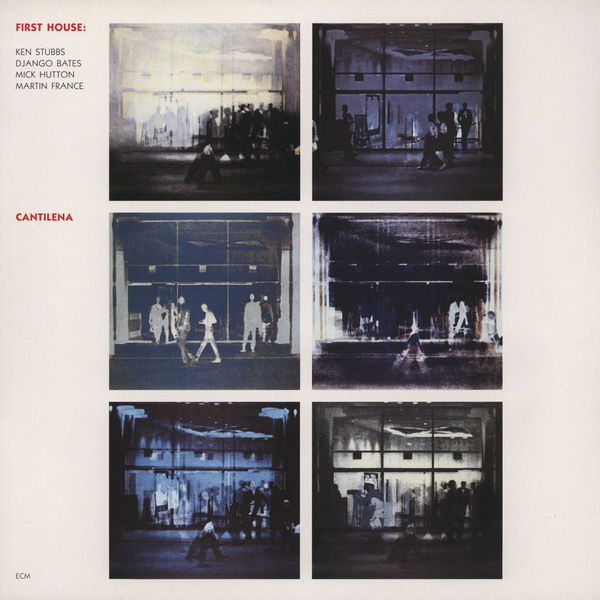
First House: Cantilena (ECM 1393)

First House
Cantilena

Ken Stubbs alto saxophone
Django Bates piano, tenor horn
Mick Hutton bass
Martin France drums
Recorded March 1989 at Rainbow Studio, Oslo
Engineer: Jan Erik Kongshaug
Produced by Manfred Eicher

After a memorable ECM debut with Eréndira, the talented quartet of saxophonist Ken Stubbs, pianist Django Bates, bassist Mike Hutton, and drummer Martin France—a.k.a. First House—followed up with an even more effective chunk of progressive jazz in Cantilena. From the first soulful licks of the title opener, we know we are in for something special and from the heart. The composer’s alto draws us into the night with recumbent charm, thereby opening an ambitious set that delivers everything it promises and more. Like a model posing for a painting, its contours come into representational being only through an artist’s touch. This leads us into the connective tissue of the piano, which seems to blossom, lured by the alto’s return to a place where dreams can be made real. From this we are introduced to the writing of Bates, of whose “Underfelt” the theme is anything but as it sneaks its way through a burrow of circular motives. Stubbs shells out some incredible improvisation here, working his way far beyond the corners of the page. The Bates train continues on through the whimsies of “Dimple,” for which he clashes horns with alto against exemplary and jaunty support from Hutton and France. More of the same energy awaits us the sprightly abstractions of “Low-Down (Toytown),” to which the rubato slice of blues that is “Sweet Williams” (Bates) is indeed a sweet preamble, while the urban sprawl of “Jay-Tee” features the date’s most spirited soloing from our two lead melodicians. The Bates sector rounds out with the vastly energizing “Hollyhocks,” which features rolling harmonies in the pianism and a spate of resplendent energy that grabs us hook, line, and sinker into the contemplative yet all-too-brief tenderness of Eddie Parker’s “Madeleine After Prayer” (the only non-group tune on the record), which is spun through “Shining Brightly” into a horizon backlit by hope. Once again the alto hollows out our bones and fills them with the marrow of sentiment. Some tracings from Bates initiate “Pablo,” thus ending the album where it began: in a dream where music is the only language that remains.


Original cover

Of the many strengths First House possesses, it is the compositional prowess within that shines above the rest. The group’s robust musical ideas have immense staying power, and in combination with such a smooth blend of the forward-thinking and the classic, one would be as foolish as Oliver to ask for more in a jazz outfit.

<< Keith Jarrett Trio: Changeless (ECM 1392)
>> AM 4: …and she answered: (ECM 1394)

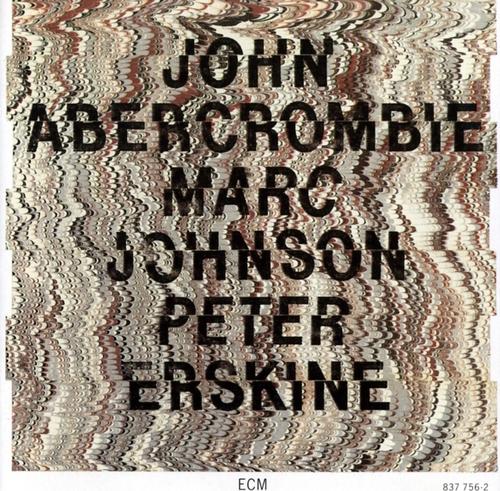
Abercrombie/Johnson/Erskine: s/t (ECM 1390)


John Abercrombie
Marc Johnson
Peter Erskine
s/t

John Abercrombie guitar, guitar synthesizer
Marc Johnson bass
Peter Erskine drums
Recorded April 21, 1988 live at the Nightstage, Boston
Engineer: Tony Romano
Produced by Manfred Eicher

After the resounding success of their two studio albums, Current Events and Getting There (with Michael Brecker), guitarist John Abercrombie teamed up with bassist Marc Johnson and drummer Peter Erskine for this wondrous live 1988 recording from the Nightstage in Boston. It’s crystal clear from the groove laid down by Johnson and Erskine in the opener, “Furs On Ice” (think Getting There), that each of these men travels the edges of a constantly shifting yet with-it triangle. Abercrombie spins some Frisell-like chording before emerging with a soaring synclavier line in this, one of two Johnson-penned tunes, the other being a trimmed-down version of his “Samurai Hee-Haw” (see Bass Desires). Replacing Bill Frisell and John Scofield is no small order, yet Abercrombie fills these shoes with plenty of funk to spare. That unmistakable bass line, in fact, courts some of the most electrifying improv heard in a while from Abercrombie, who brings a Hammond organist’s sensibility to the proceedings via his fiery macramé. Erskine is also fantastic here. Abercrombie turns up the heat even more on his own two contributions. “Light Beam” is a particularly well-suited vehicle for synth guitar, and indeed seems focused like a laser splashed through the prism of his rhythm section. This is followed by a drum solo from Erskine, who shows us a nifty thing or two from his skill set, particularly in his dialoguing between bass drum and toms, before Abercrombie’s classic “Four On One” (from his seminal 1984 joint, Night) plies its musings and rounded edges with the record’s crunchiest playing. The three continue to converse beautifully in their group improv piece, “Innerplay.” Notable for Johnson’s delightful string games, it is a lasting testament to the powers of spontaneity.

The rest of the set is filled to bursting with a hefty portion of standards. Between Erskine’s delicate rat-a-tat timekeeping in “Stella By Starlight” and the delicacies of “Alice In Wonderland” (into which the rhythm section eases so carefully one feels more than hears it), there is much to stimulate repeated listening. Yet it is in “Beautiful Love” that we find the pot of gold at the end of this rainbow. From the gentlest guitar solo Abercrombie spins a song even as he unravels it into a water-skating journey so gorgeous it almost weeps. The trio’s finest moment and easily one of Abercrombie’s most inspired (and inspiring) improvisatory passages on record. The final “Haunted Heart” almost reaches those same depths, smoothing out an extended guitar intro into a velvety soft ballad that stirs us into a pool of melting chocolate and lets us steep.

A sublime recording from musicians at the top of their game, for a game this most certainly is, played by those who know the rules as well as anyone.

<< Terje Rypdal: Undisonus (ECM 1389)
>> Thomas Demenga: Bach/Carter (ECM 1391 NS)

Fred Frith and Annie Lewandowski: An Improvisation

Fred Frith guitar
Annie Lewandowski piano
Barnes Hall, Cornell University
February 29, 2012
8:00 pm

This is what it feels like to close one’s eyes and listen to the shadows for the first time:

Feet bare and prayerful. They tremble on either side of the divide. Turn the radio dial to a frequency where life pours in through the cracks, they seem to say, and you will find in the draw of a bow (whose memories of cracked whips whistle in the distance) a chance to hear the change in your pocket as if it were inside your skull. Place a forest of fingers in the sand and you have only kernels to show for your treasure hunting. It’s not as if one need crack open a tooth to find the nail on the chalkboard, for in each arid stretch there was a music so beautiful it might have knocked you right out of your adolescent skin. The instrument sprouts leaves, adds to its own skeleton with every spontaneous preparation. Those gestures, they come back. The march, the very rhythm of it, has substance. It drips like sap, filling crusted buckets only when left to its own devices. A koto-like thing amplified and stretched to another shore, it cries with the force of a crane in soaring flight. It reverses time even as it drags its own reflection by the magnet on the end of its golden tail. The winds still carry a scent: village candles, bite of tower bell, snuff of horse’s mane. The radio crackles again, speaking as might a mother who has forgotten a lullaby and cannot sleep for all the unrequited attempts swirling behind her eyelids. He plays with light and lights with play. A thousand beams for a thousand children, each the bearer of gifts for hungry wayfarers. Our radio loves us to pieces, hugs us so hard it puts us back together. The sounds of repair are the speech of the broken. Clouds spin into a sea of gray, the stairs a blanket of norms duly obscured. Heat whispers through rips in the mirage: “There is a grain for every hope. Why do you tread here?” A messenger of the plains runs into view, bringing with it tales of pasture and a looping caprice. He taps the edge of the bark and teaches the termites to sing. A spate of talk, a bird’s living wish rewound back to the egg. The beak crunches into flour and is baked into a pastry of careening, listless messages.

Intermission is a word invented by psychics in their sleep with an agenda geared toward interruption. The missions, yes, are hearable, but the “inter”-ness of it is lost to our idle chatter, which tries to unravel everything that has been spun. An obsession, to be sure, throughout which the mind desires silence yet at which we cringe to find the words. What is improvisation but the absence of tongues? There are battles in places we will never visit, and far more visits to places where battle will never be waged. I can smell the ice.

Stairs walking up themselves: that’s what I feel, at least. For whatever is to be made by holding our looking glasses to our ears, this is it. Someone gallops away. We are left, subtracted from one. An animal breathes, decidedly mechanomorphic. Can you speak without also whispering? The piano tells us no: the latter is always hidden in the former. She touches the breeze, clips the hilltops with her wingtips, and showers the land with a promise of elastic. A footstep felt from the inside. The delicacies of our harshest gestures creased until the paper becomes softer than breath. The bottle has a tune to uncork, and in it lies a metallic question. He blinks his eyes as she squeezes hers. Pulling blades of grass from their communities becomes an act of self-destruction. Spindles of willow reaching skyward, forgetting the fires that have long since abandoned them. Masks switch places where the sun has touched them (the cheeks, forehead, and nose) and hold fast to where the moon (lips, eyes, throat). Only the burnished reflection tells us from where its life has sprung. Unscrewing the lid, she dumps out water and mouths, folktales and tracts of yesteryear, each the first of its kind to have suffered the iniquities of a printed score. Thus freed, they dance a path’s worth of steps on overgrown earth. He traces the edge of a language; she transcribes her own on surfaces desirous of fadeout. Every grandmother’s hum of an afternoon crashes outward. Run a fingernail along the ridges of your cochlea, and you will come closest to recreating what has transpired. But you must do it alone, where only ghosts can blow out the candles melting in your hallway. Sounding the pulse like sugar, it distills the spirit of the thing by never repeating itself.

Murder in the Red Chamber

To my faithful readers, new and old alike: if you’ve been reading my words thus far you may be interested to know that, in addition to spouting flowery dross about my favorite sounds, I occasionally moonlight as a translator of contemporary Japanese fiction. My latest endeavor, published by Kurodahan Press, is a fantastic historical mystery novel by Ashibe Taku entitled Murder in the Red Chamber, which reworks the 18th-century Chinese classic Dream of the Red Chamber into a fiendishly entertaining detective story. The novel can be purchased at Amazon or any other fine purveyor of printed matter.

For the curious, a more detailed synopsis:

Murder in the Red Chamber, first published in Japanese by Bungei Shunjū as part of its “Mystery Masters” series, is set in the world of the original Dream of the Red Chamber, the masterwork of eighteenth-century Chinese fiction by Cao Xueqin. Building skillfully on that famous background, Ashibe plays out a most formidable murder mystery set in Peking during the late Qing dynasty. The tale opens with the visitation of Jia Yuan-chun, esteemed daughter of the prosperous Jia family and newly instated concubine to the emperor.

In preparation for her arrival, the Jias have constructed a magnificent homage in land known as Prospect Garden. After an all too brief celebration, as a parting gift to her beloved family Yuan-chun decrees that her sisters and closest female cousins relocate from their homes to the Garden proper, along with her brother Bao-yu.

Little do they know what horrors await them.

During an evening gathering, one of the young maidens of the Garden is brutally murdered in plain sight. This spectacle sets off a series of mysterious deaths. Lai Shang-rong, a local magistrate and Chief Inspector in service to the Jias, is specially commissioned to investigate the goings on and get to the root of the evil that has darkened this otherwise idyllic setting.

Bao-yu, however, has designs of his own. As the only male inhabitant of Prospect Garden, and with the pressure of success breathing down his neck as the next in line to the Jia throne, Bao-yu feels obliged to protect those dearest to him and decides to launch a private investigation. Bao-yu’s methods confuse Shang-rong, who is certain that a more orthodox approach will flush out the killer in due course. As luck would have it, Bao-yu is soon assigned as an assistant to Shang-rong, who is content to work alone. In spite of the inconvenience, Shang-rong knows that Bao-yu’s status as an insider might prove helpful.

Yet as time goes on and more murders are committed right under his nose, Shang-rong begins to suspect that Bao-yu may in fact be behind them all. Shang-rong is expected to cooperate with Bao-yu all the same, and so he must face a difficult choice: point the finger at his exalted sidekick, or crack the case before imminent dangers destroy him.

Ashibe’s tragic conclusion leaves us with a heavy moral question while presenting even the most seasoned mystery fan with a refreshing and innovative take on the detective novel formula.

Stephan Micus: The Music Of Stones (ECM 1384)


Stephan Micus
The Music Of Stones

Stephan Micus shakuhachi, tin whistle, stone chimes, resonating stones, voice
Elmar Daucher resonating stones
Günther Federer resonating stones
Nobuko Micus resonating stones
Recorded 1986 at Ulm Cathedral
Engineer: Martin Wieland

Elmar Daucher’s resonating stones have haunted me since I first heard them on Klangsteine-Steinklänge (released 1990 on ProViva). While not conceptually unique (stone instruments, notes Micus, have at least a 2500-year history), Daucher’s playable sculptures nevertheless speak with voices all their own. They are, as anyone familiar will tell you, enchanting enough on their own terms, but to hear them in the context of Stephen Micus’s visceral melodies is to hear them as the source of some nameless creation. For the most part Micus has had free reign in recording for and submitting his work to ECM producer Manfred Eicher, who commits the material to disc as an acolyte might transcribe a master’s words. But for this project he took a rare dip into the pool of collaboration along with his wife Nobuko, Günther Federer, and Daucher himself all playing resonating stones. Add to these Micus’s unique instrumental prowess in the reverberant embrace of Germany’s Ulm Cathedral, and the results are as profound as they are extraordinary.


Micus and Daucher at Ulm Cathedral

The stones come alive in Part 1. Their voices hum through the listener’s bones. A shakuhachi begins its bird-like dip from the heavens, touching its wings to freedom. In its song one finds a cave, never knowing what will be heard, for under the cover of that night there is but a single voice calling (or is it weeping?) for someone. Two hands hold a song of water, turning it like a teacup held high in the absence of ceremony for the gods to drink. The shakuhachi then becomes a woodland creature who knows the trees well enough to skip through the branches blindfolded. The striking of the stones in Part 2 therefore startles with a blast of light. With the delicate force of a prepared piano or gamelan it is at once metal and flesh. One feels within it a sense of coming together through falling apart, a slow dissolve into unity at a molecular level. Part 3 introduces a penetrating tin whistle, and with it a feeling of windswept plains and distant shorelines, the continued gonging of the stones like cow bells in the pastures. Underlying rhythms carry over into Part 4, embracing an elemental sound in their tectonic heart, in which every seismic shift carves a new glyph of experience. Part 5 is a shakuhachi solo, tremulous and breaking. Spun of cloud and snow, it is a crane’s inner life unfolding before the dawn. Micus lets his throat unspool at last in Part 6, making music out of the very air around him. Which brings our attention to the one uncredited stone sculpture in all of this: the very cathedral itself, which has collected and preserved the footprint of every note played and which imparts its histories to us in an everlasting whisper.

<< Terje Rypdal: The Singles Collection (ECM 1383)
>> The Hilliard Ensemble: Perotin (ECM 1385 NS)

Shankar: nobody told me (ECM 1397)

Shankar
nobody told me

Shankar double violin, vocals
V. Lakshminarayana violin, double violin, vocals
Ganam Rao vocals
Zakir Hussain tabla
Vikku Vinayakram ghatam
Caroline vocals, tamboura
Recorded 1989 at The Complex, Los Angeles
Engineer: Billy Yodelman
Produced by The Epidemics (Shankar & Caroline)

After the uncharacteristic misstep that was The Epidemics, Shankar returned to his roots with nobody told me and showed us that his flair for Carnatic vocals is almost as deeply fleshed as his improvisational gifts on the double violin. And while he has never quite recaptured the magic of Who’s To Know, that same generative spirit is present here in every gesture of his bow. The recording is far more intimate than anything else he has put out. For that reason alone it bears repeated listening and the nuances that repetition brings to each new experience. He is also accompanied by some staggering talents, among them V. Lakshminarayana (father of the venerable L. Subramaniam and pioneer of the Indian violin, he died the year following this session), Zakir Hussain on tabla (who, if you’re reading this, probably needs no introduction), and ghatam master Vikku Vinayakram. The session is rounded out by vocalists Ganam Rao and Caroline, the latter of whom also provides the foundational tamboura drone throughout.

The most heartening moments are to be found between Lakshminarayana and Shankar, whose exchanges in the opening Chittham Irangaayo constitute a spiritual conversation to which the listener can only nod. From tender beginnings, their stichomythia of the rustic and the laser-like opens into a broader language as the rest join in the fray. Shankar emerges from this milieu with beautifully articulated chording and pizzicato accentuations in turn before bowing his way into a rousing finish. Vocals predominate the Chodhanai Thanthu that follows. The unrestrained cadences therein bring us to the root of this music, which at its best floats straight from the body and into the heart of the divine. Only with the introduction of percussion and violin do words step out onto the histrionic stage, taking us by the hand into the brief yet inescapable Nadru Dri Dhom ­Tillana, a fitting end to a raw and impassioned document of collective music-making.

<< Misha Alperin/Arkady Shilkloper: Wave Of Sorrow (ECM 1396)
>> Charles Lloyd: Fish Out Of Water (ECM 1398)