Bach/Webern: Ricercar (ECM New Series 1774)

Johann Sebastian Bach
Anton Webern
Ricercar

The Hilliard Ensemble
Monika Mauch
soprano
David James countertenor
Rogers Covey-Crump tenor
Gordon Jones baritone
Münchener Kammerorchester
Christoph Poppen
Recorded January 2001, Himmelfahrtskirche, Sendling, München
Engineer: Andreas Neubronner
Produced by Manfred Eicher

With Ricercar Christoph Poppen continues where he left off on Morimur. While the goal of the latter project was to reveal what was hidden, here it is to direct our ears to what is already there. To achieve this Poppen bridges the J. S. Bach divide now to Anton Webern, highlighting an early Bach cantata—“Christ lag in Todesbanden” (Christ lay in the bonds of death)—as a genetic link to Webern’s op. 5 and the String Quartet of 1905, and ultimately to Webern’s own rendering of the six-part ricercar from Das musikalische Opfer (The Musical Offering). Herbert Glossner, in his liner notes, analogizes the relationship between the cantata and the ricercar in architectural terms, with the former standing at the center and the latter providing the cornerstones. The structural comparisons are far from arbitrary. They provide key insight into the potential for both composers to interlock in fresh and enlivening (more on this below) ways.

The bookending ricercar does, in fact, support the program like the columns of some aged temple, letting the language therein build from the afterlife of a single oboe line. This weave seems to pull the orchestra from a profound slumber, also drawing from within it deeper threads that unfold rather than obscure their source. This is no mere interpretation, but a bodily dip into Baroque waters. The same can be said of Poppen’s project on the whole: Ricercar is neither trying to modernize Bach nor even to accentuate the timelessness of his music, but rather taking an informed look into the prism of its inception. Paired with the conductor’s variegated arrangement of the 1905 quartet, it pours like the sun through an open curtain. On this side of the spectrum the music has a similarly fugal structure and sits comfortably in its shell, yet also bleeds into the cup of Bach’s fourth cantata. The soaring organ and heavy foliage of strings and voices in the opening movement accentuate the kaleidoscopic effects of all that have fed into it thus far. The assembled forces accelerate into a beautifully syncopated passage that almost rings of Steve Reich’s Tehillim in the allelujas. The cantata’s only duet, here between soprano Monika Mauch and countertenor David James, is a crystal of fine diction (especially in the words, “Das macht…”), as are the respective tenor and baritone solos from Rogers Covey-Crump and Gordon Jones. The performances are carefully striated and blossom in the glory of their full inclusion (whereas in Morimur only selections were decidedly offered out of their immediate contexts).

All of this gives us a profound feel for the concept and for the awakening stirrings of Webern’s Five Movements for String Quartet, performed here in the composer’s own expanded version. Not unlike the preceding cantata, it awakens in plush contours into a duet of sorts before regaling us with tutti and solo passages in turn. This constant negotiation between speaker and spoken heightens the music’s physicality and thus its mortal vitality, so that in its throes we think not of death but rather of the life-giving soil in a landscape now heavily traveled. For while it is tempting, of course, to read these works as if they were written on the brittle paper of death, one cannot help but feel the affirmation of survival thrumming through their veins. Each is a universe in fragments waiting to be painted, and the exigencies of our fragile existence its subjects.

<< Giya Kancheli: Diplipito (ECM 1773 NS)
>> Sofia Gubaidulina: Seven Words / Ten Preludes / De profundis (
ECM 1775 NS)

Stephan Micus: Twilight Fields (ECM 1358)


Stephan Micus
Twilight Fields

Stephan Micus flowerpots, hammered dulcimer, Bavarian zither, shakuhachi, nay
Recorded November 1987 at Tonstudio Bauer, Ludwigsburg
Engineer: Martin Wieland

Instrumentation is ever at the heart of the Stephan Micus experience. Never a gimmick, it imparts to listeners a sense of organic care that is palpable in every gesture. Of those gestures we get a plethora in Twilight Fields, his second album for ECM proper. In this close-eyed experience, the crowning elements come from a set of tuned flowerpots which, when struck with hand or mallet, produce a xylophonic texture that borders on gamelan. Part 1 spreads its vision like a walk through rice fields, lush and crepuscular. Hammered dulcimers dance above your head like a thousand memories, through which the rasp of a shakuhachi carries a pregnant song. Myriad footsteps walk alongside as you traipse through the otherwise unpopulated expanse of a nubile life, one to which you have strung all manner of concerns and loves and which now unites in a cord of simple possibility. The thrumming energy of that shakuhachi dissipates into Part 2, in which one hears only contact in lieu of movement, sound stepping in for dance with the gentle persuasion of a lullaby. The song returns, this time not a memory but a harbinger of things to come, an oracle bone hollowed out and given vocal shape. It dries and cracks with age yet maintains its splendor. Its golden light leaks between leaves and breathes in their veins. Out of these gonging interiors Part 3 enacts a rite of flowerpotted passage into the strains of Part 4, one of the most beautiful creations Micus has ever recorded. Here it is the nay that sings, at once moonlight and its reflection, the singer and the sung. Its surroundings open up in a hammered flower, lotus-like and iridescent. The shakuhachi’s mournful stag cry in the fifth and final part drops its dipper into a font of forgotten wisdom, scooping out the moon to drink down its cratered light. The wind refracts into a zither’s hum, leading us to the shaded glens of introspection that sustain all art and through which one must pass in order to arrive at the self.

No matter what instrument Micus plays, one can always hear breath running through it. Like the flutes that figure so prominently here, it rests crisply at the edge of some aquatic abyss, every careful step touched by the blade of a forgiving biography.

<< Koch/Schütz/Käppeli: Accélération (ECM 1357)
>> Rabih Abou-Khalil: Nafas (ECM 1359)

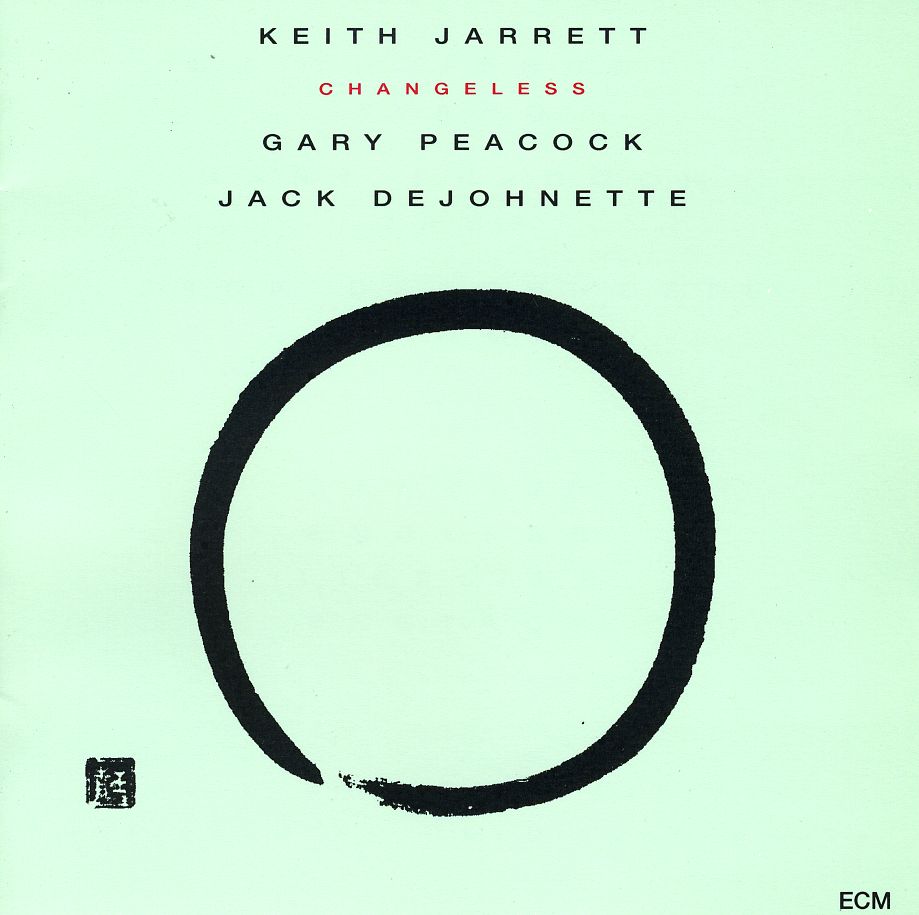
Keith Jarrett Trio: Changeless (ECM 1392)

Keith Jarrett Trio
Changeless

Keith Jarrett piano
Gary Peacock bass
Jack DeJohnette drums
Recorded October 14, 1987 (Denver); October 11, 1987 (Dallas); October 9, 1987 (Lexington); October 12, 1987 (Houston)
Engineer: Tom McKenney
Produced by Manfred Eicher

By the time of this release, Keith Jarrett’s trio with bassist Gary Peacock and drummer Jack DeJohnette was at the height of its creative powers (actually, they started high and simply went higher). One could already hear from their dip into the standards pool that Jarrett’s plenitude of creativity was a force to be reckoned with, if not simply enjoyed, and all the more so in such dovetailed company. That being said, the group was capable of far more than just extending a well-worn tune to a 20-minute diatribe of philosophical proportions. Although Jarrett himself had established quite the reputation as a solo artist, he had only rarely overlaid those transparencies over the topography of his group work. But then there is “Dancing,” the machinations of which open this positively transcendent quatrain of live recordings with a protracted leap of improvisation. As per usual, Peacock sparks the trio’s deepest running flame, and his amplified bass line herein lulls us into a memorable groove. The ostinato feel builds through Jarrett’s grinding left hand, while DeJohnette’s never-cease-to-amazing subtleties draw us in. This energetic yet trance-like state leaves us suitably cleansed for “Endless,” which is one of the most gorgeous things the trio has ever put out. There’s something profound going on here, something that proves the title isn’t just a catchy cue, but rather signals a modus operandi for Jarrett and his cohorts. Peacock’s soloing is revelatory here and spins us into the filmic fade-in of “Lifeline.” With an ear turned inward and his heart beating a versa for every vice, Jarrett floats a flower of resolution down a neorealist canyon. Soil is scarce, though watered all the same by the occasional storms of a hidden life in “Ecstasy.” This aptly titled closer is a tide that simultaneously ebbs and flows, so that the shoreline is forever redrawn.

Perhaps by no coincidence of title, this disc is on par with Changes as a different and sacred side of the trio’s sonorous rites. In some ways these pieces read like Jarrett solos while at the same time being duly enriched by the presence of Peacock and DeJohnette. There is so much to be heard in the experience, and even more to be experienced in the heard.

<< Thomas Demenga: Bach/Carter (ECM 1391 NS)
>> First House: Cantilena (ECM 1393)

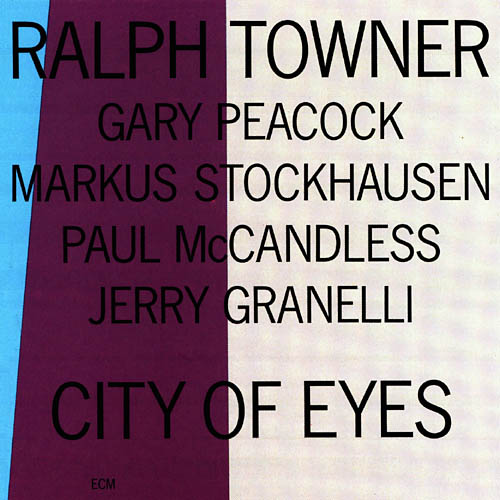
Ralph Towner: City Of Eyes (ECM 1388)


Ralph Towner
City Of Eyes

Ralph Towner 12-string and classical guitars, piano, synthesizer
Markus Stockhausen trumpet, piccolo trumpet, fluegelhorn
Paul McCandless oboe, English horn
Gary Peacock bass
Jerry Granelli drums, electronic drums
Recorded February 1986 at Power Station, New York
Engineer: David Baker
Digitally mixed at Rainbow Studio, Oslo
Recorded November 1988 at Rainbow Studio, Oslo
Engineer: Jan Erik Kongshaug
Produced by Manfred Eicher

While there are, of course, plenty of great pieces to choose from Ralph Towner’s still-growing songbook, I find myself turning more and more to “Jamaica Stopover,” the swinging opener of this late-80s session from the singular guitarist amid a cadre of friends new and old as an introduction to the unenlightened. Picturesque and lively, it is an exemplary showcase of Towner’s melodic (to say nothing of his rhythmic) flair. It is one of a handful of classical solos on City Of Eyes, of which “Janet” is another standout. Each is a snapshot in sound that sings. In addition to Towner’s skills unaccompanied, we are also regaled by a touch of Oregon in the group pieces. These take forms as varied as Towner’s instrumental role, switching as he does from frets to keys a number of times throughout. “Cascades” is perhaps the most successful in this regard. Trumpeter Markus Stockhausen gilds its already fine edges with liquid metal, forging complementary lines to the Jon Hassell-like synthesizers in the background. Stockhausen also dialogues beautifully with Paul McCandless (here on English horn) amid the deft stitching of bassist Gary Peacock. Stockhausen finds himself gilded in turn in the title track. This swell of primal energy sparkles with Towner’s 12 sparkling strings, which carry on through the contemplative solo “Sipping The Past.” Aside from being a lovely blossom in its own right, this piece demonstrates Towner’s talent for shape and architecture. The fullness of these compositional instincts fleshes out into “Far Cry.” This rare trio turn features Towner at both the piano and 12-string and stands as one of his most attractive dreams to date. Drummer Jerry Granelli adds tasteful pointillism to “Sustained Release” before “Tundra” brings us again into Oregon territory, where Stockhausen’s cries speak of an ice age weaving its feathered carpets across the tundra.

The reigning masterstroke of this date, however, has to be “Les Douzilles,” which reprises Towner’s classical against a gallery of spirited ground lines from Peacock. Its sense of movement and emotiveness is deeply performed, and one cannot help but notice the joy that both musicians get out of the interaction. They play as if from behind a sheen of ecstatic nostalgia, Peacock dancing his way through a surprisingly narrow thematic space before settling in for a gentle rejoinder.

There is a rusticity in Towner’s playing that I have always supremely appealing. It is a style unafraid to be a little rough around the edges, for those frays and twangs give the music that much more character. City Of Eyes remains a full portrait of his wide-ranging abilities and is a must-have for any fan.

<< Egberto Gismonti: Dança dos Escravos (ECM 1387)
>> Terje Rypdal: Undisonus (ECM 1389)

Then Comes The White Tiger (ECM 1499)

Red Sun
SamulNori
Then Comes The White Tiger

Red Sun
Wolfgang Puschnig alto saxophone, alto flute
Linda Sharrock voice
Rick Iannacone electric guitar
Jamaaladeen Tacuma bass guitar
SamulNori
Kim Duk Soo changgo, piri, hojok, ching
Lee Kwang Soo k’kwaenwari, vocals, ching
Kang Min Seok buk, ching
Kim Woon Tae buk, ching, bara
Kim Sung Woon komungo, kayagum
Recorded May 1993 at Garak Studio, Seoul
Engineer: Jan Erik Kongshaug
Produced by Wolfgang Puschnig

Look at the sky and pluck a star
Look at the earth and farm the land…
Moon, moon, bright moon, as bright as day
In the darkness this light is our illumination

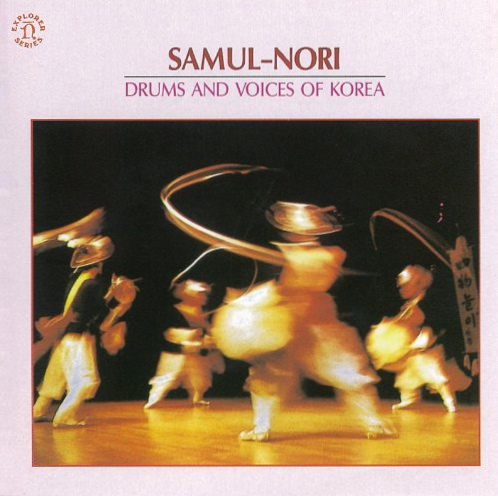
Like many people I am sure, my first exposure to the world of samul nori was through the 1984 Nonesuch Explorer Series recording Samul-nori: Drums and Voices of Korea.

The group SamulNori, which takes its name from the selfsame style of Korean folk music and was founded in 1978 by Kim Duk Soo as a means of expanding the music’s compass of awareness, combines its namesake’s balance of ritual and humble beginnings with contemporary leanings. Samul nori is at heart a percussive genre. Its four instruments are the jing (large gong), the kkwaenghwari (small gong), the janggu (hour-glass drum), and the buk (barrel drum). Each is its own element—wind, thunder, rain, and clouds, respectively—and brings a fertile sound to bear upon a range of ecologically minded texts, both recited and sung. SamulNori members have worked with, among others, Bill Laswell (a true maverick whose seamless productions were the soundtrack to my late teens) and Kodo, but perhaps most notably with Red Sun, a jazz outfit that was the brainchild of saxophonist and flutist Wolfgang Puschnig and with whom SamulNori had its first meeting eight years prior to this influential record.

The ritual drums and horns of “NanJang (The Meeting Place)” are the ideal start, giving way as they do to Lee Kwang Soo’s recitation of the “Pinari,” a Korean origin myth in verse form. Splashing gongs seem to swirl at our feet, and from them arises the voice of Linda Sharrock (wife of another maverick, Sonny), who explores a panorama of nature and living bounty. Guitarist Rick Iannacone draws a cosmic thread through these rawer beads (not to say that one is purer than the other, for they are all made from the same breath that gives all life to matter, and all matter to life), and steers us into the beauties of “Peaceful Question.” Though it is but an amorphous congregation of gongs and bells nesting a voice born from nature who blurs the lines between human and animal (and in fact shows them to be one and the same), words fail to evoke its splendor. It sounds familiar to us all the same, so that “Kil-Kun-Ak” becomes the percussive sinew connecting that voice to the void from which it has taken shape. It leaps like a fire, finds its stillness of mind in the sharing.

Like a playground swing moving of its own accord, Jamaaladeen Tacuma’s crab-walking bass line in “Hear Them Say” traces a counter arc while Sharrock’s notes tremble amid Puschnig’s starlit branches, singing of self-empowerment in a spider’s web of radial guitar lines. “Piri” changes gears dramatically and takes its name from the double-reed bamboo pipe played here by Kim Duk Soo, who soars on a crane’s back through a flowering rendition of the folk song “Han O-Paek Nyn” (The Sorrows of Five Hundred Years). “Soo Yang Kol (The Valley Of Weeping Willows)” is an equally inspired construction that celebrates the place where the musicians had their first Korean pre-production meeting. It also boasts most arresting sax solo on album. Quieter pastures await us in the electric gyrations of “Flute Sanjo” and in “Komungo,” a wavering solo from guest artist Kum Sung Woon on the zither of the same name. This is followed by the two-part “Full House.” Composed by Tacuma, it brings some groove into the mix and represents the session’s deftest idiomatic blends. Its message of joy, peace, and thanksgiving leads us into “Ariang,” which comes to us as if from a distance, an ancestral song woven anew into the lighted corridor of all life.

I have to admit that, as one who had only heard samul nori outside of any fusion context, it took me a while to understand the sound-world of this project. Yet what at first seems an incongruous meeting of “East” and “West” ends up a genuinely wholehearted attempt to undermine those very arbitrary categories. And in the end, perhaps jazz and samul nori aren’t all that different in what they are trying to achieve, in the language they speak and in the ways they speak it. Its voices enact that same need for dialogue and communication that is at the heart of jazz, and expresses said need through evolution and improvisation. All of this is wrapped up in those voices, and in the saxophonic punctuation that reorders their grammar. This music speaks to us because it tells us a story we already know. It is a story from which we were born, one into which we will be written when we die. A space-time continuum to which profundity need not apply, for it is too lowly to express that from which it hangs.

<< Hal Russell/NRG Ensemble: The Hal Russell Story (ECM 1498)
>> Jan Garbarek Group: Twelve Moons (ECM 1500)

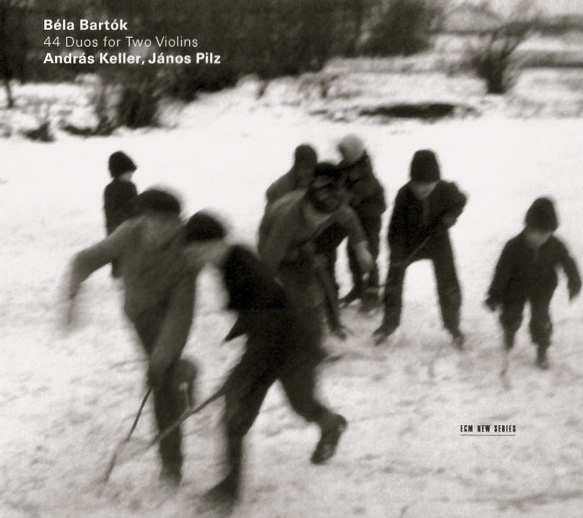
Bartók: 44 Duos for Two Violins (ECM New Series 1729)

Béla Bartók
44 Duos for Two Violins

András Keller violin
János Pilz violin
Recorded October 1999 at Propstei St. Gerold, Austria
Engineer: Peter Laenger
Produced by Manfred Eicher

Béla Bartók originally wrote his 44 Duos for Two Violins in the early 1930s at the behest of Erich Doflein, a Freiburg music instructor looking for a set of pieces both didactic and distinctly modern. Yet it is clear that the composer never intended at least some of these exercises to remain off the stage. András Keller and János Pilz of the widely celebrated Keller Quartett show us that neither were they meant to remain on the page, for in these benchmark performances they have enlivened the music with something it inherently possesses: a need to dance. That being said, and with the wealth of Eastern European sources bleeding through at nearly every stroke, folk music is not merely the means to Bartók’s message. A desire to look beyond this easy association is perhaps what lies behind the musicians’ decision to play the pieces out of sequence (Bartók had originally arranged them in order of increasing difficulty). In doing so, they focus our attention on the musicality of what is at hand.

From the verdant strains of “Erdély Tánc” (Transylvanian Song) one will hear how this music has influenced composers as diverse as Michael Galasso, Henryk Górecki, and Stephen Hartke, to name but a few. This song is like a tree of its own, every draw of the bow a newly articulated vein, and all that follows a book of its pressed leaves. Much of the work is pensive and exploratory, at once within and without. Some movements are all the more engaging for their brevity, like the uplifting and, dare I say, groovy “Párnás Tánc” (Cushion Dance), not to mention the trembling beauties of “Ujévköszöntö II” (New Year’s Greeting II), “Tót Nóta II” (Slovak Song II), and the “Menuetto.” The latter’s full double stops and swaying leads speak to the robustness of heart so characteristic of Bartók. From the sinewy leaps and bounds of “Szunyogtánc” (Mosquito Dance) to the meditations of “Mese” (Fairy Tale), he employs subtle dissonances that transmogrify seemingly straightforward gestures into more complex acts of implication. Others, like “Lakodalmas” (Wedding Song), cast simple shafts of light through a cracked attic wall, illuminating that same book of leaves into which every vignette is placed. “Szól A Duda” (Bagpipes) is one of the most stunning in the collection, its grammar so distinct that it is played twice in this recording. Keller and Pilz also underscore the percussive aspects of “Pizzicato” and “Arab Dal” (Arabian Song), the latter another standout performance in an already vivacious program. They add the most depth, however, to the more ponderous moments therein. Notable examples of this can be found in “Oláh Nóta” (Romanian Song) and “Bánkódás” (Sorrow).

While the liner notes give us no explanation regarding the program’s complementary encores, one can trace them back to the same cache of folk influences. One might also have added, if anything, the comparable duo sonatas of Prokofiev or, for that matter, Górecki, but instead we find two kindred spirits whose interest in deepening the essence of the form was as fleeting as the intensity with which they engaged it. György Ligeti’s Ballad and Dance after a Romanian folk song are two links in an otherwise obscured chain. The wavering cries of the first and the awakening of the second show us two sides of the same celestial body and wrap us in a cloak of night so intimate that the duo version of Ligatura – Message to Frances-Marie op. 31b by György Kurtág that closes reads like an orchestra whose voice strains to be heard over vast distances yet whose body has already rotted by the time that voice reaches us.

The rich sonority of these instruments and the music flowing through them moves like a blade across greased leather, and under the watchful ear of engineer Peter Laenger the recording inhabits a fine balance between capture and deference. The brilliance of this music is its ability to emote in lieu of euphemistic storytelling, getting to what Edward Gordon Craig would call “the spirit of the thing,” curling its fingers around something essential the more illusory those fingers become.

<< Tsabropoulos/Andersen/Marshall: Achirana (ECM 1728)
>> György Kurtág: Signs, Games and Messages (
ECM 1730 NS)

Keith Jarrett: Personal Mountains (ECM 1382)


Keith Jarrett
Personal Mountains

Keith Jarrett piano, percussion
Jan Garbarek tenor and soprano saxophones
Palle Danielsson bass
Jon Christensen drums
Recorded in concert, April 1979, Tokyo
Engineer: Jan Erik Kongshaug
Produced by Manfred Eicher

Despite being recorded in 1979, it would be a full decade before this jewel of a live recording from Keith Jarrett’s unparalleled European quartet (with Jan Garbarek on saxophone, Palle Danielsson on bass, and Jon Christensen on drums) would find itself sleeved and catalogued at last. From note one Personal Mountains paints melodic vistas of great majesty wrapped in a bow of rarified execution. As throughout, Garbarek’s blustery tone in the title opener proclaims themes with crystal-clear diction across the widening sky of Jarrett’s pianism. Jarrett himself takes an early leap in this outing, riding the rhythm section like a thoroughbred into open fields. He turns night into day with every chord, the fullness of his sound accentuated especially by Christensen’s rolling thunder as he unravels wonder after wonder. Yet even as Garbarek works his chromatic magic for the betterment of something profound, Christensen and Danielsson are given no small spotlight in which to shuffle their dialogue into a hollering tumble. Thus are we jettisoned skyward into an unexpected turn of phrase. Garbarek constructs hang gliders of melody in the thick night, every dip a chance to rise again. Meanwhile, Jarrett sews our hearts into the folds of a time unbound, thus moving us smoothly into “Prism.” Our usher this time is Danielsson, who pulls Jarrett’s ballad energy through a brushed corridor. Jarrett has all he needs from Garbarek to burn the midnight oil with a sparkling tapestry of soloing. His gentle cascades then release us into “Oasis” before Garbarek’s sharply inclined theme breaks the waves. Jarrett is again wondrous, spinning the finest spider’s thread into a wheel of adhesive memories. Offset by Christensen’s vibrancy, he and the others forge a vision for all senses. Jarrett invites us all by his lonesome into the aptly titled “Innocence.” Like a candle that barely trembles in the rhythm section’s sleeping breaths, his playing makes string games of moonbeams with the conviction of a dream. Of the latter we hear but a snippet in “Late Night Willie.” This gentle groove—bluesy enough to have Jarrett whooping all the same—gives us a soulful Garbarek and an overall elasticity which hurls us into an even deeper appreciation for the art at hand.

There is something magical about the pairing of Garbarek and Jarrett that brings out the best in both. And with such fine rhythmic support—and, to be sure, Danielsson and Christensen are as much melodicians as they are rhythmatists—one can hardly ask for anything grander. Although this is a live recording, one would hardly know it from the rapt silence that embraces this music until the audience’s applause breaks the spell.

<< Jan Garbarek: Legend of The Seven Dreams (ECM 1381)
>> Terje Rypdal: The Singles Collection (ECM 1383)

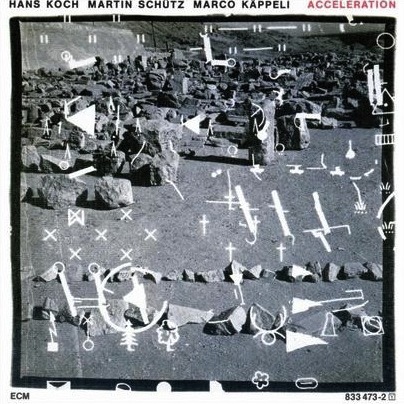
Koch/Schütz/Käppeli: Accélération (ECM 1357)

Hans Koch
Martin Schütz
Marco Käppeli
Accélération

Hans Koch clarinet, bass clarinet, tenor and soprano saxophones
Martin Schütz bass, cello
Marco Käppeli drums
Recorded June 1987 at Tonstudio Bauer, Ludwigsburg
Engineer: Martin Wieland
Produced by Manfred Eicher

The debut recording of classically trained Swiss clarinetist Hans Koch’s jazz trio with bassist/cellist Martin Schütz and drummer Marco Käppeli, Accélération is not a shy blip in the fascinating potpourri of ECM’s 80s period, by which time Koch’s formidable outfit had left its footprints in standard territories before branching out here with a set of nine originals. Into this, the shivering cello and pointillist rims of “Shy Csárdás” provide a fitting point of entry. Like an opera overture these sounds recede as quickly as they rise, making way for the clarineted protagonist whose introductory aria secures a tether of human folly to the romantic sentiments that follow. Koch’s forte sings as it moves and moves as it sings, finding an ecstatic dance “Im Delirium,” which gives us also the album’s first and last tenor line over a waltzing bass. “Midori” is a synaesthetic exercise, rustling through leaves and time with the obsession of hunger and divulging some fine moments from Schütz against a spate of frenetic drumming. That clarinet waves like the last thread to something familiar as it snaps into an ecstatic death throe. “Loisaida” casts a dreamy spotlight thereon and unspools a whirligig of a denouement in “Glas(s)no(s)t.” Of this, the engaging stichomythia between cello and soprano is but an appetizer to the screeching “Tatzelwurm,” itself a preamble to the bouquet of trio action that begins with “Nitrams Rock” and ends in the playful piece of swank that is “GG-U-GG-U-RR-U-GG.”

A personal favorite among ECM’s lesser-knowns.

<< Pepl/Joos/Christensen: Cracked Mirrors (ECM 1356)
>> Stephan Micus: Twilight Fields (ECM 1358)

Through the Fog: A Contact Live Report from Birdland

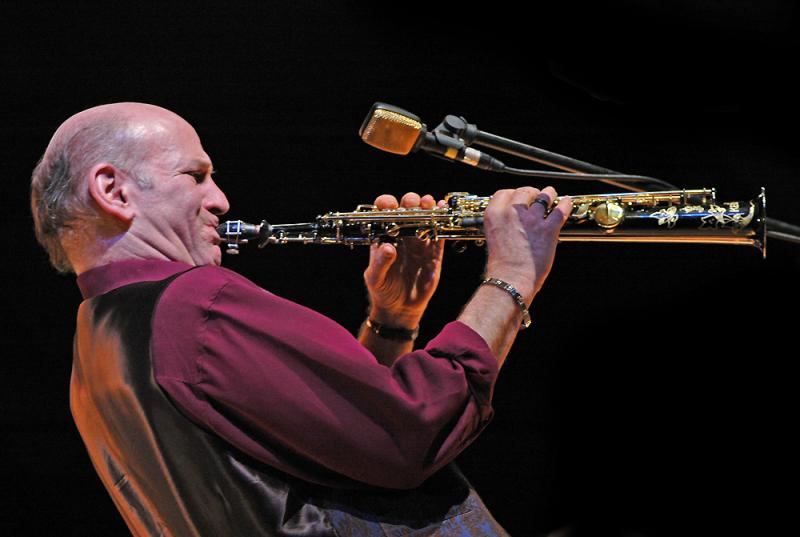
Dave Liebman soprano and tenor saxophones
John Abercrombie guitar
Marc Copland piano
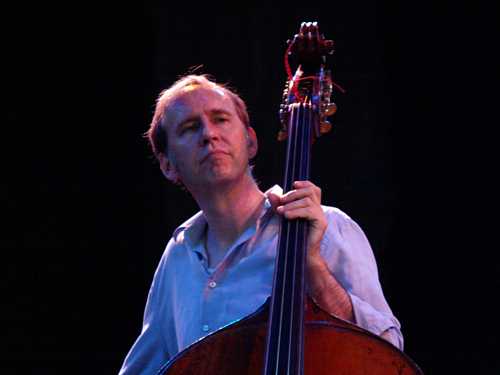
Drew Gress bass
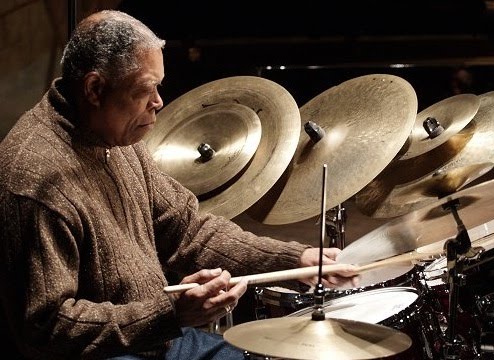
Billy Hart drums

Birdland, New York City
February 10, 2012
11:00 pm

Contact is as appropriate a name as one might come up with for saxophonist Dave Liebman’s newish outfit. This star-filled quintet—in which he joins forces with guitarist John Abercrombie, pianist Marc Copland, bassist Drew Gress, and drummer Billy Hart—practices what it preaches, bringing a surprisingly permeable sound to bear upon equitably spread writing and performing. Once the group took to the stage at Birdland last Friday night, Abercrombie quipped on the name, assuring us it had nothing to do with the Jodie Foster film of the same name. Then again, he added, such a connection might prove valid as they develop their interactions over time. If this show was any indication, I am inclined to agree, for most intriguing were the dramatic developments it underwent over the course of its four long tunes.

Liebman’s soprano, at once flute- and trumpet-like, was the first to catch our ears as it danced through a tentative midrange guitar in “Soundup” (Abercrombie), also the opener of the group’s 2010 Pirouet album, Five On One. Hart set a precedent of color for the night with his glottal cymbals, while Gress’s well-tuned fingers brought an omnipresent depth. Abercrombie’s first solo was buoyant, if conservative, and seemed to end just as it was flapping its wings. Copland was almost inaudible at first, preferring, it seemed, to linger like a trembling breath. Liebman’s bubbling gestures, on the other hand, sprouted a wealth of chromatic foliage. Every note had its own tone, shaped by a rare breadth of embouchure. Once he and Abercrombie receded, Copland at last came to the fore. Spearheading some lovely trio action, he brought out the classic core that moves the heart of all of these musicians. Notable was the way in which he unraveled the number’s tightly woven themes, making the rejoinder all the more comforting.

“Footprints” (Shorter) arose out of a quiet eddy in which Liebman swam limberly on tenor, fading in and out, as he did throughout the set, like an ear selectively attuned to stillness. Abercrombie was visibly more comfortable in his solo this time around. He moved with a hum of wincing energy, seeming to first define a branch then trail from it like a spider from a thread of web. Copland kept his hands quite close for his turn, as if tied by one of those very threads to some hope through foggier days. Hart was the real star here, dialoguing on the light fantastic with the rest of the band in vast, metallic exchanges.

If the winds of improvisation had only begun to blow before, in “Childmoon Smile” (Copland) they now whistled through the trees of the audience with the insistence of a dream. The tune’s composer regaled us with a lush solo, gilded by Hart’s bronze, before Liebman dovetailed his soprano to the emerging carving. Gress evoked Gary Peacock in his solo, while Copland sparkled like a watery surface in soft focus. Hart’s brushes were at once ice and sand, brought to life with a kiss of warmth. After leaving the quiet vessel of Abercrombie’s solo, Liebman saw fit to ply more cosmic territories. Copland added his characteristic impressionism to the cubist splendor of Liebman, who enchanted with the most innovative solo of the night before Copland wrung out another verdant splash to close.

Abercrombie led us down an abstract path to “Blues Connotation” (Coleman), which kicked off the set’s final cerebral groove. Liebman was superb on tenor here, moving in clusters and high-flying loop-de-loops, echoed by Abercrombie at every catch. Both scaled and slid through this melodic plane like an uninterrupted game of Snakes and Ladders. Gress flickered like a candle in fast forward before Copland crept in from the periphery. Then, it was just he and Gress taking us into blissfully unexpected territories, uniting in moments that elicited gasps of admiration from the audience. Hart reprised his locomotive charm and unmasked a solo like an origami figure unfolding and refolding itself by fire alone. The final stretch went down like a swig of Jameson.

Liebman plays at the speed of thought. He allows for space, vital and alive, drifting in and out of the ear like an idea does the mind. His playing is something beyond melody, yet entirely devoted to it. Copland’s inventiveness is limitless, and in such a rich setting he had more enough to work with. Abercrombie was fluid as ever, though it seemed to take him a while to warm up to the feeling of the moment, and it a great pleasure to finally see Gress and Hart in concert, for the two of them provided a penetrating elasticity that was subtly surprising. Here is a band that really listens, and we can only give the same in return.