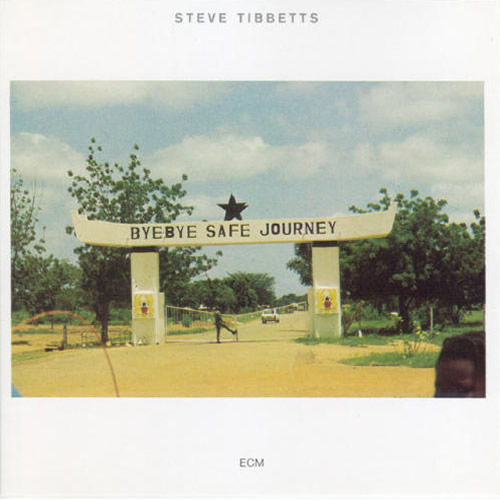
Steve Tibbetts: Safe Journey (ECM 1270)

Steve Tibbetts
Safe Journey

Steve Tibbetts guitars, kalimba, tapes
Marc Anderson congas, steel drum, percussion
Bob Hughes bass
Tim Weinhold vase
Steve Cochrane tabla
Recorded 1983 in St. Paul, Minnesota
Engineer: Steve Tibbetts
Produced by Manfred Eicher

Guitarist Steve Tibbetts exploded our view when ECM introduced the world to the adroit textures of Northern Song. He did so again with “Test,” the doorway onto the enlightening path that winds through Safe Journey. Don’t let its initial stirrings fool you into slumber, for you are sure to be jolted by a guitar that seems to scrape the walls of its harmonic enclosure and expose the burnished paneling within. From humble genesis to almost frightening expanse: this is Tibbetts’s MO. With a minimal assortment of instruments in his coterie, he excavates eras’ worth of sediment. Note the stunning passage where his electric gets caught in echoing loops, while its second self solos over the remnants of what it once was. Such splitting of voices is another trademark, as are the contrasts of “Climbing.” In this quiet cave, Tibbetts sits cross-legged with a kalimba in hand, letting its plunking droplets of sound gild the surrounding stalagmites. Curiously, this track feels less like climbing and more like burrowing. Similarly, the delicacies of “Running” feel like a closing of eyelids, behind which the only feet to touch ground are those of an unfinished dream. A sparkling acoustic guitar, a touch of steel drum and sitar, and the patter of footsteps like rain through a children’s rhyme pull a shade of darkness that plunges us into “Night Again.” Here, the programmatic title holds true in the vastness of sound Tibbetts elicits from his strings as he weaves a lullaby against mounting starlit percussion, for neither does the night abide by arbitrary delineations of territory and bodily space. Eventually, the guitar cuts out, leaving the drone to “solo,” as it were, drifting like the Northern Lights into melodic aftereffects. “My Last Chance” is a swath of nostalgia filigreed by a promising future and opens us to the moral intensity of “Vision.” Tibbetts makes some of the most effective use of taped music one is likely to encounter in a band setting, and especially here. His electric cries like a voice from a cracked egg, breaking with the dawn into blinding intensity, seeming to hold its breath before every note is expectorated. “Any Minute” is another fragile design that wavers in ghostlike existence, never quite resolving the memories so fully fleshed out in “Mission.” Running on the gentle propulsion of a spiritual engine, “Burning Up” humbles itself before a smoldering backdrop, where only the trails of fleeting human figures “Going Somewhere” tell us where we might safely tread home. And it is in the tinkling of starlight that we finally come face to face with our destination, which has been ourselves all along.

With such distinct shades of ambience—all activated by an intuitive sense of ebb and flow—and a incredible group of musicians to give it life, this music glints anew every time. Tibbetts is the perennial traveler whose rucksack contains only the freedom of possibility.

Oh, to have been there, at a record shop when this album first came out. If what I feel now is any indication, I can only imagine the depth of its impact.

Wondrous to the nth degree.

<< Dave Holland Quintet: Jumpin’ In (ECM 1269)
>> Pat Metheny: Rejoicing (ECM 1271)

Dave Holland Quintet: Jumpin’ In (ECM 1269)

Dave Holland Quintet
Jumpin’ In

Dave Holland bass, cello
Steve Coleman alto saxophone, flute
Kenny Wheeler trumpet, pocket trumpet, cornet, fluegelhorn
Julian Priester trombone
Steve Ellington drums
Recorded October 1983 at Tonstudio Bauer, Ludwigsburg
Engineer: Martin Wieland
Produced by Manfred Eicher

Jumpin’ In isn’t just a title. It’s a call to action. So let’s get to it. The eponymous opener is a veritable résumé, a formative and ever-growing catalogue of accomplishments through which one can view the development of an artist at work. Only here, we experience that development in real time. It is clear from the first moments that Dave Holland is a step above not only so many other jazz bassists, but also composers in bringing freshness to his music. In the absence of a piano or mallet instrument, acceptance into the Quintet firm requires an equally impressive CV (that stands for “Consummate Virtuosity”) to pull it off right. Like a fine pointillist drawing, each scene has no definite border, but rather coheres through the openness of the image. Holland seems to have always had a soft spot for great trombonists, and the inclusion of Julian Priester was a masterstroke in this regard, for his anchorage is nearly as fresh as Holland’s throughout. Drummer Steve Ellington and a young Steve Coleman on alto and flute complete a powerful improvisational picture lit by Kenny Wheeler’s sideways trumpeting. Holland’s compositional sensitivity reveals itself in “First Snow,” a gorgeous concept for a jazz tune, and equally so in its execution. It is also a potent example of Wheeler’s craft and the fine balance it achieves between delicacy and piercing evocation. Coleman offers up the album’s only non-Holland tune with “The Dragon And The Samurai.” This respectable palette cleanser boasts some fabulous braiding from the three horns and pulls us down a bumpy road to “New-One,” Priester’s time to shine. “Sunrise” flags the elemental themes that are the album’s touchstones, while “Shadow Dance” spins a cinematic tale that is equal parts Spy Hunter and melodrama. The tongue-in-cheek “You I Love” shows the horn players at their best and plays us out on a whim.

Jumpin’ In bristles with energies sure to work their way into your tapping foot and nodding head. It is also a fitting testament to Charles Mingus, to whom the album is lovingly dedicated.

<< Ulrich P. Lask: Sucht+Ordnung (ECM 1268)
>> Steve Tibbetts: Safe Journey (ECM 1270)

Ulrich Lask: Sucht+Ordnung (ECM 1268)

Ulrich Lask
Lask 2: Sucht+Ordnung

Ulrich Lask alto and tenor saxophones, computer programming
Meinolf Bauschulte drums, electronic percussion
Maggie Nicols
Sigrid Meyer narration
Monika Linges narration
Recorded January 1984 at Tonstudio Bauer, Ludwigsburg
Engineer: Martin Wieland
Produced by Ulrich P. Lask and Meinolf Bauschulte

I must confess to having a soft spot for Mr. Ulrich P. Lask, whose brief flirtations with ECM have been forgotten under a pile of subsequent beauties. This whimsical little oddity continues where his initial outlier dropped off a flat earth. In such a post-apocalyptic Elliot Sharp-like sound-world, Lask and company can only retrace the urban nightmare that so haunted the waking life of its predecessor. Yet where Lask the first benefited from the boggling virtuosity of vocalist Maggie Nicols, Lask the second suffers from too little of it. What we get instead is a lighter, more capricious chain of German narration over spiky soundtracks. Morphological anxieties still run rampant, as in “Mamamerika,” and Lask’s reed work cuts intriguing enough chains of deformed handholding figures from the pessimistic shadows of “Erfolgreich Und Beliebt,” as it does in all the instrumentals, but only when Nicols rises from the primordial soup of “Ordnung” does the album hit its stride. Like some spastic, panting experiment, breath and electronics make for glowing concoctions from hereon out. The freestyle sparring of “None The Wiser” and gritting teeth of “Kleine Narkosen” are standouts, as are the vocal vampirism and deft arrangement of “Sigi Sigi.” And even as ghostly lips nip at our backs, after this puree of angst and ennui we finish with a taste of hope in “Sucht.”

Lask 2 is worth listening to at least once and is yet another example of a recording that breaks the mold into which ECM criticism is so often poured. Like the voice in “Freie Mädchen Arbeiten Im Hafen” that laughs at her own aplomb, this head-scratching detour on the label’s quest for silence spits in its own face, so that any insult you might throw its way will have to contend with a sheen of self-derision. Worth finding if your face prefers to wear a smile.

<< Chick Corea: Children’s Songs (ECM 1267)
>> Dave Holland Quintet: Jumpin’ In (ECM 1269)

Rainer Brüninghaus: Continuum (ECM 1266)

Rainer Brüninghaus
Continuum

Rainer Brüninghaus piano, synthesizer
Markus Stockhausen trumpets, fluegelhorn
Fredy Studer drums
Recorded September 1983 at Talent Studio, Oslo
Engineer: Jan Erik Kongshaug
Produced by Manfred Eicher

For his second ECM album as leader, keyboardist Rainer Brüninghaus sidestepped the Eberhard Weber nexus in favor of this unique trio outfit with trumpeter Markus Stockhausen and drummer Fredy Studer, with whom he recorded a few albums on through the early nineties. Though none of the musicianship will have you bowing down in worship, the compositions are the real strength of the album. The lush spread of synths and horns in “Strahlenspur” welcomes us into the sort of affirmative warmth that one would expect from Pat Metheny, while the icy backdrop of “Stille” moves far more contemplatively through Stockhausen’s gently unfurling banners. The title track shuttles Brüninghaus’s fine pianism through a loom of drums in the album’s shortest but most uplifting passage. The airy “Raga Rag” is by contrast, at 11 minutes, the longest. As might an airplane’s white trail, it heals slowly like a cut across the sky’s blue skin. The superb trumpeting sets Brüninghaus off on an ethereal tangent, the heel of every winged step nipped by Studer’s intuitive timekeeping. “Schattenfrei” is another short and sweet dialogue, and leaves us well informed to navigate the final expectorations of “Innerfern” with confidence. Each new turn bleeds into an uncharted solar system. From the saccharine yet uplifting ornamentation of a flanged sequencer to Stockhausen’s careening off into the farthest reaches of the universe, it is a transcendent way to end things.

Brüninghaus’s style and ECM’s production values feel like old friends, and in so being welcome us into their friendship in the listening. One need only pick up this thoughtful album to join their circle.

<< The George Gruntz Concert Jazz Band: ’83 Theatre (ECM 1265)
>> Chick Corea: Children’s Songs (ECM 1267)

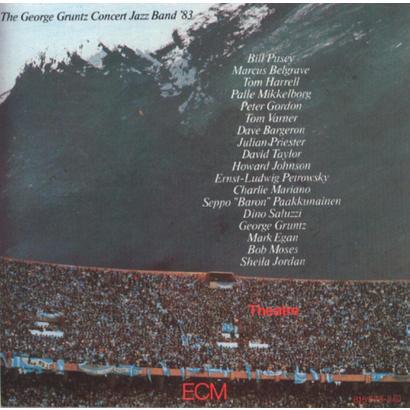
George Gruntz Concert Jazz Band: Theatre (ECM 1265)

George Gruntz Concert Jazz Band
Theatre

Palle Mikkelborg trumpet, fluegelhorn
Peter Gordon French horn
Julian Priester trombone
David Taylor bass trombone
Howard Johnson tuba, bass clarinet, saxophone
Charlie Mariano saxophones, flute
Dino Saluzzi bandoneón
George Gruntz keyboards
Mark Egan bass
Bob Moses drums
Sheila Jordan vocal
Recorded July 1983 at Tonstudio Bauer, Ludwigsburg
Engineer: Martin Wieland
Produced by Manfred Eicher

“We are contrary as the weather.”

The Swiss jazz musician, composer, and arranger George Gruntz is known for thinking big. Having served as the JazzFest Berlin artistic director from 1972 to 1994, he is clearly comfortable in juggling hefty amounts of musical information. This is reflected also in his music, which has dealt with a number of formats over the years, ranging from intimate piano works to expansive suites on political and cultural themes. Theatre, his only album for ECM, sits somewhere in the middle. The result is a work that never quite knows where it’s going. One look at the roster tells you that, at the very least, this is a remarkable assembly of musicians. On that note, some of the better moments can be found breathing in the bandoneón of Dino Saluzzi, who also composed the opening “El Chancho.” Saluzzi’s gentle persuasion leaves the most ripples in this pool, and deepens the proceedings with ancestral yearnings. Trumpeter Palle Mikkelborg also brings glory to the table, while bassist Mark Egan (of onetime Pat Metheny Group renown) adds a sinewy backbone. The growling tuba and brass menagerie of “In The Tradition Of Switzerland” swells like some boppish nightmare turned inside out, so that its darkness becomes its skin and its light remains hidden except through performance. Freer abstractions abound, coalescing into the album’s most powerful: a solo from saxophonist Ernst-Ludwig Petrowsky. A cathartic highlight, and all the more so for being contrasted by the wooden flutes that follow. With the introduction of sputtering words, we encounter touches of Michael Mantler alongside allusions to Duke Ellington and Ornette Coleman. Sheila Jordan brings her smooth and sultry lines to bear on “No One Can Explain It,” carrying on the torch through “The Holy Grail Of Jazz And Joy.” Jordan adds much-needed spunk to an album that has by this point begun to lose some of its drive, especially in this final track, a 25-minute paean to the art that bubbles with big band personality and ends with a slow fling into the night, a popped champagne cork, a bid and farewell.

From the bizarre cover photograph, one would think this was a live album of some importance. What we get, however, is a relatively intimate and respectable studio session. There’s no need to drop everything and buy this, and may have more value to the ECM completist than the workaday listener. Will move some more than others.

<< Alfred Harth: This Earth! (ECM 1264)
>> Rainer Brüninghaus: Continuum (ECM 1266)

Kenny Wheeler: Double, Double You (ECM 1262)

Kenny Wheeler
Double, Double You

Kenny Wheeler trumpet, fluegelhorn
Michael Brecker tenor saxophone
John Taylor piano
Dave Holland bass
Jack DeJohnette drums
Recorded May 1983 at Power Station, New York
Engineer: Jan Erik Kongshaug
Produced by Manfred Eicher

One can always count on trumpeter Kenney Wheeler for three things: (1) rounded writing contrasted with pointed soloing, (2) an always-engaging sound, whether alone or surrounded by a large band, and (3) a perfect marriage with ECM production values. For this modest set, we get two epic cuts bookending two shorter ones, and the results do not disappoint. As if having the talents of Jack DeJohnette, Dave Holland, and Mike Brecker along for the ride weren’t enough, Wheeler is also joined by John Taylor, whose sweeping pianism tempers the trumpeter’s fire just enough to keep it from scalding us, and whose resplendence could alone carry the album. The potent lyricism of the entire congregation is on full display in “Foxy Trot.” Holland and DeJohnette bring on their own heat, as well as a live, exuberant energy to the proceedings that provides an ideal carpet of hot coals for Brecker’s carefully measured walk. After an unremarkable duet between Wheeler and Taylor (“Ma Bel”), he and Brecker spin a duet in “W. W.” that bowls us over once the rhythm section kicks in. The two horns are superbly attuned here, and Brecker in particular in his soaring solo, which burns up all of its available oxygen and leaves Holland to dance among the ashes. Last is a triptych of compositions that begins in bliss with Brecker and Taylor, wrought through by Wheeler’s sunshine and the glistening accents of DeJohnette and Holland. We also get an effervescent solo from Taylor, who draws the curtains around us like a silo of intimate memories. Wheeler’s resolutions seem to trace a life of contented solitude and bring closure to an album of high energy.

Wheeler hits his stride at every turn with his unabashed brand of exposition, which defines new sonic territory with every project. One could easy gush at length about his lyricism, but on this album we also get an even clearer sense his rhythmic sensibilities. Ignore the filler of “Ma Bel,” and you have an almost perfect album.

<< Shankar: Vision (ECM 1261)
>> Terje Rypdal/David Darling: Eos (ECM 1263)

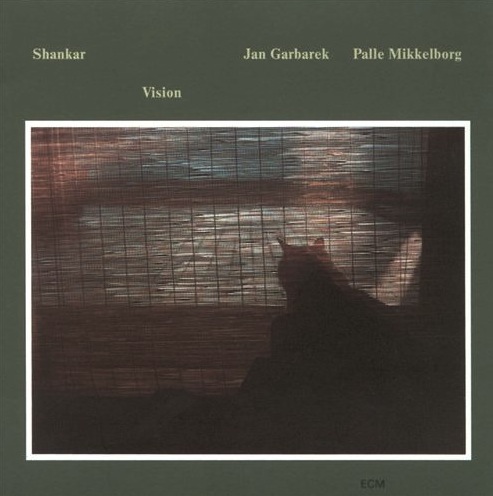
Shankar: Vision (ECM 1261)

Shankar
Vision

Shankar 10-string double violin, percussion
Jan Garbarek tenor, soprano and bass saxophones, percussion
Palle Mikkelborg trumpet, fluegelhorn
Recorded April 1983 at Talent Studio, Oslo
Engineer: Jan Erik Kongshaug
Produced by Manfred Eicher

After the masterstroke of Who’s To Know, perhaps it was inevitable that the growing ECM pool would provide unusual collaborative opportunities for the 10-string stereophonic electric violin of L. Shankar. And that we certainly are given in Vision, an unearthly journey that finds him in the company of saxophonist Jan Garbarek and trumpeter Palle Mikkelborg. The former is a no-brainer for this date, while the latter provides an ethereal depth to the already expansive sound. Shankar’s violin is heavily flanged throughout, an effect that does grow tiresome after a while. But such caveats hardly register in the melodious hearth in which they burn.

One need only follow the pizzicato footsteps of “All For You” to get acquainted with the album’s beauties and to feel the shadows of Garbarek and Mikkelborg flying overhead. With this exuberant awakening still echoing inside us, we can only close our eyes in the title track. Amid the raspy breath of the violin’s lower strings, the air itself vibrates with a cosmic growl, as if some enormous lioness were slowly coming out of her shell in Terje Rypdal’s dreams. Through the glacial slides of “Astral Projection,” Garbarek and Mikkelborg etch a flock of shooting stars in a slow-moving tide of meditation. “Psychic Elephant” follows in much the same vein as the opener, blossoming into a pizzicato line that one could listen to for hours on its own. This time around, Mikkelborg dons the ether like a cloak, while Garbarek surprises with rare turns on drums and bass saxophone. Only here does Shankar lose himself in more pronounced streams of life before the solitude of “The Message” carries us into stasis.

I wasn’t fully convinced by this album the first time I heard it, yet as I have grown with it, so too has it grown with me: proof positive of its power to transcend the disc on which it was recorded and find sanctum in the human heart.

<< Chick Corea/Gary Burton: Lyric Suite For Sextet (ECM 1260)
>> Kenny Wheeler: Double, Double You (ECM 1262)

Chick Corea/Gary Burton: Lyric Suite For Sextet (ECM 1260)

Chick Corea
Gary Burton
Lyric Suite For Sextet

Chick Corea piano
Gary Burton vibraharp
Ikwhan Bae violin
Carol Shive violin
Karen Dreyfus viola
Fred Sherry cello
Recorded September 1982 at Mad Hatter Studios, Los Angeles
Engineer: Bernie Kirsh
Produced by Manfred Eicher

The Lyric Suite for Sextet joins the unparalleled duo of Chick Corea and Gary Burton with string quartet for a combination soon to be repeated with the release of Hot House. Through an erratic and sometimes disjointed hall of mirrors, it explores a series of never quite fully formed ideas. The opening notes of this then unique collaboration create a thriving and exuberant sound that permeates every moment that follows. Burton’s liquid runs, especially in “Waltz” and in “Dreams,” bring forth all the music’s chambered revelry as Corea weaves nimbly through every sprung carnation left in his footfall. From the brief yet enthralling “Rollercoaster” to the ebullient “Finale,” feelings sweep us away, and are swept away by, their own intensity. But the album’s true colors come out in “Brasilia,” which opens with the gorgeous unfolding of Corea’s piano, slowly introducing water droplets of vibes and the firmer grounding of strings, which at last become a vital presence, interacting with the piano lines in a deeply internal conversation for the album’s tenderest moments. Corea’s delicacy is a wonder here.

As a concept album, the Lyric Suite is a classic to be sure, albeit one that’s difficult to put a finger on. Then again, perhaps that’s the point. And while the strings may seem a superfluous stroke alongside musicians already so lush (seeming to unify only in the album’s latter half), it is the expansiveness of vision and the infectious exuberance of the playing that may keep you returning on occasion to this curious little experiment.

<< Jan Garbarek Group: Wayfarer (ECM 1259)
>> Shankar: Vision (ECM 1261)

Oregon: s/t (ECM 1258)

Oregon
Oregon

Paul McCandless reeds, flute
Glen Moore bass, violin, piano
Ralph Towner guitar, piano, synthesizer
Collin Walcott sitar, percussion, voice
Recorded February 1983, Tonstudio Bauer, Ludwigsburg
Engineer: Martin Wieland
Produced by Manfred Eicher

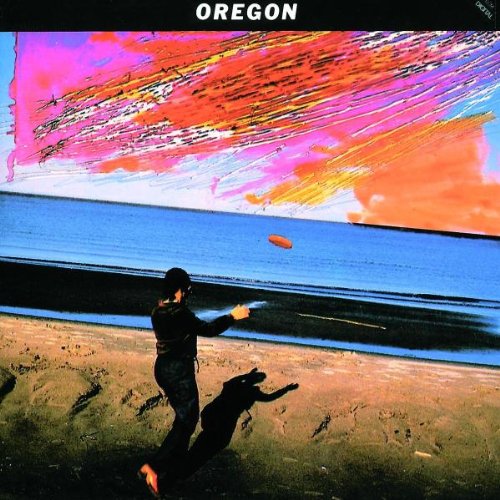
By the time of this self-titled ECM debut, the collective known as Oregon had firmly established its uncategorizable sound on a host of recordings for Vanguard. From the cover photograph, which stands as one of the more confounding choices in ECM history, those unfamiliar with Oregon would probably never guess that the music it sleeves could be so ethereal. Oregon finds the group still in its original incarnation with Paul McCandless, Ralph Towner, Glen Moore, and Collin Walcott (in one of his last sessions with the group before his life was tragically ended in a 1984 car crash).

The opening chords of “The Rapids” render some of the album’s more compositionally minded passages (the others being McCandless’s “Beside A Brook” and two pieces from Moore, of which the winged “Arianna” stands out). And yet, while rays of light shoot from McCandless’s soprano, the music’s percussive colors are what really hold our attention. Oregon doesn’t so much cross into as over idioms, as exemplified to pointillist effect in the droning “Beacon.” These sustained emotions continue later in “Skyline,” before carrying us into “Impending Bloom,” the rhythms of which burst like an organic ancestor of Aphex Twin’s “Alberto Balsalm.” It also constitutes a meta-descriptive statement for Oregon’s musical process, where the idea of profusion is but a memory on the slope toward a different kind of light. It moves with the persistence of a small locomotive, soprano saxophone flirting with the snake of smoke above it. The evocative “Taos” is another highlight, so adroitly negotiating as it does subterranean thrums with high flutes. The crepuscular guitar and wayfaring bass clarinet of “There Was No Moon That Night” form yet another.

I must confess that, despite Oregon’s legendary status, I was only recently introduced to their music via this recording. A magical experience. As I understand it, those more well-versed than I in Oregon lore tend to look down upon this album, so who knows how my relationship with it might change as I begin to familiarize myself with the more classic material. Whatever may come, I know I’ll always appreciate this date for having shown me the way.

<< Barre Phillips: Call me when you get there (ECM 1257)
>> Jan Garbarek Group: Wayfarer (ECM 1259)