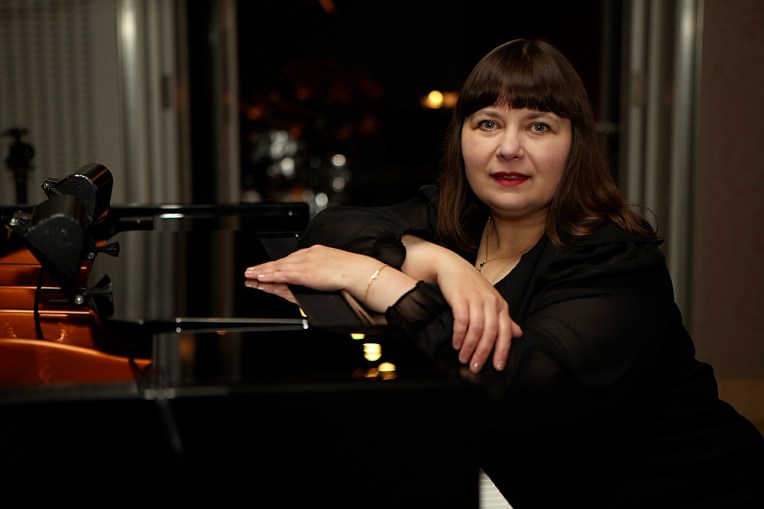
“Scenic” is the word that comes foremost to my mind when basking in the music of Yelena Eckemoff. Not only in the sense of being rural and picturesque, but also in the filmic sense, as if each album were a scene from an evolving motion picture. Snapshots of memory, flickers of time, and points of reflection: these are the nourishments on which Eckemoff’s sonic activities thrive. The Moscow-born, U.S.-based musician, composer, artist, and teacher brings her experiences of (re)location to bear upon each new project, and draws upon a deep spiritual awareness to give weight to the painterly melodies therein. Simultaneously, her music has an uncanny ability to manifest itself through feelings in lieu of images, conjuring instead a state of listening rather than a type of listening. With this in mind, I have set out to evoke four recent albums—of which Eckemoff has composed and produced every moment—and braid these reflections with an interview in which she was gracious enough to participate via e-mail. In the interest of starting our discussion, I begin with a rudimentary question…
Tyran Grillo: What role does music play in your life?
Yelena Eckemoff: Music has been a vital part of my whole existence since the first day of my life, as I was a daughter of a wonderful pianist—my dear mother Olga. My head has always been filled with music, and I started to play by ear and make up little tunes at the age of four, and then years of extensive professional training with some of the best teachers in the world, followed by decades of personal growth and never-ending evolution as a musician. I’ve been living and breathing music…this is pretty much all I care about, not counting of course my family.

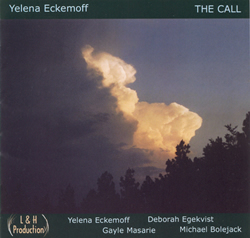
The Call (2006)
The genesis of this album came with the unexpected passing of Eckemoff’s dog, Daisy, in October of 2004. The titular call was first a heartfelt reaction to this loss, sprung naturally from the realization that Daisy would never again answer it. Yet through the improvisations that emerged in the coming year, lovingly transcribed and rendered in the company of a few committed musicians, Eckemoff found another calling, knowing that the absence left behind by a loved one can always be filled with creation. This recording followed an exclusive period of solo work, and the addition of Gayle Masarie on cello, Deborah Egekvist on flutes, and Michael Bolejack on drums represents an embrace of togetherness that the mourning process had perhaps previously obscured.
TG: Now that five years separates you from The Call, can you reflect further on its title and on the period of loss that nurtured its coming into being?
YE: The Call was my first CD that I recorded with live musicians. Before that I was doing solo piano recitals and working with the synthesizer and sequencer, while raising my children and trying to make it with my husband in our new country. But in the end of 2005 I felt “the call” to go back to interacting with live musicians and found several local ones with whom I started my own band. I was so excited and encouraged with the new perspectives that my creativity peaked, and I composed a lot of new music for my new ensemble.
After the piano’s light opening touch, the grand thematic statement that soon takes shape is its own call, one that speaks to each listener in different ways. To these ears, it is a prompt to act upon one’s desires for fulfillment, an urging toward spiritual purpose, a shift beyond the blindness of temptation. The piece ends in a sprinkle of raindrops, resting at the edge of darkness.
TG: The combination of instruments is delightful, the flute adding an obvious touch of breath to the sonic palette. One hears this especially in “Daisy,” which so beautifully conveys your beloved pet. What made you decide to introduce a flute into the mix?
YE: In the past I’ve written a lot of music for various instruments, and I have always been motivated by the prospect of my music being performed, so I gladly wrote for any instrumentalists who I had available at the moment. When I work with a certain musician, I try to adjust my music to his or her performing style to achieve the best musical outcome.
Whimsy abounds in The Call. In everything from the titles to the arrangements, there is revelry to be experienced in both the playing and listening; that in the simple gift of music-making, one can gift not only melody, but also memories. Much of this comes through in shorter pieces like “Strolling Towards Sunset,” “Sushi Dinner” (a tongue-in-cheek ode to the atmospherics of ingestion), and “Questions.” These tracks are a light jazz blend, contrasting vividly with the somber “Ripples on Water,” and are a testament to Yelena’s eclectic fluency.
Others like “Sunny Day in the Woods” (in which the flute glistens against the circular motions of the piano), “Suspicions” (which includes a lovely cello solo against a Satie-like lattice), and “Garden in May” (one of the album’s finest) leave us in little doubt as to their associations. In this sense they are quite photographic.
TG: Do you approach your music and images in a particularly scenic way, or do you perhaps approach the images through the music?
YE: Any strong impressions and especially feelings result in music being born inside me. I never try to come up with melodies—they just flow out of me constantly…often even at night. In the morning I write them down and sort them later…or forget about them.
Like the symphony of windy hands that rake the “Ocean of Pine,” the album moves in circuitous progressions. From the cinematic (“Temptation”) to the wistful (“Windy Day in the Countryside”), we are treated to a feast of time and possibilities. And as the title of “My Cozy Bed” implies, Eckemoff is interested in the simpler pleasures in life, uncluttered by unnecessary intellectual trappings and bound instead to a direct moral compass. This track also gets up to some jazzier business, anchored by heavy double stops in the cello. Masarie stands out again in “Full Moon,” a revolving door of pizzicato and sustained notes. Eckemoff and company save the best for last with “Imaginary Lake,” capping off an 18-track album that is sure to please many with its variety.
TG: In the liner notes for The Call, drummer Michael Bolejack lists his favorite musicians: Peter Erskine, Jack DeJohnette, Paul Motian, Bobo Stenson, John Taylor, and Keith Jarrett. These peak my interest, of course, for having recorded extensively for ECM. How, if at all, has the music of ECM influenced your own work? Does it comprise any portion of your listening life?
YE: I am ashamed to admit that I did not even know about the very existence of ECM until Michael Bolejack introduced me to the label and its production in the course of 2006. I was happy to realize that there are other musicians out there whose approach to modern music is somewhat similar to mine, and it gave me this feeling of unity with other musicians, which I was happy about.
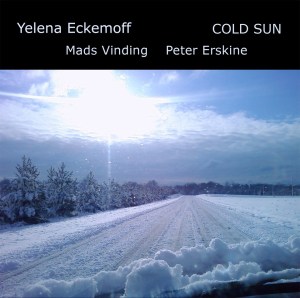
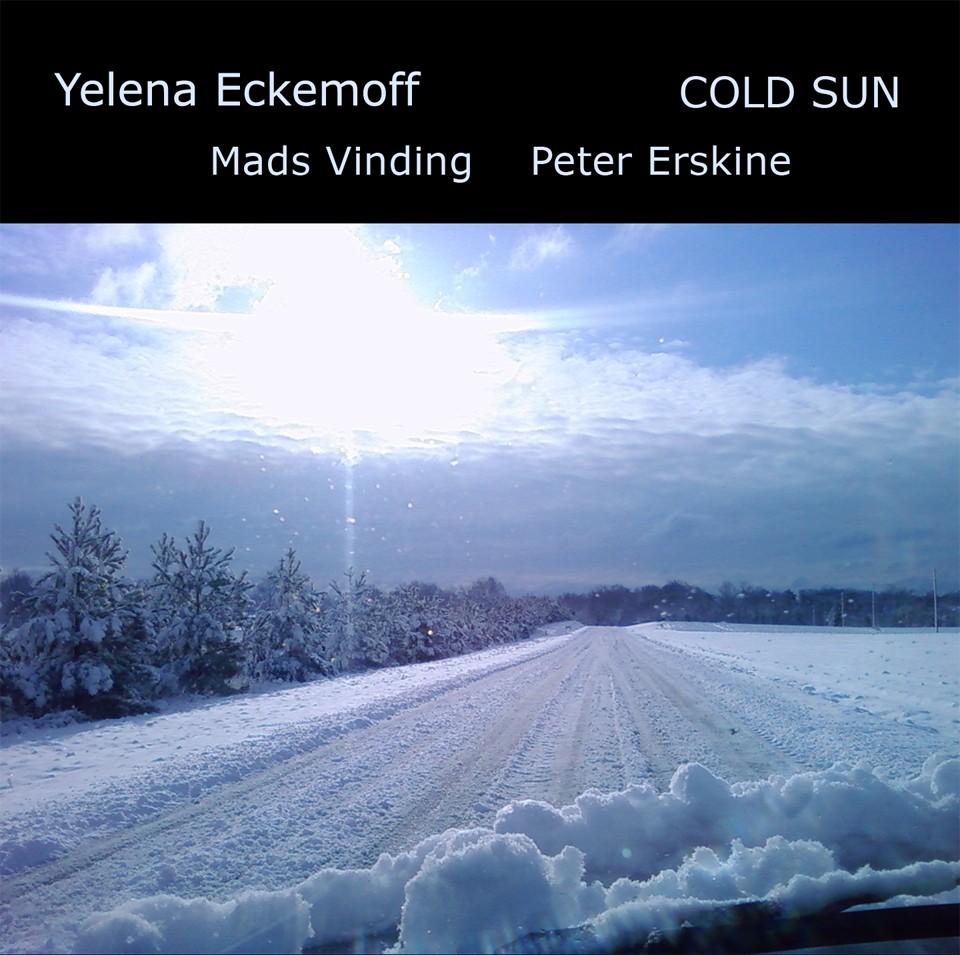
Cold Sun (2009)
This album represents the most fruitful shift in Eckemoff’s career by joining her with bassist Mads Vinding and drummer Peter Erskine. Her relationship with the latter is particularly striking and achieves a clearly discernible balance of distance and intimacy throughout. Erskine’s profoundly subtle craft—sharing peerage with Jon Christensen especially in the use of cymbals—ever so delicately paints in those gaps that the piano leaves untouched in its abyss. His gestures swirl like snowdrifts, each the afterthought of something internally more dramatic. These wintry nuances crystallize in sonic postcards such as “Scents of Christmas,” “Romance by the Fireplace,” and “Freezing Point.”
TG: Cold Sun comes across to me as a distinctly airy album. Its feet touch the ground only occasionally, as in the gnarled groove of “Stubborn,” making for a, dare I say, mysterious experience. Did this album develop any differently than the rest?
YE: There was The Call as a starter. Then my group gained a double-bassist and an oboe/saxophone player, and we rehearsed actively as a band, played gigs, and performed many new compositions that actually did not get incorporated into any of the CDs yet. Then there was Advocate of Love (2008)—a mostly trio album, reflecting a somewhat jazzier feel. The Cold Sun material was formed out of my 4-year experience working actively with my ensemble. The material of this winter album required a more improvisatory approach. And I reached out to the musicians who I thought would work best for that project.
Other tracks are more abstract and prompt us into deeper listening. “Silence,” for example, is not a literal description but more an evocation of state and mind. Like fingers running through hair, Eckemoff’s notes comb the ether. “White Magic” is a subdued evocation, which blends effectively into the touching dissonances of “Snow Bliss.” Yet it is in the throes of “Winter” that we at last encounter the synthesis of the album’s many threads. Brimming with glorious leaps and bounds, as well as more subterranean reflections, it brings us delicate closure to a moody and free-flowing album that is sure to please fans of Tord Gustavsen and Marcin Wasilewski.
TG: The piano trio is clearly a comfortable format for you. What is it about the combination that appeals to you and how does it enliven your expressivity?
YE: I suspect the piano trio will always be my favorite format, because I am a skilled pianist and the piano has always been a dominating expressive source for me. However, I do like the variety of the sounds, and I get many ideas that call for different sets of instruments (that I hope to see through in the future). But the intimacy and perfect balance of timbres in the trio is the most comfortable setup that surely has my first love.

Grass Catching the Wind (2010)
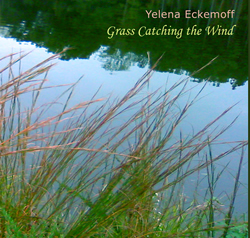
As the unnamed sequel to Cold Sun, Grass Catching the Wind picks up where the former left off with “Anticipation of Spring.” Its shaded bass solo, courtesy of Vinding, sets the tone for the album’s crepuscular seepage. Nocturnal gestures unfurl in “Night of the Fireflies & Crickets” and the masterful “Neverland,” while “Summer Heat,” “Harvest,” and “Sonnet for the Flowers” flap like laundry hanging in an afternoon breeze, intermittently revealing the vast countryside behind.
TG: You seem to be overflowing with musical ideas. What is your creative wellspring? What inspires you?
YE: Musical ideas and melodies constantly bubble up and accumulate inside me. Making music for me is the way to live and to cope with my life’s ups and downs. If I can’t express myself in music, I virtually suffocate. I hear music everywhere, especially in nature, but my feelings and emotions are still the greatest source of my inspiration and stimulant for my creativity.
We also find ourselves in the more upbeat stylings of drummer Morten Lund in “Somebody Likes Jogging,” “Rain Streams,” and “Emerald World,” the latter being the grooviest leg on this tour and the album’s crowning highlight. The distinctive bass line in the title track also pulls us forward in fluid motion, fanned along by card-deck riffles from snare. And where “Overcast” engages shadowy figures in a puppet show of opaque emotions, “Beautiful Destruction” actually bonds them with light. This is music unveiled to reveal a softly beating heart, where memory is the only present.
TG: I hear so many memories in your pieces, as if each were an autobiography in miniature, the reflection of a time and place long past but ever alive in your heart. How much of you resides in this music?
YE: My music is me, no question about it. If you listen to my music, you get to know me better than you would through talking or anything else. My soul is completely bare in what you hear! I never try to show off or please the listener. My only aspiration is to express my thoughts and feelings as accurately as only I can. I can’t resist this overwhelming desire—to pour out my soul in sounds and reach out to the people who would like to feel the same vibes.

Flying Steps (2010)
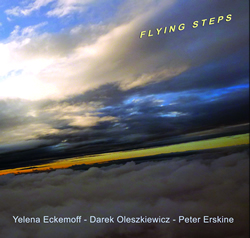
Eckemoff’s latest trio album marks the return of Erskine into the fold, and with it the inaugural “Promise,” a languid journey through innocence into resignation and back again, with an isolated rest stop or two along the way. Darek Oleszkiewicz takes the helm at bass this time around, completing a trio of superb insight. His dexterity brings a gentle urge to the foreground and gilds Erskine’s already filigreed approach.
Here is an album that works particularly vividly in images. “A Smile” seems to paint itself one tooth at a time, opening the pathways of its own emotional distance, while “Good Morning” scintillates like sunlight on a kitchen table, glinting off coffee cups, illuminating a newspaper, shimmering outside the window—and all of it threaded by Erskine’s delicate rolls.
TG: You clearly share a deep musical connection with Erskine. You even dedicate the inviting title track of Flying Steps to him. How did that partnership come about and how do you feel it has changed the way you play, listen, and perform?
YE: As I mentioned before, I was searching for like-minded musicians who I thought would feel at ease with my music. Peter was on my mind for a long time, because as far as I could tell listening to his playing, I felt that we would likely have many things in common. This proved to be completely true when we met and played together—a complete mutual understanding! Of course, Peter is a genius, and surely all musicians would feel great having him on board. And I was flattered at how respectfully Peter treated my music, and it made me so happy that he really liked it and that he enjoyed working with me. Working with him was a fabulous and joyful experience. Everything comes easy and naturally to Peter, and making a record with him was a truly exciting journey.
“For Harry” is a dance of piano and cymbals, all threaded by Oleszkiewicz’s invisible stitching. A memorable color shift occurs when Erskine lays down rims over Eckemoff’s light-as-a-feather touch. “Isolated” seems to represent the album’s theme. There is something expository in its activity, finding profundity in the everyday.
TG: Following up on the question of memory, there is an unmistakable note of nostalgia in all of your music that is only intensified with each new listen. In what ways does the past influence the immediacy of your musical creation?
YE: Nostalgia…everybody feels it toward childhood, their younger years, lost friends and family members, beloved pets and places… In my case it got even more complicated by my immigration and living so far from my homeland… A lot of pain is hidden inside the souls of many people. And it only grows stronger when you age and experience new losses… But not only losses. I am also feeling nostalgic toward many happy memories and events. It is said that passionate love of all kinds is painful: how true!
“Isolated” also clues us in on the enigma of the album’s cover. Though isolated insofar as it is elevated above all social and civil signs, as such it is also connected to the vastness of the great beyond. In this liminal space one finds the aptitude of solitude.
“Where is Maxim?” forms a trilogy of sorts with “Tears Will Come” and “Insomnia,” for each evokes weighted emotions with equal lightness. For me, more overtly personal tracks like these reach deepest. Take, for example, “Mama,” which is a brilliant and sublime confluence of time, space, and technique that seems to constitute the very heart of what Eckemoff is capable of at her best. Oleszkiewicz shines again in “Steps,” especially in his captivating solo. We end with “Tomorrow,” a soft exercise in humility and the unpredictability of circumstance.
TG: Where do you see your music, and your life, going next?
YE: While new music keeps piling up, I have quite a few projects on hold, including a vast work with Old King James Biblical Psalms. At the moment I am getting ready to release a new CD, Forget-Me-Not, which I have just recorded with Marilyn Mazur and Mats Eilertsen this August in Copenhagen. And now I am truly looking forward to a couple of very exciting projects (in planning) for the next year: I cannot disclose the details yet, but it is shaping out to be the next important step in my musical journey.
To learn more about Yelena Eckemoff and purchase CDs, please visit her website.





 (Ensemble photos by
 (Jordan Sramek)

 Between Sound and Space: ECM Records and Beyond