Arvo Pärt: Adam’s Lament (ECM New Series 2225)

Arvo Pärt
Adam’s Lament

Latvian Radio Choir
Sinfonietta Riga
Vox Clamantis
Estonian Philharmonic Chamber Choir
Tallinn Chamber Orchestra
Tõnu Kaljuste conductor
Recorded November 2011 at Niguliste Church in Tallinn by Peter Laenger and Stephan Schellmann, except for Estonian Lullby and Christmas Lullaby, recorded May 2007 by Margo Kõlar
Mixed at Rainbow Studio in Oslo by Arvo Pärt and Manfred Eicher with Jan Erik Kongshaug (engineer)
Produced by Manfred Eicher

“The text is independent of us; it awaits us. Everyone needs his own time to come to it. The encounter occurs when the text is no longer treated as literature or artwork, but as reference point or model.”

If the above is any indication, Arvo Pärt is one who understands text for what it is: a stepping-stone. With an attention equaled perhaps only by Alexander Knaifel, he holds words like votive candles, giving them flame by the touch of his gift for sound. Whatever we bring along the way is welcomed as it is, broken and hungry for a voice to lift its spirits. To this end, the writings of Saint Silouan (1866-1938) again form the touchstone for a program shaped as much by lips and tongue as by the Holy Spirit that guides them. If we never forget Silouans Song, the strains of which bled through the Estonian composer’s groundbreaking Te Deum recording of 1993 with especial scintillation, it is because its source had already been surpassed by the first draw of a bow. On Adam’s Lament, texts come to us as travelers with distant knowledge in their satchels. For ECM’s thirteenth program devoted to his art, Pärt builds on the tintinnabulation that shrouded his work of the eighties and nineties. He looks even more internally, seeking not only the echo’s path but also its unknowable spark.


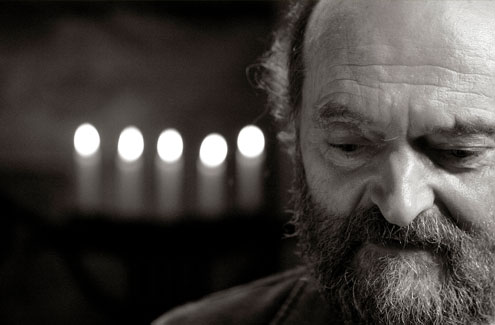
(Photo by Kaupo Kikkas)

Paradise as Adam knew it may be lost, but in the eponymous piece we find our own. Though it is an illusion made possible by reverberation and microphones, its power rings beyond the circumscription of its capture. Here, Pärt works from the inside out, finding in every contour of its ecclesial Slavic text a vision of flesh and nature. Holding these together is the touch of one whose own humility exceeds him. And is not humility the greatest mystery to be enhanced through the act of putting pen to staves? It is, says Pärt, an enigma to the stained mind: “like marble, its beauty radiates from its depths.” The locus of that beauty takes form through the body’s destruction. Even then, its reality is partial. To be sure, the gaze of science goes far in this regard but stops at the threshold of something invisible. In the absence of eyes to see, the Lord’s grace gives us receptacles to hear.

Pärt’s microscopic approach sees us as something more than the sum of our parts. Shouldering the vagaries of time, we drag our feet toward a light on the horizon. Its name is stillness, and we are its destroyers. Strings and voices do not so much blend as talk with one another, finding synchronicity through varying degrees of unrest. Paradise, then, lives on as an idea of its former self. And perhaps it was never anything more. It was the voice of generative silence. Only through its fall—which looms wispily at best in the violins—can we look back to our infancy.

Adam’s Lament is about lineages: of us as descendants of Adam, of our future as reflection of the decisions we make today, of that single thread still being spun from the breath of its Creator. As the newest of the present recording, it looks back on a singular catalogue of sonic truth-seeking and self-reflection. The handful of older pieces reworked thereafter shine like the inner circle of its rosette.

My soul wearies for the Lord, and I seek Him in tears.

“The feathery lightness of Beatus Petronius and, by contrast, the potency of Statuit ei Dominus are two sonic worlds,” says Pärt, “like the two sides of God, which I tried to touch, to trace in these works.” Composed in 1990 and revised in 2011, both embody the architectural wonders of their service. In offering themselves so directly, they take off their masks of freedom in search of the real thing. Their departure balances on the apex of a steeple, poised for the coming of sun and moon. In their brevity lies the secret to faith: never waste your words. Every syllable becomes a community in and of itself, bustling with activity in trade with those around it.

The Lord made to him a covenant of peace…

The composer imagines his Salve Regina (2001/2011) as a funnel, turning in progressively smaller circles until its center manifests like a dwarfed star. That he manages to evoke such cosmic brilliance in earthly terms is barely short of the miracle it so ardently expresses. It draws lines from cloud to soil in ways that transcend all obstacles. Starlight trades footprints with human history, filling each with enough hope to light the way in darkest night. Astonishment comes nowhere near to describing its effect.

To thee do we send up our sighs…

The Alleluja-Tropus (2008/2010) sets liturgical words devoted to St. Nicholas of Myra (270-345), whose relics absorbed its first performance in Bari. The refrain is key to this jagged string game of antiphony. Although short in scope, its feathers engage in a spectral bit of play as they float free of their bones toward skies clouded by ash and fear.

A rule of faith and a model of meekness…

L’Abbé Agathon (2004/2008) tells the story of St. Agathon, whose carrying of a leper—later, it turns out, a testing angel—is evoked in the music’s heavy gait toward awareness. A soprano of infirmity spills like ink across the baritone’s selfless paper. The resulting patterns are what the strings fill in. Like onlookers to moral awareness, they take in what is before them, realizing only later the folly of their inaction.

“For mercy’s sake, take me forth with you.”

The Estonian and Christmas lullabies (2002/2006) are, according to their composer, “for adults and for the child within every one of us.” Both arise as if of their own volition. The use of pause and reflection is genius, allowing us to bask in the delicacy of a border-crossing nostalgia while adding to it the lessons of our lives.

And she brought forth her firstborn son…

If Tabula rasa was a revelation and Te Deum a call to harmony, then Adam’s Lament is the birth of our Messiah, wrapped in Christ child’s swaddle. The association sets me to marvel at my own firstborn sleeping next to me as I attempt to recast this music into meager sentences, to seek in his contented face the promise of a time when the world will no longer hold a knife to its own throat. The manger smells of song, and its name is Love.


(My 2-month-old son basking in the warmth of Christmas Lullaby)

All of this puts a finger on the pulse of a divinity beyond the prescription of any religion, which necessarily flows in opposing directions as an embodiment of universal balance. Were it not for the bleakness of our transgressions, such music might never find our hearts, but simply flow through them, unnoticed, as part of the hum of Time. That it comes to us so undeniably is due to many talents, including engineers and producers. Yet we must thank above all Tõnu Kaljuste and the musicians at his cue. Their undying commitment to Pärt’s mission has yielded one of the most indomitable partnerships in music, classical or otherwise. One hardly needs to reiterate the fact that, as with every label project, Pärt participated fully in all stages of this production. His contact is palpable in what we hear, reaching for us like a grandfather we never knew we had and whispering a story into our souls. Much of that story has already been written. The rest is for us to inscribe.

(To hear samples of Adam’s Lament, click here.)
Arvo Pärt: In Principio (ECM New Series 2050)


Arvo Pärt
In Principio

Estonian Philharmonic Chamber Choir
Estonian National Symphony Orchestra
Tallinn Chamber Orchestra
Tõnu Kaljuste conductor
In principio; La Sindone; Cecilia, vergine romana recorded June 2008 at Estonia Concert Hall, Tallinn
Engineer: Teije van Geest
Recording assistant: Thomas Gärtner
Digital editing: Kohei Seguchi
Mixed by Teije van Geest, Manfred Eicher, Arvo Pärt, and Tõnu Kaljuste
Da pacem Domine, Mein Weg, Für Lennart in memoriam recorded May 2007 at Niguliste Church, Tallinn
Engineer: Margo Kõlar
Recording assistance and editing: Helena Tulve
MIxed at Rainbow Studio by Manfred Eicher, Arvo Pärt, and Jan Erik Kongshaug (engineer)
Produced by Manfred Eicher

In the beginning was the word, and in the word was sound, music, life itself. Such are the sentiments behind In principio, the title work of Arvo Pärt’s eleventh album for ECM. The label that started it all has been charting the Estonian composer’s work with devotion since 1985, when producer Manfred Eicher introduced his New Series with Tabula rasa. Because of him, we’ve been privileged to witness Pärt’s evolution as a musical thinker in a devolving world.

The eponymous 2003 work for mixed choir and orchestra bursts with a dramatic edge that sounds fresh to these ears. Its choral blast and ascendant strings seem to leap into the firmament, yet with such restraint that one hears order in every movement. The orchestral writing and performance are on point throughout, especially in the third movement, which introduces an atmosphere of lamentation. Voices spread, melting into brass chords, sustaining themselves through the nourishment of the fourth movement, in which the orchestra flashes through the darkness like a lighthouse. In this regularity one hears a touch of Philip Glass, especially in the flute of the final movement, amid a heap of faith.

The simpler Pärt’s music is, the more detailed it becomes. We can hear this in the descriptive approach of La Sindone for orchestra. Composed in 2006, it evokes (and ponders) the Shroud of Turin, where the piece received its premier performance. Moments of stunning lucidity open their eyes against the music’s gradual swell, which the orchestra handles with appropriate sensitivity. Cecilia, vergine romana (2000, rev. 2002) for mixed choir and orchestra in an ode to the eponymous patron saint of musicians. At sixteen and half minutes, it is among the album’s longer works. As such, it adopts a relatively clustered approach, shifting instrumental and vocal combinations with great vigor. One notes especially the pounding tympani, which leaves only the slightest of dents in the music’s unbreakable bonds. Next, Da Pacem Domine (2004/07) finds itself expanded from its original a cappella version to include a full choir and orchestra. The same stepwise motions are there, but the line drawn by the sopranos throughout is more profound than ever. Mein Weg (1989/99, rev. 2000) also finds itself repackaged here. Originally for organ, it is now scored for 14 strings and percussion. Ancestral wisdom paints a new dawn for every bow drawn, and finds in its revelation the path toward afterlife. Which brings us to Für Lennart in memoriam (2006), written for the funeral of late Estonian president Lennart Georg Meri. This endearing orchestral statement signs a mostly exultant program with a somber flourish.

If I had to describe Pärt’s music in one word, I would call it “non-allegorical.” This is as direct as it gets.

Silvestrov/Pärt/Ustvolskaya: Misterioso (ECM New Series 1959)

Misterioso

Alexei Lubimov piano
Alexander Trostiansky violin
Kirill Rybakov clarinet
Recorded May 2005, Historischer Reitstadel, Neumarkt
Engineer: Stephan Schellmann
Produced by Manfred Eicher

Alexei Lubimov has been painting himself quite the somber niche in ECM’s New Series catalogue, and perhaps nowhere more so than with Misterioso. This suitably titled disc brings the Russian pianist together with two younger colleagues—clarinetist Kyrill Rybakov and violinist Alexander Trostiansky—for a program of splendid contrasts.

We begin at the end, as it were, with Valentin Silvestrov’s Post scriptum (1990) for violin and piano. Like much of the composer’s later work, it manages to sound like a quotation without, in fact, being derivative—a reference to the abyss in which the creative spirit dances. In this vastly self-referential universe, the balance between drama and gentility breathes in shadowy cascades and pizzicato afterglows. The piano acts as core, while the violin etches upon it signs of its own becoming. Between alternating contacts and separations, the piece eschews sequential development in favor of hopping reflections. Where the Andantino shows a profoundly respectful sense of melody, constructing with minimal elements a fully fleshed organism of song without words, the third and final movement picks up on the plucked themes of the first, sounding almost synthetic in its precision before total dissipation.

Silvestrov’s 1996 title composition is the most cerebral piece on the record. Scored for “solo clarinet (with piano),” the piece is dedicated to Evgeny Orkin, a musician adept at both instruments, thereby necessitating the same demands on the contemporary solo performer. What may seem on the surface an elusive piece quickly turns, however, into something geometric, even gritty. Through its protracted twenty minutes we find ourselves at an impasse of time and space. The structure is sporadic, yet bound, every sub-section joined by the barest of chains. It is the temerity of creative life and of the existence that engenders it. Delicate flutters from the clarinet speak of an era beyond the now. Breath is expelled without notes, expressing more solitude than wind. It is the base level of the utterance, a song reduced to its core constituent.

One might think there would be no need for another version of Arvo Pärt’s Spiegel im Spiegel (1978), but in this for clarinet and piano we find ourselves regaled anew by its simple, mirrored beauties. The faster treatment here gives it something of a romantic quality and allows it to congeal against the constant threat of silence that embraces it from all directions.

Considering the mastery encoded into every moment of Galina Ustvolskaya’s 1949 Trio for clarinet, violin and piano, it’s no wonder the piece remains one of the greatest for its combination. The dynamism of its contours bespeaks a surface tension so resilient that its fulfillment (enhanced by the unification of the album’s three musicians at last) rings genuine and unforced. A jovial sense of play is at work here, skirting an edge between exuberance and emotional turmoil. At moments the syncopation recalls Shostakovich (unsurprising, considering that Ustvolskaya was his student), making for an intense danse macabre. The central Dolce wanders like a creeping shadow into all-consuming thought, and seems to echo the beauties with which the program began, while the final movement, marked Energico, throws us into a murky spiral, crashing in a punctuation of deflated purpose.

We end with another Ustvolskaya piece, the 1952 Sonata for violin and piano. Over the course of its nearly 20-minute single movement, we listen as a staggering entity, drunk with regret, turns in on itself, stretching thin like taffy until barely connected to the breath that animates the album as a whole.

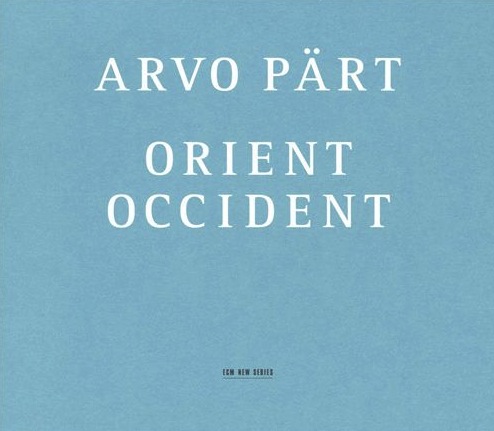
Arvo Pärt: Orient & Occident (ECM New Series 1795)


Arvo Pärt
Orient & Occident

Swedish Radio Symphony Orchestra
Swedish Radio Choir
Helena Olsson soprano
Tõnu Kaljuste conductor
Recorded May 28 – June 1 2001, Berwaldhallen, Swedish Radio, Stockholm
Engineers: Jan B. Larsson, Anders Hägglöf, and Rune Sundvall
Produced by Manfred Eicher

The name of Arvo Pärt has become something of an institution in the consumer culture of classical music. The “New Spiritualism” heralded by such seminal recordings as his Tabula rasa and Te Deum crystallized a sentiment that listeners were craving in the ruins of a postmodern malaise. Yet with this music came a host of expectations: it was supposed to heal us, guide us to an inner light, and provide an inexpensive and convenient means of achieving (temporary) peace. It was something to rely upon, a sonic friend that would never leave us. In believing this, however, we began to lose sight of our own powers and the tremendous dependence we were placing upon recorded media to wrestle with moral dilemmas in our stead. Beautiful and, yes, spiritual though these media are, they can never be a substitute for the enlightenment we read into them.

The frame of Orient & Occident captures the dark side of Pärt’s compositional moon. Stand too close to it, and its darkness overwhelms; too far and it becomes a mere block of shadow. Wallfahrtslied (Pilgrim’s Song), a German setting of Psalm 121, positions us at a median distance and allows us to appreciate the best of both worlds. Composed in 1984 in memory of the composer’s close friend, Estonian director Grigori Kromanov, and since revised for men’s choir and strings, it is a harrowing slice of emotion. The music seems to grit its teeth in a slow, seething discontinuation as voices lay themselves at the orchestral altar. Strings try to remain passive, yet cannot help but break free from their subordinate position with cries of supplication. Before long, they stretch themselves into the thinnest of layers, through which one may see the translucence of the “self” and the “other” and acknowledge that the same light passes through and gives both substance.

The seven-minute title composition, penned in 2000, is for strings only and continues the path that Pärt first began laying with Psalom and Trisagion. It is a grand statement, to be sure, but works its effect through tiny sonic miracles and primes us for the sojourn that awaits us in Como cierva sedienta (1998), a Spanish setting of Psalms 42-43 for women’s choir and orchestra. Exquisite winds recall 1989’s Miserere and rock like a cradle for soprano soloist Helena Olsson’s spiraling invocations. This is music firmly entrenched in its surroundings, while also content to break free from its compulsory resolutions. Strictly choral passages add pastoral unrest. Words tumble out of their own volition, filled with outbursts and infectious proclamations. Like the soul in this final Psalm, downcast even in the light of salvation, I realize that I fall into traps only of my own making. Every time I pull myself out of one, I am reminded that sounds like these are more than incidental to that struggle. Rather, they embody it to the fullest, a collective reminder of the physicality of living experience and the lessons it provides.

The title of Pärt’s eighth ECM album makes me think of colonialism and its feeble justifications for subversion. That being said, I don’t think this is what the music is about. It deals instead with the gap that links these two words and the sacrifices that fill it with song. It is the blood flowing through that emptiness, and we the plunger pulling back to suction out the contagion of enslavement that prevents us all from staring into the face of love.

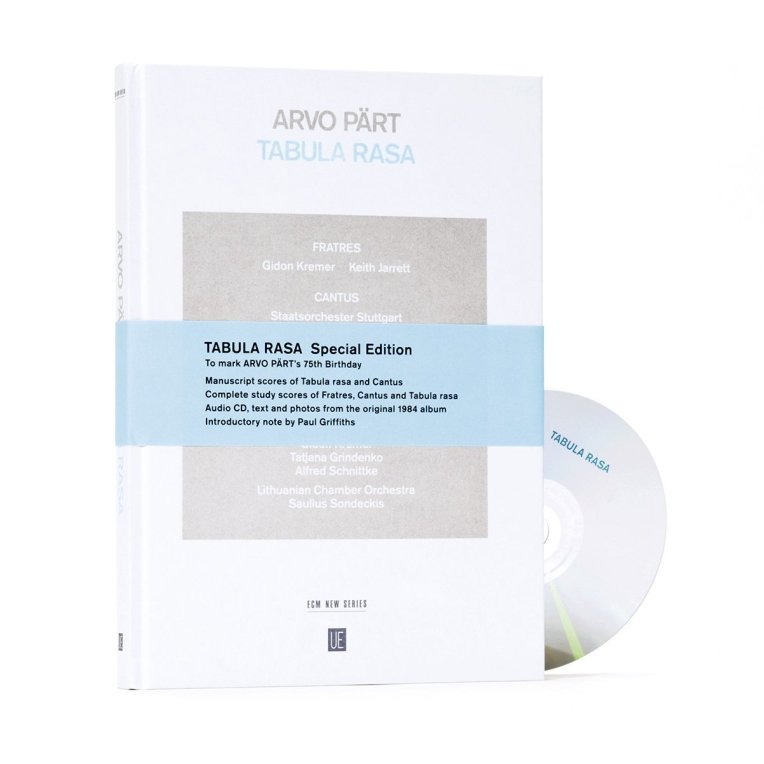
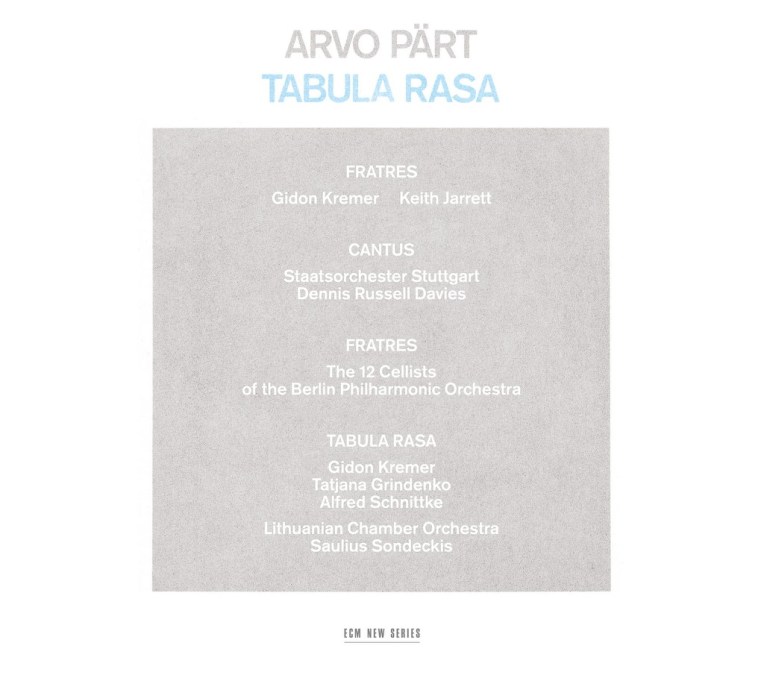
Arvo Pärt: Tabula rasa (Special Edition)

Tabula rasa SE

Arvo Pärt
Tabula rasa

Gidon Kremer violin
Keith Jarrett piano
Staatsorchester Stuttgart
Dennis Russell Davies conductor
The 12 Cellists of the Berlin Philharmonic Orchestra
Tatjana Grindenko violin
Alfred Schnittke prepared piano
Lithuanian Chamber Orchestra
Saulius Sondeckis conductor
Recorded October 1983, Basel; January 1984, Stuttgart; February 1984, Berlin; November 1977, Bonn
Engineers: Heinz Wildhagen, Peter Laenger, Eberhard Sengpiel, and Dieter Frobeen
Produced by Manfred Eicher

“The complex and many-faceted only confuses me, and I must search for unity. What is it, this one thing, and how do I find my way to it? Traces of this perfect thing appear in many guises—and everything that is unimportant falls away.”
–Arvo Pärt (photo courtesy of The Sonic Spread)

The composer
On 11 September 2010, Arvo Pärt welcomed his 75th year. To celebrate this milestone, ECM has rereleased its first New Series album in a special deluxe edition. When it first appeared in 1984, hardly anyone outside the composer’s native Estonia could have known what to expect from this modest cover of muted pastel and block lettering, but Tabula rasa has since taken on a life of its own. Yet behind the iconicity, word-of-mouth marketing, and a few choice celebrity endorsements (not least among them, R.E.M.’s Michael Stipe), Pärt’s music remains as it is: reverence in sonic form.

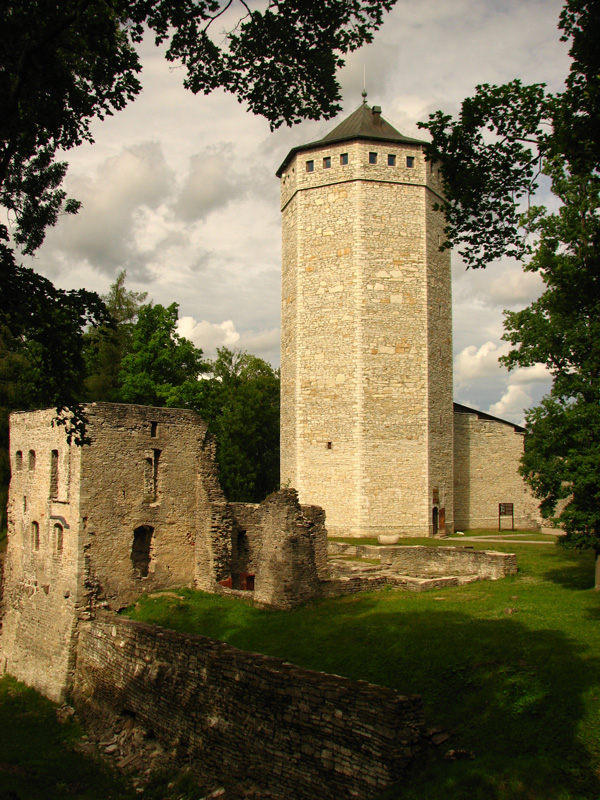
Paide Castle (photo by Liene Strautmane-Kaze)

Born in the small town of Paide, just outside of Tallinn, Pärt took his first musical steps at age seven and was already composing by his teens. He would later study with Heino Eller at Tallinn Conservatory, where he was characterized as one who “just seemed to shake his sleeves and notes would fall out.” The sixties found him at a critical juncture in his creative life. Disillusioned by the serialism with which his early works engaged, and which had earned him the red pen of Soviet censors, he fell into silence and personal reformation. According to biographer Paul Hillier, this silence has been the alpha and omega of his subsequent musical output. It is the silence of death, a reminder of our spiritual origins and of life’s fragility. Out of this nexus arose his signature “tintinnabuli” style, which finds its harmonic roots in the overtones of the struck bell. One finds its power in every note, and through an allegiance so delicate it knows no other shelter than the human heart.

Tabula rasa original
Original cover
(ECM New Series 1275)

The music
Of the significant body of Pärt’s works represented by ECM, this album came relatively late in my listening. Nevertheless, its visceral power and openness to interpretation have yet to wane, for it has only grown with me. It is 1 a.m. as I sit alone in my study, listening to this seminal recording once again. I find myself filled with words but faithful to none of them. Each seems to go right through the music’s liquid surface.

We are graced with two strikingly different variations of Fratres. One of Pärt’s most successful compositions, it exists in many versions. The first represented here is for violin and piano (1980). The combined intuition of Gidon Kremer and Keith Jarrett shades this interpretation with frail determination. What begins as an energetic swoon of arpeggios soon coalesces into a dirge of heartrending poignancy in which pizzicato bursts puncture the visual landscape like dying flames. These percussive rituals are common to all incarnations of Fratres, and act as tactile pedal points. Passages bordering on the vocal swoop down to graze the piano’s gravid footsteps, even as we watch from a place neither near nor far. This is a space in which our ears and our emotions become one, and in this respect Fratres is an anthem for the spirit unafraid to drink its own tears. Title aside, for me there is something divinely maternal about this piece, especially as played by the 12 celli (1982) heard two tracks later. This version brings to light a clearer sense of the piece’s mathematical anatomy. The low grumbles of the piano are replaced here with the tapping of cello bodies. The air inside them is heard on its own terms, unfettered by the strings that lay just outside its escape routes. The cellists begin in whispers before proclaiming their tentative motif with due conviction. Each mirrored descent is a caress in a restless night, the knocking of wood like a boat listing slowly in darkening waters.

Bowing humbly between these two “brethren” is the Cantus In Memory Of Benjamin Britten (1977), a rarer secular piece from Pärt, who once said, “I have discovered that it is enough when a single note is beautifully played. This one note, or a silent beat, or a moment of silence, comforts me.” Nowhere is this truer than here, where a single tubular bell sounds that single note (an A) throughout, reflecting both the tonal and emotional veins of the piece. Having the score before me also reveals the silent beats that circumscribe the piece. Like the dead space between stars, this silence breathes with the potential for creation. Thematically the music is laid bare and layered with dizzying resolution, the sympathetic bell ringing as if from a great void. As homage to a composer in whom Pärt sought a kindred spirit, Cantus thrives with anguish and adoration. In its brief five minutes, it manages to reach past the listener into a realm where personhood is no longer relevant and music thrives on its own performance.

With Tabula rasa (1977), Pärt does more than wipe the proverbial slate clean, but spins from that same emptiness an open web of tangible effects. The title is both philosophy and mantra. Structurally speaking, none could be more appropriate. Violins circle one another like birds in flight before being awestruck by the haunting chimes of a prepared piano (played by the late Alfred Schnittke). Each successive eruption is deeper than the last, carrying with it the ghost of all that has come before. This piece is famous for having boggled its musicians on paper (“Where’s the music?” they are said to have cried), so bare did the score seem to them before being committed to fingers and bows. But once the music was given voice, it was clear that what had originally appeared porous was in fact pregnant with life-affirming rapture. Tabula rasa undergoes a dramatic change in its latter half as the violins begin to fade into the surrounding architecture. The carillon-like refrain of the prepared piano drops a child’s handful of crystals into water, naked and unassuming while also strangely coercive. By the end we are left in the company of solemn double basses, whose commentary seems but an afterthought to an experience that lies just beyond the grasp of words.

Open Tabula

The book
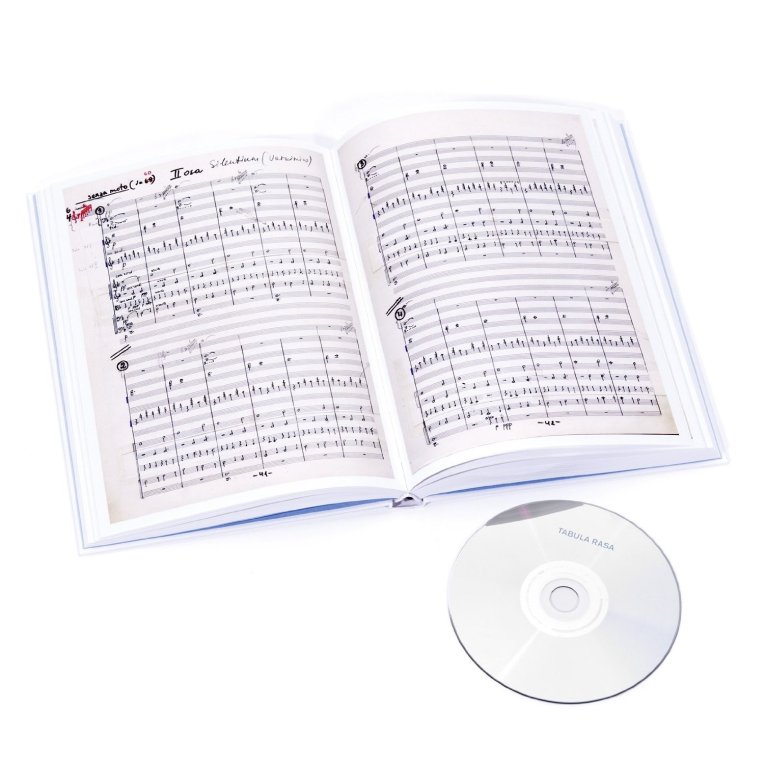
In his original accompanying essay, Wolfgang Sandner describes the music on Tabula rasa as a “curious union of historical master-craftsmanship and modern ‘gestus.’” The same might be said of this handsome Special Edition. Housed in a 200-page hardcover book, the album is given the royal treatment with full study scores for all four works therein, two facsimile autographs of its title work and Cantus, and a new introductory essay by Paul Griffiths. As an artifact it is a tangible intersection of passionate commitment to detail from all angles.

The scores in particular offer even non-musicologists vast insight into their inner workings. We see clearly before us the peaks and valleys of Fratres in chamber form, and the drone strung below its cello counterpart like a safety net. We see also the cosmic structure of the Cantus, like binary stars bound by mortality. And we can experience for ourselves that confrontation with emptiness that must have so perplexed the first interpreters of Tabula rasa. A cursory glance reveals further shades of understanding. For example, we find that, in Part 1 (“Ludus”), sometimes only double basses accompany the two violinists with no noticeable loss of orchestral density, and each ascent on the prepared piano in Part 2 (“Silentium”) stands out like a stairway into light.

To say that Tabula rasa has held up perfectly would be misleading, for it would imply that it possesses physical substance to be upheld. As a whole this album is more about spaces: of mourning, of self-reflection, of impermanence, of privacy in a violent world, of virtue and history, of weakness and flesh, and ultimately of life itself. It is the undoing of forced representation. It is the challenge of confession. It is the hardship of conflict and the joy of affirmation. It is the silent rendered audible, and the audible rendered silent.

It is you.
It is I.
It is.

<< Pierre Favre Ensemble: Singing Drums (ECM 1274)
>> Keith Jarrett: Trio Changes (ECM 1276)

Arvo Pärt: Kanon pokajanen (ECM New Series 1654/55)


Arvo Pärt
Kanon pokajanen

Estonian Philharmonic Chamber Choir
Tõnu Kaljuste conductor
Recorded June 1997 at Niguliste Church, Tallinn
Engineer: Teije van Geest
Produced by Manfred Eicher

I have lived my life wantonly on earth and have delivered my soul to darkness. But now I implore Thee, O merciful Lord, free me from this work of the enemy and give me the knowledge to do Thy will.

Of all the music to have graced the digital grooves of ECM’s ongoing relationship with Arvo Pärt, these settings of the Russian Orthodox Canon of Repentance to Our Lord Jesus Christ in its entirety stand out as the pinnacle of his craft. On second thought, perhaps “stand out” is the wrong analogy, for if anything the music of Kanon pokajanen comports itself through kneeling and supplication. Completed in 1997 in commemoration of the 750th anniversary of Cologne Cathedral, it was premiered the following year by its dedicatees, Tõnu Kaljuste conducting the Estonian Philharmonic Chamber Choir, who also perform it here to humble perfection. Sung entirely in Church Slavonic, the Kanon is structured as follows:

Ode I
Ode III
Sedalen
Ode IV
Ode V
Ode VI
Kontakion
Ikos
Ode VII
Ode VIII
Ode IX
Prayer after the Canon

Ode II has no text and drops out as the silent number. The remaining Odes are introduced by an irmos, which acts as a link between word blocks, followed by four troparia, or hymnal stanzas, of which the last is always the Theotokion, or Hymn to Mary. The “intermezzo hymns” between Odes III/IV and VI/VII provide a summary function, not unlike a recap episode in a long-running series, except that here they are full-fledged episodes in and of themselves, each its own hue in the emerging aural ikon. The Kontakion and its Ikos are deeply rooted in the act of reading, as in the ways in which these hymns would normally be chanted, while the final prayer serves to close the circle in preparation for Communion. The lifeblood of the text is its refrain of “Have mercy on me, O God, have mercy on me,” which circulates like an involuntary reflex of the spiritual body.

If there is a more heart-stopping, transportive moment in all of choral literature than the opening proclamation, I have yet to hear it. Sung with such passion in every single voice and rising in a collective exhalation of Godly energies, it never fails to halve me to my core. On the whole, the sound palette of the Kanon varies from barely harmonized periodic elements to full-blown organic compounds. Antiphonal glue holds the most fragile texts together in preparation for glorious leaps of faith, such as the passage in Ode III during which tenors and altos soar over a beautifully sustained drone. Ode VI is another notable moment, featuring cosmic ambulation between women’s voices over a deep cantus firmus. It is a vital motif, rocking between Heaven and Earth with baptismal impact. And one will be hard pressed to forget the doubling male soloists of the Ikos, which always haunts me long after its brief traversal. The tearfully arranged Prayer after the Canon distills the thematic energy even further, drawing with its pigments an image of such careful self-immolation that only silence can offer itself as palimpsest.

The Estonian Philharmonic Chamber Choir is as much a treasure as the one who has provided them such bounty. They handle every note as the holy relic that it is, passed down through the ages and translated in song so that others may touch it without degrading its surface. The altos in particular emit an outstanding richness of tone. The recording space is potently reverberant, drawing out every pause like a comet’s tail. Listening to this music, one comes to appreciate the choral qualities of Pärt’s instrumental pieces as well. And while those have received plenty of deserved attention, Kanon pokajanen is a must-listen for anyone wishing to hear the Estonian visionary in his most enlightened state of grace. The music is almost too powerful, such that listening to the entire album in one sitting can be a draining experience, faced as we are with the prospect of returning to a secular world once its last ghost leaves our ears.

If language is, as the composer himself professes, for him a constant “point of departure,” then nowhere is it so intensely communicative than in the Kanon. Anyone who fears that Pärt’s music was a passing fad in an era craving spiritually minded music for the weary masses need look no further than this heavenly spool from which a thread has tied itself around us before we even press PLAY. You may just find something new that has resided in your soul all along.

Arvo Pärt: Symphony No. 4 (ECM New Series 2160)

Symphony No. 4

Arvo Pärt
Symphony No. 4

Los Angeles Philharmonic
Esa-Pekka Salonen conductor
Estonian Philharmonic Chamber Choir
Tõnu Kaljuste conductor
Symphony No. 4:
Concert recording January 2009, Walt Disney Hall, Los Angeles
Engineer: Fred Vogler
Producers: Bruce Leek and Fred Vogler
Kanon pokajanen:
Recorded June 1997, Niguliste Church, Tallinn
Engineer: Teije van Geest
Produced by Manfred Eicher

…grace and pardon are all the more necessary as the laws are absurd and the sentences are cruel…
–Cesare Beccaria

Arvo Pärt’s Symphony No. 4 “Los Angeles” (2008) was the result of a Los Angeles Philharmonic Association joint commission. The symphony is dedicated to Mikhail Khodorkovsky, a Russian political prisoner in whose moral steadfastness Pärt found inspiration for the present work. Says the Estonian composer, “The tragic tone of the symphony is not a lament for Khodorkovsky, but a bow to the great power of the human spirit and human dignity.” Compared to his earlier symphonies (an almost 40-year gap separates this and the Third), the Fourth is transparent in being scored for string orchestra, harp, timpani, and percussion, and all the more transcendent for it. That being said, there is a certain weightiness here not to be found in the others, achievable only through the modest means by which he breaches its many sound barriers. Here, Pärt has taken seeds from his more recent works for strings and cultivated them into a near-silent, looming forest. In the capable hands of Esa-Pekka Salonen, conducting the Los Angeles Philharmonic in this premier live performance, we can be sure that we are hearing every leaf of that forest humming with fervent ceremony.

The symphony takes a tripartite structure. “Con sublimità” opens us to a stretch of high strings, at once stratospheric and subterranean. A struck triangle drops like a feather onto this cosmic pond. Rather than evoke such an image and leave it at that, Pärt traces each ripple outward to the very fringes of our ken. Timpani introduce a mournful strain for the movement’s latter half. “Affannoso” is brought to life by deeply resonant pizzicato clusters, which recur like insistent memories that never quite materialize. At times, these interrupt more protracted bowings, while at others they ride a tectonic shift of mallet percussion. The metallic sheen of a brushed cymbal arcs over a bowed reinstatement of the pizzicato theme. A quote transposed from Psalom makes a ghostly cameo, bleeding into the rumbling of a distant storm and its attendant tubular bells. More plucked strings etch their thoughts across sheets of glassine chords in “Deciso” before a martial rhythm (echoing Pärt’s Te Deum) rides in sideways. The violins stand on their tiptoes, reaching for a cloud that isn’t there, only to realize that in this new space there is infinite possibility.

Based on the Russian Orthodox “Canon to the Guardian Angel,” the Fourth Symphony is Pärt’s first major engagement with canonic texts since 1997’s Kanon pokajanen. Hence, its pairing with fragments from the selfsame work. If the inexpressible repentant beauties of the Kanon were almost too potent to bear in their entirety, in this 15-minute redaction we find ourselves no less overwhelmed by the force of their texts, which push us into a chasm of divine trust like no other. Still, the Fourth Symphony is as much an invocation as this vocal counterpart, for it takes the same air into its lungs and blows it across the fields in all of us.

The Walt Disney Concert Hall is one of the world’s finest acoustical achievements, and its benefits are put to fullest advantage here. Every echo resolves itself with the smoothest dissolution in a delicate balance of fire and ice. Blessedly, the applause on this recording is elided in favor of a seamless transition from one “choir” to another, lest the spell be broken.

Arvo Pärt: Litany (ECM New Series 1592)

Litany

Arvo Pärt
Litany

The Hilliard Ensemble
David James countertenor
Rogers Covey-Crump tenor
John Potter tenor
Gordon Jones baritone
Tallinn Chamber Orchestra
Estonian Philharmonic Chamber Choir
Tõnu Kaljuste conductor
Lithuanian Chamber Orchestra
Saulius Sondeckis conductor
Recorded September 1995, Niguliste Church, Tallinn
Engineer: Teije van Geest

Drawing from the writings of St. John Chrysostum (c. 349-407), whose prayers for daily hours comprise the font from which Arvo Pärt anoints this musical setting, the Estonian composer spins a soft thread of light with limited information. Like the equally visceral settings of Tchaikovsky and Rachmaninoff before him, Pärt’s is utterly moving and uniquely colored by the sensitivity of his instrumental writing, such as listeners have encountered in his Miserere and Passio. The voices of Litany seem to arise out of their orchestral surroundings as if they have been hiding within it and are only now choosing to reveal themselves. Such is the effect of the Hilliard Ensemble’s unity throughout. Tubular bells and horns make their presence known. Subtle clues from orchestra and choir announce the hours as women’s voices pour their glorious shine like starlight from an alabaster jar. Philip Glassean punctuations of winds enhance the spell. The volume builds, only to subside, returning to the silence of a head bowed in contemplation. Under the guidance of Tõnu Kaljuste, the Tallinn Chamber Orchestra and Estonian Philharmonic Chamber Choir, along with the Hilliard Ensemble, have given us a most selfless reading of this masterful composition.

Following this are two pieces performed by the Lithuanian Chamber Orchestra at the baton of Saulius Sondeckis, under whose direction the world at large was first introduced to the music of Arvo Pärt through ECM’s Tabula Rasa. Originally conceived as a string quartet, Psalom emerges here as one of the composer’s most heartrending pieces for strings, second perhaps only to Silouans Song. Each phrase is lifted before it fades, blurring “vocal” lines like breath in winter air. Trisagion also takes its inspiration from St. John Chrysostum. Like a landmass over time, it falls into the inevitability of erosion, so that only the abstract remains untouched by the limits of tangibility. It ends on a repeated proclamation that would be overbearing in its insistence, if not for its decline in volume and number, mathematically reduced to zero.

Pacing is absolutely essential to the mood and architecture of the entire album, and this the musicians accomplish with uncanny immediacy. One of the more powerful post-Te Deum releases, Litany is sung and performed with unparalleled dedication. Countertenor David James is the perfect foil for Pärt’s anti-dualism, and emerges as the voice of reason in an unreasonable era.

<< Arvo Pärt: Alina (ECM 1591 NS)
>> Ketil Bjørnstad/David Darling: The River (ECM 1593)

Arvo Pärt: Alina (ECM New Series 1591)

Arvo Pärt
Alina

Vladimir Spivakov violin
Sergev Bezrodny piano
Alexander Malter piano
Dietmar Schwalke cello
Recorded July 1995, Festburgkirche, Frankfurt am Main
Engineer: Markus Heiland
Produced by Manfred Eicher

When this album was first released I was already a longtime listener of Arvo Pärt and quite accustomed to experiencing his sound in large-scale form. The grandiosity of other seminal ECM recordings, such as his popular Te Deum and epic Passio, left me with a vision of a composer with vast canvases to fill. Alina changed all that when I loaded it into my CD player, only to hear the most sublime understatement to ever issue from my speakers. Says Pärt, “I could compare my music to white light which contains all colours. Only a prism can divide the colours and make them appear; this prism could be the spirit of the listener.” And indeed, this album is a mise-en-abyme of airy beauty.

Tripartite structures abound in Alina.

First, they form the guiding principle of Pärt’s musical ideology, which embraces the triad as alpha and omega. It is no coincidence, then, that the album’s title piece marked the inauguration of his “tintinnabuli style,” which has since been his calling card, as it were, in a genre-hungry marketplace. Originally a two-minute piece, its extended treatment here peels away layers of possibility residing in the score. Recorded in the presence of the composer, each repetition seeks its own segue into silence.

Second, the tracks are symmetrically ordered:

1. Spiegel im Spiegel (violin and piano)
2. Für Alina (solo piano)
3. Spiegel im Spiegel (cello and piano)
4. Für Alina (solo piano)
5. Spiegel im Spiegel (violin and piano)

This rigidity ensures that any complex posturing is shunned in favor of direct communion. Despite their sparse instrumentation, the three versions of Spiegel im Spiegel comprise Pärt’s most spacious statement ever committed to disc. Each is like an edge of his metaphorical prism, bending light into hues that one can almost taste in the listening. One might easily criticize this approach as a halfhearted attempt to fill a disc were it not for the profound indeterminacy throughout. It is in this sense that the cello in the central incarnation sighs like an exhausted organ sending its final pulses straight into the heart of a period passed in quiet humility.

Third, the album is situated at the intersection of three planes of existence: the spatial, the bodily, and the vibrational. The piano’s own resonant interior speaks precisely of its external effect, thereby establishing a striking continuity between the details of its construction and the boundless receptacle that is the listener’s mind. The music speaks, because it knows no other way of communicating. It is the voice that whispers at the edge of sleep, that ever so slightly indecipherable instinct at the heart of selfless wishes.

As I listen to this album again, the patter of raindrops outside my window provides a fitting backdrop to the sheer grace of its first arpeggios. This weather lends the music a liquid shield around every note, turning each into an earthbound droplet. Alina is filled with more emptiness than substance, all the while forming through that emptiness a substance far greater than its own vocabulary can express. It enacts a unique sort of transfiguration which, through the quietude of its own coalescence, ends up turning into itself.

<< Erkki-Sven Tüür: Crystallisatio (ECM 1590 NS)
>> Arvo Pärt: Litany (ECM 1592 NS)