Thomas Demenga: J. S. Bach – Suiten für Violoncello (ECM New Series 2530/31)

Demenga Bach

Thomas Demenga
J. S. Bach: Suiten für Violoncello

Thomas Demenga violoncello
Recorded February 2014, Hans Huber-Saal, Basel
Engineer: Laurentius Bonitz
Executive producer: Manfred Eicher
Release date: October 27, 2017

The Cello Suites of Johann Sebastian Bach, like his Sonatas and Partitas for solo violin, are touchstones for listeners and performers alike. In the latter sense, Thomas Demenga approaches them through an ECM lens for the second time here. Having first fragmented his traversal between 1986 and 2002 through a series of pairings with contemporary works, thereby suggesting exciting new relationships, here he uncovers intra- rather than interrelationships, moving from fundament to firmament and back again with mind and hands sculpted by experience into something unmissable.

Where some interpretations might seek to add something new, Demenga’s embrace something old, always there but too often crucified on the scoreboard of modernism. Here we encounter a return to form, if not also a form of return, in the deepest interest of music that springs eternal from Creator to creator. Referred to in Thomas Meyer’s liner essay as “every cellist’s gospel,” the Cello Suites do more than encourage rereading; they demand it. Having played these masterpieces for more than 50 years, Demenga understands that no one is ever “done” with them and that we’re all born and expire in its swaddling echoes.

In the First Suite, he carries an antique sensibility from first inhale of Prélude to last exhale of Gigue, working shadows into familiar nooks and crannies as if they constituted a physical substance. That same feeling of breath, more than metaphorical, whispers, rasps, and soliloquizes through the Second Suite’s philosophical journey. Its Prélude liquifies the heart and feeds it to another in a cycle of life that cannot be qualified by any other means than the gut strings and baroque bow with which Demenga has chosen to articulate every stroke. The Courante is strangely beautiful in its jagged denouement, while the Sarabande that follows it speaks with haunting urgency and the concluding Gigue with three-dimensional tactility.

The lithe stirrings of the Third Suite’s Prélude and Allemande form a dyad of such emotional integrity as to occupy a realm all their own. As in the famous Bourrée I & II, he dives inward for pearls of wisdom, unpolished and offered in their own shells, glorious specimens of nature whose perfection communicates in the language of imperfection. Demenga’s trills and glissandi are as surprising as they are organic, and flow of their own volition.

Says Demenga of Bach, “His music is detached from personal feelings and dramas or other events to which many composers give expression in their music. That is why his music is so pure and why it possesses, we might say, something divine.” In interest of that expression, this performance is made all the more solitary for its attention to dance-informed structures. This is especially evident in the program’s second half, which through the prism of the Fourth Suite shines a light striated with as much solemnity as exuberance. From the throaty Prélude unspools a narrative of timeless impulses. In the Allemande and Courante that follow, one can feel the soul of a viola da gamba squeezing through the strings, as if the latter were portals of mastery to which our ears must seem as eyes hungry for vistas beyond the known. And in the footwork of the final Gigue, the press of flesh into soil is vivid and alive.

From that sunlit scene Bach pivots into the twilight of the Fifth Suite. Here the modesty of its inception tangles in moral debate with its fleshly Courante—made all the more carnal for Demenga’s intuitive bowing—before finding solace in the blushing Gigue.

This leaves the Sixth Suite to stand as its own Book of Revelation, a scriptural culmination of all that came before it, a fulfillment of prophesies as old as they are indisputable, and which spread the good news of salvation not through words but actions.

As the opening movements—not least of all in the dizzying Prélude—suggest, we must find our own way into this music not by way of deciphering but in the knowledge of receiving a gift in and of faith. And if the finality of its Gigue is any indication, we must treat farewell as the opening of a deeper relationship with life itself, personified in every tremble of the waiting ear and reciprocated whenever we need to be reminded of purpose.

Dénes Várjon: De la nuit (ECM New Series 2521)

De la nuit.jpg

Dénes Várjon
De la nuit

Dénes Várjon piano
Recorded April 2016, Auditorio Stelio Molo RSI, Lugano
Engineer: Markus Heiland
Produced by Manfred Eicher
Release date: August 31, 2018

He searched under the bed, around the fireplace,
in the chest: but he found no one.
And he could not understand how the spirit had crept in—
and how he had escaped again.
–E.T.A. Hoffmann, Night Pieces

Hungarian pianist Dénes Várjon, who last regaled ECM listeners on 2012’s Precipitando, returns with another program of three culturally disparate composers united by the immaterial. Although the blood running through the veins of Robert Schumann (1810-1856), Maurice Ravel (1875-1937), and Béla Bartók (1881-1945) may be genetically dissimilar, in each we find arbitrations of music that, according to the booklet essay by Jürg Stenzl, “far transcended the confines of their time.” The untethered quality of these compositions, each chosen with utmost attention to detail, by virtue of their literary angles interlock in organic conversation. And in rendering them, ECM has found an unparalleled interpreter.

Schumann’s Fantasiestücke, op. 12 of 1837 are comprised of transfixing poetry. In these “character pieces,” linked explicitly to the writings of E.T.A. Hoffmann and Jean Paul, Schumann eschews sonata form in favor of an emotional mosaic that abides by its own logic. Its foundations support a lighthouse for listeners lost at sea. From the dramatic (Aufschwung and In der Nacht) and tenderly inquisitive (Warum?) to the mythic (Fabel) and dreamlike (Traumes Wirren), Schumann shines his light through one incredible prism after another until, coming to rest after the robust Ende vom Lied, Várjon, too, breathes the sigh of a journeyman closing his eyes with success.

Ravel’s Gaspard de la nuit (1908), inspired by a prose-poetry collection of the same name by Aloysius Bertrand, spins those latter impulses into a web of vivid imagery. The lambent Ondine evokes the water sprite of the same name, whose attempts at seduction follow fountain-like trajectories before rejection sends her reeling into the background. Le Gibet (Gallows) is meant to illustrate the body of a hanged man. Morbid yet beautiful, its suspensions take on new meaning. Scarbo returns to folklore in its depiction of the eponymous dwarf, said to haunt nightmares. The sensation of running desperately through a forest of which every tree is a hand tearing at our clothes makes this one of the most astonishing renditions I’ve ever heard of this piece.

The title of Bartók’sSzabadban(1926) means “Out of Doors,” and provides respite in the pastoral truths of its canvas. Some of its many influences include folk songs in the darkly percussive first movement and the harpsichord music of Couperin in the third. Throughout, a sense of comfort is always one step removed, locked in step with the march of a history that has all but left these jewels behind. Like the final movement, each scene is totally committed to its own unfolding, until we’re ready to work it back into shape as a promise to return.

Trio Mediaeval & Arve Henriksen: Rímur (ECM 2520)

Rímur

Trio Mediaeval & Arve Henriksen
Rímur

Anna Maria Friman voice, Hardanger fiddle
Linn Andrea Fuglseth voice, shruti box
Berit Opheim voice
Arve Henriksen trumpet
Recorded February 2016, Himmelfahrtskirche, München
Engineer: Peter Laenger
Produced by Manfred Eicher
Release date: March 3, 2017

If fate would send me around the world
far away from you,
I would yet, with tears, send you a sigh
that belongs to you.

The title of Rímur, Trio Mediaeval’s seventh album for ECM, takes its name from a longstanding tradition of Icelandic rhyming verses, passed down orally from generation to generation until reaching their present incarnations in a program that meshes three distinct voices with a fourth: that of trumpeter Arve Henriksen. In this artful sequence of chants, hymns, and folk songs drawn from Scandinavian sources, the quartet reimagines music as it might have swept across northern landscapes during bygone ages whose histories are renewed in these melodic survivors.

Because improvisation has always been a vital component of Nordic folk tunes, the leaps of intuition required of their interpretation are in-built into the music. And while saxophonist Jan Garbarek’s collaboration with the Hilliard Ensemble will draw obvious comparison—and, to be sure, fans of that project will want to own this one as well—it’s very much its own world, tracing a continental fringe that runs crosswise to that ECM classic.

The Icelandic material yields the most ghostly effects—not only because of a certain transparency, but more importantly because of Henriksen’s ability to see in it what few others might. Whether rising like the stream of a quiet fountain in “O Jesu dulcissime,” a highpoint of the disc for its vocal blending and Hardanger fiddle accents, or unraveling inner spirit in “Morgunstjarna,” a hymn to God’s only begotten Son in confirmation of grace, Henriksen reveals unforced harmonies, by turns balladic and martial. Other highlights include the original “Krummi,” the traditional Swedish shanty “Du är den första,” and the anonymous chant “Alma Redemptoris Mater.” In each of these, he extends the wingspan of expectation while yet cooling us in a familiar shade. In his absence, Friman, Fuglseth, and Opheim are spotlighted by a handful of vocal pieces, including some especially evocative material from Norway. Of these, the wedding tune “Brureslått” features some of the most stillness-inducing singing the trio has ever recorded.

At the heart of this recording are substantial hymns to Saints Birgitta (Sweden), Magnus (Orkney), and Sunniva (Norway). The first, by 14th-century Swedish composer Nils Hermansson, epitomizes the dynamics that make Trio Mediaeval such a unique ensemble. The way in which they spin from a single voice a sonority beyond triplicate measure is exquisite, even as Henriksen adds a voice of his own, at first in lockstep then in untethered flight. In the other hymns, they sail equally selfless waters. Would that we were able to turn their metaphorical vessel into a reality, docked far beyond the world’s storehouse of hatred by a braid of divine inspiration.

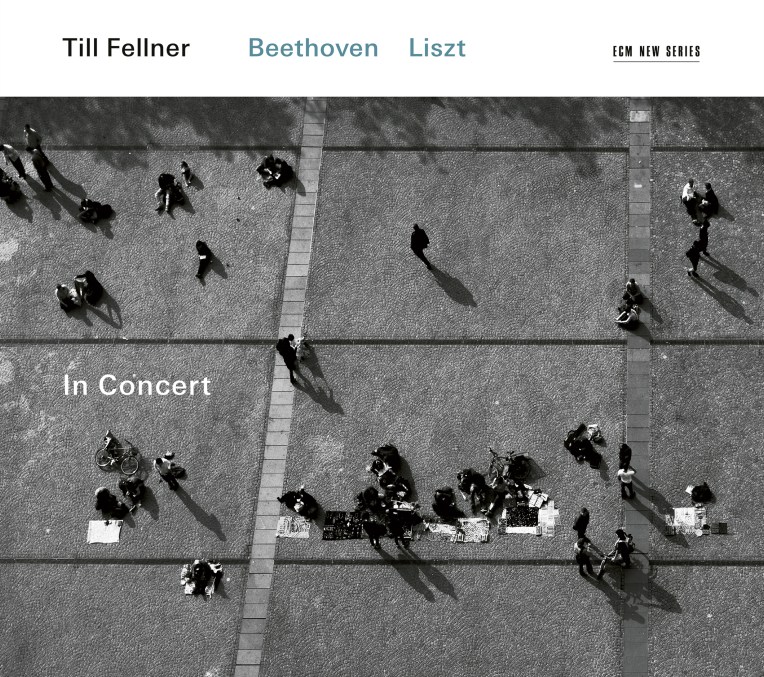
Till Fellner: In Concert – Beethoven/Liszt (ECM New Series 2511)

2511 X

Till Fellner
In Concert: Beethoven/Liszt

Till Fellner piano
Années de pèlerinage
Concert recording, June 2002
Wien, Musikverein, Großer Saal
Tonmeister: Gottfried Zawichowski
Engineer: Andreas Karlberger
An ORF Recording (Austrian Broadcasting Corporation/Radio Österreich 1)
Sonata No. 32
Concert recording, October 2010
Middlebury College Performing Arts Series
Mahaney Center for the Arts, Robison Hall
Tonmeister: Mark Christensen
Mastering: Markus Heiland
An ECM Production
Release date: November 2, 2018

But where of ye, O tempests! is the goal?
Are ye like those within the human breast?
Or do ye find, at length, like eagles, some high nest?
–Lord Byron, Childe Harold’s Pilgrimage

After a mosaic of recordings spanning the gamut from J. S. Bach to Thomas Larcher, Till Fellner returns to ECM with a pastiche of live recordings from 2002 and 2010. The first presents the Austrian pianist in his home capital for year one of Franz Liszt’s Années de pèlerinage. Inspired by the composer’s trip to Switzerland from 1835 to 1836 but unpublished until 1855, this aural scrapbook is alive with alpine imagery and motifs, encompassing firsthand memories, friendships, and even political views. It’s on the latter note that the collection begins with La Chapelle de Guillaume Tell. This stately introduction to an otherwise flowing work sets a precedent of architectural soundness that infuses all to follow. Contrast this with the watery beauties of Au lac de Wallenstadt and Au bord d’une source, and you already have a sense of the variety to which Liszt had eloquent access, rendered by Fellner with dynamic temperament.

While many sections, such as the sunlit Pastorale and Eglogue (the latter riffing on a shepherd’s song), are built around fleeting impressions, each nevertheless feels complete. This may be due to the fact nearly all of the music is revised from earlier material, an exception being the tempestuous Orage. No matter the duration, emotional integrity is the primary ingredient, so that the descriptions of Vallée d’Obermann’s thirteen precious minutes feel just as thick as Le mal du pays. Both seem to find the composer yearning for home when away from it, if not also for distant travels when in it, lending themselves to a score that only serves to nourish Fellner’s radiance. All the above shades of meaning cohere in Les cloches de Genève, by which the pianist elicits rich yet subtle sonorities.

If Liszt is a photographer, then Ludwig van Beethoven is a filmmaker whose magnum opus is surely the Sonata No. 32 in c minor. His Opus 111 shares its key signature with the Fifth Symphony and other monumental works, and provides a fitting end to his sonata cycle. As suggested in William Kinderman’s deeply considered liner essay, “The pair of movements of this sonata interact as a contrasting duality suggesting strife and fulfillment, evoking qualities which have stimulated much discussion, reminding commentators of the ‘here’ and the ‘beyond,’ or ‘samsara’ and ‘nirvana.’” Such spiritual language is no mere hyperbole, but an activation point of Beethoven’s grander concerns over the effects of art on the soul. As The Art of Fugue was to Bach, so is the Sonata No. 32 to Beethoven with regard to variation.

To be sure, Fellner touches upon those grander narratives, but more importantly keeps his ears attuned to the details. In the opening movement, for example, his arpeggios feel like quills on paper. Balancing stream-of-consciousness impulses with deeply articulated control, he links an unbreakable chain of progression. The second and final movement begins almost timidly, as if sifting through old notes for fear of what one might find, only to be surprised by a joy one never knew was waiting for rediscovery. Urgency compels the left hand while trills in the right signal a transformation of flesh into glory. “The transformational power of this closing music,” says Kinderman, “acts like a utopian symbol, which seeks to neutralize if not dispel the tragic reality embodied in the weighty opening movement of the work.” And perhaps weight is the most appropriate physical property by which to analyze what’s happening here, for regardless of size and scope, the relationship of every note to gravity is meticulously examined, its potential for flight believed in like a prayer.

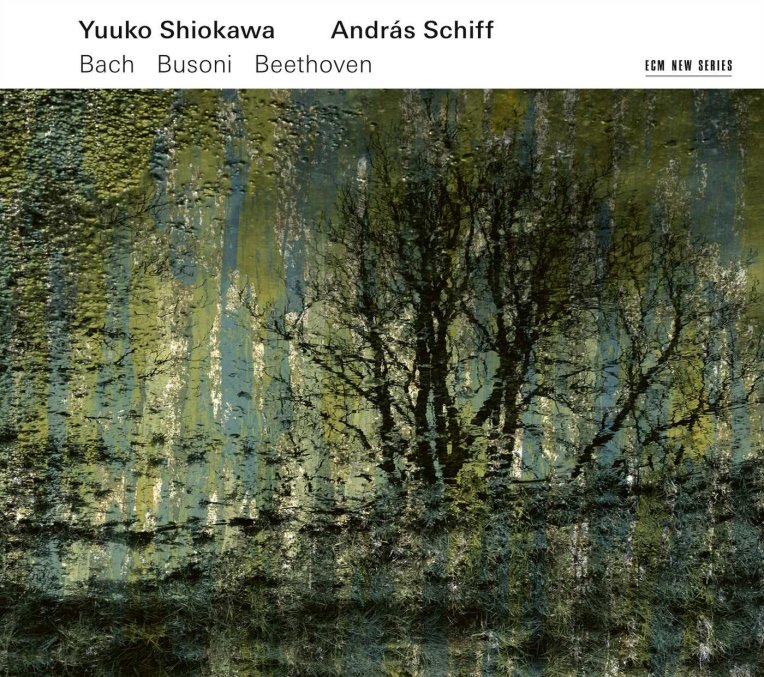
Yuuko Shiokawa/András Schiff: Bach/Busoni/Beethoven (ECM New Series 2510)

Bach Busoni Beethoven

Yuuko Shiokawa
András Schiff
Bach/Busoni/Beethoven

Yuuko Shiokawa violin
András Schiff piano
Recorded December 2016, Auditorio Stelio Molo RSI, Lugano
Engineer: Stephan Schellmann
Produced by Manfred Eicher
Release date: October 27, 2017

Seventeen years separate the first appearance of Yuuko Shiokawa and pianist András Schiff on ECM’s New Series and this long-awaited follow-up. Here they bring their intimate knowledge and experience to bear on sonatas by Johann Sebastian Bach (1685-1750), Ferruccio Busoni (1866-1924), and Ludwig van Beethoven (1770-1827). Through its sequence and execution, the program reveals as much richness of ideas within the pieces as between them.

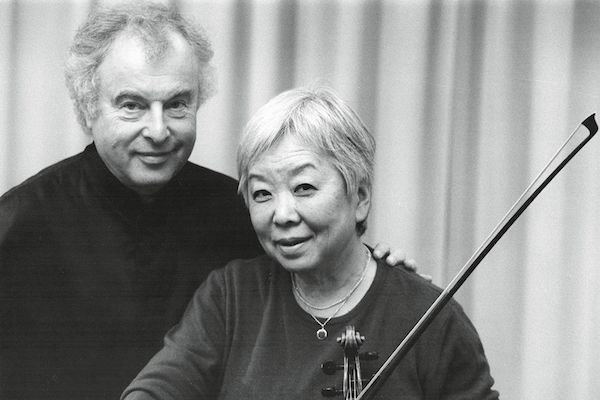
Shiokawa Schiff
(Photo credit: Barbara Klemm)

Bach’s Sonata No. 3 in E Major, BWV 1016, dating to his 1717-23 tenure as Kapellmeister at Köthen, is emblematic of a then-nascent genre, and finds both composer and interpreters ordering lines of many shapes and sizes. Schiff’s role at the keyboard is a challenging one, each hand operating independently yet with deep awareness of the other, while Shiokawa must paint with an actorly brush from first note to last. The vulnerability she brings to the opening Adagio is but one example of her ability to take something so lilting, so fragile, and render it impervious to the trampling feet of time. From there she takes us on a journey of inward focus, and by an interactive cartography traces bubbling streams to destinations of delight.

Although Busoni was more steeped in Bach than perhaps any composer before or since, one would be hard-pressed to find Baroque affinity in the first movement of his Sonata No. 2 in e minor, Op. 36a. Towering over a decidedly Beethovenian landscape, it leans toward and away from its historical precedents with fervor. Whereas single movements in the Bach were facets of a larger mosaic, each of Busoni’s sections is a sonata unto itself. The gargantuan final movement, however, is a theme and variations on the Bach chorale “Wie wohl ist mir, o Freund der Seelen, wenn ich in deiner Liebe ruh,” as it appears in wife Anna Magdalena’s Clavier-Büchlein of 1725. Busoni’s 17-minute exegesis goes from funereal to exuberant and back again. Between those worthy bookends stand two slim, insightful volumes. Where the Presto is playful yet adhesive, the somber Andante treads over shifting terrain.

In light of these fantastic excursions, Beethoven’s Sonata No. 10 in G Major comes across as non-fiction. As the composer’s last violin sonata, it holds a status all its own, and its details are organically suited to the duo. Where the trills and harmonies of its Allegro yield an enchanting ripple effect, the Adagio holds us suspended as if in need of nothing more than a confirmation of breath. A brief Scherzo scales the highest peak before trekking down into an Allegretto with a joy given life through musicians who care genuinely for everything they touch. It’s therefore difficult to listen to this recording without reminding oneself that Shiokawa and Schiff are partners in both music and life. Not only because they play so lovingly, but also because they listen to each other with rapt attention, inspiring nothing short of the same.

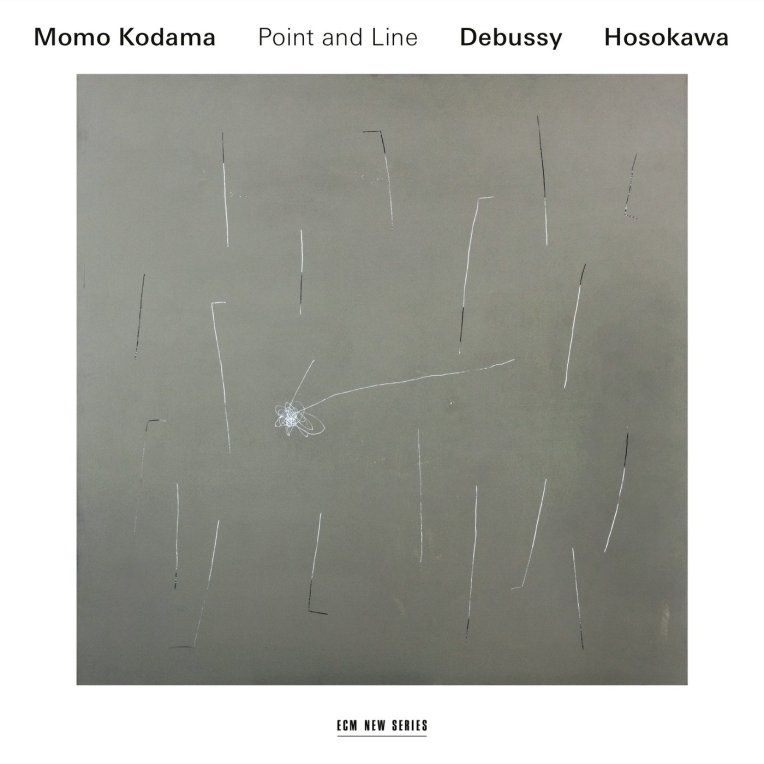
Momo Kodama: Point and Line (ECM New Series 2509)

Point and Line

Momo Kodama
Point and Line

Momo Kodamapiano
Recorded January 2016, Historischer Reitstadel, Neumarkt
Engineer: Stephan Schellmann
Produced by Manfred Eicher
Release date: January 27, 2017

Four years after making her ECM New Series debut with La vallée des cloches, pianist Momo Kodama returns with a program that is equally adventurous in expectation and inevitable in hindsight, this time shuffling the Études pour piano, L 136 (1915) of Claude Debussy (1862-1918) and Etude I-VI for piano, SJ 1180 (2011-13) of Toshio Hosokawa (b. 1955) into an integrated experience. Having performed both cycles separately, here Kodama imagines them in dialogue with each other. “A number of elements in Hosokawa’s music,” she writes in her liner note, “make me sense a proximity to Debussy. One is the freedom of its formal design; another is its interplay and layering of colors. What I fins especially remarkable in both is a capacity for poetic utterance and ranges widely between lyricism and drama, between meditation and virtuosic display.” As in acts of translation between languages, what separates is also what binds, and Kodama is a masterful interpreter in that regard, fluent as she is in every dialectical nuance at hand.

“Hand” is indeed the operative word, as Kodama’s parallel communicators ride over the intimate cascades of Debussy’s Etude XI before swirling the waters below in defiance of prettiness. Thus, whatever conversational approach we might attribute to process isn’t necessarily between two (or more) people, but rather between different shades of the same musical self. Kodama’s rendering thereof illuminates a cohesive identity, and she, as surely the composers themselves, revels in disruptions, treating each as an opportunity for productive change.

Hosokawa’s Etude II, from which this album get its name, takes its descriptive heading with beautiful literalness, contrasting sustained notes and dotted clusters, the latter as sprays of baby’s breath in a wider bouquet. A spirit of favorable conflict prevails, as also in Debussy’s Etude III, wherein points and lines are converted into poetry. Not that what follows is a series of impressionistic vignettes, but a space in which every utterance counts. As dynamics lob from soft to loud and back again, we are primed for the versification of Hosokawa’s “Calligraphy, Haiku, 1 Line” (Etude III), of which dramatic outbursts amid resonant silences become organic allies.

As the composers continue to seesaw between foreground and background, something surprising begins to happen: we begin to lose track of who wrote what. For while the reveries of Etudes IV and VIII have an obviously Debussean flavor, we might also read distinctly Hosokawan associations into the second and first etudes. And while the tail-chasing details of Hosokawa’s first and fourth etudes reveal a childlike dedication to play (the latter’s subtitle, “Ayatori, Magic by 2 Hands, 3 Lines,” makes reference to the cat’s cradle game), his respect for Debussy peeks from behind the curtains of “Lied, Melody” (Etude VI), a high point that pushes darkness and light through lattices of memory.

Retrospection seems equally vital to sustaining Debussy’s mocking Etude I and Hosokawa’s visceral “Anger” (Etude V), and by the emotional clarity of those expressions turns anticipation into reflection. Like Debussy’s Etude VII, they draw a compass between our ears, for while the notes may go up and down, the hands travel right and left, leaving us with a navigational instrument to cherish as we leave this land behind into uncharted waters.

Bruno Maderna/Luciano Berio: Now, And Then (ECM New Series 2485)

2485 X

Bruno Maderna
Luciano Berio
Now, And Then

Orchestra della Szizzera italiana
Dennis Russell Davies
conductor
Pablo Márquezguitar
Recorded August 2015, Auditorio Stelio Molo RSI, Lugano
Engineer: Michael Rast (RSI)
Editing and mixing: Michael Rast and Manfred Eicher
Produced by Manfred Eicher
Release date: October 27, 2017

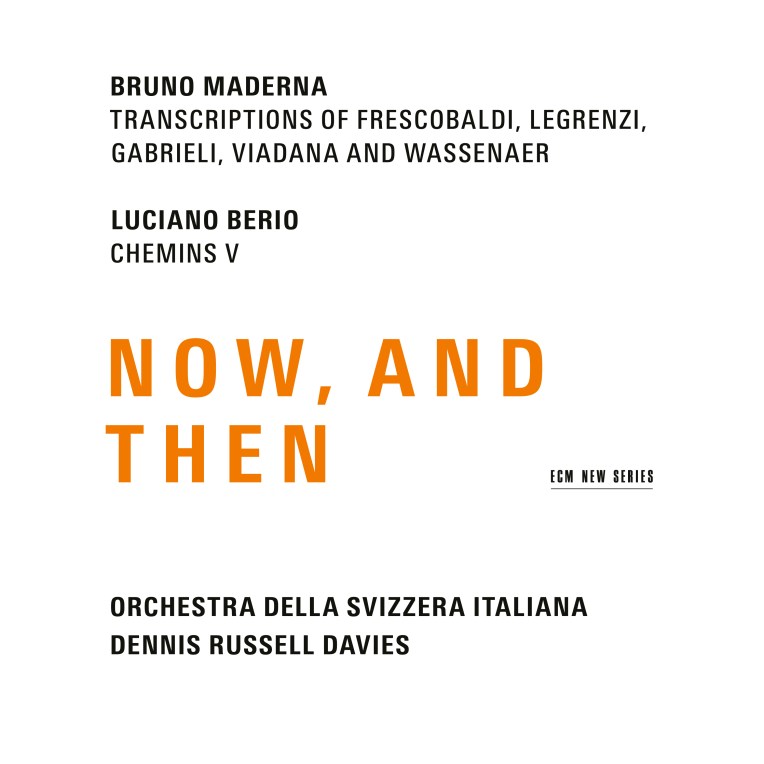
Bruno Maderna (1920-1973) was an instrumental force in contemporary music throughout the 1950s, when composers of “modern” persuasion were still struggling to at once uphold and break open the secrets of bygone masters. Maderna was no stranger to the past and had a particular fondness for the clarity of the Italian Baroque, as evidenced in his transcriptions of Girolamo Frescobaldi, Giovanni Legrenzi, Giovanni Gabrieli, Tommaso Lodovico da Viadana, and Unico Wilhelm van Wassenaer presented by the Orchestra della Szizzera italiana under the baton of Dennis Russell Davies.

It should come as no surprise that Maderna had a love for the theatre, as these pieces breathe like dramaturgical backdrops to well-studied action. While nearly all of them date from 1952, the sole exception is Gabrieli’s Canzone a tre cori (1969/72), of which Maderna’s recrafting turns glory into lyrical shadow. Frescobaldi’s Tre Pezzi (1952), by contrast, constitute an exercise in contradiction. Robust yet naïve, they move fluidly across and between planes of exposition. The liturgical center, comprised of a brief “Christe” and “Kyrie,” hints at a spiritual undercurrent before deferring to a regal finish. Against this, La Basadonna (1951-52) is a delightful interlude that dances with delicate assurance across this dioramic stage. As heartbeats of golden ages mesh into an elegy for silver futures, Viadana’s Le Sinfonie (1952) reads like an archive of memory. It’s portrait of Italian cities bustles with life and character. Of these, the buoyant “La Venetiana” recalls the programmatic brilliance of Carlo Farina. Last is the “Palestrina-Konzert” (1952) by Wassenaer. Once attributed to Pergolesi, this gorgeous triptych sets up an alluring Vivace through two slower precursors. Enchanting sonorities abound.

From all of these, we know that Maderna understood Baroque music as a giant wheel, sporting a clearly defined center from which regular spokes extended to an more open perimeter. His respect for that underlying architecture reveals its own.

Lodged therein, between the Legrenzi and Gabrieli, is Chemins V, a self-transcription of Sequenza XI (1987-88) by Luciano Berio (1925-2003), with whom Maderna founded Europe’s first electronic music studio, the Studio de fonologia musicale di Radio Milano. This piece, composed in 1992, receives its premiere recording here. Featuring guitarist Pablo Márquez on the instrument for which it was originally written, it’s a deeply psychological journey. Márquez navigates every topographical change with confidence, finding purchase on the narrowest of cliffs and staying grounded on the slipperiest of terrain. Brimming with Berio’s uncanny ability to make the beautiful eerie and vice versa, it treats the guitar as leading voice and internal percussion, ambulating without apparent direction until the subdued, shimmering finale. Worth the price of entry alone, this rare morsel in an already-rich covering speaks to the core of our being as a species at a time when uncertainty rules the day.

Meredith Monk: On Behalf Of Nature (ECM New Series 2473)

2473 X

Meredith Monk
On Behalf Of Nature

Meredith Monk & Vocal Ensemble
Sidney Chen, Ellen Fisher, Katie Geissinger, Meredith Monk, Bruce Rameker, Allison Sniffin
voices
Bohdan Hilash 
woodwinds
John Hollenbeck percussion
Allison Sniffin piano, keyboard, violin, French horn
Laura Sherman harp
Recorded June 2015 at Avatar Studios, New York
Engineer: James A. Farber
Assistant: Akihiro Nishimura
Produced by Manfred Eicher
Release date: October 21, 2016

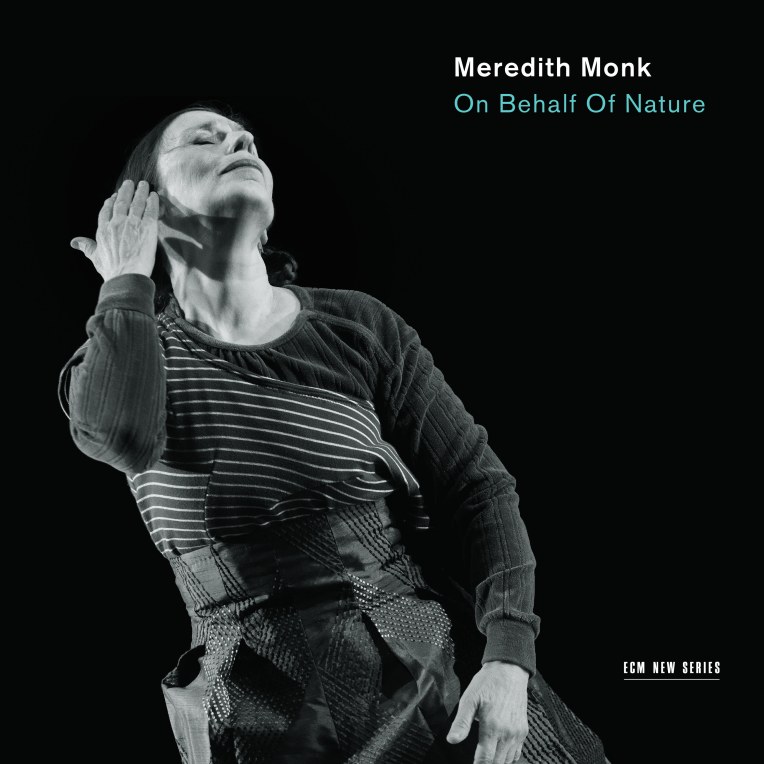
Since 1981’s Dolmen Music, Meredith Monk has contributed an integral DNA segment of ECM’s evolution as a label. But at no time in history has she felt as poignant as in On Behalf Of Nature. Tracing echoes of relevance to today’s social, spiritual, and terrestrial climate, the album is a mouthpiece for those who are voiceless, epitomized in the lone wooden flute that opens “Dark/Light 1.” As a call born of its own will to be heard, it flowers by nourishment of an egoless sun. Such can be also said of Meredith Monk and her vocal ensemble, whose own voices shape that same will selflessly, dutifully, necessarily—because opportunities to do so are dwindling more rapidly than can be articulated by breath and touch. By these signs is established a grammar that lives beyond codification, yet which is felt in the body even as it wanders into our dreams.

While the 19 offerings placed on this altar of creative sacrifice belong to the same ecosystem, Monk seems to link them to three distinct streams of consciousness. The most visceral of these is accessible in three pieces titled “Environs,” in which the fearful heart trembling at the core of a scarred earth sheds both light and darkness on injuries in which we would much rather never admit complicity. Deep yet delicate, these are about as honest as music gets.

A second stream is heard flowing through the album’s largest forests, which acclimate themselves in the prepared piano of “Ritual Zone,” the prophetic violin of “Memory Zone,” and the joyful cries of “Harvest.” Further gifts emerge in “Duet with Shifting Ground,” “Evolution,” and “Water/Sky Rant.” The latter’s harp-infused anthem of abuse, recovery, and hope is perhaps the most powerful statement Monk has ever committed to record. Each of these is a chamber of truths that have existed since the dawn of humanity, reminding us that harmony must be chosen, not expected. As by the ligaments of “Spider Web Anthem,” cohesion requires patient work and purpose by which to cultivate it.

Such connective tissue is the mantra enlivening interlinear pieces throughout. Through them flow the base elements of all life, whether natural (“Eon”) or human-made (“Pavement Steps”). Therein beats the heart of a question that cannot be spoken yet whose answer is so clear as to be anxiety-inducing. It is not the planet itself but those on it without the means to communicate their traumas across electronic signals or paper who sing. On Behalf Of Nature, then, is their stage: an album so relevant as to be worthy of beaming into outer space in the hopes of clearing a path to salvific inner spaces.

Erkki-Sven Tüür/Brett Dean: Gesualdo (ECM New Series 2452)

Gesualdo

Erkki-Sven Tüür
Brett Dean
Gesualdo

Estonian Philharmonic Chamber Choir
Tallinn Chamber Orchestra
Tõnu Kaljuste conductor
Recorded February 2014 at The Tallinn Methodist Church
Engineer: Maido Maadik
Edited and mixed December 2014 by Maido Maadik, Manfred Eicher, Erkki-Sven Tüür, and Tõnu Kaljuste
Produced by Manfred Eicher
Release date: September 18, 2015

I die, alas, in my suffering,
And she who could give me life,
Alas, kills me and will not help me…

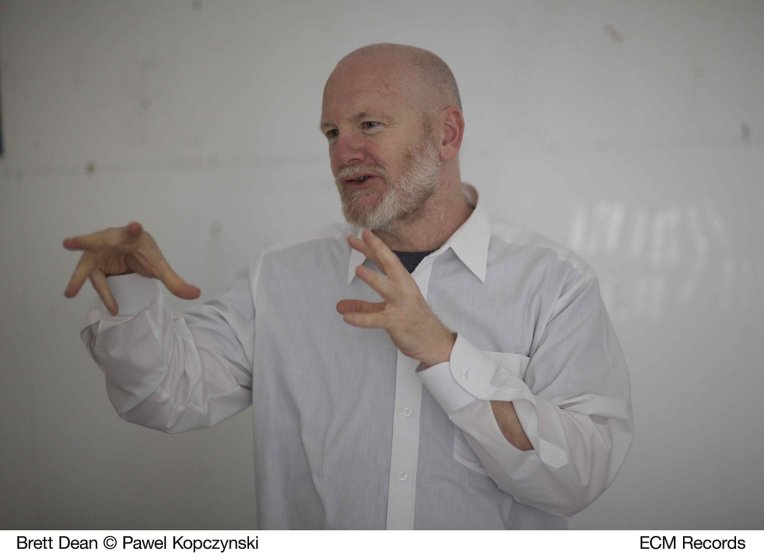
These words, originally sung as Moro lassofrom the Sixth Book of Madrigalsby Carlo Gesualdo da Venosa (1566-1613), recede to let their notes carry on alone in a transcription for string orchestra by conductor Tõnu Kaljuste. This inward look, by proxy, of a composer whose trespasses have been relegated to an afterthought by his oeuvre newly emphasizes repentance trickling through the historical cracks. Echoes of that repentence, in both melody and metaphor, ripple across Carlo (1997). Written by Australian composer Brett Dean, here making his ECM debut, it marshals the Estonian Philharmonic Choir and Tallinn Chamber Orchestra via compressions of space and time. As displacements of the original seed multiply, we hear fear and trembling emerging from within, gradually pared down to morbid whispers and cries of pain, as if to recreate the crime scene that would define Gesualdo’s life, so that when his polyphony returns, it feels like self-deprecation.

Tüür

Given that Carlo is somewhat reminiscent of Erkki-Sven Tüür’s Requiem (1994), no other composer would feel so well included to round out the program. Tüür’s own arrangement of the motet O crux benedicta spotlights a younger Gesualdo, allowing a slightly more optimistic glow to escape. This is followed by L’ombra della croce (2014), a piece for strings that exists somewhere between Illusion and Passion (both from 1993), and Psalmody (1993/2011). This last piece draws a line back to In Spe, a prog-rock band Tüür led between 1979 and 1982. As a dialogue between electric piano, orchestra, and choir, it speaks more to the flesh than to the spirit, at the same time fashioning youth into a crucible of nostalgias. Throughout its 22 minutes, one encounters a chronology of Tüür’s compositional development, from architectonic tinkerer to mosaic master. There’s even a touch of American minimalism to keep the experience centered, well aware as Tüür is that music bleeds.

Dean

Because he is one of the ECM New Series’ integral figures, any new Tüür material on disc is cause for celebration. Yet this pairing with Dean exceeds expectation and heralds a true return to form, such that by its end the album reveals itself to be at once a homecoming from, and departure for, a long journey.

O sorrowful fate,
She who could give me life,
Alas, gives me death.