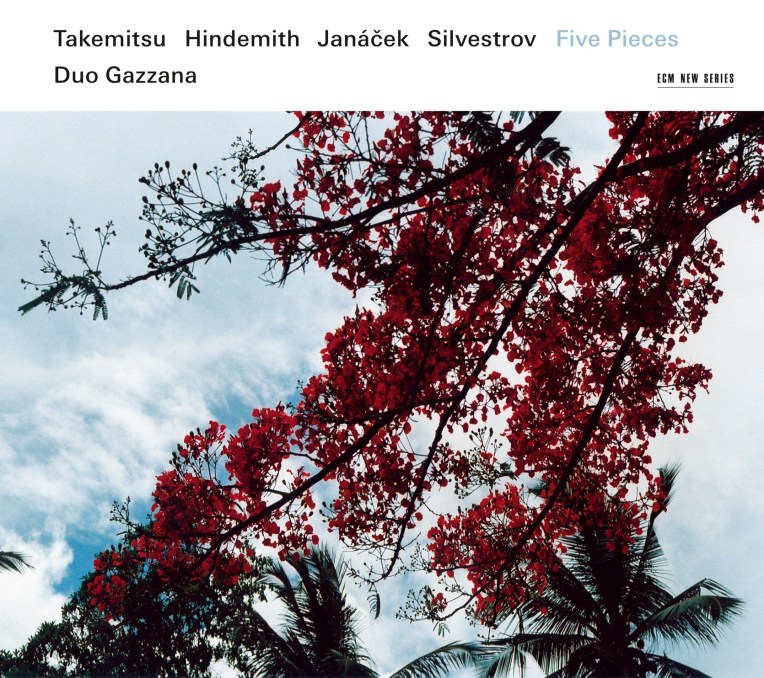
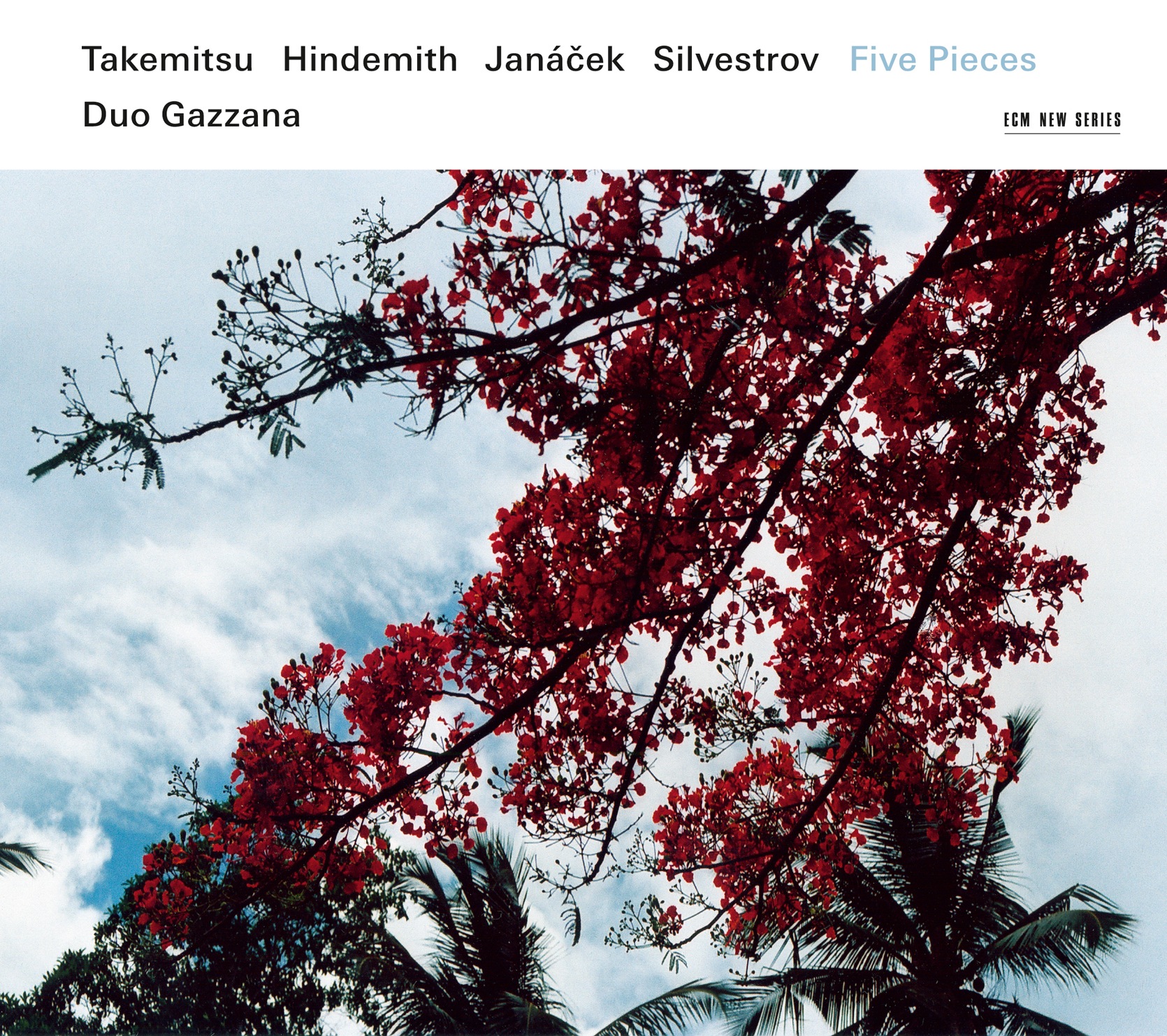
Duo Gazzana
Five Pieces
Natascia Gazzana violin
Raffaella Gazzana piano
Recorded March 2011, Auditorio Radiotelevisione svizzera, Lugano
Engineer: Markus Heiland
Produced by Manfred Eicher
Beautiful teeth sung behind the trees
Finely shaped ears were between the clouds
Iridescent nails blended with water
Kicked off a pebble
All like footsteps
–Shuzo Takiguchi, trans. Noriko Ohtake
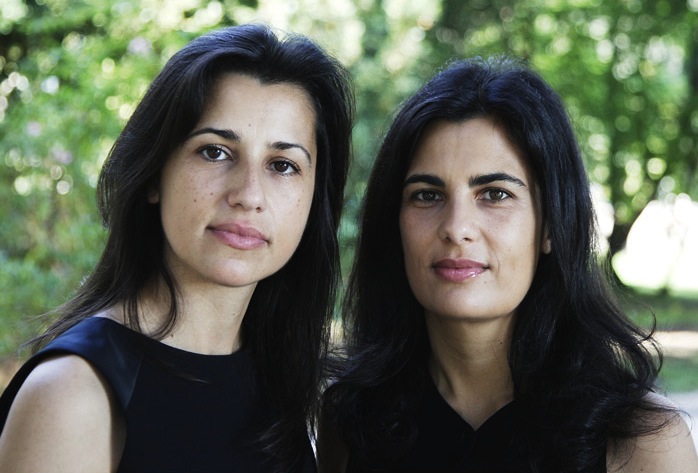
Natascia and Raffaella Gazzana are sisters in more ways than one. Having performed together since they began their classical educations, as Duo Gazzana they have been impressing audiences since the 1990s with the galactic swirl of their milk-and-coffee blend. It is perhaps no coincidence, then, that their sororal sound and abiding interest in modern music would lead them to ECM producer Manfred Eicher, who has seen fit to oversee their recording debut of a program that includes works by Tōru Takemitsu, Paul Hindemith, Leoš Janáček, and Valentin Silvestrov. I recently “sat down” (inasmuch as one can via e-mail) with the Gazzanas, who were gracious enough to expound at some length on the questions tickling this voracious listener’s brain.
The violin/piano repertoire is so vast. How did you begin to conceive of such a refreshing program? Were you looking at it in terms of obscurity versus knowability, or simply playing what you love?
Thanks for calling it “refreshing”! We liked the idea of proposing pieces not so often played, excluding perhaps the Janáček sonata. This became possible with the ECM label, which generally offers its listeners “unusual” music. We particularly enjoy playing all the pieces in this program, and each has its own reason for being on the CD. While Janáček and Hindemith were part of our usual repertoire, we encountered Takemitsu relatively late. We came to know Silvestrov’s music through the several ECM recordings that Manfred Eicher encouraged us to listen to. We were immediately captivated by his delicate and evocative writing.
Does the music in this program, as a whole, tell a story? If so, what you hear, see, or feel in it?
The four composers, so apparently far from one another in age and background, tell similar stories with different languages. We liked the idea of giving this program a direction by moving from central European expressionism (Hindemith), through Janáček’s tormented postwar sonata and the gentle approach of Silvestrov, and finally into the far eastern refinement of Takemitsu’s music, loaded with that French influence that takes us back to where we began. A travel through old and new stories, with plenty of different nuances!
Takemitsu’s Distance de fée (1951) is indeed all about nuance. Its Debussean magic lures us into twilight from Raffaella’s first chord. Natascia’s cotton-spun tone wafts across time and space like pollen in darkness—which is to say, unseen yet felt at the bridge of a nose, gracing the forehead with the promise of an unattainable daybreak. She waits, the wind seems to say, as if there were no alternative but to run with her into the future. Harmonics cry like birds in the boughs of our unrest and end where we began, a palindrome in the night.
With such evocative threads to unravel, I ask the Duo how they approach this young piece from a then relatively new composer, one navigating the moral topography of the postwar era with decidedly French tools. Are these geographical slights of hand, I wonder, important to keep in mind?
We have great affinity for Japanese literature and culture and were curious to learn as much as possible about their different aspects, in which ancient traditions are so well integrated with advanced technology. We approached Takemitsu just before a long tour we held in Japan a couple of years ago. It was the right occasion for us to play the new, refined music that we wanted to offer to such an audience. Distance de fée, inspired by a surrealistic poem of Shuzo Takiguchi, is an early piece in which, still searching for more personal and original writing, he was strongly influenced by French music, and Messiaen in particular. Takemitsu himself once described the process as “reciprocal action, musical art re-imported to Japan.” His fascination for impressionistic music came from the fact that harmonies of modal scales, so dear to French composers, had been at the base of traditional Japanese music for centuries. Both cultures were united by a keen sense of tone, for pictorial and naturalistic elements. Nevertheless, he only took inspiration from the great Frenchman’s modes to transpose and create a world properly Japanese. The philosophical concept of MA, so distant from our culture, in music can be translated as the “art of no sound” or “art of the vacuum,” by which is born an inseparable relation of continuity rather than opposition between music and silence. Silence surrounded by sound adds tension and gives unity. You can hear this right from the beginning of the composition: we are immediately transported into a suspended world rising from nowhere. There are no real melodic lines but fragmented motivic cells alternating with pauses on the violin. They are never truly developed but are reiterated literally or with little variations supported by the rich harmonies of the piano’s ever-changing chords. In a way they represent the world around us from which the composer extracts but a segment.
That one finds all of this and more in six-and-a-half minutes of music is a testament not only to the composer, but to the performers who sensitively tease out these subtleties in thought and gesture.
And while the shift to Hindemith’s Sonata in E may seem like a dramatic one, the expressivity of the writing and the playing bears itself out with likeminded attention to color. The first movement of this 1935 diptych is like lost children running off into the sunset, trailing shadows of superstition and leaving footprints like barely audible commas before the languid search of the second surges forth at an equine clip to find them.
If in Hindemith we find a quick and easy resolution, then in the Janáček Sonata of 1914 (rev. 1921) we find a composer who revels in the uncertainty and internal reflections leading up to it. The violin’s silvery threads foreshadow the quiet aftershocks in the final Adagio, along the way sharing a variety of interactions with piano. Sometimes they walk parallel paths while at others seem blissfully indifferent. The second movement takes us on a journey not unlike Takemitsu’s, the coil set to spring from Raffaella’s rainfall into the starkly contrasting Allegretto, for which Natascia shades those memorable punctuations with individuality and purpose.
It is tempting to quarantine Janáček from the surrounding company, but to my ears his sonata is a mixture, and then some, of everything else in the program. That you were able to draw out that kinship is wonderful. What is your take on Janáček?
We have always admired Janáček for his intensity in writing music rich with twists and turns. You could distinguish him from any other composer. Beside his moodiness he is always capable of drawing captivating melodic material, mostly marked by sadness and sorrow. That makes us think of him as a poet of his people, Czechoslovakia being so often bereft of freedom. We used to listen to his chamber music very often: his string quartets dense with impassioned lyricism and dynamics, his fairytale-like cello sonata, his deeply touching piano sonatas and miniatures. Before getting to know the sonata we play, we saw Kát’a Kabanová at the opera. It is the tragic story of a young woman and her attempts to escape from a stifling environment and marriage. Driven by remorse, she throws herself into a river. It was a nice discovery to recognize soon after many themes borrowed from that opera in the violin sonata. It became a source of liberation for our playing.
One of the most striking turns in the Janáček takes place in the concluding Adagio, during which the violin is asked to speak in echoes. Seeing as the sonata ends with this effect, what does it signify to you?
The final Adagio is perhaps the most tragic movement of the sonata. The piano plays a sad, gently nostalgic melody in octaves, rather resigned, in a kind of rough but quiet mood. The violin, with its nervous interventions, gives a restless strength to the music. We would rather speak of a real dialogue between the two instruments more than an echo effect. Indeed the violin points out the increasing anxiety that reaches its natural climax toward the end of the movement, where the piano plays tremolos con forza and the violin a very expressive ascending melody. A quieter atmosphere is finally restored with both instruments agonizing over the nervous violin fragments with which the sonata began.
Nervousness would seem farthest from the sound-world of Valentin Silvestrov, who in his Five Pieces (2004) builds a nest of long flexible motives. His music always seems to rise from nowhere, as if birthed from some infinite yearning, realized only through the fleshiness of instrument and human touch. And what demands, if any, might this quality place on the performers?
Silvestrov’s music is pervaded by a sense of nostalgia, pure tenderness, and touching simplicity. Almost paradoxically this simplicity is achieved by the interpreters with great efforts, because of the numerous and detailed indications in each bar of the score. Maintaining awareness of all these dynamics does nothing to stop the musical flow in its organic atmosphere. Everything has to sound like as if it were wrapped in distance, through the balance of the instruments; the shrewd use of long, half, and una corda pedaling throughout; continuous rubato, sudden accelerando and suspensions. Dynamics range from pianissimo to piano, with small peaks never going beyond mezzo-piano. The approach suggested by the composer is that of extreme delicacy toward the instruments. Indeed we tend to think of caressing our piano and violin. Maybe the best definition of this sublime Ukrainian composer is given by Wolfgang Sandner in the refined booklet of our CD, where you can read that Silvestrov was able to catch the flower at the edge of the path left by Schubert in his musical wanderings…
And in that opening Elegie we do, in fact, wander that same path. The flower is heartening, drawing us on a canvas without even seeming to touch it. Certain themes (e.g., the Serenade) seem to call not to us, but from us, and are all the more inescapable for it.
Natascia, I adore your pizzicato technique yet we hear so little of it. We get a taste in the Silvestrov Intermezzo, evocative and tiptoeing through shadow. What does it feel like to bring out this splash of color, so dramatic against the palette of which it is such a brief part?
I appreciate very much the possibility that Silvestrov allows interpreters of his music to develop many different techniques for both the right and the left hand. The Intermezzo pizzicato technique creates a completely new atmosphere. It gives the piece a separate and defined character in comparison with the previous Serenada and the following Barcarole. As we can see in the score, Silvestrov writes many musical indications and dynamic marks on each pizzicato to give a precise meaning to the piece. That’s a great opportunity for a musician to serve a musical idea with all the means at her disposal.
This sense of service, of offering something to the listener, flows through every movement, floating quietly through the Barcarole on bittersweet currents into the concluding Nocturne, a long and winding signature to this aural love letter.
There something arboreal and forested about all the sonic choices taken on this endearing record. We can hear it in Natascia ringed tone of her instrument and in the clarity of separation (especially in the lower register) that Raffaella elicits from hers. Each note rises like a silent trunk, even as it falls like the leaves from its boughs. There is also the sense of casting that Paul Griffiths so poetically articulates in his liner notes, of composers drawing lines between themselves and idealized, faraway places, and brought home again through individual expression.
To play this music with such color as you do, is it fair to say that you draw upon personal experiences and emotional understandings, as might stage actors, when performing?
Music is a means of communication. The life of a person is constantly changing. Every day we receive different stimuli according to what we see, what we listen to, who we meet…. Personal experiences and emotional understandings become meaningful through music. That is why it is so important for us to dedicate spare time to our interests that may not be so apparently related to music. We both hold university degrees: Raffaella in Italian Literature and Musicology, Natascia in Visual Arts. We study, respectively, Japanese and Russian language, because we are very fond of cultures so different from ours. We had the chance to grow up in a house full of Latin and Greek books because our parents taught both in high schools. We like reading, listening to music, and watching good cinema. Music gives us the great opportunity to travel, to see different countries and their ways of living, to learn and exchange opinions. Life and music are absolutely intertwined.
Can you tell us what it was like to record for ECM? How did Manfred Eicher approach you for this recording? What did he bring to the project? How did he encourage you?
ECM is a legendary label, synonymous with high quality recording, attention to detail, elegance, refinement, and courage in programming. It was an honor and a privilege for us to make our recording debut for such a prestigious label. We had the chance to record in Lugano’s RSI Studio, one of the most reputed and acoustically perfect for classical music. Beside all these technical considerations, the most important thing was the professional relationship we established with producer Manfred Eicher. He told us from the beginning that the recording process starts long before the studio session. Indeed, we contemplated our CD program for almost a year before stepping into the studio. He encouraged our decision to play music from the twentieth and twenty-first centuries. Thanks to him, we discovered Silvestrov’s music, which has now become part of our concert repertoire. We felt very focused but completely at ease during the recording session. That is because Mr. Eicher, as a musician first and a producer second, understands the needs of artists and helps tremendously with his inspiration at just the right time, during such delicate moments.
Are you both ECM fans? If so, what artists, composers, or albums do you most admire and why?
Yes we are! We think ECM’s greatest merit is bringing the public “new” music of different geographical areas by contemporary composers that would probably never be heard so widely otherwise. There are many ECM New Series discs we listen to quite often, with great interpreters such as Gidon Kremer, András Schiff (whose account of Janáček,A Recollection,is one of our top favorites), and the Keller Quartett (Die Kunst der Fuge). We love Kim Kashkashian, whose playing is very near perfect in most of her recordings. We would single out, though, the double-CD set of Hindemith’s viola sonatas or the Brahms viola-and-piano masterpieces, to say nothing of her touching interpretations of the Shostakovich sonata, Schnittke’s concerto, and all of the Kancheli and Mansurian recordings. Silvestrov and Kancheli are the composers we appreciate most among many others for being so different and intimately touching. Jazz-wise we enjoy Keith Jarrett’s early solo records and Tord Gustavsen’s Nordic flavors.
To listen to samples, click here. To learn more about Duo Gazzana, click here.






 Between Sound and Space: ECM Records and Beyond