Bill Connors: Of Mist And Melting (ECM 1120)

1120 X

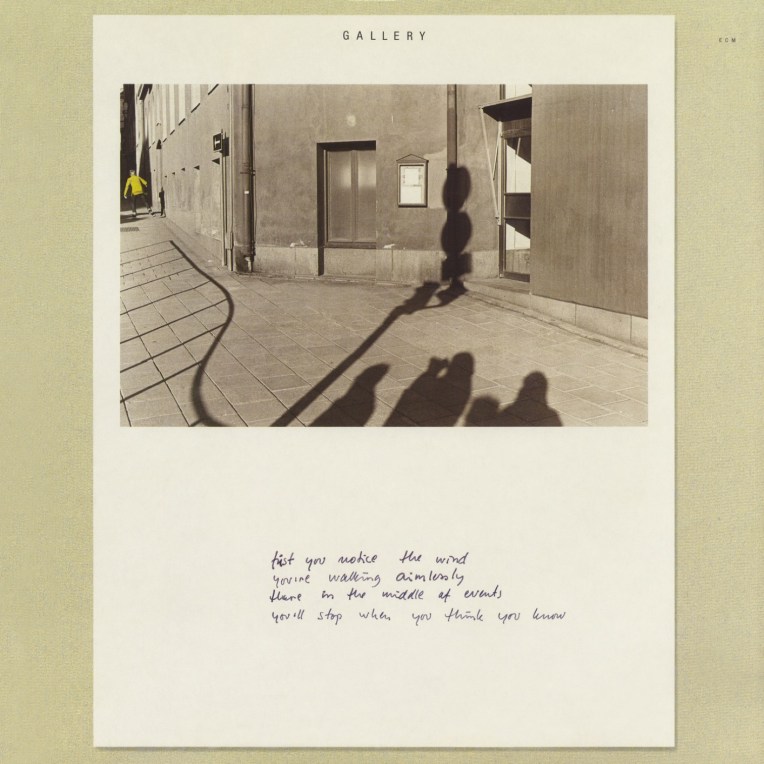
Bill Connors
Of Mist And Melting

Bill Connors guitar
Jan Garbarek saxophones
Gary Peacock bass
Jack DeJohnette drums
Recorded December 1977, Talent Studio, Oslo
Engineer: Jan Erik Kongshaug
Produced by Manfred Eicher

Three years after his astonishing acoustic turn on Theme To The Gaurdian and fresh from Jan Garbarek’s Places session, guitarist Bill Connors returned as leader for this moody quartet, for which one could hardly dream up a better roster: Garbarek (saxophones), Gary Peacock (bass), and Jack DeJohnette (drums) fill out the spectrum of this sound palette with the best of them. The synergy for which the latter two musicians have come to be so highly regarded is already plain to see here and spins the free and easy flow that characterizes the album’s ethos from beginning to end. While one might expect an electric guitar at anchor, Connors maintains his wireless interests with no loss of potency. One “side effect,” if you will, of this configuration is that the backing generally keeps its volume low and fades to near silence in order to give Connors ample soloing room. Garbarek’s chops are kept in check, for instance, in the opening cut, given only a single cosmic needle through which to thread their potentially overpowering strains. Similarly attractive negotiations abound in the heartrending tenor of “Not Forgetting,” in the lullaby effect of “Face In The Water.” Garbarek reignites in “Aubade” as if he were embodying the wavering reflections of a pool of fire. Where much of the album is diffuse and liquid, the groove of “Café Vue” is undeniably solid and allows for some engaging breaches of calm before being restored in “Unending.”

While perhaps less specific than Connors’s ECM debut, Of Mist And Melting is a worthy successor. It holds on to that same sense of freedom while charting an ethereal sound that could only come from those gathered.

<< Gary Peacock: December Poems (ECM 1119)
>> Ralph Towner: Batik (ECM 1121)

Gary Peacock: December Poems (ECM 1119)

ECM 1119

Gary Peacock
December Poems

Gary Peacock double-bass
Jan Garbarek tenor and soprano saxophones
Recorded December 1977 at Talent Studio, Oslo
Engineer: Jan Erik Kongshaug
Produced by Manfred Eicher

From the start of Gary Peacock’s December Poems, one revels in the sound of his instrument, the buzzing, raw quality of which comes to listeners at last relatively unmitigated. After a languid intro, “Snow Dance” lays down an unsinkable bass line, over which overdubbed improvisations abound. Jan Garbarek’s reports paint “Winterlude” like the sky outside my streaked window: that is, with only the barest of contrasts separating heaven and earth. “A Northern Tale” is a strangely airy segue into the wistful intro of “December Greenwings” and Garbarek’s subsequent reappearance. His winding paths intersect beautifully with Peacock’s straight and narrow in a track that is about as upbeat as the album gets. “Flower Crystals” changes the tone considerably with some internal pianism before settling into “Celebrations.” Like the opener, this also features two basses, only this time caught in a more erratic chain of events.

As I write this, it is indeed December—New Year’s Eve to be precise—and I am on a bus bound for New York City. Behind thoughts of friends and fun (the Metropolitan Opera’s performance of Pelléas et Mélisande awaits me), I feel in the starkness of this music the deeper roots of my travel. As the sun rises somewhere behind the cloud cover, I know that its light shines within. Recorded with unsurprising clarity, the album captures every creak, tap, and involuntary hum. Like a bare tree standing in a snowy field, its branches cut a bold hand-stretch of lines across a canvas of white and gray. As with Jack DeJohnette’s Pictures, this effort offers insight into an otherwise fiery group player whose free-spiritedness is akin to that of the label on which he has found his ideal home.

<< Jan Garbarek: Places (ECM 1118)
>> Bill Connors: Of Mist And Melting (ECM 1120)

Jan Garbarek: Places (ECM 1118)

ECM 1118b

Jan Garbarek
Places

Jan Garbarek saxophones
Bill Connors guitar
John Taylor organ, piano
Jack DeJohnette drums
Recorded December 1977 at Talent Studio, Oslo
Engineer: Jan Erik Kongshaug
Produced by Manfred Eicher

Places brings together another congregation of musicians that could only come from ECM. Drummer Jack DeJohnette lassoes his scurrying loops to the acoustic hooks of guitarist Bill Connors, while John Taylor supplements most of the cargo with organ. At the helm of this vessel is Jan Garbarek, whose saxophonism starts high and goes only higher. With cumulative notecraft and a heartfelt commitment to atmosphere, he and Taylor unwrap a lush nexus in the stunning opener. The occasional harmonic falls like a dandelion seed onto this pool of night as cymbals splash all around us. Taylor weaves a fine spread, anchoring us with sustained bass lines and attentive chording, leaving Garbarek to seal every crack with his sonic caulk. Connors seeks to light his surroundings, striking at the flint with his percussive gesticulations in hopes that one spark might show the way. Garbarek sharpens himself with arid flavor and carves out a miniature oasis in the crumbling image of exotic desire. The organ weaves in and out like a halo circumscribing us with subtle urgency until it pulls us beyond the point of no return, where dwells only silence in these “Reflections.” We then find the organ “Entering” into an electric guitar embrace. Bass and drums give us footholds where we might not expect to find them. Thus, what began as an elegy turns into a far-reaching journey that is over too soon. But in the next track we’re still “Going Places,” spurred by DeJohnette’s steady pulse and Garbarek’s hidden thermals. The energy comes in waves, subsiding here for a guitar solo and swelling there at Garbarek’s call. “Passing” ends where the album began, in a fluid ostinato of organ over which Connors looses his wavering song. Garbarek draws an ascendant pattern between those quiet strings, lifting us to an arena in which age curls into a semblance of time.

For anyone who wished Aftenland had a beat, this one’s for you.

<< John Abercrombie: Characters (ECM 1117)
>> Gary Peacock: December Poems (ECM 1119)

Heiner Goebbels: Eislermaterial (ECM New Series 1779)

Heiner Goebbels
Eislermaterial

Ensemble Modern
Joseph Bierbichler voice
Recorded live October 1998 at Hebbel-Theater, Berlin
Engineer: Max Federhofer, SWR
ECM Records co-production with Ensemble Modern, Südwestrundfunk, Deutschlandfunk

“Fear is a false expression.”
–Hanns Eisler

Hanns Eisler (1898-1962) is the subject of Heiner Goebbels’s fascinating homage, which has become as beloved as the music that inspired it. Eisler was the third protégé, after Berg and Webern, of the Schönberg dodecaphonic school, and a German expatriate who fled with close friend/collaborator Bertold Brecht in the 1930s to the United States, where he would go on to compose two Oscar-nominated film scores (1943’s Hangmen Also Die!, for which Brecht also wrote the script, and None but The Lonely Heart one year later). Just as he was settling into his exile, however, Eisler was deported (he was among the first to find his name on the Hollywood blacklist), but not before a series of benefit concerts—sponsored by Aaron Copland, Roger Sessions, Charlie Chaplin, Igor Stravinsky, and Leonard Bernstein, to name an illustrious few—were given to raise funds for his defense. Virgil Thomson, writing for the New York Herald Tribune, said of the final program on 11 March 1948:

The impressiveness is due less to any profound originality, as in the case of his master, Arnold Schönberg, or in that of his sometime model, the German-language works of Kurt Weill, than to his graceful and to his delicate taste. Eisler’s music, whether the style of it is chromatic and emotional, diatonic and formalist, or strictly atonal in the dodecaphonic manner, always has charm. It has charm because the tunes are pretty, the textures bright and light, the expressive intentions thoroughly straightforward and clear. Eisler is that rare specimen, a German composer without weight. He uses no heaviness, makes no insistence.

When Eisler returned to East Berlin he penned the GDR’s national anthem amid a spate of intense musical activity, culminating in a Faustian opera that was characterized by Neues Deutschland as “a slap in the face of German national feeling” and therefore never completed. After the death of Brecht, Eisler’s disillusionment intensified and plunged him into depression, during which time he breathed his last.

Eisler and Brecht, 21 March 1950 (Bundesarchiv)

The dramaturgy of Eislermaterial calls for a small statue of its namesake to be placed at the center of the performance space: the surrogate conductor, standing in a field plotted like some gridless Go board. Befittingly, Eisler’s compositions make up the piece’s entirety. The resulting “assemblage” uses his many voices as raw materials for a tribute that shuns ideological heavy-handedness in favor of a bittersweet portrait comprised of lieder and relatively unknown instrumental pieces. The latter are artfully arranged and performed here by the discerning musicians of Ensemble Modern, who crack open the kinetic energy residing within. Of these, Suite for Septet No. 1 provides particularly delightful insight into this eclectic mind, while a fragment for string quartet is rendered all the more moving for being juxtaposed with a turn from his Orchestral Suite No. 3, which sounds like a big band falling down a flight of stairs. Wonderful.

Eisler statue, up close and in situ (photos by Matthias Cruetziger)

Surrounded as these are by nine of Eisler’s songs, they take on more than mere interludinal quality, rather embedding themselves like nodules of concentration. Eight of these are settings of poems by Brecht. Tones range from patriotic (Children’s Anthem) and nostalgic (And I shall never again see) to proletarian (Four Lullabies for Working Mothers), and cover such themes as adaptability (The Grey Goose), the visibility of privacy (Mother Beimlein), renewal (Of Sprinkling the Garden), and fatalism (War Song). On Suicide unfurls the set’s most pensive backdrop, both lyrically and musically:

In such a country and at such a time
There should be fewer melancholy evenings
And lofty bridges over the rivers
While the hours that link the night to morning
And the winter season too each year, are full of danger.
For having seen all this misery
People won’t linger
But will decide at once
To fling their too heavy life away.

A verse by Peter Altenberg closes the set with a melancholic picture of resignation: “Eventually, longing dies, too, / as blossoms languish in a cellar / waiting daily for a little sun.” The interpretations are sometimes augmented by stark contrasts, such as the scratchy free jazz solo of The Grey Goose and the morose rubato of Mother Beimlein. Singer Joseph Bierbichler makes no attempt to sing like Eisler and instead brings out subjective and endearing performances that are as genuine as they are vulnerable. Goebbels also includes two “Audio dramas,” making use of clips from the Eisler archive in true Glenn Gould fashion. In these we are treated to his thoughts on sound, culture, science, and contemplation, evoking an age of black and white imposed upon a world of horrid color.

The comprehensive booklet for Eislermaterial includes an interview with Goebbels, who credits Eisler with having jumpstarted his life in sound. Certainly, one need hardly look deeply to see the affinity. Not only did Goebbels find his own Brecht in Heiner Müller, but both he and Eisler have successfully united politics and music in such a way that one finds them impossible to separate in the listening and likewise to dilute in the thinking. Eisler was more than a Marxist cog with a creative streak, and no one is better suited than Goebbels to tell that story to its fullest. This is the most “filmic” of Goebbels projects and lends itself wisely to an aural and textual world bound by an undying love for theatre. A masterpiece on all counts and a crowd favorite among fans and newcomers alike.

<< Valentin Silvestrov: Requiem for Larissa (ECM 1778 NS)
>> Keith Jarrett Trio: Inside Out (
ECM 1780)

Keith Jarrett: My Song (ECM 1115)

ECM 1115

Keith Jarrett
My Song

Keith Jarrett piano, percussion
Jan Garbarek tenor and soprano saxophones
Palle Danielsson bass
Jon Christensen drums
Recorded November 1977 at Talent Studio, Oslo
Engineer: Jan Erik Kongshaug
Produced by Manfred Eicher

From the moment we step into the transport of Keith Jarrett’s European quartet, we know we are in for a comforting ride filled with lush scenery and temperate climes. “Questar” opens this set of six Jarrett originals by unfolding a melodic altar for the saxophonic offerings of Jan Garbarek, who trades prime invocations with Jarrett in a formula that pervades the rest of the album to great success. The gorgeous title track, in which we encounter a slightly mournful but always majestic invocation, widens the music’s embrace. Garbarek’s pleasing yet incisive tone works wonders and continues to lead the way in “Tabarka,” where nostalgia shares its berth with the dripping shadows of resolution, and which protects the Michael Naura-like buoyancy of “Country” like a dome over Palle Danielsson’s wonderful solo on bass.

Jarrett cultivates the talents of his fellow musicians in a garden rife with unique hybrids. While his left hand is firmly rooted in the soil of his rhythm section, his right seems to frolic in the rain that nourishes it, changing from liquid to gas and back to liquid in a perpetual cycle of self-renewal. He comes across as nothing less than perfection, sharing in this democratic spread of passion. The colorful scatterings of his solo in “Mandala,” for example, are made all the more so for the fantastic rhythm section backing him every step of the way. As Jarrett peaks with intensity, Garbarek arches his back like a sun flare, a whip cracking silently through time-space in slow motion, giving us an aftertaste of the Norwegian reedman at his early best. During another rich bass solo, Jarrett plucks the strings inside his piano as if to defuse the epiphany. After this palpable spurt of energy, “The Journey Home” breathes a sigh of relief and provides the album’s most gorgeous turns from Jarrett. Fluid as his song, his voice basks in the sunshine. Not to be outdone, Garbarek matches this elegiac acuity, at last fading into brushed cymbals.

The music of Keith Jarrett was already highly sustainable long before the concept became an obligatory buzzword. With My Song he brings that personal ecology in fullest force. Garbarek hardly sounds better than he does alongside the discerning piano man, and is here soulful, restrained, consolatory but also insistent, and never afraid to let loose once in a while. These are musicians bound by trust, which they express with every pellucid turn of phrase they utter on an album that represents one of ECM’s most stunning dates of the seventies.

<< Pat Metheny Group: s/t (ECM 1114)
>> Egberto Gismonti: Sol Do Meio Dia (ECM 1116)

Egberto Gismonti: Sol Do Meio Dia (ECM 1116)

ECM 1116

Egberto Gismonti
Sol Do Meio Dia

Egberto Gismonti guitars, piano, kalimba, percussion, flute, voice
Nana Vasconcelos berimbau, percussion
Ralph Towner guitar
Collin Walcott tabla
Jan Garbarek soprano saxophone
Recorded November 1977 at Talent Studio, Oslo
Engineer: Jan Erik Kongshaug
Produced by Manfred Eicher

Inspired by his time spent with the Xingu Indians of the Amazon, to whom the album is also dedicated, Sol Do Meio Dia (Midday Sun) is a consistently intriguing transitional album from multi-instrumentalist Egberto Gismonti. With him are percussionists Nana Vasconcelos and Collin Walcott and guitarist Ralph Towner, as well as Jan Garbarek on soprano saxophone for a brief spell. At this point in his career, Gismonti was beginning to fill in the porous sound of his 8-string guitar. To this end, Vasconcelos and Walcott flesh out much of the dizzying rhythmic space that defines his sound, while Towner’s 12-string laces the background with more explicit chording. Walcott traces magical circles in “Raga,” for which Gismonti engages us with nimble fingerwork on the guitar’s highest harmonics. Thus begins a chain of sporadic bursts acting in dialogue. With modest virtuosity, the musicians run hand-in-hand down this ecstatic path of music-making to an even more specific sound, this time marked by kalimba and thumb piano. Gismonti’s shrill flute and wordless chanting here recall the work of CODONA. “Coração” is a rich solo and, along with the album’s closer, is a perfect exposition of Gismonti’s notecraft. The disc finishes with a 25-minute suite. Garbarek makes his only appearance in the opening section, which glows with his mournful ululations. An inviting solo from Towner opens the ears to another fluted passage anchored by percussion and handclaps. One can feel the forest at such moments as if it were living and breathing all around us.

The combination of musicians is pure ECM and reflects the brilliant casting of producer Manfred Eicher. As airy as Sol Do Meio Dia sounds, it is also weighted with a certain nostalgia that is difficult to quantify. Like a memory, its actors are always out of focus even when their intentions ring clear. And in the end the intentions are what it’s all about.

<< Keith Jarrett: My Song (ECM 1115)
>> John Abercrombie: Characters (ECM 1117)

Pat Metheny Group: s/t (ECM 1114)

ECM 1114

Pat Metheny Group

Pat Metheny 6- and 12-string guitars
Lyle Mays piano, oberheim synthesizer, autoharp
Mark Egan bass
Dan Gottlieb drums
Recorded January 1978 at Talent Studio, Oslo
Engineer: Jan Erik Kongshaug
Produced by Manfred Eicher

There’s no mistaking a Pat Metheny album, and along with running mates Lyle Mays, Mark Egan, and Dan Gottlieb, the experience is unforgettable. From its inaugural moments, the group’s self-titled debut overflows with radiance. Ironically, this was one of the last PMG albums to cross my ears. During my first listen, the seamless combination of guitar and keyboard on “San Lorenzo” in its original guise was enough to show what I’d been missing, for clearly it had already kicked up the ECM ethos up a notch or two. This quiet revelation is further enhanced by the synth lead, gently skating its way across a surface that glitters with an artfully placed autoharp (which presages the sound of Metheny’s Pikasso guitar). Egan’s weighty but smooth bass works magic through the unmistakable lyricism of Mays’s pianism as both are swept favorably along by Gottlieb’s foamy breakers. And there is Metheny himself, whose own waves scorch the shorelines of our expectations with fragrant sunset. There is much to be found here in the way of timeless material, such as “Phase Dance,” another formative cell of the PMG canon. Buoyed by a seesawing bass, effortless soloing from Metheny and Mays scintillates over tight drumming. The wide open spaces of “Jaco,” named for the bassist and early collaborator Jaco Pastorius, veer our attention to a savvy and vigorous funk from which Metheny spins his web with both the grace of a ballerina and the raw emotive power of a blues guitarist. The following tune, “Aprilwind,” is as elegiac as the previous is jubilant. This solo guitar lozenge, wrapped in bittersweet introspection, proves a brief medicinal corrective to the positively acrobatic “April Joy.” A dream within a dream, it awakens our senses to a life renewed. But perhaps none is more uplifting than “Lone Jack,” in which an upbeat narrative flair and superb ground line make for a perfect sling with which to hurtle Metheny’s flames for one arousing final lap around the firmament.

Metheny’s sound has a bright and fluid posture that never fails to work its way into our hearts. No matter what mood we are in before pressing PLAY, we can always be sure of finishing with a smile. This is life-affirming music that stays true to itself no matter what the weather. One sometimes speaks of “desert island discs”—i.e., albums that are indispensable in our listening lives. This is beyond that, for once we hear it we have it with us always.

<< Tom van der Geld and Children At Play: Patience (ECM 1113)
>> Keith Jarrett: My Song (ECM 1115)

Keith Jarrett: Ritual (ECM 1112)

1112 X

Keith Jarrett
Ritual

Dennis Russell Davies piano
Recorded June 1977 at Tonstudio Bauer, Ludwigsburg
Engineer: Martin Wieland
Produced by Manfred Eicher

Ritual is something of an anomaly in the Keith Jarrett archive. It’s a solo album, as many of his best are, only this time it is pianist, conductor, and frequent collaborator Dennis Russell Davies at the keys playing a work penned entirely by Jarrett. The hallmarks of a Jarrett piano recital are all there—the rolling ostinatos, dense arpeggios, and profound doublings—yet are valenced differently under the rubric of “composition.” In this context, we get a sense of “once removed-ness” that might not present itself under improvisational circumstances. The piece’s modest 32 minutes are divided into two immodest parts. From the opening groundswell we get not only dense pockets of energy, but also nodes of emptiness. Put another way: the music’s glorious peaks share the same space as the shadowy valleys at their feet, thereby encompassing a harmonious middle ground. Like a geyser, its eruptions are predictable yet manage to enthrall every time. Despite its claustrophobic beginnings, Part 1 ends in bright solitude, like a room in which the curtain has been slowly opened to welcome the morning sun. Heavier chording marks Part 2, which resolves in a hopeful melancholy, but not before gelling the emotional plasticity of its precursor. This brings us full circle, ending on a solemn intonation of a single note.

Ritual is far more “regulated” than typical Jarrett fare, spun as it is from the surrogacy of another performer rather than through the alchemy of spontaneous creation (though there is, of course, some of each in the other). The results are captivating in their own way, stoked by every depressed key and lifted pedal. Its shapes are drawn not by what is, but what has been and will be. The present is invisible and lives on only as formless possibility, caught like a blown kiss in the cup of one’s hand.

<< Gary Burton: Times Square (ECM 1111)
>> Tom van der Geld and Children At Play: Patience (ECM 1113)

Dave Holland: Emerald Tears (ECM 1109)

ECM 1109

Dave Holland
Emerald Tears

Dave Holland double bass
Recorded August 1977 at Talent Studio, Oslo
Engineer: Jan Erik Kongshaug
Produced by Manfred Eicher

The upright bass is, of course, a fixture of many jazz ensembles, in which it often “solos” but only over or surrounded by other instruments. Strange, then, that the thought of it on its own should be such a difficult one to swallow (no pun intended). Where most musicians might have fallen back on the comfort of overdubbing and other postproduction trickery, Dave Holland stepped boldly into the limelight (pun intended) with Emerald Tears. Although the album does retain a certain novelty factor by its very concept, even in the hypothetical presence of a tradition of solo bass recordings one imagines it would stand out for its broad palette and ingenuity.

Six of the album’s eight selections bear Holland’s name as composer. “Spheres” and “Under Redwoods” are the two contemplative interlocutors. The former volleys melodic cells between lower thrums and a harmonic pedal point. Quick fingerwork from both hands adapts the instrument to constantly shifting desires for a sound that is fragmented yet immediately relatable. The latter spreads a wider net that is more experiential than autobiographical.

The heavily lilting intro of the title cut declares its state of mind with ceremonial regularity, even as it bends to the whim of improvisation. A flick of the finger gives off a burst of virtuosity. “Combination” is, not surprisingly, a relay between bowing and plucking. This is the outlier of the program and for me doesn’t work quite so well as the rest. Nevertheless, its timbral variety is only heightened by its surroundings. In this vein, and far more effective, are the extended techniques of “Flurries,” which liquefy the strings even further. “Hooveling” is a most characteristic Holland bass line that could easily inaugurate a full-blown quintet piece, but is used instead as a hook into scattered monologues. Of the two non-Holland cuts, the post-bop wings of “B-40/RS-4-W/M23-6K” (Anthony Braxton) give plenty of lift. One might feel tempted to populate the sky around it with clouds shaped like drums, sax, and piano were it not for Holland’s rewarding density. Urgency is regained in “Solar” (Miles Davis), which maps its paths in jagged strokes across an already erratic geography.

Emerald Tears is more than a love song to its instrument. It is a free journey with definite returns, each a touchstone along the way. It takes a few listens to pick out the album’s motives, but they’re surely there, pristine and flowing. I think for the right mood this is a perfect album to put on and let carry you away. Either way, it is a striking and exemplary solo achievement bearing one of jazz’s most distinctive creative signatures.

<< Paul Motian Trio: Dance (ECM 1108)
>> Terje Rypdal: Waves (ECM 1110)