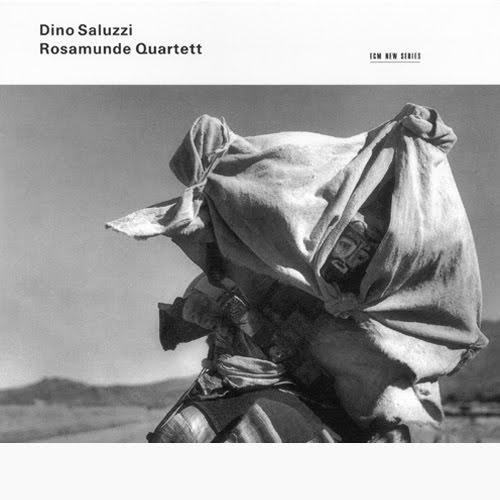
Dino Saluzzi/Rosamunde Quartett: Kultrum – Music for bandoneón and string quartet (ECM New Series 1638)

Dino Saluzzi
Rosamunde Quartett
Kultrum: Music for bandoneón and string quartet

Dino Saluzzi bandoneón
Andreas Reiner violin
Simon Fordham violin
Helmut Nicolai viola
Anja Lechner cello
Recorded March 1998, Propstei St. Gerold
Engineer: Markus Heiland
Produced by Manfred Eicher

The relationship between Argentinian bandoneónista Dino Saluzzi and ECM’s mainstay Rosamunde Quartett has produced some of the most intriguing cross-culturalisms the label has yet to offer. Not so much a coming together of genres as it is an unraveling of possibilities within them, Kultrum manifests much of the latent orchestrations lurking within Saluzzi’s compelling solo outings of years past. The inaugural “Cruz del Sur” is utterly emblematic of the project’s fecundity, cutting strings from the cloth of Saluzzi’s distinctive sound and winding them into a singular amalgamation of rustling and stillness. At once dolorous and laudatory, the sound strays ever so gently into the ecstatic harmonies of “Salón de tango,” in which sparks of confluence abound at every turn. Here, as in much of the album’s hour-long recollection, Saluzzi asserts his rhythmic and melodic authority with a humble joie de vivre. Generally, the music dons solemn clothing, as in its most potent moments between Saluzzi and Rosamunde cellist Anja Lechner, giving us a foretaste of their untouchable Ojos Negros session some eight years later. Every color they mix is rendered lighter by the surrounding musicians. Brief dissonances either slide with ease or are slowed to the point of non-existence. “Miserere” provides brittle catharsis in a brewing fugal storm. Pizzicato statements flash like lightning without thunder. “El apriete” wrings the heart of its sympathy and rehydrates it with renewed life, as if to shield us from the mournful edge of the album’s remainder, which erases thin lines from a darkening periphery before folding in on itself to end.

Much like Ástor Piazzolla, of whom he is heralded as the only legitimate successor, Saluzzi cuts an unmistakable form in any auditory context. His reach is already so orchestral that the present expansion seems only nature. And while the musical talents thereof are as high as one would expect in an ECM recording of this caliber, the compositions themselves are the real stars here, leading said talents into new directions. This is an album that inhales in black and white, but exhales only color. Assuming we are able to approach it with a blank canvas in mind, who knows what images might come of it?

<< Jack DeJohnette: Oneness (ECM 1637)
>> John Surman: Proverbs and Songs (ECM 1639
)

Keith Jarrett: Sun Bear Concerts (ECM 1100)

ECM 1100

Keith Jarrett
Sun Bear Concerts

Keith Jarrett piano
Recorded November 1976 in Japan
Engineers: Okihiko Sugano and Shinji Ohtsuka
Produced by Manfred Eicher

Before beginning this review, I imagined writing one line and one line only: Let the music speak for itself. And while such a move does have a certain charm, if not arrogance, I can only hope that the following attempts to transcribe what Keith Jarrett’s Sun Bear Concerts say to this listener might convey even the humblest fraction of the wonders therein. Over the course of two weeks in November of 1976, Jarrett laid his hands to keys in seven major Japanese cities for an historic series of improvised concerts (not all of which are included in this recording). The result was a 10-LP set, now telescoped to six CDs, that must be heard to be believed. Within this modestly typographed grey box beats one of ECM’s profoundest creative hearts. In light of this, a more fitting line might read: Keith Jarrett is music itself. Let it only be the beginning.

Kyoto, November 5, 1976
Part 1 opens in absolute heaven with I daresay the most spellbinding music ever elicited from a piano. Like all such things, it grows all the more affecting as it transforms into something else entirely. Jarrett introduces some jazzier ornaments into these tectonic elegies until he reaches what sounds like a Philip Glass motif broken open, maps drawn from its essence in half-note rolls. Expulsive chording animates this newborn organism with premature self-awareness. This is music to make one weep, for like tears it drips from the eyes and tastes like the sea. With patience, it becomes ecstatically uplifting, scaling a virtual ladder of Steve Reichian phases before plunging into an exhilarating vamp over which Jarrett sings and dances his blissful way. Every rise and fall is vividly etched into our minds as he articulates the grace that so consumes him. He begins to tread water, taking in his aural surroundings like a compass simultaneously pointing in every direction. He dives deep into the notion of depth itself, where sounds are muted as much by the water as by the careful transparency that defines it. With every sweep of a cupped hand, every kick of a calloused foot, we are brought nearer a world where sound takes the place of air. His fingers seem to double their strength in numbers, spreading wide with ecstatic cause, all the while reliving a poignant memory in reverse.

Part 2 brings us into a noticeably more resonant space, and is like multiple radios broadcasting some morbid ragtime catharsis. This music is as good an example as any of how everything that Jarrett does is also done to us. We are flexed, tumbled, turned, and reconfigured at every moment, an endless series of resurrections throughout which one desires no particular body. Jarrett’s tender singing buoys every kinetic gesture. His fingers stretch like wisps of cloud and harden into a giant’s hands. Like Scrabble tablets knocked from their board, the numerical value of every letter becomes meaningless as it slips into a linguistic black hole, in which only the sound of applause echoes like a faceless totem in the audible universe.

Osaka, November 8, 1976
Part 1 is loosely enfolded in time, leaning nostalgically into the forgiving winds of its own recollection—running, tripping, falling, and pulled up every time by strings of hope. It is a persistent hunger that feeds on itself. It pauses to regroup and redeploy, coalescing like a breath into voice. The pianism here breathes organically, shaping itself through a bridge of chemical interaction that connects the physical and cosmological worlds. Jarrett rests in familiar territory while the lead runs off on its own scavenger hunt, bringing back one melodic treasure after another. His creative energy seems inexhaustible in such moments. One begins to appreciate the continuity of his art, for pauses stand out with such weighted clarity that they remind us we’ve been listening to an unbroken stream all along. The music develops into a rolling vamp in which Jarrett foils his own precision with that of chaos. His playing soon plateaus, shaving one hair-thin layer after another from his cartographic imagination as it falls into a Gurdjieff-like trance. From this delicate weave he tears out an image like some consonant idol, only to stagger on dissonant legs into solitude with the resoluteness of a vibrating string coming to rest. Like the vocal articulations that emerge toward the end, this music is guttural and scrapes deep inside a barrel of emotional reserves before ending on a luscious chord, one note suspended from every fingertip like a celestial ornament.

Part 2 begins with a parallel statement from both hands, spreading out ever so slightly like an infant fractal into its implied harmonies. After a cry-inducing peak, Jarrett falls into lilting runs that are variously robust and crumbling. With the quiet revelry of self-discovery, Jarrett crosses boundaries here like identities, each traversal bringing with it a new fear of discovery. It is the fear of the known over the unknown, the lighthouse beyond which one perseveres through adversity, and yet in which is encapsulated all possibilities of being lost. These gorgeous but terse meditations open like an ever-evolving gift before suddenly breaking into an airy enlightenment, bringing with them a hope one never knew existed. The end flutters like the wingtip of a bird loosed from the edge of our half-sleep.

Nagoya, November 12, 1976
In Part 1, not only does Jarrett draw upon his travels, it seems, but also creates new ones as they happen. This music begins in a tighter embrace, coalescing around the piano’s middle range, so that when high notes begin cutting through the fabric of our attention with solid ether, we feel them acutely: a tingle in the spine, a twinge at the back of the brain, a skip in our heartbeats. Jarrett traverses quieter waters, catching the errant melody in his net. The atmosphere is as meditative as that of Osaka and achieves this state through a buildup of energy, the release of which is found in its continual accumulation. With every layer peeled, we come closer to an anthemic center, through which is articulated an oceanic expanse of memories. Some of these are playful, others cumbersome, but all deeply informative of the present moment as a subjective portrait of the music personified. We emerge from this jaunty reverie clad in new aural garments, sewn by a melodic other.

Part 2 reclines with anticipatory passion in an extended introductory ballad. Jarrett is in particularly astute form here, finding in every note the potential for a thousand more. In his simplicity breathes a host of surrounding narratives, each more involved and more historically minded than the last. With this performance, Jarrett shows that even at his most contemplative moments he is all fire. As he seesaws between lower and higher registers, he lapses into transcendental flutters, as if to interrupt our rest with the promise of transmigration. It is a reserved and careful path, but one in which footsteps leave permanent marks of their passage. It is the stories that press them into the earth that are ephemeral, forever lost among the vestiges of diaristic instincts.

Tokyo, November 14, 1976
As if to mimic the geography of his travels throughout Japan, the music finds its own capital in Part 1, fleshing through a long and varied history the deepest heart of the metropole. From gentle beginnings Jarrett tells an inspiring tale of youth gone awry, of love cut short and most unexpectedly reformed, and of the undeniable art these tribulations birth through the performative moment. Over one of his most engaging ostinatos, which he pulls and stretches to its utmost capacity, Jarrett paints a forest of faces opening their mouths without speech. Over time, the trees blend into a more flirtatious musical energy, unfolding in what I can only describe as a passionate aggression into an ecstatic and heartwarming ending.

Part 2 unfolds like a vision and may very well change the way you look at the world, as it describes even the most familiar things with a profound sense of renewal and supreme awareness of the illusory nature of reality. Jarrett’s right hand is like a memory encroaching upon the present of the left, until both become unified in an invisible story. It is a story that can be told only once. Though Jarrett locks himself in a confined space, he flirts with anarchy through anthemic modalities, alternating between heavy arpeggios and even heavier punctuations, and ending in a chaotic resolution toward that last uphill climb.

Sapporo, November 18, 1976
Part 1 begins in flame, glowing like a candle in the window that is so far away it appears as a star. Jarrett locks himself into loops upon loops. These are not periods of indecision, but simply felt as they are felt. At once romantic and mechanical, his sound opens in a captivating sustain-pedaled passage. With equal ardor, it is arrested by a damper just as the intensity gels with magnificent density. It is knocked over like an ink bottle onto the parchment of a somber ballad. The ends of the piano curl in on themselves like a quantum leap through musical space-time as they fall into galactic slumber.

Part 2 paints a funkier sky, brimming with hope and lithe exuberance. Its bittersweet resolution is tempered by a premonition. Such are the moments in which Jarrett is at his most vocal. As the energy diffuses, it unleashes a selfless stream of consciousness. We become privy to a deeper current of animation. We ignore the stumbling blocks at our feet and touch the sky with our hands instead. And as our bodies dissolve into light, we become the sounds that shaped our physicality in the first place. All that’s left of us is a single image of childhood, balanced ever so precariously at a cognitive cusp. From it, we fashion a new one, repeating this process until we are spent.

Appended to these epic journeys are a few possible destinations in the form of three encores. Sapporo is another minimal yet meditative juggernaut. A constantly finger-pedaled C hardwires itself into every exaltation. Tokyo is a heartrending 8-minute experience, throughout which sadness becomes the most harmonious aspiration we can think of. One would be hard pressed to uncover a more magical moment in the Jarrett archive. Nagoya walks a similar path, taking a familiar chord progression and turning it into a ritual object, this time fading in a series of spaced chords, for which there is only stillness as altar.

This set is dearest to my heart, not only for the music it contains but also for having been performed in a country throughout which I have traveled extensively and which has dominated my creative and academic interest for years. I can almost feel the pulse of every city in which he performs (my feet have left their ephemeral prints on all but Sapporo), sharing in the unique atmosphere of each. A bit romantic, maybe, but a reaction I cannot help but nurture every time this music graces my ears. And while location need not necessarily inhere itself into any musical happening, I do feel there is a distinct quality to these Japan performances. One can feel it in the rapt silence with which Jarrett’s audience shows appreciation throughout, in the cathartic applause and appeals for encore.

The Sun Bear Concerts prove that not only is Jarrett an unparalleled improviser but a melodician of the highest order. These pieces are consistent in their striking differences, yet all seem couched in a palpable melancholy that is striated with joy. Despite the sheer volume of music that seems to reside in Jarrett’s entire physiological being, one gets the sense after listening to these six-and-a-half hours of brilliance that they comprise but a single molecule of creation dissected and slowed to discernible speeds. At least we, at this moment in time, can witness these atomic paths, knowing full well that their beauty lies in an allegiance to silence. Not a single note ever feels out of place, because it has no place to begin with, except as the emblem of that which is gone before it arrives.

If you ever buy only one recording of Keith Jarrett, look no further. Then again, why stop here?

<< Taylor/Winstone/Wheeler: Azimuth (ECM 1099)
>> Gary Peacock: Tales Of Another (ECM 1101)

Keith Jarrett: Staircase (ECM 1090/91)

ECM 1090-91

Keith Jarrett
Staircase

Keith Jarrett piano
Recorded May 1976 at Davout Studio, Paris
Engineer: Roger Roche
Produced by Manfred Eicher

Staircase is Keith Jarrett’s fourth solo piano album for ECM, and his first after the previous year’s Köln Concert. In contrast to his earlier studio effort, Facing You, Jarrett elides romantic titles in favor of four singly marked suites in this entirely improvised studio session. Like every carefully chosen word of a William Carlos Williams verse, Jarrett’s equally lyrical insights plough to the heart of the matter like no others.

The title work gives special insight into the pianist’s improvisational process. Atop a foundation of steady syncopation, he constructs a helical tower. Rather than expanding it into a broader sound palette, however, he works his way into every crevice. Ever the master builder, he approaches melodies as if they were bricks to be laid. Upon these he takes careful steps, taking care to rest his fingers upon ivory like toes upon stone. And though he may stumble, there is always a counterbalancing action waiting in the wings, swooping down like an owl from the rafters, pulling a thread in its break to that final microscopic strand.

While Jarrett often works wonders with variations, in the first part of “Hourglass” we also experience the reverse. With great vibrancy, he rolls through its spiritual-infused fields like a child tumbler. Yet this is only a prelude to Part II, in which the ecstasy of elegy blinds us with its 14-minute plenitude. Jarrett’s crisp yet fluid arpeggios run across the keyboard with the fullness of a life that has much to give still. Every note in the left hand is a feather tested by the heavy air of the right. And as every utterance floats ever so gently to the waters below, it traces a zigzag of arcs in the winds of our slumber.

Like the angled shadow of its eponymous timepiece, Part I of “Sundial” appears still when we look at it directly, and only seems to move when we do not. It is at once frozen and highly animate, pulling existence forward with every intangible revolution. Jarrett sings with a genuine croon, holding his breath through the keys. This music is his respiration, and he concludes it on a forgiving sigh.

The three-part “Sand” rises in large handfuls before being thrown into the air. We listen, enthralled, as Jarrett scours the landscape, picking up every last grain. He places them into the hourglass, which he rests on a nearby sundial before ascending the staircase out of sight.

Though difficult to spot in the shadows of other many fine solo outings, there is an essential quality to Staircase that one rarely finds in the confines of a studio. Jarrett accomplishes something much greater than music here, flushing out details like a biological organism developing in reverse, so that by the end we return to the music’s infancy, where the corruptions of a nurturing world fail to wreak havoc on a tender mind. There is a method to his seeming lack thereof, and its name is “now.”

<< Egberto Gismonti: Dança Das Cabeças (ECM 1089)
>> The Gary Burton Quartet with Eberhard Weber: Passengers (ECM 1092)

Edward Vesala: Satu (ECM 1088)

ECM 1088

Edward Vesala
Satu

Edward Vesala drums
Tomasz Stanko trumpet
Palle Mikkelborg trumpet
Juhani Aaltonen saxophone
Tomasz Szukalski saxophone
Knut Riisnaes saxophone
Rolf Malm bass clarinet
Torbjørn Sunde trombone
Terje Rypdal guitar
Palle Danielsson double-bass
Recorded October 1976 at Talent Studio, Oslo
Engineer: Jan Erik Kongshaug
Produced by Manfred Eicher

Edward Vesala is one of those rare treasures whose every recorded move seems to ooze with profundity. Flanked by an all-star cast of mostly Scandinavian talent, he and his collective visions have produced some of the most inestimable highpoints of the ECM discography. On Satu, it’s as if he has stumbled into an old radio program, the signal of which has only now reached us. As in a community of mystics squinting into the morning sun, it brightens with the golden light of selfless realization. The thrumming bass of Palle Danielsson vibrates like an inner voice in the title cut, an earthen call to wordless action. Terje Rypdal cries into shape, carried along nocturnal routes into even darker destinations. Tomasz Stanko winds the band with his trumpet into a tight spring before loosing into unsuspecting ether. A droning call from Rolf Malm on bass clarinet grinds the edges of our expectations down to rounded barbs. The brass of “Ballade For San” threads through its vamp like a choir coloring in the constellations with nostalgia. Ecstatic interplay between Rypdal and his periphery pulls us into the album’s longest dives. “Star Flight” glows with more of Rypdal’s singing guitar, and with a screeching solo from Stanko, recorded as if in another time or place. Meanwhile, horns and drums reach an agreement, as guitar and trumpet continue their assault, unifying as the emergent voice of chaos and reason (here, one and the same). The ponderous “Komba” cradles a mind-altering soprano sax solo. It wails like a mourner in ecstasy and circulates through the bloodstream long after it fades. Vesala ends positively with “Together.” A lovely flute solo undresses before a blind observer, allowing synthetic thoughts from bass to plunk their way into the frame. And as Vesala dances circles around it, the flute gilds its edges with every color of the rainbow until only a white sheen is left.

While certainly more “accessible” than Vesala’s fine Nan Madol, this effort is no less enigmatic for all its inner details, each of which seems to compress a profound wealth of déjà vu into a single expulsion of breath, a tapping of cymbals, the grating flange of a guitar. Vesala’s music is an extension of a force unseen, but ever felt in the vast aptitude of its effects. While very much uprooted from discernible foundations, it is peppered with delicate obbligati that give us purchaase. These thematic statements take on a totemic quality in Vesala’s context, for his is an atmosphere that is supremely internal, throwing off the shackles of social order and plumbing the depths of an uncompromising will to power. Vesala’s music feels as if it has broken through a dimensional barrier to make itself known to us, and all we need to do to make the return flight is grab on and never let go.

<< Keith Jarrett: Hymns/Spheres (ECM 1086/87)
>> Egberto Gismonti: Dança Das Cabeças (ECM 1089)

Enrico Rava: The Plot (ECM 1078)

ECM 1078 CD

Enrico Rava
The Plot

Enrico Rava trumpet
John Abercrombie electric and accoustic guitars
Palle Danielsson bass
Jon Christensen drums
Recorded August, 1976 at Talent Studio, Oslo
Engineer: Jan Erik Kongshaug
Produced by Manfred Eicher

Like its cover, Enrico Rava’s The Plot is a storybook with much to delight our hungry eyes and ears. Its dramatis personae will be familiar to the ECM enthusiast: John Abercrombie as the guitarist, Palle Danielsson as the bassist, Jon Christensen as the drummer, and Rava himself as the trumpeter who leads them on a profoundly satisfying adventure. Our tale begins with the airy bass line of “Tribe.” Abercrombie’s restrained wails and Christensen’s splashing cymbals spread their arms wide in a loose net across the page. Rava spins outward from its center like a spider, checking every tether to make sure it is securely fastened to the surrounding flora. Only then does he jump off, held by a single lifeline, almost invisible in the air, as he soars in his improvised freefall. Rava then takes us “On The Red Side Of The Street,” where focused solos and curiosity comingle incognito. What begins as erratic reverie in “Amici” turns into a protracted groove in which Rava unleashes a most potent narrative omniscience. To this, Abercrombie adds own staccato punctuation. The next chapter introduces us to “Dr. Ra And Mr. Va.” These mysterious alter egos paint a world of black and white, but describe it with the most colorful language at their disposal. Rava’s brassy pirouettes bring lively energy to the climax, instigating an ecstatic call and response with Abercrombie. We then come to a sepia illustration, Rava’s “Foto Di Famiglia,” a duet for acoustic guitar and trumpet. A plaintive stroll through half-remembered places long since transformed by the passage of time and gentrification, it is the counterpart to “Parks” on 1975’s The Pilgrim And The Stars. A brief interlude, it is usurped by the 15-minute epilogue, from which the album gets its name. It eases into our hearts with a somber yet soulful trumpet solo against an awakening rhythm section. The synergy builds to a non-abrasive intensity, threaded by Abercrombie’s hieroglyphic chords before shifting to his fuzz box sound, careening through the night like some cosmic wayfarer whose only guides are the sounds of Rava’s winding paths. And as the final page turns to reveal its blank reverse, we want nothing more than to reread this forgotten classic immediately.

<< Edward Vesala: Nan Madol (ECM 1077)
>> Jack DeJohnette: Pictures (ECM 1079)

Art Lande: Rubisa Patrol (ECM 1081)

ECM 1081

Art Lande
Rubisa Patrol

Art Lande piano
Mark Isham trumpet, fluegelhorn, soprano saxophone
Bill Douglass bass, flute, bamboo flute
Glenn Cronkhite drums, percussion
Recorded May 1976 at Talent Studio, Oslo
Engineer: Jan Erik Kongshaug
Produced by Manfred Eicher

With Art Lande’s Rubisa Patrol, ECM took a step in a much-heralded direction, one that pushed the scope of its reach even farther. An album like this proves there is no one sound for the label, but only many through which both musicians and listeners develop deeply personal connections, recollections, and changing identities. The vibrancy of its moods remains as potent as it was three-and-a-half decades ago. With Lande at the keys, Mark Isham (very much in a Kenny Wheeler mode) on horns and soprano sax, Bill Douglass on bass and flutes, and Glenn Cronkhite on drums and percussion, the results can only be magical. The opening strains of “Celestial Guests–Many Chinas” introduce the dizi, a Chinese bamboo flute, to the ECM instrument bank. Its clarity cuts through our expectations and embraces us with its immediacy. From behind this arresting tonal horizon arises a blazing sun of percussion and lyrical horns. Lande makes things complete by dropping his own potent melodies into this auditory tincture. The veil is lifted with “Romany.” Watching like a pair of eyes scanning an empty landscape in hopes of movement, it discloses the inner trepidation of an unstable politic. Our allegiance is broken and reformed again with the klezmer-like inteisity of “Bulgarian Folk Tune.” Throughout its enthralling single minute, we cannot help but be moved by its tightly executed energies. “Corinthian Melodies” is another stunning reworking of traditional sources. Here, those resilient fibers are spun into even thicker cords, allowing Isham and Douglass more traction in their solos. Anyone missing the groovier side of things gets just that in the piano-bass interplay of “For Nancy,” in and out of which Isham weaves with the deftness of a hummingbird, sampling nectar where it may until it vanishes in a spray of raindrops. “Jaimi’s Birthday Song” and it reprise feature a duet of flute and piano in two relaxed Red Lanta-esque messages. The latter of these leads us to “A Monk In His Simple Room,” bicycling through thematic material with a leisurely panache in this lavish closer.

A magical album from start to finish, Rubisa is an exercise in atmosphere. Lande captivates on all levels and seems to bring out nothing short of the best in his fellow musicians. And while the label has no shortage of fine horn players, on this recording we get an especially fluid example of the craft through Isham’s unmitigated wanderings. With its nods to folk elements and host of other influences, this makes for a fitting companion for the more recent Kuára.

<< John Abercrombie/Ralph Towner: Sargasso Sea (ECM 1080)
>> Arild Andersen: Shimri (ECM 1082)

Julian Priester and Marine Intrusion: Polarization (ECM 1098)

ECM 1098

Julian Priester and Marine Intrusion
Polarization

Julian Priester trombone, string ensemble
Ron Stallings tenor and soprano saxophones
Ray Obiedo electric and acoustic guitars
Curtis Clark piano
Heshima Mark Williams electric bass
Augusta Lee Collins drums
Recorded January 1977 at Tonstudio Bauer, Ludwigsburg
Engineer: Martin Wieland
Produced by Manfred Eicher

The trombone is the viola of the brass world. It is arid, languid, and also incredibly beautiful in its range and melodic honesty. And on Polarization, Julian Priester’s ECM follow-up to his 1973 Love, Love session, we get more of that gorgeous depth than we could ever ask for.

The first three tracks form a unified whole. “Polarization” (Priester) begins with two overdubbed trombones improvising in a lofty space. We get some wonderful staccato technique in the left channel, and a wealth of implied energy all around. As the right-hand trombone fades, we hear the slightest indication of drums at the cut’s tail end, of which “Rhythm Magnet” (Priester) fleshes out every audible detail. Synthesized strings lend expanse while bassist Heshima Mark Williams lays down a gorgeous, almost Bill Laswell-like mysticism, albeit with an added twang and sharper features. Ray Obiedo weaves a slack guitar into the mix, and as the horns settle in to their respective stations, the piano lets out a final exaltation. “Wind Dolphin” (Bruce Horiuchi) begins with a cluster of drums. From this, we get a flowing run from brass and flanged guitar. The band breaks into a powerful free-for-all, marked by a “laughing” trombone and piano. “Coincidence” (Obiedo) is a piece for trombone, acoustic guitar, and piano, as beautiful as it is short. “Scorpio Blue” (Curtis Clark) arises from a solo trombone as drums lift the piano skyward into rolling flights of fantasy. The final track, “Anatomy Of Longing” (Curtis Clark), aside from having one of the best titles I’ve encountered in a long time, brings on the funk with electric guitar ornamenting the already fine calligraphy of the brass. And just when you think the music is over, it drips into a simmering sax solo over a pellucid piano and cymbals before the bass line returns with its undeniable insistence. The sax reels while the electric guitar squeals in joy over the thematic reinstatement before hurtling itself forward into an enthralling solo of its own. A smooth nightcap to a phenomenal outing.

While not as consistent in texture as Priester’s earlier effort, Polarization delivers in its many moods and emotional travels. The musicians don’t so much feed off as feed into one another, nourishing a delicate conversation in which agreement is the norm. Their harmonies are tender, the synergy relaxed and intuitive, acute yet soft around the edges. The recording is superb, the resonance at once immediate and expansive.

Unlike its predecessor, this one is still out of print.

<< Pat Metheny: Watercolors (ECM 1097)
>> Taylor/Winstone/Wheeler: Azimuth (ECM 1099)

Steve Kuhn: Life’s Backward Glances – Solo and Quartet (ECM 2090-92)

ECM 2090-92

Steve Kuhn
Life’s Backward Glances: Solo and Quartet

Steve Kuhn piano
Sheila Jordan voice
Steve Slagle soprano and alto saxophones, flute
Harvie Swartz double-bass
Michael Smith drums
Bob Moses drums

In an open boat at sea,
lights are darkened by a tree.
All the world is all I see.

Brooklyn-born pianist Steve Kuhn is one of the savviest interpreters of our time. On ECM, we have also been fortunate enough to know him as an equally engaging composer. For this entry in its Old & New Masters series, the label gathers another fine trio of out-of-print treasures, of which Motility and Playground make their digital debuts (ECSTASY having been made limitedly available in Japan).

ECM 1094

Motility (ECM 1094)

Recorded January 1977 at Tonstudio Bauer, Ludwigsburg
Engineer: Martin Wieland
Produced by Manfred Eicher

Entering Kuhn’s world is indeed like stepping into “The Rain Forest,” the first track on this phenomenal quartet recording. Not only is it visually resplendent and rich with life, but it also boasts distinct melodic qualities. Every last molecule has its role to play in the symphonic superstructure. Kuhn’s fingers navigate the forest’s ever-changing paths, arching lithely through overgrowth while Steve Slagle’s flute sings like an avian guide flitting from branch to branch: a thread of cognitive continuity between listener and the listened. The band’s sound really opens up in “Oceans In The Sky.” Like a waterfall in reverse, it returns to the cloud from which it was born, closing its eyes in a promise of clearer days. The private trajectories of “Catherine” intersect only briefly with our own, even as Harvie S.’s tenderest of bass solos pulls at the heart in muted song. “Bittersweet Passages” is a two-part journey, beginning in a swell of anticipation before fading into solemnity. The slightest movement becomes infinitely magnified, so that when the quartet returns in tutti, it bustles like a crowd of zealots flocking to their monument of worship. “Deep Tango” is driven by a braid of martial snare, bass, and soprano sax, beneath which Kuhn spreads carpet of fallen leaves. “Motility/The Child Is Gone” changes from elegy to ode in a blink. Kuhn lays on the expressivity, at once van Gogh and Monet, before delighting us with “A Danse For One,” in which one can almost hear his band mates lingering like a ghostly presence. Lastly is “Places I’ve Never Been,” another exciting tune replete with infectious grooves. Superb soloing from all, particularly in the diving flute, make this one a winner.

<< Jan Garbarek: Dis (ECM 1093)
>> Ralph Towner’s Solstice: Sound And Shadows (ECM 1095)

… . …

ECM 1159

Playground (ECM 1159)

Recorded July 1979 at Columbia Recording Studios, New York
Engineer: David Baker
Produced by Robert Hurwitz

In this album, we get an enlivening dose of Kuhn’s other brand of lyricism in the form of actual words. We had a taste of these in “Life’s Backward Glance” on 1974’s Trance. That selfsame tune makes a cameo here, also as a closer, only this time transformed by the throaty contralto of Sheila Jordan Kuhn, who turns everything she touches to melancholic gold. This is a markedly different album, not least because it is the latest of the three, and one that seems to have been consciously sandwiched between the others.

As Jordan turns verses in her lips in “Tomorrow’s Son,” she traces the undulations of bass and brushed drums, setting off the piano into a string of footnotes. Two adjacent pieces, “Gentle Thoughts” and “Poem For No. 15,” appear as the diptych “Thoughts of a Gentleman – The Sage of Harrison Crabfeathers” on ECSTASY. In their present incarnations, Kuhn’s pianism scintillates, his right hand so full that when his left hand comes in it sounds like another instrument entirely. The rhythm section is never enough to weigh him down. Rather, it seems to inspire him to ever-ecstatic heights. A personal favorite on this disc is “The Zoo,” a fantastic little slice of whimsy about communication, self-sufficiency, and delight in discovery. And one can hardly escape the allure of “Deep Tango,” which in this vocal version unfolds with even greater narrative potency.

Jordan’s voice strolls down memory lane as if it actually were a physical path to be strolled upon. Her constant vibrato lends a vulnerable sadness to the proceedings. The musicians feed off her presence tenfold, as evidenced in Kuhn’s transformation throughout from intimacy to fantasy.

<< Bill Connors: Swimming With A Hole In My Body (ECM 1158)
>> Steve Swallow: Home (ECM 1160)

… . …

ECM 1058

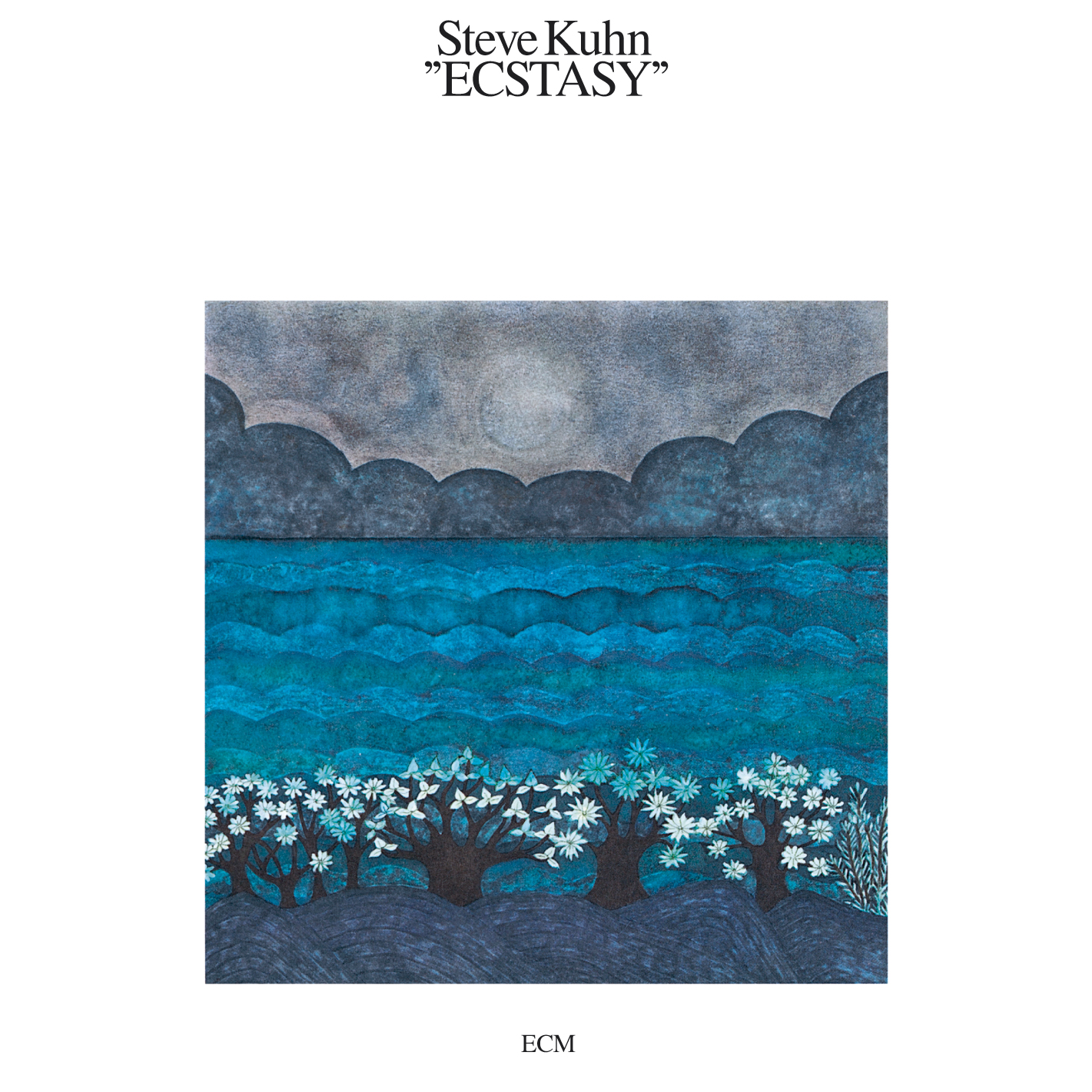
ECSTASY (ECM 1058)

Recorded November 1974 at Arne Bendiksen Studio, Oslo
Engineer: Jan Erik Kongshaug
Produced by Manfred Eicher

This album was recorded one day following the Trance session, and revisits some of that same material in a solo setting. In spite of the density in which his playing often clothes itself, here he adopts a decidedly porous sound, breathing in and out like an organism that finds its invisible nourishment in notecraft alone. The present rendition of “Silver” is three times its original length on Trance, honed in reflections rather than shadows. An unexpected roll from the piano’s nether regions rises like oil from the ground, but never materializes into a full-blown breach, lapsing instead into a gentle trickle into the valley of resolution. Unique entries on this album include the entirely improvised “Prelude in G,” in which an increasingly frantic lead runs over a brooding ostinato, and “Ulla,” an emotional journey marked by careful pauses. Some insistent statements in the right hand lead one to believe there is far more to be said than what is being articulated in both. Kuhn ends again with “Life’s Backward Glance,” something of an iconic piece for him, here more erratic than its vocal counterpart. It reads like a critical self-assessment, born from years of improvisatory living, finding in the moment those truths with which we build an ever-changing concept of the self.

This is the darkest of the three albums, gilded in dissonant color schemes and more visceral reflections.

Kuhn thinks in voices, but speaks in images. His story is a book without pages. Oftentimes, he looks away, but always acknowledges us through its colors. One moment finds him courting Vince Guaraldi on steroids, while the next recalls Bill Evans on a rainy afternoon. With such a full sound, one wonders how other musicians could add anything, but add they do, and beautifully so. The only thing missing now is you, the constant listener.

<< Bill Connors: Theme To The Gaurdian (ECM 1057)
>> Arild Andersen: Clouds In My Head (ECM 1059)

Arild Andersen: Green In Blue – Early Quartets (ECM 2143-45)

ECM 2143-45

Arild Andersen
Green In Blue: Early Quartets

Arild Andersen double-bass
Jon Balke piano
Knut Riisnaes tenor and soprano saxophones, flute
Pål Thowsen drums
Juhani Aaltonen tenor and soprano saxophones, flutes, percussion
Lars Jansson piano, Moog-synthesizer, string ensemble

I used to hear jazz through a diurnal lens: it was either night or day. I saw this reflected in many album covers, which could be bright (Milt Jackson’s Sunflower comes to mind) or deeply nocturnal (which pegs a good portion of the Blue Note catalogue). ECM has been unique in charting the in-between, those crepuscular moments of the genre in which transitions abound, and in fact define the parameters of the music. This fabulous collection of long out-of-print label efforts by Norwegian bassist Arild Andersen brings those transitions most clearly into focus. His music is firmly earthbound, yet at the same time so far beyond the stratosphere that seasons and times of day cease to matter. Such an approach allows us to come to the music as we are, absorbing it with the same spontaneity in which it is produced.

ECM 1059

Clouds In My Head (ECM 1059)

Recorded February 1975 at Arne Bendiksen Studio, Oslo
Engineer: Jan Erik Kongshaug
Produced by Manfred Eicher

“305 W 18 St” is a breath of fresh air in even the freshest climate. The title refers to the bassist’s onetime home base, a New York apartment belonging to singer Sheila Jordan (who can be heard on Steve Kuhn’s Playground). I suspect these kinds of autobiographical details lie behind almost every title, some more inferable than others. Either way, Andersen’s gravid bass line and the lilting flute of Knut Riisnaes usher us into the album’s optimistic world, setting the pace for an exemplary thematic journey. There are plenty of breathtaking stops along the way, including the piano-driven “Outhouse,” with fine soloing to be had by all over a tight rhythm section headed by Pål Thowsen on drums; the sympathetic embrace of “Song For A Sad Day,” in which Riisnaes’s bone-tickling tenor tears our inhibitions to shreds; and the uplifting promises of the title cut. Neither can we pass up “The Sword Under His Wings,” a closer to end all closers. Lightning fast fingerwork from Andersen brings a live dynamism that practically begs for applause at every given opportunity. Not to be outdone, Jon Balke shows his chops as well, intimating what would become his own flowering career beyond the band. The album’s finest sax solo sparks a flare of virtuosity, snuffed too soon. A groove-oriented aesthetic dominates Clouds, but with enough downtempo diversions to soften the blow. Each theme is a springboard to fantastic leaps of intuition. Those of Riisnaes, whose resemblance to the early Garbarek is uncanny, are the farthest-reaching, variously filled with glorious hesitations and catharses.

<< Steve Kuhn: ECSTASY (ECM 1058)
>> Ralph Towner: Solstice (ECM 1060)

… . …

ECM 1082

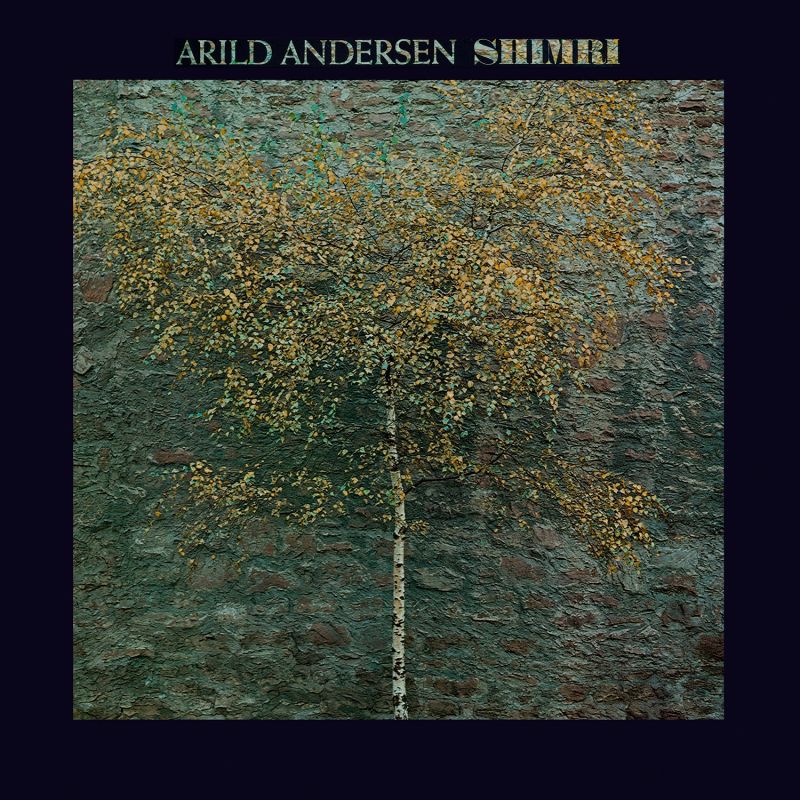
Shimri (ECM 1082)

Recorded October 1976 at Talent Studio, Oslo
Engineer: Jan Erik Kongshaug
Produced by Manfred Eicher

In its second outing, the Arild Andersen Quartet saw the replacement of Balke and Rissnæs with saxophonist Juhani Aaltonen (already heard to mind-blowing effect on Edward Vesala’s Nan Madol and soon to appear on Satu of the same) and pianist Lars Jansson (whose trio, of which Anders Jormin was an original member, remains one of Sweden’s great jazz outfits). Here, Andersen dons more overtly compositional clothing, and lays his heart bare. The mood is a little more relaxed, its sound more porous, its gestures more internal. Starting with some chromatic pianism and Aaltonen’s winged soprano in the title track, and working through the timeless beauties of “No Tears” and “Ways Of Days,” we encounter deeper mysteries in “Wood Song.” On the surface, its wooden flute and colorful percussion evoke an arid landscape populated by rattlesnakes and desert winds, yet on deeper inspection seeks to reveal the improvisational in the mundane. “Vaggvisa För Hanna” is a multifaceted little number that plays like Red Lanta with an added rhythm section. Tenor sax makes its triumphant return in “Dedication.” Jansson wanders into some incredibly lyrical asides, singing like Keith Jarrett (who was among his formative influences as a music student), but led back to the main path by Aaltonen every time. While it is unclear who or what this concluding track is a dedication to, I like to think it was made for the listener, whose very existence animates the creative process at hand. For as Andersen recedes, leaving Aaltonen alone, we are drawn into that final gasp of cymbals and toms like an acolyte into selflessness.

<< Art Lande: Rubisa Patrol (ECM 1081)
>> Terje Rypdal: After The Rain (ECM 1083)

… . …

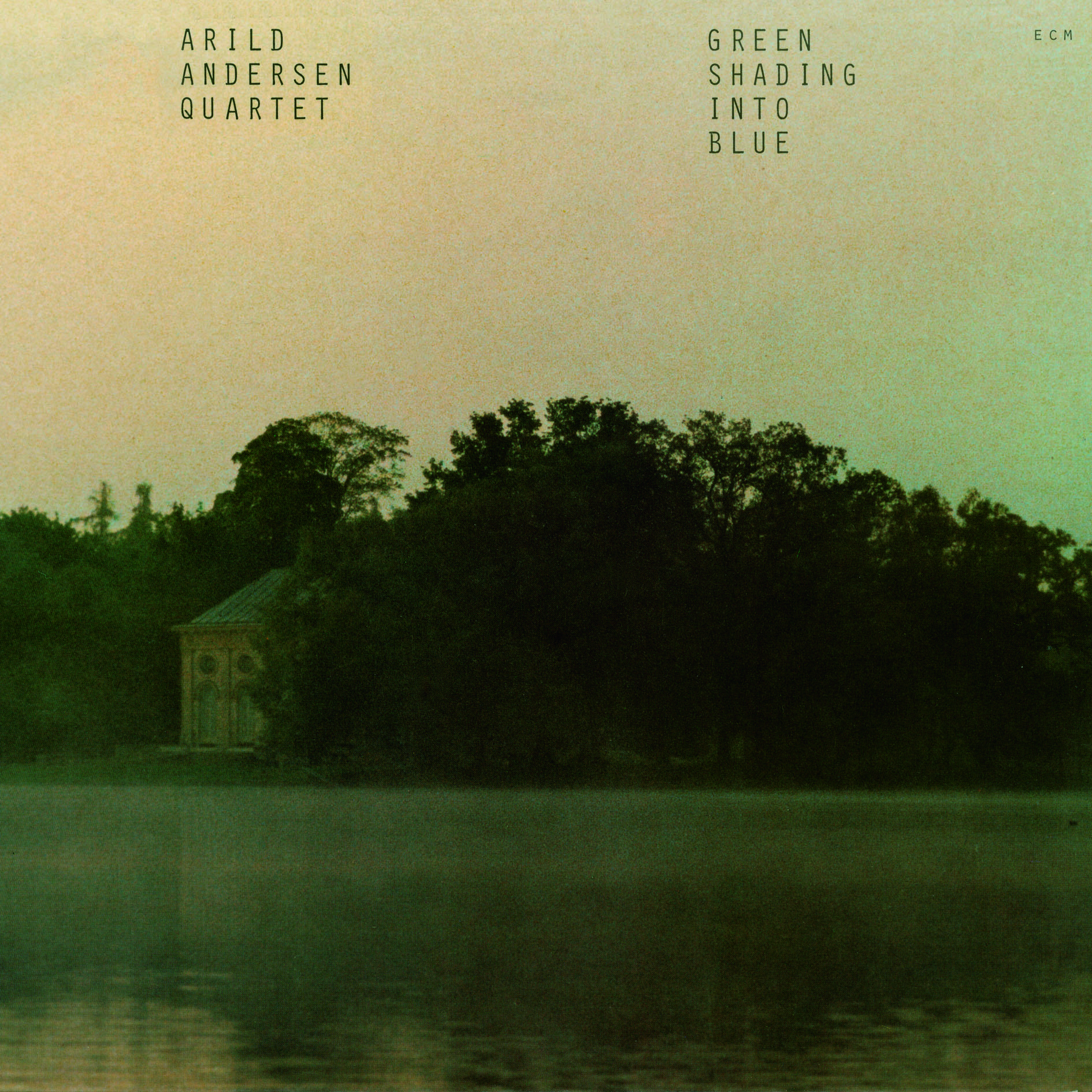
ECM 1127

Green Shading Into Blue (ECM 1127)

Recorded April 1978 at Talent Studio
Engineer: Jan Erik Kongshaug
Produced by Manfred Eicher

The final album of this set changes gears yet again, working itself into a highly refined configuration. Jansson expands his contributions with added electronics. Their presence, subtle as it is, unpacks the music’s histories with far greater visibility. From the laid-back groove of “Sole” to the staccato backing of “Radka’s Samba,” we are treated to a colorful array of songs without words. Stories are the primary driving forces here, such that “The Guitarist” is not about the instrument but about the trembling hands that cradle it. Like an intro that never materializes into a full-blown swing, it has more than enough to sustain itself. “Anima” is another smooth joint that offers some of Andersen’s most understated brilliance. Aaltonen’s legato tenor lends an illusory impermanence. The album’s remainder is like a garden of quiet beauty. The cultivated panache of the sax-heavy “Terhi” and the “organic” backing of the title track wander into Eberhard Weber territory with every step. “Jana” closes in all the lushness this quartet has to offer in a synth-infused groove, finishing with the exuberance of Aaltonen’s soprano flourishes.

Andersen is about as straightforward a musician as you are likely to encounter. His motivic acuity is engagingly bipolar, easily straddling funk and elegy in a single breath. His notes are powerful, sustained, and binding like glue. And in such fine company, the cumulative effects are unfathomable. Though his presence was vividly felt in a handful of early ECM releases, including Afric Pepperbird, Sart, and Triptykon, it was with these three albums that Andersen left his first inedible marks. What a joy it is to finally have them in the digital archive.

<< Art Ensemble of Chicago: Nice Guys (ECM 1126)
>> Jack DeJohnette: New Directions (ECM 1128)